Accounting Information Systems (AIS): What They Are and How They Work
An accounting information system (AIS) turns transactions into financial statements. Its 6 parts, how its data is organized, and IRS record rules.
An accounting information system (AIS) is the set of people, procedures, data, software, hardware and internal controls a business uses to record its financial transactions and turn them into financial statements, tax returns and management reports. When accountants say "AIS," this is what they mean: not one product, but the whole system that carries a sale, a bill or a paycheck from the source document to the general ledger and out the other side as a balance sheet.
For a small business, the AIS is usually an accounting software package plus the rules for who enters what and who approves it. For a large company, it is typically the finance module of an enterprise resource planning (ERP) system. Either way, the data sits in a structured database of linked tables, and the same principles apply: every transaction is captured once, recorded in balanced debits and credits, controlled, and kept for as long as the tax and securities rules require. This page explains how that works, with a worked example, and is general information rather than advice for any particular business.
What an Accounting Information System Is, and What "AIS" Means in Accounting
In accounting, AIS stands for accounting information system. It sits between what the business does and what its financial reports say. A shop sells goods, a contractor buys materials, a firm pays its staff. The AIS captures each of those events, checks them, classifies them into accounts, and summarizes them so that owners, lenders, investors and tax authorities can see the result.
The idea is older than computers. The IRS's small-business recordkeeping guide, Publication 583, still describes the paper version: "A journal is a book where you record each business transaction shown on your supporting documents," and "A ledger is a book that contains the totals from all of your journals." A modern AIS does the same job in a database. The journal becomes a transaction table, the ledger becomes a query that totals it, and the paper invoice becomes a record linked to a customer file.
Two points are worth settling early, because they cause most of the confusion:
- An AIS is not just software. A business that runs good software with no approval rules, no reconciliations and one person doing everything has a weak AIS. The controls and the people are part of the system.
- AIS is not the same as ERP. An ERP covers purchasing, inventory, manufacturing, HR and more, with accounting as one module. An AIS is the accounting part, whether it stands alone or lives inside an ERP. The difference is covered in its own section below.
For the wider role accounting plays in a business, see the entry on the role of accounting in finance.
The Six Components of an AIS
Accounting textbooks usually break an AIS into six parts. The list matters less than the point behind it: a failure in any one of them produces wrong numbers, however good the others are.
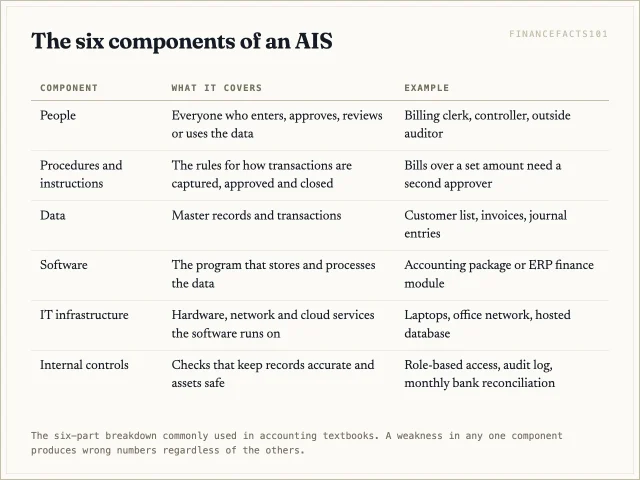
People include everyone who touches the data: sales staff who raise orders, clerks who enter bills, the controller who closes the books, and the outside accountant or auditor who reviews them. Procedures and instructions are the written and unwritten rules: who can create a vendor, what needs a second approval, when the month is closed.
Data is the content itself, covered in detail in the next section. Software is the accounting package or ERP module that stores and processes it. Information technology infrastructure is the hardware, network and cloud services the software runs on. Internal controls cut across all five: the passwords, approval limits, reconciliations and audit logs that keep the records accurate and the assets safe.
An older textbook view of an AIS as four stages, data collection, storage, processing and reporting, describes the same system from a different angle. Collection and reporting are what people see. Storage and processing, the database and the rules applied to it, are where accuracy is won or lost.
How Data Is Organized in an AIS
Almost every modern AIS stores its data in a relational database: a set of tables, each made of rows (records) and columns (fields), linked by shared identifiers called keys. Knowing this structure answers most questions about what an AIS can and cannot do.
The tables fall into two groups.
Master tables hold data that changes rarely: the chart of accounts, customers, vendors, employees and inventory items. Each row has a primary key, a unique code such as customer C-1043 or account 1200, that other tables use to point to it.
Transaction tables hold events: invoices, receipts, bills, payments, payroll runs and journal entries. Each row carries a date, an amount and foreign keys pointing to the master records involved. An invoice row does not repeat the customer's name and address; it stores C-1043 and looks the rest up. That is why changing a customer's address once updates every future document, and why a mistyped key can post a sale to the wrong customer.
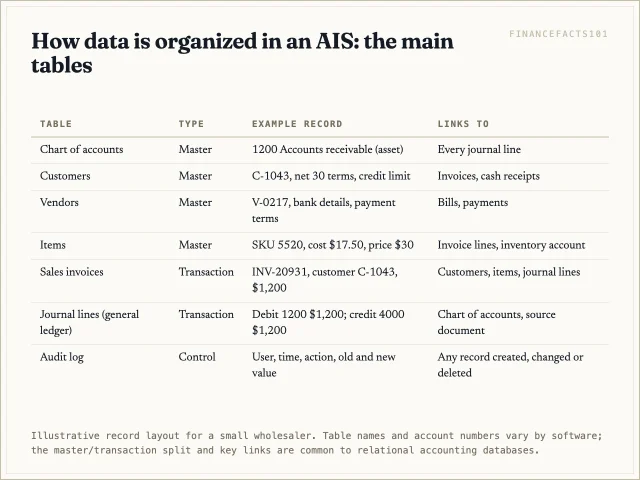
The chart of accounts is the spine of the whole structure. It lists every account the business uses, each with a number and a type (asset, liability, equity, revenue or expense). A common convention numbers assets in the 1000s, liabilities in the 2000s, equity in the 3000s, revenue in the 4000s and expenses from 5000 up, though each business sets its own. Every line of every journal entry must point to one account in this table, which is what lets the system produce a balance sheet and income statement automatically.
The general ledger is where all transaction tables meet. Each posted transaction becomes journal lines, and each line debits or credits one account. Publication 583 states the rule the database enforces: each account "has a left side for debits and a right side for credits," and "the total debits must equal the total credits." Most systems refuse to save an entry that does not balance. Subsidiary ledgers, such as accounts receivable by customer or accounts payable by vendor, hold the detail behind a single control account in the general ledger, and the two must reconcile.
Reports are then queries against these tables. A balance sheet totals every journal line by account up to a date. An aged receivables report groups open invoices by customer and by days outstanding. Behind the menus, many systems use SQL (Structured Query Language) to do this, and larger ones let analysts query the tables directly.
The IRS cares about this structure too. If you keep books on a computer, Publication 583 says your documentation must show the "Functions being performed as the data flows through the system," the "Controls used to ensure accurate and reliable processing," the "Controls used to prevent the unauthorized addition, alteration, or deletion of retained records," and your "Charts of accounts and detailed account descriptions."
How a Transaction Flows Through an AIS: A Worked Example
Take a small wholesaler that sells 40 units of one product to a regular customer at $30 each, on 30-day terms. Each unit cost the business $17.50. Leaving sales tax aside, here is what the AIS does, step by step.
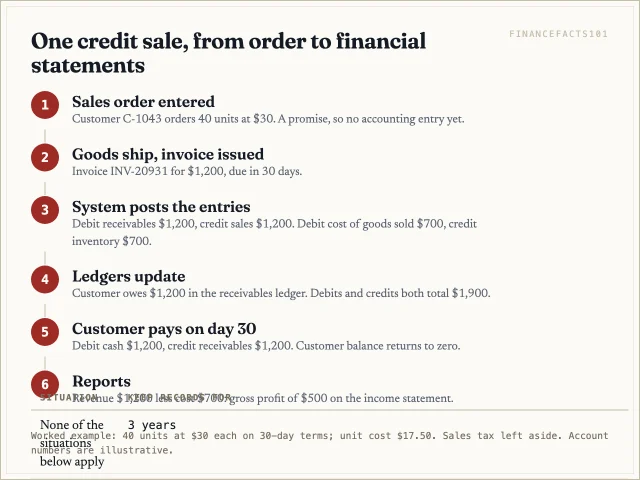
The sales order creates no accounting entry; it is a promise, not a transaction. Shipping the goods and issuing invoice INV-20931 is the accounting event. At that moment the system writes two balanced entries:
| Entry | Account | Debit | Credit |
|---|---|---|---|
| Record the sale | 1200 Accounts receivable | $1,200 | |
| 4000 Sales revenue | $1,200 | ||
| Record the cost | 5000 Cost of goods sold | $700 | |
| 1400 Inventory | $700 | ||
| Customer pays, day 30 | 1010 Cash | $1,200 | |
| 1200 Accounts receivable | $1,200 |
On the invoice date, total debits and total credits are both $1,900, so the ledger still balances. The income statement now shows $1,200 of revenue and $700 of cost, a gross profit of $500. The balance sheet shows $1,200 more receivables and $700 less inventory. When the customer pays on day 30, cash rises by $1,200, receivables fall by the same amount, and the customer's balance in the receivables subsidiary ledger drops to zero.
Nobody in this example typed a journal entry. The clerk entered an invoice; the system knew from the item record which accounts and costs applied. That is the main practical difference between an AIS and a spreadsheet: the rules are set up once and applied to every transaction the same way. It also means a wrong setting, such as an item mapped to the wrong revenue account, is repeated on every sale until someone catches it.
What an AIS Is Used For: Transaction Cycles and Reports
Most businesses repeat the same handful of transaction patterns, and an AIS is organized around them. Accountants call them cycles:
- Revenue cycle: customer orders, shipping, invoicing, cash receipts, returns and bad debts.
- Expenditure cycle: purchase orders, receiving, vendor bills, approvals and payments.
- Payroll (human resources) cycle: hiring records, time, pay runs, withholding and payroll tax deposits.
- Production cycle: for manufacturers, materials, labor and overhead moving into finished goods. The entry on cost accounting covers how those costs are assigned.
- Financing cycle: loans, interest, equity and dividends.
- General ledger and reporting: adjusting entries, the month-end close and the financial statements.
Each cycle feeds the general ledger, and the outputs serve different readers. Owners and managers use budgets against actuals, cash forecasts and margins by product. Lenders want financial statements and covenant calculations. Tax authorities get returns built from the ledger, which is why a self-employed owner's Schedule C and self-employment tax figures are only as good as the books behind them. Auditors use the audit trail to trace any reported number back to the source documents.
The interdepartmental role follows from the same design. When sales enters an order, the warehouse sees what to pick, purchasing sees stock falling toward its reorder point, and accounts receivable sees what to bill, all from one record rather than three re-typed copies.
GAAP, Tax Rules and Record-Keeping Requirements
An AIS has to produce numbers that satisfy outside rules, and which rules apply depends on the business.
GAAP. For businesses and nonprofits, US generally accepted accounting principles are set by the Financial Accounting Standards Board, which the SEC recognized in a 2003 policy statement as the designated private-sector standard setter. For US domestic public companies, GAAP is mandatory: under SEC Regulation S-X, 17 CFR 210.4-01, financial statements filed with the Commission that are not prepared in accordance with GAAP "will be presumed to be misleading or inaccurate." Foreign private issuers are the exception: the same section lets them file statements prepared under International Financial Reporting Standards (IFRS) as issued by the International Accounting Standards Board, and since the SEC's 2007 rule they need no reconciliation to US GAAP. No federal rule requires a private company to use GAAP, and many small businesses keep cash-basis or tax-basis books. Lenders and investors often require GAAP statements anyway. In an AIS, GAAP shows up as accrual entries, revenue recognized when it is earned rather than when cash arrives, depreciation schedules, and a chart of accounts that maps to standard statement lines.
Tax records. The IRS lets you choose "any recordkeeping system suited to your business that clearly shows your income and expenses," per its recordkeeping page. What it fixes is how long you keep the support.
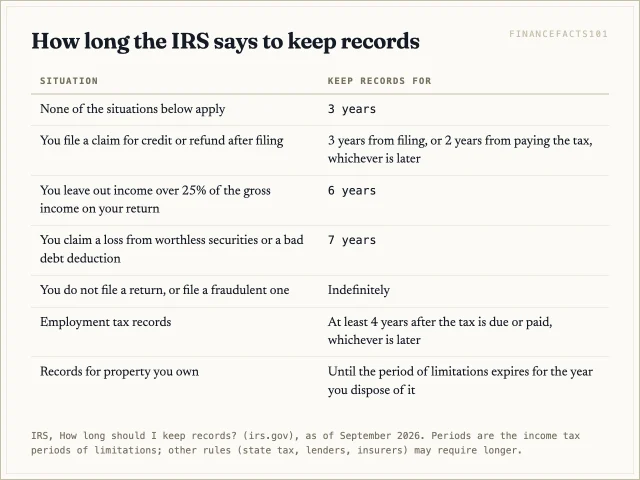
The electronic file itself. If you keep your books in accounting software, the IRS can ask for the software's backup file in an exam. Its FAQ on electronic accounting records says the backup file "is an exact copy of the original books of entry," and that the integrity testing it allows "cannot adequately be performed on records that have already been converted into Excel spreadsheets." The detailed rules for machine-readable records are in Revenue Procedure 98-25. In practice, keep the native data file for each closed year, not only PDF or spreadsheet exports.
Internal Controls Inside an AIS
Internal controls are the rules and checks that keep an AIS honest. For public companies they have a legal definition. SEC Rule 13a-15(f), 17 CFR 240.13a-15, describes internal control over financial reporting as a process designed to "provide reasonable assurance regarding the reliability of financial reporting." It includes policies that "Provide reasonable assurance that transactions are recorded as necessary to permit preparation of financial statements in accordance with generally accepted accounting principles."
Under Item 308 of Regulation S-K, 17 CFR 229.308, which implements Section 404 of the Sarbanes-Oxley Act, a public company's annual report must include management's assessment of whether those controls are effective, and management "is not permitted to conclude" they are effective if there is a material weakness. Companies generally get a transition period for their first annual report. The outside auditor's attestation on those controls is required only for accelerated and large accelerated filers, and emerging growth companies are exempt.
Management's evaluation must use "a suitable, recognized control framework." The best known is the COSO Internal Control—Integrated Framework, which the SEC's 2007 interpretive guidance cites as an example of a suitable framework and which organizes controls into five components: control environment, risk assessment, control activities, information and communication, and monitoring. The AIS is the core of the "information and communication" component, and most control activities run through it.
Private businesses face no such filing, but the same controls protect them. The ones an AIS can enforce include:
- Segregation of duties. The person who creates a vendor should not also approve its bills and release payments. In a small office, owner review of the bank statement and vendor list can stand in for staff separation.
- Approval limits. Bills or journal entries above a set amount need a second approver, and the system blocks posting until they get one.
- Three-way match. A vendor bill is paid only when it matches the purchase order and the receiving record.
- Access by role. Users see and change only what their job requires.
- Audit logs. The system records who created, changed or deleted each record, and when.
- Reconciliations and a period close. Bank, receivables and payables accounts are reconciled every month, and closed periods are locked against edits.
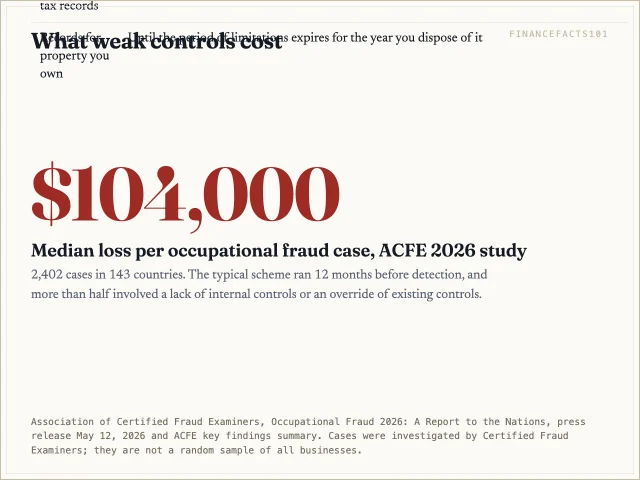
The payoff is measurable. The Association of Certified Fraud Examiners' 2026 Report to the Nations, released May 12, 2026, studied 2,402 occupational fraud cases in 143 countries. The median loss per case was $104,000, and a typical scheme ran 12 months before it was caught. The ACFE's summary of key findings adds that "More than half of all cases involved either a lack of internal controls or an override of existing controls."
Cybersecurity for Accounting Data
An AIS holds exactly what criminals want: bank account numbers, employee Social Security numbers, customer payment data and the authority to send money. Security is part of the system, not an add-on.
The measures that matter most are practical:
- Multi-factor authentication on the accounting system, online banking and email. A stolen password alone should not open any of them.
- Least-privilege access, reviewed when people change roles or leave. Departed employees with live logins are a common gap.
- Encryption of data stored and in transit, which cloud accounting providers generally handle; ask your provider how.
- Prompt updates to software, operating systems and browsers, so known holes are closed.
- Backups you have tested. A backup nobody has restored is a hope, not a plan. Keep at least one copy that ransomware on your network cannot reach. The entry on contingency planning covers the wider recovery plan.
- Payment-change verification. Many frauds against accounting teams are not hacks at all: an email, apparently from a vendor, asks you to send future payments to a new bank account. Confirm any change by phone, using a number you already have on file, before the system accepts it.
Staff training ties these together, because phishing, fake invoices and impersonated executives all target people rather than software. The entries on identity theft and eavesdropping attacks describe how stolen data and intercepted messages are used.
AIS vs ERP Systems
The two terms overlap, which is why they are so often confused. An AIS is defined by its purpose, financial records and reporting. An ERP is defined by its scope: one database shared by finance, purchasing, inventory, manufacturing, sales, HR and often more.
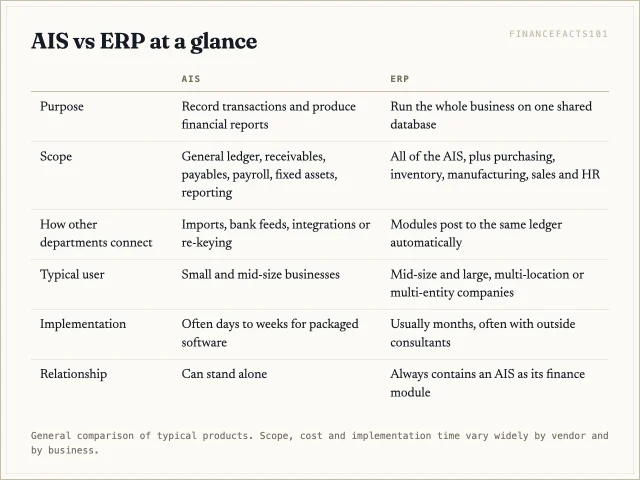
Every ERP contains an AIS; not every AIS is part of an ERP. A small business running stand-alone accounting software has an AIS and no ERP. A manufacturer running an ERP has an AIS inside it, with the advantage that a goods receipt in the warehouse module posts to inventory and payables without anyone re-entering it.
Which one a business needs depends on how many departments must share live data. A service firm with a dozen staff rarely needs an ERP; accounting software linked to a payroll service and a bank feed covers it. A company holding inventory in several locations, manufacturing to order or consolidating multiple entities usually outgrows stand-alone software. The signs are familiar: month-end closes that take weeks, spreadsheets bridging systems, and nobody sure which inventory number is right. ERP projects cost far more and take longer to implement, so the move is worth making when the re-keying and reconciliation work it removes is larger than the cost.
Benefits, Limits and Best Practices for Implementing an AIS
A well-run AIS delivers four things. Accuracy, because balanced entries and validation rules catch many errors at entry. Speed, because invoices, bills and reports come from data entered once. Control, because approvals, access limits and audit logs are enforced by the system rather than by memory. And decision information: current receivables, cash, margins and budget variances, not last quarter's.
The limits are just as real. An AIS processes whatever it is given, so a wrong item setup or a mistyped vendor bank account is repeated faithfully. Automation can hide errors that a manual process would expose. And controls can be overridden by anyone with enough access, which is why the ACFE finds override among the leading weaknesses.
When you implement or replace an AIS, these steps prevent most of the problems:
- Write down requirements first. List the reports you need, the cycles you run and who must approve what, before you look at products.
- Clean up the chart of accounts. Merge duplicates and set a numbering scheme before migration. It is far harder to fix afterward.
- Migrate opening balances and reconcile them. Bring over master data and closing balances as of a clean cut-off date, then prove the new trial balance matches the old one.
- Run in parallel for at least one close. Compare the new system's month-end results with the old system's before switching off the old one.
- Design user roles around segregation of duties. Set approval limits in the system rather than in a policy document.
- Train people on their own tasks, not on every menu. A clerk entering bills needs to know the three-way match rule, not the consolidation module.
- Set up backups and test a restore. Keep the native data files for closed years to meet the IRS retention periods above.
- Document the system. Publication 583's list, data flows, controls and the chart of accounts, is a good minimum for any business.
FAQ
What is an accounting information system in simple terms?
It is the system a business uses to record its money transactions and turn them into reports. That includes the accounting software, the data stored in it, the people who enter and approve transactions, the procedures they follow and the controls that keep the numbers accurate. The outputs are financial statements, tax returns and management reports.
How is data organized in an AIS?
In a relational database of linked tables. Master tables hold customers, vendors, items, employees and the chart of accounts, each with a unique key. Transaction tables hold invoices, bills, payments and journal entries, each pointing to those keys. Every transaction posts balanced debits and credits to accounts in the general ledger, and reports are queries that total those entries.
Is accounting software the same thing as an AIS?
No. Software is one of six components. An AIS also includes the data, the people, the procedures, the IT infrastructure and the internal controls. Two businesses running the same software can have very different AIS quality depending on how they set up approvals, reconciliations and access.
What is the difference between an AIS and an ERP system?
An AIS handles financial recording and reporting. An ERP is a wider system that shares one database across finance, purchasing, inventory, manufacturing, sales and HR, with an AIS as its accounting module. Small businesses usually need only an AIS; companies with many departments or locations often move to an ERP.
Sources
- IRS, Publication 583, Starting a Business and Keeping Records (revised December 2024) — journals and ledgers, double-entry rules, documentation required for computerized systems, Revenue Procedure 98-25 reference
- IRS, Recordkeeping — choice of any recordkeeping system that clearly shows income and expenses
- IRS, How long should I keep records? — 3-, 6- and 7-year periods, indefinite retention, 4 years for employment tax records, property records
- IRS, Use of electronic accounting software records: Frequently asked questions and answers — backup files, legal authority, limits of Excel exports
- SEC, Policy Statement: Reaffirming the Status of the FASB as a Designated Private-Sector Standard Setter (Release 33-8221, 2003)
- eCFR, 17 CFR 210.4-01 — non-GAAP filed statements presumed misleading; paragraph (a)(2) on foreign private issuers
- SEC, Acceptance From Foreign Private Issuers of Financial Statements Prepared in Accordance With IFRS Without Reconciliation to U.S. GAAP (Release 33-8879, December 21, 2007)
- eCFR, 17 CFR 240.13a-15 — definition of internal control over financial reporting; suitable framework requirement
- eCFR, 17 CFR 229.308 (Item 308) — management's report and auditor attestation on internal control
- SEC, Management's Report on Internal Control Over Financial Reporting, interpretive guidance (Release 33-8810, 2007) — COSO framework as an example of a suitable framework; its five components
- Association of Certified Fraud Examiners, Occupational Fraud 2026: A Report to the Nations, press release (May 12, 2026) and key findings — 2,402 cases, $104,000 median loss, 12-month median duration, control weaknesses
 Next entry · No. 30Understanding Accounting Policies: Procedures for Preparing Financial Statements
See also
-
 No. 787
08 Jun 2024
19 min
Understanding Cost Accounting: Techniques, Types, and Differences from Financial Accounting
Business Strategy
No. 787
08 Jun 2024
19 min
Understanding Cost Accounting: Techniques, Types, and Differences from Financial Accounting
Business Strategy -
 No. 5,334
31 Aug 2025
23 min
Understanding the Role and Importance of Upper Management in Corporate Strategy
Business Strategy
No. 5,334
31 Aug 2025
23 min
Understanding the Role and Importance of Upper Management in Corporate Strategy
Business Strategy -
 No. 2,487
10 Jan 2025
17 min
The Importance and Functionality of Inventory Accounting for Institutional Investors
Business Strategy
No. 2,487
10 Jan 2025
17 min
The Importance and Functionality of Inventory Accounting for Institutional Investors
Business Strategy -
 No. 2,456
07 Jan 2025
18 min
The Role and Importance of Internal Auditors in Enhancing Corporate Governance and Financial Performance
Business Strategy
No. 2,456
07 Jan 2025
18 min
The Role and Importance of Internal Auditors in Enhancing Corporate Governance and Financial Performance
Business Strategy -
 No. 767
04 Jun 2024
19 min
Understanding the Role and Responsibilities of Financial Controllers: A Comprehensive Guide
Business Strategy
No. 767
04 Jun 2024
19 min
Understanding the Role and Responsibilities of Financial Controllers: A Comprehensive Guide
Business Strategy -
 No. 755
02 Jun 2024
19 min
Contingency Planning: Preparing for Unexpected Negative Events in Finance and Investment
Business Strategy
No. 755
02 Jun 2024
19 min
Contingency Planning: Preparing for Unexpected Negative Events in Finance and Investment
Business Strategy