What a 1% Advisory Fee Really Costs Over 30 Years
On $250,000 plus $1,000 a month at 7%, a 1% advisory fee costs $738,937 over 30 years — 22.7% of final wealth. When it's worth paying, and what isn't.
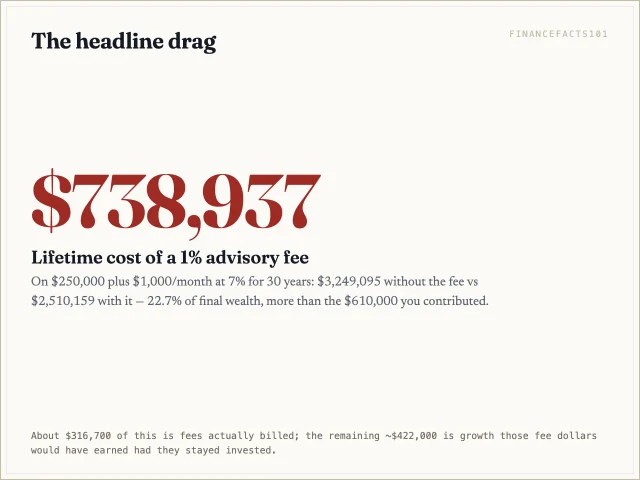
Keep the 1%-of-assets adviser, switch to a 0.25% robo-adviser, pay a flat-fee planner by the job, or manage the money yourself — that is the decision this guide prices. On a $250,000 portfolio with $1,000 a month added and a 7% return before fees, what a 1% advisory fee really costs over 30 years is $738,937: the portfolio ends at $2,510,159 instead of $3,249,095. That is not a typo and not an attack on advisers — some of them earn every basis point, and this guide works through when that is true. But 22.7% of your final wealth is a price that deserves arithmetic, not a shrug.
Every dollar figure below comes from one set of assumptions, stated once: $250,000 starting balance, $1,000 contributed monthly, 7% annual return before fees, compounded monthly, 30 years, with the advisory fee deducted monthly from the balance. Fee levels for robo-advisers and planners are as of September 2026 and dated where quoted. Change the inputs and the dollars move; the shape of the conclusion does not.
Scope honesty: this is general information built on the stated assumptions, not personal advice. Your returns, taxes, and fee quotes will differ.
Who this is for — and who it is not for
This guide is for a US investor with a five-to-seven-figure portfolio who is either paying an assets-under-management (AUM) fee now or being pitched one, and wants the cost and the alternatives priced side by side. It is also for the investor leaving a 401(k)-only world for the first time, staring at a rollover, and hearing "we only charge 1%."
It is not for you if your finances genuinely need ongoing professional coordination — a business sale, concentrated stock with option grants, special-needs planning, a blended-family estate — and you have no intention of doing any of it yourself. In that case the question is not whether to pay for advice but which type of adviser to pay and how; the fee-model and fiduciary sections below still apply to you. It is also not a guide to picking investments. The portfolio here is assumed identical in every scenario; only the fee changes.
The worked example: $250,000, $1,000 a month, 30 years
Run the same portfolio three times — no advisory fee, a 0.25% robo-adviser fee, and a 1% AUM fee — and let each compound monthly for 30 years at 7% before fees. You contribute $610,000 in total ($250,000 up front plus 360 monthly deposits of $1,000). The end values:
- No advisory fee: $3,249,095
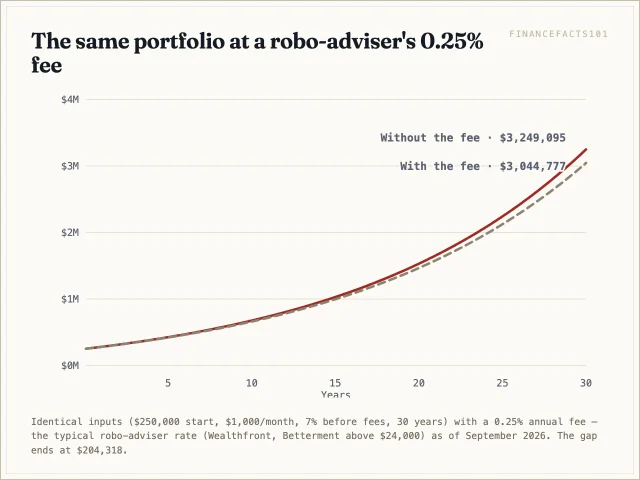
- 0.25% annual fee: $3,044,777 — a drag of $204,318
- 1% annual fee: $2,510,159 — a drag of $738,937

The centerpiece chart below shows the 1% case unfolding month by month: two curves from identical deposits and identical market returns, separated only by the fee.

Notice when the gap opens. After 5 years it is about $19,000 — annoying, not alarming. After 15 years it is roughly $125,000. The final 10 years do most of the damage, because by then the fee is being charged on a seven-figure balance and every dollar it removes had two decades of compounding left in it.
What a 1% advisory fee really costs: three ways to say $738,937
The same number, framed three ways, because each framing answers a different objection.
As dollars: $738,937, against total contributions of $610,000. The fee's lifetime cost exceeds every dollar you personally put in.
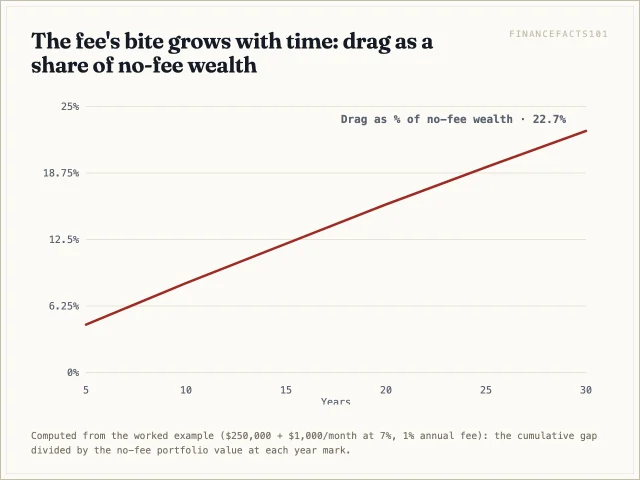
As a share of final wealth: 22.7%. A 1% annual fee does not cost you 1% of your money; it costs you between a fifth and a quarter of your ending wealth over a 30-year horizon on these assumptions. The chart below shows that share climbing with the years — 4.5% of wealth at year 5, 8.4% at year 10, 15.8% at year 20, 22.7% at year 30 — which is also why the same fee is far less damaging over a 5-year engagement than a 30-year one.
As a return haircut: 7% gross compounding becomes 6% net. That single percentage point, applied every year to the whole balance, is the entire mechanism — which brings us to why the damage is so much larger than "1% of my returns" suggests.
Why the drag is bigger than "1% of returns"
Three compounding effects stack, and the sales pitch mentions none of them.
First, the fee is charged on assets, not returns. In a year the market returns 7%, a 1% AUM fee consumes about a seventh of your gain. In a flat year it consumes all of it. In a down year it deepens the loss. "One percent" is one percent of everything you own, every year, regardless of what the adviser's work produced.
Second, every fee dollar forfeits its own future growth. Across the 30 years, the adviser actually bills about $316,700 in fees on this portfolio. The remaining ~$422,000 of the $738,937 drag is money those billed dollars would have earned had they stayed invested. More than half the true cost is invisible on any statement you will ever receive.
Third, the fee compounds against a growing base. The 1% that cost $2,500 in year one costs over $20,000 a year by the late 2040s, because the balance it is levied on has grown eightfold — while the work of managing a diversified portfolio has not grown eightfold.
The SEC's own arithmetic agrees
This is not a fringe calculation. The SEC's Office of Investor Education runs the same exercise in its investor bulletin How Fees and Expenses Affect Your Investment Portfolio (updated July 23, 2025): a $100,000 portfolio earning 4% for 20 years ends near $208,000 with a 0.25% annual fee but only about $179,000 with a 1% fee — roughly $29,000 gone on a portfolio a fraction of our example's size, at a return almost half as high. The bulletin's chart also separates fees paid from earnings forgone on those fees, the same decomposition as above. Lower returns and shorter horizons shrink the dollars; nothing changes the direction.
For comparison, the 0.25% robo-fee version of our worked example is charted below. The gap exists — $204,318 is real money — but it is between a quarter and a third of the 1% gap, for services that overlap more than the price difference implies.
What 1% can legitimately buy
The strongest honest case for the fee is Vanguard's Advisor's Alpha research — industry research from a firm that sells advice, but unusually candid about assumptions. The July 2022 quantification, Putting a Value on Your Value, estimates that a good adviser can add "up to, or even exceed, 3%" in net returns per year, from specific, mostly non-investment activities: behavioral coaching (up to ~2% — stopping the panic sale near a bottom), cost-effective fund selection (~0.30%), asset location across taxable and tax-deferred accounts (0–0.60%), withdrawal-order strategy in retirement (0–1.20%), and rebalancing (~0.14%). Vanguard reaffirmed the framework in February 2025 and added tax-loss harvesting as a module.
Read the caveats as carefully as the headline. Vanguard itself says the 3% "should not be viewed as an annual value-add" — it is intermittent, concentrated in "periods of market duress or euphoria," and varies enormously by client. The biggest component, behavioral coaching, is worth ~2% only to someone who would otherwise have sold in a crash. If 2008 or 2020 or 2022 did not shake you out of your allocation, that line item is worth close to zero to you — and it is most of the pitch.

When 1% is defensible — and when it is dead weight
The fee is most defensible when the components above actually bind: you have panic-sold before; you hold large balances across taxable, traditional, and Roth accounts where asset location and withdrawal sequencing carry real basis points; you are within five years of retirement and need a drawdown plan, Social Security timing, and Roth-conversion sequencing; or your situation involves equity compensation, a business, or an estate that needs coordination. Even then, note that most of these are episodic problems — heaviest at retirement and in crises — being paid for with a perpetual fee.
It is closest to dead weight for the investor the industry quietly depends on: the accumulator holding a diversified index portfolio, adding money monthly, decades from retirement, who would hold through a drawdown anyway. That investor's job is automatable and largely already automated — see our guide to hands-off investing. Paying 1% of assets forever to be told "keep doing what you're doing" is how $738,937 leaves a portfolio politely.
Fee-on-fees: the advisory fee never travels alone
The 1% is the adviser's fee; the funds inside the portfolio charge their own expense ratios on top. The stack is what you actually pay. An adviser who implements with broad index funds might add only ~0.06% (Vanguard's total-market ETF charges 0.03%, and index equity mutual funds averaged 0.05% asset-weighted in 2025 per the Investment Company Institute's March 2026 fee study). An adviser who fills the portfolio with active funds can easily add 0.60% or more — the simple-average equity mutual fund expense ratio was 1.08% in 2025.
Re-run the worked example with the stacked fee:
- 1% + 0.06% index funds (1.06% all-in): $2,471,980 — total drag $777,115
- 1% + 0.60% active funds (1.60% all-in): $2,155,303 — total drag $1,093,792

The fund layer alone is worth $316,677 over the 30 years in this comparison. Before negotiating the advisory fee, look at what the adviser puts inside the accounts — it is the easier fee to cut and the one least connected to any service you receive.
The robo middle: 0.25%, and what it leaves out
Robo-advisers occupy the middle at roughly a quarter of the human price. As of September 2026, Wealthfront charges 0.25% annually on its automated investing accounts, and Betterment charges $5 a month, converting to 0.25% annually once you hold $24,000+ or set up recurring deposits of $200+ a month (its premium tier, with human CFP access, runs 0.65% on the first $1M). On $250,000, that is about $625 a year versus $2,500 at 1%.
For that 0.25% you get the automatable parts of the Advisor's Alpha list: allocation to low-cost funds, automatic rebalancing, tax-loss harvesting, asset location in some configurations. What you do not get, at the base tier, is a human who knows your situation — no withdrawal-sequencing plan, no estate coordination, no one to call in a 30% drawdown except an app notification. Our comparison of full-service, discount, and robo accounts covers the structural differences; the short version is that a robo is a cheap implementation layer, not a planner.
Flat-fee and hourly planners: buying advice by the job
The fourth model separates advice from assets entirely, which removes the compounding problem: a fixed dollar fee does not scale with your balance. Typical market rates, per the Kitces Research 2024 advisor-fee study (as reported by NerdWallet, verified September 2026):
- Flat annual retainer: $2,500–$9,200, median $4,500
- One-time full financial plan: about $3,000
- Hourly: $200–$400 an hour, with a focused engagement often landing at $1,000–$4,000
On $250,000, a $4,500 retainer is more than the 1% fee ($2,500) — flat fees are not automatically cheaper for smaller portfolios. The crossover sits near $450,000 for that median retainer, and by $1M the AUM model costs roughly $10,000 a year against the same $4,500. The flat-fee model's real advantage is at large balances and for episodic needs: pay $3,000 once for a retirement drawdown plan, implement it yourself, come back in three years.

Fiduciary vs suitability — and how to check before you sign
Titles are marketing; registration status is law. A registered investment adviser (RIA) owes you a fiduciary duty — care and loyalty — under the Investment Advisers Act, per the SEC's 2019 interpretation. A broker-dealer representative is instead covered by Regulation Best Interest (adopted June 2019, in force since June 30, 2020), which requires recommendations in your best interest at the time they are made — a higher bar than the old suitability standard, but not an ongoing duty, and commissions still steer. The Department of Labor's 2024 attempt to extend fiduciary status to more retirement advice was struck down in court: the rule was vacated, with final judgments entered in March 2026. The regulatory floor is not rising to meet you; you have to check.
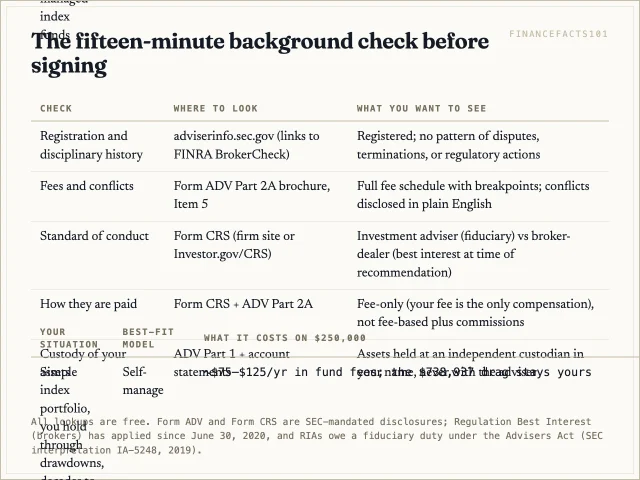
Checking takes fifteen minutes. Look the firm and the individual up on adviserinfo.sec.gov, read Form ADV Part 2A (fees, conflicts, disciplinary history — in plain English by rule), and read the two-to-four-page Form CRS every broker and adviser must hand you. The SEC's investor-professional check walks through it.
The exit cost: leaving an adviser is not free either
Factor in the cost of the door before you walk through it — in either direction. Leaving an AUM adviser usually means transferring accounts (ACAT transfer fees of roughly $50–$150 per account are common — see our breakdown of brokerage fees) and, more seriously, unwinding what the adviser bought. IRAs move tax-free. Taxable accounts do not: if the adviser filled yours with proprietary or high-fee funds that your next custodian will not hold, selling them realizes capital gains. A $500,000 taxable account carrying $150,000 of unrealized gains costs $22,500 to liquidate at the 15% long-term rate, plus any state tax — a one-time toll that can equal several years of fee savings.
Two mitigations: transfer in kind wherever possible and sell only what truly must go, spreading sales across tax years; and treat this as a reason to insist, up front, on plain low-cost ETFs any custodian will hold. An adviser whose portfolio is expensive to leave has built a moat out of your tax bill.
Questions to ask before signing
Ask these in writing, and keep the answers:
- Are you a fiduciary at all times, for all accounts, in writing? "I act in your best interest" spoken aloud is not the same as an RIA's legal duty on paper.
- What is your all-in cost? Advisory fee plus the weighted expense ratio of what you will actually hold, plus platform and trading costs, as one number.
- How are you paid beyond my fee? Commissions, 12b-1 fees, revenue sharing, insurance products. Fee-only means your fee is the only compensation; fee-based means it is not.
- What, specifically, do I get each year? Meetings, a written plan, tax-loss harvesting, drawdown modeling — services you can verify happened.
- What is the fee at $500,000 and at $1 million? Breakpoints are standard; the 2026 Envestnet/Datos fee study puts average AUM fees near 0.96% and falling above $1M. Silence on breakpoints is an answer.
- If I leave in three years, what does exit cost? Termination fees, transfer fees, and whether the holdings move in kind.
The decision framework
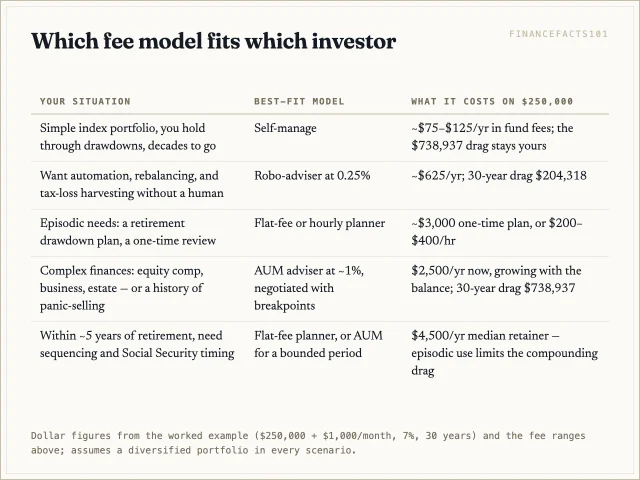
The one-paragraph version: self-manage if your portfolio is a handful of index funds and your track record says you hold through drawdowns — the ~$739,000 stays yours for roughly $100 a year in fund costs. Use a robo at 0.25% if you want the automation without the discipline of doing it yourself; on these assumptions that choice preserves $534,619 of the 1% adviser's drag. Buy advice flat or hourly when your needs are episodic — a retirement drawdown plan, a one-time portfolio review — or your balance is large enough that $4,500 beats 1%. Pay the 1% knowingly when the Advisor's Alpha components genuinely apply to you, negotiate breakpoints, insist on low-cost funds inside, and re-ask the question every few years as the balance — and therefore the fee — grows.
FAQ
Is a 1% fee negotiable?
Usually, and increasingly so as balances grow. Industry fee studies (Envestnet/Datos 2026; Kitces 2024) show average AUM fees near 0.96–1% below $1M and declining above it, with NerdWallet's review data finding ~0.86% typical at $1M. Breakpoint schedules are standard at most firms even when the first quote is a flat 1%. If a firm will not discuss its schedule, its Form ADV Part 2A discloses it anyway — read Item 5 before the second meeting.
Does the 1% include the fund fees inside my portfolio?
No. The advisory fee and fund expense ratios are separate layers, and both come out of your return. The stack ranges from about 1.06% all-in (1% plus broad index funds at ~0.06%) to 1.60% or more with active funds — on the worked example, that fund layer alone is worth $316,677 over 30 years. Ask for the weighted average expense ratio of the proposed portfolio as a single number.
Vanguard says advisers add 3% — doesn't that beat the fee?
The claim is "up to, or even exceed, 3%," and Vanguard's own paper says it is not an annual figure — it is intermittent, concentrated in market panics and major transitions, and varies by client. The largest component (behavioral coaching, up to ~2%) only pays if you would otherwise abandon your plan. For an investor who demonstrably holds through downturns and has simple finances, most components round toward zero; for a panic-seller with complex accounts approaching retirement, the framework is credible. The 3% is a ceiling for the right client, not a floor for every client.
How do I check whether an adviser has a disciplinary history?
Search the individual and the firm at adviserinfo.sec.gov (which also covers state-registered advisers and links to FINRA's BrokerCheck for brokers). Disclosures of customer disputes, regulatory actions, terminations, and bankruptcies appear on the report, and Form ADV Part 2A must describe disciplinary events in its brochure. The SEC's free check takes minutes; per the agency's investor-education materials, unregistered individuals are a leading red flag in enforcement cases.
Sources
- SEC / Investor.gov: How Fees and Expenses Affect Your Investment Portfolio — investor bulletin, updated July 23, 2025
- SEC: Commission Interpretation Regarding Standard of Conduct for Investment Advisers (IA-5248) — June 2019
- SEC: Regulation Best Interest and Form CRS compliance statement — June 2020
- Investor.gov: Form CRS
- Investor.gov: Check Out Your Investment Professional
- SEC: Investment Adviser Public Disclosure (adviserinfo.sec.gov)
- Federal Register: Retirement Security Rule — Notice of Court Vacatur — March 20, 2026
- Vanguard: Putting a Value on Your Value — Quantifying Advisor's Alpha — July 2022; 25-year update February 2025
- Investment Company Institute: Trends in the Expenses and Fees of Funds, 2025 — March 2026
- NerdWallet: How Much Does a Financial Advisor Cost? — citing Kitces Research 2024 and Envestnet fee studies; verified September 2026
- Betterment pricing — as of September 2026
- Wealthfront pricing — as of September 2026
 Next entry · No. 5,938Renting vs Buying a Home: The Real Math
See also
-
 No. 5,811
09 Oct 2025
22 min
Understanding Wrap Fees: A Comprehensive Guide for Institutional Investors
Business Finance
-
 No. 4,472
21 Jun 2025
19 min
Understanding Registered Investment Advisors (RIAs): Their Role, Responsibilities, and Differences from Broker-Dealers
Financial Education
-
 No. 4,986
02 Aug 2025
26 min
Understanding Timber Investment Management Organizations (TIMOs): The Role of Middlemen in Institutional Forestry Investments
Investments
-
 No. 2,508
12 Jan 2025
20 min
Understanding Investment Advisers: Roles, Responsibilities, Regulations, and Real-World Examples
Investments
-
 No. 2,279
24 Dec 2024
23 min
Understanding Investment Advisory Representatives (IARs): Roles, Requirements, and Benefits
Investments
-
 No. 2,246
21 Dec 2024
21 min
Understanding Hub and Spoke Structures in Investment Management: Benefits, Efficiencies, and Tax Implications
Investments