Debt Avalanche vs Snowball: Which Pays Off Faster
On four typical debts both orders finish in 32 months with $4,858 of interest — a $0 gap. Rearrange the APRs and snowball costs $1,187 more.
You have several debts, one monthly budget, and a choice: which balance gets the extra money. The debt avalanche vs snowball argument is usually framed as math versus motivation — avalanche saves more, snowball keeps you going — but on many real debt profiles the two orders produce the same schedule to the dollar, and the argument is about nothing. This guide runs both methods on the same four debts, shows exactly when the order costs money and how much, and compares both against the two alternatives that matter more: paying only minimums, and a 0% balance transfer.
One line of scope honesty up front: everything below is general information computed from stated assumptions. Your balances, rates, and budget will move every number, and none of it is personal advice.
The two rules, one sentence each
Debt avalanche: pay the minimum on every debt, and send every spare dollar to the debt with the highest APR until it is gone, then to the next-highest, and so on. Debt snowball: pay the minimum on every debt, and send every spare dollar to the debt with the smallest balance, then the next-smallest, regardless of interest rate.
That is the entire difference — a sort key. Avalanche sorts by rate, snowball sorts by balance. The CFPB describes both (it calls avalanche the "highest interest rate method") and declines to pick a winner, which turns out to be more defensible than most personal-finance writing admits.
Who this is for — and who it is not for
This guide is for a US reader with two or more consumer debts — cards, a personal loan, a car loan — who can pay meaningfully more than the combined minimums every month and wants the cheapest, fastest order of attack. The worked example assumes $445 a month above minimums; the logic holds at $50 or $900, only the dates change.
It is not for you if you cannot cover the minimums — that is a hardship problem, not an ordering problem, and the moves are different (calling lenders, nonprofit credit counseling, in the worst case bankruptcy). It also is not aimed at federal student loans, which carry income-driven plans and forgiveness clocks that break the simple APR ranking, or at mortgage prepayment, which competes with investing rather than with other debts. And if you have exactly one debt, there is no order to choose — every method collapses to "pay extra."
The worked example: four debts, $1,200 a month
Every number in this article comes from the same household. Four debts totaling $31,500, minimums totaling $755, and a payoff budget of $1,200 a month — $445 above the minimums:

This profile is deliberately typical. The credit-card balance of $6,800 sits close to the national average of $6,610 per cardholder (TransUnion, Q2 2026), and its 22.99% APR is just above the 21.52% average that interest-paying card accounts were charged as of the Federal Reserve's June 2026 G.19 consumer credit release. Nationally there is $1.26 trillion of card debt behind numbers like these (New York Fed Household Debt and Credit report, Q2 2026).
In month one, this household's debts accrue $342.47 of interest: $28.99 on the store card, $130.27 on the credit card, $91.04 on the personal loan, $92.17 on the car loan. Of the $755 in minimum payments, 45% is consumed by interest before a dollar of principal moves.

Debt avalanche vs snowball: both schedules, run out
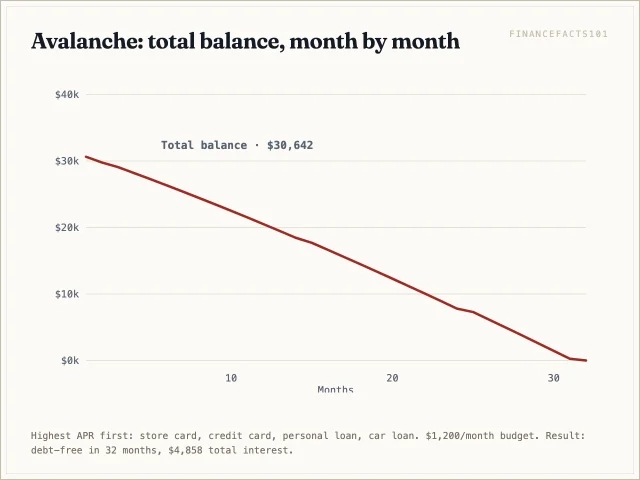
Run the avalanche: minimums to everything, the spare $445 to the store card at 28.99%, then the credit card at 22.99%, then the personal loan, then the car. Result: debt-free in 32 months, $4,858 of total interest.
Now run the snowball: the spare $445 to the smallest balance — the $1,200 store card — then the $6,800 credit card, then the $9,500 loan, then the $14,000 car. Result: debt-free in 32 months, $4,858 of total interest.
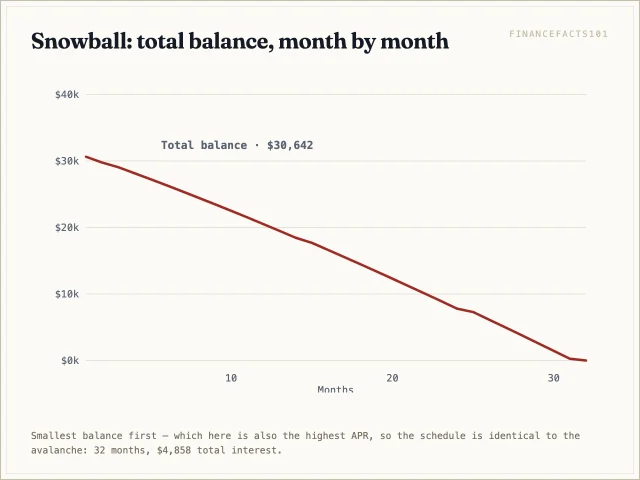
The same schedule, to the penny. That is not a rounding coincidence; it is structural. In this household — and in a great many real ones — the smallest balance is the highest-APR debt. Store cards and starter cards carry the ugliest rates and the smallest limits, so both sort keys pick the same target: store card first, credit card second, personal loan third, car loan last. When the orders agree, the methods are literally the same plan wearing different names.
When the order does cost money — and how much
To see the gap the argument is actually about, rearrange one thing: swap the APRs so the $9,500 personal loan costs 28.99% (a real rate for subprime personal loans) and the $1,200 store card costs 11.5%. Same balances, same minimums, same $1,200 budget. Now the sort keys disagree — avalanche attacks the big expensive loan first; snowball still attacks the little cheap card first.

Avalanche finishes in 34 months with $7,469 of interest. Snowball takes 35 months and $8,655 — $1,187 more, plus one extra month, on the same debts with the same budget. That is the honest size of the stakes in a case built to show them: a four-figure difference, real but not ruinous, roughly 3.8% of the starting balance. The gap grows with the spread between your highest and lowest APRs, with the size of the high-rate balance, and with how long the plan runs; it shrinks toward zero as your rates converge.
Which produces the actual decision rule: before debating methods, check whether your two sort orders even differ. List your debts by balance and by APR. If the columns rank the same way — smallest is dearest, as in our base case — stop debating; both methods hand you the identical schedule. If they diverge, the avalanche's edge is worth estimating before you decide it is worth ignoring.
The comparison that actually matters: minimums only
The avalanche-versus-snowball gap in our rearranged example is $1,187. Here is the gap nobody argues about. Suppose this household pays only the stated minimums — $35, $170, $210, $340, held constant, with nothing extra and nothing redirected as debts close:
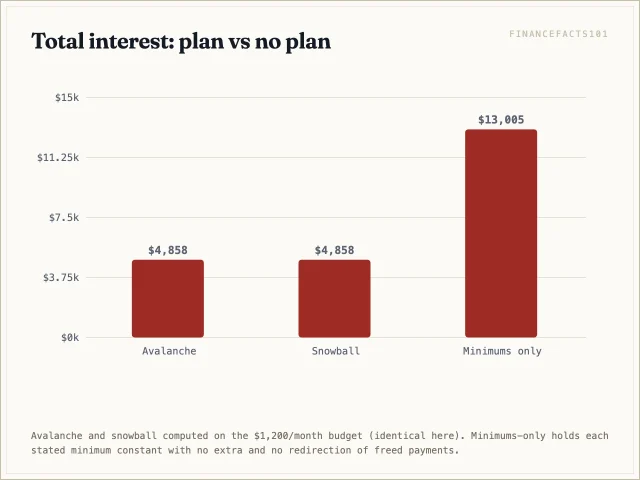

Minimums alone take 77 months — six and a half years — and $13,005 of interest: $8,147 more than either method, across 45 extra months. The credit card alone eats $6,224, nearly its own starting balance, because its $170 minimum barely outruns the $130 of monthly interest at 22.99%. (Real card minimums are typically set as a small percentage of the balance and shrink as you pay, which stretches the timeline further still — this fixed-minimum version is the kind case. How issuers compute those charges is covered in our entry on the average daily balance method.)
Choosing between avalanche and snowball moves hundreds, occasionally a thousand or two. Choosing between "a plan" and "minimums" moves five figures. Any ordering beats no ordering by an order of magnitude.
The case for avalanche: rate ranking is cost ranking
The mathematical argument for the avalanche needs one sentence: every dollar of balance costs you its APR, so retiring the highest-APR dollars first minimizes total interest — always. APR is the price of renting each dollar; avalanche returns the most expensive rentals first. No other fixed ordering can beat it, and in our rearranged example its edge over snowball is that $1,187.
The subtlety is that "always cheapest" says nothing about "by how much." Avalanche's edge is large when a big balance carries a high rate and the plan is long; it is small when rates cluster (three cards at 19–23%), when the extra budget is large enough to finish everything within a couple of years, or when the expensive debt is tiny — a $600 store card at 29% versus a $500 card at 27% is a decision worth zero dollars and zero minutes. And, as the base case shows, the edge is exactly $0 whenever the balance order matches the rate order.
The case for snowball: the completion evidence
Snowball's defense is not arithmetic, and it should not be dismissed as feelings. It is the best-documented finding in debt-repayment behavior. Gal and McShane (Kellogg School of Management) analyzed thousands of borrowers in a debt-settlement program and found that the fraction of accounts closed — not the dollars retired — predicted whether people finished eliminating their debt; the paper, "Can Small Victories Help Win the War?" (Journal of Marketing Research, August 2012), gave the small-victories effect its name (Kellogg's summary). Kettle, Trudel, Blanchard, and Häubl extended it experimentally in "Repayment Concentration and Consumer Motivation to Get Out of Debt" (Journal of Consumer Research, 2016): concentrating payments on one account — most powerfully the smallest — raised subsequent repayment effort by around 20% versus spreading payments around.
Read carefully, though, the research endorses something narrower than "snowball beats avalanche." It says closing accounts sustains effort and concentration beats dispersion. Both methods concentrate; avalanche also closes accounts, just sometimes later. The behavioral risk avalanche carries is specific: when your highest-APR debt is also your largest, the first win may be years away, and plans with distant first wins get abandoned. A plan that saves $1,187 on paper and gets quit in month nine costs more than a plan that "wastes" $1,187 and finishes. If you have started and abandoned payoff plans before, that history is data about you, and it belongs in the decision.
The hybrid: buy one win, then follow the rates
The two findings combine cleanly. Take one early victory, then switch to rate order: knock out a single small balance first — whatever its APR — and run a pure avalanche on everything that remains.

In the rearranged example, the hybrid clears the little store card in month 3 (the snowball's first win, two years sooner than the avalanche's), then turns rate-ordered: it finishes in 35 months with $8,050 of interest — $605 cheaper than pure snowball, $582 dearer than pure avalanche. You pay roughly half the snowball premium and get the psychological jump-start the research says predicts finishing. As a bonus, the closed account's minimum joins your attack budget immediately, and one bill disappears from your month.
The hybrid is pointless when the base case's condition holds — smallest balance, highest rate — because all three plans are then identical. It earns its keep exactly when the orders diverge and your first avalanche target would take a year or more to kill.
Freed minimums: why the attack accelerates
Whichever order you pick, the mechanism that makes these plans finish is the rollover: each debt you close releases its minimum payment into the attack on the next target. The budget stays $1,200; the tip of the spear grows.
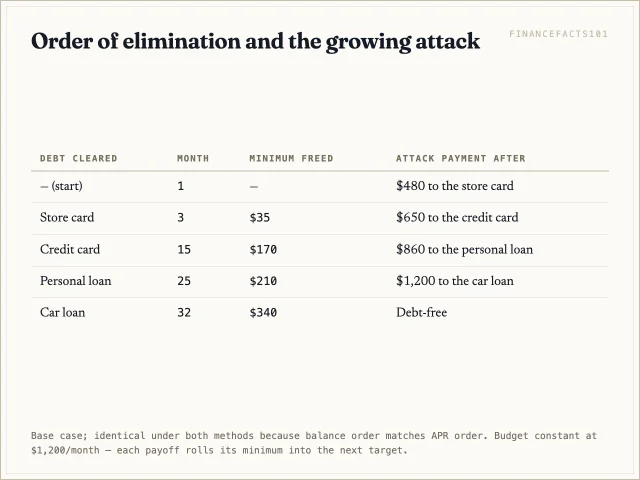
In the base case the attack payment starts at $480 a month ($35 minimum plus the $445 extra) against the store card. From month 4 it is $650 against the credit card; from month 16, $860 against the personal loan; from month 26, the full $1,200 lands on the car. The last debt — an ordinary amortized loan that began with a $340 payment — is being hit three and a half times that hard at the end. This is the honest meaning of "snowball": not the ordering, the acceleration. It only works if you hold the total at $1,200 after each payoff instead of absorbing the freed minimum into spending — which is where most plans actually leak.
The 0% balance transfer: cheaper than either — with a trap
For the card portion of the debt, there is an option that beats both orderings outright: moving the balances to a 0% introductory-APR card. The CFPB's explainer notes the catch that matters first: 0% offers still charge a transfer fee, typically 3–5% of the amount moved, added to the balance.

Our household's two cards total $8,000 and generate $1,274 of the plan's interest. Transferred to an 18-month 0% offer at a 3% fee, the balance becomes $8,240 and clearing it inside the window takes $457.78 a month — comfortably within this budget. Net saving versus the avalanche plan: about $1,034 on the cards, and the freed interest shortens the whole schedule. A 21-month offer at a 5% fee needs $400 a month on $8,400 and saves less.
The traps are behavioral and contractual at once. Miss the window and the leftover balance reverts to a standard purchase APR near 22%; pay more than 60 days late and the promotional rate can be revoked early; and new purchases on the transfer card usually accrue interest immediately while your payments chip at the 0% balance. The transfer also requires good enough credit to get a limit near $8,000 — not a given mid-payoff. Treat it as a tool for people who have already stopped adding card debt, and size the monthly payment to clear the balance with two months to spare.
Mistakes that cost more than the ordering
Three errors reliably outweigh the avalanche-snowball gap:
- Closing cards as you clear them. A paid-off card left open keeps its credit limit in your utilization denominator; closing it can push utilization — balances divided by limits across your revolving credit — sharply higher and drop your score just when you might want a 0% offer or an auto refinance. Pay it, keep it open, stop carrying it.
- Running the plan with no cash buffer. With every spare dollar aimed at debt, the first $600 car repair goes straight back on a card at 22.99%, undoing months of progress. Park a starter emergency fund — even $1,000 — before maximizing the attack budget.
- Respending cleared limits. The schedule's arithmetic assumes the card balances only fall. New spending on a cleared card at 22.99% silently converts your 32-month plan back into the 77-month one.
The decision in four questions

Work down the table. If your balance order and rate order agree, there is no decision — take the shared schedule and go. If they diverge by a wide APR spread on a large balance, the avalanche's edge is real money; take it unless your own history says you will not finish, in which case buy the first win with a hybrid. If a 0% transfer is available and you can clear it inside the window with margin, it beats both. And in every branch, the choice that dominates all of them is the budget line itself: $1,200 a month instead of $755 is worth $8,147 and 45 months here — no ordering cleverness comes close.
FAQ
Does the snowball ever cost less than the avalanche?
It can only tie, never win, on total interest — the avalanche is provably the cheapest fixed order. The tie happens whenever balance order matches rate order, as in this article's base case, where both take 32 months and $4,858. The snowball "wins" only in the practical sense the research points to: a plan you finish beats a cheaper plan you abandon.
Should the car loan and personal loan be in the plan, or just the cards?
Include every debt in the schedule, because their minimums shape your budget and their payoffs free cash flow — but expect the extra dollars to reach them last. At 7.9%, prepaying the car saves $92 a month per $14,000 of balance at the start; the same dollars against a 22.99% card save nearly three times as much. Some would even divert the car-loan extra to investing or savings once the double-digit APRs are gone; that is a separate decision with its own trade-offs.
What happens to my credit score during the payoff?
Usually it improves: utilization falls as card balances drop, and on-time payment history accumulates. The two self-inflicted dents are closing cards (higher utilization, shorter average account age) and applying for several new accounts at once, transfer cards included. Expect a small, temporary dip from a transfer application, then improvement as balances fall.
Is $1,200 a month realistic, and what if I only have $50 extra?
The $445-above-minimums assumption is illustrative, not a requirement. Every mechanism here — rate ordering, small victories, freed minimums — works identically at $805 a month; the schedule simply stretches. The one threshold that matters is paying meaningfully more than interest accrues ($342 in month one here). Below that line, balances grow no matter how cleverly you order them, and the move is negotiating rates or seeking counseling, not choosing a sort key.
Sources
- Federal Reserve, G.19 Consumer Credit — average credit-card APRs (21.52% on accounts assessed interest; June 2026 data, released August 7, 2026)
- Federal Reserve Bank of New York, Household Debt and Credit Report, Q2 2026 — $1.26 trillion in credit-card balances (released August 11, 2026)
- CFPB, How to reduce your debt — the two payoff methods
- CFPB, What is a balance transfer fee?
- CFPB, How long can I keep a low rate on a balance transfer?
- CFPB, Do I pay interest on new purchases after a balance transfer?
- Gal, D. & McShane, B., "Can Small Victories Help Win the War? Evidence from Consumer Debt Management", Journal of Marketing Research 49(4), 2012 — Kellogg summary
- Kettle, K., Trudel, R., Blanchard, S. & Häubl, G., "Repayment Concentration and Consumer Motivation to Get Out of Debt", Journal of Consumer Research 43(3), 2016
- TransUnion, Q2 2026 Credit Industry Insights Report — average card balance $6,610
 Next entry · No. 5,937What a 1% Advisory Fee Really Costs Over 30 Years
See also
-
 No. 5,980
14 Oct 2026
21 min
Pay Off Debt or Invest? Compare Two After-Tax Rates
Personal Finance
-
 No. 5,942
13 Sep 2026
19 min
How Long It Takes to Pay Off a Credit Card at $8,000 and 22.15%
Personal Finance
-
 No. 5,946
15 Sep 2026
17 min
Student Loan Repayment Plans: Cheapest Payment vs Cheapest Total
Credit & Loans
-
 No. 5,975
09 Oct 2026
19 min
Balance Transfer vs Personal Loan: Which Clears Card Debt Cheaper
Personal Finance
-
 No. 815
13 Jun 2024
19 min
Understanding Your Credit Card Balance and its Impact on Your Credit Score
Personal Finance
-
 No. 289
09 Apr 2024
19 min
Understanding Average Outstanding Balance: Implications for Lenders and Borrowers
Financial Tools