How Much Life Insurance You Actually Need
A DIME worksheet turns $60,000 of income, a $240,000 mortgage and two kids into a $980,000 answer — and shows where the 10x shortcut goes wrong.
You are deciding two numbers: how large a death benefit to buy, and how many years it should last. This guide answers both — how much life insurance a household with dependents actually needs, worked through with real arithmetic rather than a slogan — and makes the case that for pure protection the answer is almost always term insurance, sized to your obligations, not whole life sized to your budget.
The short version: add up what your death would cost the people who depend on your income, subtract what they would already have, and buy a term policy for the difference. For the example family below, that comes to $980,000 — not the $600,000 the popular 10x-income rule suggests.
One line of honesty before the numbers: this is general information built on stated assumptions and typical mid-2026 quotes, not personal advice. Your health, state, and insurer will move every figure here.
Who this is for — and who needs no coverage at all
This guide is for a US adult whose death would leave someone else short of money: a spouse who could not carry the mortgage alone, children who need eighteen years of feeding and a shot at college, a co-signer stuck with your loan, aging parents you support, or a business partner who would have to buy out your share.
It is not for everyone, and the insurance industry rarely says so. You likely need no life insurance at all if you are single with no dependents and no co-signed debt, if your children are financially independent and your spouse could live on your combined assets, or if you are retired with a pension and survivor option already elected. Federal student loans are discharged at death, so they create no need on their own. A funeral runs roughly $8,000–$10,000; if your savings cover that, coverage bought only for burial costs is a poor trade.
If you fall in the no-need group, stop reading and put the premium money in an index fund. If someone depends on your paycheck, keep going — the next ten sections size the policy.
Income replacement is the real question, not a magic number
Every sizing shortcut — 10x income, $500,000 because it sounded round, whatever your employer's plan defaults to — is an attempt to answer one underlying question: how many years of your income do your dependents need, and what large bills land on them the day you die? Start from the question and the number falls out; start from a shortcut and you get a number that fits someone else's family.
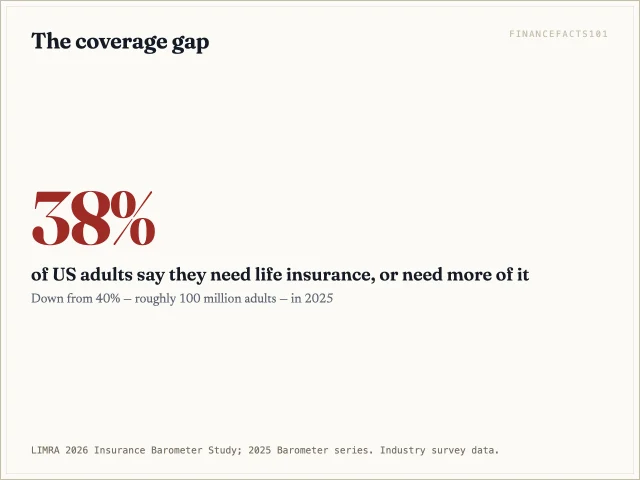
Most households have not done this math. In LIMRA's 2026 Insurance Barometer Study, 38% of US adults said they need life insurance or need more of it — down from 40%, roughly 100 million adults, in the 2025 study. The most common reason given for not buying is cost, yet LIMRA also finds about three quarters of adults overestimate the price of term coverage, younger adults by 10–12 times.
The overestimation matters because the real price is small: about $25–$40 a month buys a healthy 35-year-old a $500,000, 20-year term policy as of mid-2026. The hard part is not affording the premium. It is picking the right face amount, which is what the DIME method is for.
The DIME method: how much life insurance the worksheet says you need
DIME stands for Debt, Income, Mortgage, Education — the four piles of money your death would demand. The NAIC's Life Insurance Buyer's Guide recommends the same logic: estimate what your dependents would need, then subtract what they would have. Work it with a real family.
The assumptions. Sole earner, age 35, income $60,000. Mortgage balance $240,000. Two children, ages 8 and 10 — the youngest reaches 18 in 10 years. Non-mortgage debt (car loan plus cards) $30,000. Funeral and final expenses $10,000. College support target: $50,000 per child, roughly four years of in-state public tuition and fees.
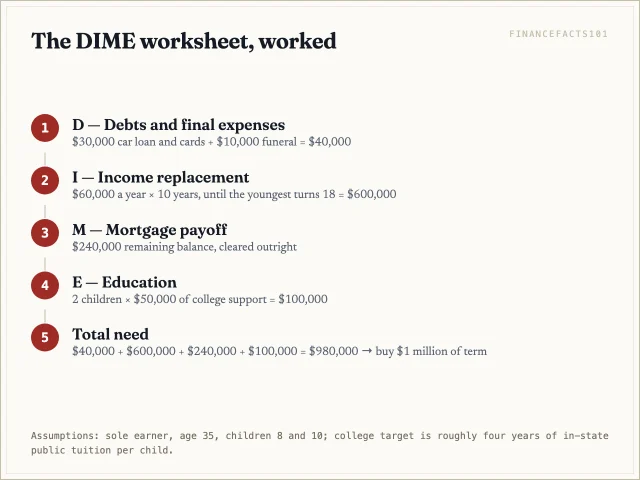
The arithmetic, line by line.
- Debt and final expenses: $30,000 + $10,000 = $40,000.
- Income: $60,000 × 10 years until the youngest turns 18 = $600,000.
- Mortgage: $240,000, paid off outright so the family's housing cost drops to taxes and insurance.
- Education: 2 × $50,000 = $100,000.
Total: $40,000 + $600,000 + $240,000 + $100,000 = $980,000. Term policies price in $250,000 bands and a $1,000,000 face amount often costs barely more than $900,000, so this family buys $1 million of 20-year term.
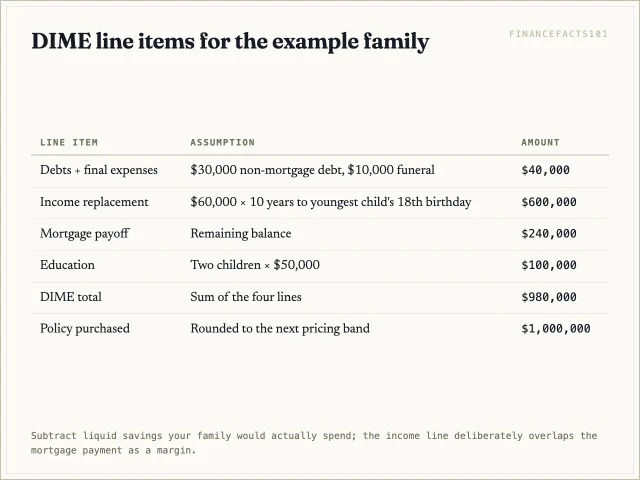
Two refinements are worth making before you shop. First, subtract liquid assets your family would actually spend — if you hold $80,000 outside retirement accounts, the need drops to $900,000. Second, note the deliberate overlap: paying off the mortgage and replacing gross income double-counts the mortgage payment inside that income. Most planners leave the overlap in as a margin for inflation and investment risk. If you strip it out, this family's need falls to about $800,000 — still far above what the shortcut below produces.
Where the 10x-income shortcut misleads
Multiply income by ten and buy that. It is fast, it is everywhere, and for the family above it produces $600,000 — 39% short of the DIME answer, because it ignores the $240,000 mortgage and the college bills entirely. The shortcut fails in a predictable direction for each household type.
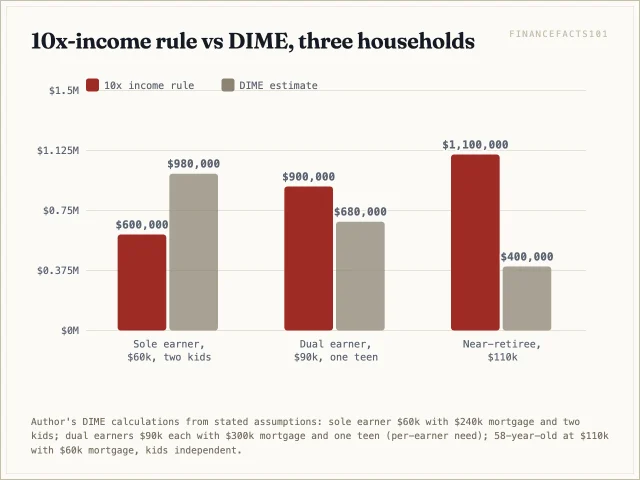
Sole earners with young kids and a mortgage: 10x runs low. Income alone is $600,000 in our example; the obligations on top push the true need near $1 million.
Dual high earners: 10x runs high. Take spouses each earning $90,000 with a $300,000 mortgage and one 14-year-old. The survivor keeps earning, so each policy only needs to cover the survivor's shortfall: call it $30,000 of debt and final costs, five years of income ($450,000), half the mortgage ($150,000) and $50,000 of college — about $680,000, not $900,000.
Near-retirees: 10x runs absurdly high. A 58-year-old earning $110,000 with a $60,000 mortgage balance and independent kids needs perhaps three years of income bridge ($330,000) plus the mortgage and final expenses — roughly $400,000 — not $1.1 million, and only until retirement assets take over.
The shortcut is a starting anchor, nothing more. Ten minutes with the DIME lines replaces it with your own number.
Social Security survivor benefits: the offset most guides skip
Your family is probably not starting from zero. If you have worked and paid FICA for long enough — as little as 1.5 years of recent work for young parents — Social Security pays survivor benefits to your children until 18 (19 if still in high school) and to a spouse caring for your child under 16. Each eligible child can receive 75% of your basic benefit amount, subject to a family maximum of roughly 150–180% of it.
The headline figure is not small. SSA's 2026 cost-of-living fact sheet puts the average benefit for a widowed parent with two children at $3,898 a month — about $46,800 a year — up from $3,792 in 2025.
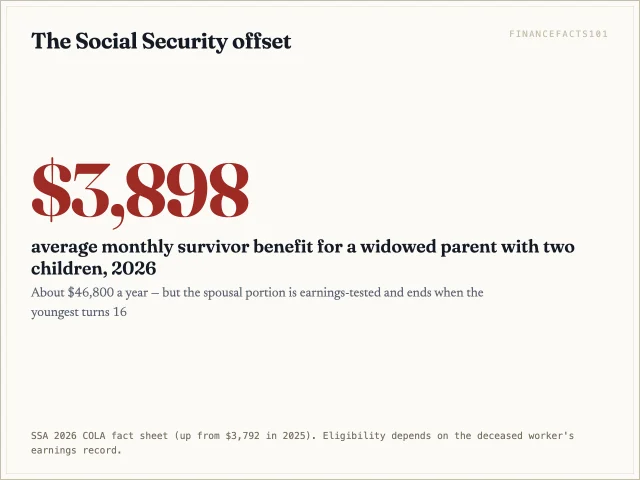
So why does almost every guide ignore it, and why should you only lean on it lightly? Three reasons. The caring-spouse benefit is reduced $1 for every $2 earned above the annual earnings limit, so a surviving parent who keeps working full-time may collect little beyond the children's checks. The benefits age out — the spousal portion ends when the youngest turns 16, each child's at 18 — while your family's expenses do not. And the family maximum caps what three beneficiaries can collect at once.
The practical use: treat survivor benefits as the reason a 10-year income multiple is enough rather than 15, not as a line-item deduction. If you want to deduct explicitly, count only the children's benefits for the years a working survivor would actually receive them, and check your own earnings record at ssa.gov before assuming eligibility.
Term vs. whole life: the price of pure protection
For the protection problem this guide sizes — replace income for a fixed number of years — term insurance is the tool, and whole life is the expensive default that agents present first because commissions on it are far higher.
The premium gap at identical coverage is not close. As of mid-2026, MoneyGeek's rate data prices a healthy 35-year-old man at about $40 a month for a $500,000, 20-year term policy versus about $545 a month for whole life with the same death benefit — roughly 13 times more. Across sources, whole-life quotes at that age and face amount cluster between $300 and $600 a month. Our term vs. whole life guide works through when permanent coverage is worth that premium and when buying term and investing the difference wins.
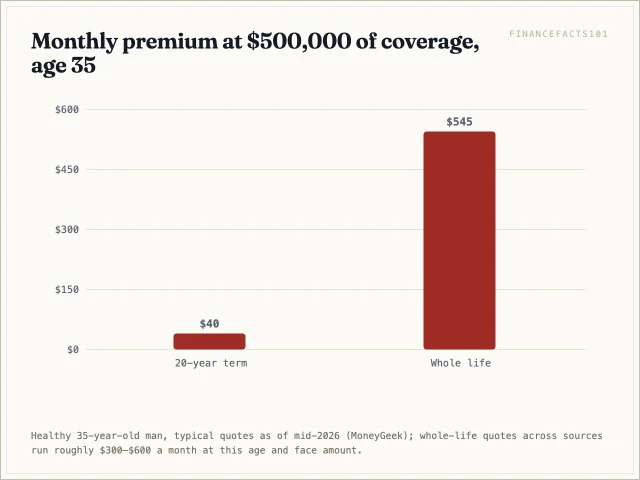
Whole life is not a scam; it is a different product solving a different problem. It lasts your entire life, builds cash value you can borrow against, and suits genuinely permanent needs — estate-tax liquidity, a lifelong dependent with a disability. But as income protection it forces a brutal trade: at $545 a month, most families buy far less coverage than they need, and industry persistency studies have long shown a substantial share of whole-life policies lapsing within the first decade — often for less cash surrender value than the premiums paid. The family in our worked example needs $1 million of protection. At term rates that is roughly $50–$60 a month at 35; at whole-life rates it is more than $1,000 a month, which is why underinsurance and whole life so often travel together.
Buy the coverage as term. If a permanent need truly exists, size it separately and small.
Matching term length to the years people actually depend on you
The term should expire when the dependence does, not on a round number. Work backward from three dates: when your youngest child turns about 22, when the mortgage is paid off, and when your retirement savings could support your spouse without your paycheck.
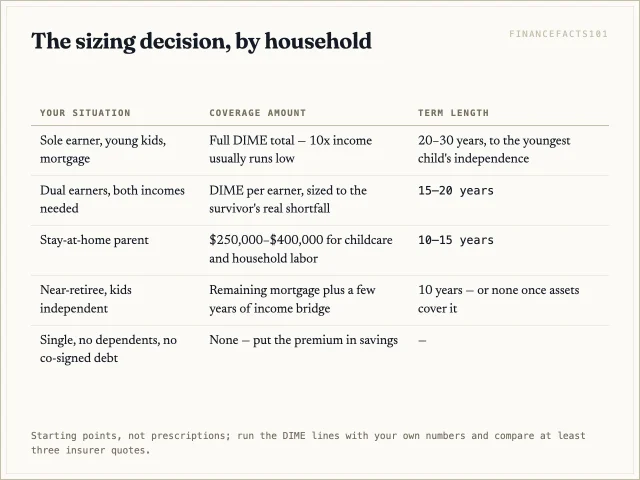
Our example family's youngest is 8, so dependence runs about 14 more years; the mortgage has perhaps 25 years left but shrinks throughout. A 20-year term covers the children fully and all but the tail of the mortgage — the right call. A 35-year-old with a newborn wants 25–30 years. A 50-year-old whose kids are in college may need only 10, bridging to the point where assets replace income.
Err one notch long, not short. Renewing or replacing coverage at the end of a too-short term means repricing at your new age and new health — the age-price curve later in this guide shows what that costs — while a too-long term merely means a few years of premiums you can stop paying, since term policies can be dropped at any time without penalty.
Laddering two policies instead of one big one
Your need is not flat across 20 years. In year one, our example family needs the full amount; by year 12 the kids are nearly grown, the mortgage is smaller, and retirement savings have compounded. Laddering matches coverage to that decline: buy two overlapping policies with different terms instead of one large one.
Say the need is $750,000 for the first decade and $500,000 after. Compare one $750,000, 20-year policy against a ladder of $500,000/20-year plus $250,000/10-year, using typical mid-2026 quotes for a healthy 35-year-old: the single policy at $42 a month costs $10,080 over 20 years; the ladder costs $44 a month for ten years ($30 + $14), then $30 for ten more — $5,280 + $3,600 = $8,880. Saving: $1,200, about 12%, for identical protection in every year.
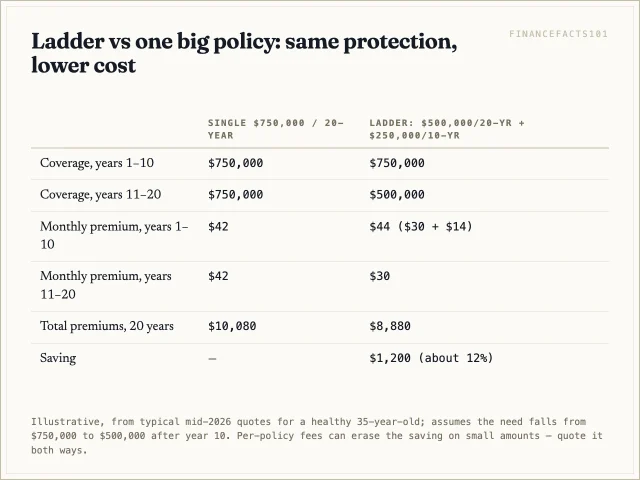
The saving grows with the gap between early and late need — a three-rung ladder on $1.5 million of peak coverage can save 25% or more — but it can also shrink to nothing on small policies, because each policy carries its own annual fee. Get quotes both ways before assuming the ladder wins. The other virtue is flexibility: each rung can be cancelled independently if your savings outrun the plan.
The payout is income-tax-free — the fact that makes sizing clean
When you size the death benefit, you do not need to gross it up for taxes. Under IRS rules, life insurance proceeds paid to a beneficiary because of the insured's death are generally not includable in gross income and are not reported on a tax return. A $1,000,000 policy delivers $1,000,000.
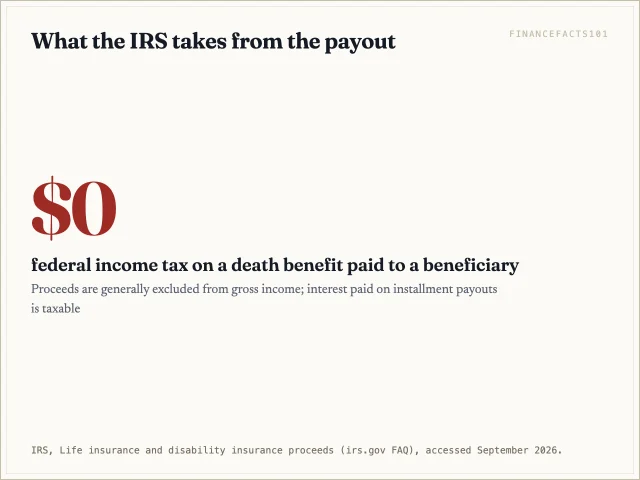
Two caveats keep "generally" in that sentence. Any interest the insurer pays on top — common when the payout is taken in installments rather than a lump sum — is taxable income. And very large estates can owe estate tax on proceeds if the deceased owned the policy; the federal exemption is high enough that this touches few families, but it is a reason the very wealthy hold policies in trusts. How the money actually reaches your family is covered in our guide to how death benefits are paid — and none of it works as intended if the beneficiary designations are stale. Name primary and contingent beneficiaries, never your own estate, and recheck after every marriage, divorce, or birth.
Employer coverage and the portability trap
The free group life insurance from work is worth taking and dangerous to rely on. Typical employer plans pay one to two times salary — $60,000–$120,000 for our example earner, against a $980,000 need — and the coverage usually ends when the job does. Lose the job at 48 with a health condition, and the individual policy you should have bought at 35 now costs multiples more, if you qualify at all. Conversion rights exist in most plans but convert you into pricey permanent coverage.
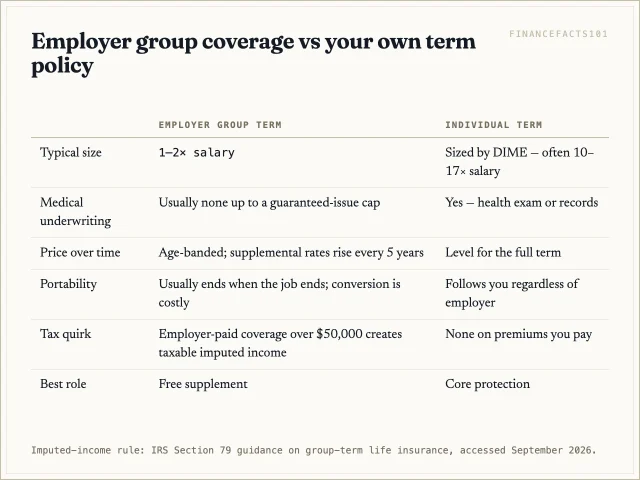
There is also a small tax wrinkle: the IRS treats employer-paid group coverage above $50,000 as imputed income, taxed for Social Security and Medicare per the IRS premium table. Supplemental group coverage you buy through payroll is usually age-banded, so the price steps up every five years while an individual term policy stays level.
The right role for group coverage: a free bonus on top of an individually owned policy that is sized by DIME and follows you between jobs. Our guide to group term life covers the mechanics.
What actually drives your premium
Three variables set most of your price: age, health class, and tobacco. Insurers price in age bands, and the curve is steep — each year of delay adds roughly 5–10% for the same policy.
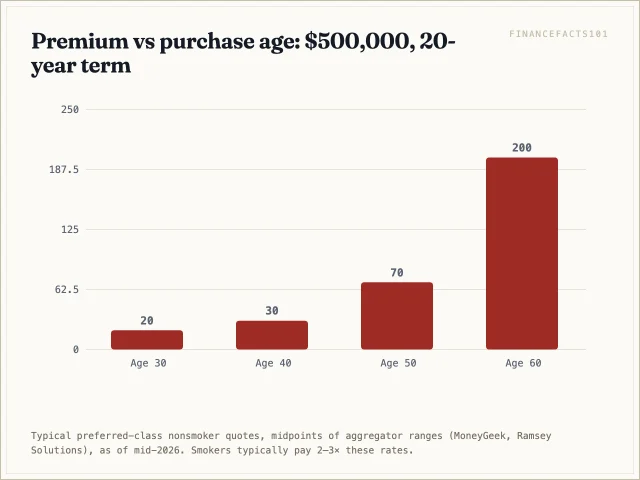
Using typical preferred-class quotes for a $500,000, 20-year term as of mid-2026: about $20 a month at age 30, $30 at 40, $70 at 50, and $200 at 60 — ten times the age-30 price. The lesson is not to panic-buy, but delay has a real cost, and you lock a level premium for the full term the day you qualify.
Health class is the second lever. The gap between the best class (preferred plus) and standard commonly runs 50% or more on the same body, which is why comparison-shopping several insurers matters — each one scores blood pressure, cholesterol, build, and family history differently. Tobacco is the bluntest lever of all: smoker rates typically run two to three times nonsmoker rates, and most insurers re-class you as a nonsmoker only after 12 months clean, some after 24. If health problems have made you decline-prone, see our guide to guaranteed-issue life insurance — small, expensive, no-questions coverage that is a last resort, not a substitute for term.
When coverage should shrink — and when it should end
A well-sized policy is designed to become unnecessary. Every year, the mortgage balance falls, the kids get closer to independence, and your retirement accounts grow; the DIME total quietly declines toward zero. That is the plan working.
Recompute the worksheet every few years and after every big event — a child born, a house refinanced, a spouse's income doubling. If the need has clearly dropped below the coverage, you can cancel a ladder rung or simply let the term run out. If it has risen — another child, a bigger mortgage — buy a second small policy rather than replacing the first, so you keep the old, cheaper age band on the original coverage. Coverage should generally end when you reach the point of self-insurance: assets large enough that your death would be a grief, not a financial event.
Common sizing mistakes
- Insuring only the breadwinner. A stay-at-home parent's death forces the survivor to buy childcare, transport, and household labor — commonly estimated at $200,000+ over a decade. A $250,000–$400,000 term policy on the at-home parent is cheap and routinely skipped.
- Rounding down to lower the premium. Cutting from $1,000,000 to $500,000 saves perhaps $25 a month at 35 and halves the protection. The premium is the cheap part.
- Buying whole life for a 20-year problem, then lapsing it in year eight with little to show.
- Counting employer coverage as permanent. It is tied to the job, not to you.
- Letting the beneficiary form rot. Ex-spouses collect legally when forms go unupdated.
- Waiting for perfect health. The age band costs more each birthday; buy insurable, improve later, and ask for a re-rate.
The decision framework
Pull it together in three steps. First, decide whether anyone depends on your income; if not, buy nothing. Second, run the four DIME lines with your own numbers, subtract liquid savings, and lean on Social Security survivor benefits only as margin. Third, buy level term for the years of dependence — laddered if your need clearly steps down — from a highly rated insurer after comparing at least three quotes.
The whole exercise takes an evening, and the difference between a guessed number and a computed one — $600,000 versus $980,000 for the family in this guide — is the difference between a survivor who grieves and one who grieves while selling the house. State insurance departments and the NAIC's consumer pages offer free help checking an insurer's licensing and complaint record before you sign.
FAQ
Is 10x my income ever the right answer?
Sometimes, by coincidence. It lands near the DIME result for a sole earner with a modest mortgage and school-age kids. It runs badly low when a large mortgage and college costs sit on top of a middle income, and badly high for dual high earners and near-retirees. Since the DIME worksheet takes ten minutes, there is no reason to trust the coincidence.
Should I buy 20-year or 30-year term?
Match the term to your youngest dependent and your mortgage. A rough rule: youngest child's age subtracted from 22, rounded up to the next term length insurers sell (10, 15, 20, 25, 30). A 30-year term on a 35-year-old typically costs 30–50% more per month than a 20-year, so if only a small tail of need extends past year 20, a ladder usually beats stretching the whole amount to 30 years.
Does my family pay tax on the payout?
Generally no. The IRS excludes death benefits paid to a beneficiary from gross income, so a $1,000,000 policy delivers the full $1,000,000. Interest paid on delayed or installment payouts is taxable, and estate tax can apply to very large estates when the deceased owned the policy.
What if I cannot afford the full DIME amount?
Buy the largest term policy you can sustain — never a smaller whole-life policy at the same premium. At mid-2026 rates, a healthy 35-year-old's dollar buys roughly 13 times more term coverage than whole-life coverage. Partial protection at $500,000 is enormously better than none, and you can add a second policy later when income rises.
Do I need life insurance if my employer gives me 2x salary free?
Take the free coverage, but treat it as a supplement. Two times salary is a fraction of a DIME-computed need for most parents, it usually vanishes when you change jobs, and employer coverage above $50,000 generates small amounts of taxable imputed income. The core of your protection should be an individual policy you own.
Sources
- IRS — Life insurance and disability insurance proceeds (accessed September 2026)
- IRS — Group-term life insurance and the $50,000 exclusion (accessed September 2026)
- Social Security Administration — Survivor benefits (accessed September 2026)
- Social Security Administration — 2026 COLA fact sheet (average widowed parent + two children benefit, 2026)
- NAIC — Life Insurance Buyer's Guide and consumer life insurance pages
- LIMRA — 2026 Insurance Barometer Study and 2025 Barometer series (need-gap and cost-perception data)
- MoneyGeek — term vs. whole life rates, $500,000 policy rates, and rates by age (2026 quote data)
- Guardian — term life rates; Ramsey Solutions — 2026 term life rate chart (corroborating quote data)
 Next entry · No. 5,936Debt Avalanche vs Snowball: Which Pays Off Faster
See also
-
 No. 3,378
23 Mar 2025
17 min
The Needs Approach to Life Insurance Planning: A Comprehensive Guide
Insurance
-
 No. 2,873
10 Feb 2025
21 min
A Comprehensive Guide to Understanding Different Types of Life Insurance: Term vs. Permanent
Insurance
-
 No. 5,991
25 Oct 2026
16 min
How Much Umbrella Insurance Do I Need? The Exposure Math
Insurance
-
 No. 5,425
07 Sep 2025
19 min
Understanding Vanishing Premiums: The Controversial Side of Life Insurance
Insurance
-
 No. 2,832
07 Feb 2025
20 min
Understanding Level Death Benefits: Fixed Insurance Payouts and Their Implications
Insurance
-
 No. 2,254
22 Dec 2024
19 min
The Human-Life Approach to Life Insurance: Calculating the Economic Value of a Life
Insurance