Term vs Whole Life Insurance: Which Is Better for Me?

A healthy 35-year-old pays about $40 a month for $500,000 of term vs $545 for whole life (Sept 2026). Invest the gap at 3.9% or more and term leads at year 20.
For most people asking term vs whole life insurance, term is the better buy: as of September 2026 a healthy 35-year-old man pays an average of about $40 a month for $500,000 of 20-year term coverage against $545 a month for whole life with the same death benefit, according to MoneyGeek's quote averages. Whole life earns that 13-fold price only when the need is genuinely permanent — estate liquidity, a dependant who will never support themselves, an obligation with no end date — because as a savings vehicle it has to beat a simple rule: in the worked example below, investing the $505 monthly difference at about 3.9% a year or better leaves you ahead after 20 years.
Below: what whole-life cash value is worth in years 1 to 20, "buy term and invest the difference" with stated returns, and what sales illustrations skip — surrender values, policy loans, the modified endowment contract rule and state guaranty limits. How large a death benefit you need is covered in our guide to how much life insurance you need; here the face amount is fixed at $500,000.
One line of scope honesty: this is general information built on stated assumptions, published quote averages and one published illustration, not personal advice. Your age, health class, state and insurer will move every number.
Term vs whole life insurance: how each contract works
Term insurance is a rental. You pay a level premium for a fixed period — 10, 20 or 30 years is common — and if you die inside that window the insurer pays the face amount. If you outlive it, the policy ends and nothing comes back. The California Department of Insurance puts it without softening: "If you live beyond the term period you had selected, no benefit is payable."
Whole life is a purchase. The premium stays level for life, the death benefit is guaranteed while premiums are paid, and the policy builds a cash value you can borrow against or take by surrendering. The level premium is the trick: mortality costs rise as you age, so a flat premium must overcharge early and undercharge late. California's regulator describes it: "To keep the premium level, the premium at the younger ages exceed the actual cost of protection. This extra premium builds a reserve (cash value) which helps pay for the policy in later years ..."
The state regulators' NAIC Life Insurance Buyer's Guide frames the choice in two sentences: "Term insurance is intended to provide lower cost coverage for a specific period of time" and "If you want coverage for a longer period of time, such as for your lifetime, cash value insurance may be more cost effective." The question is which period you actually need covered.
Who this is for — and who it is not for
This guide is for a US adult who has decided they need life insurance and is being offered a choice between term and a permanent policy, usually whole life. It assumes you are insurable at standard or better rates and that your budget is finite, so every dollar of whole-life premium is a dollar not spent on coverage or on savings elsewhere.
It is not a sizing guide; if nobody depends on your income you may need no policy at all. It does not cover universal, indexed or variable life, which share whole life's cash-value logic with more moving parts. And if you have paid into a whole-life policy for a decade, keeping it is a different calculation from buying one, covered near the end.
The premium gap for the same $500,000 death benefit
Start with price. MoneyGeek's table, updated September 14, 2026, averages quotes from multiple carriers for $500,000 of coverage for nonsmokers in average health: 20-year level term against traditional level-premium whole life.
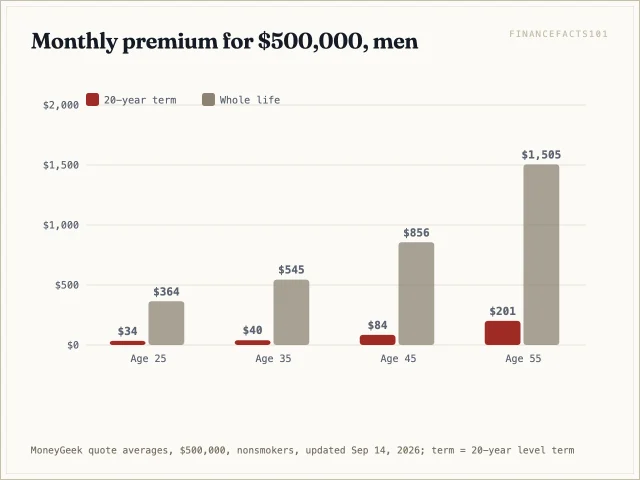
At 35 the man's gap is $505 a month, $6,060 a year. At 25 it is $330; at 55 it is $1,304. Measured as a multiple the picture is starker: whole life costs 13.6 times as much as term at 35, and about 10 to 11 times at 25 and 45.
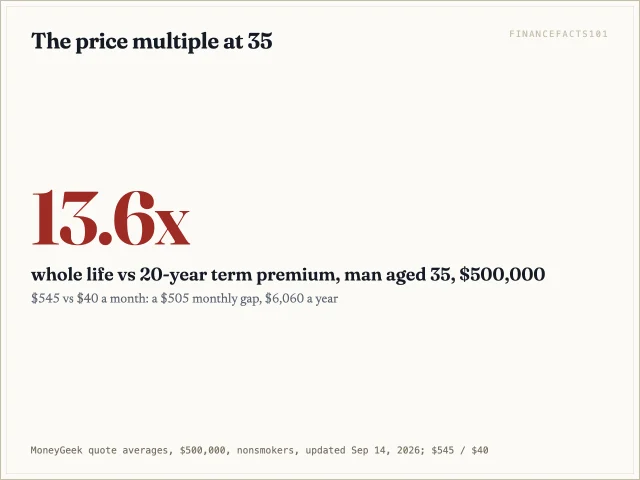
That multiple is not simply an overcharge. Most of the whole-life premium prefunds coverage at ages 70, 80 and 90 and builds cash value. The honest comparison is "$40 for 20 years of protection versus $545 for lifetime protection plus a savings account." The rest of this guide prices the savings account.
Where the whole-life premium goes: cash value and its costs
Each whole-life premium pays for the death benefit, the insurer's expenses and commissions, and the reserve that becomes your cash value. The split is not level over time, which is why the NAIC buyer's guide warns that "In some cash value policies, the values are low in the early years but build later on."
To see how low, you need a real illustration. One firm that sells whole life, Insurance & Estates, publishes a full year-by-year illustration (updated April 30, 2026) for a 36-year-old man paying $12,000 a year into a traditional "all base" policy designed for maximum death benefit. The carrier is not named, and the page does not separate guaranteed from non-guaranteed values, so read it as one example, not an industry average. The page attributes the zero first-year value to premium going to "death benefit, insurer costs, and commissions."
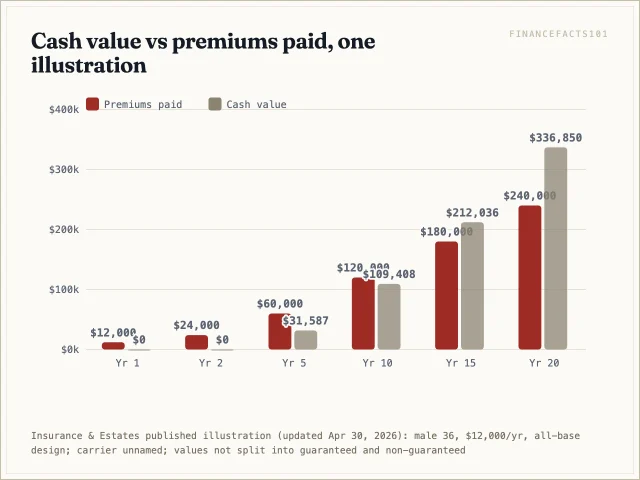
After two years and $24,000 of premiums, the cash value is $0. After five years and $60,000, it is $31,587 — 53 cents per premium dollar. The cash value does not overtake the premiums paid into it until year 12. By year 20, $240,000 of premiums has become $336,850 of cash value.
As an annual return, treating each premium as paid at the start of its policy year:
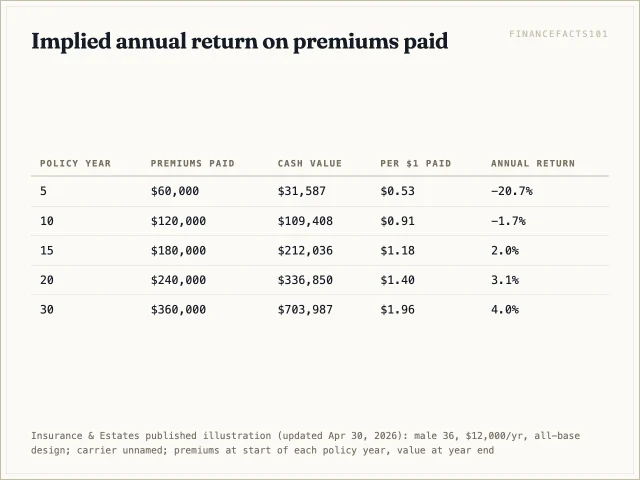
The implied return on premiums paid is negative through year 11, about 3.1% a year at year 20 and 4.0% at year 30. Those figures are the return on the whole premium, which also bought a death benefit the whole time — so they understate the policy's value to someone who needed the coverage, and overstate it to someone who did not. They probably include non-guaranteed dividends, which the insurer is not obliged to pay (the page does not split the two); the NAIC guide lists "What part of the premium or policy value isn't guaranteed?" among the questions you should be able to answer when you read the policy.
Surrender charges and the early-years cash value trap
The most expensive way to own whole life is to buy it and drop it. In whole life the exit cost mostly shows up as the low early cash values you just saw rather than as a separate fee. Guardian's explainer draws the distinction for its own policies: whole-life surrender value is the guaranteed cash value plus accumulated dividends, while universal life deducts surrender charges, which after 10 to 15 years "typically go away." California's regulator is blunter: "It is not a good idea to buy a cash value life insurance policy if you plan to surrender early due to substantial surrender penalties."
Apply that to the 35-year-old paying $545 a month, with one stated assumption: his policy builds cash value at the illustration's ratio to premiums paid — zero through year 2, 53% at year 5, 91% at year 10, 140% at year 20. The alternative is $40-a-month term with the $505 difference invested at 5.5%, compounded monthly.
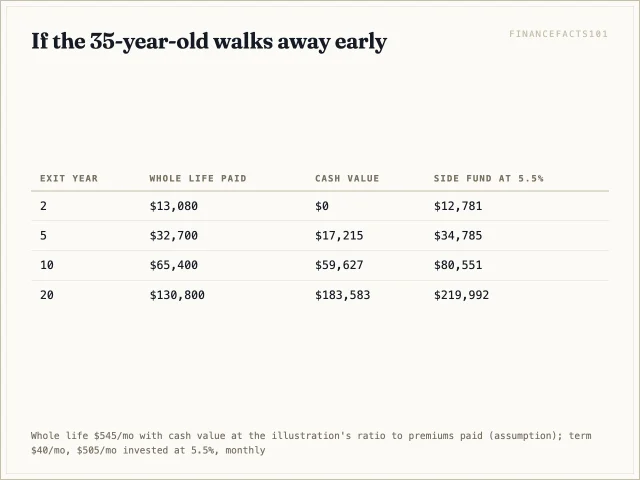
Walk away in year 2 and he has paid $13,080 for coverage $960 of term would have bought, with nothing back. Walk away in year 10 and he recovers $59,600 of $65,400 paid, while the side fund holds about $80,600.
A surrender at a gain is taxed. Under IRS Publication 525, "If you surrender a life insurance policy for cash, you must include in income any proceeds that are more than the cost of the life insurance policy," with cost generally meaning premiums paid less refunds, dividends and unrepaid loans that were not taxed. At year 20 in our example that is roughly $183,600 minus $130,800: about $52,800 of ordinary income.
Buy term and invest the difference: the worked comparison
"Buy term and invest the difference" is only as good as its inputs. Here they are.
The buyer. A 35-year-old man, nonsmoker, average health, needing $500,000 of coverage.
Path A — whole life. $545 a month, level for life. Cash value follows the published illustration's ratios, as above.
Path B — term plus investing. $40 a month for 20-year term. The $505 difference, $6,060 a year, is invested at the end of each month at a constant annual return, compounded monthly — the same method as our compound interest calculator. Three return assumptions: 4.0% (a cautious bond-like return), 5.5% (close to the 20-year Treasury yield of 5.54% on September 25, 2026), and 7.0% (a stock-heavy portfolio's long-run hope, not a promise).
Taxes. $6,060 a year fits inside the 2026 IRA limit of $7,500, so a buyer under the Roth income limits can shelter the side fund in a Roth IRA if they are not already using their IRA allowance, where qualified withdrawals are tax-free — roughly matching the tax-deferred, loan-accessible growth inside the policy.
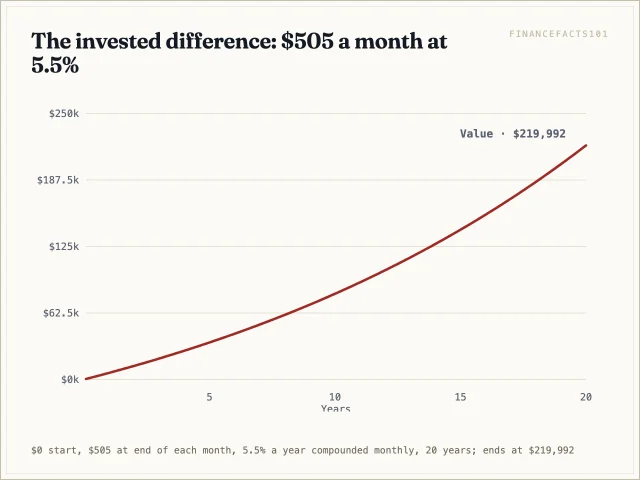
At 5.5%, $121,200 of contributions grows to $219,992 after 20 years. You can reproduce that figure in the calculator with these inputs preloaded: $0 starting balance, $505 a month, 5.5%, 20 years, monthly compounding.
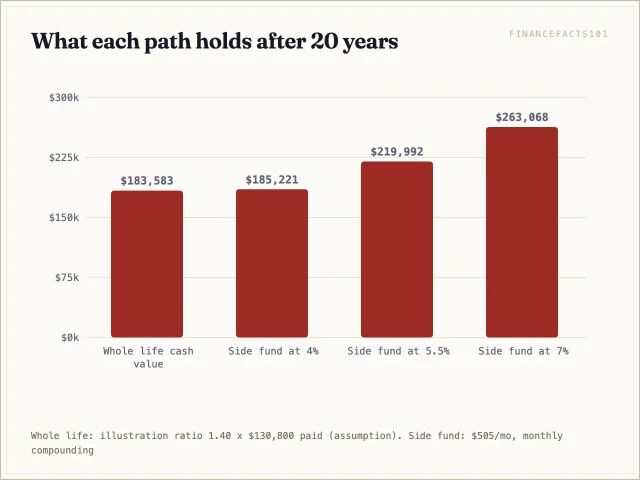
Against a whole-life cash value of about $183,600 at year 20, the side fund wins at 5.5% by roughly $36,400 and at 7% by about $79,500. At 4% it is a tie within $1,700. Solve for the crossover and the break-even return is about 3.9% a year: any steady return above that and Path B holds more money at year 20.
What the return comparison leaves out
The year-20 snapshot flatters term in one way: at 55, Path B's coverage ends. If the buyer still needs a death benefit — a late child, a spouse without savings, a business debt — he must buy it at 55, when new 20-year term averages $201 a month in MoneyGeek's table, and only if his health still qualifies. Path A's $500,000 is still in force with no new medical exam.
Stretch the comparison to 30 years at equal outlay: Path A keeps paying $545; Path B, with no premium after year 20, invests the full $545 for ten more years.
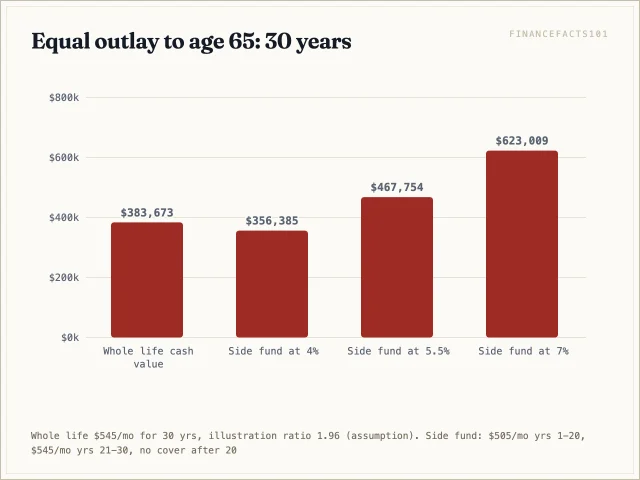
At 65 the whole-life cash value reaches about $383,700 with a death benefit still attached. The side fund holds about $356,400 at 4%, $467,800 at 5.5% and $623,000 at 7%, with no insurance for the last ten years; the break-even return rises to about 4.4%. If you will not need coverage after the term, Path B is simply more money. If you might, the gap is the price of that option.
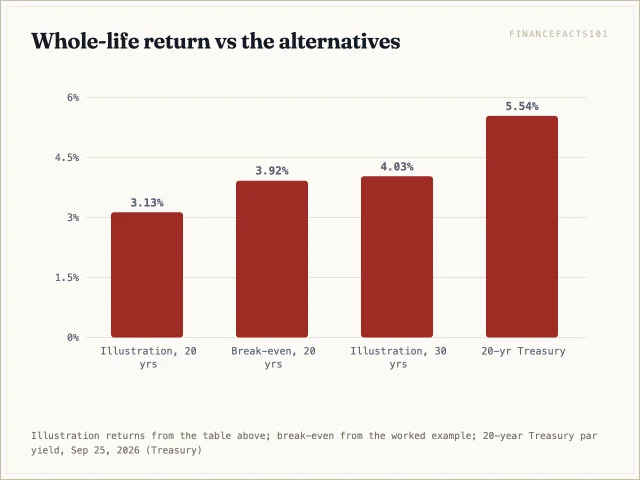
Two more cautions pull in opposite directions. The side fund exists only if you really invest $505 every month for 20 years; for people who would spend the difference, whole life's forced saving is a real benefit. And the whole-life numbers are an illustration, not a contract, and most likely assume the current dividend scale continues. A 20-year Treasury bought at 5.54% and held to maturity pays that rate with US government backing; a dividend scale carries no such promise.
When permanent coverage genuinely fits
Whole life is the right tool when the need does not expire. Three cases qualify on the numbers.
Estate liquidity. The federal estate tax applies only when an estate, plus lifetime taxable gifts, exceeds the basic exclusion amount of $15,000,000 per person for 2026, with a top rate of 40% under IRC section 2001. Above that line, an estate heavy in a family business, farm or real estate may need cash quickly to avoid a forced sale. Because the death benefit counts in your gross estate if you held "incidents of ownership" under section 2042, these policies are usually owned by an irrevocable trust. Some states levy their own estate taxes with lower exemptions.
A dependant who will never be self-supporting. If your child has a disability and will rely on Supplemental Security Income and Medicaid, your death at 80 costs them as much as your death at 45. Term coverage bought at 35 expires while the need continues, and new term at 70 averages $1,132 a month for a man in MoneyGeek's table. The death benefit also has to be routed with care: under SSI rules, the countable resource limit for an individual has been $2,000 since 1989, and money received in a month counts as income that month and as a resource if kept into the next. Families typically name a special needs trust, drafted by an attorney, as beneficiary rather than the child.
Other lifelong obligations. A buy-sell agreement between business partners with no end date, or a spouse who would lose income from a single-life pension, are needs that last as long as you do.
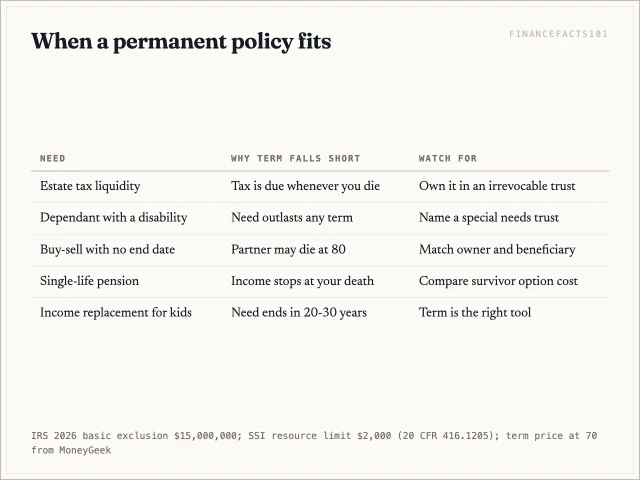
Even here, whole life competes with guaranteed universal life, which strips out most of the cash value to deliver lifetime coverage for less. If the need is permanent but the savings goal is not, ask for both illustrations.
Policy loans: borrowing against your own cash value
Whole-life owners can borrow against the cash value without a credit check or repayment schedule. It is not free money: interest accrues, and California's regulator notes in its glossary that the face amount "will be reduced by any unpaid policy loans and interest on those loans." A loan left to compound can eventually consume the cash value and lapse the policy.
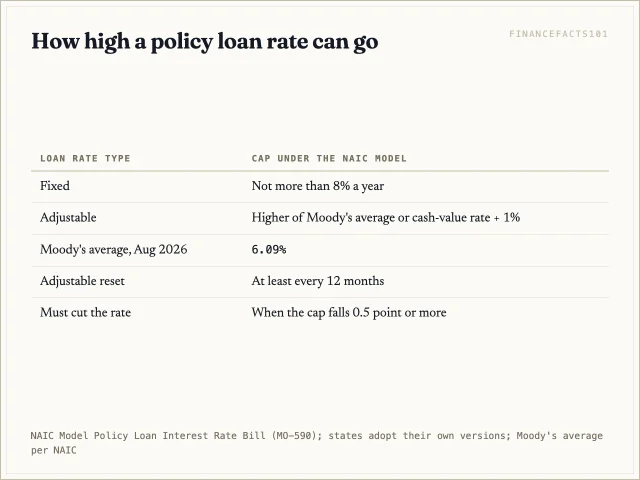
How high can the rate go? The NAIC's Model Policy Loan Interest Rate Bill allows either a fixed maximum of "not more than eight percent (8%) per annum" or an adjustable rate capped at the higher of Moody's monthly corporate bond yield average for the month ending two months earlier or the policy's cash-value interest rate plus one point; states adopt their own versions. The NAIC's posted Moody's average was 6.09% for August 2026.
The tax treatment is the quiet risk. For a policy that is not a modified endowment contract, IRC section 72(e) does not treat a loan as a distribution, so borrowing is not taxed while the policy stays in force. If the policy lapses or is surrendered with a loan outstanding, the loan counts toward what you received; Guardian's disclosure warns that such loans "may be subject to ordinary income taxes." That can produce a tax bill with no cash to pay it.
The MEC line: IRC section 7702A and the 7-pay test
The loan and withdrawal perks above depend on the policy not being a modified endowment contract. Section 7702A defines one as a contract entered into on or after June 21, 1988 that fails the "7-pay test", which happens if "the accumulated amount paid under the contract at any time during the 1st 7 contract years exceeds the sum of the net level premiums which would have been paid on or before such time if the contract provided for paid-up future benefits after the payment of 7 level annual premiums." In plain terms: fund the policy faster than seven level annual payments would pay it up, and it becomes a MEC.
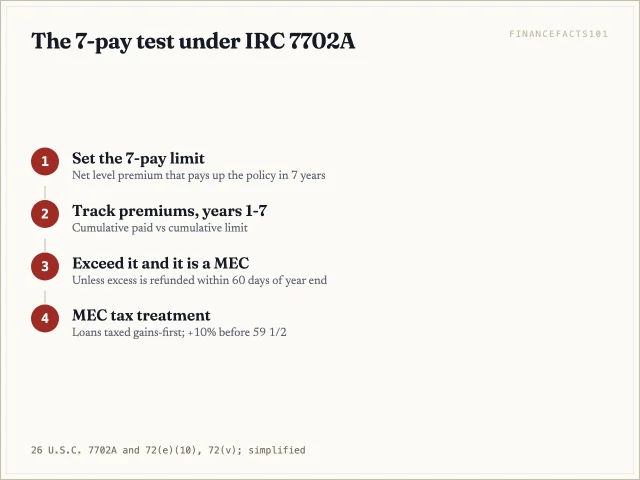
The consequences sit in section 72: MEC loans and withdrawals are taxed gains-first under section 72(e)(10), and the taxable part carries a 10% additional tax under section 72(v) unless you are 59½ or older, disabled, or taking substantially equal periodic payments. A policy received in exchange for a MEC is also a MEC. A "material change," such as a death benefit increase, restarts the test, and a benefit cut within the first seven years re-runs it at the lower level. The death benefit stays income-tax-free either way; per the IRS, death proceeds generally "aren't includable in gross income."
A standard whole-life policy paid on schedule is designed to pass. The risk comes from overfunding — large paid-up-addition riders, lump sums, or a face-amount cut in the early years — and the statute offers a fix: excess premium returned with interest within 60 days after the contract year ends does not count. Our entry on modified endowment contracts has more.
If the insurer fails: state guaranty association limits
A whole-life policy is a promise running 50 years or more, so the insurer's solvency matters more than for a 20-year term policy, and there is no FDIC for life insurance. Each state has a guaranty association funded by assessments on insurers, and NOLHGA, their national organization, publishes a state-by-state table: most states cover $300,000 of death benefit and $100,000 of cash surrender value, and a few go higher, such as $500,000 for both in Connecticut and New York. Protection generally comes from the association in your state of residence when the insurer is ordered into liquidation.
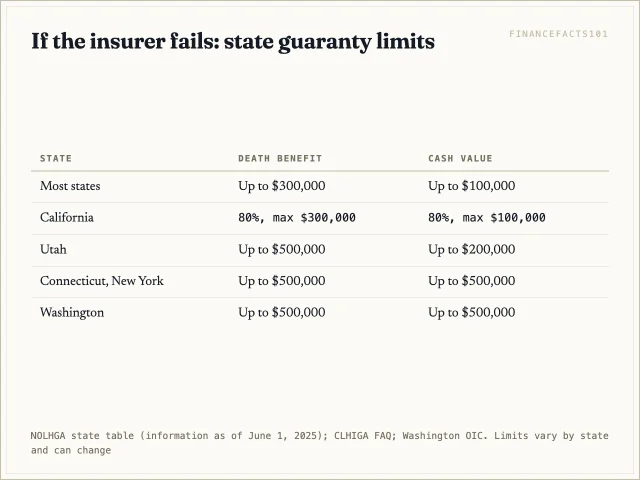
California protects only 80%: CLHIGA covers "80% of the policy death benefit up to a maximum of $300,000" and 80% of cash values up to $100,000, so a $300,000 policy is protected up to $240,000. Washington's insurance commissioner lists life coverage "up to the policy limit, or up to $500,000, whichever is lower." A whole-life owner in California with $250,000 of cash value is covered for $100,000 of it. For large cash values, check the insurer's financial strength and consider splitting coverage between insurers.
Middle paths, and what to do if you already own whole life
California's guide notes that "Some term insurance can be converted to cash value insurance up to a specified age with no physical examination," at a higher premium. Convertible term at 35 keeps the permanent option open at today's health rating while you pay term prices; check the conversion deadline, which can end before the term does.
Just bought whole life and having second thoughts? Use the free-look window: the NAIC guide says you can return a new policy "for a full refund within a certain period, usually 10 days after you receive it," and California sets 10 to 30 days, or at least 30 for seniors.
If you have held a policy for years, the early costs are already sunk; in the illustration above, the cash value roughly triples between years 10 and 20 on $120,000 of further premiums, a far better run than the first decade. Get an in-force illustration before cancelling. IRC section 1035 lets you exchange one life policy for another, or for an annuity, without recognising the gain. The NAIC's advice is short: "Don't cancel your current policy until you get the new one." Our entry on cash surrender value explains how that figure is calculated.
The decision framework
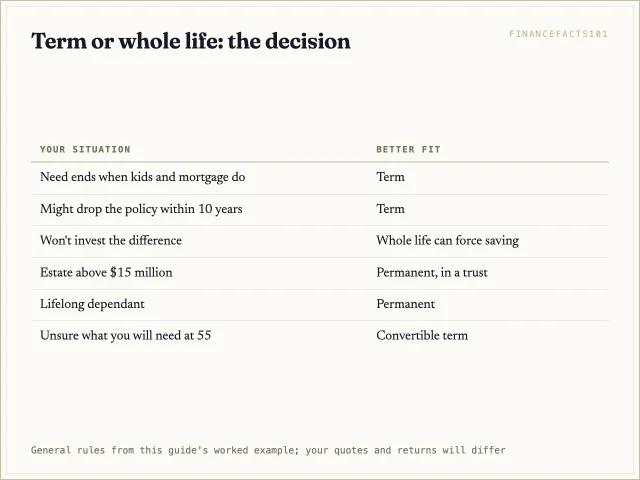
The rule is short. Buy term, sized to your obligations and timed to expire with them, if your need ends within about 30 years, as it does for most parents and mortgage holders. Invest the difference where it will stay invested, ideally inside a Roth IRA or a workplace plan with a 2026 deferral limit of $24,500; if you are choosing between index funds and ETFs for that money, see our comparison. Consider whole life when the need is permanent, when you have already filled your tax-advantaged accounts, and when you are certain you can pay the premium for at least 15 to 20 years. If you cannot say yes to that last condition, the early-years table is the reason not to start.
FAQ
Is whole life insurance ever a good investment?
As a pure investment, rarely. The published illustration in this guide returns about 3.1% a year on premiums after 20 years and 4.0% after 30, below the 5.54% a 20-year Treasury paid on September 25, 2026. It makes sense as insurance with a savings side for permanent needs, or as a tax-deferred, bond-like holding for high earners who have already filled their 401(k) and IRA.
What happens to my term premiums if I outlive the policy?
Nothing comes back; the premiums paid for protection you did not use, like home insurance on a house that did not burn. Return-of-premium term refunds premiums at the end in exchange for a higher premium, effectively a zero-interest savings plan attached to the policy.
Is a policy loan taxable?
Not while a non-MEC policy stays in force. It can become taxable if the policy lapses or is surrendered with the loan outstanding; in a MEC, loans are taxed gains-first, with a possible 10% additional tax before 59½.
Sources
- NAIC — Life Insurance Buyer's Guide (2026 edition; term vs cash value, early-year values, free look, replacement)
- NAIC — Model Policy Loan Interest Rate Bill and recent Moody's corporate average yields (6.09% for August 2026)
- California Department of Insurance — Life Insurance Guide (whole life reserve, surrender penalties, conversion, free look, loan glossary)
- California Life & Health Insurance Guarantee Association — FAQ (80% up to $300,000 death benefit, $100,000 cash value)
- Washington Office of the Insurance Commissioner — What's a guaranty association
- NOLHGA — How you're protected (state coverage limits)
- US Code via GovInfo — 26 U.S.C. 7702A, 26 U.S.C. 72, 26 U.S.C. 1035, 26 U.S.C. 2001, 26 U.S.C. 2042
- IRS — Publication 525 (surrender of a policy for cash), life insurance proceeds FAQ, What's new — estate and gift tax ($15,000,000 for 2026), IRA contribution limits and 401(k) limits for 2026
- US Treasury — Daily Treasury par yield curve rates, September 2026 (20-year at 5.54% on September 25)
- eCFR — 20 CFR 416.1205 and 20 CFR 416.1207 (SSI resource limit and counting rules)
- MoneyGeek — Term vs whole life rates (quote averages, updated September 14, 2026)
- Insurance & Estates — Whole life cash value chart (published illustration, updated April 30, 2026)
- Guardian Life — Cash surrender value of life insurance
 Next entry · No. 5,973How Much Do I Need to Retire? Spending, Social Security and the 4% Rule
See also
-
 No. 631
11 May 2024
20 min
Understanding Cash Value Life Insurance: Pros, Cons, and How It Works
Insurance
No. 631
11 May 2024
20 min
Understanding Cash Value Life Insurance: Pros, Cons, and How It Works
Insurance -
 No. 5,707
01 Oct 2025
21 min
Understanding Whole Life Insurance: A Comprehensive Guide for Institutional Investors
Insurance
No. 5,707
01 Oct 2025
21 min
Understanding Whole Life Insurance: A Comprehensive Guide for Institutional Investors
Insurance -
 No. 3,225
11 Mar 2025
18 min
Understanding Modified Endowment Contracts (MEC) and Their Tax Implications
Finance Policy
No. 3,225
11 Mar 2025
18 min
Understanding Modified Endowment Contracts (MEC) and Their Tax Implications
Finance Policy -
 No. 5,935
07 Sep 2026
16 min
How Much Life Insurance You Actually Need
Insurance
No. 5,935
07 Sep 2026
16 min
How Much Life Insurance You Actually Need
Insurance -
 No. 5,804
08 Oct 2025
18 min
Understanding Worldwide Coverage: A Comprehensive Guide for Global Insurance
Insurance
No. 5,804
08 Oct 2025
18 min
Understanding Worldwide Coverage: A Comprehensive Guide for Global Insurance
Insurance -
 No. 5,653
26 Sep 2025
18 min
Understanding Wear and Tear Exclusions in Insurance Policies: What They Are and Why They Matter
Insurance
No. 5,653
26 Sep 2025
18 min
Understanding Wear and Tear Exclusions in Insurance Policies: What They Are and Why They Matter
Insurance