Index Funds vs ETFs: Fees, Taxes, and Which to Pick

In 2025, 72% of US equity mutual funds paid out capital gains; 6% of ETFs did. In an IRA that edge is worth $0. On fees the gap is 0.015% vs 0.03%.
You have already picked the index — the S&P 500 or the total US market — and one question is left: hold it as an index mutual fund or as an ETF. That is the index funds vs ETFs decision, and for a US retail investor it comes down to three things: a few hundredths of a percent in fees, a tax mechanism that matters only in a taxable account, and the mechanics of how you actually buy every month.
This guide is general information built on stated assumptions — expense ratios from 2026 prospectuses, a hypothetical 7% return, current federal tax rules — not personal investment or tax advice.
What is identical: the index, the return, the risk
An S&P 500 index mutual fund and an S&P 500 ETF own the same roughly 500 stocks in the same weights. When the index returns 25%, both return 25% minus a few basis points of cost; when the index fell more than 18% in 2022, both fell right along with it. Nothing about the wrapper changes market risk, diversification, or the long-run return of the stocks inside.
That is what makes this decision unusual: it is purely structural. You are not choosing an investment — you already did that when you chose passive indexing over active management. You are choosing a legal and operational wrapper, and the differences between the wrappers are measured in hundredths of a percent and in taxes. Small stakes per year, but compounded over 30 years they are worth real money — the worked example below puts the range at $3,598 to $83,026 on the same contributions.
Who this is for — and who it is not for
This is for a US retail investor putting money into broad passive index exposure through an account where both vehicles are actually available — a taxable brokerage account, a traditional or Roth IRA, or an HSA with a brokerage window.
It is not for three groups. If your money is in a 401(k), the plan menu decides for you — most menus carry index mutual funds only, and as the taxable-vs-IRA section shows, that costs you nothing. If you want to trade intraday — options, stop orders, tactical entries — you need an ETF by definition, and the passive framing here is not your framing. And if you are still deciding which index to own, settle that first; the wrapper question is downstream of the allocation question.
Index funds vs ETFs on fees: the named funds
Here is the flagship S&P 500 lineup, with expense ratios taken from each fund's current prospectus filed with the SEC (mutual funds and ETFs must publish these in a standardized fee table):

Two things stand out. First, everything except SPY costs 0.04% or less a year — these are the cheapest pooled investments ever offered to the public. Second, the cheapest vehicles on the list are the mutual funds: Fidelity's FXAIX charges 0.015% and Schwab's SWPPX 0.02%, both below VOO's 0.03%. The old rule of thumb that "ETFs are cheaper" is dead at the index end of the market. If fees are your reason for choosing a side, the honest answer is that there is no side to choose — the gap between 0.015% and 0.03% is $1.50 a year per $10,000 invested.

SPY is the exception worth understanding: at 0.0945% (as of August 31, 2026, per State Street) it costs roughly three times VOO or IVV for the same index. It persists because it is the oldest and most heavily traded ETF in the world — valuable to institutions trading blocks by the second, irrelevant to a monthly buyer. A long-term investor has no reason to pay SPY's premium. For how to read these numbers on any fund, see what an expense ratio actually measures, and check any specific fund with FINRA's Fund Analyzer.
The 30-year worked example: $500 a month at three fee levels
Name the assumptions: you invest $500 a month for 30 years — $180,000 of contributions — the market compounds at a nominal 7% a year (compounded monthly), and the fund's expense ratio is the only cost. With no fee at all, that grows to $609,985. Now run the same contributions through three real fee levels: 0.03% (VOO or IVV), 0.15% (a typical mid-cost index fund), and 0.75% (a garden-variety active fund).

At 0.03%, the fee costs you $3,598 over 30 years — you end with $606,387. Real money, but two weeks of contributions across three decades.
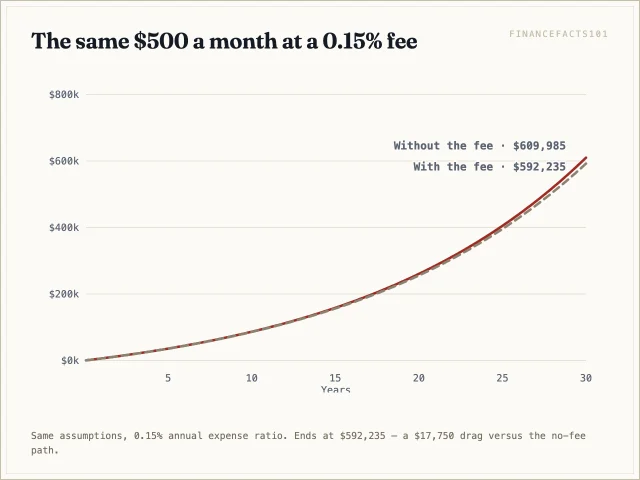
At 0.15%, the drag is $17,750 and you end with $592,235. Five times the fee, five times the damage — the arithmetic is nearly linear at these levels.

At 0.75%, the drag is $83,026 and you end with $526,960. Check one step yourself: 0.75% of a mid-period balance around $300,000 is $2,250 in a single year — run that against a growing balance for three decades and $83,026 stops being surprising.

The gap between the cheapest index vehicle and the 0.75% fund is $79,427 — 44% of everything you contributed. The gap between the cheapest and the second-cheapest index vehicle is about $14,000, and between 0.015% and 0.03% it would be under $2,000. The lesson has an edge on both sides: getting out of high-fee funds is the highest-value move in investing, and agonizing between two funds that both charge under 0.05% is a waste of an evening.
Trading mechanics: intraday price vs once-a-day NAV
A mutual fund order executes once a day. Whenever you place it, you get the fund's net asset value calculated after the market closes — the SEC's investor bulletin on fund characteristics puts it plainly: investors "sell their shares back to the fund at the next calculated net asset value... on any business day." An ETF trades on an exchange at the market price any moment the market is open.

For the investor this article is scoped to — a recurring buyer holding for decades — intraday execution is noise. Whether your $500 buys in at 11:14 a.m. or at the 4 p.m. NAV changes the outcome by whatever the index moved in a few hours, a coin flip that averages to nothing over 360 monthly purchases. The mechanics matter at the edges: if you are moving a large lump sum, use a limit order, avoid the first and last fifteen minutes of the session when spreads are widest, and never leave a stop-loss order sitting under an ETF — the May 2010 and August 2015 flash events filled stop orders far below fair value. A mutual fund makes all of those mistakes impossible, which is a genuine, underrated feature.
The tax mechanism: in-kind creation and redemption
The one structural difference with real money attached is how shares enter and leave each vehicle. Per the SEC's investor bulletin on ETFs, only large institutions called authorized participants transact directly with an ETF, in blocks of roughly 50,000 shares called creation units — and they pay in kind, swapping baskets of the underlying stocks for ETF shares rather than cash.
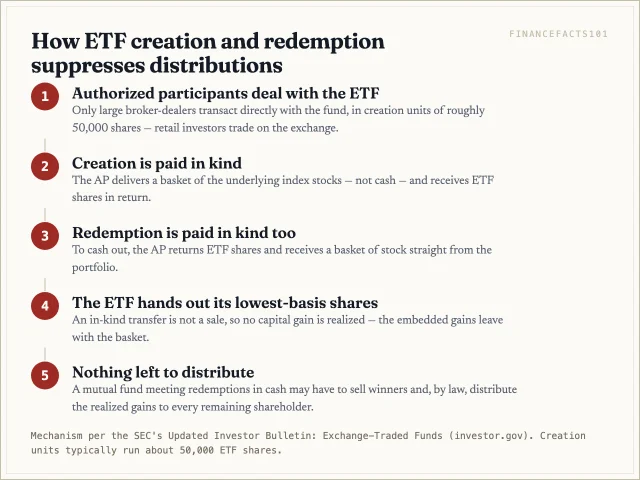
The tax consequence hides in the redemption leg. When an authorized participant redeems, the ETF hands over stock — and it deliberately hands over its lowest-cost-basis shares. Handing out stock in kind is not a sale, so no capital gain is realized, and the fund's embedded gains walk out the door with the basket. A mutual fund facing redemptions has no such valve: it pays cash, and if it must sell appreciated stock to raise that cash, the realized gains are distributed to every remaining shareholder at year-end — the law requires it. You can owe capital-gains tax on a fund you never sold, in a year your account went down.
The distribution record: what actually gets paid out
The mechanism shows up clearly in the data. Morningstar's surveys found that in 2024 roughly 40% of US mutual funds paid out capital gains against roughly 5% of US ETFs, and in 2025 about 72% of US equity mutual funds distributed gains — averaging 7% to 10% of net asset value — while only 6% of surveyed ETFs anticipated any distribution at all.

One honesty note before you over-weight those bars: they cover all mutual funds, and the average mutual fund is actively managed. A broad-market index mutual fund is far better behaved — VFIAX reported portfolio turnover of just 2% in its latest prospectus, and Vanguard's index funds share a structure with their ETF class that lets the mutual fund side benefit from in-kind redemptions too. Big S&P 500 index mutual funds distribute rarely and modestly, not annually and heavily. The ETF advantage is real but it is an advantage over a good option, not a bad one. When distributions do arrive, they are taxed in the year received — long-term capital gain rates for gains the fund held over a year — a mechanic covered in depth in how mutual funds distribute capital gains.
Taxable account or IRA: where the tax edge matters — and where it is worth zero
Everything in the last two sections applies to taxable brokerage accounts only. Inside an IRA, a 401(k), or an HSA, distributions are not taxable events — a capital-gains distribution landing in your Roth IRA generates no tax, no form, no consequence. In a tax-advantaged account the ETF tax advantage is worth exactly $0. Plainly: if you are choosing a vehicle for your IRA, cross taxes off the list entirely and decide on fees and convenience alone.

In a taxable account, the edge is real and compounds. A distribution of 7% of NAV taxed at the 15% long-term rate skims about 1% of your balance that year — money that leaves the account decades before you intended to sell. An index mutual fund will do that to you occasionally; a broad-market ETF, on the record above, almost never. The larger the taxable balance and the higher your bracket, the more the ETF column wins.
Spreads and premiums: the ETF costs the expense ratio does not show
An ETF's market price is not its NAV. You buy at the ask and sell at the bid, and the gap between them is a real cost paid on every round trip. The price can also drift from the value of the underlying stocks — the SEC notes that an investor "may pay more or less than the NAV when buying shares", a premium or discount that arbitrage keeps small on big funds but that widens in stressed markets.
For the funds in this article, these costs are close to rounding error: VOO, IVV, and SPY typically trade a cent or two wide, a fraction of a basis point on share prices in the hundreds of dollars. Where it bites is everywhere else — thinly traded ETFs, niche sectors, bond ETFs during liquidity events, and any ETF in the opening minutes of a volatile session. A mutual fund charges no spread and always transacts exactly at NAV; that is one honest structural point for the mutual fund column, and it grows with how exotic your ETF tastes get. If you stick to flagship index ETFs and avoid trading during turmoil, treat spreads as a tie.
Automatic investing, fractional shares, and minimums: where mutual funds still win
A mutual fund is denominated in dollars, not shares. You can invest exactly $500.00 on the 1st of every month, dividends reinvest to the penny, and every major brokerage will automate the schedule — this is the natural home of genuinely hands-off investing. Minimums are no longer a barrier on the fund side: FXAIX and SWPPX have no purchase minimum per their prospectuses, while VFIAX requires $3,000 to open (VOO, its ETF share class, requires one share or less).
ETFs price in shares, so dollar-exact and automatic investing depend on your broker. As of September 2026 the support is uneven: Fidelity offers fractional and recurring ETF purchases down to $1; Vanguard added automatic, dollar-based ETF investing in late 2024, but only for Vanguard's own ETFs; Schwab's recurring-investment feature covers mutual funds, and its fractional-share program covers S&P 500 stocks rather than ETFs. If your broker makes automatic ETF purchases easy, this section is a tie. If it does not, the mutual fund wins on the single behavior that matters most to outcomes — making the contribution happen every month without a decision.
Switching later: lock-in and conversions
The choice is cheap to change in a tax-advantaged account and expensive to change in a taxable one. Inside an IRA you can sell FXAIX and buy VOO tomorrow with no tax consequence. In a taxable account, selling a fund you have held for years realizes every embedded gain at once — after a decade of growth, switching a $200,000 position with $80,000 of gains costs $12,000 at the 15% rate. That lock-in is why the vehicle decision deserves ten minutes of thought now: in a taxable account you are choosing for decades. If you do unwind a position, which cost-basis method you elect controls how much gain each sale realizes.
Two escape hatches exist. Vanguard allows a one-way, tax-free conversion of its index mutual fund shares into the ETF share class of the same fund (VFIAX into VOO) because they are legally the same portfolio. And some fund companies have converted entire mutual funds into ETFs — the SEC's bulletin on mutual-fund-to-ETF conversions explains the mechanics and what shareholders should expect. Neither hatch works in reverse: there is no tax-free path from an ETF into a mutual fund.
Platform nuances that can outweigh everything above
The practical tiebreaker is usually where your account already lives. Index mutual funds travel badly: buy a Fidelity fund at Fidelity or a Schwab fund at Schwab and it is free, but buying one family's mutual fund on a rival's platform often triggers a transaction fee per purchase — poison for a monthly contribution plan. Flagship ETFs travel perfectly: VOO, IVV, and SPY trade commission-free at essentially every major US brokerage.
So the decision often collapses to geography. At Fidelity, FXAIX at 0.015% with native automation is hard to argue against. At Vanguard, VFIAX or VOO both work, and the automatic-ETF feature has closed most of the convenience gap. At Schwab, SWPPX automates and VOO does not. At a brokerage with no house index fund — or one you might leave — the ETF's portability is decisive, because ETF shares transfer in kind to any new broker while a house mutual fund may have to be sold, with the tax bill above.
The decision framework
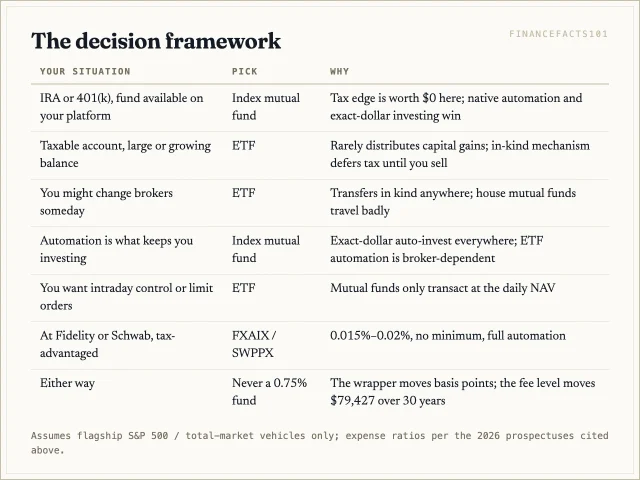
Compressed to three questions. First: taxable or tax-advantaged? In an IRA or 401(k), taxes are irrelevant — pick whichever vehicle your platform automates cheaply, which usually means the house index mutual fund. Second, in a taxable account: how large will this get, and how sure are you about your brokerage? Large, long-lived taxable positions favor the ETF for its distribution record and its portability. Third: will you actually automate? If ETF automation is clumsy at your broker and that friction would ever cost you a month's contribution, take the mutual fund — a 0.015% fund bought every single month beats a 0.03% fund bought when you remember. Either way you are paying under $4 a year per $10,000 for the market's return, which is the real win; the rest of this decision is basis points, honestly counted.
FAQ
Is VOO better than VFIAX?
They are share classes of the same Vanguard 500 Index Fund — identical portfolio, identical index. VOO costs 0.03% against VFIAX's 0.04% and can be converted from VFIAX tax-free (not the reverse); VFIAX takes $3,000 to open, prices once daily at NAV, and automates anywhere Vanguard funds are sold. Pick by mechanics, not performance — the performance is the same by construction.
Do S&P 500 ETFs ever distribute capital gains?
Rarely. In Morningstar's 2025 survey only 6% of US ETFs anticipated any capital-gains distribution, and just 2% expected more than 1% of NAV; the big S&P 500 ETFs have gone many consecutive years without one, because in-kind redemption continuously flushes low-basis shares out of the portfolio. It is not a legal guarantee — ETFs holding assets that cannot redeem in kind do distribute — but for flagship US equity index ETFs the record is close to zero.
Does the ETF tax advantage matter in my 401(k)?
No. Distributions inside a 401(k), IRA, or HSA are not taxable events, so the entire capital-gains-distribution story is worth nothing there. A 401(k) menu offering only index mutual funds is costing you nothing relative to ETFs — judge the menu on expense ratios alone.
Why does SPY cost 0.0945% when IVV and VOO charge 0.03%?
SPY is the original 1993 ETF, structured as a unit investment trust and priced for its role as the world's most traded instrument — massive intraday volume and the deepest options market. Institutions pay for that liquidity. A buy-and-hold investor gets nothing from it: for the same index, IVV or VOO delivers the same return at roughly a third of the annual cost.
Sources
- Fidelity 500 Index Fund (FXAIX) summary prospectus, April 29, 2026 — SEC EDGAR
- Schwab S&P 500 Index Fund (SWPPX) summary prospectus, February 26, 2026 — SEC EDGAR
- Vanguard S&P 500 ETF (VOO) summary prospectus, April 28, 2026 — SEC EDGAR
- Vanguard 500 Index Fund Admiral Shares (VFIAX) summary prospectus, April 28, 2026 — SEC EDGAR
- iShares Core S&P 500 ETF (IVV) summary prospectus, July 31, 2026 — SEC EDGAR
- SPDR S&P 500 ETF Trust (SPY) — State Street Global Advisors fund page
- Characteristics of Mutual Funds and Exchange-Traded Funds — Investor Bulletin, investor.gov
- Updated Investor Bulletin: Exchange-Traded Funds (ETFs) — investor.gov
- Exchange-Traded Funds (ETFs) — investor.gov
- Mutual Funds — investor.gov
- Investor Bulletin: Mutual Fund Conversion to Exchange-Traded Fund — investor.gov
- Topic No. 409, Capital Gains and Losses — IRS
- Fund Analyzer — FINRA
- Why ETFs Win the Tax Battle Over Mutual Funds — Morningstar, March 18, 2026
- Few ETFs Project Capital Gains Distributions in 2025 — Morningstar, December 11, 2025
- Good News for ETF Investors: Capital Gains Distributions Remain Low — Morningstar, December 17, 2024
 Next entry · No. 5,935How Much Life Insurance You Actually Need
See also
-
 No. 5,983
17 Oct 2026
18 min
Target-Date Fund vs Index Funds: Which Should You Hold?
Investments
-
 No. 2,507
12 Jan 2025
23 min
Understanding the Different Types of Investments: An Essential Guide for Professional and Institutional Investors
Investments
-
 No. 1,416
12 Sep 2024
22 min
Understanding Expense Ratios: An Essential Metric for Investors
Investments
-
 No. 2,365
31 Dec 2024
24 min
Understanding Index Funds: A Comprehensive Guide for Institutional Investors
Business Finance
-
 No. 5,496
13 Sep 2025
19 min
Understanding Vanguard Exchange-Traded Funds: Types, Benefits, and Comparison with Stocks and Mutual Funds
Investments
-
 No. 3,913
06 May 2025
23 min
Mastering Passive Investing: A Guide for Institutional Investors
Investments