Target-Date Fund vs Index Funds: Which Should You Hold?
Index target-date funds cost 0.08%-0.12% in 2026, 0.04-0.08 points over three index ETFs: $11,406-$22,694 in 30 years. When each wins; the double-up trap.
For most people saving in a 401(k) or IRA, the better answer to target-date fund vs index funds is a low-cost index target-date fund held on its own: the Vanguard, Schwab and Fidelity index versions charge 0.08% to 0.12% a year in their 2026 fund documents, about 0.04 to 0.08 points more than building the same mix from three index ETFs. On $60,000 plus $600 a month for 30 years, the cheapest of those premiums costs about $11,406, less than even a conservative estimate of what badly timed trades cost the average fund investor; separate index funds win in taxable accounts, across several accounts, or when you want a different risk path, and actively managed target-date funds rarely earn their fee.
This guide prices each of those cases with named funds, a worked example you can rerun in the investment return calculator, and the checks the SEC tells target-date investors to make. It is general information built on stated assumptions and fund documents dated January to July 2026, not personal investment or tax advice.
Target-Date Fund or Index Funds: The Choice in One Paragraph
A target-date fund is one fund that holds other index or active funds and changes its own mix as a chosen year approaches. Building it yourself means buying those underlying index funds directly, usually three of them, and doing the mixing and the de-risking on your own. Both routes can end with almost identical holdings. What differs is who rebalances, who decides when to cut stock exposure, what that service costs, and how each behaves in a taxable account. If you have not yet settled the wrapper question for the index funds themselves, mutual fund or ETF, the index funds vs ETFs guide covers it; this guide assumes either works.
Who This Is For — and Who It Isn't
This is for a US investor deciding what to hold for retirement in a 401(k), 403(b), traditional or Roth IRA, or a taxable brokerage account, who already accepts low-cost indexing and wants to know whether to buy the all-in-one fund or assemble the pieces.
It is not for three readers. If you pay an adviser to manage the money, the adviser's fee will dwarf everything here; the advisory fee guide prices that decision. If your question is when to invest a lump sum rather than what to buy, see lump sum vs dollar-cost averaging. And if you will retire within about five years, the glide path stops being an abstraction and the choice of fund family matters more than this guide can cover in one section: read the prospectus of every fund you are considering.
One structural caution for 401(k) savers. The SEC's investor bulletin on target date funds, dated March 25, 2025, notes that some target-date options inside retirement plans are collective investment trusts rather than mutual funds and are not regulated by the SEC. They also set their own fees, so your plan's version of a fund family's 2055 option may not charge what the retail fund below charges.
What a Target-Date Fund Actually Holds
The SEC bulletin describes the product plainly: a target date fund is typically a fund of funds, holding shares of other funds rather than individual stocks and bonds, and the adviser shifts money among those underlying funds over time. Open the Vanguard Target Retirement 2055 Fund's summary prospectus dated January 28, 2026 and the contents are four asset classes, held through four Vanguard index funds (total US stock, total international stock, total bond and total international bond). As of September 30, 2025 the fund held 54.4% US stocks, 37.1% foreign stocks, 5.5% US bonds and 2.4% foreign bonds.
That is the whole product. A 35-year-old who bought Vanguard's US total-market, international and total bond index funds in those weights would own the same securities. The fund adds three services on top: it rebalances back to its target mix, it moves that target toward bonds on a schedule, and it reduces your account to a single holding you are less likely to tinker with.
The Glide Path: "To" Versus "Through"
The schedule is the glide path. The bulletin explains that there are two types of glide paths – “to” and “through” the target date. A "to" fund stops changing at the target year. A "through" fund keeps cutting stocks for years afterward. In the bulletin's words, “Funds with a “to” glide path typically switch to more conservative investments earlier than funds with a “through” glide path.”
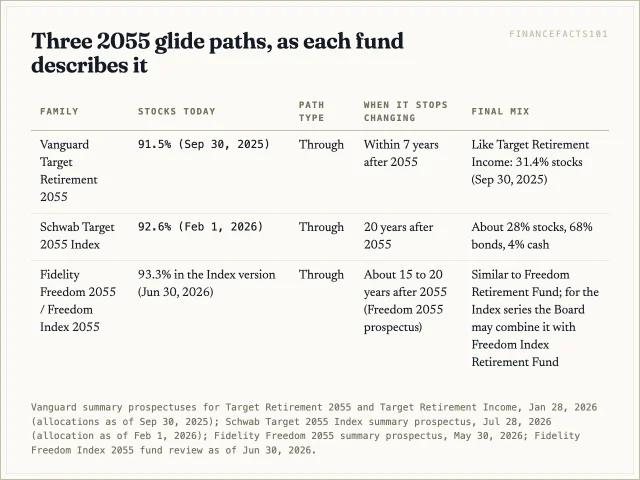
All three families above use through paths, and today their 2055 funds look nearly identical: 91% to 93% stocks. They part ways later. Vanguard's prospectus says that within seven years after 2055, the fund’s asset allocation should become similar to that of Vanguard Target Retirement Income Fund, which held 31.4% stocks as of September 30, 2025. Fidelity's Freedom 2055 summary prospectus dated May 30, 2026 puts its endpoint about 15 to 20 years after 2055. Schwab's is the most explicit:
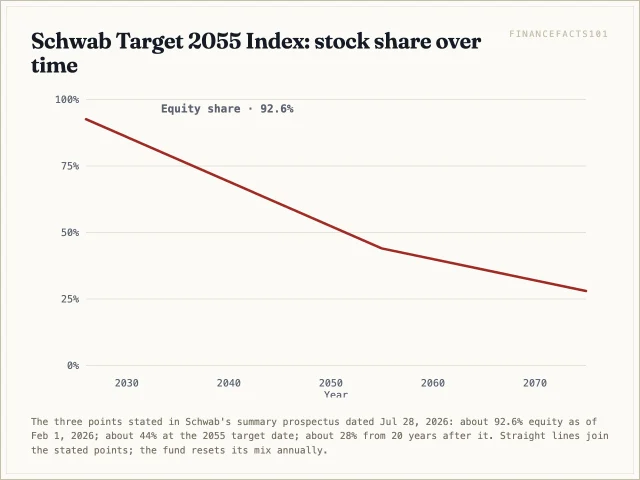
Per the Schwab Target 2055 Index Fund summary prospectus dated July 28, 2026, the fund aims for about 44% equities at 2055 and keeps reducing for 20 more years, to about 28%. A 2055 investor who retires on schedule at 65 is holding a different portfolio at 72 depending on which family's fund the plan menu happened to carry. The SEC bulletin's warning applies: even target date funds with the same target date often have very different investments and different performance/returns.
Expense Ratios: Three Fund Families, Named
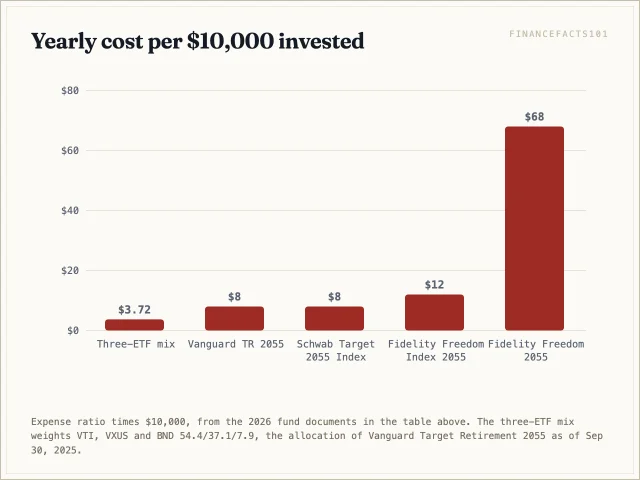
Each family's 2055 fund, from its own documents, next to the three Vanguard index ETFs that replicate the Vanguard fund:
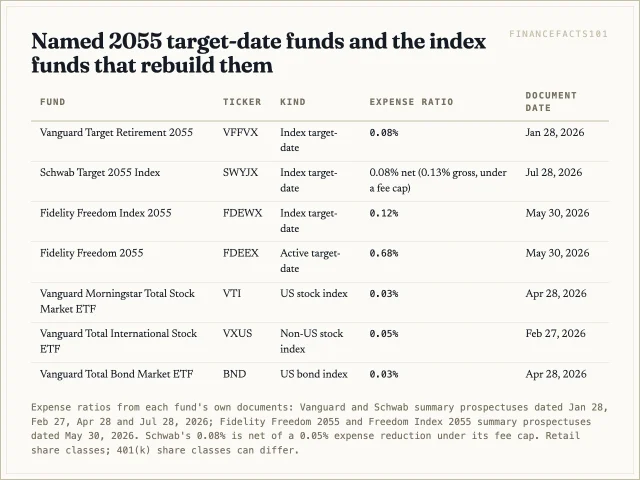
Three readings. First, the index target-date funds are cheap: Vanguard's 0.08% is entirely acquired fund fees, the costs of the four underlying funds, with no extra layer (its prospectus also lists a $25 annual account service fee for certain balances below $5,000,000, so check whether it applies to your account). Schwab's fund is 0.13% gross and 0.08% net: its prospectus shows 0.13% of total expenses less a 0.05% reduction, because Schwab has agreed to cap total expenses (excluding taxes and certain non-routine expenses) at 0.08% for as long as it advises the fund, an agreement the fund's board can amend. Fidelity's Freedom Index 2055 Investor Class charges 0.12% per its summary prospectus dated May 30, 2026, which lists the plan-only classes lower still: 0.08% (Institutional Premium), 0.05% (Premier) and 0.04% (Premier II). Its allocation, 93.3% stocks, comes from Fidelity's quarterly fund review as of June 30, 2026.
Second, the active version is a different product. Fidelity Freedom 2055 charges 0.68% in its retail class, and the same prospectus lists its other share classes at 0.65% (Class K, for employer plans), 0.45% (Class K6, also for plans) and 0.37% (Premier Class, with a $1 billion minimum). That spread is why your plan's share class matters as much as the family name.
Third, the do-it-yourself version is cheaper still, but not by much. VTI charges 0.03% per its April 28, 2026 summary prospectus (the fund was renamed Vanguard Morningstar Total Stock Market ETF on July 29, 2026), VXUS 0.05% (February 27, 2026) and BND 0.03% (April 28, 2026). Weighted like the 2055 fund, with BND standing in for both of its bond funds, that mix costs about 0.037% a year. The Admiral mutual-fund versions of the same three funds cost a bit more, 0.04%, 0.09% and 0.04%, or about 0.058% weighted.
The Worked Example: $60,000 Plus $600 a Month for 30 Years
Name the assumptions. Maya is 35, plans to retire around 2055, has $60,000 in a rollover IRA where she can buy anything, and will add $600 a month for 30 years, $276,000 of contributions in all. Every option earns the same 7% nominal return before costs, compounded monthly, with deposits at month-end, and the expense ratio is the only cost. A constant 7% ignores that the target-date fund de-risks along the way; the do-it-yourself portfolio is assumed to follow the same path, so the comparison isolates fees.
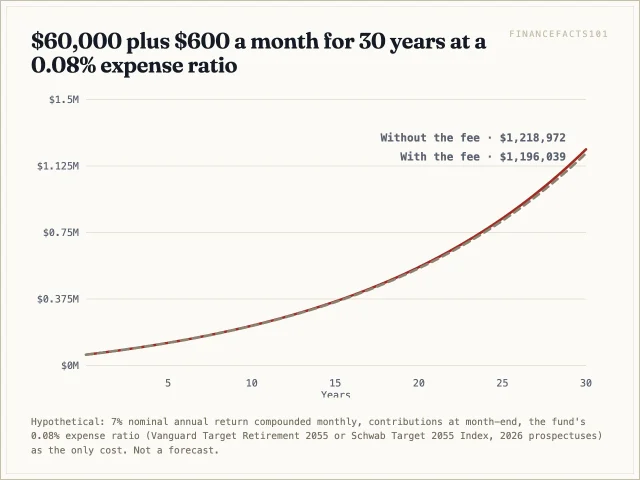
At 0.08%, the Vanguard or Schwab fund grows to about $1,196,039. With no fee at all, the same savings would reach $1,218,972, so the fund's cost over three decades is about $22,933, or 8% of what Maya contributes.
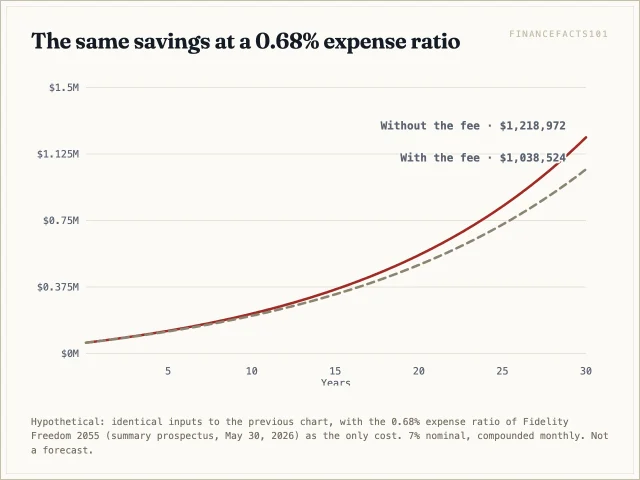
At Fidelity Freedom 2055's 0.68%, the account ends near $1,038,524. The fee takes about $180,449, which is 65% of her contributions. Same idea, same glide-path logic; the difference is the price of active management inside the wrapper.
To check the arithmetic, open the calculator with Maya's inputs. It converts the annual return to an effective monthly rate rather than dividing by 12, so its results run lower, $1,138,014 at 0.08% and $996,805 at 0.68%, but the gaps tell the same story: about $10,100 between the three-ETF mix and the index target-date fund, about $141,200 between the index and active target-date funds.
Target-Date Fund vs Index Funds on Fees: Where the Real Gap Is
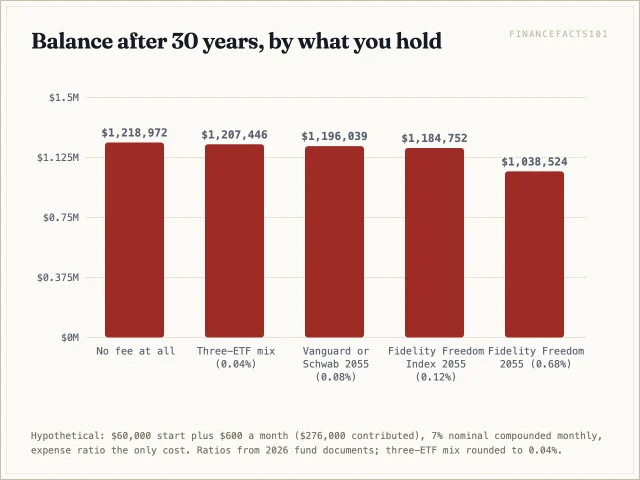
Line the endings up and two gaps appear. The three-ETF mix beats the 0.08% target-date fund by $11,406. The 0.08% fund beats the 0.68% fund by $157,516. The first gap is the price of convenience; the second is the price of a product choice, and it is about fourteen times larger.
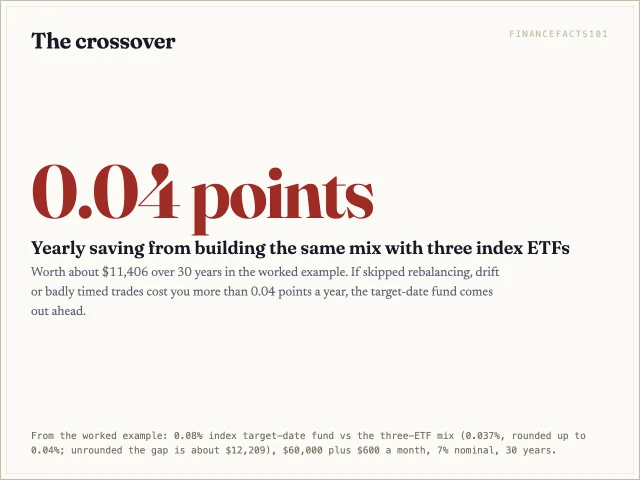
The convenience premium is about 0.04 points a year. That is the crossover. A do-it-yourself investor comes out ahead only if their own handling of the portfolio costs less than 0.04 points a year: no years of drift, no missed rebalancing, no selling after a crash, no buying a hot fund. At Fidelity Freedom Index's 0.12%, the bar rises to about 0.08 points and the do-it-yourself saving to about $22,694 on Maya's numbers. Neither bar is high, and the next two sections show why many investors miss it.
Rebalancing: The Job You Take On With Index Funds
With three funds, nobody resets the mix but you. The SEC's guide to asset allocation and rebalancing describes the usual methods: sell what has grown overweight, buy what is underweight with new money, or redirect contributions, on a calendar (every six or twelve months) or whenever a weight drifts past a set band. It also tells you to check whether your method triggers transaction fees or taxes.
For a 90/10 portfolio at 35, drift is mild; a 30% stock drop with a 3% bond gain moves it to about 86% stocks. The job gets heavier with age.
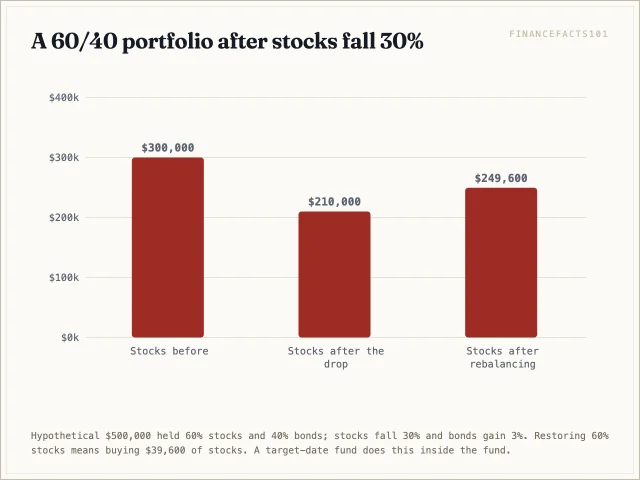
Take $500,000 held 60/40 near retirement. Stocks fall 30% and bonds gain 3%: the portfolio is now $210,000 in stocks and $206,000 in bonds, 50.5% stocks. Getting back to 60% means buying $39,600 of stocks in the middle of a crash. The target-date fund makes that trade inside the fund without asking. The do-it-yourself investor has to place the order. Then there is the slower job: building your own glide path, cutting stocks from about 90% toward where the families above land (Schwab about 44% at 2055, Vanguard about 31% within seven years after), one decision at a time over 30 years.
Behavior: The Cost That Does Not Appear in the Fee Table
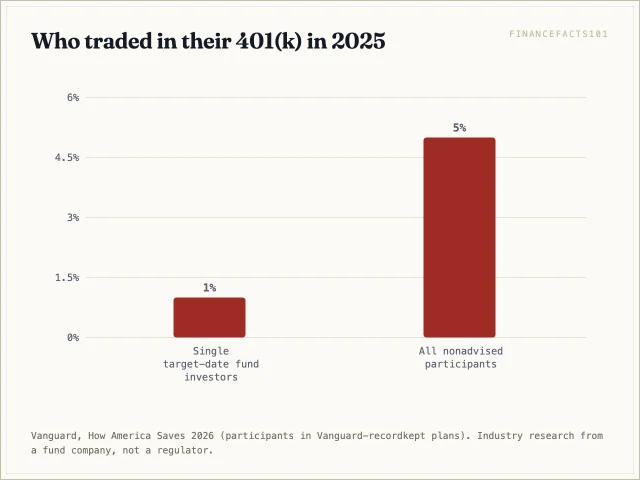
The strongest argument for the one-fund approach is what its owners do not do. In Vanguard's How America Saves 2026, covering Vanguard-recordkept 401(k) plans, only 1% of participants holding a single target-date fund made an exchange in 2025, against 5% of all nonadvised participants. It is a fund company's research on its own products, but the direction is unsurprising: there is nothing to tinker with.
How much bad timing costs ordinary fund investors is disputed. Morningstar's 2025 "Mind the Gap" study put the shortfall between investor returns and fund returns at 1.2% a year from 2015 through 2024. A Financial Analysts Journal paper published May 12, 2026 re-examined the same sample and found poor timing costs about 0.10% a year. Both are averages across all fund investors, not a measure of you, but even the low estimate is more than double the 0.04-point saving from building the portfolio yourself. If you will rebalance on schedule and sit through a 30% drawdown, the saving is real; if not, the target-date fund is cheaper once behavior is counted.
The Double-Up Mistake
The most common way to break a target-date fund is to hold it next to other funds. In Vanguard's 2025 data, 73% of target-date investors held a single target-date fund and nothing else; 22% held one target-date fund plus other funds, and the rest held two or more. Vanguard notes that some of those mixed accounts come from employer actions, such as company-stock contributions, rather than participant choice.
The fund cannot see the rest of your money. The Department of Labor's default-investment rule, 29 CFR 2550.404c-5, states that "asset allocation decisions for such products and portfolios are not required to take into account risk tolerances, investments or other preferences of an individual participant." The fund rebalances itself, not you.
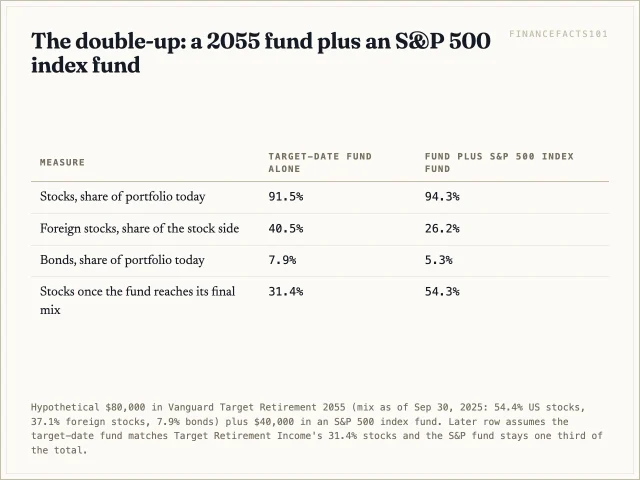
Here is what that does. Jordan has $80,000 in Vanguard Target Retirement 2055 in his 401(k) and adds $40,000 of an S&P 500 index fund in a Roth IRA because it "did better last year." His stock share rises from 91.5% to 94.3%, which is small. His foreign stock share falls from 40.5% of the stock side to 26.2%, which undoes a design choice he never examined. And the S&P 500 fund never de-risks: when the target-date fund reaches its final 31.4% stock mix, a portfolio still one-third S&P 500 is about 54% stocks. The glide path he chose now applies to two-thirds of his money.
The fix is to pick one approach. Hold the target-date fund alone across your retirement accounts, or drop it and run index funds across all accounts as one portfolio. If you want more risk than your fund's path, the SEC bulletin notes that a fund dated later or earlier than your retirement year may suit you better; a 2060 or 2065 fund raises your stock share while keeping one glide path in charge, which bolting on an extra stock fund does not.
Taxable Accounts: Where Target-Date Funds Fit Worst
Inside an IRA or 401(k), none of this section applies. In a taxable brokerage account, three problems stack up.
First, distributions you do not control. Mutual funds generally pass their net realized gains out to shareholders each year, and the IRS tells you to report capital gain distributions as long-term capital gains, regardless of how long you owned your shares in the mutual fund. Vanguard's target-date funds showed how large that can get. On December 11, 2020, Vanguard cut the minimum for its institutional target-date funds from $100 million to $5 million; retirement plans moved over, the retail funds sold appreciated holdings to pay them, and remaining retail shareholders in taxable accounts faced what the SEC called historically larger capital gains distributions and tax liabilities. In January 2025 Vanguard agreed to pay $106.41 million, including parallel state settlements, to resolve the SEC's charges that its prospectuses had not disclosed that risk, without admitting or denying the findings.
Second, no asset location. A do-it-yourself investor with both taxable and IRA money can keep bonds, whose interest is taxed as ordinary income, inside the IRA and stocks, whose long-term gains are taxed at 0%, 15% or 20% (IRS Topic 409) and whose qualified dividends get the same rates, in the taxable account. A target-date fund holds the same mix in every account.
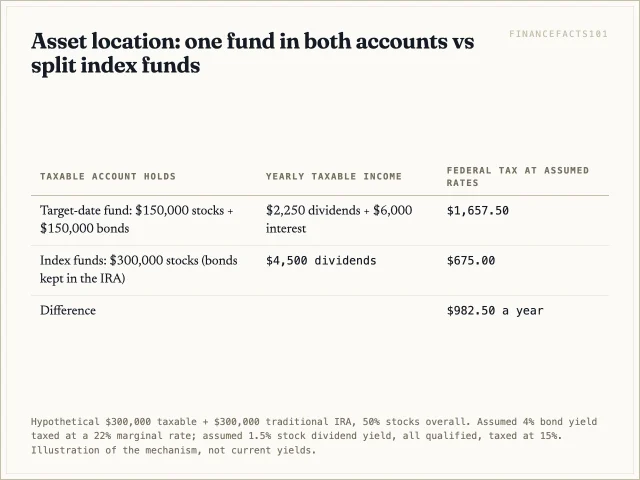
On a $300,000 taxable account and a $300,000 IRA, 50% stocks overall, the target-date fund puts $150,000 of bonds in the taxable account. At an assumed 4% bond yield taxed at 22% and a 1.5% dividend yield taxed at 15%, that costs about $983 a year more in federal tax than holding only stock index funds there. The assumptions are illustrative; the mechanism is not. The gap tends to widen as the glide path shifts toward bonds, which is also when the account is largest.
Third, less control at the edges. You cannot harvest a loss on just the international piece, and every sale sells the whole mix. For taxable money, separate index funds, and the capital gains rules for selling stocks and funds, are usually the better fit.
What the SEC Tells You to Check
Before buying any target-date fund, the bulletin's checklist is short and worth following literally. Read the prospectus and latest shareholder report. Check the stock share at every point along the glide path, not just today. Make sure you understand when the fund will reach its most conservative investment mix. Read the fee table, which shows both the fund's costs and the underlying funds' costs, since fees may be charged by both the target date fund and the underlying funds. Consider your overall asset allocation, including other accounts and income. And do not let the year in the name choose for you.
The bulletin also states the limit that matters most: target-date mutual funds and ETFs do not guarantee that you will have sufficient retirement income at or after the target date. Vanguard's own prospectus is blunter: an investment in the fund could lose money over any time period. The Labor Department's tips for plan fiduciaries make the same points from the employer's side: compare glide paths, compare fees, and understand that small fee differences compound over a career.
The Decision Framework
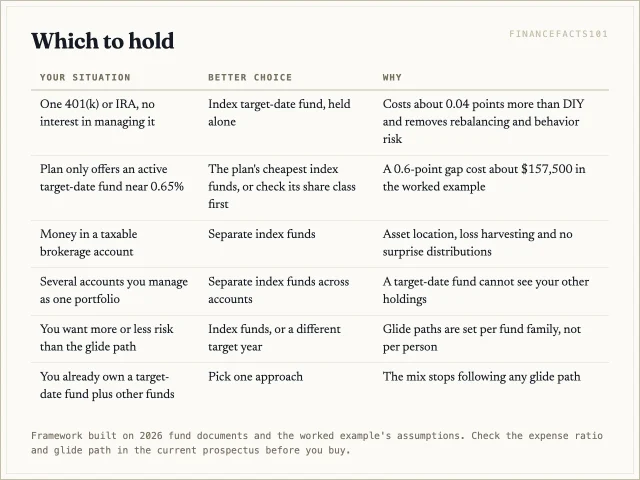
For most people with one retirement account and no wish to manage it, an index target-date fund held alone is the answer, and the 0.04-point premium is cheap insurance against your own behavior. Switch to separate index funds when the money sits in a taxable account, when you run several accounts as one portfolio, or when you want a risk path the fund families do not offer, and then commit to a written rebalancing rule. Whichever you pick, do not hold both, and do not pay 0.6 points a year for an active target-date fund when the index version of the same idea costs 0.08%.
FAQ
Is a target-date fund just an index fund?
Not exactly. An index target-date fund is a fund of index funds: Vanguard Target Retirement 2055 holds four Vanguard index funds and charges 0.08% in total. But many target-date funds, including Fidelity Freedom 2055 at 0.68%, hold actively managed funds. The name alone does not tell you which you own; the prospectus does.
Can I hold a target-date fund and an S&P 500 index fund together?
You can, but it changes your mix in ways the fund cannot correct. In the example above, adding a one-third S&P 500 position raised stocks to 94.3% today and left about 54% in stocks after the target-date fund had cut to 31.4%. If you want more stock exposure, a later-dated target fund does it without breaking the glide path; the SEC bulletin notes that a target year other than your retirement year may suit you.
Are target-date funds bad in a taxable account?
They are a weaker fit, not forbidden. You lose asset location, you cannot harvest losses on one asset class, and you are exposed to capital gain distributions caused by other shareholders, as Vanguard's retail target-date fund holders were after its December 2020 minimum change. For small balances the simplicity may still be worth it; for large taxable balances, separate index funds usually cost less in tax.
How much more does a target-date fund cost than building it myself?
With index versions, about 0.04 to 0.08 points a year in 2026: 0.08% to 0.12% for the Vanguard, Schwab and Fidelity index funds against about 0.04% for three Vanguard ETFs. On $60,000 plus $600 a month for 30 years at 7%, that is about $11,406 to $22,694.
Sources
- SEC Office of Investor Education and Assistance, Target Date Funds – Investor Bulletin, March 25, 2025 — glide paths, fund-of-funds fees, what to check
- SEC, Vanguard to Pay More Than $100 Million to Resolve Violations Related to Target Date Retirement Funds, January 17, 2025
- SEC, Beginners' Guide to Asset Allocation, Diversification, and Rebalancing
- SEC EDGAR, Fidelity Freedom 2055 Fund summary prospectus, May 30, 2026
- SEC EDGAR, Schwab Target 2055 Index Fund summary prospectus, July 28, 2026
- eCFR, 29 CFR 2550.404c-5, qualified default investment alternatives
- US Department of Labor, EBSA, Target Date Retirement Funds – Tips for ERISA Plan Fiduciaries, February 2013
- IRS, Publication 550, Investment Income and Expenses — capital gain distributions
- IRS, Topic 409, Capital Gains and Losses
- Vanguard, Target Retirement 2055 Fund summary prospectus and Target Retirement Income Fund summary prospectus, January 28, 2026
- Vanguard, summary prospectuses for VTI (April 28, 2026, with July 29, 2026 renaming supplement), VXUS (February 27, 2026) and BND (April 28, 2026)
- Vanguard, Admiral Shares summary prospectuses for VTSAX, VTIAX and VBTLX, 2026
- SEC EDGAR, Fidelity Freedom Index 2055 Fund summary prospectus, May 30, 2026
- Fidelity, Freedom Index 2055 Fund quarterly fund review, as of June 30, 2026
- Vanguard, How America Saves 2026 — target-date use, mixed investors, trading rates
- Fulkerson, Jordan, Riley and Yan, Bad Timing Does Not Cost Investors 15% of Their Funds' Returns, Financial Analysts Journal, May 12, 2026
 Next entry · No. 5,984Are Annuities Worth It? What They Pay, What They Cost
See also
-
 No. 5,934
06 Sep 2026
15 min
Index Funds vs ETFs: Fees, Taxes, and Which to Pick
Investments
-
 No. 5,949
16 Sep 2026
17 min
Lump Sum vs Dollar-Cost Averaging: What Waiting Costs on $120,000
Investments
-
 No. 3,913
06 May 2025
23 min
Mastering Passive Investing: A Guide for Institutional Investors
Investments
-
 No. 1,106
28 Jul 2024
18 min
Dollar-Cost Averaging: An Effective Strategy for Long-Term Investors
Investments
-
 No. 323
09 Apr 2024
23 min
Understanding Balanced Funds: A Mix of Stocks and Bonds for Professional Investors
Investments
-
 No. 248
07 Apr 2024
23 min
Understanding the Role and Significance of Asset Management Companies (AMC)
Investments