Are Annuities Worth It? What They Pay, What They Cost
Are annuities worth it? In Sept 2026 a 65-year-old man could get 7.5% to 8.3% a year for life per $100,000, vs 4% from savings. When that wins.
Are annuities worth it? For lifetime income, often yes: in September and early October 2026, published quote surveys put an immediate annuity for a 65-year-old man at $625 to $693 a month for life per $100,000, or 7.5% to 8.3% a year, against $4,000 a year (4%) under the classic withdrawal rule. For growth, usually not: variable and indexed annuities sold as investments carry yearly charges, caps on gains and surrender charges that, in the SEC's own example, start at 7%.
The income side has a price too. The payment is usually fixed in dollars, the premium is gone for your heirs, and measured as an investment return the annuity only beats a 5.29% Treasury note if you live past about 84 to 88. This guide prices each trade-off with a worked example, Walter Hughes at 65 with $500,000, and covers the five main types, tax, state guaranty limits and the 2026 QLAC limit.
One line of scope honesty: this is general information built on stated assumptions (a hypothetical retiree, quotes from September 2026 and Treasury yields from September 30, 2026, 2026 tax law), not personal advice. Annuity quotes move with interest rates and differ by insurer and state.
Who this is for — and who it is not for
This is for someone at or near retirement with savings beyond an emergency fund, little or no pension, and average or better health, whose real fear is running out of money at 88 or 95. Also for anyone pricing an annuity proposal before signing.
It is not for you if Social Security and a pension already cover your essential spending, if your health makes a short retirement likely, if you may need the money as a lump sum for care or a house, or if leaving the largest estate is the priority. And if you are under 59½ and want tax deferral, a 401(k) or IRA does that more cheaply. How much you need in total is covered in how much you need to retire; this guide takes the savings as given and asks whether to turn part of them into income.
The five annuities people mean, and what each buys
"Annuity" covers contracts that share little except the issuer, an insurance company. FINRA's annuity overview sorts them by timing: an immediate annuity starts income right away for a lump sum; a deferred annuity is paid for earlier and pays later. Then by how the money is credited: a fixed rate, an index-linked formula, or market returns.
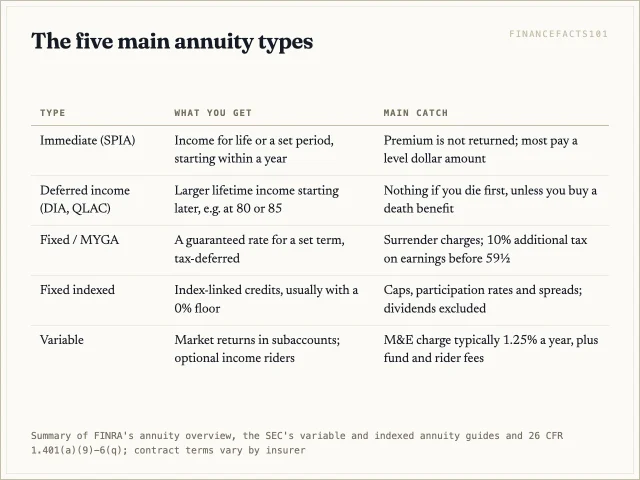
Only the first two are pure longevity insurance. A multi-year guaranteed annuity (MYGA) is a fixed-rate savings contract. Indexed and variable annuities are investment wrappers, and any lifetime income they offer usually comes from an optional rider with its own charge. State insurance commissions regulate all of them. The SEC also regulates variable annuities and, per its indexed annuity bulletin, only those indexed annuities that are securities.
What an immediate annuity pays in 2026
A single premium immediate annuity (SPIA) is priced as monthly income per premium dollar. Two published examples from September 2026, neither an offer you can buy at:
- An Annuity.org analysis reported by CBS News on September 17, 2026: a $750,000 single-life annuity would pay a 65-year-old man about $4,688 a month and a woman $4,425, which is $625 and $590 per $100,000. Ten years certain cut the man's to $4,560; a joint-life contract for two 65-year-olds, to $4,020.
- LifeAnnuities.us, a comparison service that quotes for clients, published $693 a month per $100,000 for a 65-year-old man as the best of eight A-rated carriers, single life with five years certain, as of October 1, 2026 and unchanged since September 16.
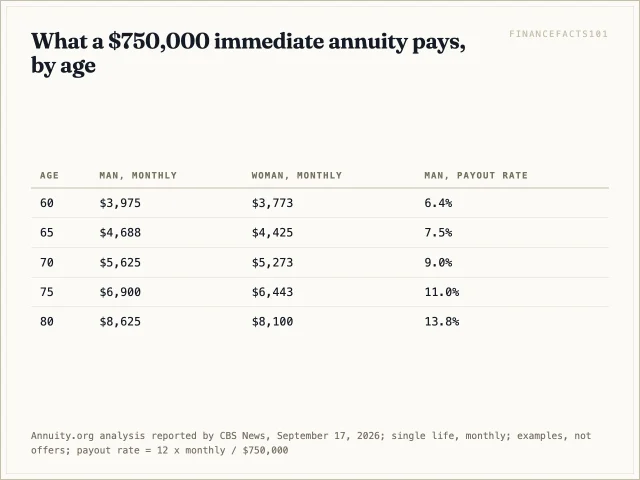
Age moves the number most: on $750,000 an 80-year-old man gets $8,625 a month, more than double the 60-year-old's $3,975, because the insurer expects fewer payments. Women get less because they live longer. Interest rates matter because insurers invest premiums in bonds; on September 30, 2026, the 10-year Treasury yielded 5.29% and the 5-year 5.09%, per Treasury's daily yield curve. And the $68 gap between the two surveys, even though the higher one includes a guarantee period that normally lowers a payout, is the case for comparing several insurers.
Longevity insurance: why 7.5% is not a yield
A 7.5% payout rate is not a 7.5% return. Each payment is partly interest, partly your own premium coming back, and partly mortality credits: money from buyers who die early, paid to those who live long. That pooling is the product.
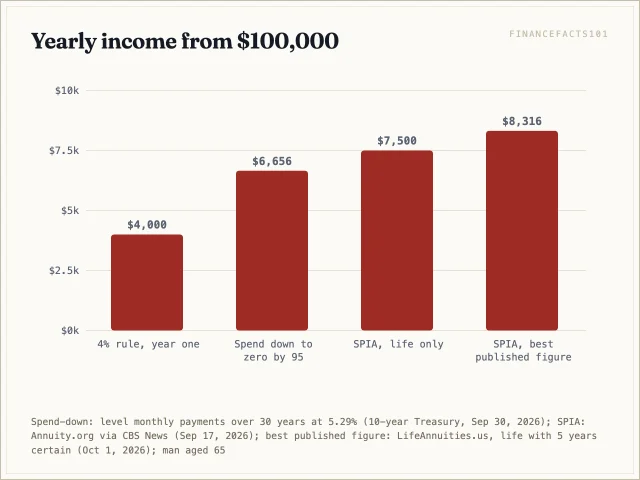
Without a pool, $100,000 spent evenly to zero by age 95 at 5.29% pays $6,656 a year and nothing at 96. The life-only SPIA pays $7,500 for as long as you live, at 96 or 104. The 4% rule starts at only $4,000, rising with inflation, because it must survive bad markets and a long life alone.
How long is long? SSA's 2023 period life table, the one used in the 2026 Trustees Report, gives a 65-year-old man a life expectancy of 18.1 years and a woman 20.7.
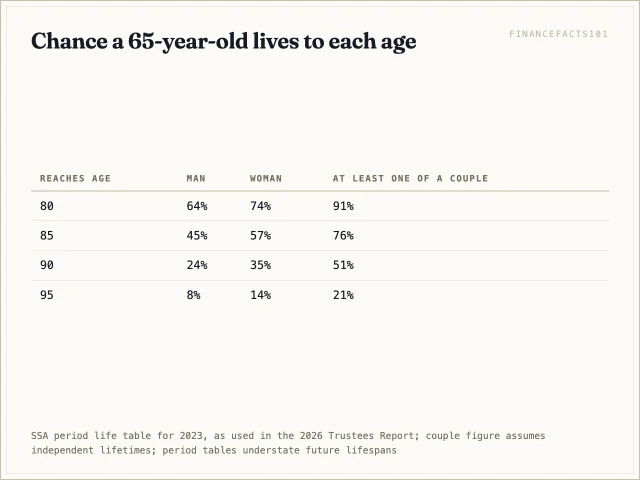
About 24% of 65-year-old men and 35% of women reach 90, and for a couple the chance that at least one does is 51%. A period table ignores future improvements in mortality, and annuity buyers tend to outlive the general population, so treat these as floors.
Seen as an investment, the return depends entirely on when you die.
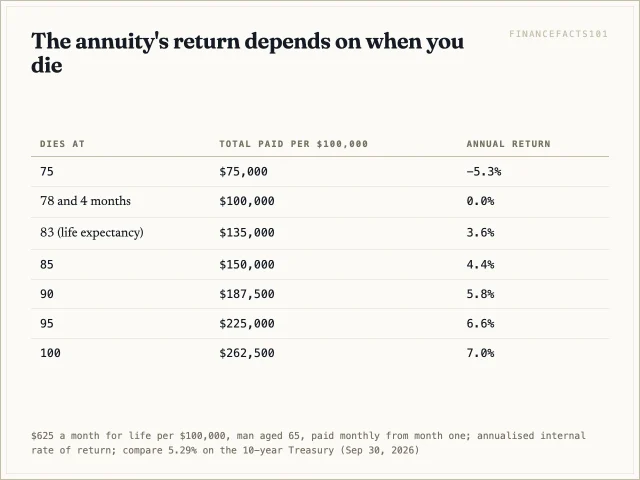
At $625 a month per $100,000, a man who dies at 78 and 4 months has received his premium back and nothing more: 0%. At his life expectancy, about 83, the return is 3.6%. He beats the 5.29% Treasury only by living past about 87 years and 8 months, or past about 84 at the $693 figure. Like fire insurance, it pays off in the outcome you could not otherwise afford.
Worked example: $500,000, annuity vs the 4% rule
Walter Hughes is 65, single, and retiring in October 2026 with $500,000 of after-tax savings earmarked for income, separate from his emergency fund, plus $2,200 a month of Social Security. His essential spending is $50,000 a year. Two choices for the $500,000:
- Option A, annuity: a life-only SPIA at $625 a month per $100,000, the CBS-reported figure: $3,125 a month, $37,500 a year, fixed for life.
- Option B, 4% rule: withdraw $20,000 at the start of year one, raise it 2.5% a year for inflation, and earn 5% a year on the rest, a little below the 10-year Treasury yield, so roughly a bond portfolio.
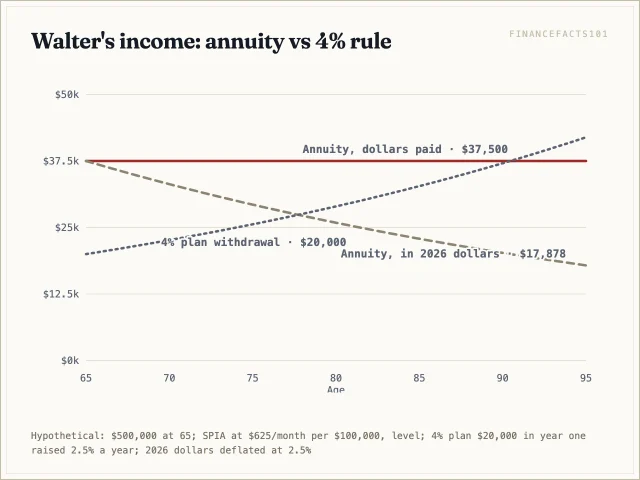
Option A pays 87.5% more from the first month: $37,500 against $20,000. Option B's rising withdrawal does not pass the annuity's fixed payment until age 91, when it reaches $38,006.
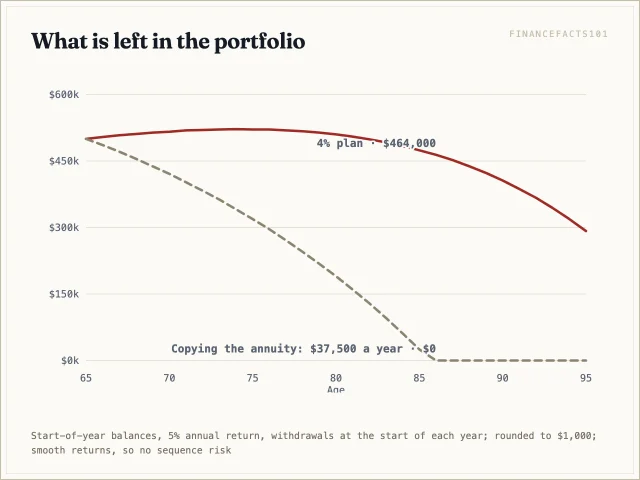
Suppose Walter copies the annuity himself, taking $37,500 a year from the same 5% portfolio. The money covers 20 full years, ages 65 through 84, and runs out at 85, an age SSA's table says about 45% of 65-year-old men reach. The annuity keeps paying; those years are what the insurance covers.
The cost lands on his heirs.
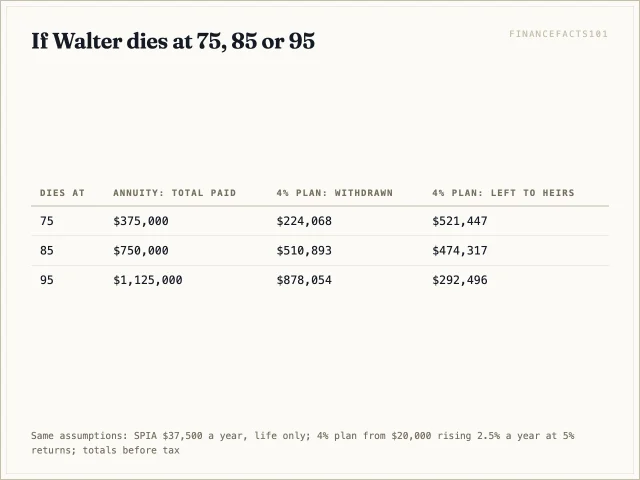
If Walter dies at 75, the annuity has paid $375,000 and stops, while Option B has paid $224,068 and still holds $521,447. On these smooth 5% returns, Option B's withdrawals plus what is left beat the annuity's total at every age shown; the annuity wins on the size and certainty of the check while Walter is alive. Real markets are not smooth, and how a bad first decade can sink a withdrawal plan is shown in the retirement-target guide.
Inflation: the fixed payment's weak spot
Most SPIAs pay a level dollar amount. At 2.5% inflation, Walter's $37,500 buys what $29,295 buys today when he is 75, $22,885 at 85 and $17,878 at 95. If prices kept rising at the 3.4% the CPI rose in the 12 months to August 2026, per the BLS, the age-85 payment would be worth $19,214.
Two fixes: a yearly increase rider, which starts the payment lower (get both quotes), or annuitizing only the essentials and letting invested money absorb inflation.
Are annuities worth it for part of your savings?
The answer that survives most stress tests is partial: buy enough guaranteed income to cover essential spending, and invest the rest.
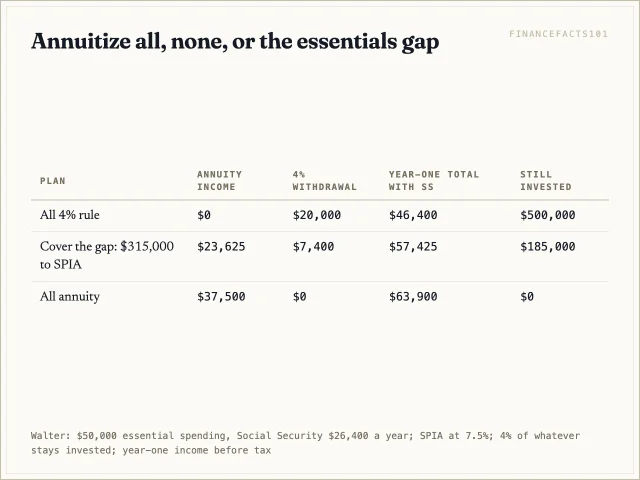
Walter's Social Security covers $26,400 of his $50,000 essentials, a $23,600 gap. At 7.5%, $315,000 buys $23,625 a year for life. He keeps $185,000 invested and takes 4% of it, $7,400. Year-one income is $57,425, against $46,400 with everything on the 4% rule and $63,900 with everything annuitized and no liquid savings left.
Our retirement calculator shows why this is efficient. Enter age 64, retirement at 65 and 0% inflation (the worksheet needs at least a year to go), with $50,000 of spending and $2,200 a month of Social Security, and its 4% rule asks for 25 × $23,600 = $590,000 to cover the gap. The annuity covers it for about $314,667.
Before buying any annuity, look at the cheapest one. Each year you delay Social Security past full retirement age adds 8% for anyone born in 1943 or later, per SSA's delayed retirement credit table, and the benefit is inflation-indexed. Our guide on when to claim Social Security works through the break-even and argues that no annuity on the market matches its price.
Deferred income annuities and QLACs
A deferred income annuity (DIA) is a SPIA bought now with income starting later, at 80 or 85, say. Pooling works harder: the insurer holds the premium for years, and by SSA's table only about 45 of every 100 65-year-old men are alive at 85 to collect. So a given premium buys a much larger check than an immediate annuity, but nothing comes back if you die first unless you pay for a return-of-premium death benefit, which lowers the payout.
Inside IRAs and workplace plans, a DIA can qualify as a qualifying longevity annuity contract (QLAC). Under Treasury regulation 1.401(a)(9)-6(q), payments must start no later than "the first day of the month next following the 85th anniversary of the employee's birth," the contract cannot be a variable or indexed contract, and it offers no cash surrender right after the required beginning date. IRS Notice 2025-67 states that the 2026 premium limit "remains $210,000," counted across all your plans and IRAs.

The tax benefit: a QLAC's value is left out of the balance used for required minimum distributions until payments begin. For anyone born in 1960 or later, RMDs start at 75, where the divisor in IRS Publication 590-B is 24.6, so each $210,000 kept out lowers the first RMD by $8,537 before growth. The RMD guide has the start ages and divisors, and our QLAC entry covers contract features.
Fixed annuities and MYGAs: a CD with strings
A MYGA credits a fixed rate for a set term, such as five years. It competes with CDs and Treasury notes, not with an income annuity, so compare any quoted rate with the Treasury of the same term: the 5-year note yielded 5.09% on September 30, 2026.
Three differences decide it. Interest inside the MYGA is tax-deferred, then taxed as ordinary income when withdrawn; Treasury note interest is taxed federally each year but, per TreasuryDirect, not by states or localities. Taking money out mid-term can trigger a surrender charge, and before 59½ a 10% additional tax on the earnings. And the backstop is a state guaranty association, not FDIC insurance. A MYGA earns its place only when its rate clears the Treasury by enough to pay for all three.
Indexed annuities: caps, participation rates and spreads
A fixed indexed annuity credits a return linked to a market index, usually with a 0% floor and a limit on the upside. The SEC's bulletin, dated July 31, 2020, sets out the limits: a participation rate (75% of a 10% gain credits 7.5%), a cap (with a 7% cap, a 12% index gain credits 7%) and a spread (a 3% spread turns a 9% gain into 6%). Gains are "generally calculated without including dividends," and the insurer can change some features, "such as the rate cap," periodically.
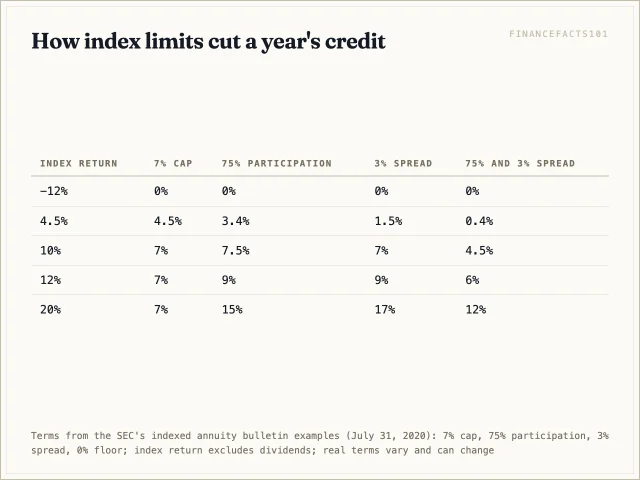
Applied to a 20% year, the SEC's example terms credit 7% under the cap and 12% with participation and spread combined. In a down year the credit is zero, not negative. FINRA's indexed annuity alert adds that surrender charges usually apply for the first six to 10 years, and the guaranteed minimum usually ranges from 1% to 3% on at least 87.5% of the premium. It is worth it only if you value the floor more than the dividends and upside you give up. Indexed annuities that are securities differ: the SEC warns they can lose money when the index falls, with only a floor or buffer limiting the loss.
Variable annuities: what the fees cost
The SEC's investor guide, Variable Annuities: What You Should Know, puts the mortality and expense risk charge "typically in the range of 1.25% per year," plus an administrative fee of about 0.15% a year or a flat $25 to $30. Underlying fund expenses come on top, and optional features such as a guaranteed minimum income benefit carry extra charges.
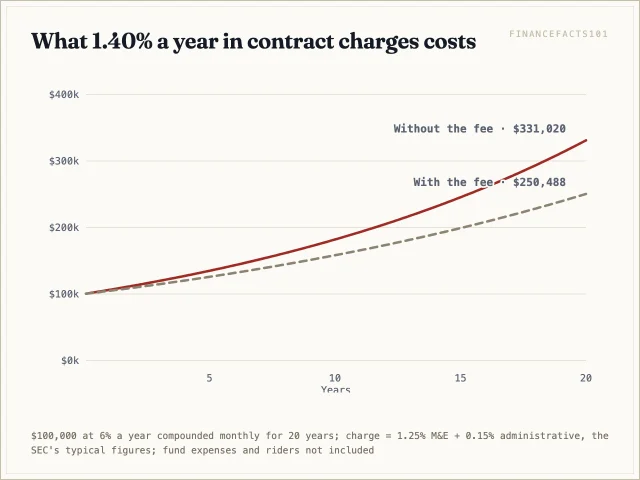
Those two contract charges alone, 1.40% a year, on $100,000 compounding monthly at 6% for 20 years leave $250,488 instead of $331,020: $80,532, or 24%, less before any fund expense or rider. Inside an IRA or 401(k) the annuity's tax deferral adds nothing, and the SEC suggests buying one there only for features such as lifetime income or a death benefit. If the attraction is a guaranteed withdrawal rider, our GLWB entry explains how it works; price it against a plain SPIA.
Surrender charges and the exit door
The SEC describes surrender periods "typically within six to eight years, but sometimes as long as ten years," with an example schedule of 7% in year one, 6% in year two and 5% in year three.
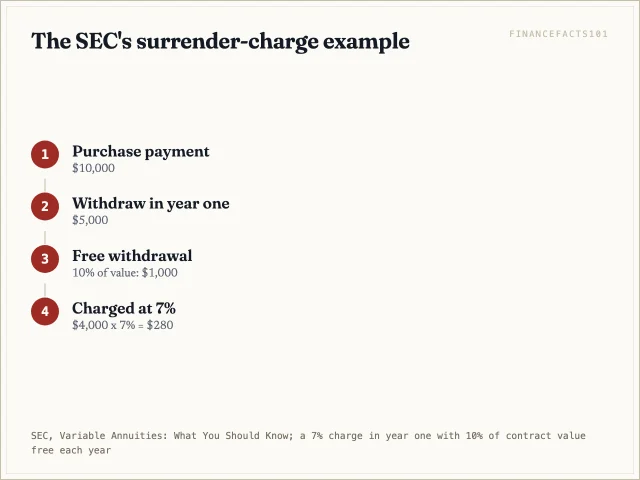
In the SEC's example, an investor who paid $10,000 withdraws $5,000 in the first year; 10% of the contract value comes out free, and the remaining $4,000 is charged 7%, or $280. Variable annuity contracts, the SEC adds, typically have a free-look period of ten or more days to cancel without a surrender charge; use it.
Swapping contracts can be tax-free. FINRA's exchange alert notes the IRS lets you exchange one annuity for another without tax on the gains, but warns that a new contract may restart a surrender period and that bonus credits, typically 1% to 5%, can come with higher expenses that offset them. The same provision, section 1035, lets a life policy be exchanged into an annuity, as our term vs whole life guide notes.
How annuity income is taxed
Bought with after-tax money, an annuity's payments are partly a tax-free return of your cost. IRS Publication 939 sets the exclusion percentage as your investment in the contract divided by the expected return, which is the annual payment times a life-expectancy multiple from its Table V: 20.0 at age 65.
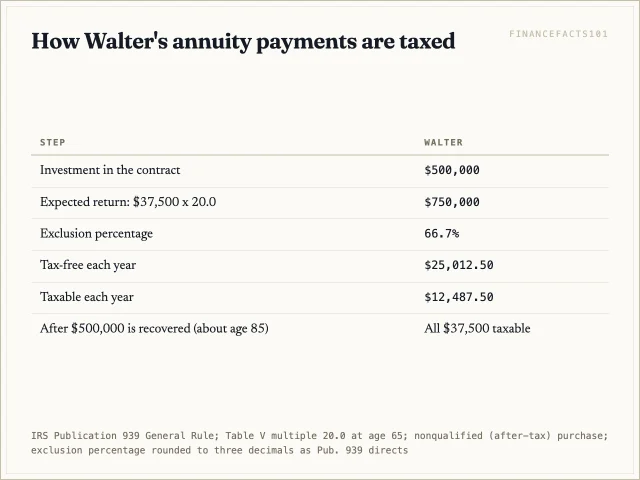
For Walter: $500,000 ÷ ($37,500 × 20.0 = $750,000) = 66.7%. Each year $25,012.50 comes tax-free and $12,487.50 is taxable, until he has recovered his $500,000, which takes about 20 years, to 85. After that every dollar is taxable; if he dies sooner, the unrecovered cost is an itemized deduction on his final return. Bought with IRA or 401(k) money, the payments are usually fully taxable, because no after-tax cost went in.
Before payments start, withdrawals from a deferred annuity bought with after-tax money come out earnings first and are taxed as ordinary income, per IRS Publication 575. Before 59½ the taxable part generally carries a 10% additional tax, with exceptions including death, disability, substantially equal periodic payments, and an immediate annuity whose payments start within one year of purchase. The 2025 tax law, Public Law 119-21, left these rules alone; its $6,000 senior deduction for those 65 and older (2025 through 2028, phased out above $75,000 of modified AGI, $150,000 joint) offsets annuity income like any other.
If the insurer fails: state guaranty limits
Annuities carry no FDIC insurance. Each state has a life and health guaranty association, and NOLHGA, their national organization, says most states cover up to $250,000 in present value of annuity benefits. A contract worth $300,000 would be covered for 83.3% of its benefits. Coverage excludes parts of a contract the insurer does not guarantee, which in a variable annuity means the subaccount investments, and most index-linked interest not yet credited.
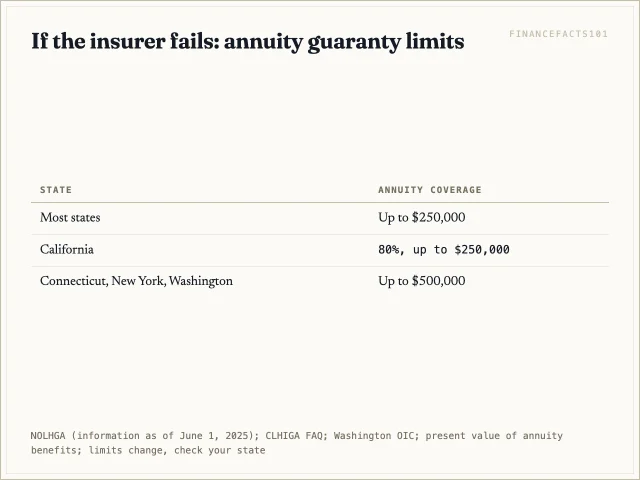
California covers 80% up to $250,000, per CLHIGA; Washington's insurance commissioner lists up to $500,000. Walter's $500,000 SPIA with one insurer would exceed the limit in most states, so he should split it between two highly rated insurers.
The decision, step by step
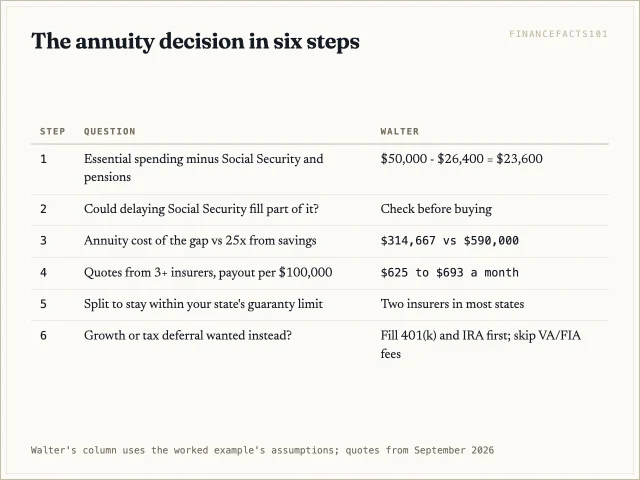
If an annuity fills the essentials gap for less than 25 times the gap from savings, and you can do without that money for heirs, it is worth it for that slice.
FAQ
Are annuities a good investment?
As investments, mostly not: variable annuities typically charge 1.25% a year for mortality and expense risk before fund costs, and indexed annuities cap gains and exclude dividends. As insurance, an income annuity can be worth it, because it pays more per dollar than you can safely withdraw yourself, for life.
How much does a $100,000 annuity pay per month?
For a 65-year-old man in September 2026, about $625 a month for life on a life-only contract in the Annuity.org analysis reported by CBS News, and $693 as the best figure in LifeAnnuities.us's survey-based tables, with five years certain. A 65-year-old woman got about $590 in the Annuity.org figures.
Is it better to buy an annuity at 65 or 75?
Waiting raises the payout: in the Annuity.org figures, $750,000 pays a man $6,900 a month at 75 against $4,688 at 65. But you forgo ten years of payments and bet on future interest rates; buying in pieces at 65, 70 and 75 spreads that bet.
Can you lose money in an annuity?
Yes. A life-only SPIA pays less than the premium if you die before about 78; surrender charges cut early withdrawals from deferred contracts; variable annuities and some indexed annuities that are securities can lose value with markets; and an insurer can fail, with guaranty coverage capped at $250,000 in most states.
Sources
- SEC, Variable Annuities: What You Should Know: M&E charge typically 1.25% a year; administrative fees; surrender schedules and the $280 example
- SEC Office of Investor Education and Advocacy, Updated Investor Bulletin: Indexed Annuities (July 31, 2020): participation rates, caps, spreads, floors and buffers
- FINRA, Annuities: immediate vs deferred; fees; 10% tax before 59½
- FINRA, The Complicated Risks and Rewards of Indexed Annuities (July 14, 2022)
- FINRA, Should You Exchange Your Variable Annuity? (May 24, 2022)
- IRS, Notice 2025-67: 2026 QLAC premium limit of $210,000
- eCFR, 26 CFR 1.401(a)(9)-6, paragraph (q): QLAC requirements
- IRS, Publication 939, General Rule for Pensions and Annuities (December 2025): exclusion percentage; Table V multiple of 20.0 at 65
- IRS, Publication 575, Pension and Annuity Income (2025): earnings-first withdrawals; 10% additional tax and its exceptions
- IRS, Publication 590-B: Uniform Lifetime divisor of 24.6 at 75
- IRS, Tax deductions for working Americans and seniors: $6,000 senior deduction, 2025 through 2028
- GovInfo, Public Law 119-21 (July 4, 2025)
- SSA, Period Life Table, 2023, as used in the 2026 Trustees Report
- SSA, Delayed retirement credits: 8% a year for those born 1943 or later
- US Treasury, Daily Treasury Par Yield Curve Rates, September 2026: 5-year 5.09% and 10-year 5.29% on September 30, 2026
- TreasuryDirect, Treasury notes: no state or local tax on interest
- Bureau of Labor Statistics, Consumer Price Index, August 2026 (released September 11, 2026)
- NOLHGA, How You're Protected (information as of June 1, 2025) and Product coverage FAQs
- California Life and Health Insurance Guarantee Association, FAQ
- Washington Office of the Insurance Commissioner, What's a guaranty association
- CBS News, How much will a $750,000 annuity pay each month in 2026? (September 17, 2026), citing an Annuity.org analysis
- LifeAnnuities.us, Best SPIA Rates, October 2026 (updated October 1, 2026)
 Next entry · No. 5,985Money Market vs Savings: Account, Fund or High-Yield Savings?
See also
-
 No. 5,973
07 Oct 2026
16 min
How Much Do I Need to Retire? Spending, Social Security and the 4% Rule
Retirement
-
 No. 5,970
04 Oct 2026
17 min
Required Minimum Distributions: When to Start, How Much, and How to Cut the Tax
Retirement
-
 No. 5,944
14 Sep 2026
18 min
When to Claim Social Security: Break-Even at 62, 67 and 70
Retirement
-
 No. 178
07 Apr 2024
21 min
Understanding Annuitization: The Process of Converting an Annuity Investment into Income Payments
Retirement
-
 No. 5,987
21 Oct 2026
19 min
Should I Do a Backdoor Roth IRA? How to Avoid the Pro-Rata Tax
Retirement
-
 No. 5,982
16 Oct 2026
16 min
HSA vs 401(k): Where Should Your Next Dollar Go?
Retirement