Money Market vs Savings: Account, Fund or High-Yield Savings?
On Oct. 1, 2026 top savings paid 4.01%, top money market accounts 3.90%, a Treasury money fund 3.80%. Insurance and state tax decide where $20,000 goes.
For cash you may need any week, the best high-yield savings account and the best money market accounts pay almost the same and both are FDIC-insured, while a Treasury money market fund pays slightly less before tax but wins after tax wherever your state taxes interest at more than about 3% and lets the Treasury exemption pass through a fund: on October 1, 2026, the best rate in Yahoo Finance's savings roundup was 4.01% APY, the best money market accounts paid 3.90%, and Vanguard Treasury Money Market Fund a 3.80% 7-day SEC yield. The money market vs savings decision therefore turns on two facts the names hide: a money market account is a bank deposit insured up to $250,000, and a money market fund is a mutual fund that nobody insures, whose Treasury income many income-tax states let you exclude, if the fund meets their rules.
This guide prices both facts in dollars. It works through what each product legally is, what Rule 2a-7 and the SEC's 2023 reforms changed inside money funds, how the state tax exemption actually passes through a fund, and what $20,000 earns in each for a year after tax. Every market rate here is dated October 1, 2026 unless the text says otherwise. This is general information built on stated assumptions, not personal advice.
Money Market vs Savings: The Short Answer for October 2026
Three homes compete for the same cash, and only one of them is different in kind. A savings account and a money market account are both deposits: the bank owes you the dollars, the FDIC (or NCUA at a credit union) insures them, and the bank sets the rate. A money market fund is a security: you own shares of a pool of short-term debt, the price is meant to stay at $1.00 but is not guaranteed, and the yield is whatever the holdings earn minus the fund's costs.
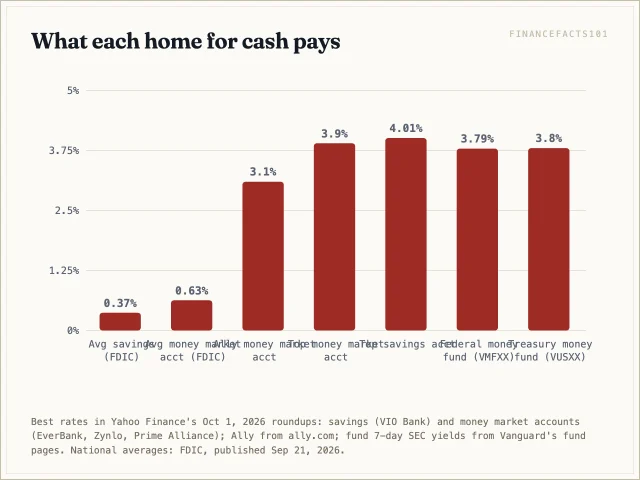
The chart has two stories. The first is the old one: the national average savings rate is 0.37% and the average money market account 0.63%, per the FDIC's national rates published September 21, 2026 (built from data as of the last business day of August). Money left at an average bank earns a tenth of what the top accounts pay. The second story is newer. At the top of the market, a savings account, a money market account and a government money fund now pay within about 0.2 percentage points of one another, so the choice is no longer about yield alone. It is about insurance, state tax and how you get the money out.
Who This Is For — and Who It Isn't
This guide is for a US saver choosing a home for $5,000 to $250,000 of cash that must stay safe and reachable: an emergency fund, a house deposit, a tax payment, the proceeds of a sale. It assumes you will not lock the money up and that you want to compare the three liquid options on equal terms.
It is not for money with a fixed date six or twelve months out. That cash can earn a locked rate, and the trade-offs are covered in high-yield savings vs CDs and T-bills vs CDs, which also explains buying Treasury bills directly. It is not a guide to choosing a bank, checking accounts or account types in general; for how checking, savings, money market accounts and CDs split the jobs, see deposit accounts. And it is not for long-term money, where any of these three will trail a diversified portfolio over a decade.
Three Products, Two Legal Species
The FDIC's own list of what deposit insurance covers names checking accounts, savings accounts, money market deposit accounts and CDs. Its list of financial products that are not insured includes mutual funds, even when bought at an insured bank, and a money market fund is a mutual fund. The IRS draws the same line for tax: Publication 550 says to report amounts received from money market funds as dividend income and adds that money market funds "should not be confused with bank money market accounts that pay interest."
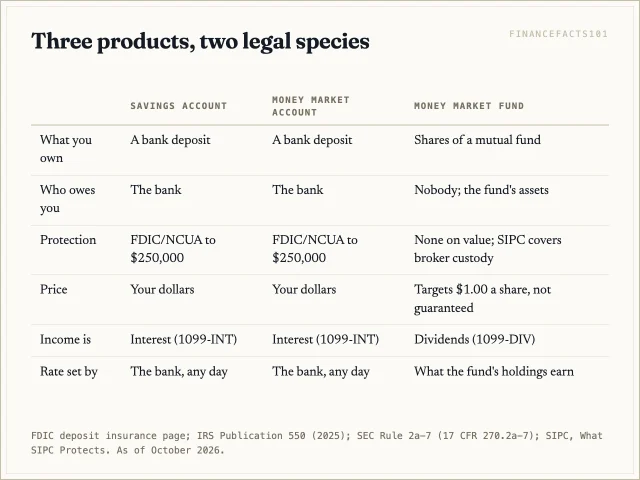
The fund side states the risk in its own documents. Vanguard's fund pages carry the standard warning that the fund "cannot guarantee" it will preserve $1.00 a share and that an investment in it "is not a bank account and is not insured or guaranteed by the Federal Deposit Insurance Corporation or any other government agency." The SEC's Investor.gov bulletin on money market funds says the same in plainer words: money in a money market fund is not guaranteed by the FDIC, so you may lose some or all of it.
None of that makes a government money fund fragile. It makes it a different promise. A deposit is a debt the bank owes you, backed by a government insurer. A fund share is a claim on whatever the fund holds, backed by the quality of those holdings and the rules that constrain them.
What Each Pays on October 1, 2026
The bank side, as of October 1, 2026. The highest savings rate in Yahoo Finance's October 1 roundup without a promo code or deposit condition was VIO Bank Online Savings at 4.01% APY. The headline 4.25% at CIT Bank includes a 0.50-point bonus for six months with a promo code, and Happen Bank's 4.2% requires $250 of deposits every month. Yahoo's October money market roundup, published October 1, put the best accounts at 3.9% (EverBank, Zynlo and Prime Alliance Bank). Ally's money market account paid 3.10% that day, a useful reminder that a household name is not the top payer.
The fund side, from each fund's own page. As of October 1, 2026, Vanguard Federal Money Market Fund (VMFXX) showed a 7-day SEC yield of 3.79% and Vanguard Treasury Money Market Fund (VUSXX) 3.80%, with expense ratios of 0.11% and 0.07%.
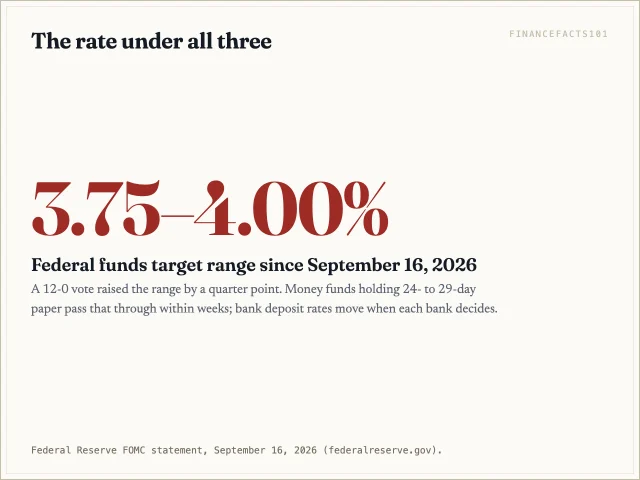
Why the funds sit where they do: the FOMC raised the federal funds target by a quarter point to 3.75%-4.00% on September 16, 2026, and money funds holding paper that matures in about a month (24 days on average at VMFXX and 29 at VUSXX on August 31) reprice within weeks. A bank's savings rate moves only when the bank decides to move it.
Money Market Accounts vs Savings Accounts: Mostly a Label
Inside the bank, the two accounts are close cousins. Both are savings deposits under federal rules, both are insured to the same limit, and both pay a variable rate. The FDIC's averages differ, 0.63% for money market accounts against 0.37% for savings, but part of that gap is the measurement: the FDIC averages money market rates over its $10,000 and $100,000 tiers and savings rates at the $2,500 tier.
The practical differences are features. Ally's money market account comes with checks and a debit card; Sallie Mae's money market account lets you write checks from it. Some money market accounts price in balance tiers or carry a monthly fee unless you keep a minimum. UFB Direct's charges $10 a month below $5,000, per Yahoo's roundup. At the top of the market, the best savings account paid 0.11 points more than the best money market account on October 1, which is $22 a year on $20,000. If you will never write a check from this money, shop the higher rate whatever the account is called.
Inside a Money Market Fund: Rule 2a-7
A money fund can hold its price at $1.00 because federal rules keep its holdings short, liquid and high quality. Those rules are in SEC Rule 2a-7, and they bind every fund that calls itself a money market fund.
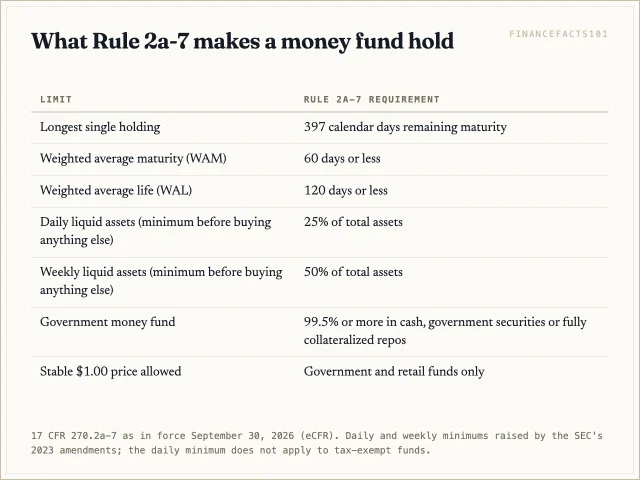
Two definitions in the rule matter for savers. A government money market fund must invest 99.5% or more of its total assets in cash, government securities or fully collateralized repurchase agreements. A retail money market fund limits its owners to natural persons. Only government and retail funds may use amortized-cost or penny-rounding pricing to keep a stable $1.00 share price; institutional prime and institutional tax-exempt funds must float their price, as Investor.gov explains.
The stable price has limits. If a stable-price fund's value per share deviates by more than half a cent from $1.00, it must reprice, which is "breaking the buck." It has happened: the SEC records that the Reserve Primary Fund broke the buck on September 16, 2008, when its net asset value fell below $1 a share; it held $785 million of Lehman-issued securities. That was a prime fund holding corporate debt, not a government fund. The distinction is the one the next two sections turn on. For more history and mechanics, see the site's entry on money market funds.
The 2023 Reforms: What Changed Inside Your Fund
On July 12, 2023 the SEC adopted money market fund reforms, effective October 2, 2023 under the Federal Register notice. Its fact sheet gives the reason: in March 2020, prime and tax-exempt funds, "particularly institutional funds, experienced large outflows."
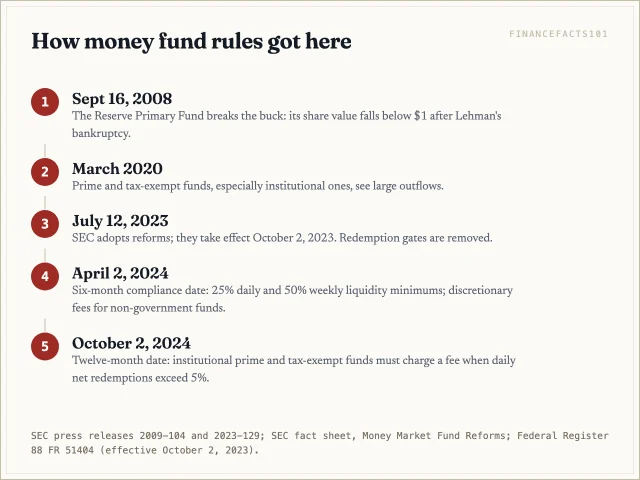
Four changes reached the funds savers own. Redemption gates are gone: a fund can no longer temporarily suspend redemptions to protect its liquidity. Minimum liquidity rose to 25% of assets in daily liquid assets and 50% in weekly liquid assets; a fund below either level may not buy anything except such liquid assets until it is back above. Institutional prime and institutional tax-exempt funds must charge a liquidity fee when daily net redemptions exceed 5% of net assets, unless the fund's liquidity costs are de minimis. And any non-government fund must charge a discretionary fee of up to 2% of the shares redeemed if its board decides a fee is in the fund's best interests.
For a retail saver in a government or Treasury fund, the fee rules have almost no reach. Rule 2a-7 says the discretionary fee requirement does not apply to a government money market fund, though such a fund may choose to rely on it, and the mandatory fee applies only to funds that are neither government nor retail. The reforms also let stable-price government and retail funds handle a negative-rate world by floating the price or cancelling shares, subject to board findings and disclosure. Fund prospectuses say which options a given fund reserves. One escape hatch survives elsewhere in the rules: under Rule 22e-3, a money fund whose board has irrevocably approved liquidation may suspend redemptions, but only after a liquidity or price trigger and notice to the SEC.
Government, Treasury or Prime: Picking the Fund Type
If you choose a fund, the type matters more than the family. Schwab publishes all its money fund yields on one page, which makes the spread visible: on October 1, 2026, its investor-share prime fund paid 3.71%, its government fund 3.58%, its Treasury obligations fund 3.61%, its U.S. Treasury fund 3.53% and its municipal fund 2.94%.
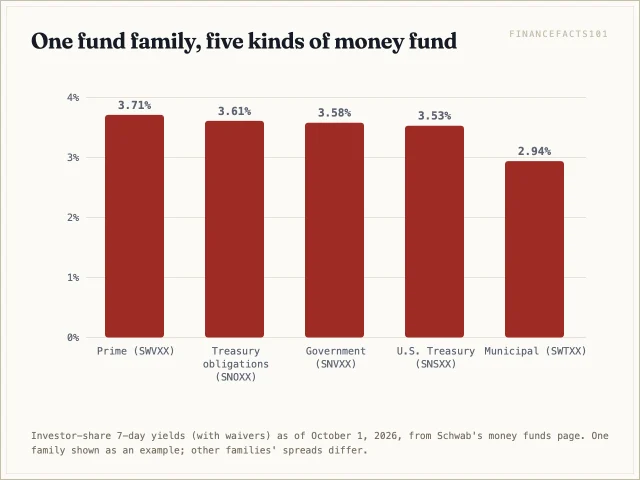
The prime premium at that family was 0.13 points over the government fund, about $26 a year on $20,000. For that, a prime fund holds corporate and bank paper, and it is the kind of fund that can charge a discretionary liquidity fee under the 2023 rules. Most savers who picked a money fund for safety are better served by a government or Treasury fund. Municipal funds pay less before tax and are worth comparing only in high federal brackets, where their federally tax-exempt income can come out ahead.
Government and Treasury funds are not the same either. Vanguard's pages list what each held on August 31, 2026.
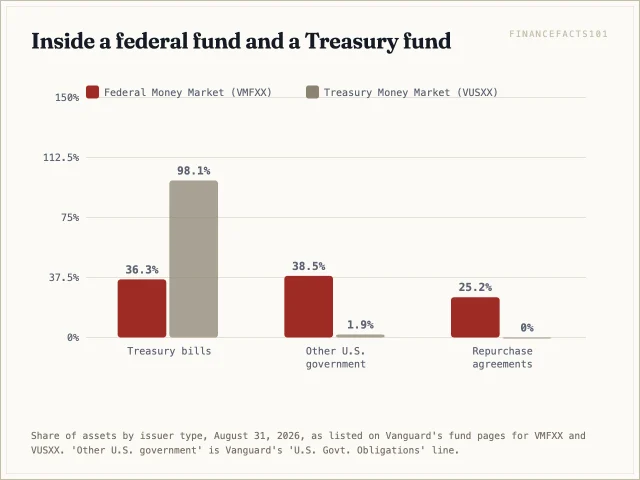
The federal fund held about a quarter of its assets in repurchase agreements and 38% in other government paper, which can include agency debt not backed by the full faith and credit of the United States; its own strategy text says some holdings are "neither guaranteed by the U.S. Treasury nor supported by the full faith and credit of the U.S. government." The Treasury fund held 98% Treasury bills and no repos. That composition decides the state tax answer below.
FDIC vs SIPC: What Protects Each Dollar
Deposit insurance and brokerage protection sound alike and cover different things. The FDIC covers deposits up to $250,000 per depositor, per insured bank, per ownership category, and credit unions carry the same limit through NCUA share insurance. If the bank fails, the insurer pays.
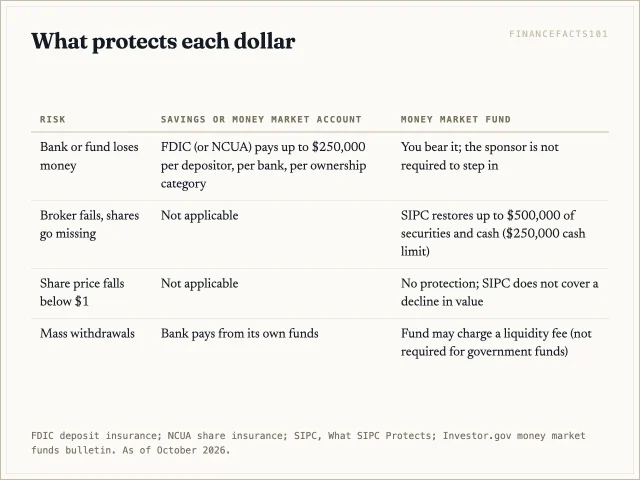
SIPC protects up to $500,000 per customer at a failed member brokerage, including a $250,000 limit for cash, and it counts money market mutual funds as securities. But it protects the custody function only: it restores shares that are missing when a broker fails. In SIPC's own words, it "does not protect against the decline in value of your securities." If a money fund broke the buck, SIPC would not make up the difference.
So the insurance question has a crisp answer. Under $250,000 per bank and ownership category, a deposit is backed by a government insurer and a fund share is not. Above that line, the choice is between spreading deposits across banks and ownership categories or holding a Treasury money fund whose assets are the same Treasury bills you could buy directly.
Taxes: Interest, Dividends and the State Exemption
Federally, the three are taxed the same way. Bank interest is ordinary income reported on Form 1099-INT; money fund distributions are dividends on Form 1099-DIV, and because they come from interest on short-term debt rather than from stock, they generally do not get the lower qualified-dividend rates. The federal bill is the same per dollar earned.
The state bill is where the fund can pull ahead. Federal law, 31 U.S.C. 3124, exempts obligations of the United States government from state and local taxation, with exceptions such as nondiscriminatory franchise taxes on corporations and estate taxes. Bank interest gets no such treatment. A fund dividend is not interest on an obligation you hold, so each state decides whether and how the exemption passes through. California, for example, exempts the U.S.-obligation share of a fund's dividends only if the fund holds at least 50% of its assets in such obligations, per the 2025 Schedule CA instructions. Connecticut (Conn. Gen. Stat. §12-718) and New York (IT-201 instructions, line 28) apply the same test: at least 50% of the fund's assets in U.S. obligations at the close of each quarter. Check your own state's rule before counting on it.
After each year ends, fund companies publish what share of each fund's income came from U.S. government obligations; only that share can be exempt. A fund that holds a quarter of its assets in repos and much of the rest in agency paper reports a smaller share than one holding nearly all Treasury bills. If you want the state exemption, buy the Treasury fund, not the "federal" or "government" one, and confirm its percentage on the tax statement.
Worked Example: $20,000 for a Year, After Tax
Name the assumptions. You have $20,000 and will hold it for twelve months. Every yield stays at its October 1, 2026 level all year, which it will not; these are variable rates. You are in the 22% federal bracket and take the standard deduction, so state tax is not itemized. Fund dividends are paid monthly and reinvested. The Treasury fund's income is entirely state-exempt, consistent with its 98% Treasury-bill portfolio but to be confirmed on its tax statement. The federal fund's income is treated as fully state-taxable, the cautious case.
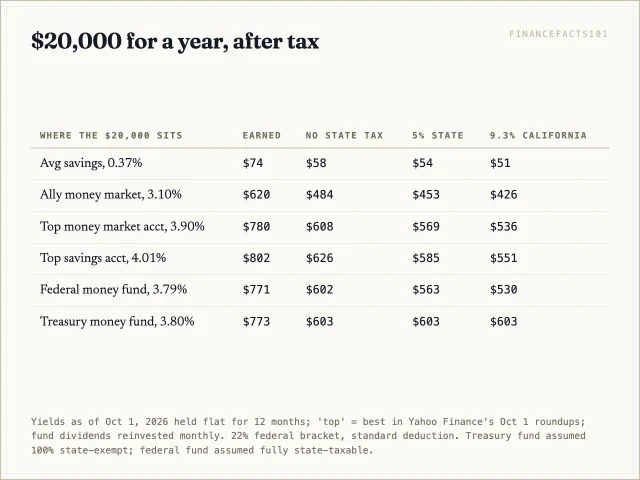
The arithmetic, line by line. The top savings account at 4.01% APY earns $20,000 × 4.01% = $802. The Treasury fund's 3.80% 7-day yield, compounded monthly, is (1 + 0.038/12)^12 − 1 = 3.867%, which matches the 3.87% compound yield Vanguard publishes, and earns $773.38. Federal tax at 22% takes $176.44 from the savings interest and $170.14 from the fund.
With no state income tax, the savings account keeps $625.56 and the Treasury fund $603.23: the bank wins by $22. In a state with a 5% rate, the savings account also loses $40.10 to the state and keeps $585.46, while the fund still keeps $603.23: the fund wins by $17.77. At California's 9.3% bracket the savings account keeps $550.97 and the fund wins by $52.26. The top money market account at 3.90% keeps $608.40, $569.40 and $535.86 in the three cases.
Two quieter lines matter as much. The federal money fund, if its state treatment is no better than a bank's, never beats the top savings account. And the national-average savings account keeps between $51 and $58, so moving $20,000 out of it into any of the other five is worth about $375 to $570 a year after tax, depending on the choice and the state.
To run your own balance and timeline, the compound interest calculator handles any APY, and the savings goal calculator works backwards from a target.
The Crossover: Which State Tax Rate Tips It
The worked example generalizes into one formula. A bank account ties a fully state-exempt fund when its APY equals the fund's effective yield × (1 − federal rate) ÷ (1 − federal rate − state rate). At a 22% federal rate and a 3.867% fund, that is 3.867 × 0.78 ÷ (0.78 − s).
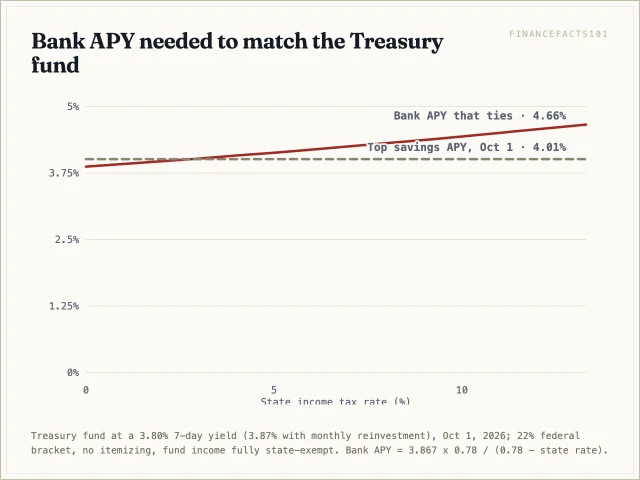
With no state tax, a bank needs 3.87% to tie, so the 4.01% savings account wins. At a 2% state rate it needs 3.97%; at 3%, 4.02%. The top savings account and the Treasury fund cross at a state rate of about 2.8%. Against the 3.90% money market account the crossover is far lower, about 0.7%, so in nearly every state that taxes interest and lets the exemption pass through a fund, the Treasury fund beats the best money market account after tax. At 9.3% a bank would need 4.39%, and at 13.3%, 4.66%, a rate no account in either October 1 roundup paid without conditions.
Two cautions. If you itemize and deduct state income tax, the state's bite is smaller and the crossover moves up. And if your fund's U.S.-obligation share is below 100%, scale the advantage down by the same proportion; in a state with a 50% threshold, such as California, Connecticut or New York, a fund under the line gets no exemption at all.
Getting Money Out: Checks, Cards and Withdrawal Limits
Liquidity is where the bank accounts earn back their slightly lower after-tax yield in high-tax states. A deposit sits at the bank you transfer from; a fund sits in a brokerage account, and spending it means selling shares and then moving the cash.
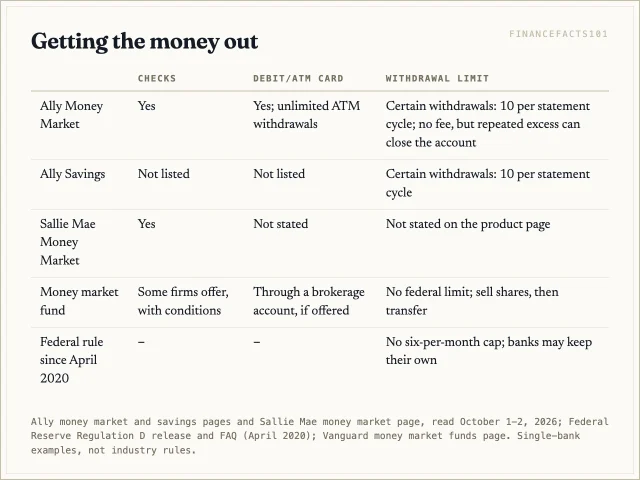
The old federal limit is gone. On April 24, 2020 the Federal Reserve issued an interim final rule deleting the six-per-month limit on convenient transfers from savings deposits, and its savings deposits FAQ says the rule permits banks to stop enforcing the limit but does not require it. The deposit accounts guide covers the history; the point here is what banks do now.
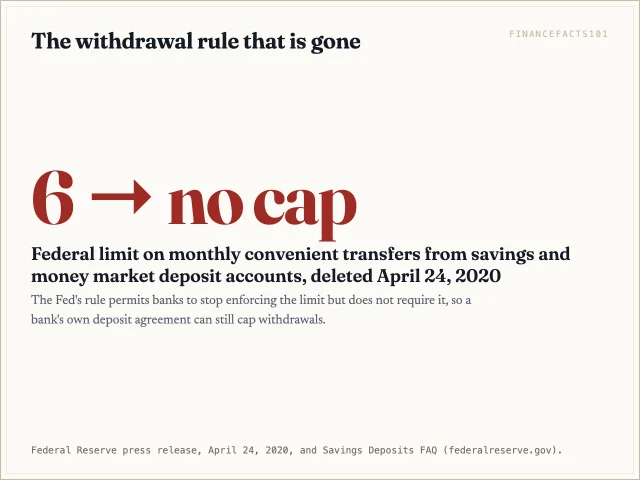
Banks still set their own caps. Ally's money market account allows unlimited ATM withdrawals, but Ally says it limits "certain types of withdrawals and transfers from Savings and Money Market Accounts to a combined total of 10 per statement cycle," per Ally's savings page. Ally charges no fee for going over but says it will close an account that exceeds the limit more than occasionally. That is one bank's policy, not an industry rule, so read your deposit agreement. A money fund has no federal transaction cap, but it has no ATM either: Vanguard's own money market page notes that bank accounts "can offer more liquidity, ATM access, and overdraft protection."
For a fund already inside a brokerage account, the friction is lower. Vanguard sets VMFXX's minimum at $3,000, or $0 when it is the brokerage account's settlement fund, and Schwab lists minimums "as low as $0" for its money funds. If your emergency money must be reachable on a Saturday, keep at least part of it at a bank.
Fees and the 7-Day Yield Fine Print
A bank APY and a fund's 7-day yield are not quite the same measure. APY includes compounding over a year at today's rate. The 7-day SEC yield is the fund's income over the past seven days, annualized without compounding, and because it is built from dividends actually paid it is already net of the fund's expense ratio. That is why the worked example converts 3.80% to 3.867% before comparing. The site's entry on the SEC yield covers the calculation.
Expenses vary more than yields suggest. VUSXX charges 0.07% and VMFXX 0.11%; some funds waive part of their fee, and Schwab labels its figures "with waivers." A waiver can end, and a fund's yield would fall by the amount waived. Banks have their own version: tier minimums, monthly fees below a balance and promotional rates that lapse, like the six-month bonus inside CIT's 4.25%. On the checking side of the same banks, overdraft and monthly fees are tallied in checking account fees by bank.
The Decision
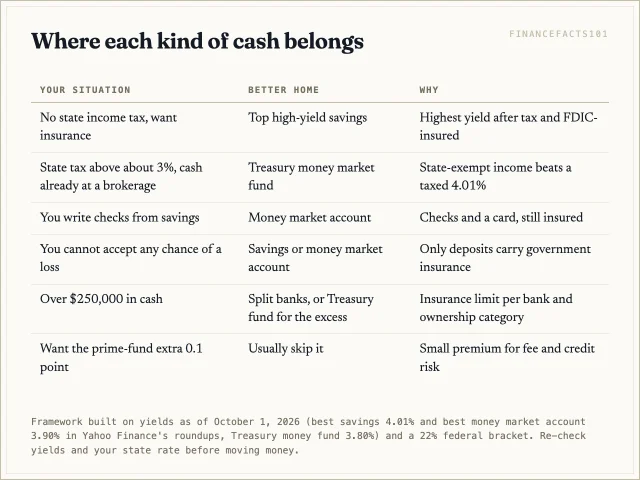
For most readers the answer is a split. Keep the part of your cash you might need on a weekend, or cannot accept any chance of losing, in the best-paying insured account you can find, and call it savings or money market according to whether you want checks. If you live in a state that taxes interest at more than about 3%, and your brokerage account is already open, move the rest of the cash into a Treasury money market fund and confirm its U.S.-obligation share each January. If you pay no state income tax, the top savings account wins on yield as well as insurance, and a fund adds only complexity.
Recheck three numbers before moving money: the savings or money market APY on the bank's own page, the fund's 7-day SEC yield on the fund's own page, and your state's marginal rate. All three move.
FAQ
Is a money market fund as safe as a savings account?
No, though a government or Treasury money fund is very low risk. A savings account is a deposit insured by the FDIC or NCUA up to $250,000 per depositor, per bank, per ownership category. A money fund is an uninsured mutual fund that aims to keep a $1.00 share price but cannot guarantee it; SIPC protects against a broker losing your shares, not against a fall in their value.
Do money market accounts pay more than savings accounts?
On average yes, at the top no. The FDIC's September 21, 2026 averages were 0.63% for money market accounts and 0.37% for savings, partly because money market rates are averaged at higher balance tiers. On October 1, 2026 the best savings account paid 4.01% against 3.90% for the best money market accounts.
Is money market fund income exempt from state tax?
Only the share that comes from U.S. government obligations, and only as your state allows. A Treasury money fund that holds nearly all Treasury bills reports most or all of its income as U.S.-obligation interest; a federal or government fund holding repos and agency paper reports less. California, Connecticut and New York require the fund to hold at least 50% of its assets in such obligations at the end of each quarter before any of the dividend is exempt.
Can a money market fund stop me from withdrawing?
Not by closing the door, except when its board has voted to liquidate the fund (Rule 22e-3). The SEC's 2023 reforms removed redemption gates. Institutional prime and tax-exempt funds must charge a fee on heavy-redemption days, and other non-government funds can charge up to 2% if their board decides to, but government money market funds are not required to impose any fee.
Sources
- FDIC, National Rates and Rate Caps — published September 21, 2026: savings 0.37%, money market 0.63%, tier definitions
- FDIC, Deposit Insurance — money market deposit accounts covered; $250,000 limit
- FDIC, Financial Products That Are Not Insured by the FDIC — mutual funds not insured
- NCUA, Share Insurance Coverage
- Federal Reserve, FOMC statement, September 16, 2026 — target range 3.75%-4.00%
- Federal Reserve, Regulation D interim final rule, April 24, 2020 and Savings Deposits FAQ
- SEC, Rule 2a-7, 17 CFR 270.2a-7 (eCFR)
- SEC, Press release 2023-129, money market fund reforms and fact sheet
- Federal Register, Money Market Fund Reforms, 88 FR 51404 — effective October 2, 2023
- SEC, Press release 2009-104, Reserve Primary Fund
- SEC / Investor.gov, Money Market Funds
- IRS, Publication 550 (2025), Investment Income and Expenses
- 31 U.S.C. 3124, Exemption from taxation (govinfo)
- California Franchise Tax Board, 2025 Schedule CA (540) instructions — 50% rule for fund dividends
- Connecticut General Statutes, §12-718 — 50% quarter-end test for fund dividends
- New York State, IT-201 instructions (2025), line 28 — 50% asset requirement each quarter
- SIPC, What SIPC Protects
- Vanguard, Federal Money Market Fund (VMFXX), Treasury Money Market Fund (VUSXX) and money market funds overview
- Schwab, Schwab Money Funds — 7-day yields as of October 1, 2026
- Yahoo Finance, Best high-yield savings rates, October 1, 2026 and 10 best money market accounts for October 2026
- Ally Bank, Money Market Account and Online Savings Account
- Sallie Mae Bank, Money Market Account
 Next entry · No. 5,986Is Tax-Loss Harvesting Worth It? The Math and the Wash-Sale Rule
See also
-
 No. 5,968
02 Oct 2026
18 min
T-Bills vs CDs vs High-Yield Savings: Where 3-12 Month Cash Goes
Investments
-
 No. 5,930
02 Sep 2026
14 min
High-Yield Savings vs CDs: Where Cash Earns More
Personal Finance
-
 No. 658
16 May 2024
22 min
Understanding Certificates of Deposit (CDs) and Their Benefits
Investments
-
 No. 5,939
11 Sep 2026
14 min
Emergency Fund: How Much and Where to Keep It
Personal Finance
-
 No. 5,988
22 Oct 2026
17 min
Credit Union vs Bank: Which Is Better for You?
Banking
-
 No. 5,955
19 Sep 2026
20 min
Deposit Accounts: Checking vs Savings vs Money Market vs CD
Banking