High-Yield Savings vs CDs: Where Cash Earns More

Top HYSAs pay about 4.1% and 1-year CDs 4.3% as of September 2026. The 0.2-point gap, penalty math, and a $25,000 ladder decide where cash goes.
You have somewhere between $5,000 and $100,000 in cash, and two sensible homes for it: a high-yield savings account paying about 4.1% or a certificate of deposit paying about 4.3%. The high-yield savings vs CDs decision comes down to three numbers — a rate gap of roughly 0.2 percentage points as of September 2026, an early-withdrawal penalty of 2 to 12 months of interest if you break a CD, and your honest odds of needing the money before a term ends.
This guide works through all three with current, sourced rates, prices the penalties in dollars at four named banks, builds a five-rung $25,000 CD ladder you can copy, and ends with a decision table. One line of scope honesty before we start: this is general information built on stated assumptions and rates as of September 2026, not personal advice.
High-Yield Savings vs CDs: The Same Cash, Two Contracts
Both accounts are insured bank deposits. The difference is the contract. A high-yield savings account (HYSA) pays a variable rate the bank can change any day, and you can withdraw any day. A CD pays a rate fixed for a term — commonly 6, 12, or 60 months — and charges a penalty if you leave early.
The rate landscape has a strange shape right now. Per the FDIC's national rate data published August 17, 2026, the national average savings rate is 0.38%, the average 6-month CD pays 1.41%, the average 12-month CD 1.71%, and the average 60-month CD just 1.36%. Meanwhile the top nationally available accounts pay roughly ten times the savings average: about 4.10% on HYSAs (Yahoo Finance, September 1, 2026, with boosted accounts up to 4.21% per NerdWallet), about 4.40% on 6-month CDs and 4.30% on 1-year CDs (Bankrate), and about 4.50% on 5-year CDs (DepositAccounts).
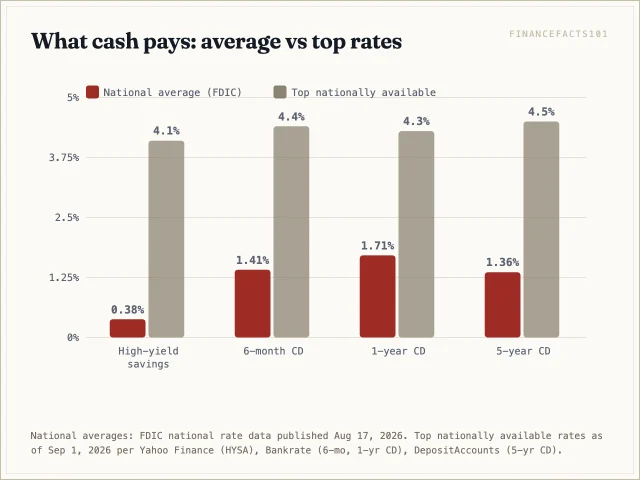
Two facts fall out of that chart. First, the single biggest yield decision is not HYSA versus CD — it is average versus top. Moving $25,000 from a 0.38% branch account to any of the top four options earns you roughly $930 to $1,030 more per year. Second, among the top rates, the HYSA-to-CD gap is thin: 0.20 to 0.40 points. The rest of this article is about whether that thin gap is worth giving up liquidity.
Who This Is For — and Who It Isn't
This guide fits a US saver holding $5,000 to $100,000 in cash that has a job to do within roughly the next five years: an emergency fund, a house down payment, tuition, a car, a planned sabbatical. It assumes you already keep a month of spending in checking and you want zero market risk on this money.
It is not for money you can genuinely leave alone for a decade — over that horizon, cash yields have historically trailed diversified investments, and locking a 4.5% CD for five years is a cash decision, not an investing one. It is also not a Treasury guide: 4- to 52-week T-bills are a third contender for the same dollars, with interest exempt from state income tax, and deserve their own comparison. And if you hold well over $250,000 at a single institution, your first problem is insurance structure, not yield — see the section on limits and the entry on jumbo CDs.
How Each Account Actually Pays
Both products quote an APY — annual percentage yield — which folds compounding into a single comparable number under the federal Truth in Savings rules; the mechanics are covered in the entry on annual percentage yield. What differs is what stands behind the number.
A HYSA's APY is a floating price. It moved up through 2022–2024 as the Federal Reserve raised rates, and it floated down as the Fed cut to a 3.50–3.75% target range by December 2025. On September 16, 2026 the Fed reversed with a quarter-point increase to 3.75–4.00%; a week later the top rate had not moved, still 4.10% on September 23 per Yahoo Finance. The bank owes you nothing beyond the rate it posts each day, and top payers routinely drift: the account that led the tables in 2024 at over 5% often sits in the pack at 3.8–4.1% now.
A CD is a fixed-price contract: the rate at purchase is the rate to maturity, as the CFPB's plain-language definition puts it. Interest typically compounds daily or monthly and is credited to the CD; many banks, Synchrony among them, let you withdraw already-credited interest penalty-free while the principal stays locked.
What $25,000 Earns Over Two Years
Name the assumptions: $25,000, twenty-four months, monthly compounding. Path one is a top HYSA that stays at 4.10% the whole time. Path two is a 1-year CD at 4.30% that renews at the same 4.30% for year two. Neither assumption will hold exactly — that is the point of the later sections — but the arithmetic frames the stakes.

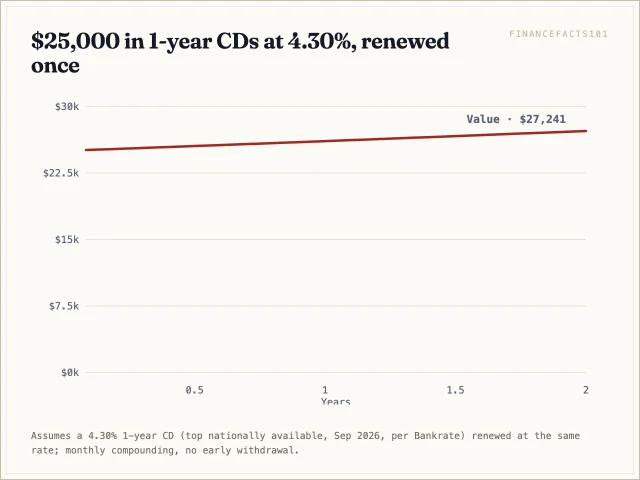
The HYSA path reaches about $26,044 at twelve months and $27,133 at twenty-four. The CD path reaches about $26,096 and $27,241. The CD's whole advantage is $52 in year one and $108 over two years — before any penalty, any rate change, or any real-world friction. On $25,000, a 0.2-point spread is about $4 a month. Hold that number; the penalty section is about to dwarf it.
The Exit Price: Early-Withdrawal Penalties
Break a CD before maturity and the bank claws back interest — measured in days or months of interest, charged even if you have not earned that much yet, which means a very early exit can eat principal. Capital One says this plainly in its 360 CD disclosures: the penalty may exceed the interest you have earned. Here are the published schedules at four widely used online banks, as of September 2026.
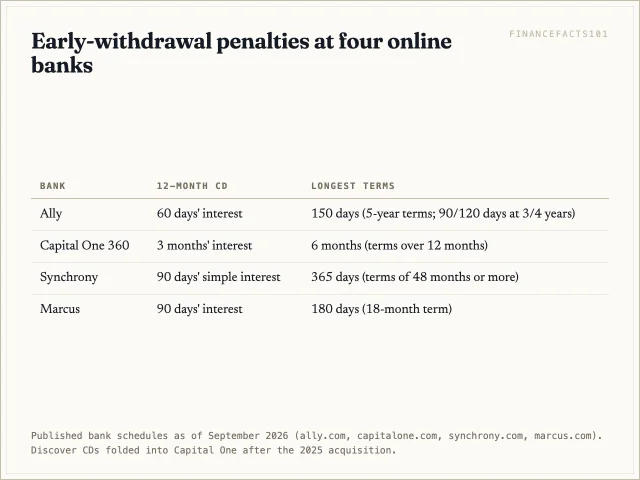
Two structural notes. Ally is the most forgiving at every term (its published schedule runs 60 to 150 days), and Synchrony is the harshest at the long end — a full 365 days of simple interest on terms of 48 months or more. Also, the Discover brand has folded into Capital One: discover.com's CD pages now redirect to Capital One's 360 CDs following the 2025 acquisition, so Discover's old penalty schedule is history.
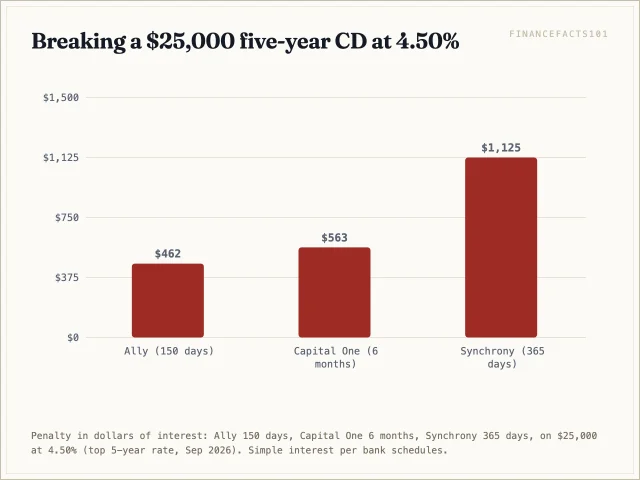
In dollars, on a $25,000 five-year CD at 4.50%: breaking it costs about $462 at Ally, $563 at Capital One, and $1,125 at Synchrony. Compare that to the $52-a-year edge the CD held over the HYSA in the previous section. Breaking a 1-year CD at a 90-day-penalty bank costs about $265 — five years of the CD's advantage, gone in one withdrawal. Some banks (Capital One among them) also prohibit partial withdrawals: it is the whole CD or nothing. If you want a lock with an escape hatch, no-penalty CDs paid up to about 4.18% as of September 2026 per CNBC Select — a fair price for the option.
Rate Risk Cuts Both Ways
The usual pitch says CDs protect you from falling rates. True — but incomplete, and September 2026 is the rare moment when the other direction is live. On July 29, 2026 the FOMC held the federal funds target at 3-1/2 to 3-3/4 percent over three dissents in favor of a quarter-point hike; on September 16 it raised the target to 3-3/4 to 4 percent, unanimously, its first increase since 2023.
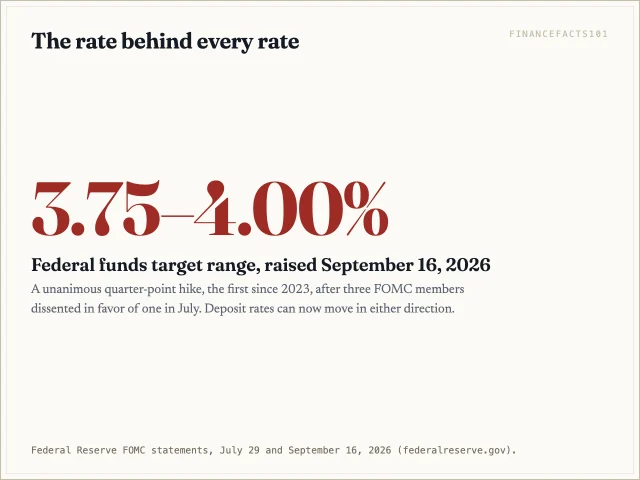
If rates fall, the HYSA follows them down within weeks and the CD holder keeps the locked rate. If rates rise, the HYSA floats up and the CD holder watches from inside the lock — the 4.30% that looked fine in September trails a 4.60% HYSA by spring, and getting out costs the penalty.
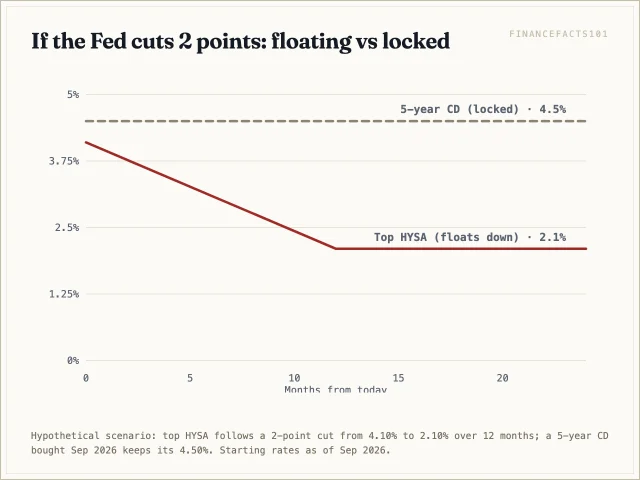
The chart above prices the downside scenario: the Fed cuts 2 points over the next year, top HYSAs drift from 4.10% to about 2.10%, and a 5-year CD bought today keeps paying 4.50%. On $25,000, by the second year the CD is earning roughly $600 more annually. That is what the lock is for. The honest framing: a CD is insurance against cuts that costs you the upside of hikes, and today the market genuinely expects either to be possible.
The CD Ladder: $25,000 in Five Rungs
A ladder buys the long-term rate without the long-term illiquidity. The mechanic, concretely, with $25,000:
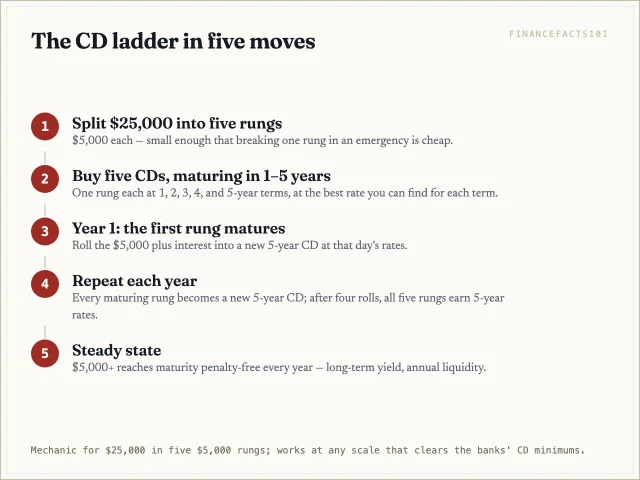
Split the cash into five $5,000 rungs and buy CDs maturing in 1, 2, 3, 4, and 5 years. Every twelve months a rung matures; roll each maturing rung into a new 5-year CD. After four years, every dollar earns 5-year rates, yet $5,000 reaches maturity — penalty-free — every single year.

Now the arithmetic, with the assumption named: suppose every rung pays a flat 4.25% (between today's top 1-year at 4.30% and top 5-year at 4.50%; your actual rungs will vary a little by term). In year one the ladder earns about $1,083 with monthly compounding — checkable as $25,000 × 4.25% = $1,062.50 simple, plus compounding. Each $5,000 rung rolled into a fresh 5-year CD at that rate matures at about $6,182. And the ladder caps your penalty exposure: an emergency between maturities forces you to break one $5,000 rung, not the whole $25,000 — at Ally's 150-day rate that is roughly $92, petty cash next to the $1,000-plus a broken jumbo CD can cost.
Taxes: Ordinary Income Either Way
Neither account wins on taxes. Interest from savings accounts and CDs is ordinary income in the year it is credited, taxed at your marginal bracket — there is no capital-gains treatment for deposit interest. Your bank reports anything over $10 on Form 1099-INT, per IRS Topic 403.
The CD wrinkle: on a multi-year CD that credits interest annually, you owe tax each year on interest you cannot spend without breaking the CD. A $25,000 CD at 4.50% credits about $1,125 in year one; at a 24% marginal rate that is a $270 tax bill paid from other money. Plan the cash flow, or hold longer CDs inside an IRA where the point is moot.
One genuine tax offset: if you do break a CD, the early-withdrawal penalty (box 2 of your 1099-INT) is deductible as an adjustment to income on Schedule 1 — no itemizing required — per IRS Publication 550. It softens the blow at your marginal rate; a $462 penalty nets to about $351 after a 24% deduction benefit. And as noted earlier, T-bill interest escapes state income tax while bank interest does not — a real consideration in high-tax states, outside this guide's scope.
Insurance: The $250,000 Line
Everything in this article rides on the money being genuinely risk-free, so verify the umbrella. FDIC insurance covers $250,000 per depositor, per insured bank, per ownership category — checking, savings, money market accounts, and CDs all count toward the same limit at a given bank. Credit unions carry the identical number through NCUA share insurance, backed by the full faith and credit of the United States.

For the reader with $100,000, one insured bank is fine with $150,000 of headroom. Getting near the line, the levers are simple: a joint account covers $250,000 per co-owner ($500,000 for a couple); a second bank restarts the limit; IRAs sit in their own ownership category. Run your exact titling through the FDIC's EDIE calculator before assuming. The full mechanics are in the site's FDIC guide. One warning shape: chasing a single high CD rate with more than $250,000 at one bank trades a solvency guarantee for basis points, which is a bad trade every time.
Teaser Rates, Tiers, and Quiet Fees
The rate tables are a marketing surface, and four traps recur. First, the boosted APY with hoops: headline rates like "up to 4.21%" often require direct deposits, balance minimums, or linked checking to hit the top tier, and pay far less if you miss one. Read the tier table, not the headline. Second, the promo window: some banks pay a high rate on new money for 3–6 months, then quietly reprice to the pack; the FDIC's 0.38% national savings average exists because balances sit still after the promo fades. Inertia is the most expensive fee in banking.
Third, CD auto-renewal. At maturity most CDs roll automatically into a new term at whatever the bank pays that day, and you get a short grace window — 10 days at Capital One — to object. Calendar every maturity date; a ladder makes this an annual five-minute chore. Fourth, minimums and transfer friction: some top CDs want $500 to $10,000 to open, and a HYSA at a separate online bank moves money to your checking in one to three business days, not instantly. A linked savings setup closes most of that gap for the everyday buffer.
Where the Crossover Sits
Put the pieces together and the crossover is sharp. Today's 1-year CD at 4.30% beats today's 4.10% HYSA only if the HYSA's average rate over the next twelve months ends below 4.30%. One quarter-point Fed cut in the first half of the term, passed through by your bank, does it. One quarter-point hike hands the year to the HYSA. At a 0.2-point spread, the CD is essentially a free-ish bet on cuts — worth $52 a year on $25,000 if rates sit still.
The penalty flips the calculus the moment liquidity matters. Break that 1-year CD at a 90-day-penalty bank and you are down $265 — about five years of the CD's edge. So the rule: money with a real chance of moving in the next 12 months belongs in the HYSA at any spread under about half a point; money you are certain stays put belongs in the CD or ladder, because certainty is exactly what the lock pays for. The 5-year CD at 4.50% is a different bet entirely — that is 0.4 points over today's HYSA plus insurance against every cut for five years, and its enemy is not the HYSA but the hike cycle the July dissenters wanted.
The Decision Framework
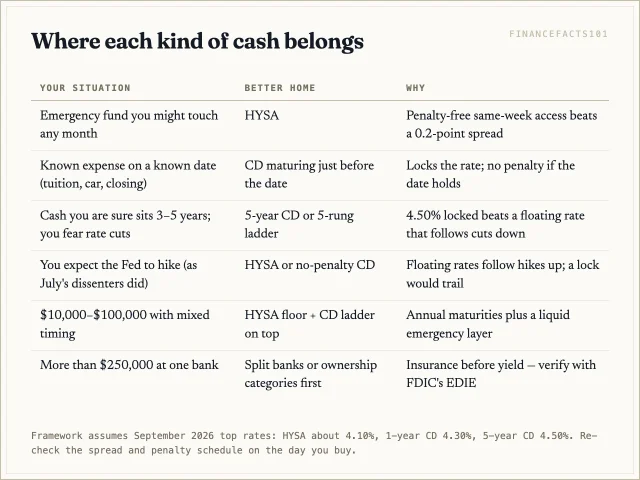
For most readers in the $5,000–$100,000 band the answer is a split, not a winner. Hold your emergency floor — three to six months of expenses — in the top-rate HYSA you can find, accept that its rate will drift with the Fed, and re-shop it once a year. Ladder the cash above the floor into five rungs if the pile is $10,000 or more; below that, a single 12-month CD or a no-penalty CD does the job with less bookkeeping. Check the two numbers that decide everything — the current spread and your bank's penalty schedule — on the day you buy, and put every CD maturity date in your calendar.
FAQ
Do CDs pay more than high-yield savings accounts right now?
Barely, at the top of the market: about 4.30–4.50% on the best 1- to 5-year CDs versus about 4.10% on the best HYSAs as of September 2026. The averages are stranger — the FDIC's average 12-month CD (1.71%) out-pays the average 60-month CD (1.36%), a leftover of the inverted curve — which is why you shop top rates, not averages.
What actually happens if I need my CD money early?
You request the withdrawal, the bank closes or reduces the CD, and it deducts the penalty — typically 60 to 365 days of interest depending on bank and term — from your proceeds. If you have not yet earned that much interest, the difference comes out of principal. Some banks, including Capital One, do not allow partial early withdrawals at all.
Do I owe taxes on CD interest before the CD matures?
Yes, if the interest is credited to your account along the way, which is how most bank CDs work. You will get a 1099-INT each year and owe ordinary income tax on that year's credited interest even though the cash is locked until maturity. See IRS Topic 403 and Publication 550.
Is $100,000 safe in one bank account?
Yes, provided the bank is FDIC-insured (or the credit union is NCUA-insured) and your combined deposits there, across checking, savings, and CDs in the same ownership category, stay at or under $250,000. Verify your exact situation with the FDIC's EDIE calculator.
Sources
- FDIC, National Rates and Rate Caps — national average deposit rates, published August 17, 2026
- FDIC, Deposit Insurance and the EDIE estimator — the $250,000 coverage rules
- Federal Reserve, FOMC statement, July 29, 2026 — 3.50–3.75% target range, three dissents for a hike
- Federal Reserve, FOMC statement, September 16, 2026 — target range raised 0.25 point to 3.75–4.00%, 12–0 vote
- NCUA, Share Insurance Coverage — the credit-union parallel to FDIC coverage
- IRS, Topic 403, Interest Received and Publication 550 — taxation of interest and the penalty deduction
- CFPB, What is a certificate of deposit?
- Bankrate, Best 1-Year CD Rates, September 2026
- NerdWallet, Best High-Yield Savings Accounts, September 2026
- Yahoo Finance, Best high-yield savings rates, September 1, 2026
- DepositAccounts, Best 5-Year CD Rates
- CNBC Select, Best no-penalty CD rates
- Ally Bank, CD early withdrawal penalties
- Capital One, 360 CD disclosures
- Synchrony Bank, CD early withdrawals explained
- Marcus by Goldman Sachs, CD rates and terms
 Next entry · No. 5,931Roth vs Traditional IRA: Which Saves You More Tax
See also
-
 No. 5,968
02 Oct 2026
18 min
T-Bills vs CDs vs High-Yield Savings: Where 3-12 Month Cash Goes
Investments
-
 No. 5,953
18 Sep 2026
17 min
Adjustable-Rate CDs: What the Bump-Up Option Really Costs
Banking
-
 No. 658
16 May 2024
22 min
Understanding Certificates of Deposit (CDs) and Their Benefits
Investments
-
 No. 5,990
24 Oct 2026
19 min
CD Ladder: Is It Worth It, and How Do You Build One?
Banking
-
 No. 5,985
19 Oct 2026
20 min
Money Market vs Savings: Account, Fund or High-Yield Savings?
Banking
-
 No. 5,955
19 Sep 2026
20 min
Deposit Accounts: Checking vs Savings vs Money Market vs CD
Banking