T-Bills vs CDs vs High-Yield Savings: Where 3-12 Month Cash Goes
Treasury bills paid 4.18% to 4.48% on Sept. 25, 2026, above the best CDs and savings at 4.10% to 4.35%, and state tax doesn't touch them. The crossover math.
For cash you will not touch for 3 to 12 months, Treasury bills pay more than the best CDs and high-yield savings accounts right now: on September 25, 2026, Treasury quoted 13-, 26- and 52-week bills at 4.18%, 4.36% and 4.48%, against about 4.10% for the top savings account and 6-month CD and 4.35% for the best 1-year CD. The T-bills vs CDs gap then widens after tax, because bill interest is exempt from state and local income tax and bank interest is not, so the part of your cash with a known date goes in bills and the part you might need any given week stays in a high-yield savings account.
Below: how to put a bill quote on the same basis as an APY, the state-tax crossover from 0% to 13.3%, $25,000 run through all three options for six months, and the cost of getting out early. This is general information built on stated assumptions and rates as of late September 2026, not personal advice.
T-Bills vs CDs: The Short Answer for Autumn 2026
The ranking was closer a month ago. The 52-week bill auctioned on September 1 cleared at a 4.161% investment rate, below the 4.35% the best 1-year CD pays today; by September 25 the same maturity quoted 4.48%. What changed is the Federal Reserve. On September 16 the FOMC raised the federal funds target range to 3-3/4 to 4 percent by a 12-0 vote, and the bill market repriced within days. Bank deposit rates mostly have not moved yet.
So the answer depends on your horizon. Under three months, a bill and a top savings account finish within about $10 of each other on $25,000. Between three and twelve months, bills lead by 0.1 to 0.3 points before tax. Add a state income tax of 5% or more and the lead roughly doubles. The rest of this guide is about the cases where that answer is wrong: when you will need the money early, when you live somewhere with no income tax, and when rates move before your bill matures.
Who This Is For — and Who It Isn't
This is for a US saver holding $5,000 to a few hundred thousand dollars of cash that has a job within the next year: a tax bill in April, tuition in January, a house closing in the spring, a car you will pay for in cash. It assumes you already keep a working buffer in checking and want no stock-market risk on this money.
It is not for your emergency fund. Money you might need on a Tuesday afternoon belongs somewhere you can reach it without selling anything; sizing that buffer is covered in the guide to how much emergency fund you need. It is not for money with a five-year horizon, where CD ladders and longer Treasuries are the real contest. And if you are only choosing between two bank products, the dedicated comparison of high-yield savings vs CDs goes deeper on penalty schedules and ladders than this guide does.
Today's Yields, Side by Side
Treasury publishes daily bill rates, which are indicative closing bid quotes collected by the New York Fed around 3:30 p.m. each business day. The FDIC publishes national average deposit rates on the third Monday of each month; the September 21, 2026 table, built from end-of-August data, puts the average savings account at 0.37%, the 3-month CD at 1.13%, the 6-month CD at 1.41% and the 12-month CD at 1.73%.
At the top of the bank market on September 25, CIT Bank's savings account paid 4.10% APY, the highest among Yahoo Finance's listed partners. Synchrony's 6-month CD paid 4.10%, and E*TRADE's 12-month CD, issued by Morgan Stanley Private Bank, paid 4.35%, per Yahoo Finance's CD roundup and its Bankrate-powered rate table. Those are single-bank examples; your own bank's rates may be far lower.
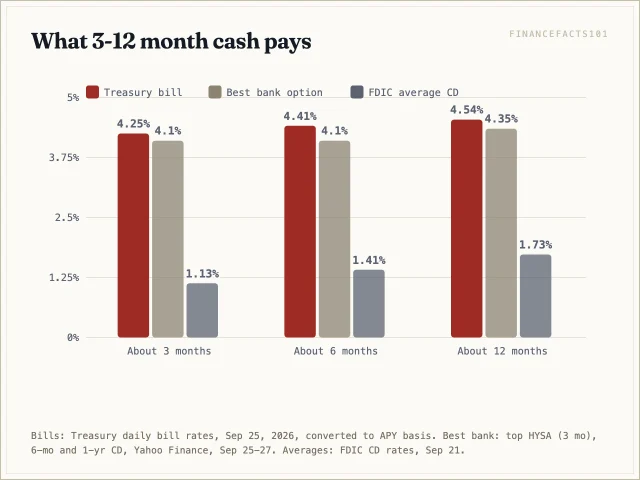
Two things stand out. The first is how far both products sit above the averages: a 12-month CD at the FDIC average earns about $433 a year on $25,000, while a top 1-year CD or a 52-week bill earns more than $1,080. The second is that the bill leads at every term once the yields are put on the same basis, which is the next section's job.
Reading a Bill Quote Against a Bank APY
A bill pays no coupon. You buy it below face value and collect face value at maturity; the difference is the interest. TreasuryDirect's pricing page gives the formula: price = face value × (1 − discount rate × days ÷ 360). That discount rate is the number bill traders quote, and it understates what you earn, for two reasons: it is computed on face value rather than on the smaller amount you actually pay, and it uses a 360-day year.
Treasury therefore also publishes an investment rate, or coupon-equivalent yield, on a 365-day basis. A bank APY goes one step further and assumes interest compounds. To compare fairly, convert the bill to what it would earn in a year if rolled at the same rate. The fuller explanation is in the entry on bond-equivalent yield.
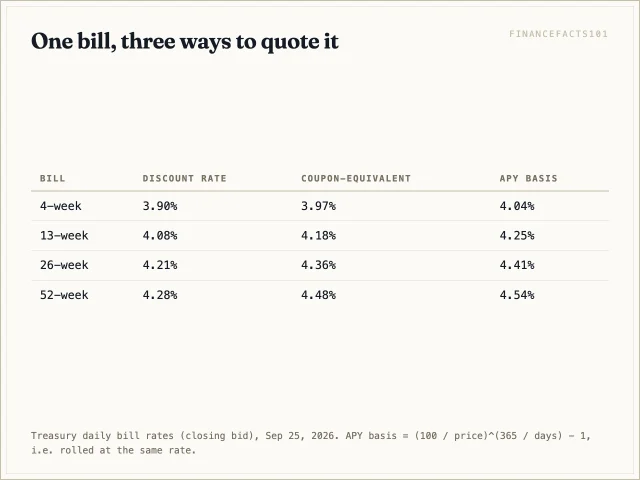
Take the 26-week bill sold at the September 21 auction. Its auction results show a 4.155% discount rate, a 4.303% investment rate, and a price of $97.899417 per $100. Check the price yourself: 100 × (1 − 0.04155 × 182 ÷ 360) = 97.8994. Your return over 182 days is 100 ÷ 97.899417 − 1 = 2.146%, which is 4.35% as an annual, APY-style yield. That is the number to set beside a CD's 4.10% APY. If you model a rolled bill in the site's compound interest calculator, enter the investment rate with quarterly compounding for a 13-week bill; enter a bank APY with yearly compounding.
How Fast Bills Reprice — and Deposits Don't
Every bill term except the 52-week is auctioned weekly, so bill yields follow the Fed within days, and often ahead of it. Across the four weekly auctions from August 31 to September 21, the 26-week bill's investment rate rose from 4.018% to 4.303% and the 13-week from 3.859% to 4.113%. The biggest jump came at the September 14 auction, two days before the decision, as the market priced the hike in; the rest followed the week after.
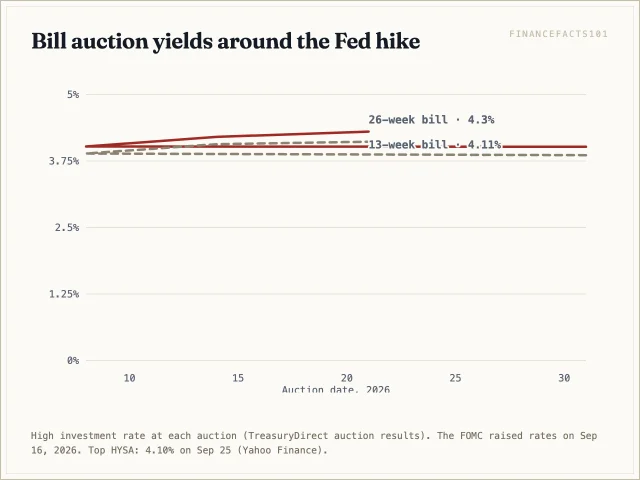
The top savings rate, 4.10% at CIT Bank on September 25, has not moved since before the hike. Banks reprice deposits slowly in both directions, a pattern the guide to prime rate changes traces for loans and savings alike. That lag is the whole opportunity right now. It also means the gap may narrow: Yahoo Finance's September 25 roundup says savings rates will not jump immediately but will likely start ticking up after the hike.
The State Tax Exemption, and Where It Crosses Over
Interest on Treasury bills is taxable federally but, in the words of IRS Publication 550, "exempt from all state and local income taxes." The statute behind that is 31 U.S.C. § 3124, which exempts federal obligations from state and local taxation with two exceptions: a nondiscriminatory franchise tax on corporations, and estate or inheritance taxes. For an individual, that means state income tax and city income tax both skip bill interest. Interest on CDs and savings accounts gets no such break.
The crossover formula is short. If your federal rate is f and your state rate is s, and you take the standard deduction (so state tax does not reduce your federal tax), a fully taxable CD has to yield the bill's yield × (1 − f) ÷ (1 − f − s) to leave you with the same money. If you itemize and your state tax is deductible without hitting the SALT cap, use the simpler bill yield ÷ (1 − s), which gives a slightly lower hurdle.
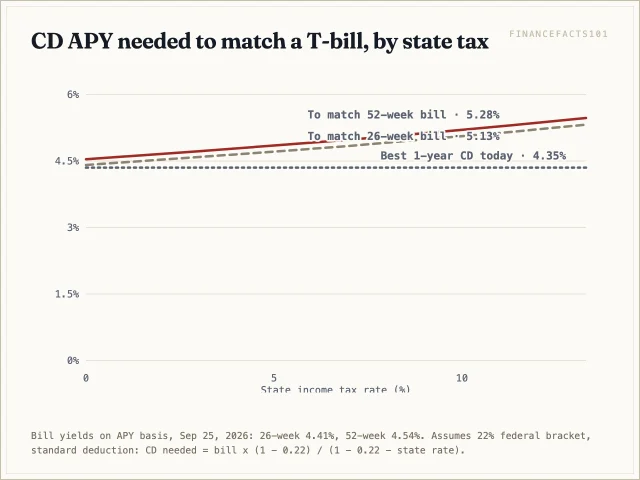
Worked through at a 22% federal bracket: against the 26-week bill's 4.41% effective yield, a CD needs 4.71% in a 5% state, 5.01% in a 9.3% state, and 5.32% in a 13.3% state. Against the 52-week bill, the hurdles are 4.85%, 5.15% and 5.47%. The best 1-year CD in the table pays 4.35%. At today's rates, the state exemption turns a small lead into a large one; in a state with no income tax, the bill still leads, just by less.
Two limits on the exemption. It covers Treasury securities you hold directly; a money market or bond fund passes it through only to the extent your state allows, and state rules differ on how much of a fund's Treasury income qualifies. And it does nothing for federal tax, including the 3.8% net investment income tax, which Publication 550 applies above $200,000 of modified adjusted gross income for single and head-of-household filers and $250,000 for joint filers, and which hits bill and bank interest alike.
Worked Example: $25,000 for Six Months
Name the assumptions. You have $25,000 for a payment due in late March 2027. You are in the 22% federal bracket and take the standard deduction. You compare three options at late-September rates:
- A 26-week bill at the September 21 auction price of 97.899417. You buy $25,500 of face value, which costs $24,964.35; the leftover $35.65 stays in checking. On March 25, 2027 you receive $25,500, so your interest is $535.65.
- A 6-month CD at 4.10% APY. Over 182 days, $25,000 earns 25,000 × (1.041^(182/365) − 1) = $505.95.
- A high-yield savings account at 4.10% APY, assuming the rate holds: the same $505.95.
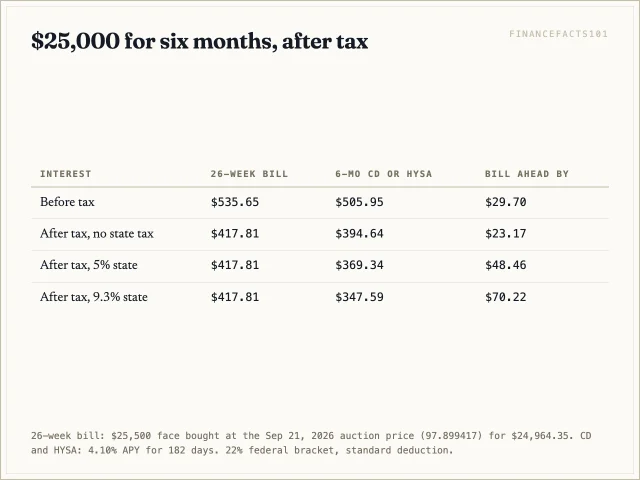
Before tax the bill is ahead by $29.70 on slightly less money. After tax, the lead is $23.17 in a state with no income tax, $48.46 in a 5% state, and $70.22 in a 9.3% state. On larger balances the gap scales in proportion: at $250,000 in a 9.3% state, about $700 for six months.
Note what the example says about the CD: at six months the best CD pays no more than the best savings account, so the lock only protects you against falling rates while the Fed is raising them. At twelve months the picture is similar: a 52-week bill bought at the September 25 quote earns about $1,131 on $25,000, a 4.35% CD $1,088, and a savings account $1,025 if 4.10% holds for a year. At 5% state tax, the bill comes out about $88 ahead of the CD after tax.
Getting Out Early: Selling a Bill vs Breaking a CD
Plans change, and each product has a different exit.
A CD has a fixed exit fee. Synchrony, for example, charges 90 days of simple interest on terms of 12 months or less. If you break a $25,000, 4.10% APY CD after 60 days, you have earned about $166 of interest and pay a penalty of about $248 (90 days at the 4.02% interest rate behind that APY), so you walk away with roughly $82 less than you deposited. Other banks charge less or more; the high-yield savings vs CDs guide tabulates four schedules.
A bill has a market exit. You can sell it before maturity, but only through a bank, broker, or dealer, at whatever price the market pays that day. If yields have not moved, you collect your accrued interest; if they have risen, the price is a little lower. Short maturities keep that swing small.
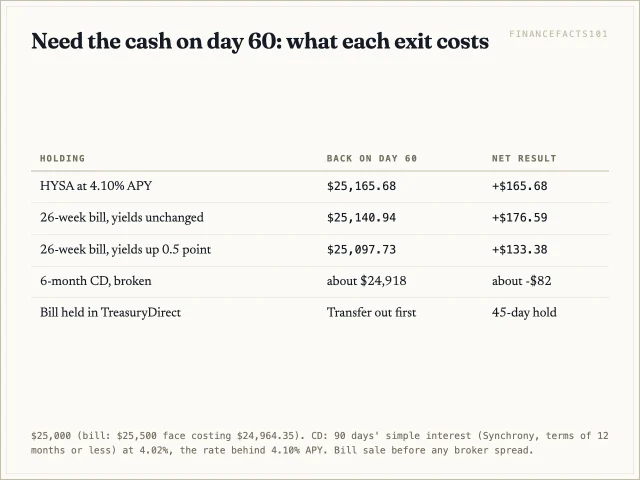
Take the example's 26-week bill, sold 60 days in with 122 days left. If bill yields are unchanged, it is worth about $25,141, so you have earned $177. If the discount rate has jumped half a point, to 4.655%, it is worth $25,098 and you have still earned $133. A broker's spread comes off those figures; Fidelity, as one example, charges $0 online for Treasury trades but notes that mark-ups and mark-downs may affect the total cost. Either way, a positive return beats a penalty that eats principal.
The catch is where the bill is held. TreasuryDirect requires you to hold a new security for 45 days before selling or transferring it, which, in TreasuryDirect's own words, means "you can't sell or transfer a 4-week bill from TreasuryDirect because it matures in less than 45 days." After the hold, you still have to move the bill to a broker with FS Form 5511 before selling. If there is a real chance you will need the money early, buy the bill at a brokerage.
FDIC Insurance vs the Full Faith and Credit
Both products are about as safe as US money gets, but the guarantees are different. FDIC deposit insurance covers savings accounts and CDs to at least $250,000 at each insured bank, with more available through different ownership categories such as joint accounts. It does not cover Treasuries. The FDIC's own list of products it does not insure includes "U.S. Treasury Bills, Bonds or Notes," with the footnote that these "are backed by the full faith and credit of the U.S. government."
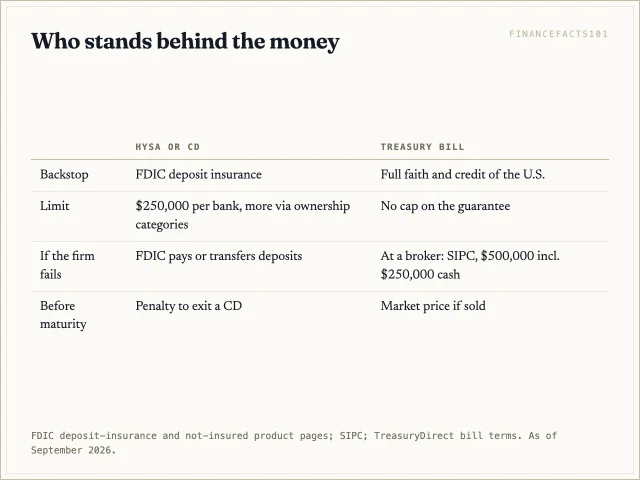
Bank failures still happen, and insured depositors rarely notice. On September 25, 2026, California regulators closed Nano Banc of Irvine, and Sunwest Bank assumed substantially all of its $686 million in deposits. Customers kept immediate access to their money. The $250,000 line matters for large balances: above it, a single bank is a credit risk, while a bill has no cap on the guarantee.
A bill held at a broker adds one layer. If the brokerage itself fails, SIPC protects missing customer securities, Treasuries included, up to $500,000 with a $250,000 limit for cash. It does not protect against a decline in market value, which matters only if you sell before maturity.
How to Buy: TreasuryDirect or a Brokerage
TreasuryDirect is Treasury's own platform. You place a non-competitive bid before the auction, which guarantees you the amount you asked for at whatever rate the auction sets. The bill page lists the terms: 4, 6, 8, 13, 17, 26 and 52 weeks, a $100 minimum in $100 increments, and a $10 million cap per auction for non-competitive bids. Results appear in your account after 5 p.m. Eastern on auction day, and the purchase money must be in your linked bank account before the issue date.
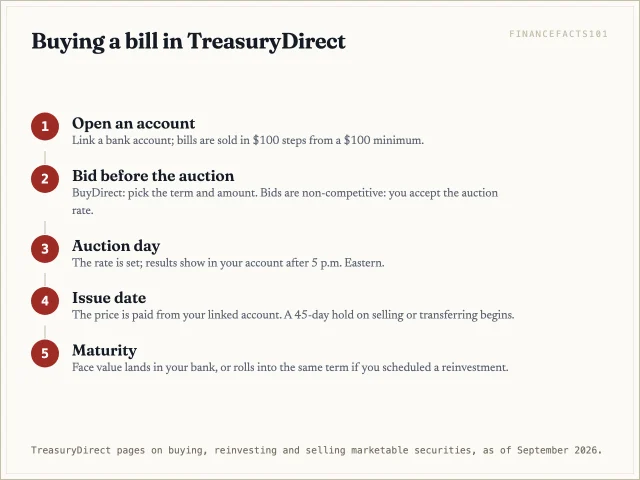
A brokerage account does all of that and adds a secondary market. You can bid at auction, buy an existing bill any trading day, or sell one. Two points of friction apply: the price you pay in the secondary market is the ask, so your yield lands a little below Treasury's published bid-side quotes, and each firm's auto-roll feature works differently.
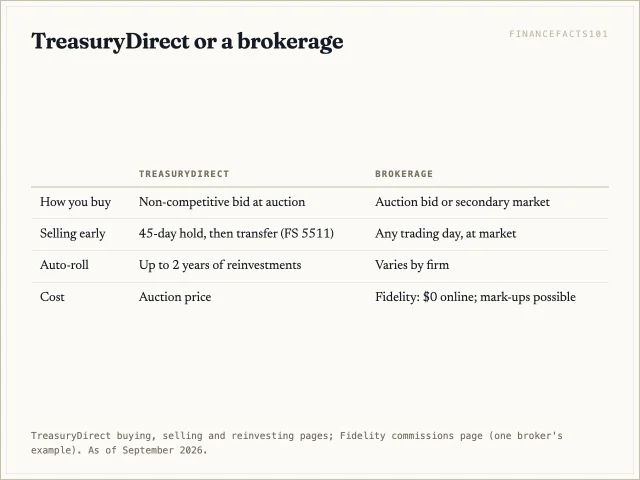
For the 3-to-12-month question, the rule of thumb is simple. If the date is fixed and you are sure of it, TreasuryDirect does the job. If there is any chance you will want out, use the brokerage.
Reinvestment Risk: What Happens When the Bill Matures
A CD locks one rate for its term. A 13-week bill locks a rate for 13 weeks, and then you buy another at whatever the market pays. TreasuryDirect lets you schedule reinvestments for up to two years, meaning up to seven for a 13-week bill, three for a 26-week, or one for a 52-week; the option closes four business days before each auction. Automating the roll does not remove the rate risk; it only keeps cash from sitting idle.
So for a full year, the question is whether to roll short bills or lock a 52-week bill. On September 25 the answer tilted toward locking, because the curve slopes up: the 52-week yielded 4.48% against 4.18% for the 13-week. Rolling a 13-week bill four times at an unchanged 4.18% earns about $1,059 on $25,000, while the 52-week earns about $1,131.
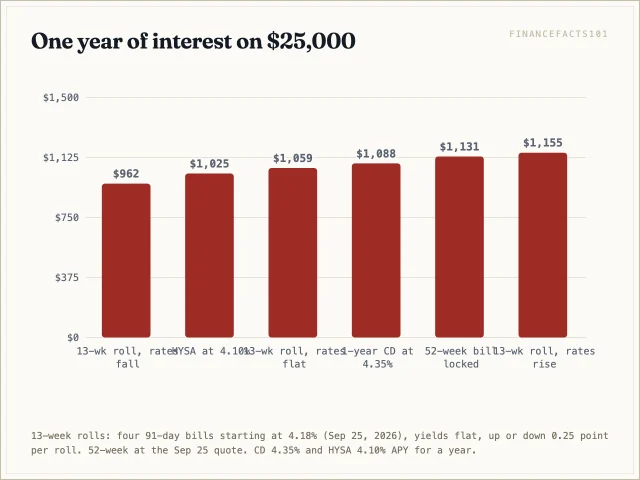
Rolling wins only if short yields rise by about 0.37 point by the first roll and stay there. That is roughly one and a half more quarter-point hikes, and the FOMC meets on October 27-28 and December 8-9. If 13-week yields instead fall a quarter point each quarter, the roll earns about $962, $169 less than the lock. Rolling is a bet that the Fed keeps hiking; locking is a bet that it doesn't. If you have no view, the 52-week bill is the higher-yielding default for money you will not need for a year.
When Bill Interest Is Taxed Federally
Timing can help, too. Per Publication 550, you generally report bill interest in the year the bill matures. A 26-week bill issued on October 1, 2026 and maturing on April 1, 2027 puts all of its interest on your 2027 return, reported in box 3 of Form 1099-INT; TreasuryDirect's tax forms page explains how to get the form.
Savings interest is taxable as it is credited. A CD of a year or less that pays only at maturity is treated much like a bill; Publication 550 covers accounts that "mature in 1 year or less and pay interest in a single payment at maturity." But many CDs credit interest monthly, and interest you can withdraw without a substantial penalty is taxable when credited. If you sell a bill before maturity, the gain is ordinary income up to your ratable share of the discount; only any gain beyond that is a capital gain.
Where the High-Yield Savings Account Still Wins
The savings account loses on yield but wins on access: it is the only one of the three you can draw from any day without a sale or a penalty, and it needs no auction calendar. Its rate also follows the Fed up on its own, so if the September hike reaches deposits, the gap to bills narrows without any action from you.
That makes it the home for money whose date you do not know: the emergency floor, a job-change buffer. If you are still building toward a dated goal, the savings goal calculator sizes the monthly deposit; once the pile is complete and the date is fixed, move it into bills. Brokered CDs, which trade at market prices like bills, are covered in the guide to adjustable-rate CDs.
The Decision, by Horizon
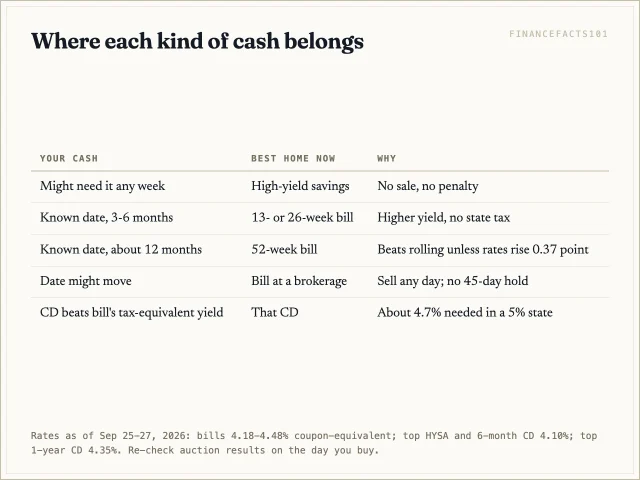
Taken together, the rule for late 2026 is to sort your cash by date, not by product. Keep money you might need any week in the best savings account you can find. Put money with a known date 3 to 12 months out in the bill that matures just before it, at a brokerage if there is any chance you will need to sell. Buy a CD only when its APY beats the bill's taxable-equivalent yield for your state, which at today's rates takes about 4.7% in a 5% state. Check the latest auction results and your bank's posted rate on the day you buy: the 13- and 26-week auctions on September 28 and the 52-week on September 29 will have reset the bill numbers again by the time you read this.
FAQ
Are T-bills better than CDs right now?
For most 3- to 12-month money, yes. On September 25, 2026, 26- and 52-week bills yielded 4.36% and 4.48% (about 4.41% and 4.54% on an APY basis) against 4.10% for a top 6-month CD and 4.35% for a top 1-year CD, and bill interest is free of state and local income tax. A CD wins only if its APY clears the bill's taxable-equivalent yield for your state.
Can I lose money on a Treasury bill?
Not if you hold it to maturity: you receive the full face value, backed by the full faith and credit of the United States. If you sell before maturity, the price depends on market rates that day. On a bill with four months left, a half-point jump in yields cuts the price by about 0.17%, roughly $43 on $25,500 of face value, and there is no early-withdrawal penalty on top.
Do I pay state tax on T-bill interest?
No. Interest on Treasury bills, notes and bonds is subject to federal income tax but exempt from state and local income taxes under 31 U.S.C. § 3124, as IRS Publication 550 confirms. Mutual funds that hold Treasuries pass the exemption through only as far as your state permits.
Should I buy T-bills through TreasuryDirect or a brokerage?
Use TreasuryDirect if you will hold to maturity: it takes $100 minimums and can auto-reinvest bills for up to two years. Use a brokerage if you might sell early, because a bill bought in TreasuryDirect must be held 45 days and then transferred to a broker before it can be sold.
Sources
- Federal Reserve, FOMC statement, September 16, 2026 — target range raised to 3.75–4.00%, 12–0 vote
- Federal Reserve, FOMC meeting calendars — October 27-28 and December 8-9, 2026 meetings
- U.S. Treasury, Daily Treasury Bill Rates, September 2026 — September 25 bank discount and coupon-equivalent quotes
- TreasuryDirect, Auction announcements, data and results — bill auctions of August 31 to September 21, 2026
- TreasuryDirect, Treasury Bills — terms, $100 minimum, $10 million non-competitive cap, tax status
- TreasuryDirect, Understanding pricing and interest rates — the bill price formula
- TreasuryDirect, Buying a Treasury marketable security — non-competitive bids, 45-day hold
- TreasuryDirect, Selling a Treasury marketable security and Transferring between systems — FS Form 5511
- TreasuryDirect, Reinvesting a Treasury marketable security — reinvestment limits by bill term
- TreasuryDirect, Tax forms and tax withholding
- IRS, Publication 550, Investment Income and Expenses — Treasury bill and CD interest timing, state-tax exemption, short-term obligation gains
- U.S. Code, 31 U.S.C. § 3124, Exemption from taxation
- FDIC, National Rates and Rate Caps, September 21, 2026
- FDIC, Deposit Insurance and Financial products that are not insured
- FDIC, Sunwest Bank assumes all deposits of Nano Banc, September 25, 2026
- SIPC, What SIPC protects
- Yahoo Finance, Best high-yield savings rates today, September 25, 2026
- Yahoo Finance, The best CD rates for September 2026 — rates as of September 27, 2026
- Synchrony Bank, CD early withdrawals explained
- Fidelity, Commissions and fees
 Next entry · No. 5,969Should I Do a Roth Conversion in 2026? How Much to Convert
See also
-
 No. 5,930
02 Sep 2026
14 min
High-Yield Savings vs CDs: Where Cash Earns More
Personal Finance
No. 5,930
02 Sep 2026
14 min
High-Yield Savings vs CDs: Where Cash Earns More
Personal Finance -
 No. 658
16 May 2024
22 min
Understanding Certificates of Deposit (CDs) and Their Benefits
Investments
No. 658
16 May 2024
22 min
Understanding Certificates of Deposit (CDs) and Their Benefits
Investments -
 No. 5,955
19 Sep 2026
20 min
Deposit Accounts: Checking vs Savings vs Money Market vs CD
Banking
No. 5,955
19 Sep 2026
20 min
Deposit Accounts: Checking vs Savings vs Money Market vs CD
Banking -
 No. 5,953
18 Sep 2026
17 min
Adjustable-Rate CDs: What the Bump-Up Option Really Costs
Banking
No. 5,953
18 Sep 2026
17 min
Adjustable-Rate CDs: What the Bump-Up Option Really Costs
Banking -
 No. 5,939
11 Sep 2026
14 min
Emergency Fund: How Much and Where to Keep It
Personal Finance
No. 5,939
11 Sep 2026
14 min
Emergency Fund: How Much and Where to Keep It
Personal Finance -
 No. 336
09 Apr 2024
22 min
Understanding Bank Deposits: Types, Functions, and Special Considerations
Banking
No. 336
09 Apr 2024
22 min
Understanding Bank Deposits: Types, Functions, and Special Considerations
Banking