2-1 Buydown: What a Seller-Paid Teaser Rate Is Actually Worth
A 2-1 buydown on a $320,000 loan at 6.76% costs the seller $7,375 and cuts year-one payments $406. The same $7,375 as points saves $121 a month for 30 years.
A seller-paid 2-1 buydown on a $320,000 loan at 6.76% lowers the buyer's payment by $406 a month in the first year and $208 in the second, then it ends. It costs the seller $7,375, deposited in an escrow at closing. The same $7,375 spent as permanent discount points would lower the payment by $121 a month for thirty years and save $43,597 of interest; spent as a price cut it would lower the loan by $7,375 and the payment by $48 a month for the life of the loan. The buydown is worth exactly $7,375 to the buyer — no more, whatever the listing says — and it is the best of the three uses only for a buyer who will refinance or sell within about two years, or who values the first two years' cash flow above everything after.
The loan throughout is the series' base case: $320,000 at 6.76% over 30 years, the Freddie Mac Primary Mortgage Market Survey average for the week of September 10, 2026, on a $400,000 home with 20% down. The note rate is 6.76% throughout; the buydown does not change it. The mortgage payment levers guide prices the permanent levers; this guide prices the one that expires.
Scope honesty: this is general information built on the stated assumptions above, not personal advice. Your rate, the seller's willingness, your lender's buydown terms and your plans will differ.
Who this is for — and who it is not for
This guide is for a buyer offered a 2-1 buydown by a seller or a builder — "we'll pay your rate down to 4.76% for the first year" — and for the buyer's agent trying to compare that concession with a price cut of the same amount. It is also for a seller deciding which concession to offer.
It is not for a buyer who needs the lower payment to qualify. Lenders underwrite a buydown at the note rate: Fannie Mae's selling guide requires the lender to "qualify the borrower based on the note rate without consideration of the bought-down rate." The buydown changes what you pay in year one, not what you must be able to pay. And it is not about permanent buydowns; those are discount points, priced in the discount points break-even guide.
How a 2-1 buydown works
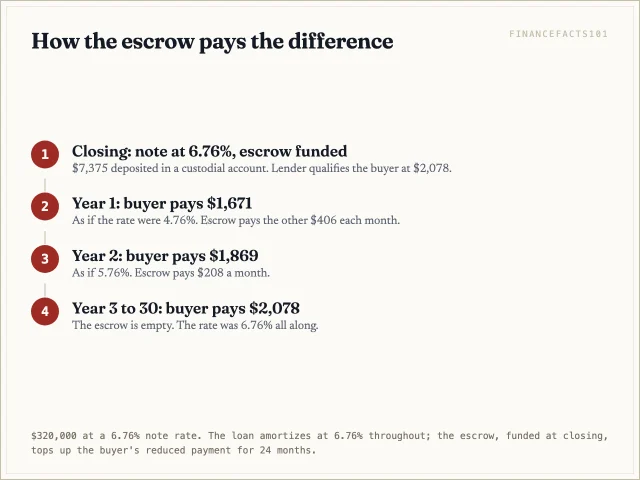
The buyer signs a note at the full rate, 6.76%, and the loan amortizes at that rate from the first payment. Separately, someone — usually the seller or builder, sometimes the lender — deposits a sum in a buydown escrow. Each month for two years the escrow pays the difference between the full payment and a reduced one: in year one the buyer pays as if the rate were 4.76%, two points below; in year two, 5.76%, one point below; from year three, the full 6.76%. Fannie Mae's rules cap the reduction at 3 points, the annual step at 1 point and the period at three years, and require the funds to sit in a custodial account separate from the lender's own money.
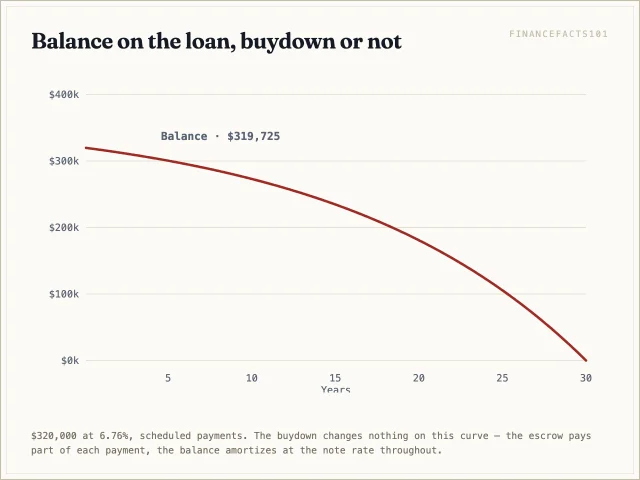
The CFPB's description is compact: "the mortgage payment is lowered for the first year or two in exchange for an up-front fee or a higher interest rate later." Two things follow. The balance and the lifetime interest are unaffected — the loan is a 6.76% loan, and $427,951 of interest is $427,951 of interest whoever writes the first twenty-four checks. And the buyer's payment rises twice, by a known amount on a known date; the CFPB lists this among the standard reasons a payment goes up, "with payments increasing each year until the buydown ends."
What it costs, and what it saves
At 6.76% the payment is $2,078. At 4.76% it would be $1,671, so year one is subsidised by $406 a month; at 5.76% it would be $1,869, so year two is subsidised by $208. Twelve of each: $7,375.
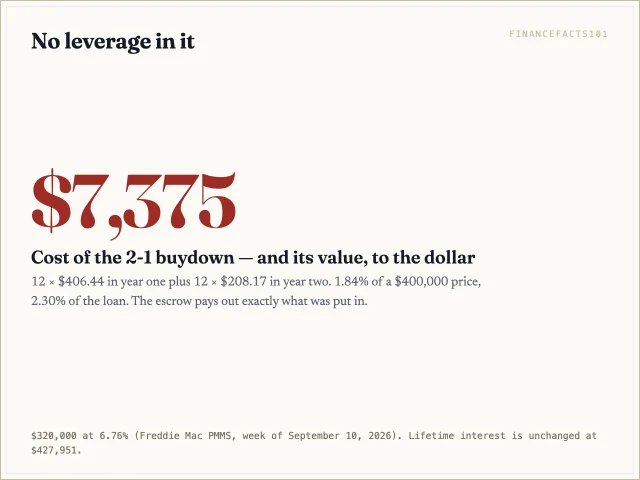
That $7,375 is the whole of the buydown — its cost to the seller and its value to the buyer, to the dollar. It is 1.84% of the price and 2.30% of the loan. There is no leverage in it: the escrow pays out exactly what was put in, on a schedule, and then it is empty.
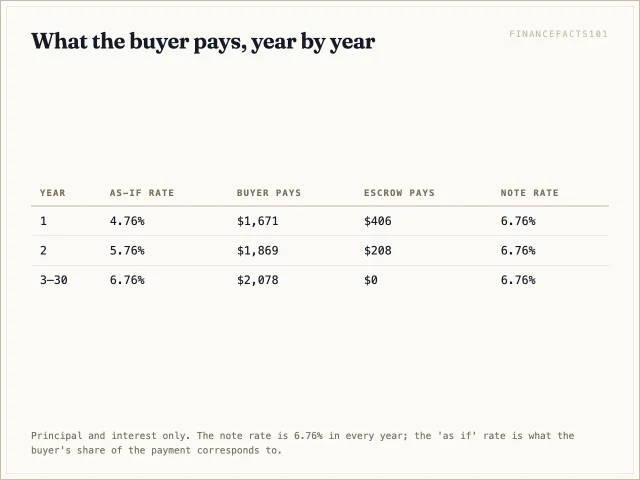
The payment table is the reason buydowns are marketed the way they are. A first-year payment of $1,671 on a $400,000 home reads as affordable in a way that $2,078 does not. The second number is the one the buyer will pay for twenty-eight years.
The same $7,375 as a price cut
A seller who would fund a $7,375 escrow could instead cut the price by $7,375. The buyer's loan falls to $312,625 and the payment to $2,030 — $48 a month less, every month for thirty years — and lifetime interest falls by $9,863.
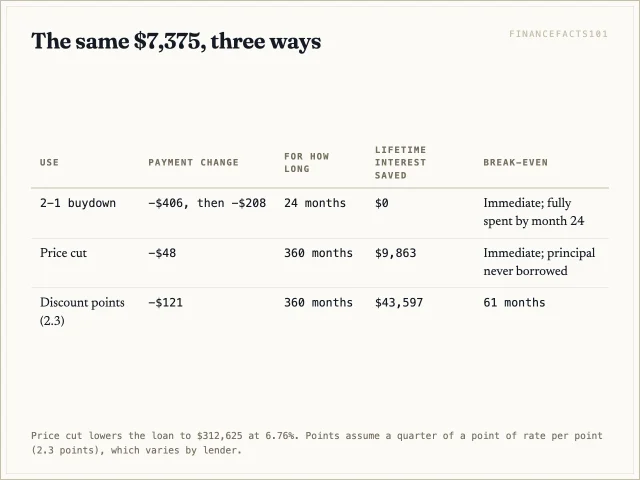
Over two years the price cut returns $1,152 in payments; the buydown returns $7,375. Over the life of the loan the price cut returns $17,239 in payments plus the $7,375 that was never borrowed. Which is better depends entirely on how long the buyer keeps the loan, and the table in the next section puts a number on the crossover.
Two side effects favour the cut slightly. It lowers the loan-to-value, which can improve pricing at the margin, and it lowers the recorded sale price — which matters for property-tax assessment in some jurisdictions, and for the comparable-sales record the next buyer on the street will see.
The same $7,375 as discount points
Spent on the rate instead of on two years of payments, $7,375 buys 2.3 points. At the common quote of a quarter of a point of rate per point, that is a permanent rate of 6.184%, a payment of $1,957 — $121 a month less for thirty years — and $43,597 of lifetime interest saved.
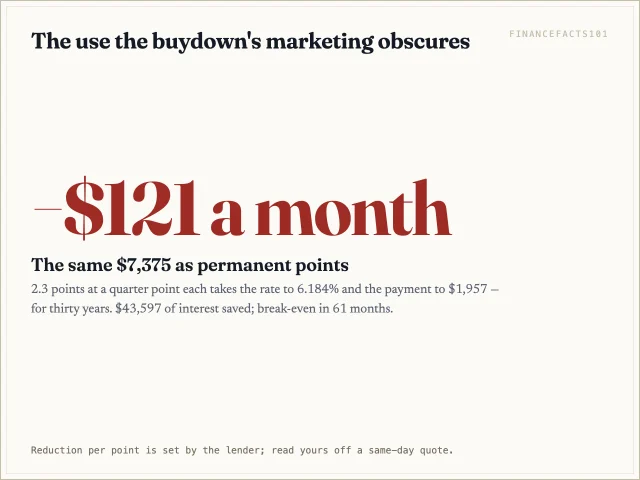
This is the use that the buydown's marketing obscures. The buydown delivers $406 in year one and nothing from year three; the points deliver $121 every month until the loan ends. The points break even against a zero-point loan in 61 months, after which every month is profit; the buydown has already been fully spent by month 24.
Which use wins, by how long you keep the loan
Counting payment savings plus, for the price cut and the points, the lower balance the buyer would hand a purchaser at sale:
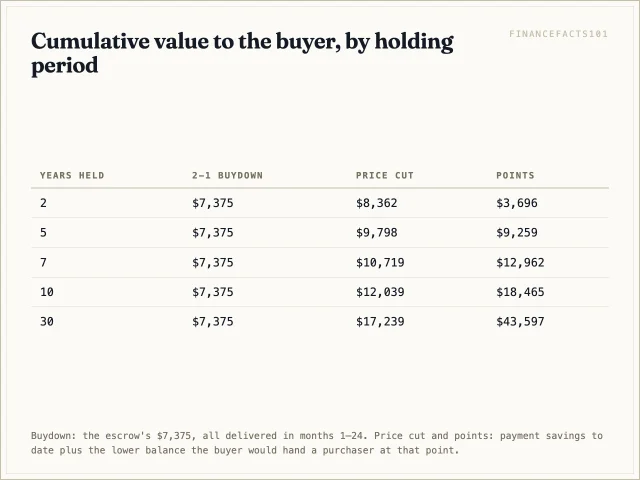
At two years the price cut is already ahead — $8,362 against the buydown's $7,375 — because its $7,375 of never-borrowed principal counts at face value from day one, while points trail at $3,696 with only 24 months of savings banked. At five years: buydown $7,375, price cut $9,798, points $9,259. At seven years the points pull ahead of the price cut at $12,962 to $10,719, and at ten years it is $18,465 to $12,039, with the buydown still at $7,375. Over the full term the points return $43,597.
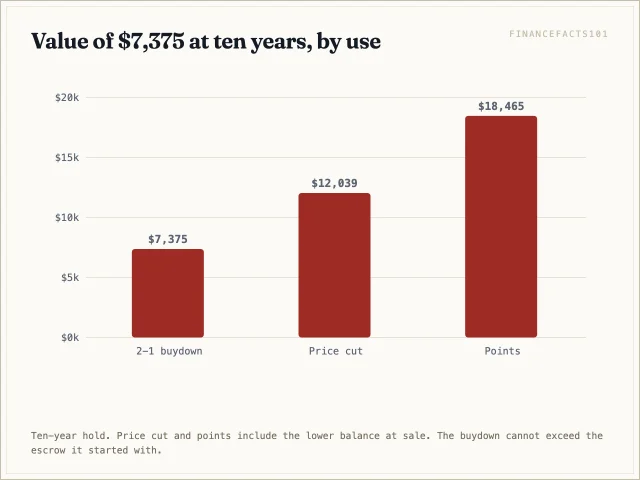
The ordering is stable. The buydown never returns more than $7,375. The price cut returns more than that from the first day, because the principal it removes is worth face value at any sale. The points return more than the price cut from about year six onward and are the largest number at every longer horizon. A buyer who will hold the loan more than a couple of years, and who has the choice, should take the concession as a price cut or as points — points if the horizon is long and refinancing unlikely, the cut if it is uncertain.
When the buydown is the right choice
It is not never. Three cases:
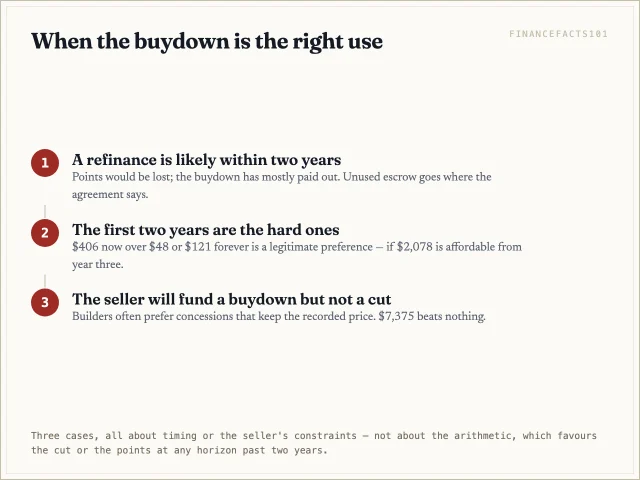
- A refinance is likely within two years. If rates fall and the buyer refinances at month 18, points bought at closing are mostly lost, and a price cut's benefit is only the principal removed; the buydown, by contrast, has delivered most of its $7,375 in cash already, and Fannie Mae's rules say unused escrow "may be returned to either the borrower or the lender as specified in the buydown agreement," or credited to the payoff — so the remainder is not necessarily lost either. Check the agreement.
- The first two years are the hard ones. A buyer furnishing a house, expecting a second income to start in year two, or paying off a car loan that ends in eighteen months, may genuinely value $406 a month now over $48 or $121 a month forever. That is a cash-flow preference, not a mistake, provided the buyer can carry $2,078 from year three, which the lender has already required.
- The seller will fund a buydown but not a price cut. Builders in particular prefer concessions that leave the recorded price intact. If the choice is a buydown or nothing, the buydown is $7,375.
The seller's side of the same $7,375
To the seller the three concessions cost the same cash, and the buydown is usually the one they prefer, for reasons that have nothing to do with the buyer's arithmetic. A price cut lowers the recorded sale price — which is the number the next listing on the street will be compared against, the number a builder's remaining inventory is priced off, and the number an agent's commission is calculated on. A buydown or points leave the price intact and appear as a credit on the closing statement instead. For a builder with forty more houses to sell, $7,375 of buydown escrow protects the comparable; $7,375 off the price does not.
That is why the buydown is offered rather than the cut, and it is also why a buyer should ask for the concession as a credit they can direct, rather than as a product. The seller's constraint is the recorded price. Points satisfy it just as well as a buydown does, and they are worth $121 a month to the buyer for thirty years rather than $406 for twelve months and $208 for twelve more. A seller who will pay for a buydown will usually pay for points instead, if asked before the contract is written.
The qualification trap
Because the lender qualifies the borrower at the note rate, the buydown cannot make an unaffordable house affordable. It can make one feel affordable for two years and then not be — the payment goes from $1,671 to $1,869 to $2,078, and a household that budgeted around the first number meets the third in month 25. The CFPB's advice is to "compare the costs for loans with and without the temporary reduced rate," and the comparison that matters is the year-three payment against the household budget, not the year-one payment. The how much house can I afford guide runs that at the full payment, which is the right one.
Reading it on the Loan Estimate
A temporary buydown is not a loan term, so it does not change the interest rate or the projected payments on page one of the Loan Estimate — the CFPB's guide to that form shows the note-rate payment, which is $2,078 here. The buydown appears as a seller credit and a separate buydown agreement. Two things to confirm in that agreement: who receives any unused escrow if the loan is paid off early, and that the escrow is held by the servicer in a custodial account, as Fannie Mae requires, so it survives a transfer of servicing. Then compare, as the discount points guide does, the same seller money as points: the lender can quote both on the same day.
A decision sequence
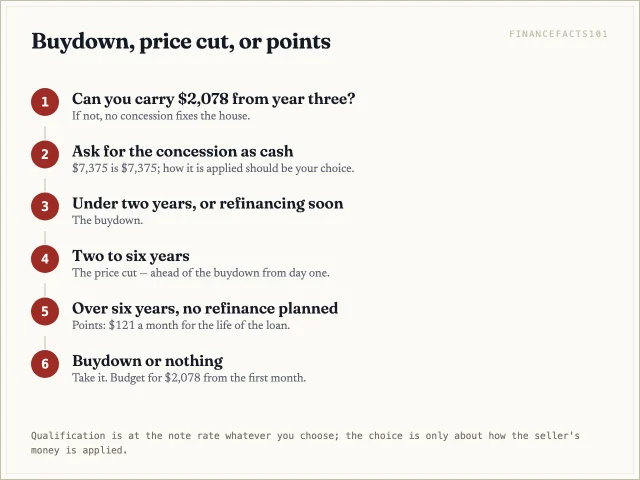
- Confirm you qualify at the note rate and can carry $2,078 from year three. If not, the house is too expensive; no concession fixes that.
- Ask the seller for the concession as cash, not as a product. $7,375 is $7,375; how it is applied is the buyer's choice, where the seller allows it.
- Horizon under two years, or a refinance likely: the buydown.
- Horizon two to six years: the price cut.
- Horizon over six years and no refinance planned: points.
- Buydown or nothing: take it, and budget from day one for the year-three payment.
FAQ
How much does a 2-1 buydown cost?
The sum of the payment differences over two years. On $320,000 at 6.76%, year one at 4.76% saves $406 a month and year two at 5.76% saves $208; twelve of each is $7,375, about 1.84% of a $400,000 price. That is also exactly what it is worth to the buyer.
Does a 2-1 buydown lower my interest rate?
No. The note rate stays at 6.76% and the loan amortizes at that rate from the first payment. An escrow funded at closing pays part of the payment for two years. Lifetime interest is unchanged at $427,951.
Is a buydown better than a price cut of the same amount?
Only if you will keep the loan less than about two years. The price cut removes $7,375 of principal permanently — $48 a month for thirty years plus the lower balance at any sale — and is ahead from the first day on a total-value basis.
Can I qualify using the buydown rate?
No. Lenders underwrite at the note rate, per Fannie Mae's selling guide. You must be able to pay $2,078 a month to get the loan, whatever the first year's payment is.
Sources
- Freddie Mac Primary Mortgage Market Survey — 30-year fixed average, week of September 10, 2026
- Fannie Mae Selling Guide B2-1.4-04, temporary interest rate buydowns — qualification at the note rate, custodial escrow, the 3-point / 1-point-a-year / 3-year limits, disposition of unused funds
- CFPB: mortgage financing options in a higher interest rate environment — how temporary buydowns work and the advice to compare with and without
- CFPB: why did my monthly mortgage payment go up or change — the end of a buydown as a standard reason for a payment increase
- CFPB: the Loan Estimate — the note-rate payment is what the form shows
- CFPB: what are discount points and lender credits — the permanent alternative
 Next entry · No. 5,968T-Bills vs CDs vs High-Yield Savings: Where 3-12 Month Cash Goes
See also
-
 No. 5,966
30 Sep 2026
12 min
Assumable Mortgage Value: What a 3% Loan Is Worth in a 6.76% Market
Mortgage
No. 5,966
30 Sep 2026
12 min
Assumable Mortgage Value: What a 3% Loan Is Worth in a 6.76% Market
Mortgage -
 No. 5,964
28 Sep 2026
12 min
Mortgage Recast vs Refinance: What to Do With a $50,000 Lump Sum
Mortgage
No. 5,964
28 Sep 2026
12 min
Mortgage Recast vs Refinance: What to Do With a $50,000 Lump Sum
Mortgage -
 No. 5,963
27 Sep 2026
12 min
ARM vs Fixed-Rate Mortgage: Pricing the Bet on a 5/1 ARM
Mortgage
No. 5,963
27 Sep 2026
12 min
ARM vs Fixed-Rate Mortgage: Pricing the Bet on a 5/1 ARM
Mortgage -
 No. 5,960
24 Sep 2026
12 min
10% vs 20% Down: What the Extra $40,000 Is Actually Worth
Mortgage
No. 5,960
24 Sep 2026
12 min
10% vs 20% Down: What the Extra $40,000 Is Actually Worth
Mortgage -
 No. 5,958
22 Sep 2026
12 min
Discount Points Break-Even: When Buying Down the Rate Pays
Mortgage
No. 5,958
22 Sep 2026
12 min
Discount Points Break-Even: When Buying Down the Rate Pays
Mortgage -
 No. 5,945
14 Sep 2026
18 min
How Much House Can I Afford? Approval Price vs Affordable Price
Real Estate
No. 5,945
14 Sep 2026
18 min
How Much House Can I Afford? Approval Price vs Affordable Price
Real Estate