Assumable Mortgage Value: What a 3% Loan Is Worth in a 6.76% Market
Assuming a seller's $280,000 loan at 3% instead of borrowing at 6.76% saves $617 a month — $41,232 in present value over seven years. The gap financing decides.
A seller's $280,000 FHA or VA loan at 3% with 27 years left costs $1,265 a month. The same $280,000 borrowed today at 6.76% would cost $1,882. Assuming the seller's loan instead of taking a new one is worth $617 a month — $41,232 in present value to a buyer who stays seven years, $53,752 over ten, and $200,062 of interest over the loan's remaining life. The catch is the gap: the home costs $400,000 and the loan is $280,000, so the buyer has to bring $120,000 in cash and second-lien financing. Priced honestly, with a $40,000 second loan at 8.5% on top of an $80,000 down payment, the assumption still costs $466 a month less than a new loan and $254,841 less over the loan's life. This guide works out what the assumable loan is worth, what the gap costs, and how much of the difference a seller can reasonably ask for in the price.
The comparison loan is the series' base case: a $320,000 mortgage at 6.76% over 30 years, the Freddie Mac Primary Mortgage Market Survey average for the week of September 10, 2026, on a $400,000 home with 20% down. The assumable loan is a $300,000 note from 2023 at 3.00%, now $280,000 with 324 payments left, which is what a government-backed loan from the low-rate years looks like today. Second-lien rates of 8.5% and 10% are scenarios; read yours off a quote. The mortgage payment levers guide prices the levers on a new loan; this guide is about inheriting someone else's.
Scope honesty: this is general information built on the stated assumptions above, not personal advice. Your seller's loan, your cash, your second-lien quote and the servicer's rules will differ.
Who this is for — and who it is not for
This guide is for a buyer looking at a listing whose seller holds an FHA, VA or USDA loan from 2020–2022, and for a seller holding one who wants to know what it is worth in the asking price. It assumes the buyer can qualify with the seller's servicer, which is a credit decision the servicer makes.
It is not for a buyer of a home with a conventional loan. Those carry a due-on-sale clause, and federal law — the Garn–St Germain Act — lets the lender enforce it on a sale, so the loan is paid off at closing rather than passed on; the exceptions are transfers within a family or on death, not sales to a stranger. And it is not for a buyer who cannot fund the gap; a second loan at 10% on $80,000 or more erodes most of the value, as the tables show.
What an assumption is
An assumption is the transfer of the seller's loan — its balance, rate, remaining term and monthly payment — to the buyer, who becomes the borrower. Regulation Z defines it exactly: an assumption "occurs when a creditor expressly agrees in writing with a subsequent consumer to accept that consumer as a primary obligor on an existing residential mortgage transaction," and requires the creditor to "make new disclosures to the subsequent consumer, based on the remaining obligation" — the text of § 1026.20(b). Every mortgage's original disclosure also has to state, under § 1026.18(q), "whether or not a subsequent purchaser of the dwelling from the consumer may be permitted to assume the remaining obligation on its original terms."
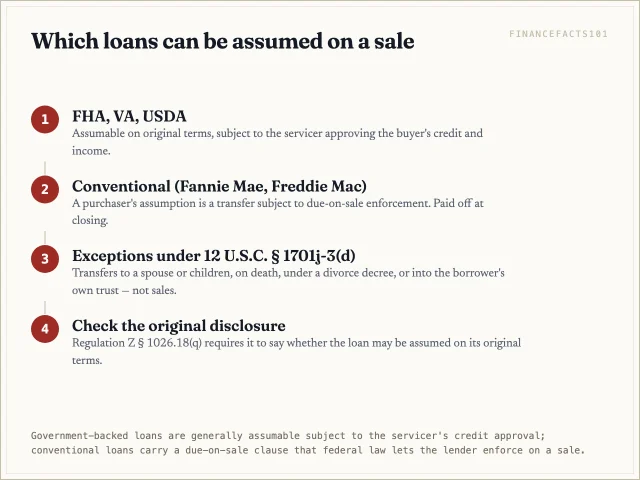
FHA, VA and USDA loans are generally assumable on those original terms, subject to the servicer's approval of the buyer's credit and income — the CFPB's note on financing in a higher-rate market names those three programs as the ones that let a buyer take over a seller's low-rate loan, with "large savings on interest and the related payment." Conventional loans sold to Fannie Mae or Freddie Mac generally are not: Fannie Mae's servicing guide lists "the assumption of the mortgage loan debt by the property purchaser" among the transfers of ownership subject to enforcement of the due-on-sale provision. The seller's loan documents say which kind you are dealing with.
The rate gap on the same $280,000
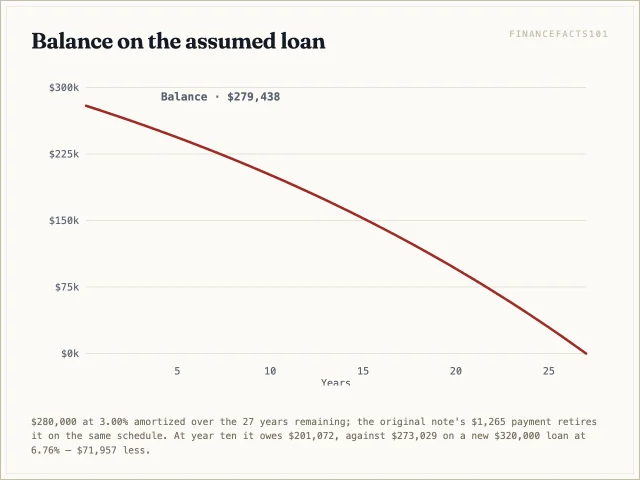
Strip the transaction down to its core: the same $280,000 over the same 324 months, at 3% or at 6.76%.
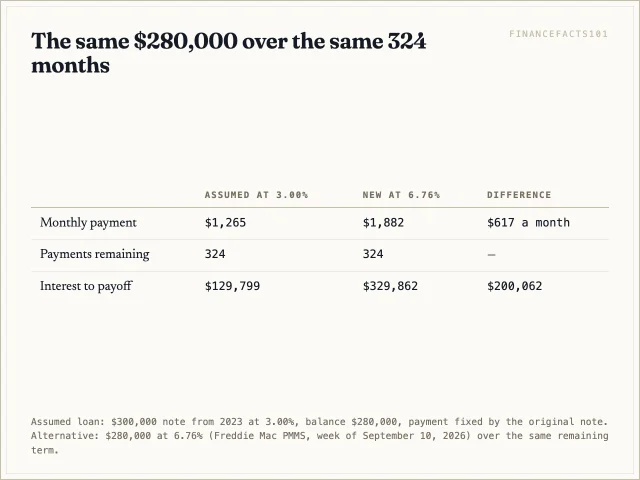
At 3% the payment is $1,265 and the remaining interest is $129,799. At 6.76% the payment would be $1,882 and the interest $329,862. The assumption saves $617 a month and $200,062 of interest — the entire difference between a 2023 rate and a 2026 one, applied to $280,000 for 27 years.
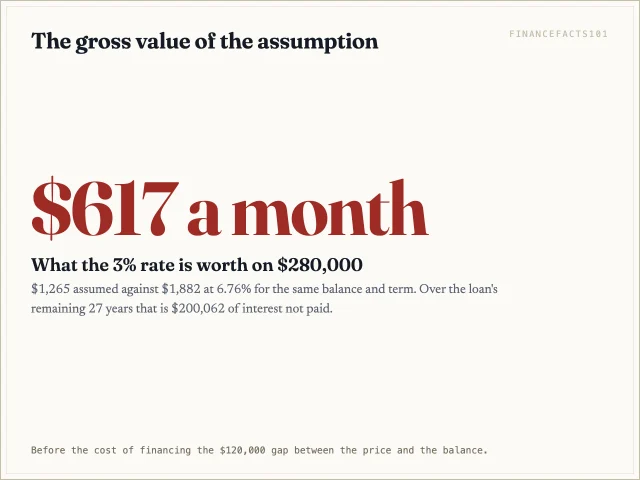
That is the gross value of the loan. Two things reduce it: how long the buyer actually holds it, and what the gap financing costs.
What it is worth over the years you actually stay
A stream of $617 a month is worth less than its nominal total, because money later is worth less than money now. Discounting at 6.76% — the rate the buyer would otherwise be paying — the present value of the saving depends on the holding period:
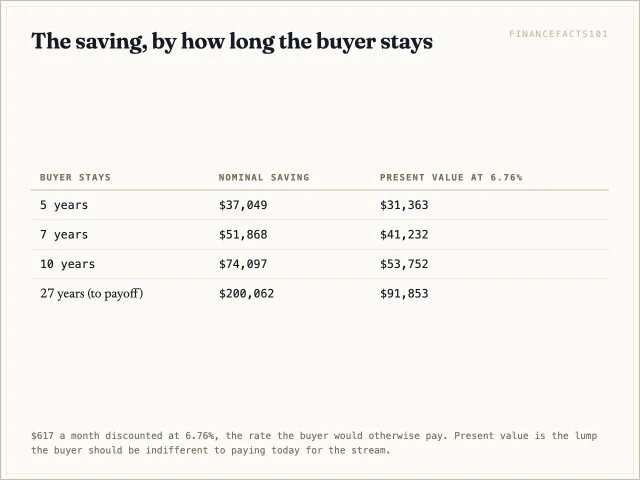
Five years: $37,049 nominal, $31,363 present value. Seven years: $51,868 and $41,232. Ten years: $74,097 and $53,752. The full 27 years: $200,062 and $91,853. The seven-year figure is the one to carry around, because it is close to how long typical buyers stay, and it is the number a seller can point to when asking for a premium — the subject of the section after next.
The gap: $120,000 between the price and the loan
Here the assumption stops being free money. The home costs $400,000; the loan is $280,000; the buyer must cover $120,000 at closing, with cash and, if the cash runs short, a second lien.
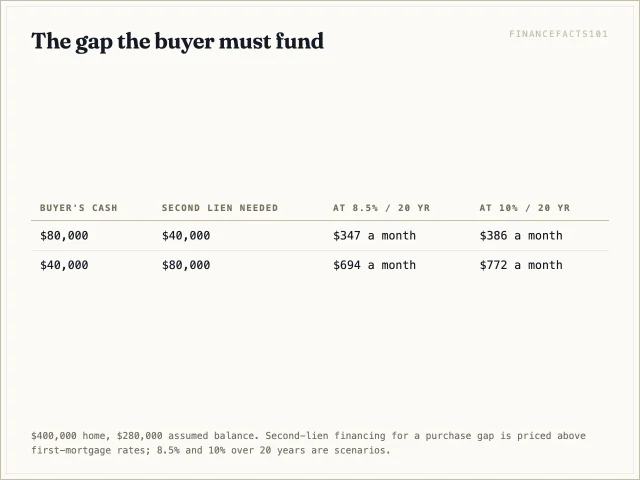
A buyer with $80,000 — the same 20% down the base loan assumes — needs $40,000 more. A buyer with $40,000 needs $80,000 more. Second-lien financing for a purchase gap is priced above first-mortgage rates; the tables use 8.5% and 10% over twenty years, and a buyer should expect the quote to depend heavily on credit and on the combined loan-to-value.
Like for like: assumption plus a second, against a new loan
Put the two paths side by side for the buyer with $80,000 down:
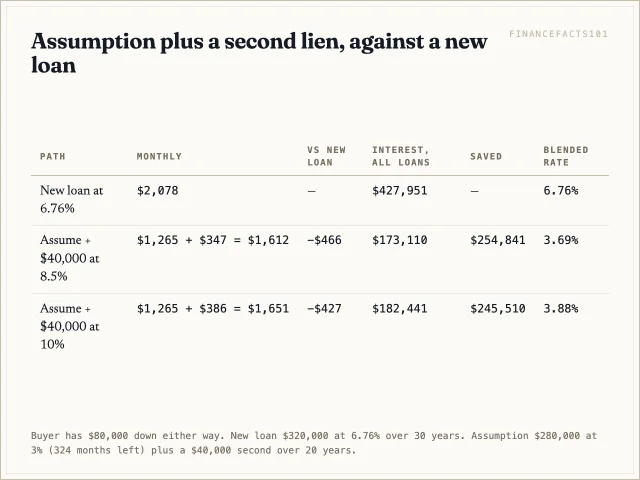
The new loan is $320,000 at 6.76%: $2,078 a month, $427,951 of interest over thirty years. The assumption is $280,000 at 3% plus a $40,000 second at 8.5% over twenty years: $1,265 plus $347, or $1,612 a month — $466 less — and $173,110 of interest across both loans, $254,841 less. At a 10% second the payment is $1,651, still $427 below the new loan, and the interest saving is $245,510.
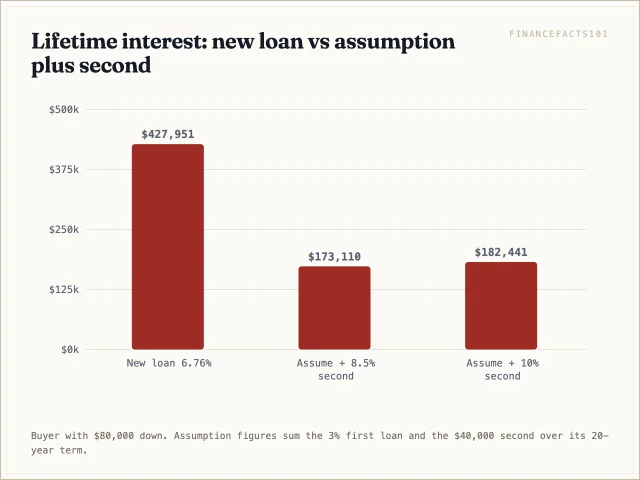
The blended rate on the buyer's $320,000 of debt is 3.69% at the 8.5% second and 3.88% at 10% — against 6.76% for the new loan. Even an expensive second lien leaves the assumption far ahead, because it applies only to a fraction of the money; the same logic as the cash-out refinance vs HELOC guide, from the buyer's side.
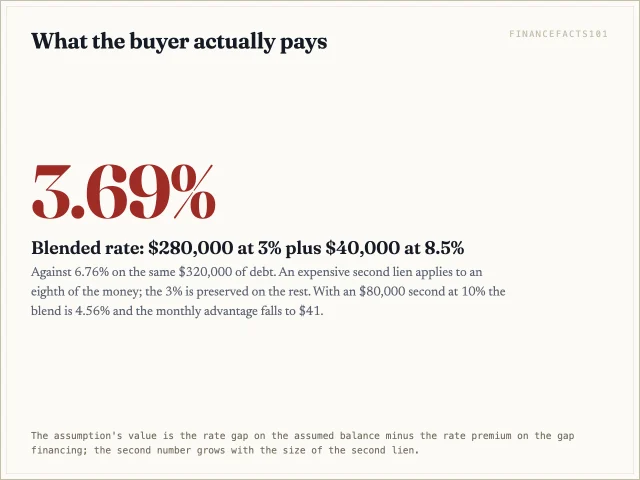
The picture changes when the gap grows. A buyer with only $40,000 down needs an $80,000 second: at 8.5% that is $694 a month and a total of $1,959 — $119 below the new loan; at 10%, $772 and $2,037, just $41 below. The assumption still wins, but the second lien has eaten most of the $617. The rule: the value of the assumption is the rate gap on the assumed balance minus the rate premium on the gap financing, and the second number scales with how much of the gap is borrowed.
What a seller can ask for it
An assumable 3% loan is an asset attached to the house, and sellers are entitled to price it. The ceiling is the buyer's present value of the saving over the buyer's expected stay, net of the gap-financing cost: about $41,232 for a seven-year buyer with cash for the gap, $53,752 for a ten-year buyer.
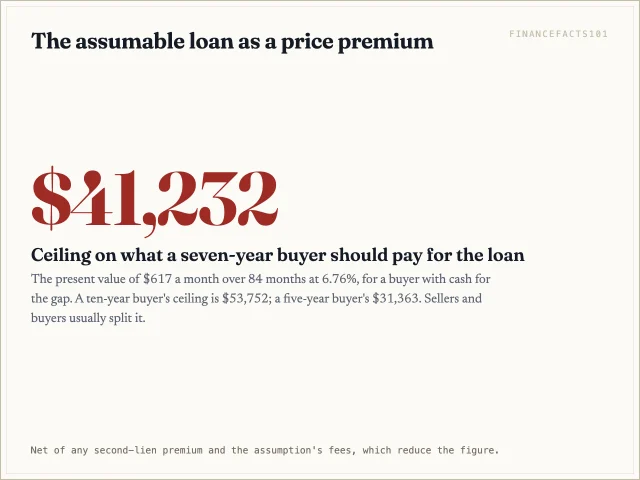
In practice the premium is shared, because the buyer has alternatives and the seller wants to close. A seller asking $20,000 above what a comparable non-assumable home would fetch is asking for half the seven-year value; a buyer paying it still comes out $21,000 ahead over seven years, before the second-lien cost. A buyer expecting to move in three years should pay little or nothing extra: the five-year present value is $31,363, the three-year figure is materially less, and the assumption's processing time and fees are the same however long you stay.
The premium also runs into the appraisal. A lender financing the gap lends against the appraised value of the home, not the contract price, so any premium the appraisal does not support has to come from the buyer's cash — which is exactly the cash the gap already needs.
Fees, processing and the seller's liability
The assumption is a credit transaction with the servicer, and it has its own costs and timeline. On a VA loan the buyer pays a funding fee of 0.5% of the loan balance — $1,400 on $280,000 — per the VA's funding-fee page, unless exempt as a veteran receiving compensation for a service-connected disability; the same page notes the fee can be financed only on purchase and construction loans, so on an assumption it is paid at closing. Servicers charge processing fees on top, set by their own policy.
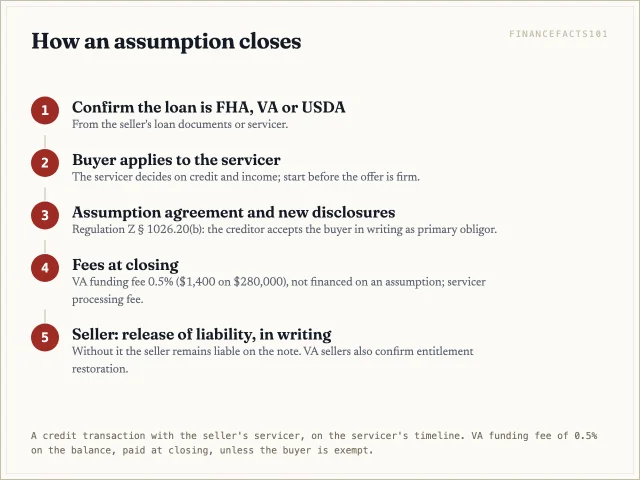
Two points for the seller. The assumed loan is transferred on its original terms, which includes any mortgage insurance it carries; that is the buyer's cost from then on. And the seller should confirm in writing that they are released from liability on the note once the assumption closes — an assumption without a release leaves the seller on the hook if the buyer defaults, and the servicer's assumption agreement is where that is settled. A VA seller has the further question of whether their entitlement is restored, which depends on the buyer's status; the servicer and the VA regional loan center answer that before closing, not after.
When the assumption is not worth it
- The gap is most of the price. A seller with $280,000 owed on a $600,000 home leaves a $320,000 gap; the second lien swamps the 3% loan.
- The buyer will move within three years. The present value of the saving shrinks faster than the fixed costs do.
- The servicer declines the buyer. The assumption is a credit decision the servicer controls, and there is no appeal to the rate.
- The seller wants the full $41,232. At that premium the seven-year buyer is indifferent and a five-year buyer loses.
The comparison for any of these is the ordinary one: a new loan at today's rate, sized by the how much house can I afford guide, with points priced by the discount points break-even guide. Our entry on assumable mortgages covers the mechanics from the seller's and buyer's sides.
A decision sequence
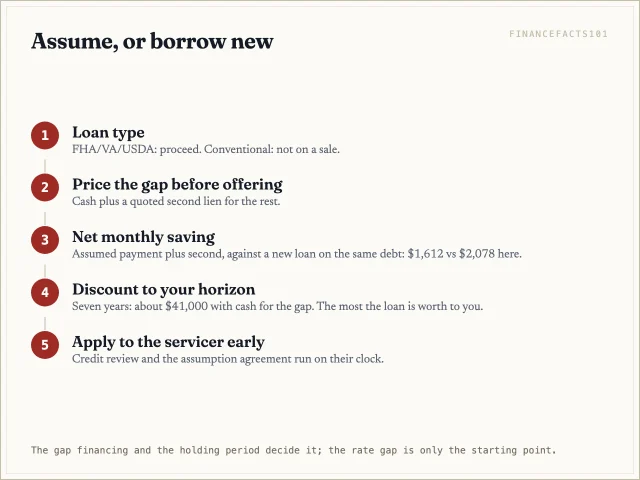
- Confirm the loan type. FHA, VA, USDA: proceed. Conventional: it is not assumable on a sale, whatever the listing says.
- Price the gap. Price minus balance. Cash you have, second lien for the rest, quoted before you make an offer.
- Compute the net monthly saving. Assumed payment plus second-lien payment, against a new loan on the same total debt. On this home, $1,612 against $2,078.
- Discount it to your horizon. Seven years: about $41,000 with cash for the gap. That is the most the loan is worth to you, and the most a seller can be paid for it.
- Apply to the servicer early. The credit review, the assumption agreement and the VA funding fee all run on the servicer's timeline, not the sale's.
- Seller: get the release of liability in writing.
FAQ
How much is an assumable mortgage worth?
The rate gap on the assumed balance, discounted over your expected stay. On $280,000 at 3% against 6.76%, that is $617 a month — $41,232 in present value over seven years, $53,752 over ten — before the cost of financing the gap between the price and the balance.
Can I assume a conventional mortgage?
Generally not on a sale. Conventional loans carry a due-on-sale clause that federal law allows lenders to enforce, and Fannie Mae's servicing rules treat a purchaser's assumption as a transfer subject to it. The exceptions cover transfers within a family, on death or divorce, or into the borrower's own trust — not sales.
What does a VA loan assumption cost?
A funding fee of 0.5% of the loan balance, paid at closing rather than financed, unless the buyer is exempt; $1,400 on $280,000. The servicer adds its own processing fee. The buyer must be approved by the servicer, and the seller should confirm a release of liability.
Should a seller ask more for a home with an assumable loan?
Yes, within the buyer's present value of the saving. Around half the seven-year figure — about $20,000 on this loan — leaves both sides better off than a non-assumable sale; asking for all of it leaves a seven-year buyer with no reason to prefer the house.
Sources
- Freddie Mac Primary Mortgage Market Survey — 30-year fixed average, week of September 10, 2026
- 12 U.S.C. § 1701j-3, preemption of due-on-sale prohibitions — lenders may enforce due-on-sale clauses; the family, death, divorce and trust exceptions
- Fannie Mae Servicing Guide D1-4.1-01, transfers of ownership — a purchaser's assumption is a transfer subject to due-on-sale enforcement
- Regulation Z § 1026.20(b), assumptions — the creditor accepts the buyer in writing as primary obligor and makes new disclosures
- Regulation Z § 1026.18(q), assumption policy — every loan's disclosure states whether it may be assumed on its original terms
- VA: funding fee and closing costs — the 0.5% funding fee on an assumption, exemptions, and financing limited to purchase and construction loans
- CFPB: mortgage financing options in a higher interest rate environment — FHA, VA and USDA loans as the assumable programs
 Next entry · No. 5,9672-1 Buydown: What a Seller-Paid Teaser Rate Is Actually Worth
See also
-
 No. 5,945
14 Sep 2026
18 min
How Much House Can I Afford? Approval Price vs Affordable Price
Real Estate
No. 5,945
14 Sep 2026
18 min
How Much House Can I Afford? Approval Price vs Affordable Price
Real Estate -
 No. 5,933
05 Sep 2026
15 min
15-Year vs 30-Year Mortgage: The Total-Cost Math
Real Estate
No. 5,933
05 Sep 2026
15 min
15-Year vs 30-Year Mortgage: The Total-Cost Math
Real Estate -
No. 5,967
01 Oct 2026
12 min
2-1 Buydown: What a Seller-Paid Teaser Rate Is Actually Worth
Mortgage
-
 No. 5,960
24 Sep 2026
12 min
10% vs 20% Down: What the Extra $40,000 Is Actually Worth
Mortgage
No. 5,960
24 Sep 2026
12 min
10% vs 20% Down: What the Extra $40,000 Is Actually Worth
Mortgage -
 No. 5,959
23 Sep 2026
12 min
PMI Removal: When It Ends, and How to End It Sooner
Mortgage
No. 5,959
23 Sep 2026
12 min
PMI Removal: When It Ends, and How to End It Sooner
Mortgage -
 No. 5,958
22 Sep 2026
12 min
Discount Points Break-Even: When Buying Down the Rate Pays
Mortgage
No. 5,958
22 Sep 2026
12 min
Discount Points Break-Even: When Buying Down the Rate Pays
Mortgage