Discount Points Break-Even: When Buying Down the Rate Pays
One point on a $320,000 loan costs $3,200 and saves about $53 a month. It breaks even at 61 months on payments alone, 48 once paydown counts. Here is the table.
Paying one discount point on a $320,000 mortgage costs $3,200 at closing and, at the common quote of a quarter point of rate per point, lowers the payment by $53 a month. That breaks even after 61 months on the payment saving alone, and after 48 months once the faster principal paydown is counted. If you will hold the loan longer than about four years, the point pays; if you will sell or refinance sooner, it does not. The rest of this guide is that break-even worked at three different lender quotes, five holding periods and three loan sizes, so you can find your own situation on a table instead of taking a lender's word for it.
The base loan is the same one used across this series: $320,000 at 6.76% over 30 years, the Freddie Mac Primary Mortgage Market Survey average for the week of September 10, 2026. The mortgage payment levers guide prices every other lever on that loan; this one takes points alone. The rate reduction a point buys is the one input this guide cannot know for you, because the CFPB is explicit that it "depends on the specific lender, the kind of loan, and the overall mortgage market" — so the tables run 0.125, 0.25 and 0.375 of a point per point, and you read across at whatever your Loan Estimate shows.
Scope honesty: this is general information built on the stated assumptions above, not personal advice. Your rate, taxes, and situation will differ.
Who this is for — and who it is not for
This guide is for a buyer or refinancer holding a Loan Estimate that offers a lower rate for points, or a higher rate for a lender credit, and wondering which line to pick. It is written for the fixed-rate case, where the saving per month is constant and the break-even is a clean division.
It is not for you if you are choosing between lenders rather than between rate options at one lender — that comparison is about the whole Loan Estimate, not the points line, and the CFPB's Loan Estimate guide walks through it section by section. It is also not for adjustable-rate loans, where the bought-down rate only lasts until the first adjustment, so the break-even has a hard stop that this arithmetic does not model; our entry on adjustable-rate mortgages covers how those reset.
What a point is, and what it is not
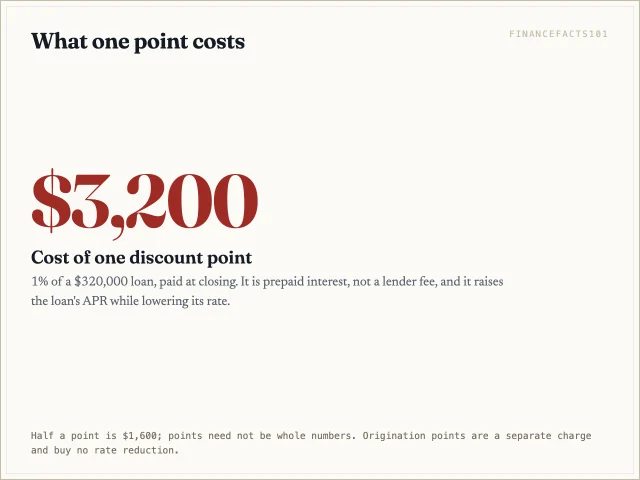
A discount point is prepaid interest: a fee of 1% of the loan amount, paid at closing, in exchange for a lower rate for the life of the loan. On $320,000, one point is $3,200; half a point is $1,600; points do not have to be whole numbers. It is not the same as an origination point, which is a lender fee for making the loan and buys no rate reduction, and the two sit on separate lines of the Loan Estimate's origination charges.
Because points are part of the cost of the loan, they raise its APR. The CFPB's explanation of rate versus APR states that "the APR reflects the interest rate, any points, mortgage broker fees, and other charges that you pay to get the loan." That is why two offers can show the same rate and different APRs: one of them charges points. It is also why the APR is a poor guide to whether points are worth it for you — the APR spreads the point cost over the full 30-year term, and almost nobody keeps a loan for 30 years.
The saving per month depends on one number your lender sets
The reduction a point buys is not fixed. In the 2026 market a quarter of a percentage point per point is a common quote on conforming 30-year loans, but an eighth is not unusual and three-eighths appears when a lender wants the fee. The same $3,200 buys very different savings:
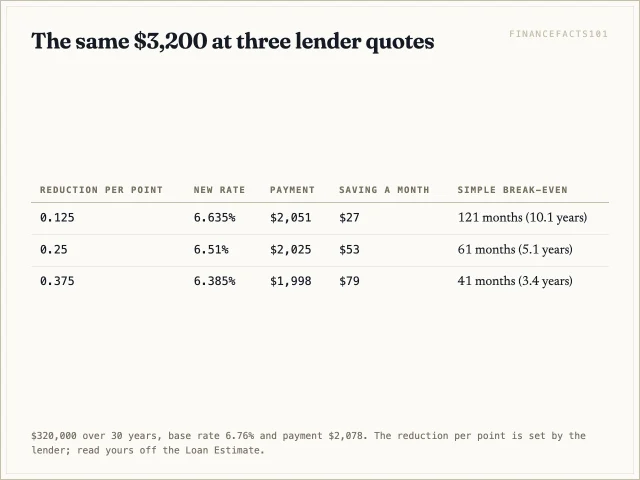
At 0.125 per point the payment drops to $2,051, saving $27 a month; at 0.25 it drops to $2,025, saving $53; at 0.375 it drops to $1,998, saving $79. Because the cost is fixed at $3,200 and the saving triples across that range, the break-even moves from 121 months to 41. The single most useful thing to do with a Loan Estimate that offers points is to divide the point cost by the monthly saving it shows. If the answer is longer than you expect to keep the loan, stop there.
The simple break-even: 61 months
Take the common case, a quarter point per point. The payment falls from $2,078 to $2,025 and the saving is $53 a month:
- $3,200 ÷ $53 = 60.4, so the 61st payment is the first one that has fully repaid the fee.
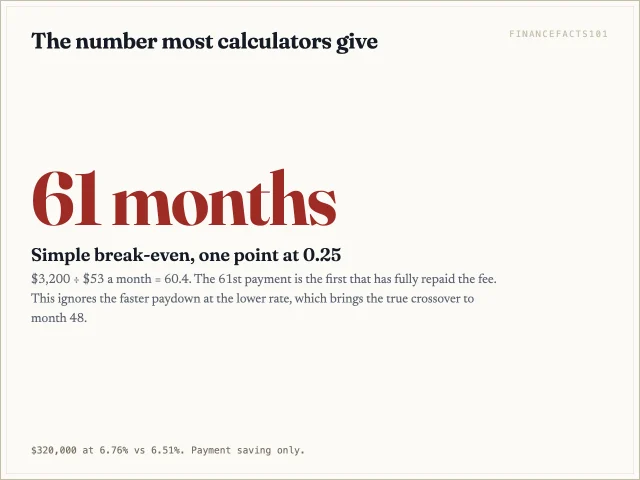
That is the number most lenders and most calculators give, and it is the right first approximation. It understates the case for points slightly, because it ignores something happening in the background.
The exact break-even: 48 months
A lower rate does not only lower the payment; it also shifts more of each payment to principal, because less of it is interest. After five years on the base loan the balance is $300,436; on the 6.51% loan it is a little lower. If you sell at year five, that difference comes back to you at closing, on top of the $53 a month you kept along the way.
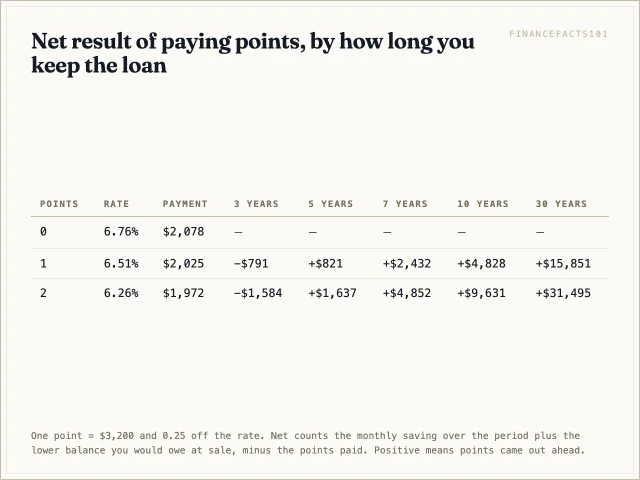
Counting both effects — cash saved on payments plus the lower balance you hand the buyer — one point at 0.25 is behind by $791 if you leave at year three, ahead by $821 at year five, by $2,432 at year seven, by $4,828 at year ten and by $15,851 at maturity. The crossover lands in month 48, four years exactly. Two points follow the same shape at double the amounts: behind $1,584 at year three, ahead $1,637 at year five, ahead $31,495 at maturity.
The practical reading: the honest break-even on a quarter-point-per-point quote is four years, not five. The extra year of margin matters for a buyer whose plans are uncertain, and it matters in the other direction too — the case for points is a little stronger than the simple division suggests, never weaker.
Five holding periods, two point choices
Put the two effects together across the horizons people actually plan around:
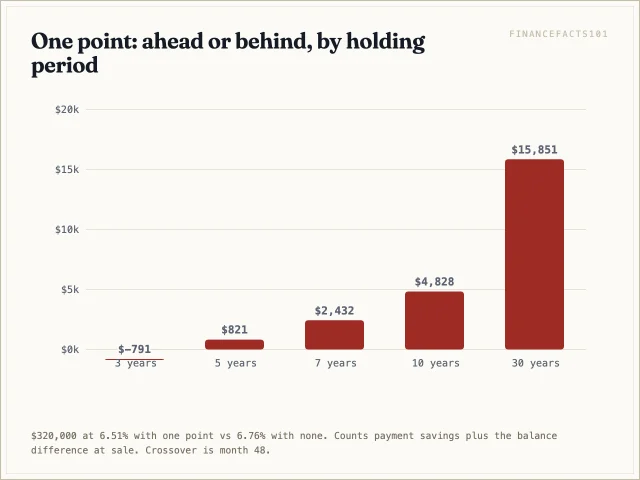
Three years is a loss at any number of points. Five years is a modest gain — $821 on one point — which is small enough that a change of plans erases it. Seven and ten years are clear gains. The full-term figure of $15,851 is real but belongs to the small minority who never refinance; on a loan taken at 6.76%, a rate drop of a point at any time in the next decade would make refinancing attractive, and refinancing resets the clock to zero on the points you paid.
That refinancing risk is the argument against points at high rates. When the market rate is 6.76% and the ten-year history includes rates near 3%, the odds that you refinance within seven years are not small. Points bought at a rate you later refinance away are money spent on a loan you no longer have.
Lender credits: the same trade in reverse
A lender credit is a negative point. You accept a higher rate and the lender pays part of your closing costs. On the base loan, a $3,200 credit for a quarter point higher — 7.01% instead of 6.76% — raises the payment to $2,131, $53 a month more.
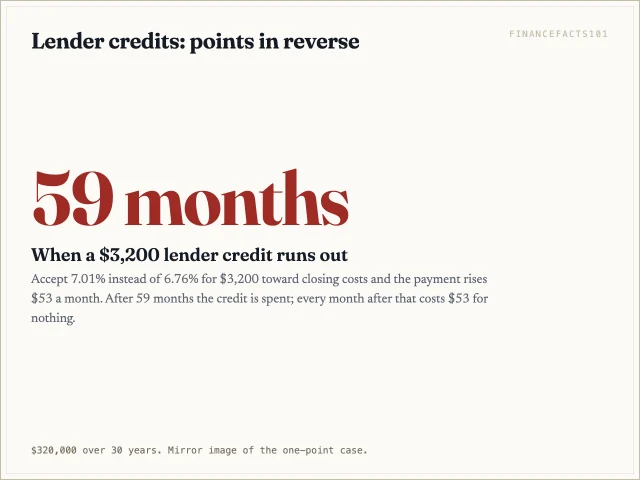
The arithmetic is the mirror image: the credit is exhausted after 59 months, and from then on you are paying $53 a month for money you spent five years ago. A lender credit suits the buyer who expects to be gone in under four years, or who is short of cash at closing and would otherwise not close at all. For anyone planning to stay, it is the more expensive option by exactly the amount the points would have saved. The CFPB's phrasing is that credits "work the same way as points, in reverse," and the same break-even question applies with the sign flipped.
Points on a purchase versus points on a refinance
The tax treatment differs, and it is worth knowing because it shifts the after-tax break-even. IRS Publication 936 allows points paid on the purchase of a main home to be deducted in full in the year paid, provided the usual conditions are met — the loan is secured by the home, paying points is an established practice in your area, the amount is clearly shown as points on the settlement statement. Points paid to refinance are instead deducted ratably over the life of the loan: $3,200 over 30 years is $107 a year.
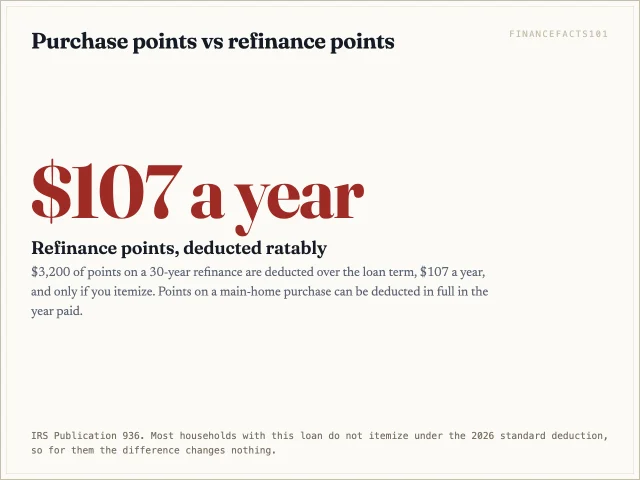
Both deductions require itemizing, and as the mortgage payment levers guide shows, on this loan a married couple with no other itemized deductions does not clear the 2026 standard deduction. For most borrowers, then, the deduction changes nothing and the pre-tax break-even is the real one. For a single filer who does itemize, a $3,200 purchase-year deduction at a 22% marginal rate is worth about $700, which shortens the simple break-even by roughly thirteen months.
Bigger and smaller loans: the break-even does not move
A useful property of points is that the break-even in months does not depend on the loan size, only on the reduction per point. One point on $100,000 costs $1,000 and saves $17 a month; on $500,000 it costs $5,000 and saves $83. Both break even at 61 months on payments alone.
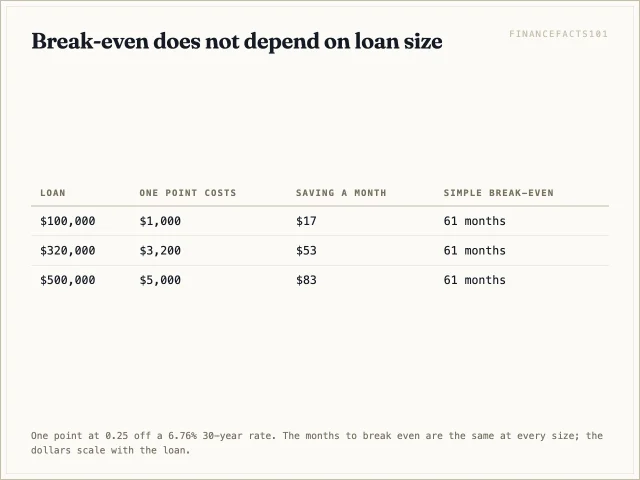
What changes with size is the dollar stake. On $500,000 two points are $10,000 of cash at closing, and the net gain at maturity is proportionally larger. A buyer stretching to make the down payment should notice that $10,000 spent on points is $10,000 not spent on the down payment — and on a loan below 20% down, that $10,000 could instead be cutting PMI, which our loan-to-value entry explains prices harder than a quarter point of rate.
The three timeframes to price before you sign
The CFPB's advice is to ask the lender to run the total costs over "a few different possible timeframes" — the shortest you might keep the loan, the longest, and the most likely. On this loan, at a quarter point per point, that produces a simple decision rule:
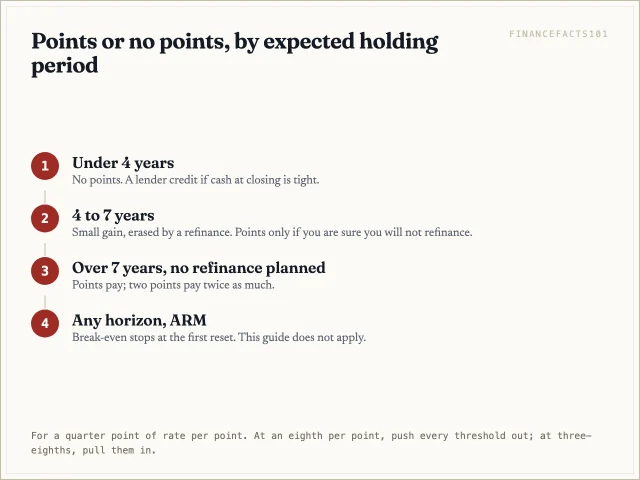
- Shortest plausible horizon under four years: take no points. Consider a lender credit if cash at closing is tight.
- Most likely horizon four to seven years: points are a small gain, easily erased by a refinance. Take them only if you are confident you will not refinance — which at a 6.76% starting rate is a strong assumption.
- Longest horizon over seven years, and no plan to refinance: points pay, and two points pay twice as much.
If your lender's quote is an eighth per point, shift every threshold out: the simple break-even is ten years, and points only make sense for a borrower who is certain to stay and certain not to refinance. If it is three-eighths, shift them in: the break-even is under three and a half years, and points become the default.
How to read the points line on a Loan Estimate
Points appear in Section A of the Closing Cost Details page, under Origination Charges, as a percentage of the loan amount and a dollar figure. The rate they buy is on page one, under Loan Terms. To compare, ask the lender for two Loan Estimates for the same loan — one with points and one without — on the same day, because the rate offered for zero points moves daily and a comparison across days is not a comparison. Then divide the Section A points figure by the difference in the monthly principal-and-interest payment on page one. That quotient, in months, is the only number that matters.
Two figures on page three of the Loan Estimate look as if they answer the question and do not. The APR, as noted above, spreads the points over the full term. The Total Interest Percentage — the share of the loan amount you will pay in interest and loan costs over the life of the loan — does the same thing, and the CFPB suggests using both to compare offers across lenders, which is what they are good for. For the points decision at one lender they both assume a 30-year hold, so the offer with points will always show the lower APR and the lower TIP, whether or not you will still have the loan at year five. Use them to pick the lender; use the division above to pick the points.
For the rate itself, and the rest of the levers a lender can move, the mortgage refinance cost guide applies the same arithmetic to closing costs generally, and the 15-year vs 30-year guide covers the term decision that changes the base rate before points are even considered.
FAQ
Is one point always a quarter of a percent off the rate?
No. The reduction is set by the lender and varies with the loan type and the market; the CFPB declines to give a standard figure. On conforming 30-year loans in 2026 a quarter point per point is common, but eighth-point and three-eighths quotes both appear. Read the figure off your own Loan Estimate.
Can I pay half a point?
Yes. Points can be fractional, and some lenders price in increments of an eighth. A half point on $320,000 is $1,600 and, at the quarter-point-per-point rate, buys about an eighth of a point of rate — roughly $27 a month.
Do points make sense if I might refinance?
Usually not. Refinancing pays off the loan the points were attached to, and any unrecovered portion of the fee is lost. At a starting rate of 6.76% the chance of an attractive refinance within seven years is meaningful, which is the main reason to be cautious about points at today's rates.
Are discount points tax-deductible?
Points on the purchase of a main home can generally be deducted in full in the year paid; points on a refinance are deducted over the loan term. Both require itemizing, which most households with this size of loan no longer do under the 2026 standard deduction. See IRS Publication 936 for the conditions.
Sources
- Freddie Mac Primary Mortgage Market Survey — 30-year fixed average, week of September 10, 2026
- CFPB: what are discount points and lender credits — definition of a point, the timeframe comparison, credits as reverse points
- CFPB: interest rate vs APR — points are included in the APR
- CFPB: the Loan Estimate — requesting and comparing estimates across lenders
- IRS Publication 936, Home Mortgage Interest Deduction — deductibility of points on a purchase versus a refinance
 Next entry · No. 5,959PMI Removal: When It Ends, and How to End It Sooner
See also
-
 No. 5,964
28 Sep 2026
12 min
Mortgage Recast vs Refinance: What to Do With a $50,000 Lump Sum
Mortgage
No. 5,964
28 Sep 2026
12 min
Mortgage Recast vs Refinance: What to Do With a $50,000 Lump Sum
Mortgage -
 No. 5,932
04 Sep 2026
16 min
How Much It Costs to Refinance a Mortgage
Mortgage
No. 5,932
04 Sep 2026
16 min
How Much It Costs to Refinance a Mortgage
Mortgage -
 No. 5,967
01 Oct 2026
12 min
2-1 Buydown: What a Seller-Paid Teaser Rate Is Actually Worth
Mortgage
No. 5,967
01 Oct 2026
12 min
2-1 Buydown: What a Seller-Paid Teaser Rate Is Actually Worth
Mortgage -
 No. 5,966
30 Sep 2026
12 min
Assumable Mortgage Value: What a 3% Loan Is Worth in a 6.76% Market
Mortgage
No. 5,966
30 Sep 2026
12 min
Assumable Mortgage Value: What a 3% Loan Is Worth in a 6.76% Market
Mortgage -
 No. 5,957
21 Sep 2026
15 min
Mortgage Payment Levers: What Actually Moves the Number
Mortgage
No. 5,957
21 Sep 2026
15 min
Mortgage Payment Levers: What Actually Moves the Number
Mortgage -
 No. 5,945
14 Sep 2026
18 min
How Much House Can I Afford? Approval Price vs Affordable Price
Real Estate
No. 5,945
14 Sep 2026
18 min
How Much House Can I Afford? Approval Price vs Affordable Price
Real Estate