Mortgage Recast vs Refinance: What to Do With a $50,000 Lump Sum
$50,000 against a $320,000 loan at year five: prepay saves $152,988, a recast cuts the payment $346 and saves $53,731, a refinance depends on the rate.
A $50,000 lump sum against a $320,000 mortgage at 6.76%, five years in, can do three different things. Paid as principal with the payment unchanged, it ends the loan seventeen years later and saves $152,988 of interest. Paid as principal and recast, it lowers the payment by $346 a month, keeps the loan at thirty years, and saves $53,731. Used to refinance, it saves nothing unless the new rate is lower — at the same 6.76% a refinance costs $5,000 or more in closing costs to produce a lower payment than the recast, and restarts the thirty-year clock. Which one is right depends on one question: do you need the payment to come down, or the loan to end sooner?
The loan throughout is the series' base case: $320,000 at 6.76% over 30 years, the Freddie Mac Primary Mortgage Market Survey average for the week of September 10, 2026, with a payment of $2,078. At month 60 the balance is $300,436 and $105,094 of interest has been paid. The $50,000 arrives then — a bonus, an inheritance, the proceeds of something sold. The mortgage payment levers guide introduced the recast as the only lever that lowers the payment without a new loan; this guide sets it against the two alternatives that use the same cash.
Scope honesty: this is general information built on the stated assumptions above, not personal advice. Your rate, balance, servicer's policy and refinance quotes will differ.
Who this is for — and who it is not for
This guide is for a homeowner with a lump sum and a fixed-rate loan who is trying to decide between putting it against the mortgage, restructuring the mortgage around it, or replacing the mortgage. It assumes the higher-rate debt is already gone and an emergency fund is already funded; if not, those come first, as the extra mortgage payment guide sets out.
It is not a general refinancing guide — that decision, without a lump sum in the picture, is priced in what a refinance actually costs. It is also not for borrowers on FHA or VA loans, where recasting is generally not offered and the refinance products differ, nor for loans with a prepayment penalty in force, which changes the arithmetic of all three options.
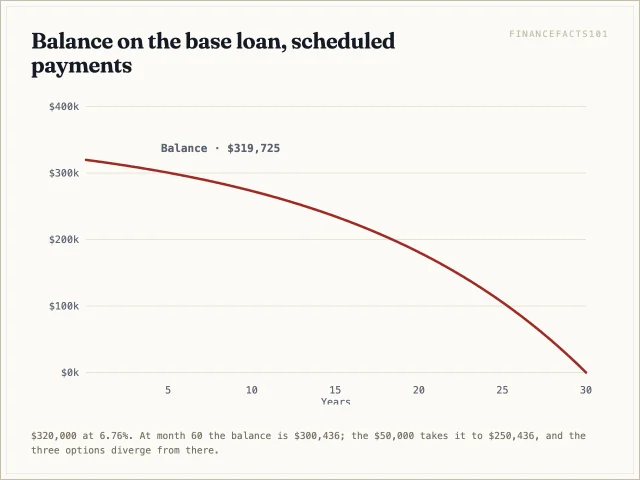
The three options, defined
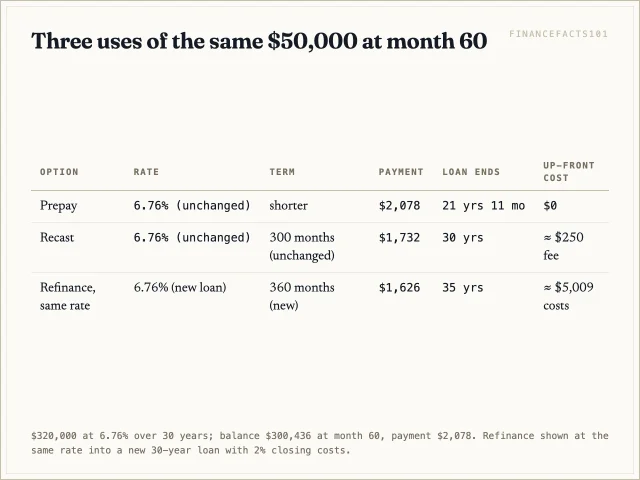
Prepay. Send the $50,000 to the servicer marked as principal. The balance falls to $250,436; the payment stays $2,078; the loan ends sooner.
Recast. Send the $50,000 as principal and ask the servicer to re-amortize the remaining balance over the remaining term. Under the Fannie Mae Servicing Guide, a servicer may do this at the borrower's request after "a substantial principal curtailment," using the current balance, the existing rate and the remaining term — neither the rate nor the term changes, only the payment. It is documented on Fannie Mae's Form 181 and, the guide is careful to say, is not treated as a loan modification. Servicers set their own fee, typically a few hundred dollars, and their own minimum curtailment.
Refinance. Pay off the old loan with a new one for the balance less the $50,000, at whatever rate is available, over a new term, paying closing costs. The CFPB's list of what closing costs include — lender charges, points, third-party services such as appraisal and title, government fees, and prepaid items — is the same list as at purchase, and this guide prices it at 2% and 3% of the new balance, $5,009 and $7,513.
Option one: prepay and keep paying
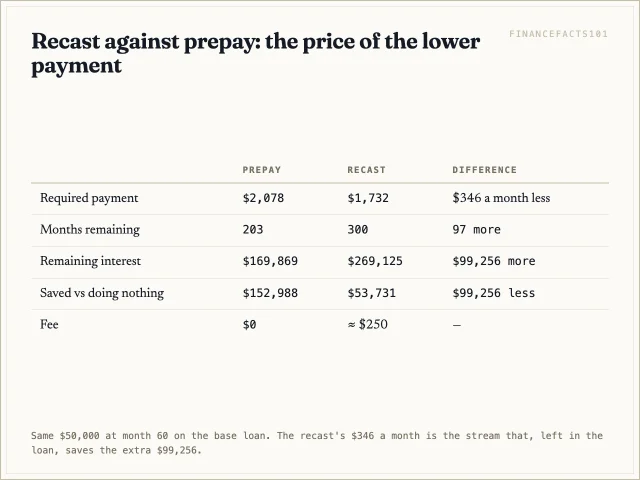
The balance drops to $250,436 and the $2,078 payment now retires it in 203 more months — the loan is gone at 21 years and 11 months from the start instead of 30. Remaining interest is $169,869, against $322,857 if the $50,000 had not been paid: $152,988 saved.
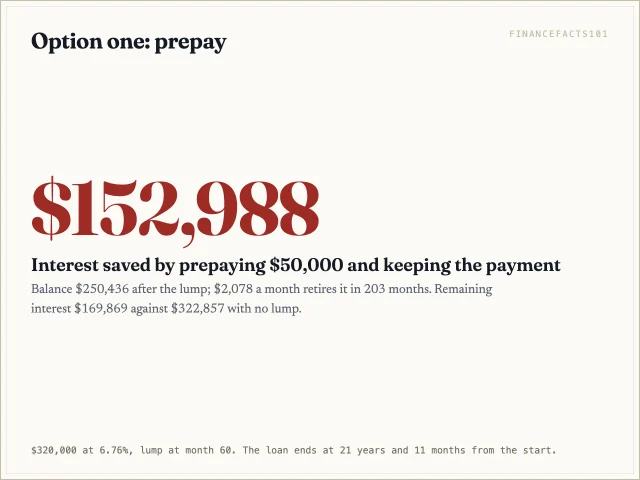
This is the largest saving of the three by a wide margin, and it is the largest precisely because the payment does not fall. Every month, the $346 the recast would have removed from the payment goes to principal instead, and every one of those dollars stops accruing interest at 6.76% for the rest of the loan. Prepaying is the recast plus $346 a month of extra principal; the difference between the two options is exactly the value of that stream.
Option two: recast and lower the payment
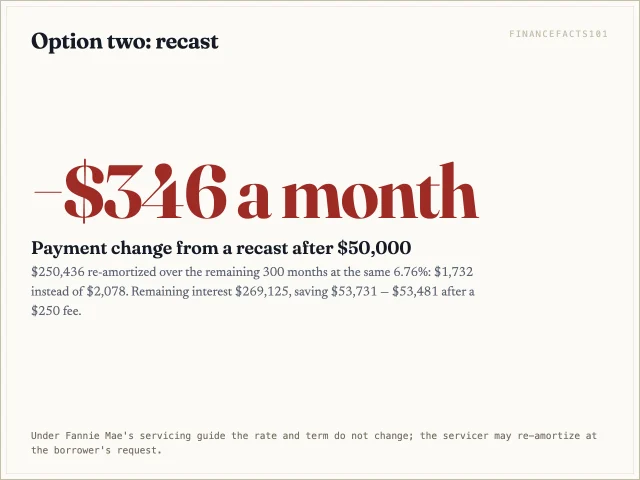
The same $50,000 goes to principal; the servicer re-amortizes $250,436 over the remaining 300 months at 6.76%. The new payment is $1,732 — $346 a month lower. Remaining interest is $269,125; the saving against doing nothing is $53,731, or $53,481 after a $250 fee.
Set beside prepaying, the recast pays $99,256 more interest over the remaining term, in exchange for $346 a month of breathing room. That is the trade, and it is not a bad one for the right household: the payment reduction is permanent and contractual, it does not depend on discipline, and the money freed up each month is available for anything — including, if circumstances allow, sending it back to principal, which reconstructs the prepay outcome one month at a time.
The recast has one feature neither alternative offers: it lowers the required payment without a credit application, an appraisal, a new rate or a new term. For a borrower whose income is about to fall — retirement, a career change, a second earner stepping back — that is often the whole point.
Option three: refinance — only the rate can justify it
Refinancing $250,436 into a new loan produces a lower payment than the recast only if the new rate is lower, or the term is longer, or both. At today's 6.76%, a new 30-year loan on $250,436 costs $1,626 a month — $106 below the recast's $1,732 — but only because it stretches the debt over 360 months instead of 300. Remaining interest is $334,919, more than the recast's $269,125, plus $5,009 to $7,513 in closing costs. The lower payment is bought with five more years of payments and $65,000 to $73,000 more interest.
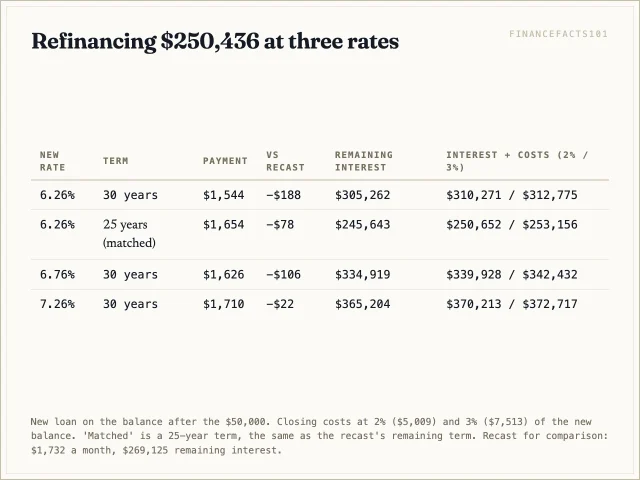
At 6.26%, half a point below the current loan, the picture changes. A 30-year refinance costs $1,544 a month, $188 below the recast, and its total of remaining interest and costs is $310,271 to $312,775 — still above the recast's $269,125, again because of the longer term. Matched to the recast's 25 remaining years instead, the 6.26% loan costs $1,654 a month, $78 below the recast, with $245,643 of interest plus $5,009 of costs: $18,474 better than the recast over the loan, net. The break-even on the closing costs against the recast is 64 months.
At 7.26%, half a point higher, the refinance is $1,710 a month over 30 years — $22 below the recast — with $365,204 of interest plus costs. It loses to the recast on every measure.
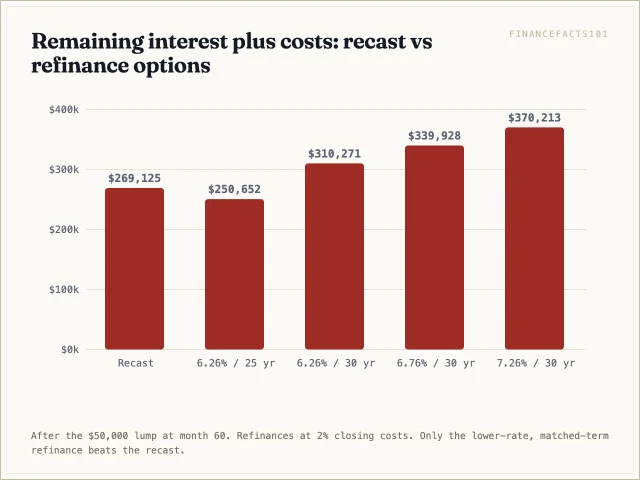
The rule that falls out: a refinance beats a recast when, and only when, the new rate is meaningfully lower than the old one and the term is not extended. Half a point lower on a matched term is worth $78 a month here, $23,482 gross over 25 years, and clears $5,009 of costs in 64 months. If the new rate is the same or higher, the refinance is a recast with closing costs and a longer term attached.
The full picture at year five
Here is the remaining outlay to payoff — every payment still to make, plus any lump and costs — for all five paths:
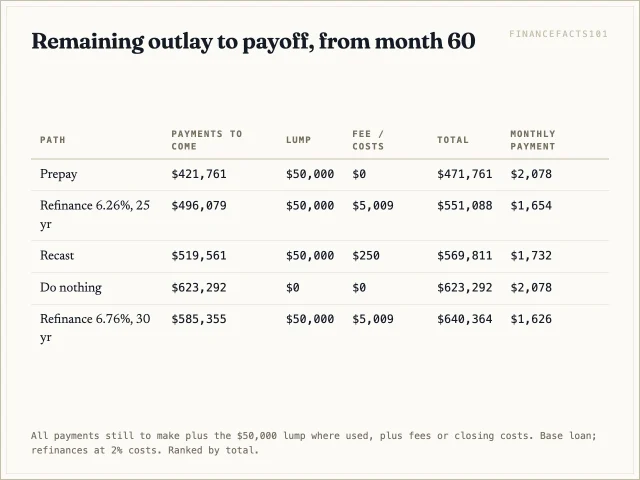
Doing nothing costs $623,292 more from here. Prepaying costs $421,761 plus the $50,000. Recasting costs $519,561 plus the lump and a $250 fee. Refinancing at the same rate into a new 30-year costs $585,355 plus the lump and $5,009 of costs — the worst of the four uses of the cash, because of the term extension. Refinancing half a point lower on a matched term costs $496,079 plus the lump and costs: better than the recast by about $18,500, worse than prepaying by about $79,000.
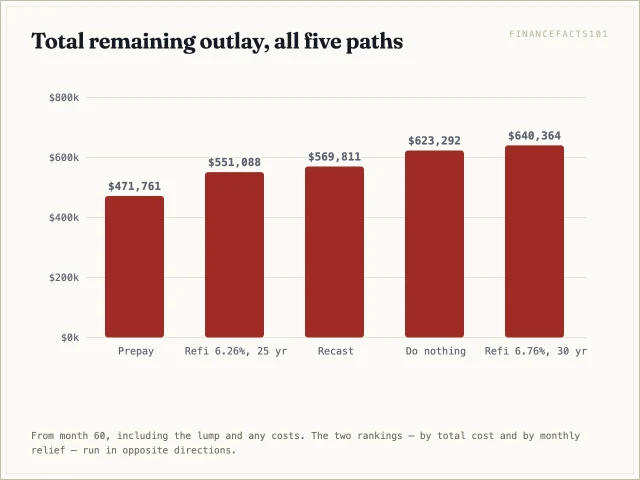
Ranked by total cost: prepay, then a lower-rate matched-term refinance, then recast, then a same-rate 30-year refinance, then nothing. Ranked by monthly payment relief: same-rate 30-year refinance ($1,626), lower-rate refinance ($1,544 or $1,654), recast ($1,732), then prepay and nothing at $2,078. The two rankings run in opposite directions, and that is the whole decision.
When the payment is the problem
A household that needs the payment lower has two real candidates, and the refinance only wins with a lower rate. Everything a refinance requires — an application, an appraisal, a credit decision, closing costs, a rescission period, and a rate set by the market that day — the recast does not. The recast is a phone call, a form, a fee, and a payment change within a cycle or two, at a rate that is already locked.
Two practical checks before choosing it. Confirm the servicer offers recasting and what its minimum curtailment and fee are — the Fannie Mae guide says the servicer may re-amortize, not must, and servicers of non-Fannie loans set their own policy. And confirm, in writing, that the $50,000 will be applied as a curtailment and not held or applied to future payments; the servicing rules the CFPB summarises require prompt crediting of full payments and give a written notice of error thirty business days to be resolved, and a payoff statement, if you want one for the refinance comparison, must be provided within seven business days.
When the loan is the problem
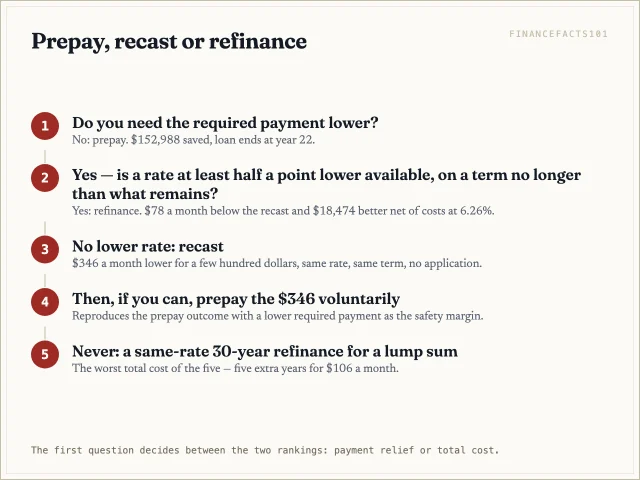
If the aim is to owe less for less long, prepaying wins and it is not close: $152,988 saved against the recast's $53,731. The only reason to choose the recast over prepaying is that the $346 a month is needed elsewhere. If it is not needed, the recast is leaving $99,256 on the table.
There is a middle path worth naming. Recast, take the $346 reduction, and set up an automatic extra principal payment of $346. The required payment is now $1,732, so a bad month can skip the extra without consequence; in every other month the outcome is identical to prepaying. This is the prepay outcome with the recast's safety margin, and it costs one fee.
The tax side, briefly
None of the three options changes much for most households, because the interest deduction requires itemizing and, as the mortgage payment levers guide shows, a married couple on this loan with no other itemized deductions does not clear the 2026 standard deduction. For a borrower who does itemize, two rules from IRS Publication 936 apply. Prepaying or recasting reduces the interest paid and therefore the interest deducted — a dollar of interest not paid is worth more than the 22 cents its deduction would have returned, so this is never a reason to avoid either. And a refinance is treated as home acquisition debt "only up to the amount of the balance of the old mortgage principal just before the refinancing," which matters if the new loan is larger than the old one — not the case here, where the new balance is $50,000 smaller, but the reason a cash-out refinance is a different tax question, covered in the cash-out refinance vs HELOC guide in this series.
Costs and timing of a refinance, for completeness
If the refinance is the answer because a lower rate is on offer, three things from the CFPB's pages belong in the comparison. Closing costs are itemised on the Loan Estimate — the CFPB's guide to it recommends getting estimates from several lenders for the same loan — and the CFPB's closing-fees page notes that fees not paid out of pocket are usually paid indirectly through a higher rate or balance. A refinance carries a three-business-day right of rescission after signing. And the old loan should be checked for a prepayment penalty, which the CFPB's prepayment page notes usually applies to paying off the whole balance in the first years — which a refinance does.
FAQ
What is the difference between recasting and refinancing a mortgage?
A recast keeps the loan — same rate, same term, same lender — and re-amortizes the remaining balance after a lump-sum principal payment, so the required payment falls. A refinance replaces the loan with a new one at a new rate and term, with closing costs. On $250,436 at 6.76% the recast payment is $1,732; a same-rate 30-year refinance is $1,626 but adds five years and $65,000 or more of interest.
Is it better to recast or just pay extra principal?
Paying extra saves far more — $152,988 against $53,731 on this loan — because the payment stays high and the loan ends sooner. Recast only if you need the required payment lower. A recast followed by voluntary extra payments of the same amount reproduces the prepay outcome with a safety margin.
Does a recast change my interest rate?
No. Under Fannie Mae's servicing rules a re-amortization uses the existing rate and the remaining term; only the payment changes. That is its advantage when rates have risen since the loan was made — a refinance would mean giving up the old rate.
How much does it cost to recast a mortgage?
Fannie Mae's guide does not set a fee; servicers charge their own, commonly a few hundred dollars, and set a minimum lump sum. On this loan a $250 fee reduces the recast's saving from $53,731 to $53,481 — trivial against the $5,009 to $7,513 in closing costs a refinance carries.
Sources
- Freddie Mac Primary Mortgage Market Survey — 30-year fixed average, week of September 10, 2026
- Fannie Mae Servicing Guide C-1.2-01, Processing Additional Principal Payments — curtailments applied immediately; re-amortization at the servicer's discretion on the existing rate and remaining term; Form 181; not a modification
- CFPB: what costs come with taking out a mortgage — the categories of closing costs
- CFPB: what fees or charges are paid when closing on a mortgage — fees paid indirectly through rate or balance
- CFPB: the Loan Estimate — comparing refinance quotes across lenders
- CFPB: your mortgage servicer must comply with federal rules — prompt crediting, notices of error, payoff statements within seven business days
- CFPB: what is the right of rescission — the three-business-day window on a refinance
- CFPB: what is a prepayment penalty — penalties usually attach to paying off the whole balance early
 Next entry · No. 5,965Cash-Out Refinance vs HELOC: The Blended-Rate Math on $50,000
See also
-
 No. 5,958
22 Sep 2026
12 min
Discount Points Break-Even: When Buying Down the Rate Pays
Mortgage
No. 5,958
22 Sep 2026
12 min
Discount Points Break-Even: When Buying Down the Rate Pays
Mortgage -
 No. 5,967
01 Oct 2026
12 min
2-1 Buydown: What a Seller-Paid Teaser Rate Is Actually Worth
Mortgage
No. 5,967
01 Oct 2026
12 min
2-1 Buydown: What a Seller-Paid Teaser Rate Is Actually Worth
Mortgage -
 No. 5,962
26 Sep 2026
12 min
Biweekly Mortgage Payments: The Saving Is Real, the Fee Is Not
Mortgage
No. 5,962
26 Sep 2026
12 min
Biweekly Mortgage Payments: The Saving Is Real, the Fee Is Not
Mortgage -
 No. 5,961
25 Sep 2026
12 min
Extra Mortgage Payments: What $200 a Month Actually Saves
Mortgage
No. 5,961
25 Sep 2026
12 min
Extra Mortgage Payments: What $200 a Month Actually Saves
Mortgage -
 No. 5,957
21 Sep 2026
15 min
Mortgage Payment Levers: What Actually Moves the Number
Mortgage
No. 5,957
21 Sep 2026
15 min
Mortgage Payment Levers: What Actually Moves the Number
Mortgage -
 No. 5,932
04 Sep 2026
16 min
How Much It Costs to Refinance a Mortgage
Mortgage
No. 5,932
04 Sep 2026
16 min
How Much It Costs to Refinance a Mortgage
Mortgage