Extra Mortgage Payments: What $200 a Month Actually Saves
$200 a month extra on a $320,000 loan at 6.76% ends it 6 years 8 months early and saves $112,349. Started at year 15 it saves $21,918. The timing table is here.
An extra $200 a month against the principal of a $320,000 mortgage at 6.76% pays the loan off in 23 years and 4 months instead of 30, and saves $112,349 of interest — two dollars back for every extra dollar paid. The same $200 started at year fifteen saves $21,918. That timing gap is the whole subject of this guide: extra principal is the cheapest lever a borrower has, its value is front-loaded, and it competes with investing the same money at a rate the market may or may not beat.
The loan throughout is the series' base case: $320,000 at 6.76% over 30 years, the Freddie Mac Primary Mortgage Market Survey average for the week of September 10, 2026, with a principal-and-interest payment of $2,078. Every figure is produced by the site's extra mortgage payment calculator, which you can point at your own balance and rate; note that it opens at 6.5%, so set 6.76% to reproduce these tables. The mortgage payment levers guide sets this lever beside the other six.
Scope honesty: this is general information built on the stated assumptions above, not personal advice. Your rate, balance, tax position and alternatives will differ.
Who this is for — and who it is not for
This guide is for a borrower with a fixed-rate mortgage and some spare monthly cash who wants to know what putting it against the loan is worth, when it is worth most, and whether investing it would be better. The arithmetic is the same at any balance; the dollar figures scale.
It is not for anyone still carrying higher-rate debt. A credit card at 22% or a car loan at 9% beats a 6.76% mortgage as a target for every spare dollar, and the debt avalanche vs snowball guide is the place to start. It is also not for a borrower without an emergency fund; extra principal cannot be withdrawn in a bad month, and the emergency fund size guide comes first. And if your loan has a prepayment penalty — some do, in their first years — read the mortgage prepayment penalty guide before anything here.
Why extra principal is worth two dollars per dollar
Each payment on an amortizing loan pays a month's interest on the outstanding balance and puts the rest to principal. The CFPB's explanation is exact: "In the beginning of your mortgage term, you owe more interest, because your loan balance is still high," and "over time, as you pay down the principal, you owe less interest each month." An extra dollar of principal today removes a dollar from the balance for every remaining month, and so removes a dollar's worth of interest every month for the rest of the loan.
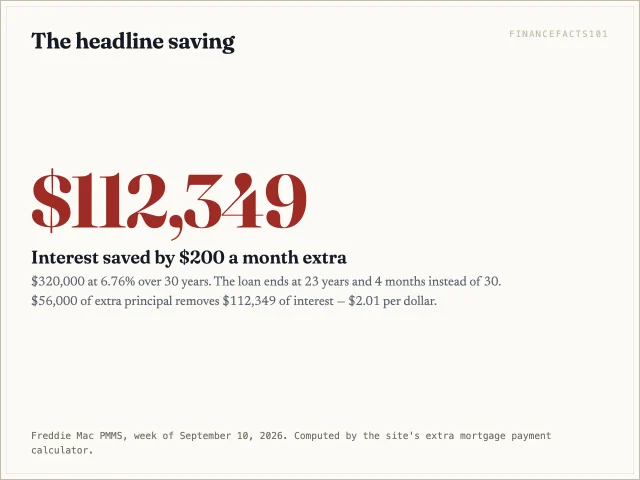
On this loan the first payment is $1,803 of interest and $275 of principal. Add $200 and the principal portion nearly doubles for that month. Do it every month and the effect compounds: $200 a month for 280 months is $56,000 of extra principal, and it removes $112,349 of interest — a return of $2.01 per dollar, every dollar of it at the loan's own 6.76%.
The extra-payment table
Here is the base loan with a fixed extra amount from the first payment:
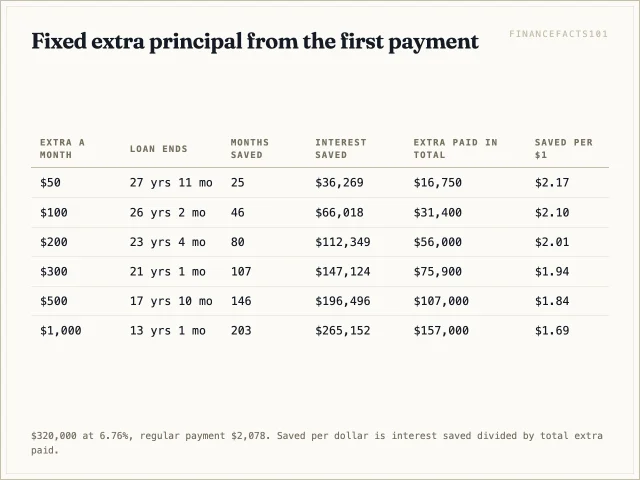
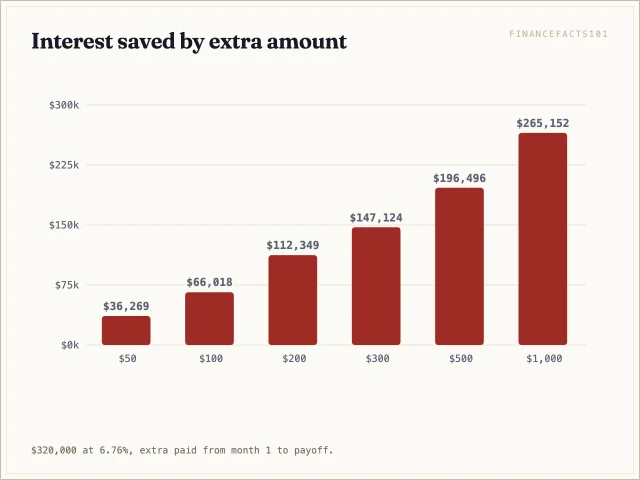
Fifty dollars a month saves $36,269 and two years and a month; $100 saves $66,018 and nearly four years; $200 saves $112,349 and six years and eight months; $500 saves $196,496 and takes the loan to 17 years and 10 months; $1,000 saves $265,152 and finishes in 13 years and a month. The CFPB's servicing guidance puts the small case plainly: "Even $100 more per month may reduce the loan term by several years."
Notice the last column: the interest saved per extra dollar falls as the extra amount rises, from $2.17 at $50 to $1.69 at $1,000. That is not a reason to pay less; every dollar still earns 6.76%. It is a reminder that the biggest extra payments shorten the loan so much that each additional dollar has fewer months left to work.
Timing: the same $200 at year 0, 5, 10, 15 and 20
This is the table that decides most borrowers' behaviour once they see it.
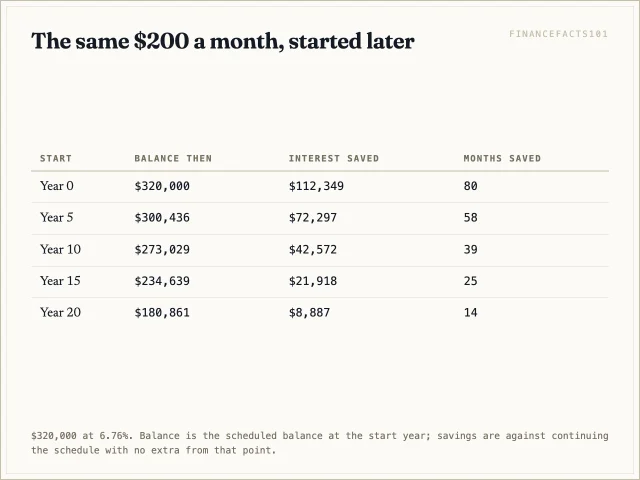
Started at closing, $200 a month saves $112,349. Started at year five, from a balance of $300,436, it saves $72,297. At year ten, from $273,029, $42,572. At year fifteen, $21,918. At year twenty, from a balance of $180,861, $8,887 — and shortens the loan by 14 months.
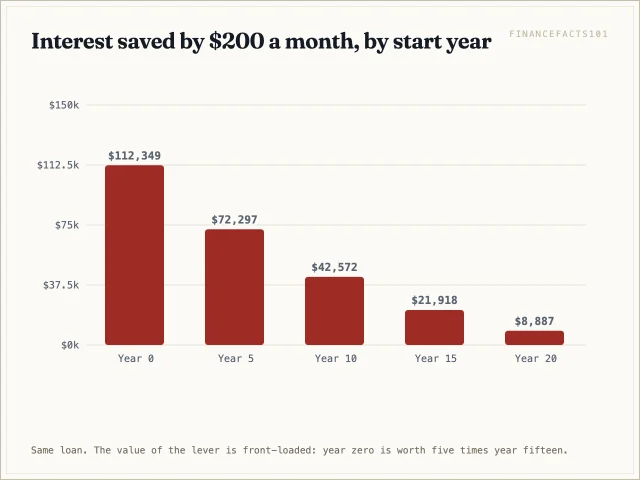
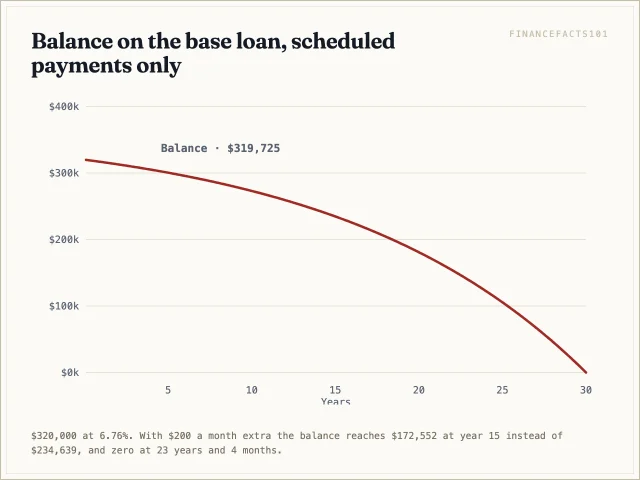
The same $200 is worth five times as much at year zero as at year fifteen, because the early payment removes principal that would otherwise have accrued interest for twenty-five more years. A household that intends to prepay "once things settle down" is choosing the cheap end of the table. If the money is there now, it is worth most now.
Lump sums: a bonus against the balance
A one-off payment works the same way, and because it lands all at once it earns even more per dollar than a monthly stream, since none of it waits. On the base loan at closing:
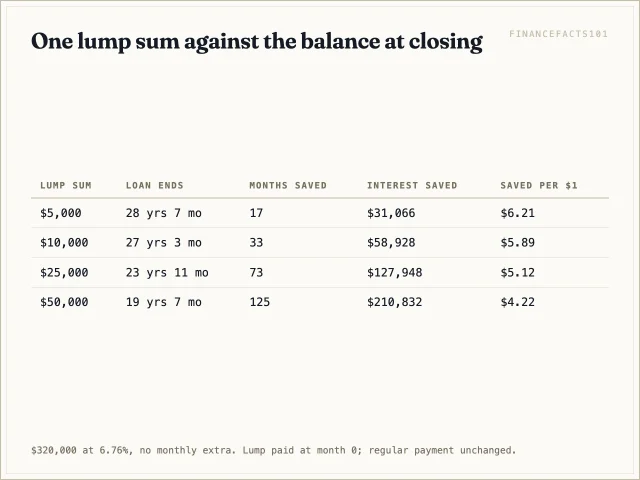
A $5,000 lump saves $31,066 and seventeen months — $6.21 per dollar. Ten thousand saves $58,928; $25,000 saves $127,948 and six years; $50,000 saves $210,832 and cuts the loan to 19 years and 7 months. The per-dollar return falls with size for the same reason as above, but every figure here is above the monthly stream's, because the money went in at month zero.
Two practical points from the CFPB's prepayment-penalty page: penalties, where they exist, usually bite on paying off the whole balance in the first three or five years, and "do not normally apply if you pay extra principal on your mortgage in small chunks at a time." A large lump in year one is the case to check — look in the Note or any Addendum, as the CFPB's early-payoff page advises.
Prepay or invest: the honest comparison
Prepaying a 6.76% loan is a guaranteed 6.76% return, pre-tax-equivalent, with no volatility. Investing the same $200 a month might beat it. Over fifteen years:
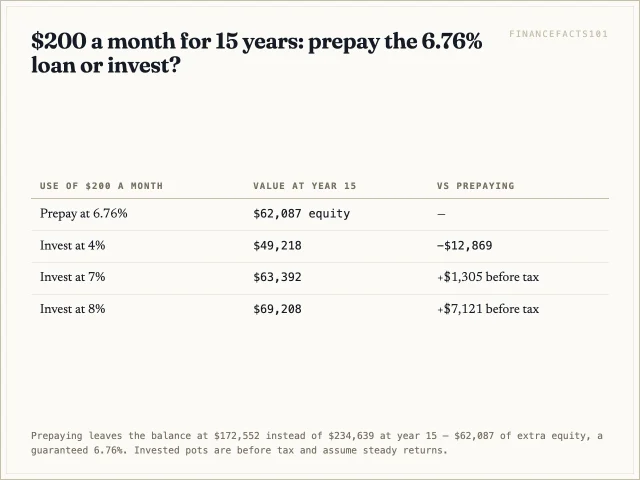
Prepaying leaves the balance at $172,552 at year fifteen instead of $234,639 — $62,087 more equity, which is exactly what $200 a month grows to at 6.76% compounded. Invested at 4% the pot is $49,218, and the prepayment wins by nearly $13,000. At 7% the pot is $63,392, ahead by $1,305 before tax — and behind after any tax on the gains. At 8% it is $69,208, ahead by $7,121 before tax.
The break-even is the mortgage rate itself, 6.76%, and it has to be beaten after tax and every year in sequence. A portfolio that averages 7% but loses 20% in year two does not produce $63,392 on this schedule. Mortgage prepayment produces its number regardless. For a borrower who already holds a diversified, tax-advantaged portfolio, splitting spare cash between the two is a defensible answer; for one who would be investing in a taxable account, the guaranteed 6.76% is hard to beat. On the tax side, mortgage interest is deductible only if you itemize, and IRS Publication 936 sets the rules; as the levers guide shows, most households with this loan do not clear the 2026 standard deduction, so 6.76% is the rate they are actually paying and actually saving.
Extra principal also ends PMI sooner
If the loan carries private mortgage insurance, the same extra payments do a second job. The right to request cancellation arrives when the balance reaches 80% of the home's original value, and extra principal brings that date forward. On the series' 10%-down twin — $360,000 on a $400,000 home, PMI at $150 a month — $200 a month extra reaches the 80% point at month 66 instead of month 98, ending thirty-two premiums early and saving $4,800 of insurance on top of the interest. The PMI removal guide has the full table from $100 to $500 a month. For a borrower paying PMI, the return on the first years of extra principal is therefore higher than the mortgage rate: 6.76% on the interest plus the premium avoided.
What prepaying does to the interest deduction
Less interest paid means less interest to deduct, and a reader who itemizes might wonder whether prepaying costs them a tax benefit. The arithmetic is not close. At a 22% marginal rate, every dollar of interest deducted saves 22 cents of tax; every dollar of interest not paid saves a full dollar. Prepaying is ahead by 78 cents on every dollar of interest it removes. And as IRS Publication 936 makes clear, the deduction is only available to itemizers in the first place — on this loan a married couple with no other itemized deductions does not clear the 2026 standard deduction, so for them the deduction is already zero and prepaying costs nothing at all. The mortgage payment levers guide works the year-by-year interest against the standard deduction.
The biweekly plan is this lever with a fee attached
A half-payment every two weeks makes 26 half-payments a year — thirteen full payments instead of twelve — which is an extra $2,078 a year, or $173 a month, to principal. On the base loan that pays off in exactly 24 years and saves $101,271.
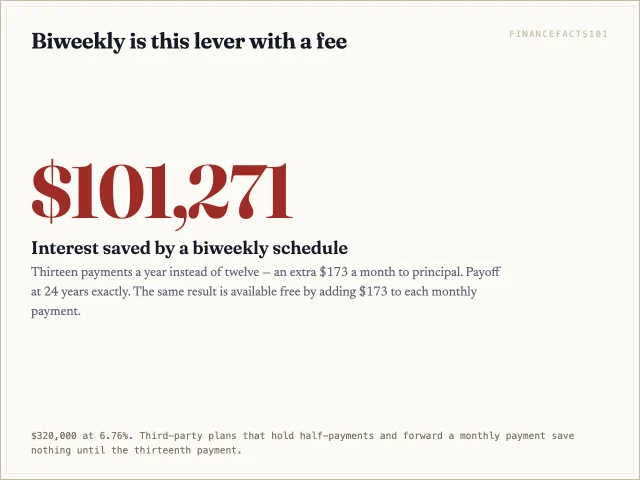
That is a good outcome and you can have it for free: add $173 to each monthly payment, or make one extra principal payment a year. Some servicers and third-party plans charge for the biweekly schedule, and some third-party plans simply hold your half-payments and forward a normal monthly payment, which saves nothing until the thirteenth arrives. Federal servicing rules, as the CFPB summarises them, allow a servicer to hold a partial payment "until enough accumulates for a complete payment," which is exactly why a half-payment sent to the servicer directly does not reduce the balance early. The biweekly payments guide in this series sets the two side by side with the fees included.
Making sure the money goes to principal
An extra $200 that the servicer applies as "next month's payment" saves nothing. The rules that matter, again from the CFPB's servicing summary: servicers must credit full payments the day they arrive, may hold partial payments in a suspense account until a full payment accumulates, and must respond to a written notice of error within thirty business days if a payment is misapplied.
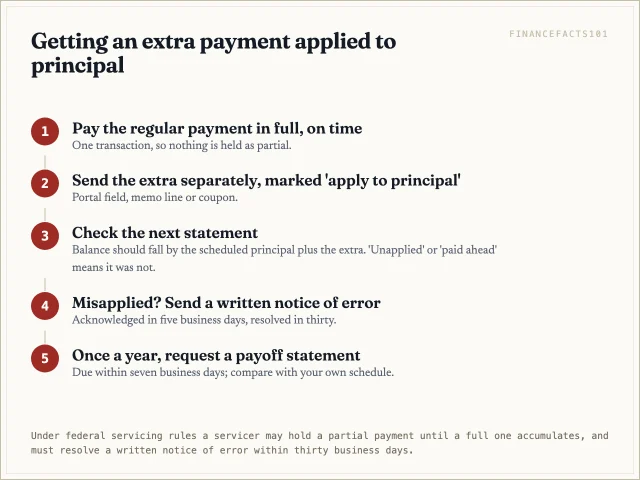
The practical sequence:
- Pay the regular payment in full, on time, as one transaction.
- Send the extra as a separate payment marked "apply to principal" — most servicers' online portals have a field for it; on paper, write it on the memo line and the coupon.
- Check the next statement: the principal balance should have fallen by the regular principal portion plus the extra. If it shows as "unapplied" or "paid ahead," send a written notice of error.
- Ask for a payoff statement once a year — the servicer must answer within seven business days — and compare it with your own amortization schedule; our entry on reading an amortization schedule shows how.
Extra principal does not lower the payment
One thing this lever cannot do: reduce the required monthly payment. The $2,078 is fixed by the original terms until the loan ends. A borrower who wants a lower payment needs a recast — a lump-sum payment after which the servicer re-amortizes the remaining balance over the remaining term — and the recast vs refinance guide in this series prices that against a refinance. The distinction matters for a household whose income is about to fall: extra principal shortens the future, a recast lightens the present.
A decision sequence
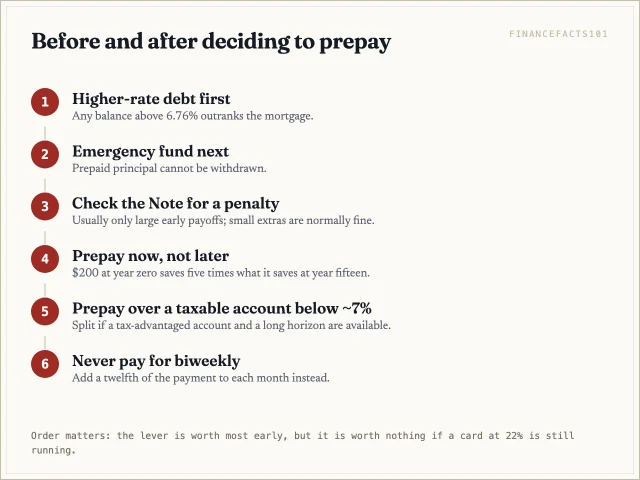
- Higher-rate debt first. A 22% card outranks a 6.76% mortgage for every dollar.
- Emergency fund next. Prepaid principal cannot be withdrawn.
- Check for a penalty in the Note or Addendum before any large lump.
- Then prepay, early. The same $200 saves five times as much at year zero as at year fifteen.
- Prepay rather than invest if the alternative is a taxable account and a return under about 7% is likely; split if a tax-advantaged account is available and the horizon is long.
- Never pay for a biweekly plan. Add a twelfth of the payment to each month instead.
FAQ
How much does $200 a month extra save on a mortgage?
On $320,000 at 6.76% over 30 years, $200 a month from the first payment saves $112,349 of interest and pays the loan off in 23 years and 4 months — six years and eight months early. Started at year ten, the same $200 saves $42,572.
Is it better to pay extra principal or invest?
Prepaying returns the mortgage rate, 6.76% here, guaranteed and in effect tax-free. Investing wins only if it beats that after tax, every year. At a 7% return before tax the two are close; at 4% prepaying wins by about $13,000 over fifteen years.
Does paying extra reduce my monthly payment?
No. It shortens the loan and cuts total interest; the required payment stays at $2,078. Lowering the payment on the same loan takes a recast, which requires a lump sum and a servicer that offers it.
How do I make sure an extra payment goes to principal?
Send it separately from the regular payment, marked for principal, and check the next statement. Servicers may hold partial payments until a full one accumulates, so a half-payment sent on its own does not reduce the balance. If a payment is misapplied, a written notice of error must be resolved within thirty business days.
Sources
- Freddie Mac Primary Mortgage Market Survey — 30-year fixed average, week of September 10, 2026
- CFPB: how does paying down a mortgage work — how the interest and principal split shifts over the loan
- CFPB: your mortgage servicer must comply with federal rules — crediting payments, partial payments, notices of error, payoff statements, and the "$100 more per month" note
- CFPB: what is a prepayment penalty — when penalties apply and that small extra principal payments normally do not trigger them
- CFPB: can I be charged a penalty for paying off my mortgage early — where to find the penalty terms in the Note or Addendum
- IRS Publication 936, Home Mortgage Interest Deduction — the interest deduction requires itemizing
 Next entry · No. 5,962Biweekly Mortgage Payments: The Saving Is Real, the Fee Is Not
See also
-
No. 5,962
26 Sep 2026
12 min
Biweekly Mortgage Payments: The Saving Is Real, the Fee Is Not
Mortgage
-
 No. 5,964
28 Sep 2026
12 min
Mortgage Recast vs Refinance: What to Do With a $50,000 Lump Sum
Mortgage
No. 5,964
28 Sep 2026
12 min
Mortgage Recast vs Refinance: What to Do With a $50,000 Lump Sum
Mortgage -
 No. 5,957
21 Sep 2026
15 min
Mortgage Payment Levers: What Actually Moves the Number
Mortgage
No. 5,957
21 Sep 2026
15 min
Mortgage Payment Levers: What Actually Moves the Number
Mortgage -
 No. 5,933
05 Sep 2026
15 min
15-Year vs 30-Year Mortgage: The Total-Cost Math
Real Estate
No. 5,933
05 Sep 2026
15 min
15-Year vs 30-Year Mortgage: The Total-Cost Math
Real Estate -
 No. 5,967
01 Oct 2026
12 min
2-1 Buydown: What a Seller-Paid Teaser Rate Is Actually Worth
Mortgage
No. 5,967
01 Oct 2026
12 min
2-1 Buydown: What a Seller-Paid Teaser Rate Is Actually Worth
Mortgage -
 No. 5,966
30 Sep 2026
12 min
Assumable Mortgage Value: What a 3% Loan Is Worth in a 6.76% Market
Mortgage
No. 5,966
30 Sep 2026
12 min
Assumable Mortgage Value: What a 3% Loan Is Worth in a 6.76% Market
Mortgage