Mortgage Prepayment Penalty: Will You Be Charged, and Should You Pay Early Anyway?
Most recent US mortgages cannot carry a penalty at all — Reg Z caps it at 2% and kills it at month 37. Then: $300 a month saves $138,446 on $320,000.
There are two questions hiding inside "should I pay my mortgage down faster," and mixing them up is what makes the answer feel hard. The first is whether a mortgage prepayment penalty will charge you for the privilege — and for most US borrowers with a conventional loan written after January 2014, the answer is a flat no, because federal law caps such a penalty at 2% of the amount prepaid, bans it outright after 36 months, and forbids it entirely on adjustable-rate, FHA and VA loans. The second question is whether paying early is worth doing at all, and that one turns on a single number: on $320,000 at 6.5%, an extra $300 a month saves $138,446 of interest and retires the loan 8 years and 10 months early.
This guide answers them in that order. First: can you be charged, how would you know, and where in the world does the charge still bite. Then: should you, priced against investing the same money, with the crossover return stated rather than asserted.
Every dollar figure below uses one loan: $320,000 at 6.5% on a 30-year fixed, a rate set just below the Freddie Mac Primary Mortgage Market Survey 30-year average of 6.66% for the week of August 27, 2026. Principal and interest come to $2,022.62 a month, and left alone the loan pays $408,142 of interest over its life. Our companion pieces on 15-year versus 30-year terms and what a refinance costs use the same balance and the same survey week.
Scope honesty: this is general information built on the stated assumptions, not personal advice. Your note, your rate and your tax situation will differ — read your own documents.
Will you actually be charged a mortgage prepayment penalty?
Start with the base rate, because it is lopsided. A prepayment penalty is a fee the lender charges for paying off some or all of the loan ahead of schedule, and its purpose is to protect the lender's expected interest income — the borrower's side of what fixed-income investors call prepayment risk. It was common before 2008. It is rare now, and on most loan types it is illegal.
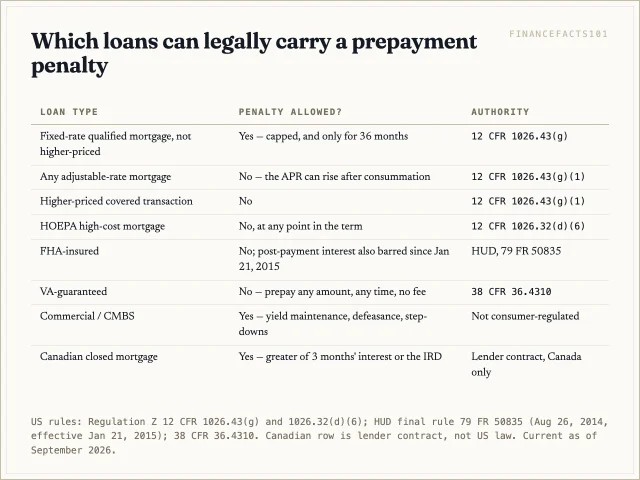
Six of the eight rows say no. The two that say yes are a narrow slice of US consumer lending and a body of commercial and foreign lending under entirely different rules.
The nuance that trips people up: a penalty clause almost always triggers on paying the loan off in full — a sale, a refinance, a lump-sum payoff — within a stated window. Sending an extra $300 a month against principal is virtually never a penalty event. The CFPB puts it plainly: a penalty typically applies if you pay the entire balance within a specific number of years, usually three or five, and typically does not apply to modest extra principal payments — though it says to confirm with your lender, and so do we.
Who this is for — and who it is not for
This is for a US homeowner with a first mortgage on a primary residence who wants to know two things: whether the note allows a charge for paying early, and whether the extra money is better spent on the loan or somewhere else. It also serves the Canadian reader who arrived searching "open vs closed mortgage" — there is a section below written for you, clearly labelled, because the Canadian rules are genuinely different and pretending otherwise would be useless.
It is not a guide for commercial borrowers, though the commercial section explains why your exit costs dwarf anything a homeowner faces and points you to deeper entries. It is not for anyone carrying credit-card debt above roughly 15% — that debt outranks the mortgage on arithmetic alone, and the avalanche method is the better read. And it is not for someone still deciding how much house to buy; that is a different question, handled in how much house you can afford.
The two shapes a prepayment penalty takes
Penalties come in two forms, and they are not equivalent in cost.
The first is a percentage of the amount prepaid — say 2% of the balance you retire. The second is a stated number of months' interest, most often three or six months at the note rate. On our $320,000 loan the difference is large:
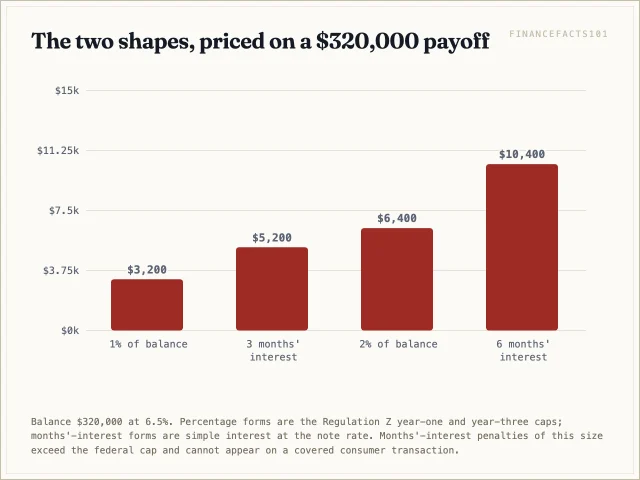
Six months' interest at 6.5% is $10,400. Two percent of the balance is $6,400. Three months' interest is $5,200, and 1% is $3,200. The months'-interest form is the harsher one at ordinary rates, and it is also the form you will not see on a US consumer mortgage written today, because it blows straight through the federal cap. Where you still meet it is in business-purpose and second-lien lending outside the consumer rules, and — in a much more expensive variant — in Canada.
A third pattern is the step-down: 3% in year one, 2% in year two, 1% in year three, nothing thereafter. Federal law now pushes US consumer penalties into roughly that shape by force. Our entry on prepayment penalties in mortgages covers the lender's-eye view of why these clauses exist.
The Dodd-Frank rules that make most US penalties illegal
Here is the regulatory position stated precisely, because it is the most decision-relevant fact in this article and most writing on the subject is vague about it.
Title XIV of the Dodd-Frank Act rewrote the mortgage-origination rules in the Truth in Lending Act, and the CFPB implemented them in the Ability-to-Repay and Qualified Mortgage rule, effective January 10, 2014. Under Regulation Z § 1026.43(g), a covered transaction may include a prepayment penalty only if all of the following hold: the penalty is otherwise permitted by law; the loan's annual percentage rate cannot increase after consummation; the loan is a qualified mortgage; and it is not a higher-priced covered transaction. The creditor must also offer the borrower an alternative loan without a penalty.
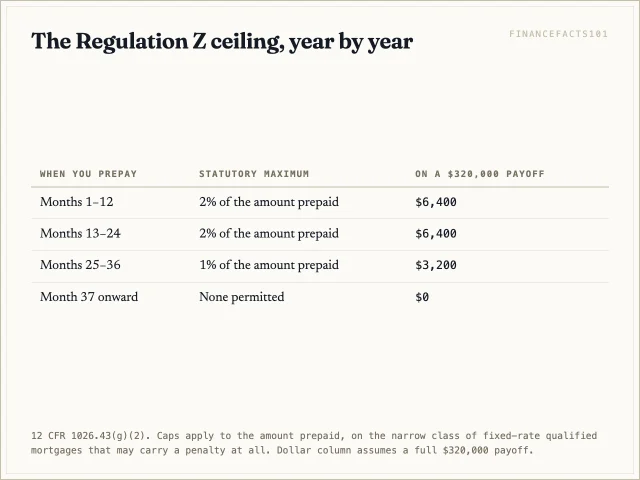
Where a penalty survives all four tests, § 1026.43(g)(2) caps it: no more than 2% of the amount prepaid during the first two years, no more than 1% during the third year, and nothing at all after 36 months.
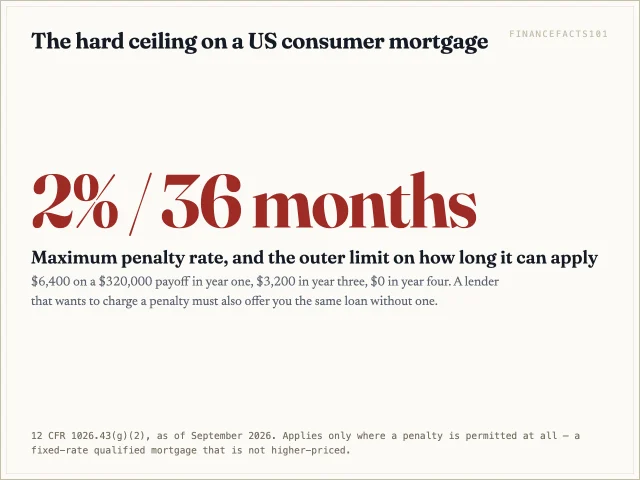
Three doors close on top of that. A HOEPA high-cost mortgage may not carry a prepayment penalty at any point — and under § 1026.32(a)(1)(iii) the existence of a penalty running past 36 months, or exceeding 2% of the amount prepaid, is itself one of the tests that makes a loan high-cost, which is a neat regulatory trap. FHA-insured mortgages may be prepaid without penalty, and since January 21, 2015 servicers may not even charge post-payment interest through the end of the payoff month, under HUD's 2014 final rule and the FHA Single Family Housing Policy Handbook 4000.1. And 38 CFR 36.4310 gives every VA borrower the right to prepay all or any part of the debt at any time without penalty or fee — the VA's own borrower-rights notice adds that if a lender's note contains language purporting to take that right away, the lender cannot enforce it on a VA loan.
Add it up. If your loan is an adjustable-rate mortgage, you cannot be charged. If it is FHA or VA, you cannot be charged. If it is a conventional fixed-rate loan more than three years old, you cannot be charged. That covers the overwhelming majority of American mortgage debt outstanding in September 2026.
How to check your own loan in ten minutes
None of the above is a substitute for reading your documents, and reading them is fast.
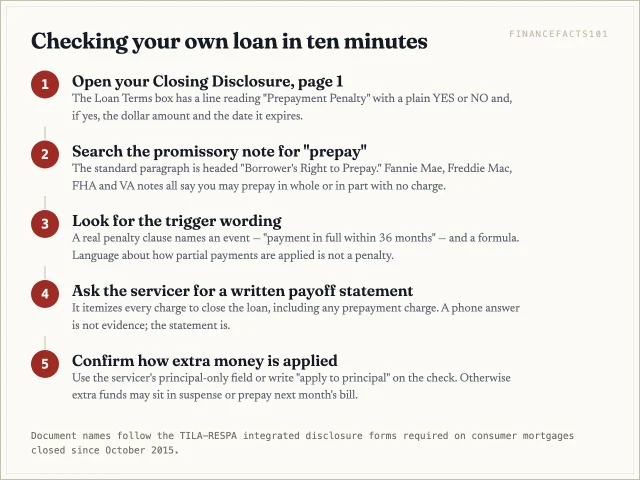
The first step is the highest-value one. Since October 2015 every consumer mortgage closes on a standard Closing Disclosure whose page-1 Loan Terms box asks, in so many words, whether the loan has a prepayment penalty, and answers YES or NO. If it says NO, you are done. If it says YES, the same box gives the maximum dollar amount and the date the clause dies.
Two things look like penalties and are not. Interest accrued to the payoff date is not a penalty — you owe interest for the days you had the money. And a servicer applying an unlabelled extra payment to next month's bill rather than to principal is a processing default, not a charge; fix it with the principal-only field. To see how each extra dollar lands, our entry on reading an amortization schedule walks the columns, and the extra mortgage payment calculator will run your own balance and rate.
Open vs closed mortgage: the Canadian terms, clearly labelled
If you searched "open vs closed mortgage," you have almost certainly landed on Canadian vocabulary. These are not US terms, they are not synonyms for anything in US lending, and the distinction matters because the Canadian penalty is far more expensive than anything Regulation Z permits.
In Canada, an open mortgage may be paid off in whole or in part at any time with no penalty; you buy that flexibility with a higher rate. A closed mortgage locks you in for the term — most commonly five years, after which the loan renews at then-current rates rather than running to maturity — and charges a breakage fee if you leave early. The nearest US analogue to "closed" is simply a normal mortgage that happens to carry a penalty clause, which as shown above is now rare and capped. There is no US analogue to the Canadian renewal cycle at all.
The breakage fee is the part worth understanding. A Canadian lender charges the greater of three months' interest or the interest-rate differential — the IRD, roughly the gap between your contract rate and the lender's current rate for the remaining term, multiplied by your balance and by the years left.
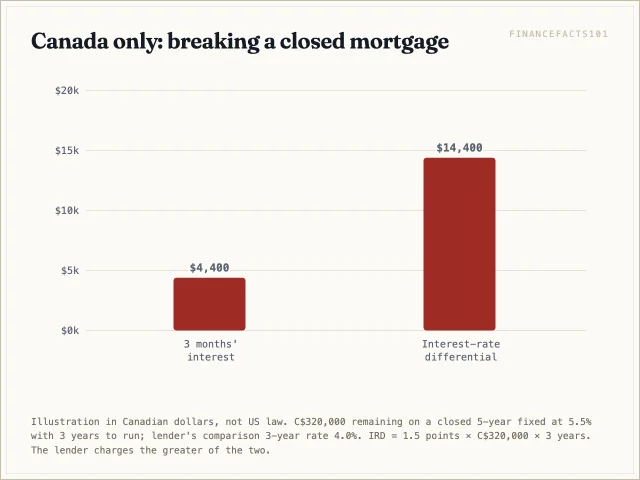
On C$320,000 with three years left on a closed five-year fixed at 5.5%, against a comparison three-year rate of 4.0%, three months' interest is C$4,400 and the IRD is about C$14,400. The lender takes the larger — and that is the polite version, since several major Canadian lenders compute the IRD from posted rates rather than the discounted rate you actually pay. Canadian penalties are governed by the lender's contract and federal cost-of-borrowing disclosure rules; every cap and figure elsewhere in this article is US law and does not apply to you.
Commercial loans: where prepayment still costs real money
The concept genuinely bites in commercial real estate, where no consumer protection applies and the loan often sits inside a securitisation that promised bondholders a specific cash-flow stream — see commercial mortgage-backed securities for why the structure demands it.
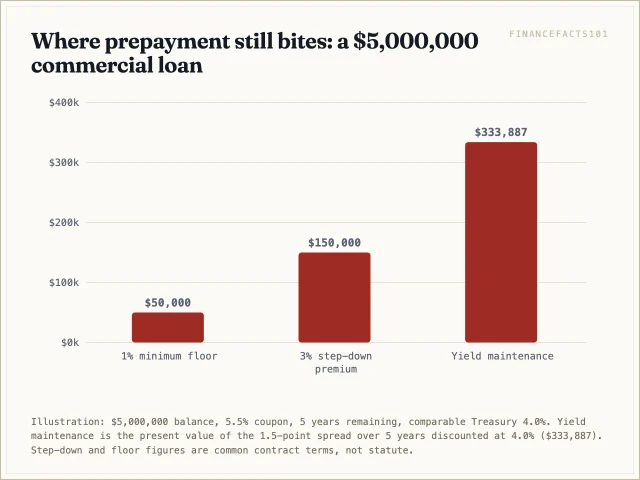
Two mechanisms dominate. Yield maintenance makes the lender whole for the interest it would have collected: you pay the present value of the spread between your coupon and a comparable Treasury yield across the remaining term, usually with a floor of 1% of the balance. On a $5,000,000 loan at 5.5% with five years to run and comparable Treasuries at 4.0%, that is about $333,900 — 6.7% of the balance, more than three times the worst case a US homeowner could ever face as a percentage.
Defeasance is the other, standard in CMBS. Rather than paying the loan off, you substitute a portfolio of government securities that replicates the remaining payments; the loan legally continues, funded by Treasuries. The securities cost whatever the market charges, but the transaction requires accountants, rating-agency confirmations, a successor borrower entity and counsel on both sides — fees running into tens of thousands of dollars regardless of the rate environment. Many CMBS loans also impose an outright lockout for the first few years, during which you cannot prepay at any price, followed by a defeasance window and an open period in the final months before maturity. If you are financing income property, price the exit at origination; it is a term you negotiate, not a fee you discover.
Can I pay off my mortgage early — and should you?
With the first question settled for most readers — yes, you can pay off your mortgage early, at no charge — the interesting one begins. Paying down a 6.5% mortgage earns a guaranteed, risk-free, after-tax 6.5%. That is the whole case, and it is strong: no retail instrument pays a certain 6.5%. The case against is that the return is locked inside an illiquid asset, and that equities have historically paid more.
Price it. Send an extra $300 a month from the first payment — $2,322.62 against the scheduled $2,022.62 — and the schedule changes like this.
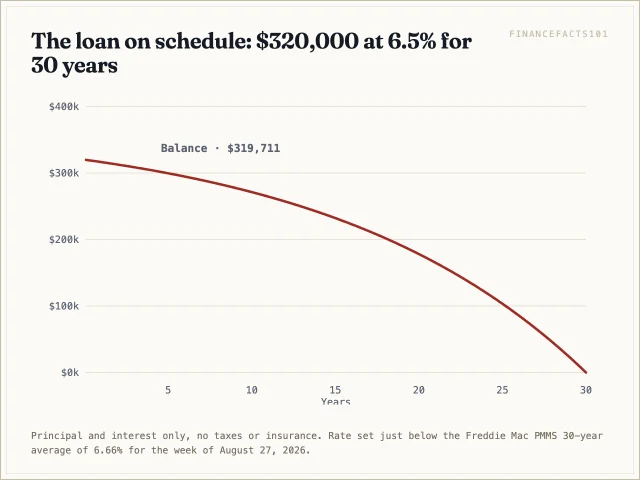
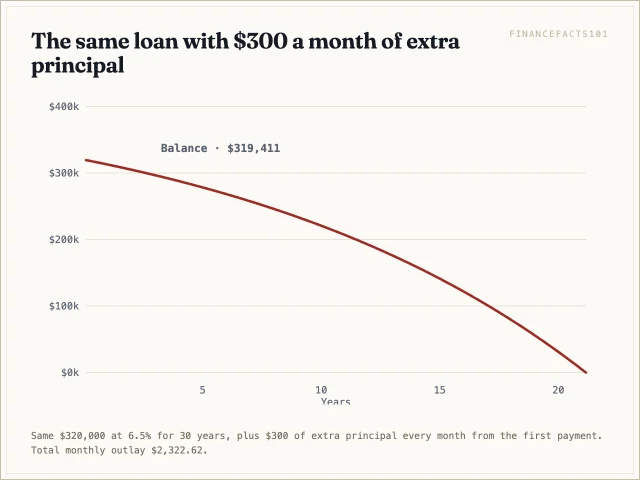
On schedule, the balance is still $299,555 after five years and $271,284 after ten. With the extra $300 it is $278,353 and $220,763, and it reaches zero at month 254 — 21 years and 2 months, against 360. The payoff date moves forward 8 years and 10 months.
The worked example: $138,446 of interest, or $365,991 in a brokerage account
The interest side of the same arithmetic:
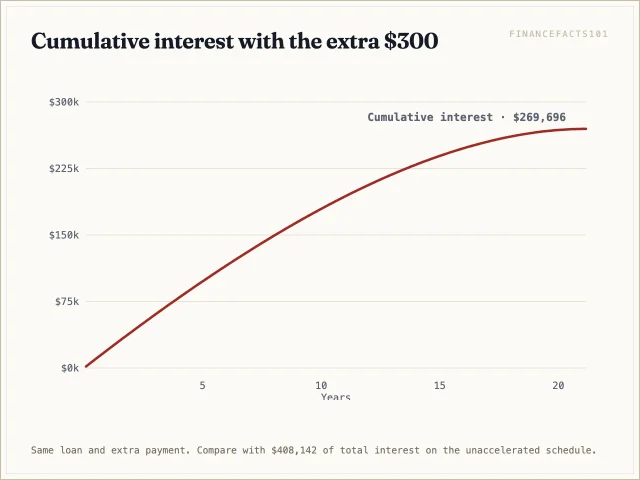
Total interest falls from $408,142 to $269,696 — a saving of $138,446 for $300 a month. Run your own balance through the extra mortgage payment calculator before accepting those figures; the shape holds at any rate, but the dollars move.
Now the counterfactual. The same $300 invested every month for the full 30 years at a 7% nominal return, compounded monthly:
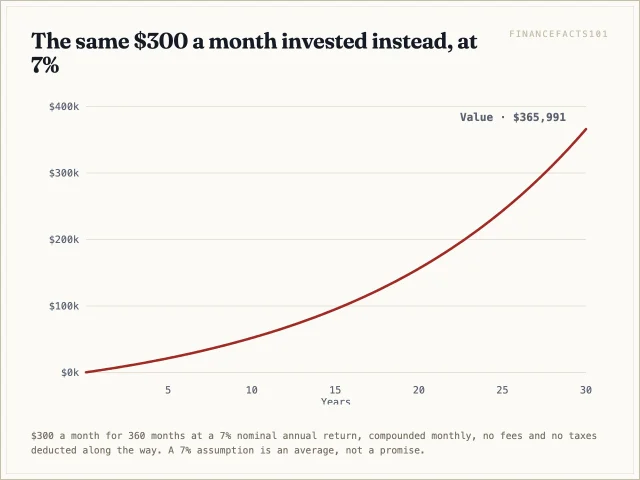
$365,991, of which $108,000 is your own contributions. Stated that way investing looks like a rout — $365,991 against $138,446. That comparison is wrong, and it is the most common error in the debate: it sets a portfolio at year 30 against interest saved over 21 years, and ignores what the prepayer does with the freed-up $2,322.62 for the last 106 months.
Prepay or invest: the crossover return
Compare the two paths properly and they end in the same place structurally — house owned outright at month 360 — so only the portfolio differs.
- Prepay path: pay $2,322.62 a month for 254 months, then invest the entire $2,322.62 for the remaining 106 months.
- Invest path: pay the scheduled $2,022.62 for all 360 months, and invest $300 a month throughout.
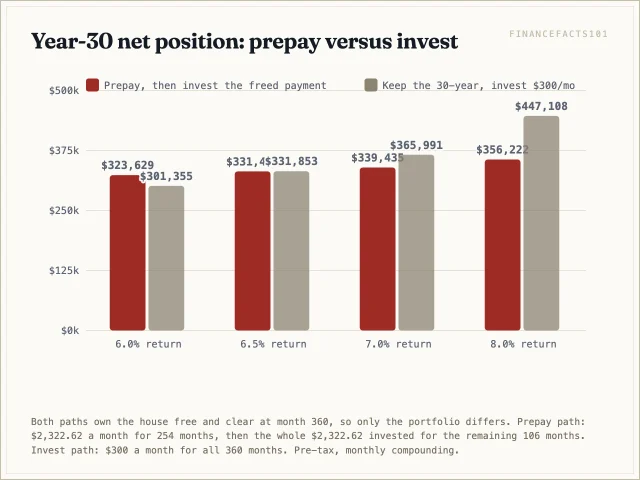
At a 6% return the prepayer finishes with $323,629 against the investor's $301,355 — ahead by $22,274. At 7% the investor takes it, $365,991 against $339,435, ahead by $26,557. At 8% the investor is ahead by $90,886.
The pre-tax crossover is 6.49% — not a coincidence. It is the mortgage rate, because prepaying is exactly a bond paying your note rate: every extra dollar of principal earns 6.5%, guaranteed, with no default risk and no sequence risk. The investment has to beat 6.5% after tax, with certainty you do not have, to be the better trade.
Taxes push the bar higher. Assume the invested money sits in a taxable brokerage account and gains are eventually taxed at the 15% long-term rate; redo the comparison net of that tax and the crossover rises to 6.96%. At exactly the 7% return most planning software assumes, prepaying a 6.5% mortgage and investing in a taxable account are a dead heat. A tax-advantaged account changes the picture: money going into a 401(k) up to the employer match is not competing with 6.5% but with an instant 50%–100% return, and it wins without argument. The investment return calculator takes your own assumed return, and lump sum versus dollar-cost averaging covers how to deploy the money once you decide to invest it.
Why the mortgage interest deduction barely moves the answer
The old objection — "but you lose the deduction" — has largely stopped being true.
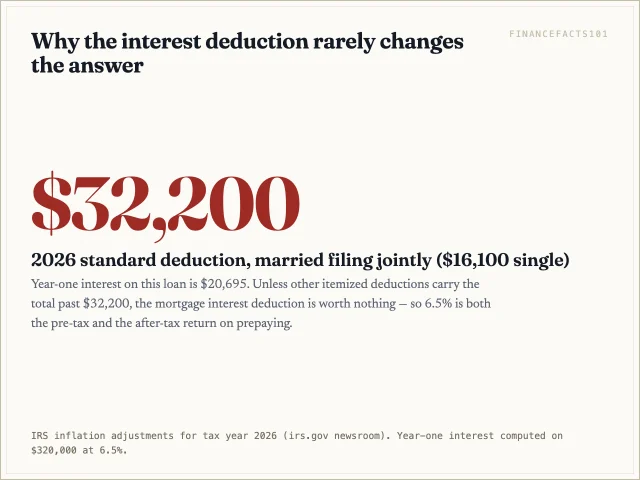
For tax year 2026 the standard deduction is $16,100 for single filers and $32,200 for married couples filing jointly, per the IRS inflation adjustments. Year-one interest on our $320,000 loan at 6.5% is $20,695. A married couple with no other large itemized deductions does not clear $32,200 on mortgage interest alone, takes the standard deduction instead, and receives no tax benefit whatsoever from that interest. Prepaying costs them nothing in foregone deductions.
Even for the minority who itemize, only the interest above the standard-deduction threshold generates value, and only at the marginal rate. A joint filer with $20,695 of interest plus $15,000 of state and local taxes itemizes $35,695, clearing the standard deduction by $3,495; at a 24% marginal rate that is about $839 a year — roughly 0.26 points off a 6.5% rate, not the 1.5-point discount people imagine, and it shrinks every year as interest falls. IRS Publication 936 sets the acquisition-debt limits, and our entry on the mortgage interest deduction covers qualification. Treat the deduction as a rounding error unless your accountant shows otherwise.
Recast, refinance, or just pay extra
Three tools do different jobs, and people reach for the wrong one.
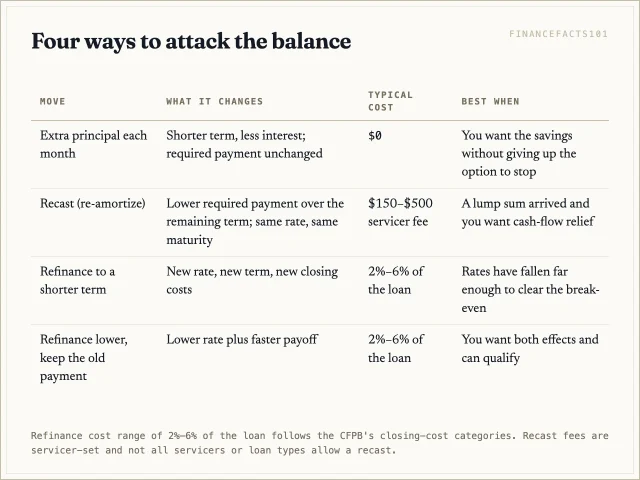
Paying extra principal is free and reversible, but it does not lower your required payment: send $300 extra for five years and the servicer still bills $2,022.62 next month. That is the trade — you keep the option to stop.
A recast, or re-amortization, is the tool that lowers the required payment. You pay a lump sum against principal and the servicer recalculates the payment over the remaining term at the same rate, usually for a $150–$500 fee. Not every servicer or loan type allows it, and government-backed loans generally do not. A recast is the right move after a windfall when you want monthly breathing room rather than a shorter term.
A refinance is the only one that changes your rate, and it costs 2%–6% of the loan — see what a refinance actually costs for the full stack, or run it through the refinance calculator. One combination is worth naming: refinance to a lower rate and keep sending the old, higher payment. You get the rate improvement and the accelerated payoff at once, and it beats either move alone. For the payment on a hypothetical loan, the mortgage payment calculator is the quicker route.
The liquidity argument against prepaying
This is the strongest objection to prepayment, stronger than the return comparison, and it deserves more than a sentence.
Money sent to principal is gone. It does not come back until you sell or borrow against the house, and both routes are slow, expensive and — this is the part that matters — least available precisely when you need them. A homeowner who loses a job cannot readily qualify for a home equity line at the moment they most want one, and lenders froze or cut existing HELOCs in 2008 and again in 2020 when property values wobbled. Prepaid principal is not an emergency fund; it is the opposite of one, and the mismatch between when the money is reachable and when it is needed is the household version of liquidity risk.
There is a second edge. Extra principal does not reduce next month's obligation. Send $50,000 to the loan and you have converted $50,000 of liquid savings into a smaller balance while still owing $2,022.62 on the first of the month, with no cushion to pay it from. The borrower who put the same $50,000 in a brokerage account has a worse guaranteed return and can cover eighteen months of payments on a Tuesday.
The resolution is ordering, not choosing. Fill the emergency fund first — three to six months of expenses in cash. Capture the employer match. Clear any debt above roughly 10%. Only then does surplus belong on the mortgage, and even then a recast, or a larger cash buffer alongside a smaller extra payment, buys back most of the flexibility for a modest cost in interest.
The decision framework
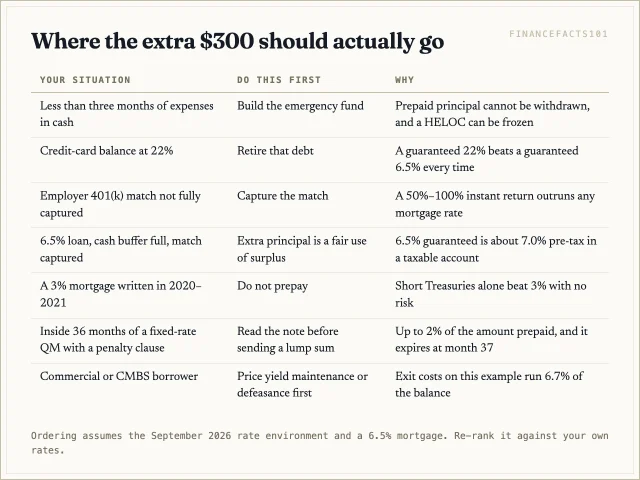
The one-paragraph version. On question one: check page 1 of your Closing Disclosure, and if it says no prepayment penalty, stop worrying — no ARM, FHA or VA loan can carry one, none of any kind survives past month 37, and where one exists it is capped at 2%. On question two: prepaying is a guaranteed return equal to your note rate, so a 6.5% loan is worth attacking and a 3% loan from 2021 is not; the taxable-account crossover here sits at 6.96%. Sequence matters more than the crossover, though — cash buffer, then match, then high-rate debt, then the mortgage. And if flexibility matters, extra monthly principal beats a lump sum, because you can turn it off any month without asking permission.
FAQ
Can my lender charge me for paying my mortgage off early?
Almost certainly not, on a US consumer mortgage. Regulation Z permits a penalty only on a fixed-rate qualified mortgage that is not higher-priced, caps it at 2% of the amount prepaid for two years and 1% in the third, and bars it after 36 months. ARMs, FHA loans, VA loans and HOEPA high-cost loans cannot carry one at all. Confirm by reading the Prepayment Penalty line on page 1 of your Closing Disclosure.
Does making extra principal payments trigger a penalty?
Very rarely. Penalty clauses are written around paying the loan off in full — sale, refinance, lump-sum payoff — within a stated window, not around routine extra principal. The CFPB says the same, while advising you to confirm with your lender. If you are inside a penalty window and planning a large lump sum, ask the servicer for a written payoff statement first, so any charge appears in writing.
What is the difference between an open and a closed mortgage?
They are Canadian terms with no US equivalent. An open mortgage can be repaid in full at any time with no penalty, at a higher rate; a closed mortgage locks you into the term and charges the greater of three months' interest or the interest-rate differential if you leave early. On C$320,000 with three years remaining, that is C$4,400 versus C$14,400. None of the US caps in this article apply in Canada.
Is it better to pay off my mortgage early or invest the money?
At 6.5% it is close to a coin flip against a 7% taxable portfolio: the after-tax crossover here is 6.96%. Below your note rate prepaying wins; above it investing wins, but only on average and with real risk of underperforming. Prepay after the emergency fund is full, the match is captured and any debt above about 10% is gone — and do not prepay a mortgage in the 2%–4% range at all.
Why do commercial mortgages still have expensive prepayment penalties?
Because no consumer protection applies and the loan usually backs a bond that promised investors a defined cash-flow stream. Yield maintenance charges the present value of the lender's lost spread — about $333,900, or 6.7% of the balance, on a $5,000,000 loan at 5.5% with five years left and Treasuries at 4.0% — and defeasance substitutes a Treasury portfolio for the payments, adding professional fees. Negotiate the exit terms at origination.
Sources
- CFPB, "What is a prepayment penalty?" — when a penalty applies and why extra principal payments usually do not trigger one
- CFPB, Regulation Z § 1026.43 — paragraph (g), the conditions and caps on prepayment penalties
- eCFR, 12 CFR § 1026.43 — current text of the ability-to-repay and qualified mortgage rule
- CFPB, Regulation Z § 1026.32 — high-cost mortgages; (d)(6) bans prepayment penalties outright
- CFPB, "What is a Qualified Mortgage?" — the QM feature restrictions
- Federal Register, Ability-to-Repay and Qualified Mortgage Standards Under TILA (Regulation Z) — the 2013 final rule implementing Dodd-Frank Title XIV
- Federal Register, FHA: Handling Prepayments — Eliminating Post-Payment Interest Charges — 79 FR 50835, effective January 21, 2015
- HUD, FHA Single Family Housing Policy Handbook 4000.1 — FHA prepayment policy
- eCFR, 38 CFR Part 36, Subpart B — § 36.4310, the VA borrower's right to prepay without penalty or fee
- Freddie Mac, Primary Mortgage Market Survey — 30-year fixed average of 6.66% for the week of August 27, 2026
- IRS, tax inflation adjustments for tax year 2026 — standard deduction of $16,100 single and $32,200 married filing jointly
- IRS Topic 551, Standard Deduction
- IRS Publication 936, Home Mortgage Interest Deduction — acquisition-debt limits and qualification
 Next entry · No. 5,957Mortgage Payment Levers: What Actually Moves the Number
See also
-
 No. 5,964
28 Sep 2026
12 min
Mortgage Recast vs Refinance: What to Do With a $50,000 Lump Sum
Mortgage
No. 5,964
28 Sep 2026
12 min
Mortgage Recast vs Refinance: What to Do With a $50,000 Lump Sum
Mortgage -
 No. 5,958
22 Sep 2026
12 min
Discount Points Break-Even: When Buying Down the Rate Pays
Mortgage
No. 5,958
22 Sep 2026
12 min
Discount Points Break-Even: When Buying Down the Rate Pays
Mortgage -
 No. 5,967
01 Oct 2026
12 min
2-1 Buydown: What a Seller-Paid Teaser Rate Is Actually Worth
Mortgage
No. 5,967
01 Oct 2026
12 min
2-1 Buydown: What a Seller-Paid Teaser Rate Is Actually Worth
Mortgage -
 No. 5,966
30 Sep 2026
12 min
Assumable Mortgage Value: What a 3% Loan Is Worth in a 6.76% Market
Mortgage
No. 5,966
30 Sep 2026
12 min
Assumable Mortgage Value: What a 3% Loan Is Worth in a 6.76% Market
Mortgage -
 No. 5,965
29 Sep 2026
12 min
Cash-Out Refinance vs HELOC: The Blended-Rate Math on $50,000
Mortgage
No. 5,965
29 Sep 2026
12 min
Cash-Out Refinance vs HELOC: The Blended-Rate Math on $50,000
Mortgage -
 No. 5,963
27 Sep 2026
12 min
ARM vs Fixed-Rate Mortgage: Pricing the Bet on a 5/1 ARM
Mortgage
No. 5,963
27 Sep 2026
12 min
ARM vs Fixed-Rate Mortgage: Pricing the Bet on a 5/1 ARM
Mortgage