Cash-Out Refinance vs HELOC: The Blended-Rate Math on $50,000
Refinancing a 3% mortgage to pull $50,000 at 6.95% costs $158,500 over ten years. A HELOC at 8.5% costs $24,391. The blended rate is 3.79%. Here is why.
A homeowner with a $300,000 balance at 3% who needs $50,000 in cash has two ways to get it against the house. A cash-out refinance replaces the whole loan with $350,000 at today's 6.95%, and over ten years costs $158,500 more in interest and closing costs than keeping the old loan — because it reprices the $300,000 that was never the problem. A $50,000 home equity line at 8.5%, paid down over ten years, costs $24,391 and leaves the 3% loan untouched. The HELOC's rate is higher; the HELOC's cost is under a sixth. The blended rate on the two balances is 3.79%, and that number, not the HELOC's headline rate, is what the borrower is actually paying.
This guide departs from the series' base loan on purpose. The decision only exists for a borrower whose existing rate is below today's, so the existing loan is a $340,000 mortgage taken at 3.00% in 2021, now $300,000 with 25 years left and a payment of $1,433. Today's refinance rate is the Freddie Mac Primary Mortgage Market Survey average for the week of September 17, 2026, 6.95% — the same week the prime rate below took effect. HELOC rates are variable and priced off the prime rate, which the Federal Reserve's H.15 release puts at 7.00% from September 17, 2026, a quarter point higher than a week earlier after the Federal Reserve raised its target range on September 16; the tables run HELOC rates of 7.5%, 8.5% and 9.5% — prime plus a half, one and a half, and two and a half — so you can read across at your own quote. The mortgage payment levers guide has the fixed-rate levers; this is the one decision in the series where the old rate is the asset.
Scope honesty: this is general information built on the stated assumptions above, not personal advice. Your existing rate, balance, HELOC quote, credit and equity will differ.
Who this is for — and who it is not for
This guide is for a homeowner holding a mortgage well below today's rates who needs a lump of cash — a renovation, tuition, consolidating expensive debt — and is being offered a cash-out refinance. It is also for the homeowner who assumes a HELOC must be worse because its rate is higher.
It is not for a borrower whose existing rate is already at or above today's; the last section prices that case, and the answer flips. It is not for anyone planning to borrow against the house to invest or to fund consumption they could not otherwise afford — the CFPB's HELOC page is blunt that "if you fall behind or can't repay the loan on schedule, you could lose your home," and that risk is identical for both products. And a borrower without a funded emergency reserve should read the emergency fund size guide before adding secured debt of any kind.
The two products, and a third
A cash-out refinance, in the CFPB's words, means "you replace your existing mortgage with a bigger mortgage and take the difference in cash." One loan, one rate — today's — on the whole balance, with closing costs. The CFPB's own caution follows immediately: "Carefully consider the interest rate, especially if it is higher than the interest rate on your current mortgage."
A HELOC is a revolving line secured by the home: a draw period during which you can borrow up to the limit, then a repayment period. The rate is usually variable and the payment moves with the balance. The lender can reduce or freeze the line if circumstances change.
A home equity loan is the fixed-rate cousin: a lump sum, a fixed rate and a fixed payment over a set term. The CFPB's comparison draws the line at revolving versus one-time: with a HELOC, "when you make payments on your HELOC the amount of available credit is replenished."
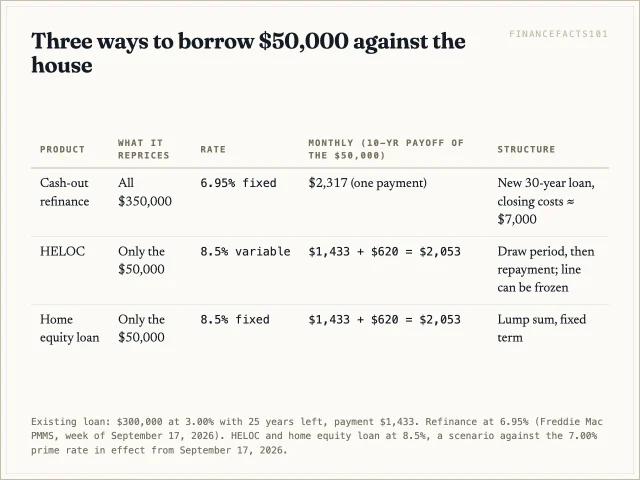
All three leave you with a lien on the house. Only the first one touches the rate on the money you already owe.
What the cash-out refinance actually costs
Refinance $300,000 at 3% into $350,000 at 6.95% over 30 years and the payment goes from $1,433 to $2,317 — up $883 a month — with about $7,000 in closing costs at 2% of the new balance.
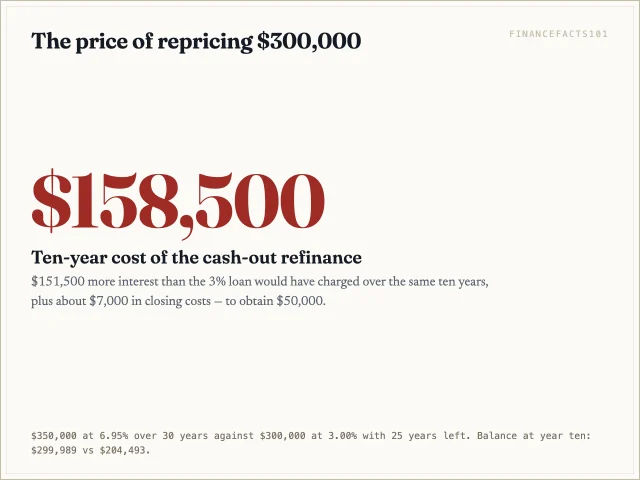
The $883 is not the cost of borrowing $50,000. Most of it is the cost of moving $300,000 from 3% to 6.95%. Over ten years the new loan charges $228,007 of interest against the $76,508 the old loan would have charged: $151,500 more, plus $7,000 of costs, $158,500 in all. And because the new loan is a fresh 30-year schedule, the balance at year ten is $299,989 — against $204,493 on the old loan — so the borrower is $95,496 further from owning the house as well.
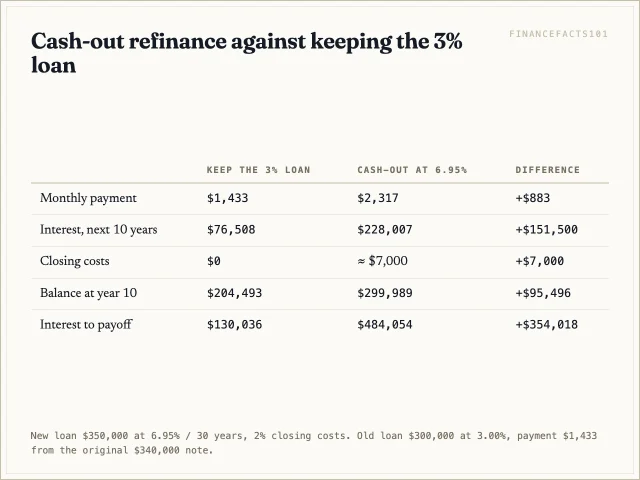
Over the full life of the loan the arithmetic is worse: $484,054 of interest on the new loan plus costs, against $130,036 remaining on the old one — $361,018 more, for $50,000 of cash.

What the HELOC actually costs
Keep the 3% loan and its $1,433 payment. Add a $50,000 HELOC, paid down over ten years:
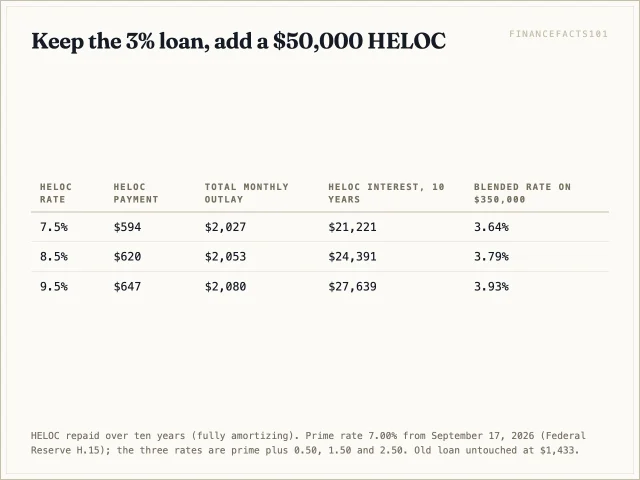
At 7.5% the HELOC costs $594 a month and $21,221 of interest; at 8.5%, $620 and $24,391; at 9.5%, $647 and $27,639. The total monthly outlay — old payment plus HELOC — is $2,027 to $2,080, which is below the cash-out refinance's $2,317 at every HELOC rate on the table, and the old loan's schedule is untouched.
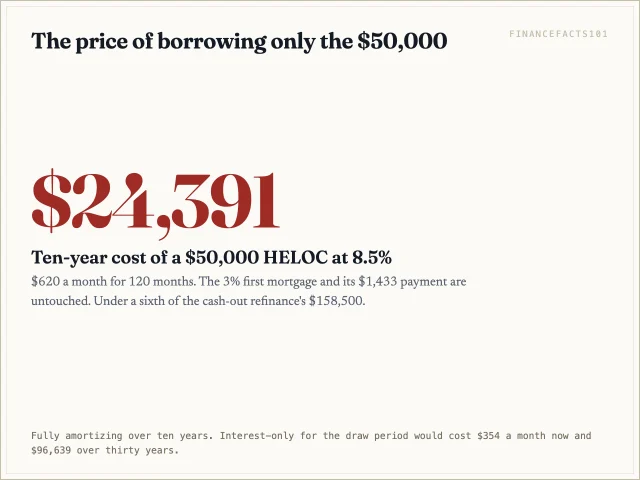
Structured as many HELOCs are — interest-only for a ten-year draw period, then amortized over twenty — the monthly cost during the draw is lower still ($312 to $396 a month) and the total interest much higher ($84,171 to $109,356 over thirty years), because nothing is repaid for a decade. The CFPB warns that entering the repayment period can bring "much higher monthly payments"; the ten-year amortizing figures above are the disciplined version, and the interest-only figures are the price of not being disciplined.
The blended rate: what you are really paying
The right way to compare a second loan against a refinance is the weighted average rate on all the money borrowed. On $300,000 at 3% plus $50,000 at 8.5%:
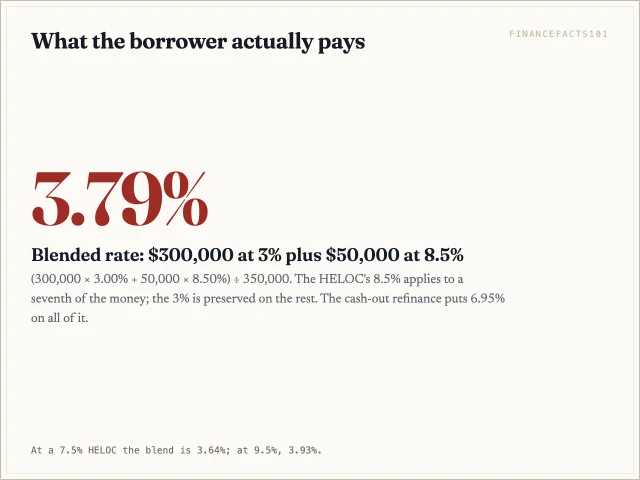
(300,000 × 3.00% + 50,000 × 8.50%) ÷ 350,000 = 3.79%. At a 7.5% HELOC it is 3.64%; at 9.5%, 3.93%. Every one of those is less than 4%, against the cash-out refinance's 6.95% on the same $350,000. The HELOC's 8.5% headline looks expensive next to 6.95%; the blended 3.79% shows that it is applied to a seventh of the money, and the 3% is preserved on the rest.
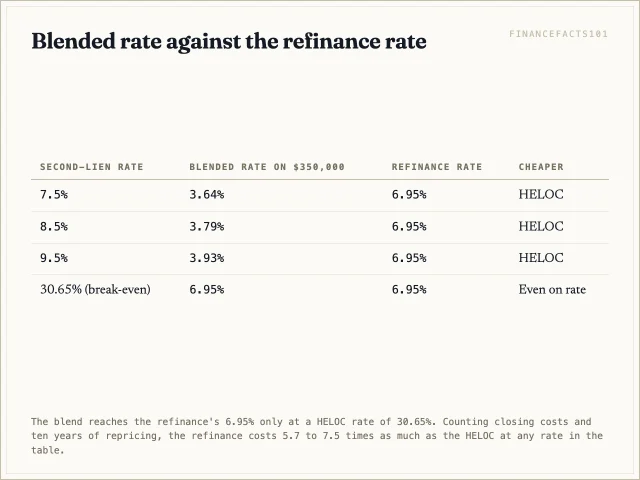
The blended rate also gives the break-even. The blend reaches the refinance's 6.95% only at a HELOC rate of 30.65%: (350,000 × 6.95% − 300,000 × 3.00%) ÷ 50,000. No home equity product is priced there. Counting closing costs and ten years of repricing the $300,000, the gap is wider still: the refinance costs 5.7 to 7.5 times as much as the HELOC at any rate in the table. On a 3% first mortgage, the cash-out refinance cannot win.
Ten years, side by side
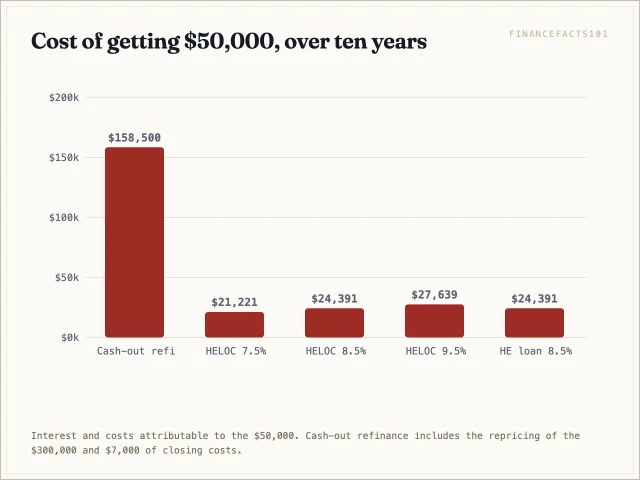
Cost of the $50,000 over ten years, counting interest and costs attributable to getting it: cash-out refinance $158,500; HELOC at 7.5% $21,221; at 8.5% $24,391; at 9.5% $27,639; fixed home equity loan at 8.5% $24,391. The refinance is roughly six to seven and a half times the cost of any second-lien route.
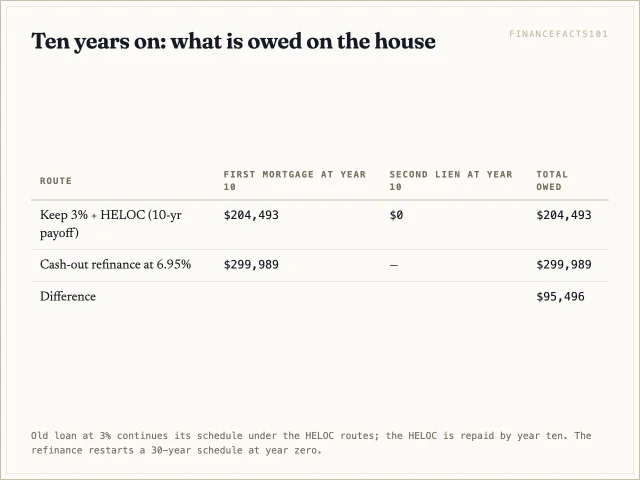
Two things the table leaves out cut in the same direction. The HELOC's rate is variable and could rise — but it would have to pass 30.65% before even the blended rate matched the refinance's 6.95%. And the cash-out refinance restarts the term, which the HELOC does not; at year ten the HELOC borrower owes $204,493 on the house and nothing on the line, while the refinance borrower owes $299,989.
The tax difference
Interest on home equity debt is deductible only, in the words of IRS Publication 936, "if the borrowed funds are used to buy, build, or substantially improve the taxpayer's home that secures the loan." A HELOC that pays for a kitchen qualifies, subject to itemizing; one that pays tuition or consolidates cards does not. The cash-out refinance faces the same test on the cash portion: the new loan counts as home acquisition debt "only up to the amount of the balance of the old mortgage principal just before the refinancing," so the $50,000 above the old balance is deductible only if it goes into the home.
The tax treatment is therefore a wash between the two products — the same $50,000 is tested the same way whichever lien it sits under. What differs is that the refinance also moves $300,000 of existing acquisition debt to a higher rate, and no deduction recovers more than a fraction of that.
When the cash-out refinance wins
Change one assumption — the existing loan is at 6.95%, not 3% — and the decision reverses in part. Refinancing $300,000 at 6.95% into $350,000 at 6.95% raises the payment from $2,111 to $2,317 and, over ten years, costs $39,145 of extra interest plus $7,000 of costs, $46,145. The 8.5% HELOC still costs $24,391 over the same ten years — still cheaper, but now by $21,754 rather than $134,108, and the refinance buys a single fixed payment and a rate that cannot rise.
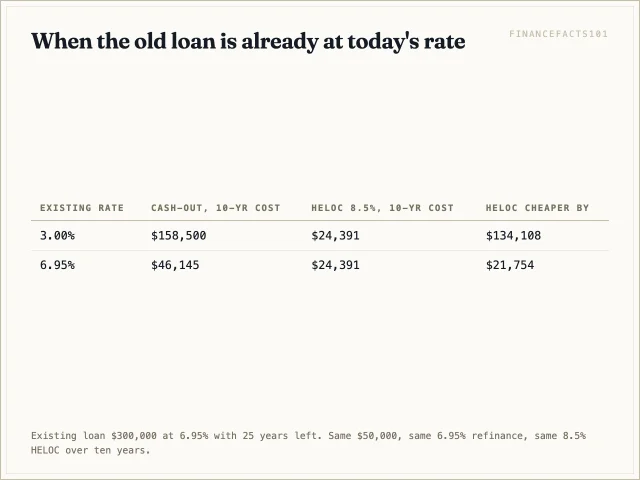
The general rule: a cash-out refinance is worth considering when the existing rate is at or above today's, when the HELOC rate on offer is unusually high, or when the borrower wants one fixed obligation and will pay for that certainty. When the existing rate is materially below today's, the HELOC or home equity loan wins by an amount that no plausible rate difference overturns. The mortgage refinance cost guide prices the pure rate-and-term refinance, which is a separate question from taking cash.
When the draw period ends
The HELOC's one structural trap is the boundary between its two periods. The CFPB's HELOC page puts it plainly: at the end of the draw period "you stop being able to borrow from your HELOC and enter the 'repayment period'," and the payment can rise sharply, because a balance that has been carried interest-only must now be amortized over what remains. On the $50,000 line at 8.5%, an interest-only draw period costs $354 a month; when the twenty-year repayment period begins, the payment becomes $434 — an $80 jump on a balance that has not fallen by a dollar in ten years, and $96,639 of interest over the thirty years against $24,391 for the ten-year amortizing route. A HELOC used the disciplined way — repaid on a schedule from the first draw — has no such boundary, and it is the only version whose cost the tables above describe.
HELOC or home equity loan
Between the two second-lien products the choice is about rate risk and drawdown, not cost — at the same rate they cost the same. The HELOC suits a renovation paid in stages, because interest accrues only on what is drawn; its rate floats, and the lender can freeze the line. The home equity loan suits a single known amount, at a fixed rate the borrower can budget against for the whole term. A borrower who wants the HELOC's flexibility and worries about rising rates can draw, then ask the lender to convert the drawn balance to a fixed rate, which many lines allow; the terms belong in the fine print, along with the draw period, the repayment period, any annual fee, and any penalty for closing the line early.
A decision sequence
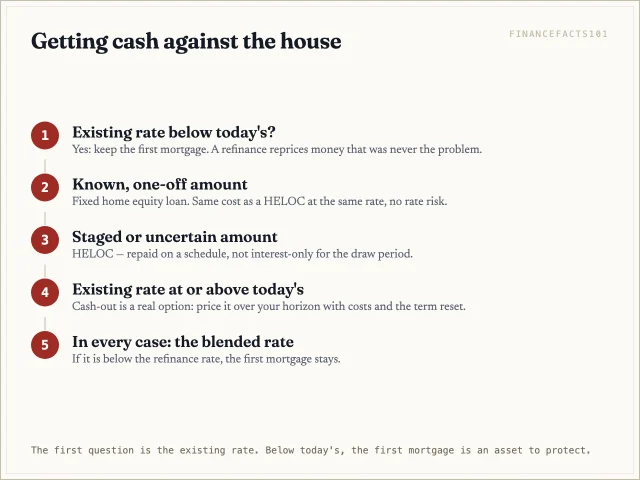
- Is the existing rate below today's? Yes: do not refinance the whole loan to get cash. Go to step 2.
- Is the amount known and one-off? A fixed home equity loan. Staged or uncertain: a HELOC, repaid on a schedule, not interest-only.
- Is the existing rate at or above today's? A cash-out refinance is now a real option; price it against the HELOC over your horizon, including closing costs and the term reset.
- Either way: compute the blended rate. If it is below the refinance rate, keep the first mortgage.
- Never: an interest-only HELOC with no plan for the repayment period, or borrowing against the house for anything you could not repay from income.
FAQ
Is a HELOC cheaper than a cash-out refinance?
When the existing mortgage rate is below today's, almost always. On a $300,000 loan at 3%, a $50,000 HELOC at 8.5% costs $24,391 over ten years; a cash-out refinance of the whole balance at 6.95% costs $158,500, because it reprices the $300,000 too. The blended rate of the two balances is 3.79%.
What is a blended rate?
The weighted average rate on all the money borrowed: (300,000 × 3% + 50,000 × 8.5%) ÷ 350,000 = 3.79%. It is the number to compare with the cash-out refinance rate, because both apply to the same $350,000.
When does a cash-out refinance make sense?
When the existing rate is at or above today's, when the HELOC rate on offer is very high, or when a single fixed payment is worth paying for. On a $300,000 loan already at 6.95%, the refinance costs $46,145 over ten years against the HELOC's $24,391 — closer, and with a fixed rate.
Is HELOC interest tax-deductible?
Only if the money is used to buy, build or substantially improve the home that secures it, and only if you itemize. The same test applies to the cash portion of a cash-out refinance.
Sources
- Freddie Mac Primary Mortgage Market Survey — 30-year fixed average 6.95%, week of September 17, 2026 (6.76% the week before)
- Federal Reserve H.15 Selected Interest Rates — bank prime loan rate, 7.00% from September 17, 2026 (6.75% through September 16)
- Federal Reserve FOMC statement, September 16, 2026 — federal funds target range raised a quarter point to 3.75–4.00%
- CFPB: what is a home equity line of credit — draw and repayment periods, variable rate, the risk of losing the home, line freezes
- CFPB: home equity loan vs HELOC — lump sum and fixed rate against revolving credit
- CFPB: what other types of loans are similar to a HELOC — the cash-out refinance defined, and the warning about a higher rate
- IRS Publication 936, Home Mortgage Interest Deduction — home equity interest deductible only for buying, building or improving the home; refinanced debt counts as acquisition debt only up to the old balance
 Next entry · No. 5,966Assumable Mortgage Value: What a 3% Loan Is Worth in a 6.76% Market
See also
-
 No. 5,932
04 Sep 2026
16 min
How Much It Costs to Refinance a Mortgage
Mortgage
No. 5,932
04 Sep 2026
16 min
How Much It Costs to Refinance a Mortgage
Mortgage -
 No. 5,964
28 Sep 2026
12 min
Mortgage Recast vs Refinance: What to Do With a $50,000 Lump Sum
Mortgage
No. 5,964
28 Sep 2026
12 min
Mortgage Recast vs Refinance: What to Do With a $50,000 Lump Sum
Mortgage -
 No. 5,962
26 Sep 2026
12 min
Biweekly Mortgage Payments: The Saving Is Real, the Fee Is Not
Mortgage
No. 5,962
26 Sep 2026
12 min
Biweekly Mortgage Payments: The Saving Is Real, the Fee Is Not
Mortgage -
 No. 5,961
25 Sep 2026
12 min
Extra Mortgage Payments: What $200 a Month Actually Saves
Mortgage
No. 5,961
25 Sep 2026
12 min
Extra Mortgage Payments: What $200 a Month Actually Saves
Mortgage -
 No. 5,958
22 Sep 2026
12 min
Discount Points Break-Even: When Buying Down the Rate Pays
Mortgage
No. 5,958
22 Sep 2026
12 min
Discount Points Break-Even: When Buying Down the Rate Pays
Mortgage -
 No. 5,967
01 Oct 2026
12 min
2-1 Buydown: What a Seller-Paid Teaser Rate Is Actually Worth
Mortgage
No. 5,967
01 Oct 2026
12 min
2-1 Buydown: What a Seller-Paid Teaser Rate Is Actually Worth
Mortgage