Mortgage Payment Levers: What Actually Moves the Number
A $320,000 loan at 6.76% costs $2,078 a month. Rate, term, points, PMI, extra principal, recast and escrow each move that figure — here is by how much.
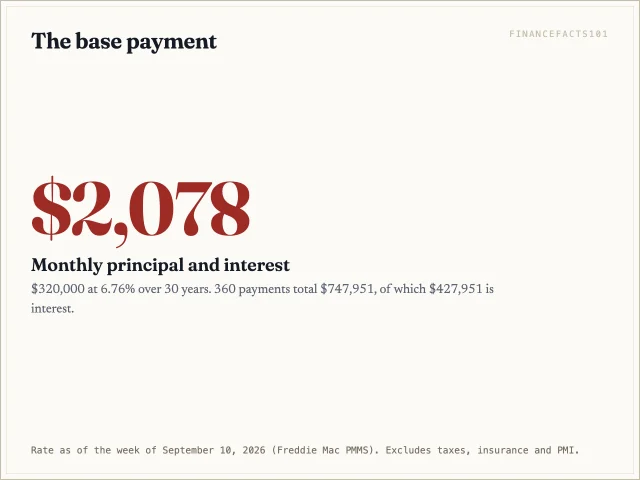
A $320,000 mortgage at 6.76% over 30 years costs $2,078 a month in principal and interest, and $427,951 of interest over its life. Seven separate levers move those two numbers, and this guide prices each one on that same loan so you can see which are worth pulling. The short version: rate and term move the payment most, extra principal moves lifetime interest most, and PMI and escrow move the check you actually write more than most buyers expect.
Every figure below uses one loan: a $400,000 home with 20% down, so $320,000 borrowed, at the Freddie Mac Primary Mortgage Market Survey average for the week of September 10, 2026 — 6.76% on the 30-year fixed, 6.09% on the 15-year fixed. Property tax is set at $4,800 a year and homeowners insurance at $1,600, both stated so you can substitute your own. If your quote differs, every conclusion keeps its shape; only the dollars move. The calculators behind each lever are linked where they apply, and the decision guides for the bigger choices — 15 vs 30 years, how much house you can afford, whether to refinance — go deeper on their own.
Scope honesty: this is general information built on the stated assumptions above, not personal advice. Your rate, taxes, and situation will differ.
Who this is for — and who it is not for
This guide is for anyone about to sign a mortgage, or already holding one, who wants to know which of the options a lender or servicer keeps offering — points, a shorter term, biweekly payments, a recast, a bigger down payment — are worth real money and which are rounding errors. It is a map of the levers, with the size of each one measured on the same loan, so that the deeper guides on each decision have a common reference.
It is not for you if you are choosing between a fixed and an adjustable rate; that is a different risk trade, covered in our entry on adjustable-rate mortgages. It is also not a refinancing guide — that decision has its own closing-cost arithmetic in what a refinance actually costs. And it will not tell you which lever to pull first for your situation; it will tell you what each one is worth, which is the information that decision needs.
The base payment: where $2,078 comes from
The standard amortization formula on $320,000 at 6.76% over 360 months gives a principal-and-interest payment of $2,077.64. Multiply that by 360 payments and you hand over $747,951 in total, of which $427,951 is interest — more than the $320,000 you borrowed.
The first payment is $1,803 of interest and $275 of principal. Over the first year you pay $21,528 of interest and reduce the balance by only $3,404. After five years the balance is still $300,436; after ten, $273,029; after fifteen, $234,639. That slow start is not a lender trick, it is what a level payment on a large balance at a fixed rate has to look like, and our entry on reading an amortization schedule traces it month by month.
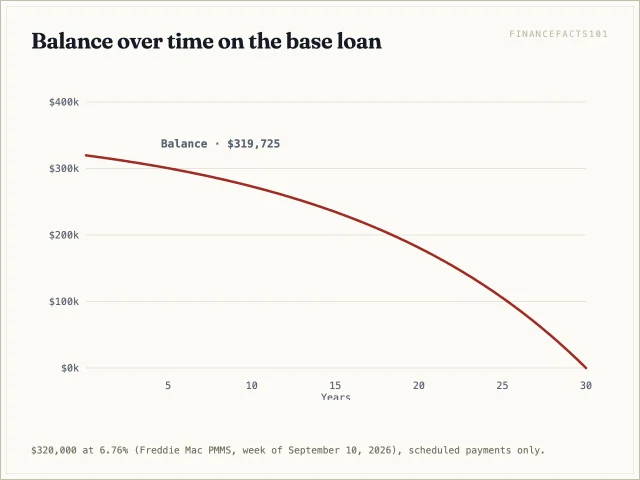
Hold on to two facts from this curve. Interest is charged on the outstanding balance, so anything that lowers the balance early — a bigger down payment, extra principal, a lump sum — saves interest for every remaining month. And the required payment is fixed by the original balance, rate and term; only three of the seven levers below change it, and one of them (recast) is the only way to lower it without a new loan.
All seven levers on one table
Here is every lever measured on the base loan. The two columns that matter are the change in the monthly payment and the change in lifetime interest, because levers that move one often barely move the other.
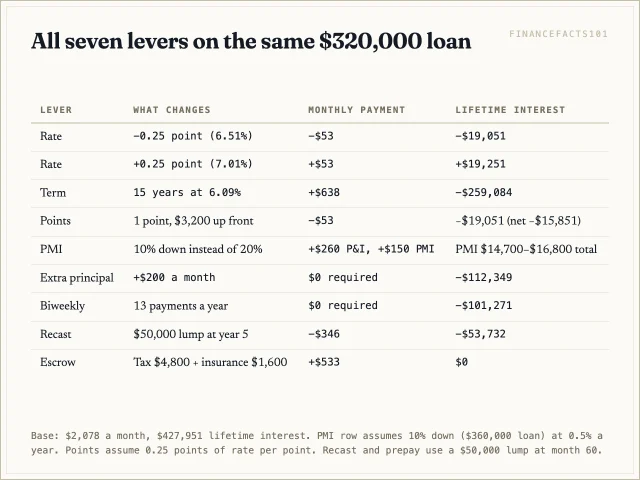
The pattern to notice: a quarter-point of rate is worth about $53 a month. A $200 extra principal payment leaves the required payment untouched but removes $112,349 of interest. A 15-year term costs $638 more a month and removes $259,084. PMI, which many buyers treat as a footnote, costs $150 a month for the first eight years on a 10%-down version of this purchase. The rest of the guide takes them one at a time.
Lever 1: the rate — $53 a month per quarter point
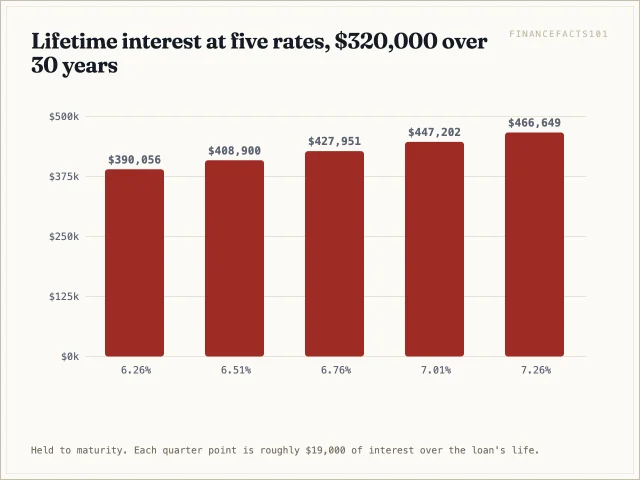
Rate is the lever buyers focus on, and on this loan each quarter of a percentage point is worth $53 a month and about $19,000 of lifetime interest. Half a point is $105 a month and roughly $38,000.
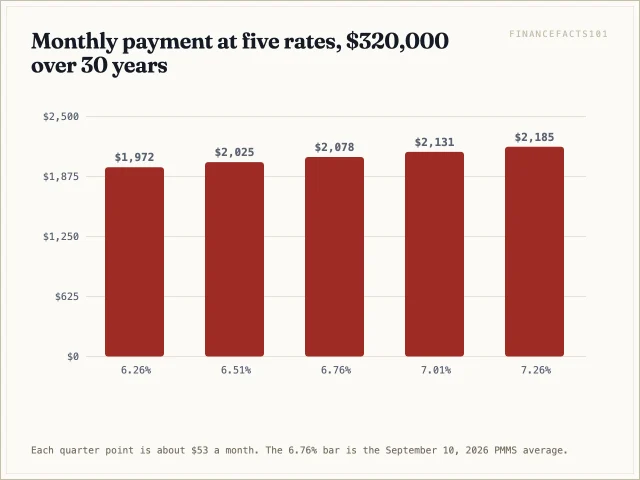
Priced on the base loan: at 6.26% the payment is $1,972 and lifetime interest $390,056; at 6.76% it is $2,078 and $427,951; at 7.26% it is $2,185 and $466,649. The relationship is close to linear across this range, which is why shopping quotes is worth a morning: a lender who is 0.125 lower than another is offering you about $26 a month for the same house. On a loan you hold for seven years that is roughly $2,200, and the CFPB's guidance on comparing loan estimates is written precisely for that comparison.
The rate you are quoted is set by the market rate plus your own pricing: credit score, loan-to-value, loan size and property type all adjust it. Loan-to-value is the one most buyers can move, and our entry on loan-to-value ratios explains why an 80% LTV prices better than a 90% one.
Lever 2: the term — $638 more a month, $259,084 less interest
Cut the term to 15 years at the 6.09% survey rate and the payment rises to $2,716 a month, $638 more than the 30-year. Lifetime interest falls to $168,867, a saving of $259,084.
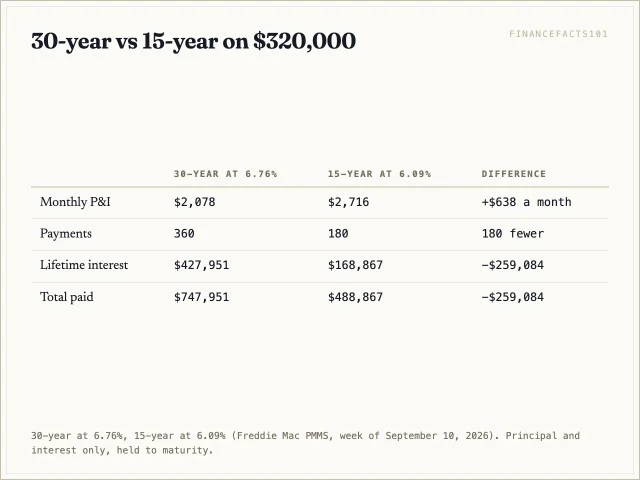
The term lever is the largest interest saver available at signing, and it is also the one that permanently commits you to the higher payment — you cannot drop back to $2,078 in a bad year without refinancing. That asymmetry is the whole argument in the 15-year vs 30-year guide, which also prices the middle path of taking the 30 and paying it like a 15. As lever 5 shows, most of the interest saving is available without the commitment.
Lever 3: discount points — a five-year bet on staying put
A discount point is a fee of 1% of the loan amount paid at closing in exchange for a lower rate. On $320,000, one point costs $3,200. The CFPB's explanation of points and lender credits is careful not to promise how much rate a point buys, because it varies by lender and market; the working assumption in this guide is a quarter of a percentage point per point, which is a common quote in 2026 but must be checked against your own loan estimate.
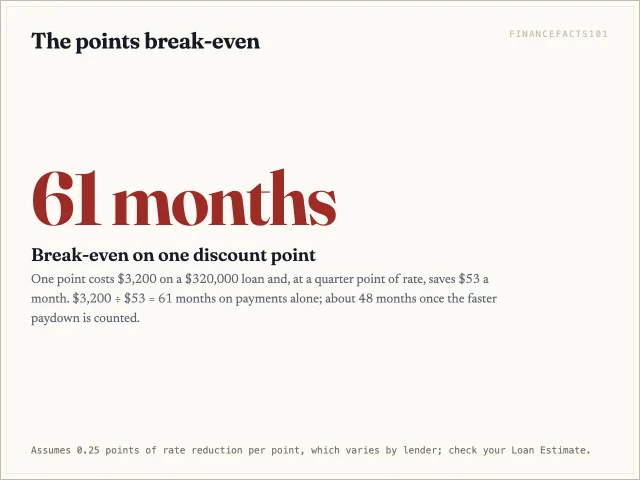
On that assumption, one point drops the rate to 6.51% and the payment to $2,025, a saving of $53 a month. The simple break-even is $3,200 divided by $53, which is 61 months — five years and one month. Count the slightly faster principal paydown at the lower rate as well and the point pulls ahead from month 48. Sell or refinance before roughly four years and the point cost you money; hold the loan to maturity and it saves $19,051 of interest for a net gain of $15,851. Two points cost $6,400, save $105 a month, and break even at the same 61 months.
The break-even is the entire decision. The typical US homeowner sells after about twelve years, which is well past five, but the typical borrower also refinances when rates fall, which resets the clock. Lender credits run the same arithmetic in reverse — a higher rate in exchange for cash toward closing costs — and suit a buyer who expects to be gone before the break-even arrives. The discount points guide in this series works through the timeframes the CFPB recommends comparing.
Lever 4: PMI — $150 a month until you reach 20% equity
Put 10% down instead of 20% on the same $400,000 house and the loan becomes $360,000, the principal-and-interest payment $2,337, and the lender requires private mortgage insurance. At a representative 0.5% annual premium that is $150 a month, or $1,800 a year, on top of the payment.
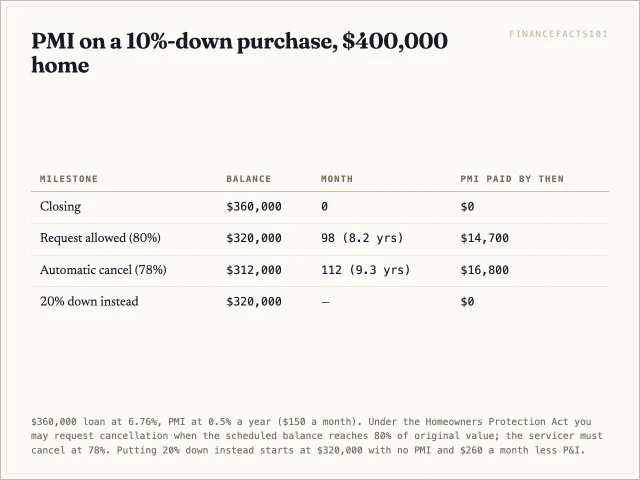
Under the Homeowners Protection Act, as summarised by the CFPB, you can request cancellation once the balance is scheduled to fall to 80% of the home's original value, and the servicer must cancel automatically when it is scheduled to reach 78%, provided you are current. On this loan the scheduled balance reaches $320,000 — 80% of the original value — at month 98, and 78% at month 112. Request on time and PMI costs $14,700 in total; wait for automatic termination and it costs $16,800. The site's entry on the Homeowners Protection Act covers the conditions — no second liens, no decline in value — that a request has to meet.
Compare the two ways of buying the same house. The extra $40,000 down saves $260 a month in principal and interest and $150 a month in PMI: $410 a month, for as long as PMI would have lasted. Whether $40,000 of cash is better spent that way or kept as reserves is the question the 10% vs 20% down guide in this series prices.
Lever 5: extra principal — $200 a month removes $112,349
Pay $200 extra toward principal every month from the first payment and the loan retires in 280 months instead of 360 — 23 years and 4 months — with $112,349 less interest. Pay $500 extra and it retires in 214 months, 17 years and 10 months, saving $196,496.
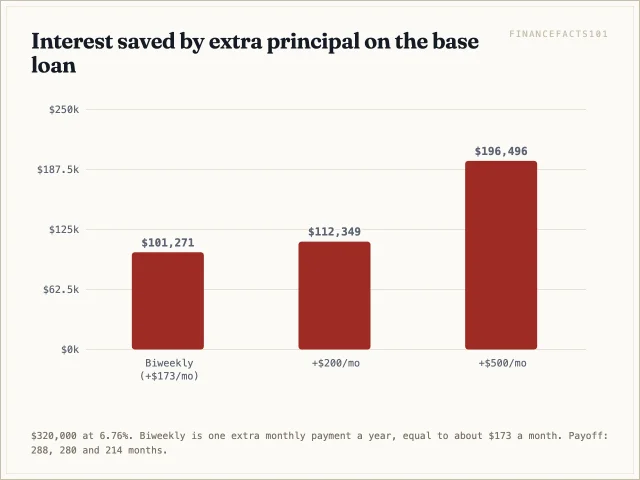
This is the lever with the best ratio of interest saved to commitment made, because the required payment never changes. The $200 is optional every single month; skip it in a hard year and nothing happens except that the payoff date drifts. The extra payment calculator will run your own balance and rate, and the extra mortgage payment guide in this series compares it with investing the same $200.
One caution that catches people: extra principal shortens the loan but does not lower the required payment. If you want a lower payment, that is lever 7.
Lever 6: biweekly payments — the same lever with a fee attached
A biweekly plan takes half the monthly payment every two weeks. Because there are 26 fortnights in a year, that is 13 full payments instead of 12 — an extra $2,078 a year, or $173 a month, to principal.
On the base loan the effect is a payoff in 288 months, exactly 24 years, and $101,271 of interest saved. That is close to the $200-a-month result above, because it is the same mechanism: a little extra principal every month. The difference is that some servicers charge a setup fee or a per-payment fee for the biweekly schedule, and some third-party plans hold the half-payments and forward a single monthly payment, which saves nothing until the thirteenth. Making one extra principal payment a year yourself, or adding a twelfth of the payment to each month, gets the same result for free. The biweekly payments guide in this series sets the two side by side with the fees included.
Lever 7: recast — the only way to lower the payment without a new loan
A recast is a lump-sum principal payment after which the servicer re-amortizes the remaining balance over the remaining term, producing a lower required payment at the same rate. Most conventional servicers allow it for a fee in the low hundreds of dollars; it is not available on every loan, and it never changes the rate.
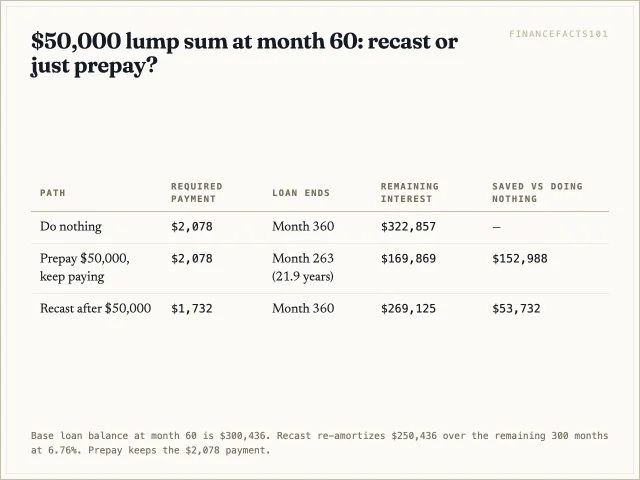
Take $50,000 at month 60, when the base loan's balance is $300,436. Three paths from there:
- Do nothing. Remaining interest is $322,857.
- Prepay without recasting. The balance drops to $250,436 and you keep paying $2,078. The loan is gone in 203 more months — 21 years and 11 months from the start — with $169,869 of remaining interest, a saving of $152,988 against doing nothing.
- Recast. The same $250,436 is re-amortized over the remaining 300 months. The required payment falls to $1,732, a drop of $346 a month, and remaining interest is $269,125 — a saving of $53,732 against doing nothing.
Both use the same $50,000; the prepayment saves nearly three times as much interest, because the payment stays high. The recast buys something different: a permanently lower obligation, which matters for a household whose income is about to fall. Set against a refinance, the recast has no closing costs and no rate change, and the recast vs refinance guide in this series shows where each one wins.
Lever 8: escrow — the $533 that is not the mortgage
The payment most buyers actually make is not $2,078. Lenders commonly collect property tax and homeowners insurance monthly into an escrow account and pay the bills when due; the CFPB notes that many lenders require it and that the escrow portion changes as taxes and premiums change. On the stated assumptions of $4,800 in tax and $1,600 in insurance, that is $533 a month, and the full payment is $2,611.
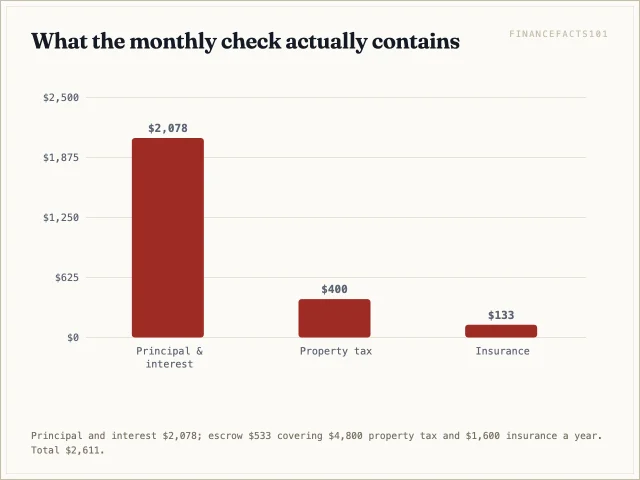
Escrow is not a lever you pull; it is one that gets pulled on you. A 10% property-tax reassessment adds $40 a month. An insurance renewal 25% higher adds $33. Neither has anything to do with the loan, and both arrive as a "payment change" letter that looks as if the mortgage moved. The affordability calculation in how much house you can afford uses the full $2,611 figure for exactly this reason.
The tax lever most borrowers no longer have
Mortgage interest is deductible only if you itemize, and on this loan most households will not. First-year interest is $21,528 and property tax is $4,800, a total of $26,328. For 2026 the standard deduction is $32,200 for a married couple filing jointly and $16,100 for a single filer, per the IRS inflation adjustments for tax year 2026.
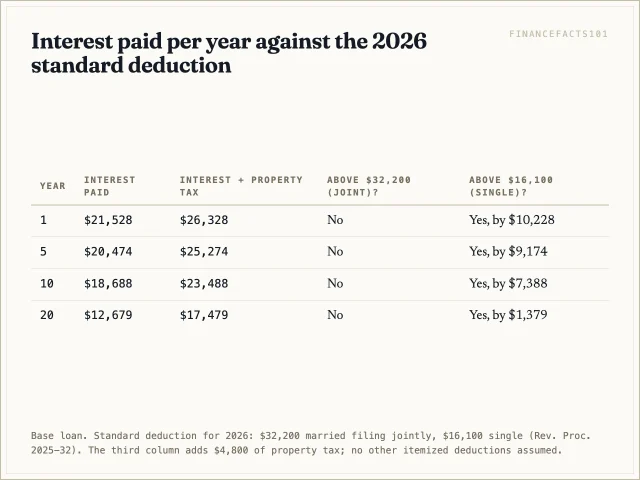
A couple with no other itemized deductions gets nothing from the mortgage: $26,328 is below $32,200. A single filer clears the threshold by $10,228, which at a 22% marginal rate is worth about $2,250 in the first year and less every year after, because interest falls as the balance does — $20,474 in year five, $18,688 in year ten, $12,679 in year twenty. IRS Publication 936 sets the acquisition-debt limit at $750,000 for loans taken out after December 15, 2017, which this loan is well inside, and allows points on a main-home purchase to be deducted in the year paid. The practical rule for this loan: price every lever above pre-tax, because for most borrowers that is the rate they actually pay.
Which levers to pull, in order
The seven levers sort themselves once they are on the same loan.
- Rate, before signing. A quarter point is $53 a month for thirty years and costs nothing but the effort of a second quote.
- Down payment to 20%, if the cash is truly spare. It removes PMI and lowers the loan; $410 a month on this purchase. If it empties the reserves, it is the wrong lever.
- Extra principal, after closing. The largest interest saving per dollar of commitment, and the commitment is zero.
- Term, only if you want the discipline enforced. The 15-year saves more than the 30-with-extra only because it forces the payment; the interest arithmetic is nearly identical.
- Points, only past a five-year horizon. Below that they lose money.
- Recast, only when the payment itself is the problem. It is the weakest interest saver here and the only lever that lowers the obligation.
- Biweekly, never with a fee. Do it yourself for free.
FAQ
Does paying extra principal lower my monthly payment?
No. Extra principal shortens the loan and cuts total interest, but the required payment is fixed by the original terms. A recast is the mechanism that lowers the payment on the same loan; it requires a lump sum and a servicer that offers it.
Is a quarter point of rate really worth $53 a month?
On $320,000 over 30 years, yes: the payment moves from $2,078 at 6.76% to $2,025 at 6.51%. The figure scales with the loan — about $16.50 a month per quarter point per $100,000 borrowed at these rates.
When can I stop paying PMI?
Under the Homeowners Protection Act you can request cancellation when the balance is scheduled to reach 80% of the original value, and it terminates automatically at 78% if you are current. On a $360,000 loan against a $400,000 purchase at 6.76%, those points arrive at months 98 and 112. A new appraisal showing higher value can bring the request forward.
Should I take the lender's biweekly plan?
Only if it is free. It saves about $101,000 of interest on this loan by making one extra payment a year; you can make that extra payment yourself, or add $173 to each monthly payment, and get the same result without a fee.
Sources
- Freddie Mac Primary Mortgage Market Survey — 30-year and 15-year fixed averages, week of September 10, 2026
- CFPB: when can I remove PMI from my loan — Homeowners Protection Act cancellation and termination thresholds
- CFPB: what are discount points and lender credits — definition of a point and the timeframe comparison
- CFPB: what is an escrow or impound account — what escrow pays for and why the amount changes
- CFPB: the Loan Estimate — comparing quotes across lenders
- IRS Publication 936, Home Mortgage Interest Deduction — $750,000 acquisition-debt limit and the treatment of points
- IRS: tax inflation adjustments for tax year 2026 — 2026 standard deduction amounts (Rev. Proc. 2025-32)
 Next entry · No. 5,958Discount Points Break-Even: When Buying Down the Rate Pays
See also
-
 No. 5,933
05 Sep 2026
15 min
15-Year vs 30-Year Mortgage: The Total-Cost Math
Real Estate
No. 5,933
05 Sep 2026
15 min
15-Year vs 30-Year Mortgage: The Total-Cost Math
Real Estate -
 No. 5,966
30 Sep 2026
12 min
Assumable Mortgage Value: What a 3% Loan Is Worth in a 6.76% Market
Mortgage
No. 5,966
30 Sep 2026
12 min
Assumable Mortgage Value: What a 3% Loan Is Worth in a 6.76% Market
Mortgage -
 No. 5,964
28 Sep 2026
12 min
Mortgage Recast vs Refinance: What to Do With a $50,000 Lump Sum
Mortgage
No. 5,964
28 Sep 2026
12 min
Mortgage Recast vs Refinance: What to Do With a $50,000 Lump Sum
Mortgage -
 No. 5,962
26 Sep 2026
12 min
Biweekly Mortgage Payments: The Saving Is Real, the Fee Is Not
Mortgage
No. 5,962
26 Sep 2026
12 min
Biweekly Mortgage Payments: The Saving Is Real, the Fee Is Not
Mortgage -
 No. 5,961
25 Sep 2026
12 min
Extra Mortgage Payments: What $200 a Month Actually Saves
Mortgage
No. 5,961
25 Sep 2026
12 min
Extra Mortgage Payments: What $200 a Month Actually Saves
Mortgage -
 No. 5,960
24 Sep 2026
12 min
10% vs 20% Down: What the Extra $40,000 Is Actually Worth
Mortgage
No. 5,960
24 Sep 2026
12 min
10% vs 20% Down: What the Extra $40,000 Is Actually Worth
Mortgage