10% vs 20% Down: What the Extra $40,000 Is Actually Worth
On a $400,000 home, 20% down instead of 10% saves $410 a month for eight years. Keeping the $40,000 only wins above an 11% return — unless it is your reserves.
Putting 20% down on a $400,000 home instead of 10% costs $40,000 more at closing and saves $410 a month for the first eight years, then $260 a month for the remaining twenty-two — a 12.3% annual return on the extra cash while PMI would have run. Keeping the $40,000 and investing it only comes out ahead if it earns more than about 11% a year, every year, after the higher payments are drawn from it. On the arithmetic alone, the house wins. The one thing that overturns the arithmetic is reserves: if the extra $40,000 is the money that would carry you through a lost job, it belongs in the bank, and the $410 a month is the price of keeping it there.
The purchase throughout is a $400,000 home at 6.76% over 30 years, the Freddie Mac Primary Mortgage Market Survey average for the week of September 10, 2026. Ten percent down means a $360,000 loan with PMI at 0.5% a year ($150 a month) until the balance reaches 80% of the price, which on a request is month 98; twenty percent down means a $320,000 loan and no PMI. The PMI removal guide covers how that month-98 figure moves; this guide takes it as given and asks the question that comes before it.
Scope honesty: this is general information built on the stated assumptions above, not personal advice. Your rate, premium, home price and cash position will differ.
Who this is for — and who it is not for
This guide is for a buyer who has the 20% and is deciding whether to put all of it down, and for the buyer who has 10% and is wondering how much it is worth to wait and save the rest. The comparison is between two ways of buying the same house at the same price; it does not model buying a cheaper house.
It is not for you if 10% is a stretch on its own — then the question is whether to buy yet, which the how much house can I afford guide answers from income and debts rather than from the down payment. It is also not about the 3% and 5% programs, where the premium rates and the rate adjustments are steeper and the CFPB's note that lenders price in 5-percent increments matters more.
The two payments, side by side
Twenty percent down borrows $320,000; the principal-and-interest payment is $2,078. Ten percent down borrows $360,000; the payment is $2,337, and PMI adds $150.
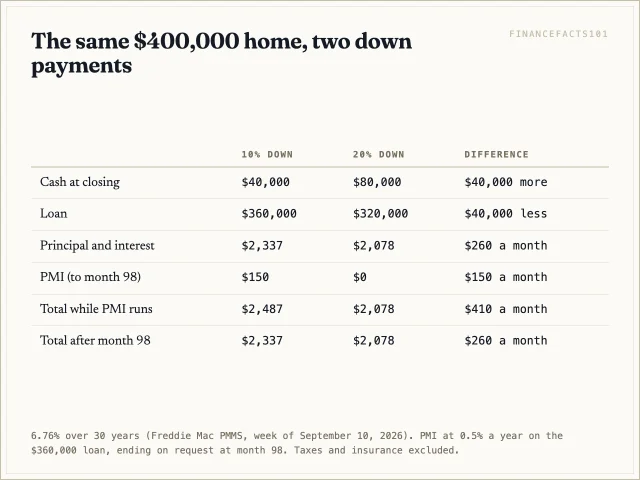
The gap is $410 a month for as long as PMI runs and $260 a month after it ends. Both numbers are permanent features of the loan — the $260 lasts until the final payment in year thirty — which is what makes the extra $40,000 look like an investment: it buys a stream of lower payments that runs for 360 months.
The CFPB's guidance on down payments puts the general case plainly: "the higher your down payment, the less your loan is likely to cost," with the largest saving arriving at 20%. That is true. The question is whether the saving is large enough to justify the cash, and that depends on what else the cash could do.
The return on the extra $40,000
Over the first 98 months — until PMI would have ended on a request — the 20%-down buyer pays $40,151 less. The extra $40,000 has returned itself in payment savings in eight years and two months, and goes on returning $260 a month for twenty-two more.
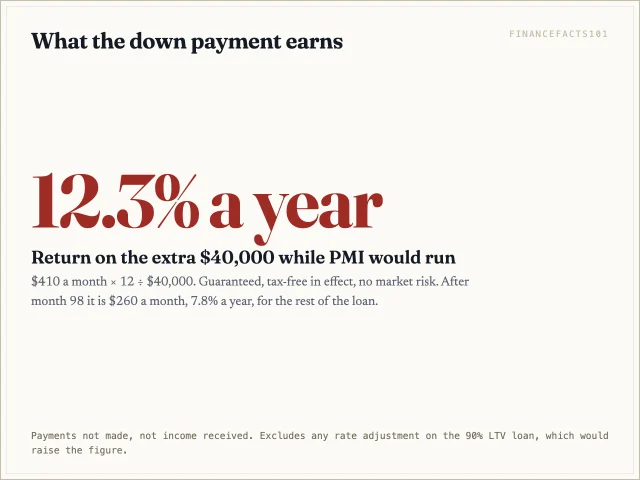
Expressed as a yield on the $40,000, that is $410 × 12 ÷ $40,000, or 12.3% a year, while the insurance would have run. After month 98 the yield falls to $260 × 12 ÷ $40,000, 7.8% a year. Both are guaranteed, tax-free in effect (they are payments not made, not income received), and carry no market risk — a rare combination that no savings account, CD or bond fund offers in 2026.
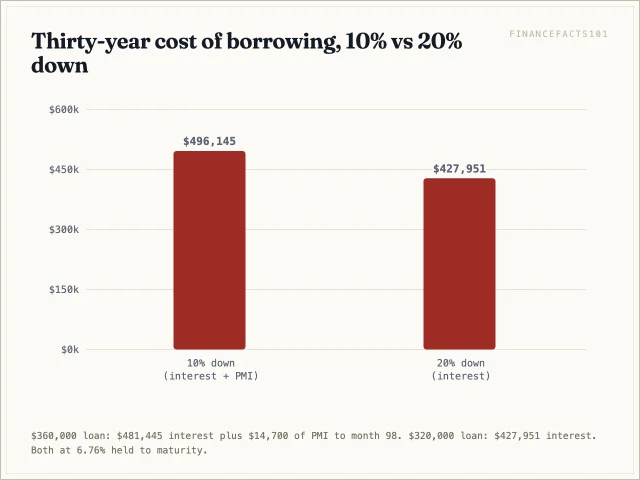
Over the full thirty years, the 10%-down path pays $481,445 of interest plus $14,700 of PMI, $496,145 in all; the 20%-down path pays $427,951. The difference is $68,194, for $40,000 up front.
Keep the cash and invest it: the honest comparison
The argument for keeping the $40,000 is that it can earn more elsewhere. To test it fairly, the kept cash has to pay for the higher mortgage payments it causes — the $410 a month, then $260 — because that money has to come from somewhere, and the fairest place to take it from is the pot that was kept.
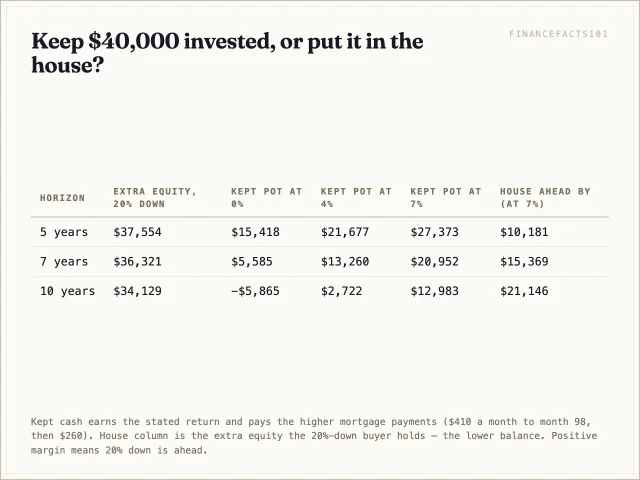
Run that way, with the pot earning 7% a year, the kept-cash buyer has $27,373 left at year five against the $37,554 of extra equity the 20%-down buyer holds — the house is ahead by $10,181. At year seven the house leads by $15,369; at year ten by $21,146. At 4% the house leads by $15,878 at year five and $31,406 at year ten. At 0% — cash in a drawer — the pot is exhausted before year ten. The kept cash never catches up at any of these returns.
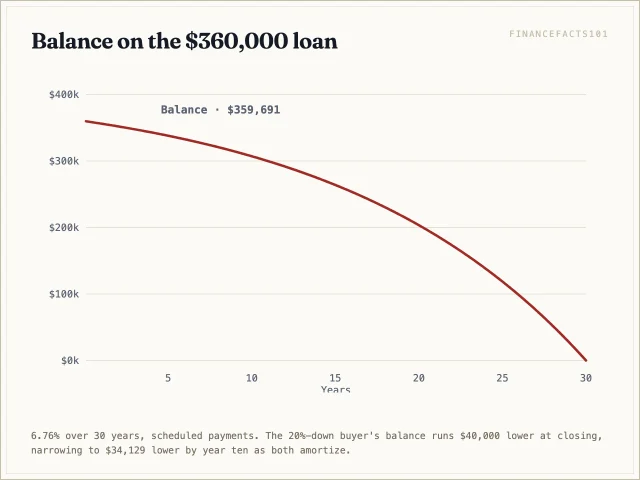
The "extra equity" column shrinks slowly over time — $40,000 at closing, $37,554 at year five, $34,129 at year ten — because the larger loan amortizes slightly faster in dollar terms. That is the only way the gap between the two paths narrows on its own, and it narrows by less than $6,000 in a decade.
The break-even return: about 11% a year
Solve for the return at which keeping the cash ties with putting it down:
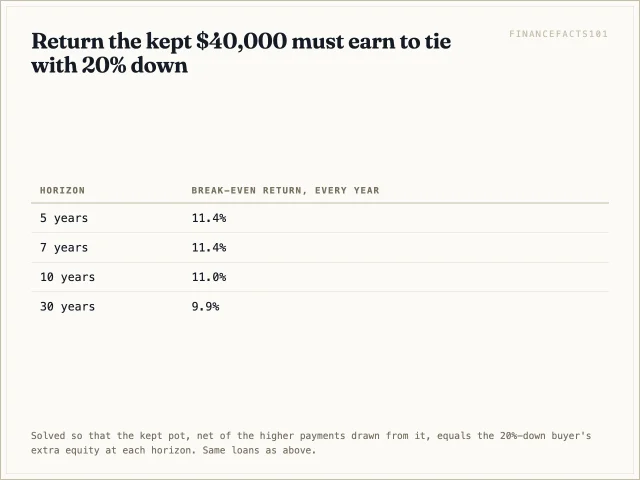
At year five and year seven the kept $40,000 needs to earn 11.4% a year to tie; at year ten, 11.0%; over thirty years, 9.9%. Those are not impossible returns — a broad stock index has delivered more over some decades — but they are returns that have to be earned every year, without a bad stretch early, because the pot is being drawn down by $410 a month from the first month. A market that falls 20% in year two leaves a pot that cannot recover on this schedule.
Against a guaranteed 12.3% for eight years and 7.8% after, an uncertain 11% is not a bet most buyers should take with money they cannot replace. On the numbers, put it down.
The rate adjustment makes the case stronger
The comparison so far uses the same 6.76% for both loans. In practice a 90% loan-to-value loan is usually priced higher than an 80% one; the CFPB's page on loan-to-value says directly that "higher-risk borrowers, those with a higher LTV, will usually be offered a higher interest rate." The size of the adjustment depends on credit score and lender, so this guide shows it as a range rather than a claim.
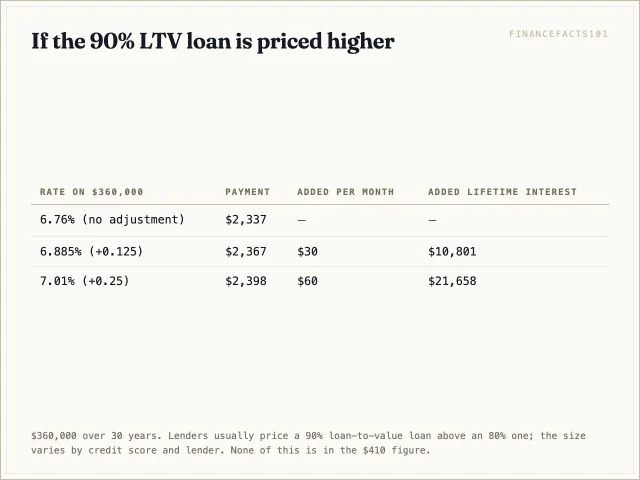
An eighth of a point on the $360,000 loan adds $30 a month and $10,801 of lifetime interest; a quarter point adds $60 and $21,658. Neither is included in the $410 figure above, so if your 10%-down quote carries any adjustment, the case for 20% is stronger than the tables show — by up to another $60 a month for thirty years.
The one argument that wins for keeping the cash: reserves
Everything above assumes the $40,000 is spare. If it is not — if putting it down leaves the household with a month of expenses in the bank — the arithmetic changes character, because the cost of a forced sale or a missed payment is not measured in monthly dollars.
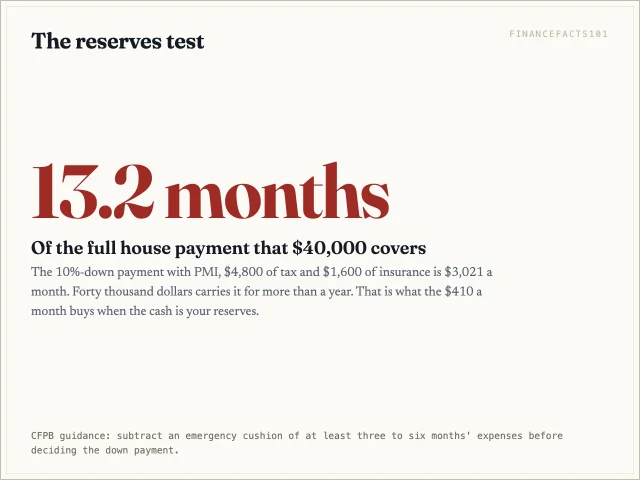
The full 10%-down payment with taxes and insurance is $3,021 a month. Forty thousand dollars is 13.2 months of that payment: more than a year of carrying the house through a lost job, a medical bill or a roof. The CFPB's down-payment guidance says to subtract "an emergency cushion" of "at least three to six months' worth of expenses" before deciding how much to put down, and its emergency-fund guide explains why: without savings, "a financial shock — even minor — could set you back, and if it turns into debt, it can potentially have a lasting impact."
The same guidance names the trap directly: "Once you put money into your home, it's not easy to get it back out again." Home equity is real wealth and it is also illiquid wealth; getting at it means selling, or a home-equity loan that takes weeks, requires income verification, and charges interest. A buyer who has $80,000 in total and puts all of it down has bought a $410-a-month saving with their entire margin for error.
The emergency fund size guide works out how many months of expenses a household needs. The rule this guide adds: put 20% down with whatever is left after that cushion is funded, not before.
Why 15% down is priced like 10%
A buyer with $60,000 might reasonably ask whether 15% gets most of the way to 20%. In pricing terms it does not. The CFPB's down-payment guidance notes that lenders evaluate down payments in 5-percent increments, and that the two thresholds where costs step down are 10% and 20% — "you can often save money if you put down at least 10 percent of the home price, and you'll save the most if you put down at least 20 percent." Fifteen percent lands on a step, but it is the step below the one that matters.
Concretely, 15% down on this home is a $340,000 loan at $2,207 a month. PMI is still required, at a somewhat lower premium rate than the 90% loan because the insurer's exposure is smaller, and it ends sooner because the balance starts at 85% of value rather than 90% — the scheduled 80% point arrives at month 59 instead of 98. But the insurance exists, the best rate tier does not apply, and the extra $20,000 has bought roughly half the monthly saving that the full $40,000 would.
The same increments rule cuts the other way at the bottom: putting down 8% instead of 10% costs the 10% pricing for the sake of $8,000. If the choice is between 8% now and 10% in four months, the four months are usually worth it. The mortgage payment levers guide shows how much a rate tier is worth once the loan exists; this is where it is decided.
Three buyers, three answers
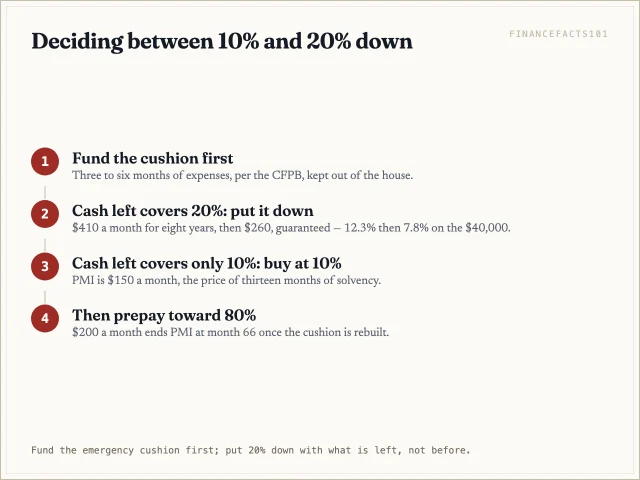
- $120,000 saved, expenses $6,000 a month. Put 20% down ($80,000). The remaining $40,000 is six and a half months of expenses. The $410 a month is a 12.3% return with no downside.
- $80,000 saved, same expenses. Put 10% down ($40,000) and keep $40,000 as thirteen months of the full house payment. Pay the $150 PMI as the price of solvency; use the PMI removal routes to end it by month 66 with extra principal once the cushion has been rebuilt.
- $85,000 saved, expenses $4,000 a month. A middle path: 15% down is not priced as well as 20% under the 5-percent-increment rule, so either put 20% down and keep $5,000 — thin, but a month and a half — or put 10% down and keep $45,000. For most households the second is the safer answer for the first two years, with a plan to prepay toward 80% as savings recover.
When the arithmetic and the reserves rule disagree
They disagree exactly when the $40,000 is the last $40,000. The arithmetic says the house returns 12.3%; the reserves rule says the cushion returns something the arithmetic cannot price — the ability to keep the house at all. Where they conflict, the reserves rule wins, because its downside is asymmetric. Losing $410 a month for a while is recoverable; losing the house is not.
Where they agree — the cash is genuinely spare — put it down. And in either case, the 10%-down buyer is not stuck: the mortgage payment levers guide shows that $200 a month of extra principal ends PMI at month 66 and saves $112,349 of interest on a comparable loan, which is most of what the 20%-down buyer got, bought on a schedule the household controls.
FAQ
Is 20% down always better than 10%?
On the payment arithmetic, yes: on this $400,000 home the extra $40,000 saves $410 a month for eight years and $260 a month after, a 12.3% then 7.8% guaranteed return. It is worse only when the $40,000 would otherwise be the household's emergency reserves.
What return would I need on the $40,000 to justify keeping it?
About 11.4% a year at five- and seven-year horizons, 11.0% at ten years and 9.9% over thirty — after the higher mortgage payments are drawn from the invested pot. Those returns have to arrive without an early bad year.
Does 15% down get me most of the benefit?
Less than half. Lenders price in 5-percent steps, and 15% still requires PMI (at a lower premium rate than 10%). The premium ends sooner because the balance starts closer to 80%, but the no-PMI pricing and the best rate tier begin at 20%.
How much should I keep in reserve after closing?
The CFPB suggests at least three to six months of expenses before deciding the down payment. On this purchase $40,000 covers thirteen months of the full 10%-down house payment, which is why keeping it can be the right call even though it costs $410 a month.
Sources
- Freddie Mac Primary Mortgage Market Survey — 30-year fixed average, week of September 10, 2026
- CFPB: determine your down payment — the 10% and 20% thresholds, 5-percent pricing increments, and the emergency cushion to subtract first
- CFPB: an essential guide to building an emergency fund — why a shock without savings turns into debt
- CFPB: what is a loan-to-value ratio — higher LTV, higher rate, and the insurance requirement
- CFPB: what is private mortgage insurance — what PMI covers and who it protects
- CFPB: when can I remove PMI from my loan — the 80% request threshold used for the month-98 figure
 Next entry · No. 5,961Extra Mortgage Payments: What $200 a Month Actually Saves
See also
-
 No. 5,959
23 Sep 2026
12 min
PMI Removal: When It Ends, and How to End It Sooner
Mortgage
No. 5,959
23 Sep 2026
12 min
PMI Removal: When It Ends, and How to End It Sooner
Mortgage -
 No. 5,967
01 Oct 2026
12 min
2-1 Buydown: What a Seller-Paid Teaser Rate Is Actually Worth
Mortgage
No. 5,967
01 Oct 2026
12 min
2-1 Buydown: What a Seller-Paid Teaser Rate Is Actually Worth
Mortgage -
 No. 5,966
30 Sep 2026
12 min
Assumable Mortgage Value: What a 3% Loan Is Worth in a 6.76% Market
Mortgage
No. 5,966
30 Sep 2026
12 min
Assumable Mortgage Value: What a 3% Loan Is Worth in a 6.76% Market
Mortgage -
 No. 5,957
21 Sep 2026
15 min
Mortgage Payment Levers: What Actually Moves the Number
Mortgage
No. 5,957
21 Sep 2026
15 min
Mortgage Payment Levers: What Actually Moves the Number
Mortgage -
 No. 5,945
14 Sep 2026
18 min
How Much House Can I Afford? Approval Price vs Affordable Price
Real Estate
No. 5,945
14 Sep 2026
18 min
How Much House Can I Afford? Approval Price vs Affordable Price
Real Estate -
 No. 5,933
05 Sep 2026
15 min
15-Year vs 30-Year Mortgage: The Total-Cost Math
Real Estate
No. 5,933
05 Sep 2026
15 min
15-Year vs 30-Year Mortgage: The Total-Cost Math
Real Estate