15-Year vs 30-Year Mortgage: The Total-Cost Math
A 15-year loan on $320,000 costs $254,900 less interest than a 30-year at September 2026 rates — for $640 more a month. The math, plus the middle path.
The 15-year vs 30-year mortgage decision is a trade of $640 a month for roughly $254,900 of interest. That is the whole choice on a $320,000 loan at the rates in effect as the week of August 27, 2026: pay $2,697 a month for 15 years, or $2,056 a month for 30 years and hand the lender about two and a half times as much interest along the way. Everything else in this guide — equity speed, PMI, qualification, the invest-the-difference argument, the "take the 30, pay it like a 15" middle path — is detail on that trade, worked through with real arithmetic you can check.
All figures below use one loan throughout: $320,000 borrowed, at the Freddie Mac Primary Mortgage Market Survey averages for the week of August 27, 2026 — 6.66% on the 30-year fixed and 5.98% on the 15-year fixed, a 0.68-point spread. That spread is typical; the 15-year rate has run below the 30-year rate in almost every week of the survey's history, because lenders get their money back sooner and carry less rate risk. If your quoted rates differ, the shape of every conclusion here survives; only the dollar amounts move. For how those quotes get set in the first place, see our entry on how mortgage rates are priced.
Scope honesty: this is general information built on the stated assumptions above, not personal advice. Your rate, taxes, and situation will differ.
Who this is for — and who it is not for
This guide is for a US buyer taking a fixed-rate loan who can plausibly afford either payment and is deciding which term to sign. It is also for the buyer who has heard "always take the 30 and invest the difference" and wants to see that claim priced instead of asserted.
It is not for you if the 15-year payment would consume so much of your income that one missed paycheck breaks the budget — in that case the 30-year is not a choice, it is the answer, and the interesting question becomes how much extra to prepay. It is also not for buyers weighing adjustable-rate products; that is a different risk trade, covered in our entry on adjustable-rate mortgages. And if you expect to sell within three or four years, the term matters far less than your rate and closing costs, as the edge-cases section shows.
The monthly payment gap on $320,000
Run the standard amortization formula on both loans and the monthly principal-and-interest payments come out as follows, as of the August 27, 2026 survey week:
- 30-year at 6.66%: $2,056 a month (360 payments)
- 15-year at 5.98%: $2,697 a month (180 payments)
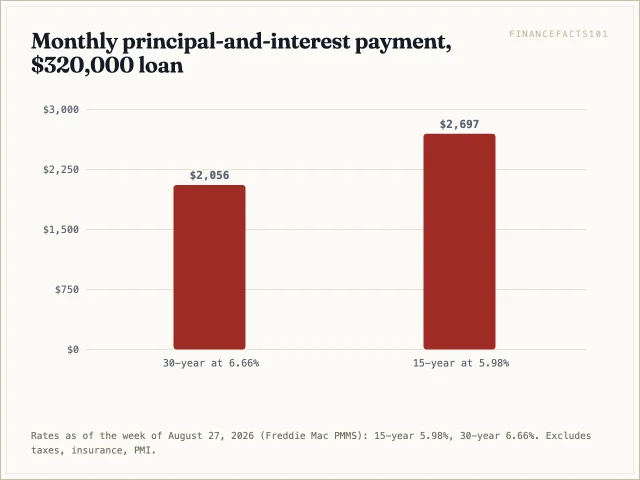
The gap is $640 a month — about 31% more than the 30-year payment. Notice what the gap is not: it is not double, even though the loan retires in half the time. The 15-year payment only needs to be about a third larger, for two reasons. First, its rate is 0.68 points lower. Second, on the 30-year loan most of the early payment is interest anyway, so the extra $640 goes almost entirely to principal, and principal paid early stops compounding against you for decades.
That $640 is the number to hold onto. Every argument in this decision — invest it, prepay with it, keep it as slack — is an argument about what to do with $640 a month.
Total interest: the $254,900 difference
Multiply the payments out and subtract the principal:
- 30-year: 360 × $2,056.41 − $320,000 = $420,306 total interest
- 15-year: 180 × $2,696.89 − $320,000 = $165,439 total interest
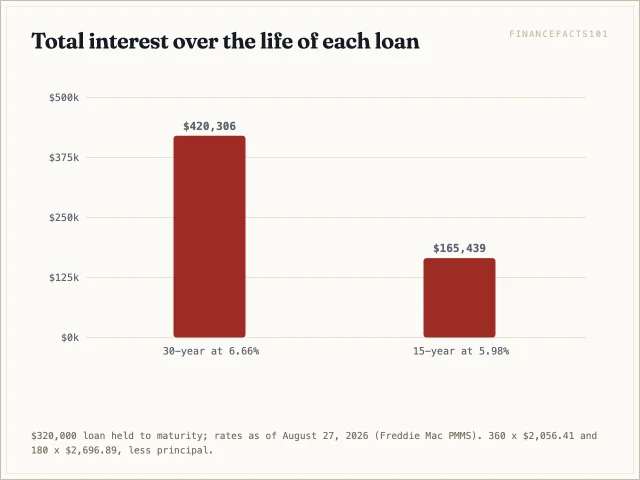
The 30-year loan costs $254,867 more in interest — call it $254,900. On this loan, the 30-year borrower pays more in interest ($420,306) than they borrowed in the first place ($320,000). The 15-year borrower pays about half the principal again.
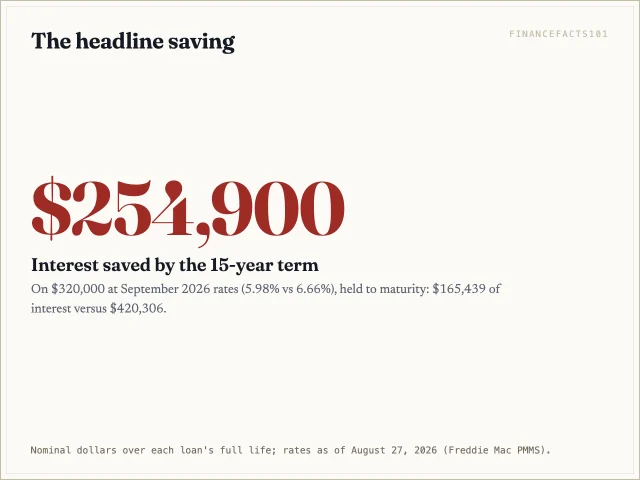
Two honest caveats before that number does all your deciding for you. First, those are nominal dollars spread over 30 years; a dollar of interest paid in 2050 costs less in real terms than one paid in 2027. Second, the comparison assumes both borrowers hold to maturity, and most do not — the typical US homeowner sells after about 12 years (Redfin's 2025 tenure analysis). The gap that actually matters for most buyers is the gap at the year they sell, which is why the balance curves below are the centerpiece of this article.
15-year vs 30-year mortgage balances: the divergence that decides it
Watch the two balance curves and the decision gets much more concrete than a single lifetime-interest number. Both loans start at $320,000. The paths apart are dramatic.
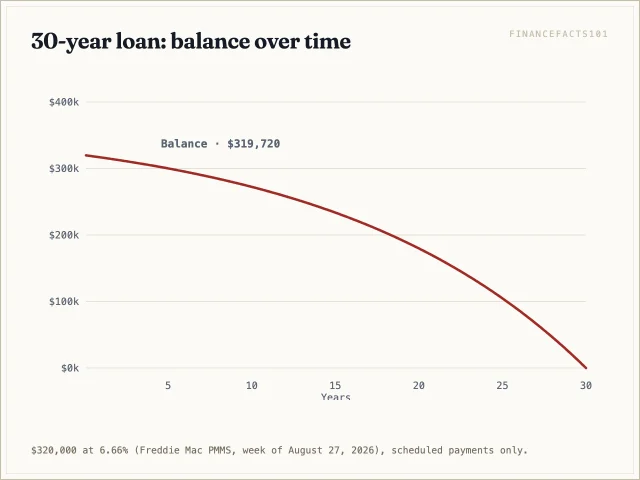
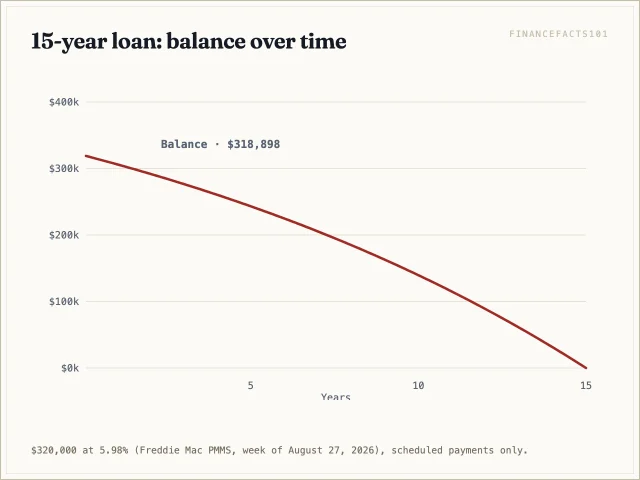
The 30-year curve is nearly flat for a decade: after 5 years the balance has fallen only to $300,101, and after 10 years it still stands at $272,364 — 85% of the original loan. The 15-year curve bends down from the first payment: $243,138 after 5 years, $139,565 after 10, zero at 15. At the 15-year mark, the 30-year borrower still owes $233,702 — 73% of what they borrowed, fifteen years in.
Why so lopsided? Because of how amortized loans front-load interest. The first $2,056 payment on the 30-year loan carries $1,776 of interest and just $280 of principal. The first 15-year payment carries $1,595 of interest and $1,102 of principal — four times the principal from day one. The mechanics are laid out in our entry on how amortized loans are structured.
Where the 30-year payment goes in the early years
The payment-split view of the 30-year loan makes the same point payment by payment: for roughly the first 20 years, interest takes the larger share of every check.
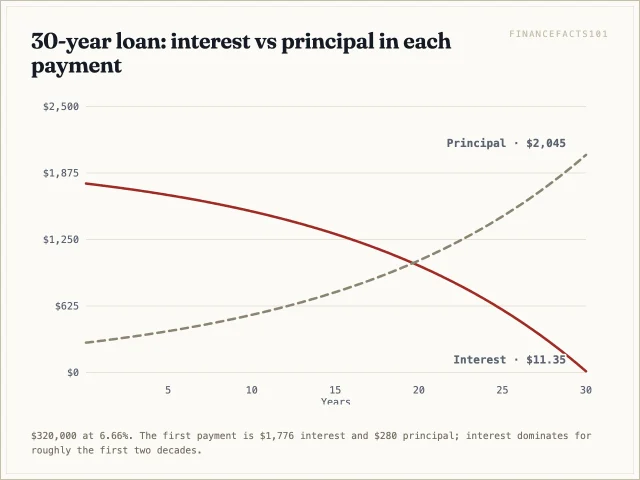
In year one alone, the 30-year borrower pays $21,207 of interest and only about $3,470 of principal. The crossover — the month when principal finally exceeds interest within a single payment — does not arrive until deep in the loan's third decade of scheduled life. If you want to trace your own loan month by month, our guide to reading an amortization schedule walks through every column.
This is the fact that makes prepayment powerful early and weak late: an extra $1,000 against principal in year 2 erases decades of scheduled interest on that $1,000; the same $1,000 in year 25 saves very little.
Equity at years 5, 10, and 15
Translate balances into equity from principal paydown (ignoring price appreciation, which lands on both borrowers equally — national trends are tracked in the FHFA House Price Index):
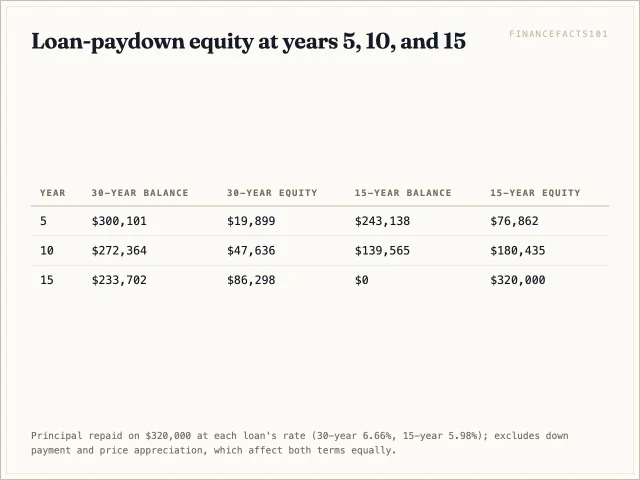
At year 5 the 15-year borrower has built $76,862 of loan-paydown equity to the 30-year borrower's $19,899 — nearly four times as much. At year 10 it is $180,435 against $47,636. At year 15, $320,000 against $86,298.
For a mover, this table is the real total-cost comparison. Sell at year 10 and the 15-year borrower walks away with about $132,800 more from the same sale price — that is the interest saved plus principal banked, and it dwarfs the roughly $76,900 of extra payments made by then. Equity built by prepaying principal is not lost when you move; it comes back at closing.
The opportunity-cost argument: invest the $640 instead
The strongest case for the 30-year is not the lower payment itself; it is what the $640 gap could earn elsewhere. Take the 30, invest $640 a month at a 7% average annual return, and after 15 years the account holds about $202,900 — $115,200 of contributions plus $87,700 of growth.
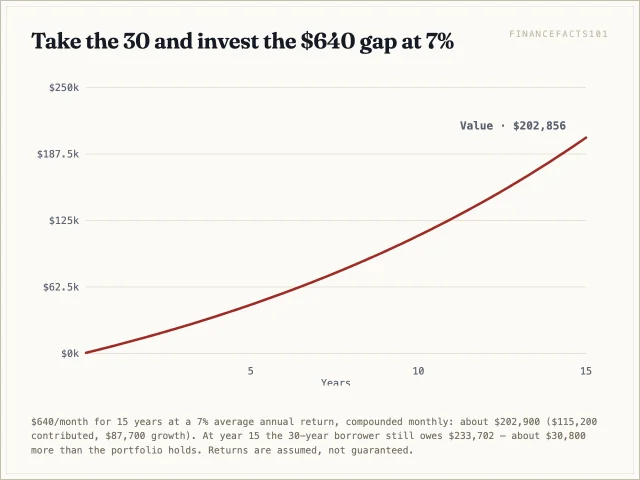
Now net it honestly. At the 15-year mark the 30-year borrower has a $202,900 portfolio but still owes $233,702 on the house. The 15-year borrower has no portfolio from this comparison but owes nothing. Position at year 15: the 15-year borrower is ahead by roughly $30,800 — even granting the 30-year borrower a 7% return with perfect monthly discipline.
Extend to year 30 and the race tightens. The 15-year borrower, mortgage-free at year 15, invests the full $2,697 payment for years 16–30 and ends with about $854,800. The 30-year borrower's $640-a-month stream, compounding the whole 30 years, ends near $781,400. At 7%, the 15-year path still wins by about $73,400. The break-even return is close to 7.8% a year, sustained for three decades — below that the 15 wins; above it, the 30-plus-investing pulls ahead.
Three caveats keep this honest:
- Sequence risk. Prepaying a 6.66% loan is a guaranteed, riskless 6.66% pre-tax-equivalent return. A 7% market assumption is an average across good and bad decades; a weak first decade can leave the invested pot far behind the schedule above, and there is no guarantee it catches up on your timeline.
- Taxes. The comparison above ignores taxes on investment gains, which push the true break-even higher than 7.8%. On the other side, mortgage interest is only deductible if you itemize, and most filers take the standard deduction instead — so for most borrowers the mortgage rate is the after-tax rate.
- Discipline. The math assumes the $640 is invested every month for 360 months, through job changes, roof repairs, and market drops. The prepaid mortgage cannot be raided; a brokerage account can.
Take the 30, pay it like a 15
The popular middle path: sign the 30-year note, then voluntarily send the 15-year payment. On our loan, that means paying $2,697 against the 30-year loan — the required $2,056 plus $640 of extra principal each month. Prepaying this way is allowed without penalty on the vast majority of loans written today; the CFPB explains prepayment penalties and the rules that restrict them, but check your own note.
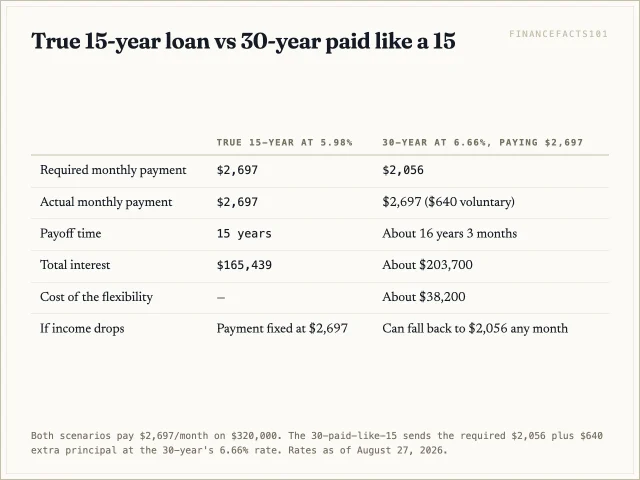
The result: the loan retires in about 16 years 3 months with roughly $203,700 of total interest. Against the true 15-year loan's $165,439, the flexibility costs about $38,200 — that is the price of carrying the 30-year's higher rate (6.66% vs 5.98%) on every dollar of balance. You do not get the 15-year's rate just by paying on its schedule.
What the $38,200 buys is a real option: any month things go wrong, your required payment drops back to $2,056. No negotiation, no refinance, no credit check. For a borrower with variable income — commissions, self-employment, one earner on leave — that option can be worth more than $38,200. For a borrower with two stable salaries, it is usually an expensive insurance policy against a risk they do not carry. One behavioral warning, though: the plan only works if the extra $640 actually goes out every month, and voluntary prepayment is the first thing squeezed when budgets tighten. If you know yourself to be a payer-of-whatever-is-billed, the true 15's mandatory payment is a feature, not a bug.
Qualifying: the income the 15-year demands
Lenders qualify you on the required payment, and the 15-year's is $640 higher, so it demands more income for the same loan. Underwriting turns on your debt-to-income ratio — and specifically the back-end ratio that counts all monthly debts, explained in our entry on how the back-end ratio works.
A concrete pass: assume $700 a month of property tax and insurance in escrow and a 28% front-end target. The 30-year loan needs roughly $118,100 of gross annual income ($2,756 ÷ 0.28 × 12); the 15-year needs about $145,600. Same house, same loan amount, roughly $27,500 more income required to qualify on the shorter term.
This cuts both ways. The 30-year term stretches your buying power to a larger loan — which is exactly how buyers end up house-rich and option-poor. The 15-year's harsher qualification acts as a built-in affordability governor: if you cannot qualify for the 15, that is information about the price you are paying, not just about the term.
PMI falls off much faster on the 15
Put less than 20% down and you will typically pay private mortgage insurance — commonly around 0.5%–1% of the balance per year — until your equity reaches the cancellation thresholds. Under the Homeowners Protection Act you can request PMI cancellation at 80% loan-to-value and it terminates automatically at 78%, based on the original value, if you are current.
Here the equity-speed difference turns into cash. Suppose our $320,000 loan came from 10% down on a $355,556 purchase. Reaching 80% of original value means amortizing the balance down to $284,444. The 15-year loan gets there in about 30 months; the 30-year takes about 97 months — eight years. Automatic termination at 78% arrives at month 36 versus month 111. At even 0.6% of the loan a year (about $160 a month), the 30-year borrower pays PMI for roughly five and a half years longer: call it $10,000–$11,000 of extra PMI on this loan, on top of the interest gap. Faster amortization is also faster escape from a fee that buys you nothing.
Rate risk and the refinancing asymmetry
Both loans fix your rate, so neither carries payment risk the way an ARM does. The difference is optionality, and it runs one direction.
If rates fall, both borrowers can refinance — but the 30-year borrower benefits more, because they hold a bigger balance for longer and started from a higher rate. If rates rise, both keep their locked rates and smile. The asymmetry that matters is between the terms themselves: a 30-year borrower can always pay faster; a 15-year borrower can never pay slower. The 30 contains the 15 as a voluntary option (at a $38,200 rate premium, as computed above); the 15 contains no 30. Refinancing out of a 15 into a longer term during hardship is possible in principle, but it costs closing costs, requires qualifying — hard to do mid-hardship — and reprices you at whatever rates then prevail.
So the term choice is really a choice about which mistake is recoverable. Take the 30 and discover you could have handled the 15: recoverable any month, for a knowable rate premium. Take the 15 and discover you cannot handle it: recoverable only through a refinance you may not be approved for, or a sale.
Edge cases: moving early and what borrowers actually do
Selling early. Sell at year 4 and the lifetime-interest comparison mostly evaporates; what remains is the equity gap ($76,862 vs $19,899 at year 5) against the extra $640 a month you paid to build it. The 15-year borrower still comes out ahead on net worth — prepaid principal returns at closing — but the margin is small relative to transaction costs, and liquidity along the way was tighter. With typical tenure near 12 years, plenty of buyers never see years 13–30 of either schedule, which shrinks the 30-year's headline interest number in practice.
Prepayment behavior. The pay-like-a-15 plan has a quiet failure mode: it is optional, and optional payments get skipped. There is not much rigorous public data on how many borrowers sustain voluntary extra payments for a decade and a half, and this article will not invent a statistic — but the incentive structure is plain. The extra $640 competes every month with every other use of money, and nothing enforces it. Borrowers who want the 15-year outcome without the 15-year obligation should automate the extra principal payment the same day the mortgage drafts, and treat any month it does not go out as the warning sign it is.
Recasting, not just prepaying. A useful hybrid: prepay a lump sum, then ask the servicer to re-amortize (recast) the 30-year loan over its remaining term — this lowers the required payment while keeping the term, usually for a small fee. It is the reverse lever of pay-like-a-15 and pairs well with it.
A decision framework

The one-paragraph version: take the true 15 if you can qualify with room to spare, hold 3–6 months of expenses after closing, have no higher-rate debt, and your income is stable — the 0.68-point rate discount and $254,900 of avoided interest are the market paying you for a commitment you can genuinely afford to make. Take the 30 and invest the difference only if you will actually automate the investing and can stomach the possibility that a 7% assumption underdelivers — at September 2026 spreads the break-even sits near 7.8%, so this is a bet on above-average markets. Take the 30 and pay it like a 15 if you value the downshift option and accept its roughly $38,200 price on this loan. And take the plain 30 without apology if the 15-year payment would leave you with no savings rate and no slack — the cheapest mortgage is the one that never forces a distressed sale.
FAQ
Is the 15-year rate always lower than the 30-year rate?
Almost always, yes. In the Freddie Mac survey the 15-year fixed has averaged below the 30-year fixed in nearly every week on record — 5.98% versus 6.66% as of August 27, 2026, a 0.68-point spread. Shorter terms return the lender's money sooner and carry less interest-rate and default exposure, and the pricing reflects it. The spread varies over time, so re-run this article's arithmetic at your actual quotes.
Can I start with a 30-year and refinance into a 15-year later?
Yes, and it is a common path once income grows. But it is not free: you pay closing costs again, you must qualify at the higher 15-year payment, and you get whatever rates prevail at the time — which may be worse than today's. Paying a 30 like a 15 gets you most of the payoff-speed benefit with no refinance at all; the refinance only beats it if 15-year rates at that future date are low enough to cover its costs.
Does paying extra on a 30-year loan lower my required monthly payment?
No. Extra principal shortens the loan and cuts total interest, but the required payment stays $2,056 until payoff unless you refinance or recast. A recast — a lump-sum prepayment followed by re-amortization over the remaining term — is the tool that actually lowers the required payment, typically for a modest servicer fee.
Is the interest difference smaller after taxes?
Only if you itemize deductions, and most filers do not — the standard deduction claims the large majority of returns, which makes mortgage interest non-deductible in practice for most borrowers. If you do itemize, deducting interest at your marginal rate narrows the gap between the two loans but does not close it, and the same logic taxes the investment gains in the invest-the-difference plan.
Sources
- Freddie Mac Primary Mortgage Market Survey — 30-year and 15-year fixed averages, week of August 27, 2026
- CFPB: What is a debt-to-income ratio?
- CFPB: What is private mortgage insurance?
- CFPB: When can I remove private mortgage insurance (PMI) from my loan?
- CFPB: What is a prepayment penalty?
- FHFA House Price Index
- IRS Topic 551: Standard Deduction
- Redfin: The typical US homeowner stays 12 years
 Next entry · No. 5,934Index Funds vs ETFs: Fees, Taxes, and Which to Pick
See also
-
 No. 5,945
14 Sep 2026
18 min
How Much House Can I Afford? Approval Price vs Affordable Price
Real Estate
-
 No. 5,966
30 Sep 2026
12 min
Assumable Mortgage Value: What a 3% Loan Is Worth in a 6.76% Market
Mortgage
-
 No. 5,957
21 Sep 2026
15 min
Mortgage Payment Levers: What Actually Moves the Number
Mortgage
-
 No. 5,967
01 Oct 2026
12 min
2-1 Buydown: What a Seller-Paid Teaser Rate Is Actually Worth
Mortgage
-
 No. 5,964
28 Sep 2026
12 min
Mortgage Recast vs Refinance: What to Do With a $50,000 Lump Sum
Mortgage
-
 No. 5,962
26 Sep 2026
12 min
Biweekly Mortgage Payments: The Saving Is Real, the Fee Is Not
Mortgage