Biweekly Mortgage Payments: The Saving Is Real, the Fee Is Not
Half a payment every two weeks makes 13 payments a year and saves $101,271 on a $320,000 loan. Adding $173 a month does the same for free. The fee plans don't.
Paying half your mortgage payment every two weeks makes 26 half-payments a year — thirteen full payments instead of twelve — and on a $320,000 loan at 6.76% that pays it off in 24 years and saves about $101,000 of interest. The saving is real. The plan is not necessary: adding a twelfth of the payment to each monthly payment produces the same $101,271 with no enrollment fee, no per-debit charge and no third party holding your money. Two of the largest biweekly-plan companies were ordered by the CFPB in 2015 to return $33.4 million in fees for precisely that reason. This guide prices the three ways of getting to thirteen payments and shows which one to pick.
The loan throughout is the series' base case: $320,000 at 6.76% over 30 years, the Freddie Mac Primary Mortgage Market Survey average for the week of September 10, 2026, with a principal-and-interest payment of $2,078. The extra mortgage payment guide prices extra principal generally; this guide isolates the biweekly form of it, because it is sold separately and often for a fee. The mortgage payment levers guide has the rest of the levers.
Scope honesty: this is general information built on the stated assumptions above, not personal advice. Your rate, balance, servicer's practices and any plan's fees will differ.
Who this is for — and who it is not for
This guide is for a homeowner who has been offered a biweekly payment plan — by the servicer, by a third party, or by a mailer on the servicer's letterhead — and wants to know whether the saving is real and whether the fee is worth it. It is also for the homeowner paid every two weeks who likes the idea of matching the mortgage to the paycheck.
It is not for anyone whose loan has a prepayment penalty in force, though penalties rarely apply to small extra amounts; check the Note or any Addendum first, as the CFPB's early-payoff page advises. And it is not for a borrower with higher-rate debt or no emergency fund — the sequence in the extra-payment guide applies here unchanged: card balances first, reserves second, then the mortgage.
Where the thirteenth payment comes from
A month is not four weeks. There are 52 weeks in a year, so a half-payment every two weeks is 26 half-payments, which is 13 whole payments. The monthly schedule makes 12. The extra payment is the entire mechanism; nothing else about the loan changes.
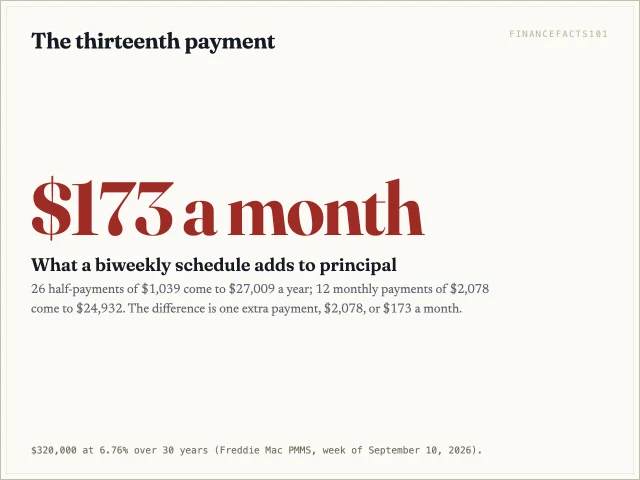
On the base loan the half-payment is $1,039. Twenty-six of them come to $27,009 a year against the monthly schedule's $24,932 — an extra $2,078, which is one more payment, or $173 a month spread evenly. Every dollar of that extra goes to principal, and the extra mortgage payment guide shows what principal paid early does: it stops accruing interest for every remaining month.
Three ways to make thirteen payments
There are three ways to arrive at the same extra $2,078 a year, and they are not quite equal.
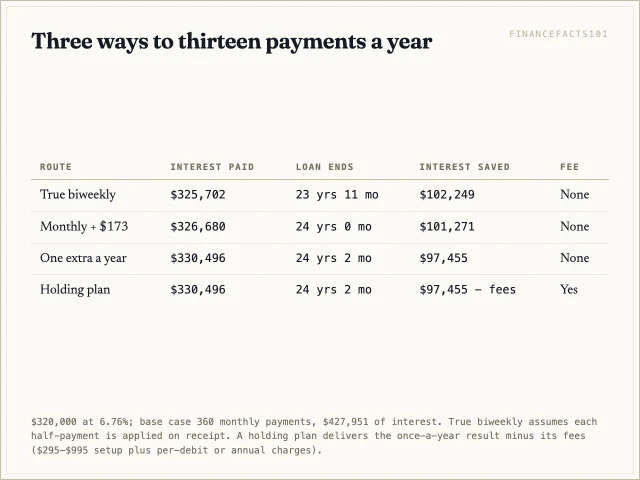
- True biweekly. The servicer accepts and applies a half-payment every fourteen days. Because half the payment lands two weeks early every cycle, this saves slightly more than the others: $102,249, with the loan ending after 622 half-payments, about 23 years and 11 months.
- Monthly plus a twelfth. Add $173 to each monthly payment, marked for principal. Saves $101,271; the loan ends at 24 years exactly.
- One extra payment a year. Pay a thirteenth full payment once a year — from a bonus, a tax refund, or savings set aside. Saves $97,455; the loan ends at 24 years and 2 months.
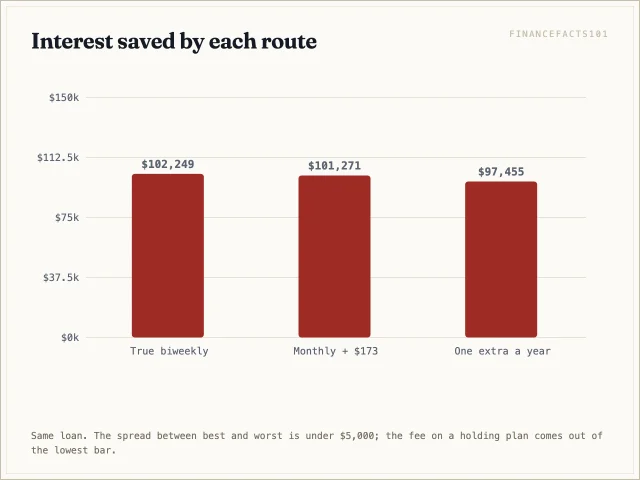
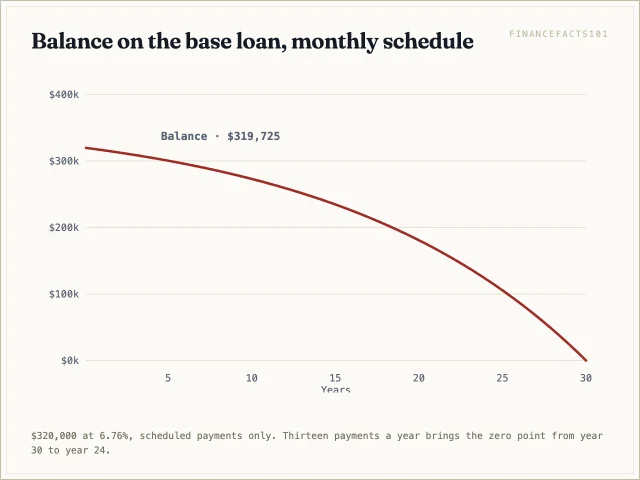
The spread between the best and the worst of these is under $5,000 over 24 years. The choice among them is about convenience and cash flow, not money. The choice that is about money is whether to pay someone to do it.
What a fee-based plan actually does
Most servicers do not apply payments every fourteen days. A servicer's obligation under federal rules, as the CFPB summarises them, is to credit full payments the day they arrive; a partial payment can be held "until enough accumulates for a complete payment." A half-payment sent to a servicer that does not offer true biweekly crediting sits in suspense for two weeks, then combines with the next half to make one monthly payment. Nothing has been accelerated.
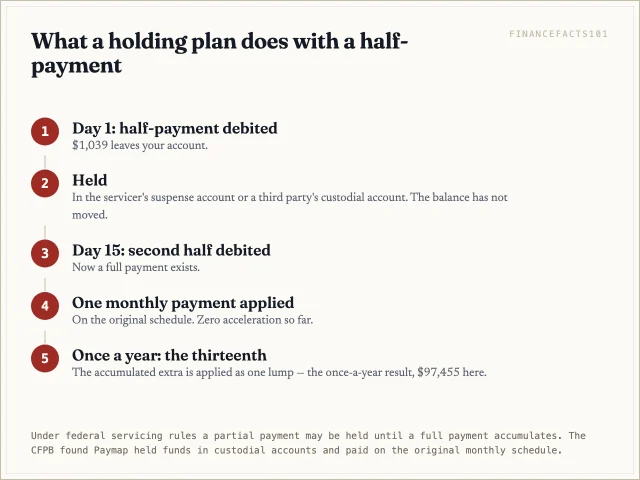
Third-party plans work the same way, and they say so in the fine print. The CFPB's July 2015 action against Paymap's Equity Accelerator Program, marketed through servicers including LoanCare, found that the company "collected funds through more frequent withdrawals but held them in custodial accounts, then applied payments to mortgages on the original monthly schedule" — the CFPB's release records a $295 enrollment fee and about $2.50 per debit, an advertised "over $33,000 in interest savings" that "only a tiny percentage, if any" of customers achieved, and an order to return $33.4 million in fees to about 125,000 consumers. A holding plan delivers, at best, the once-a-year result: $97,455 on this loan, minus the fees.
The fees, priced on this loan
Two documented fee structures, both from CFPB enforcement in 2015, applied to the base loan over the roughly 24 years a biweekly schedule runs:
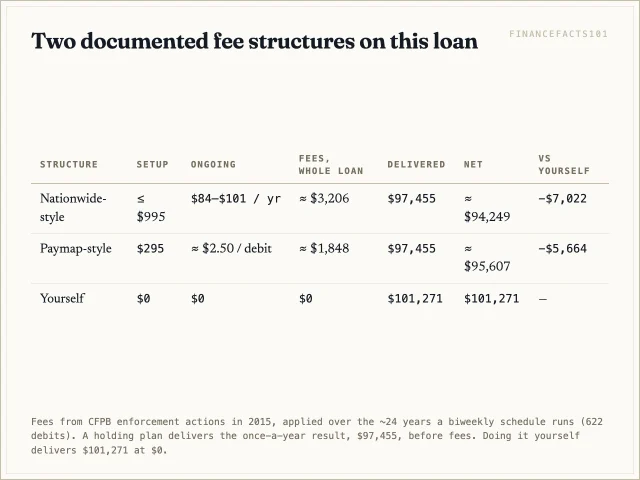
The Nationwide Biweekly structure — a setup fee of up to $995 and $84 to $101 a year in processing, per the CFPB's May 2015 complaint — comes to about $3,200 over the loan. The Paymap structure, $295 plus $2.50 a debit, comes to about $1,850. Set against the $97,455 a holding plan can actually deliver, the net is $94,249 and $95,607 — against $101,271 for doing it yourself at no cost. The plan costs $5,700 to $7,000 of the saving it advertises.
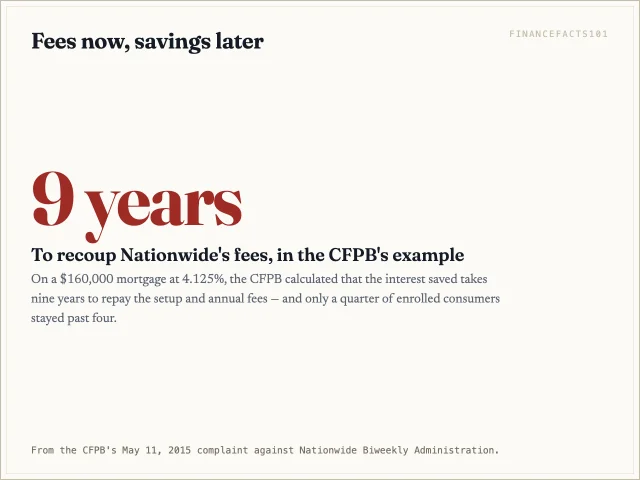
The CFPB's own worked example in the Nationwide case is sharper: on a $160,000 mortgage at 4.125%, the fees take nine years to recoup from the interest saved, and only a quarter of enrolled consumers stayed longer than four. Most paid the fee and left before it paid back. Fees are paid in the first months; the interest saving arrives over decades. That timing asymmetry is what makes an otherwise small fee expensive.
The cash-flow trap nobody mentions
A biweekly schedule is not a monthly schedule with smaller pieces. Twice a year, a calendar month contains three paydays — and three half-payment debits.
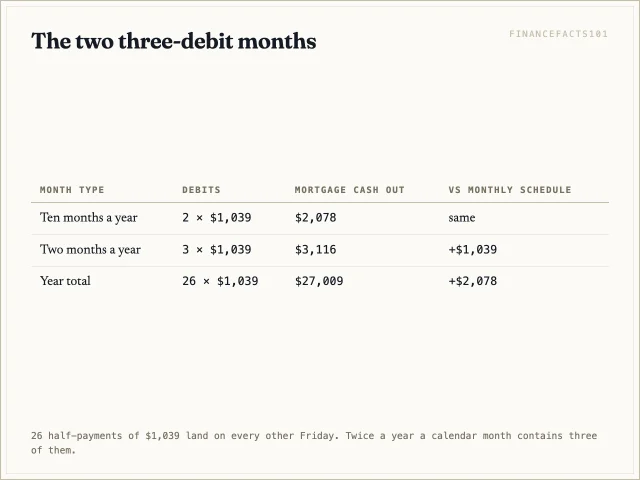
In those months the mortgage takes $3,116 instead of $2,078, a $1,039 surprise for a household budgeting monthly. For someone paid every two weeks the debits track the paychecks and the extra month is also a three-paycheck month, which is why the schedule suits that borrower. For someone paid monthly, the "monthly plus a twelfth" route puts the same $173 in every month with no spikes and is the better fit.
How to do it yourself, in three lines
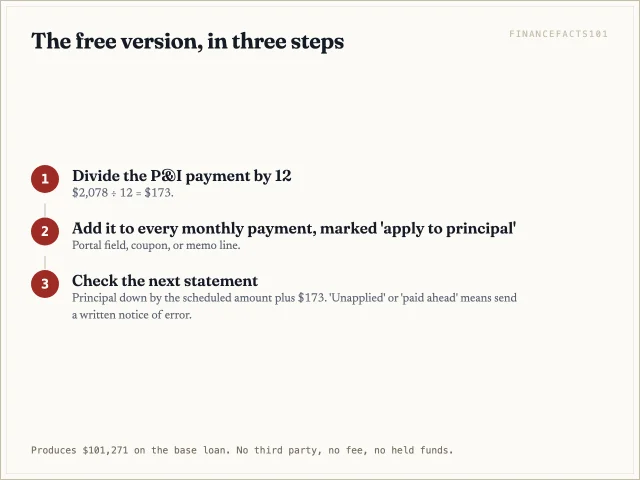
- Take your principal-and-interest payment and divide by twelve. On $2,078 that is $173.
- Add it to every monthly payment, and mark the extra "apply to principal." Most servicer portals have a field; on paper, write it on the coupon and the memo line.
- Check the next statement. The principal should have fallen by the scheduled amount plus $173. If it shows "unapplied" or "paid ahead," send the servicer a written notice of error — the rules give them thirty business days to fix it.
That is the entire plan. It costs nothing, it does not involve a third party holding your money, and it produces $101,271 on this loan — more than any fee-based holding plan can.
When a servicer's own biweekly is worth taking
Some servicers offer genuine biweekly crediting — half-payments applied on receipt — with no fee. That is the best of the three routes by about a thousand dollars and it is worth taking if, and only if, three things are true: there is no setup or per-debit fee, the servicer confirms in writing that each half-payment is applied when received rather than held, and your income arrives every two weeks so the three-debit months do not bite. Ask the servicer directly whether it applies payments biweekly or holds them; the CFPB's page on how paydown works explains why the timing of principal reduction is what drives the saving.
If any of the three is false, add the twelfth to the monthly payment instead. Where a plan carries a fee — from anyone — decline it; the CFPB's prepayment-penalty page is the only fee question worth asking about extra principal, and the answer for small regular amounts is almost always no penalty.
Biweekly against the 15-year loan
Thirteen payments a year is sometimes described as "paying a 30-year like a 15." It is not that, and the gap is worth seeing. On $320,000 the 15-year loan at the survey's 6.09% costs $2,716 a month — $638 more than the 30-year payment — and retires the loan at year fifteen with $168,867 of lifetime interest. The biweekly schedule adds $173 a month and retires the loan at year twenty-four with $326,680 of interest. The 15-year saves $157,813 more, for $465 more a month than the biweekly asks.
Put the other way: the biweekly schedule is the cheapest possible step toward a shorter loan, and it buys six years and $101,271. Each further $100 a month buys more, as the extra-payment guide's table shows, and the 15-year vs 30-year guide prices the full commitment. A borrower who can find $173 but not $638 has a real choice; a borrower who can find $638 and wants the discipline enforced has a different one. Neither is wrong, and the biweekly schedule is the entry point to both, because it can be stopped in a bad year without a refinance, while the 15-year cannot.
Matching the schedule to a biweekly paycheck
The real case for a biweekly schedule is not the arithmetic — the monthly twelfth matches it — but the fit with a biweekly paycheck. If the half-payment leaves the account the day after each payday, the mortgage is paid from money that has just arrived, and the two three-paycheck months carry the two three-debit months. For a household that budgets by paycheck rather than by month, that alignment is worth something the tables do not measure: fewer overdraft risks and no end-of-month scramble.
Two practical details make it work. First, the servicer must treat each half-payment as applied on receipt, or the alignment is cosmetic and the money simply sits in suspense until the second half arrives; under the servicing rules the CFPB summarises, a servicer that holds a partial payment is within its rights, so the crediting practice has to be confirmed in writing before relying on it. Second, the regular due date and any late-fee grace period do not move: if the second half of a payment would land after the grace period ends, the servicer can assess a late fee even though the full amount arrives within the month. Set the debit dates so both halves clear before the due date, not straddling it.
A decision sequence
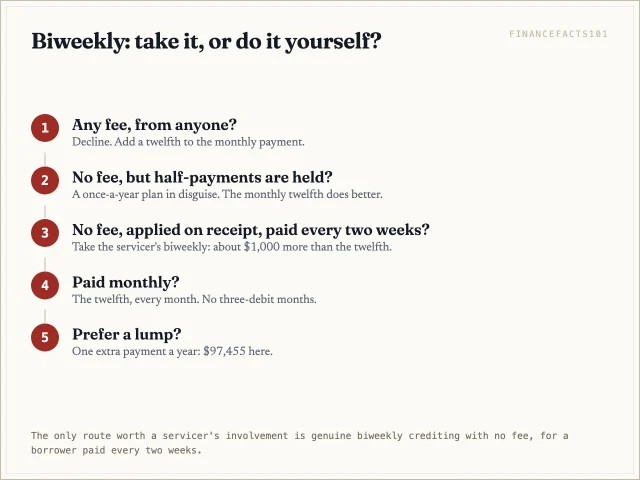
- Is there a fee? Any fee, from anyone: decline, and add a twelfth to the monthly payment.
- No fee, but does the servicer hold half-payments? Then it is a once-a-year plan in disguise; the monthly twelfth does better.
- No fee, applied on receipt, paid every two weeks? Take the servicer's biweekly; it saves about $1,000 more than the twelfth.
- Paid monthly? The twelfth, every month — no spikes, same result.
- Prefer a lump? One extra payment a year saves $97,455 here; fine if the cash is reliably there.
FAQ
How much does a biweekly mortgage plan save?
On $320,000 at 6.76% over 30 years, thirteen payments a year instead of twelve pays the loan off at 24 years and saves $101,271 of interest — $102,249 if the servicer applies each half-payment on receipt. The saving comes entirely from the extra payment, not from the frequency.
Can I get the biweekly saving without a plan?
Yes. Add a twelfth of your payment to each monthly payment and mark it for principal. On this loan that is $173 a month and it produces the same $101,271 with no fee.
Why did the CFPB act against biweekly companies?
In 2015 it found that Paymap's program held consumers' half-payments and paid the mortgage on the original monthly schedule while advertising over $33,000 of savings, and ordered $33.4 million of fees returned; it separately sued Nationwide Biweekly, which charged up to $995 to enroll and $84–$101 a year, alleging most consumers paid more in fees than they saved.
Can I stop a biweekly schedule once I have started?
Yes, and that is one of its advantages over a shorter loan term. The required payment never changed, so reverting to twelve monthly payments needs nothing more than cancelling the extra; the payoff date drifts back toward thirty years and no penalty or refinance is involved. A 15-year loan, by contrast, cannot be slowed down without refinancing.
Does biweekly change my required payment?
No. The required monthly payment stays $2,078; the schedule only changes how often and how much you send. If you stop the extra, nothing happens except that the payoff date drifts back toward 30 years.
Sources
- Freddie Mac Primary Mortgage Market Survey — 30-year fixed average, week of September 10, 2026
- CFPB: your mortgage servicer must comply with federal rules — crediting of full payments, holding of partial payments, notices of error
- CFPB: action against Paymap and LoanCare (July 28, 2015) — the $295 and $2.50 fees, funds held in custodial accounts, $33.4 million returned
- CFPB: suit against Nationwide Biweekly (May 11, 2015) — the $995 setup and $84–$101 annual fees, the nine-year recoup example
- CFPB: how does paying down a mortgage work — why early principal reduction drives the saving
- CFPB: what is a prepayment penalty — small extra principal payments normally do not trigger one
- CFPB: can I be charged a penalty for paying off my mortgage early — where the terms are found in the Note or Addendum
 Next entry · No. 5,963ARM vs Fixed-Rate Mortgage: Pricing the Bet on a 5/1 ARM
See also
-
 No. 5,961
25 Sep 2026
12 min
Extra Mortgage Payments: What $200 a Month Actually Saves
Mortgage
No. 5,961
25 Sep 2026
12 min
Extra Mortgage Payments: What $200 a Month Actually Saves
Mortgage -
 No. 5,964
28 Sep 2026
12 min
Mortgage Recast vs Refinance: What to Do With a $50,000 Lump Sum
Mortgage
No. 5,964
28 Sep 2026
12 min
Mortgage Recast vs Refinance: What to Do With a $50,000 Lump Sum
Mortgage -
 No. 5,957
21 Sep 2026
15 min
Mortgage Payment Levers: What Actually Moves the Number
Mortgage
No. 5,957
21 Sep 2026
15 min
Mortgage Payment Levers: What Actually Moves the Number
Mortgage -
 No. 5,933
05 Sep 2026
15 min
15-Year vs 30-Year Mortgage: The Total-Cost Math
Real Estate
No. 5,933
05 Sep 2026
15 min
15-Year vs 30-Year Mortgage: The Total-Cost Math
Real Estate -
 No. 5,967
01 Oct 2026
12 min
2-1 Buydown: What a Seller-Paid Teaser Rate Is Actually Worth
Mortgage
No. 5,967
01 Oct 2026
12 min
2-1 Buydown: What a Seller-Paid Teaser Rate Is Actually Worth
Mortgage -
 No. 5,966
30 Sep 2026
12 min
Assumable Mortgage Value: What a 3% Loan Is Worth in a 6.76% Market
Mortgage
No. 5,966
30 Sep 2026
12 min
Assumable Mortgage Value: What a 3% Loan Is Worth in a 6.76% Market
Mortgage