ARM vs Fixed-Rate Mortgage: Pricing the Bet on a 5/1 ARM
A 5/1 ARM 0.75 below the 6.76% fixed rate saves $9,421 in five years on $320,000. If the caps bind, that is gone by year seven. Three rate paths, priced.
A 5/1 adjustable-rate mortgage priced three-quarters of a point below the 30-year fixed — 6.01% against 6.76% on $320,000 — saves $157 a month for five years, $9,421 in all. What happens after year five is a bet on rates, and this guide prices the three ways it can go. If rates fall a point, the ARM is ahead by $38,703 at year ten. If they stay where they are, ahead by $16,607. If they rise until the caps bind, the five-year saving is gone by year seven and the ARM is behind by $38,254 at year ten, with a payment that has climbed from $1,921 to $2,902. The decision is not whether the ARM is cheaper — it is, for five years — but whether you will still hold the loan when the bet is settled.
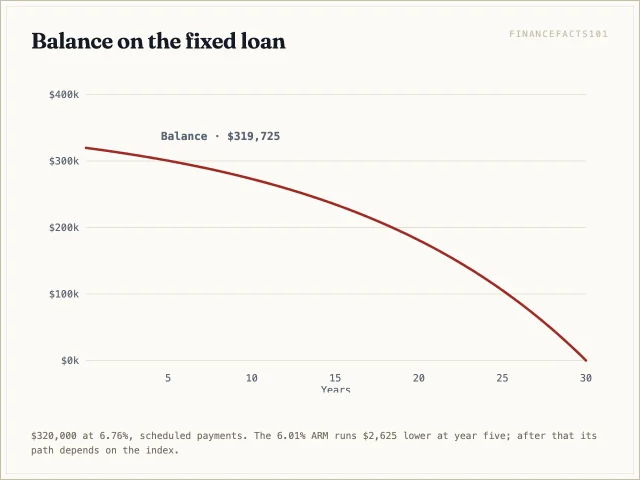
The fixed loan throughout is the series' base case: $320,000 at 6.76% over 30 years, the Freddie Mac Primary Mortgage Market Survey average for the week of September 10, 2026. Freddie Mac no longer publishes an ARM rate in that survey, so the ARM's initial rate is stated as a scenario: 0.75 of a point below the fixed rate in the headline case, with 0.50 and 1.00 shown alongside so you can find your own quote. The ARM is a 5/1 hybrid with the common 2/2/5 caps — up to 2 points at the first adjustment, up to 2 at each later one, 5 over the life of the loan. The mortgage payment levers guide covers the fixed-rate levers; this guide is about the one lever a fixed loan does not have.
Scope honesty: this is general information built on the stated assumptions above, not personal advice. Your quotes, caps, index, margin and plans will differ.
Who this is for — and who it is not for
This guide is for a buyer comparing an ARM quote with a fixed quote, and for the buyer who has heard "I'll refinance before it adjusts" and wants to see what that plan costs if it does not work. It uses a 5/1 structure because it is the most common hybrid; the arithmetic transfers to 7/1 and 10/1 loans by moving the adjustment date.
It is not for anyone planning to stay well beyond the fixed period without a clear ability to absorb the maximum payment — the CFPB's advice is to check that you can afford the payment at the maximum rate the contract allows, rather than assuming a refinance or sale will rescue you. It is also not about interest-only or negative-amortization ARMs, which carry a different risk that this guide's tables do not model; our entry on option ARMs covers those.
How the ARM is built: index, margin and caps
For the first five years the rate is fixed at the initial rate. From year six it resets each year to the index plus the margin, subject to the caps. The CFPB's page on index and margin gives the formula plainly — "Index + Margin = Your Interest Rate (subject to any rate caps)" — and notes that the margin "can vary a lot between different lenders" and can be negotiated like a rate.
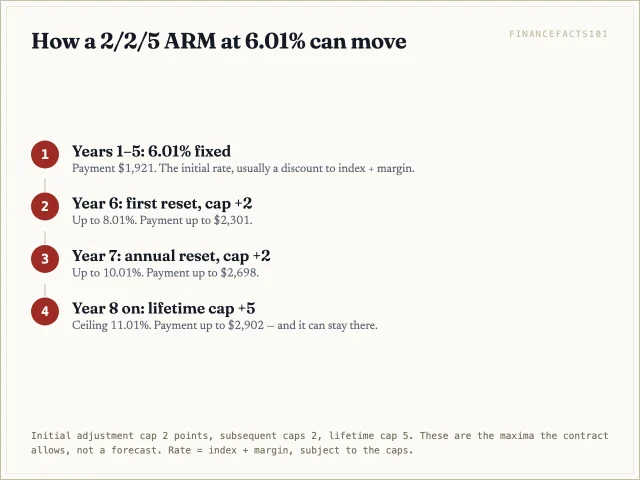
The caps are what make the worst case computable. Per the CFPB's caps page, the initial adjustment cap is typically 2 or 5 points, the subsequent cap 1 to 2, and the lifetime cap most commonly 5. On a 2/2/5 loan starting at 6.01%, the rate can reach 8.01% in year six, 10.01% in year seven and the lifetime ceiling of 11.01% in year eight — and stay there. The CFPB's practical advice is to ask the lender for the maximum possible payment; the worst-case column below is that number.
The five-year saving
For the fixed period the comparison is arithmetic, not forecasting:
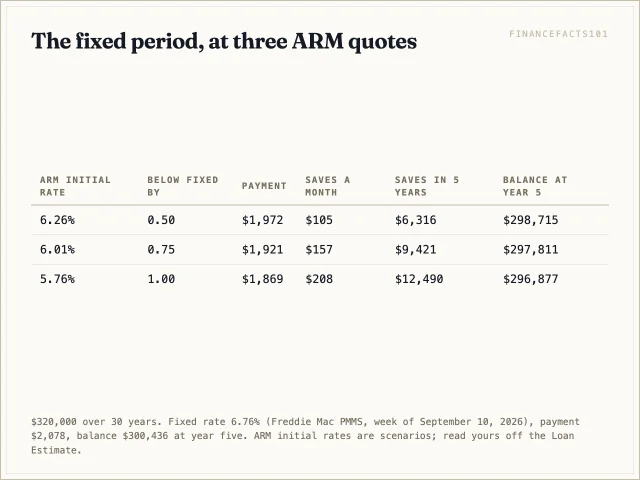
At 0.75 below the fixed rate the ARM payment is $1,921, saving $157 a month and $9,421 over sixty months. At half a point below it saves $105 a month, $6,316; at a full point, $208 a month, $12,490. The lower rate also pays slightly more principal: at year five the 6.01% loan's balance is $297,811 against the fixed loan's $300,436, $2,625 lower. Both effects are real and both are banked before the first adjustment.
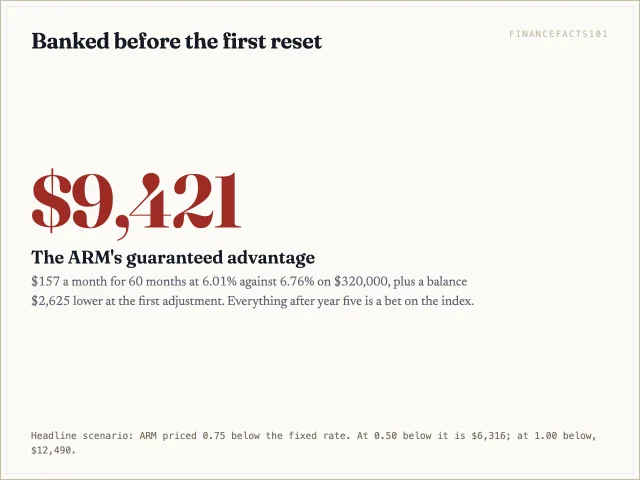
That $9,421 is the ARM's entire guaranteed advantage. Everything after it depends on where the index is in year six.
Three paths after year five
The fully indexed rate — index plus margin — is what the loan wants to charge from year six. The initial rate is usually set below it, which is why the CFPB warns that "the amount of your payment is likely to go up" at the first reset. Three scenarios, each held steady after it arrives:
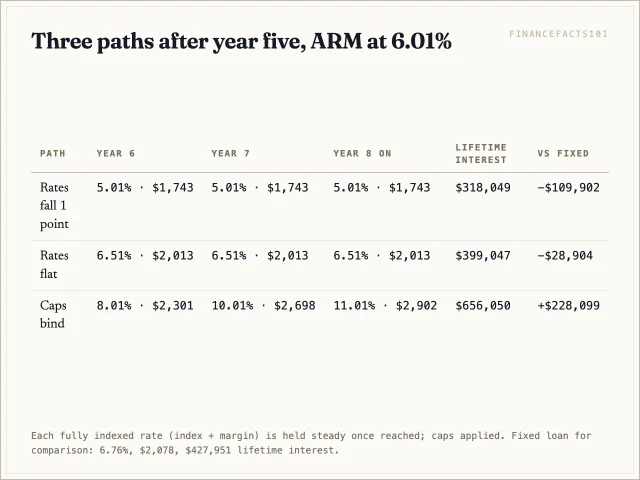
- Rates fall a point. Fully indexed rate 5.01%. Payment drops to $1,743 in year six. Lifetime interest $318,049 — $109,902 less than the fixed loan.
- Rates flat. Fully indexed rate half a point above the initial, 6.51%. Payment $2,013 — still below the fixed $2,078. Lifetime interest $399,047, $28,904 less than fixed.
- Rates rise until the caps bind. Fully indexed rate at or above the lifetime ceiling. Payment $2,301 in year six, $2,698 in year seven, $2,902 from year eight. Lifetime interest $656,050 — $228,099 more than fixed.
The flat case is worth a second look. Even if the index does not move, the ARM's payment rises at the first reset, from $1,921 to $2,013, because the initial rate was a discount to the fully indexed rate. "Rates stay the same" does not mean "my payment stays the same."
The payment shock, year by year
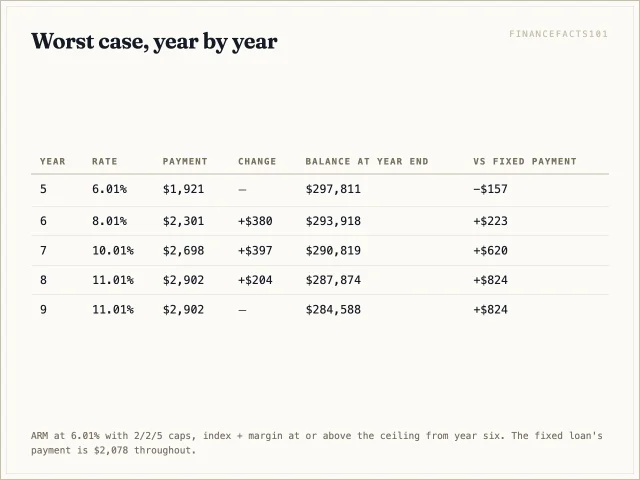
In the worst case the payment climbs $380 in year six, another $397 in year seven, and $204 in year eight, then holds at $2,902 — 51% above the initial $1,921 and $824 above the fixed loan's $2,078. A household that qualified on $1,921 has to find $981 more a month by year eight. The caps make this the ceiling, not a forecast, but it is the ceiling the contract allows, and the CFPB's advice to confirm you can afford it is the single most useful line in this guide.
Where you stand at year seven and year ten
The honest comparison counts what you have paid plus what you still owe — the total cost to walk away at that point.
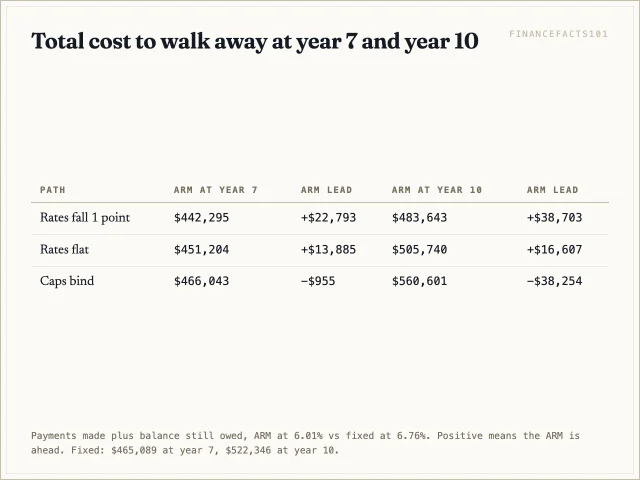
At year seven the ARM is ahead by $22,793 if rates fell, ahead by $13,885 if flat, and behind by $955 if the caps bound. At year ten: ahead by $38,703, ahead by $16,607, behind by $38,254.
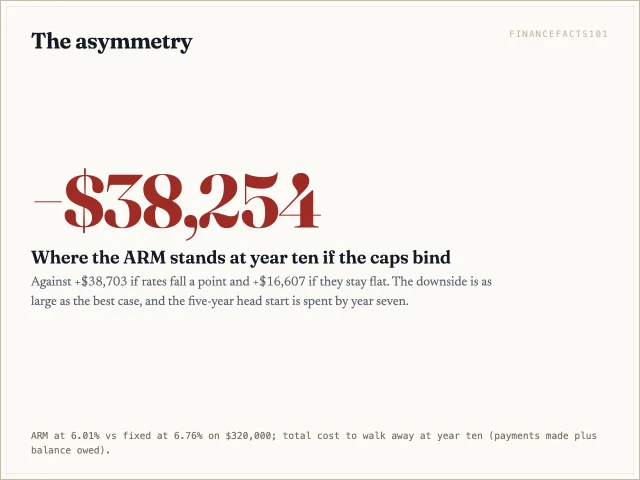
Two readings. First, in the worst case the ARM's five-year head start is fully spent by year seven — seven years is the break-even under the caps. Second, in the flat case the ARM stays ahead indefinitely, because 6.51% is still below 6.76%; the ARM only loses if the index rises materially above where it was priced. The bet is not symmetric: the upside is bounded by how far rates can fall, the downside by the lifetime cap, and on this loan the cap is the larger number.
Moving the settlement date: 7/1 and 10/1
The 5/1 structure settles the bet at year five. A 7/1 or 10/1 ARM moves the settlement date out, and the arithmetic moves with it. If a 7/1 were priced at the same 6.01%, the guaranteed saving would run for 84 months — $157 × 84, or $13,188 — and the ARM would be certain to be ahead at year seven in every path, since the first reset would not yet have happened. A 10/1 at the same rate would bank $18,840 over 120 months.
Lenders know this, and longer fixed periods are normally priced closer to the 30-year fixed rate than a 5/1 is — the borrower is buying more years of certainty and pays for them in a smaller discount. The trade is therefore not "same saving, later risk" but "smaller saving, later risk," and the right way to compare a 7/1 quote with a 5/1 quote is to multiply each discount by its fixed period: a 7/1 at 0.50 below fixed ($105 × 84 = $8,820) banks less than a 5/1 at 0.75 below ($9,421), but hands over two more years before the index matters. For a borrower whose plans run six to seven years, the 7/1 converts the "probably" case above into the "certain" one, and that conversion is often worth the smaller discount.
The refinance escape hatch, and its price
The usual plan for the worst case is to refinance into a fixed loan before or at the first adjustment. Two things stand in the way. The rate environment that makes the ARM adjust upward is the same one that makes the fixed refinance expensive — a borrower refinancing at year six because rates rose is refinancing into the higher rates. And refinancing costs money: closing costs of 2% to 3% of the balance, which on $297,811 is $6,000 to $9,000, as the mortgage refinance cost guide prices in detail. Spend $7,500 to escape the adjustment and the five-year saving of $9,421 is mostly gone.
The escape hatch works when rates fall — which is exactly the case in which the ARM did not need one. That asymmetry is the argument fixed-rate borrowers are paying $157 a month to avoid.
Two mechanics matter if the refinance is the plan. It takes time: the servicer has seven business days to answer a payoff request under the servicing rules the CFPB summarises, and a refinance carries a three-business-day right of rescission after signing, during which either side is still unwinding rather than done — so a refinance timed to beat a reset date has to be started well before it. And it is only possible on the terms available then: the CFPB's fine-print page lists a prepayment penalty among the features to check precisely because it can make leaving the ARM cost more than the adjustment does.
What to read in the fine print before signing
The CFPB's fine-print page lists what to find in the loan documents, and each item changes the tables above:
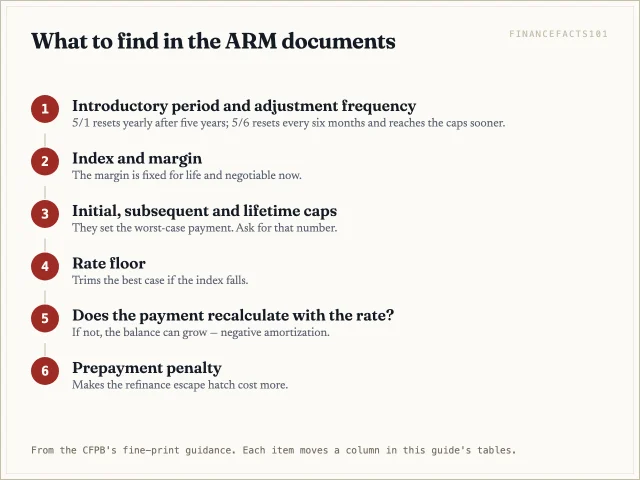
- The introductory period and adjustment frequency. Five years then annual is the case here; a 5/6 loan adjusts every six months after year five, which reaches the caps sooner.
- The index and the margin. The margin is fixed for life and negotiable at signing; a half-point lower margin is a half-point lower rate at every reset.
- The caps — initial, subsequent and lifetime — which set the worst-case column.
- A rate floor. Some loans do not adjust below a floor even if the index falls, which trims the best case.
- Whether the payment recalculates with the rate. If it does not, the CFPB notes, "your loan balance could increase" — negative amortization, excluded from this guide.
- A prepayment penalty, which would make the refinance escape hatch cost more still.
Which borrower the ARM suits
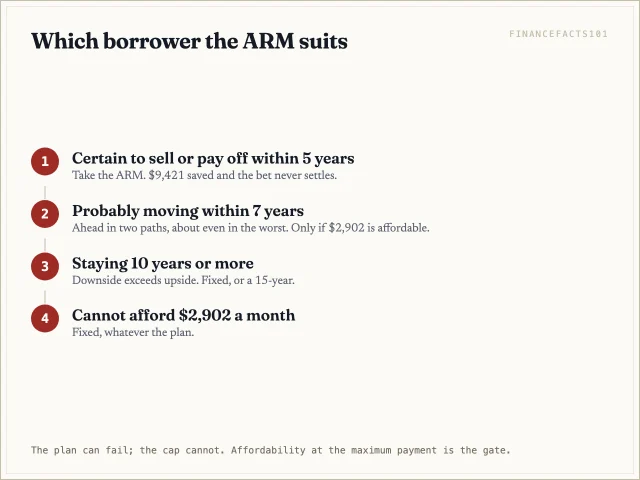
- Certain to sell or pay off within the fixed period. The ARM saves $9,421 and the bet is never settled. This is the clean case — a known relocation, a bridge to a sale, a loan that will be paid off from a known event.
- Probably moving within seven years. The ARM is ahead in two scenarios and roughly even in the worst; the risk is a plan that slips. Take it only if the worst-case payment is affordable.
- Staying ten years or more. The ARM's downside exceeds its upside. The fixed loan's $157 a month is the price of never having to watch the index; the 15-year vs 30-year guide is the better place to look for a lower lifetime cost.
- Cannot afford $2,902 a month. Do not take the ARM, whatever the plan. The plan can fail; the cap cannot.
FAQ
How much does a 5/1 ARM save compared with a fixed rate?
On $320,000, an ARM priced 0.75 below the 6.76% fixed rate saves $157 a month for five years, $9,421 in total, and leaves the balance $2,625 lower at the first adjustment. Half a point below saves $6,316; a full point, $12,490.
What is the worst the payment can reach?
With 2/2/5 caps from a 6.01% start, the rate can reach 8.01% in year six, 10.01% in year seven and 11.01% from year eight. The payment goes from $1,921 to $2,301, $2,698 and $2,902. The lender must be able to tell you this maximum payment before you sign.
Does my payment stay the same if rates do not move?
No. The initial rate is usually below the index plus margin, so the first reset raises the rate even in a flat market — here from 6.01% to 6.51% and the payment from $1,921 to $2,013. It stays below the fixed loan's $2,078, but it rises.
Can I just refinance before the ARM adjusts?
Only if rates allow it. The scenario in which the ARM adjusts upward is the scenario in which fixed rates have risen too, and refinancing costs 2% to 3% of the balance — $6,000 to $9,000 here — which consumes most of the five-year saving.
Sources
- Freddie Mac Primary Mortgage Market Survey — 30-year fixed average, week of September 10, 2026; the survey no longer reports an ARM rate
- CFPB: what is the difference between a fixed-rate and adjustable-rate mortgage — ARMs start lower, the payment is likely to rise, and the advice to afford the maximum
- CFPB: index and margin — the rate formula and the negotiable margin
- CFPB: rate caps — initial, subsequent and lifetime caps and their typical sizes
- CFPB: what to look out for in an ARM's fine print — floors, payment recalculation, negative amortization, prepayment penalties
- CFPB: adjustable-rate mortgages — the Bureau's ARM hub and its Consumer Handbook on Adjustable-Rate Mortgages
- CFPB: what is the right of rescission — the three-business-day window on a refinance
 Next entry · No. 5,964Mortgage Recast vs Refinance: What to Do With a $50,000 Lump Sum
See also
-
 No. 5,967
01 Oct 2026
12 min
2-1 Buydown: What a Seller-Paid Teaser Rate Is Actually Worth
Mortgage
No. 5,967
01 Oct 2026
12 min
2-1 Buydown: What a Seller-Paid Teaser Rate Is Actually Worth
Mortgage -
 No. 5,966
30 Sep 2026
12 min
Assumable Mortgage Value: What a 3% Loan Is Worth in a 6.76% Market
Mortgage
No. 5,966
30 Sep 2026
12 min
Assumable Mortgage Value: What a 3% Loan Is Worth in a 6.76% Market
Mortgage -
No. 5,964
28 Sep 2026
12 min
Mortgage Recast vs Refinance: What to Do With a $50,000 Lump Sum
Mortgage
-
 No. 5,962
26 Sep 2026
12 min
Biweekly Mortgage Payments: The Saving Is Real, the Fee Is Not
Mortgage
No. 5,962
26 Sep 2026
12 min
Biweekly Mortgage Payments: The Saving Is Real, the Fee Is Not
Mortgage -
 No. 5,961
25 Sep 2026
12 min
Extra Mortgage Payments: What $200 a Month Actually Saves
Mortgage
No. 5,961
25 Sep 2026
12 min
Extra Mortgage Payments: What $200 a Month Actually Saves
Mortgage -
 No. 5,960
24 Sep 2026
12 min
10% vs 20% Down: What the Extra $40,000 Is Actually Worth
Mortgage
No. 5,960
24 Sep 2026
12 min
10% vs 20% Down: What the Extra $40,000 Is Actually Worth
Mortgage