How Much It Costs to Refinance a Mortgage

A refinance typically costs 2%-6% of the loan. On $320,000, dropping 6.9% to 6.1% for $6,400 breaks even in 38 months. The full cost stack and the math.
The decision, in two numbers
Refinancing pays when the monthly saving, multiplied by the number of months you will actually keep the loan, exceeds what you pay to close. That is the entire decision: the cost to refinance a mortgage typically runs 2%–6% of the loan amount — $6,400 to $19,200 on a $320,000 balance — and everything below is about whether your rate drop earns that money back before you sell, move, or refinance again.
The rate side of the equation, as of this writing: the 30-year fixed averaged 6.66% for the week of August 27, 2026, per Freddie Mac's Primary Mortgage Market Survey. If you locked a loan near 7% or higher between 2023 and 2025, the question is live. This guide prices the costs line by line, then works one example end to end — a $320,000 balance dropping from 6.9% to 6.1% with $6,400 in costs — and walks through the three places where the simple math misleads people: no-closing-cost pricing, the reset amortization clock, and discount points.
One caveat up front: this is general information built on stated assumptions, not personal advice. Your quotes, your tax situation, and your timeline will differ, so rerun every calculation here with your own numbers before signing anything.
Who this is for — and who it is not for
This guide is for a US homeowner with a fixed-rate mortgage who is at least 0.5 percentage points above current quotes and trying to decide whether a rate-and-term refinance pays. It also covers the no-cost variant and buying points, because those are the two levers every loan officer will offer you.
It is not for three groups. If you expect to sell within about three years, the arithmetic below will almost certainly tell you no — skip to the break-even section, confirm, and keep your loan. If your goal is pulling equity out for renovations or debt consolidation, that is a different product with different pricing; start with our entry on cash-out refinancing instead. And if you hold an FHA, VA, or USDA loan, you likely qualify for a streamline program with reduced documentation and different fees — the framework here still applies, but the cost stack does not.
What it costs to refinance a mortgage: the full stack
A refinance closes like a purchase, minus the realtor. You pay the lender to originate, third parties to verify, and the county to record. The CFPB's plain-English breakdown of loan costs sorts them into lender charges, third-party services, government fees, and prepaids. Here is the stack with typical ranges:
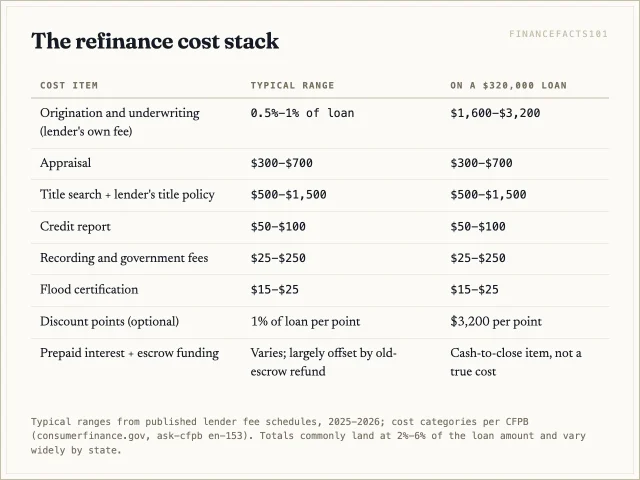
Three notes on that table. First, the origination charge is the one with real negotiating room — it is the lender's own fee, and lenders waive or shrink it to win business. Second, the prepaid items (interest to the end of the closing month, plus funding a new escrow account) are not really costs: your old servicer refunds your old escrow balance a few weeks after payoff, and prepaid interest replaces interest you would have paid anyway. They inflate cash-to-close, not the true price. Third, geography moves the total a lot — title and government charges vary by state, and 2024 state averages ran from roughly $1,700 in California to $6,600 in New York per LodeStar's closing-cost survey.

Our worked example uses $6,400 on a $320,000 loan — exactly 2%, the low end of the range, which is realistic for a shopped rate-and-term refinance with no points in a low-fee state.
The break-even formula, worked end to end
The formula is one line:
Months to break even = total closing costs ÷ monthly payment savings.
Now the example, with every input named. You owe $320,000 at 6.9% on a 30-year loan taken recently enough that the balance is still close to the original amount (we treat it as exactly $320,000 to keep the arithmetic checkable). A lender quotes 6.1% on a new 30-year loan — a rate below the late-August 2026 survey average of 6.66%, the kind of quote that shows up with strong credit and hard shopping, or if rates drift lower; the method is what matters, so substitute your own quote.
- Payment at 6.9% on $320,000 over 30 years: $2,108 per month
- Payment at 6.1% on $320,000 over 30 years: $1,939 per month
- Monthly saving: $168
- Break-even: $6,400 ÷ $168 = 38 months
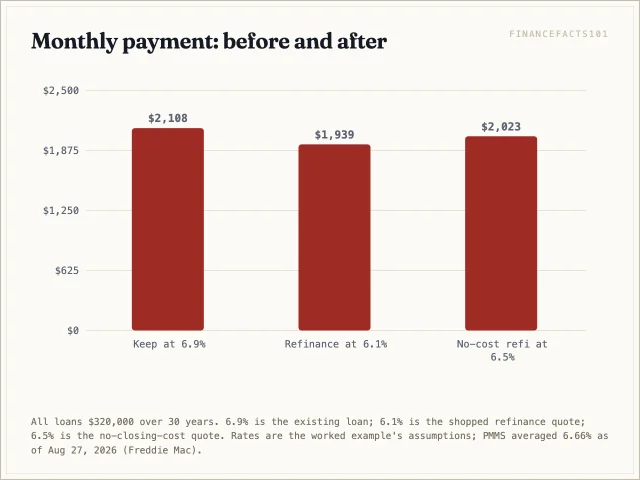
Thirty-eight months. Keep the loan past month 38 — just over three years — and every month after that is roughly $168 ahead. Sell or refinance again before month 38 and the deal lost money. The crossover looks like this:
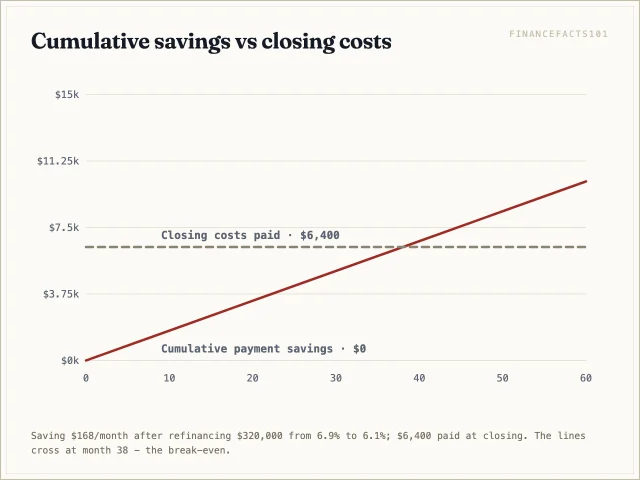
Purists will note the simple formula compares payments, not interest, and a new 30-year payment contains less principal than month 60 of an old one. That objection is real and we deal with it fully in the reset-clock section below. For a young loan like this one, the simple version lands within a few months of the exact answer and is the right first filter.
What the new rate does to your payment and balance
The payment drop is only half the effect. At 6.9%, interest accrues at about $1,840 in month one; at 6.1%, about $1,627. The lower rate means more of each dollar you send reaches principal, so the new loan amortizes faster even though the payment is smaller.
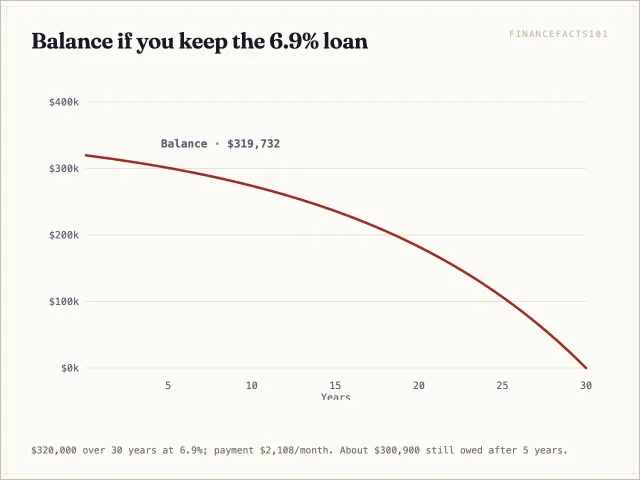
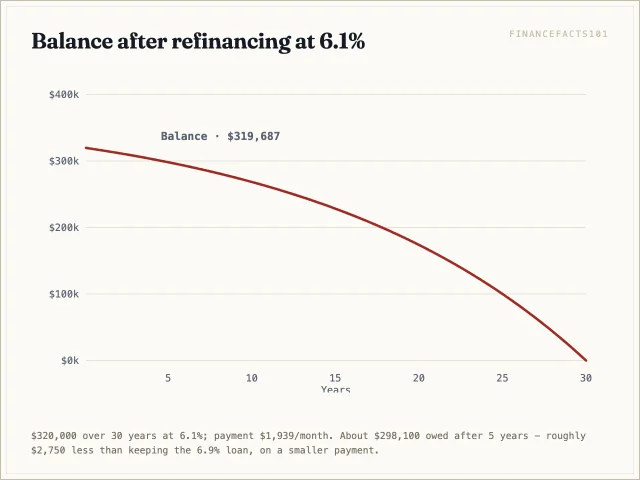
Read the five-year mark on each curve: about $300,900 remaining on the 6.9% loan versus about $298,100 on the 6.1% loan. The refinancer pays $168 less per month and owes roughly $2,750 less after five years. That double effect — cheaper payment, faster amortization — is why a genuine rate drop is so hard to beat, and why the amortization schedule is the document to check, not just the payment quote.
No-closing-cost refinances: the price of paying nothing
Every lender offers a version where you bring nothing to closing. The costs do not vanish — the lender pays them and charges you a higher rate, the mirror image of buying points. The CFPB's explainer on lender credits and discount points describes exactly this trade.
Extend the example. Instead of 6.1% with $6,400 due at closing, the no-cost quote is 6.5% with nothing due — a 0.4-point premium, a typical spread for absorbing about 2% in costs. The payment at 6.5% is $2,023, so you still save $85 a month against your old 6.9% loan, starting from day one with zero cash at risk.
The catch is the other comparison: $2,023 versus the $1,939 you would pay at 6.1%. The lender credit costs you $83 a month for the life of the loan — about $30,000 over 30 years — in exchange for $6,400 today. By payment savings alone that is a 77-month recovery, and counting the slower amortization of the higher-rate loan, the true all-in crossover lands right around month 60. The rule that falls out: a no-cost refinance wins if you will be gone within about five years, and loses by a growing margin every year after that. It is also the rational choice when you simply do not have $6,400 liquid — an immediate $85 monthly saving for nothing down is a good trade against doing nothing at all.
Keep, refinance, or no-cost: five years side by side
Here are all three choices over 60 months, counting every dollar out the door plus what you still owe at the end:
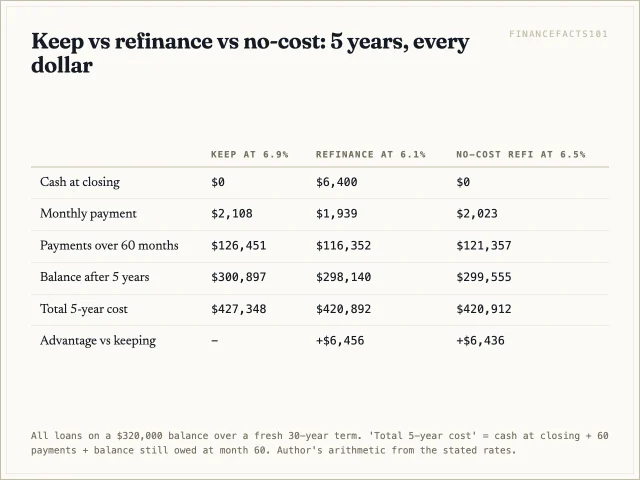
The refinance options finish within about $20 of each other at exactly five years — a genuine dead heat — and both beat keeping the loan by roughly $6,400. The table also shows what the averages hide: the paid-cost refinance spends its advantage up front and collects it back slowly, so its lead over the no-cost version only opens up in years six and beyond. Match the column to your honest timeline, not your hoped-for one.
The reset-clock trap
Everything above assumed a young loan. Deep into the schedule, the same arithmetic can quietly cost you tens of thousands, because a new 30-year loan restarts the clock at the interest-heavy end of the amortization curve.
Concrete version: you are eight years into $320,000 at 6.9%. The balance is down to about $285,900, and you have already paid roughly $168,200 in interest. Keep the loan and you will pay about $270,500 more interest over the remaining 22 years — $438,700 lifetime.
Now refinance that $285,900 into a new 30-year loan at 6.1%. The payment falls from $2,108 to $1,732 — a $375 monthly drop that feels like an obvious win. But the new loan runs to year 38 of your homeownership, and its own interest bill totals about $337,800:

Add the $168,200 already paid and the lifetime total reaches roughly $506,000 — about $67,000 more interest than keeping the 6.9% loan, despite the lower rate. The extra eight years of payments swamp the rate saving.
The trap has a clean escape: refinance to the lower rate but keep sending your old $2,108 payment, directing the extra $375 to principal. The 6.1% loan then pays off in about 19 years — year 27 overall, three years early — with roughly $200,000 of new-loan interest, cutting lifetime interest to about $368,000. That beats keeping the old loan by roughly $70,000. The rate drop was never the problem; the reset term was. If you are more than five or so years in, only refinance with a plan to keep the old payment or take a shorter term.
Points: when buying the rate down pays
Discount points are prepaid interest: 1 point costs 1% of the loan and typically buys somewhere near a quarter-point off the rate, with the exact trade varying daily by lender. Points are a bet on staying put, so price the bet.
On our $320,000 loan at a base quote of 6.1%:
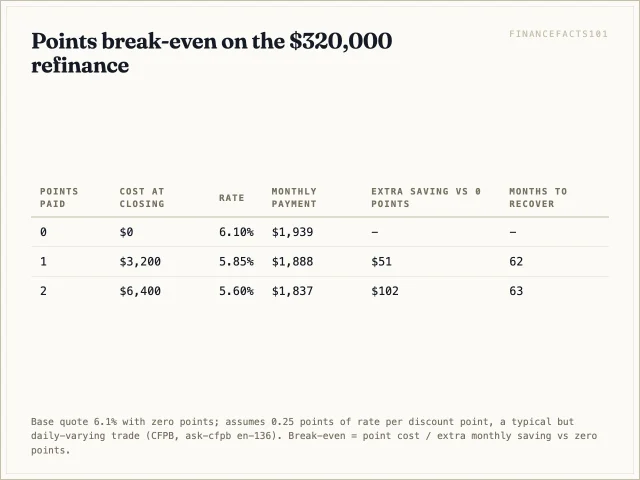
One point ($3,200) buying the rate to 5.85% saves an extra $51 a month and takes 62 months to recover; two points ($6,400) to 5.60% saves $102 and takes 63 months. Both are five-year-plus commitments layered on top of the refinance's own 38-month break-even. Buy points only when you are confident of seven-plus years in the loan and the quoted buy-down is at least this good; ask each lender to quote the same loan at zero, one, and two points on the same day and run this table with their numbers. If your horizon is uncertain, take zero points — the option to leave cheaply is worth more than the rate.
Rate-and-term versus cash-out
Everything priced so far is a rate-and-term refinance: new rate, new term, same balance. A cash-out refinance writes a bigger loan and hands you the difference, and it is priced worse — Fannie Mae and Freddie Mac charge loan-level fee adjustments on cash-out transactions that typically translate to roughly an eighth to half a point of extra rate, and lenders usually cap the new loan at 80% of appraised value. Percentage-based costs also scale with the bigger balance.
The decision rule: never take cash out to make a marginal rate-and-term deal feel worthwhile. Price the rate-and-term refinance on its own merits first; if you separately need equity, compare the cash-out quote against a home equity loan or HELOC that leaves your first mortgage untouched — usually the better path when your existing rate is already below current quotes.
How long you must stay
The break-even month is the minimum stay, not the target. Three refinements make it honest. First, use your realistic horizon in the loan, not the house — a future refinance ends this loan just as surely as a sale does, so if rates look likely to keep falling, treat your horizon as short. Second, pad the break-even by half: a 38-month break-even deserves a five-year intended stay, because transfers, growing families, and rate moves arrive unannounced. Third, remember the savings are not linear forever — the reset-clock section showed that late-life refinances need the old-payment discipline for the "savings" to be real at all.
As a quick screen: below 24 months to break even, refinance; 24–48 months, refinance if you are confident of five-plus years; above 48 months, the rate drop is too small — wait.
Getting your file ready: credit, appraisal, paperwork
Pricing depends on the file you present. Conventional pricing tiers step at credit-score and loan-to-value breakpoints, with the best pricing around 780+ FICO and lower LTVs — so pay every revolving balance below 30% utilization a full cycle before applying, and dispute errors first. Keep all applications inside a tight window: credit-scoring models count multiple mortgage inquiries within a 14–45 day shopping window as one.
The appraisal ($300–$700) is the step you cannot script, but you can predict it: check recent nearby sales and metro price trends in the FHFA House Price Index before paying application fees, because an appraisal below expectations raises your LTV and can reprice the whole quote. Our reference entry on appraisals covers how they are built and challenged.
Then shop like it matters, because it does — this is where hundreds of dollars a year are won:
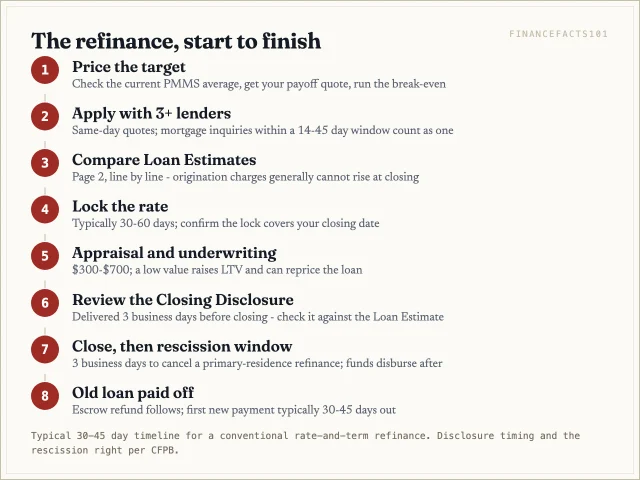
Get Loan Estimates from at least three lenders on the same day (quotes move daily), compare page 2 line by line, and know that origination charges on the estimate generally cannot increase at closing while some third-party fees can move within tolerances. After closing, federal law gives a refinance of your primary residence a three-business-day right of rescission — a final exit if something at the table did not match the disclosure.
Taxes: what the IRS lets you deduct
Refinance math is pre-tax in this article, and for most people that is also the after-tax answer — but know the rules. Points paid on a refinance are generally not deductible in the year paid: IRS Publication 936 requires you to spread them over the life of the loan. Two points ($6,400) on a 30-year refinance deduct at about $213 a year for 30 years — worth roughly $47 a year at a 22% marginal rate, and only if you itemize at all, which most filers taking the standard deduction do not. Per IRS Topic 504, if you later sell or refinance with a different lender, you deduct the remaining unamortized points that year; refinance with the same lender and the leftover points carry into the new loan's schedule.
The other closing costs — appraisal, title, recording — are not deductible on a personal residence at all. And the interest deduction itself only applies to acquisition debt within the statutory limit, so a refinance that pulls cash out for anything other than home improvement can make some of the new interest non-deductible. Treat any tax benefit as a rounding error in the decision unless your accountant shows otherwise.
Six mistakes that flip the math
- Counting the payment drop as pure savings when the term resets. The year-8 example above turned a 0.8-point rate cut into $67,000 of extra interest. Compare lifetime interest, or keep the old payment.
- Taking the first quote. The spread between lenders on the same day for the same borrower routinely exceeds 0.25 points — more than the entire benefit of many refinances. Three Loan Estimates minimum.
- Treating "no-cost" as free. It is a loan of the closing costs at your mortgage rate, forever. Fine for short horizons; expensive past year five.
- Rolling costs into the balance and forgetting them. Financing $6,400 at 6.1% for 30 years costs about $39 a month — the break-even math must count it either way.
- Buying points with an uncertain horizon. A 62-month recovery is a seven-year bet, not a discount.
- Refinancing a small balance. Fixed fees do not shrink with the loan: $4,000 of costs on an $80,000 balance is 5%, and a 0.8-point drop saves only about $42 a month there — an 8-year break-even.
The decision framework
Work it in order, with your own numbers.
- Get the real inputs. Current payoff balance, remaining term, your rate; then three same-day Loan Estimates. Anchor expectations to the current PMMS average and see our primer on how mortgage rates are set for why your quote differs from the headline.
- Compute the simple break-even. Costs ÷ monthly saving. Over 48 months, stop — wait for a bigger gap.
- Check the clock. More than five years into the loan? Only proceed with a shorter term or a commitment to keep the old payment; verify with a lifetime-interest comparison, not payments.
- Pick the cost structure by horizon. Under ~5 years: no-cost. Around 5: either. Well past 5 with cash to spare: pay the costs; 7+ years and a good buy-down quote: consider one point.
- Apply the stay test. Intended time in the loan of at least 1.5× the break-even. If yes, lock; if no, keep the loan and revisit when the spread widens.
Who should simply not refinance: anyone likely to sell within three years; anyone whose balance is too small for the fixed fees to be recovered; anyone late in the amortization schedule who knows they will absorb the lower payment rather than keep the old one; and anyone whose credit or home value has slipped enough that quoted rates no longer clear the break-even screen. For everyone else, the math above is the answer — run it, and let the crossover month decide.
FAQ
Can I roll the closing costs into the new loan?
Usually yes, if the loan still fits the lender's loan-to-value limit — the $6,400 simply becomes part of the new balance. It is not free: $6,400 financed at 6.1% over 30 years adds about $39 to the monthly payment, so your true monthly saving in the worked example drops from $168 to about $129 and the break-even stretches accordingly. It is a fair choice when preserving cash matters; just run the formula on the after-rolling numbers.
Is a 0.5-point rate drop enough to refinance?
Sometimes. On $320,000, half a point saves roughly $105 a month, so $6,400 of costs breaks even in about 61 months — marginal unless you will hold the loan a long time. The same half point via a true no-cost refinance breaks even immediately and is nearly always worth taking. The old "wait for 1%" rule is a blunt version of this: the bigger your balance and the lower your costs, the smaller the drop that pays.
Are refinance closing costs tax-deductible?
Mostly no. Points must be amortized over the loan's life under IRS Publication 936 — about $107 a year per point on a 30-year, $320,000 loan — and only help if you itemize. Appraisal, title, and recording fees on a personal residence are never deductible. The unamortized remainder of the points becomes deductible in the year the loan ends, unless you refinance with the same lender, in which case it carries forward.
How many times can I refinance?
There is no legal limit; each loan just has to pay for itself. Some lenders impose a six-month seasoning period after closing before the next refinance, and rolling costs repeatedly erodes equity. If rates are falling steadily, a no-cost refinance each leg down beats paying full costs twice — you keep the option to refinance again without an unrecovered sunk cost.
Sources
- Freddie Mac, Primary Mortgage Market Survey — 30-year fixed averages; 6.66% for the week of August 27, 2026
- CFPB, "What costs come with taking out a mortgage?" — closing-cost categories
- CFPB, "How should I use lender credits and points?" — points and lender-credit mechanics
- CFPB, "Can my final mortgage costs increase from what was on my Loan Estimate?" — fee tolerances
- CFPB, "What is the right of rescission?" — three-day cancellation right on refinances
- CFPB, mortgage closing-cost inquiry — median loan costs up more than 36% from 2021 to 2023
- IRS Publication 936, Home Mortgage Interest Deduction — points on refinances amortized over the loan term
- IRS Topic 504, Home Mortgage Points — treatment of unamortized points at payoff
- FHFA House Price Index — metro-level home-price trends for appraisal expectations
 Next entry · No. 5,93315-Year vs 30-Year Mortgage: The Total-Cost Math
See also
-
 No. 5,965
29 Sep 2026
12 min
Cash-Out Refinance vs HELOC: The Blended-Rate Math on $50,000
Mortgage
-
 No. 5,958
22 Sep 2026
12 min
Discount Points Break-Even: When Buying Down the Rate Pays
Mortgage
-
 No. 5,964
28 Sep 2026
12 min
Mortgage Recast vs Refinance: What to Do With a $50,000 Lump Sum
Mortgage
-
 No. 5,967
01 Oct 2026
12 min
2-1 Buydown: What a Seller-Paid Teaser Rate Is Actually Worth
Mortgage
-
 No. 5,966
30 Sep 2026
12 min
Assumable Mortgage Value: What a 3% Loan Is Worth in a 6.76% Market
Mortgage
-
 No. 5,962
26 Sep 2026
12 min
Biweekly Mortgage Payments: The Saving Is Real, the Fee Is Not
Mortgage