Roth vs Traditional IRA: Which Saves You More Tax
Same $7,000 a year: the Roth wins by $57,000 if your tax rate rises in retirement and loses by $85,000 if it falls. The crossover is your marginal rate.
You have up to $7,500 to put into an IRA for 2026, and one choice decides how much of it you eventually keep: pay tax on that money now (Roth) or later (traditional). The Roth vs traditional IRA question turns on a single variable — whether your marginal tax rate today is higher or lower than the rate you will pay in retirement — and this guide works the arithmetic in both directions so you can see exactly where the crossover sits, then layers on the rules that can override the math.
This is general information built on stated assumptions — 2026 IRS figures, a hypothetical 7% return, simplified flat withdrawal rates — not personal tax advice. A CPA who can see your whole return may find angles a general guide cannot.
Roth vs traditional IRA: the one-sentence difference
A traditional IRA is taxed later: you may deduct the contribution this year, the money grows untaxed, and every dollar you withdraw in retirement is ordinary income. A Roth IRA is taxed now: no deduction today, but qualified withdrawals — earnings included — come out at a 0% rate.
Everything else is the same product. Same custodians, same investment menu, same $7,500 combined limit for 2026, same age-59½ line for penalty-free earnings. The two accounts are mirror images of one tax decision, which is why the comparison reduces to a question about tax rates rather than a question about investments. For the broader pre-tax vs post-tax framing across account types, see after-tax vs pre-tax retirement contributions.
Who this is for — and who it is not for
This guide is for a US earner with taxable compensation who is putting money into an IRA this year and can choose either side — that means income below the Roth phase-out (or willingness to run a backdoor contribution) and enough cash flow that the contribution happens either way.
It is not for three groups. If your employer matches 401(k) contributions and you have not captured the full match, do that first — a 50% or 100% match beats any tax-timing gain here. If you have no earned income (compensation, not investment income), you cannot contribute to any IRA at all, with one exception: a spousal IRA funded from a working spouse's compensation on a joint return. And if your real question is "should I save at all," the answer does not depend on which wrapper you pick — pick either and start.
The decision variable: your marginal rate now vs your marginal rate later
Every dollar you put in a traditional IRA avoids tax at your marginal rate — the rate on your last dollar of income — and every dollar you later withdraw is taxed at your marginal rate in that future year. So the whole comparison is: rate now vs rate later. Not your average rate, not the headline bracket for your total income — the rate on the specific dollars moving in and out.
The 2026 federal brackets, set by Revenue Procedure 2025-32, are the reference table for "rate now":
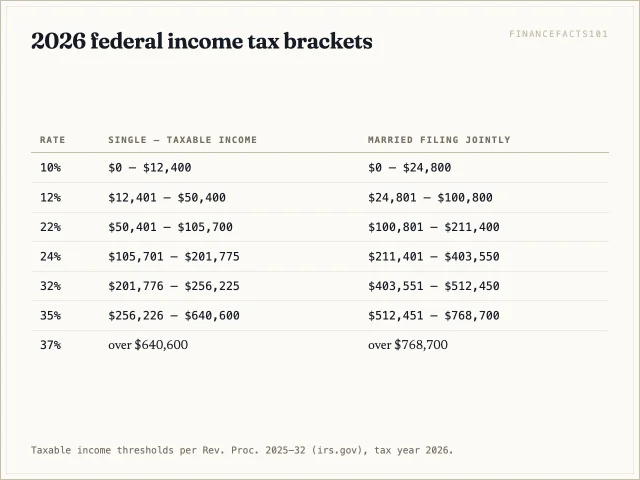
A single filer with $85,000 of taxable income sits in the 22% bracket; the same person at $110,000 has crossed into 24%. Those breakpoints matter more than any general rule of thumb, because a contribution deducted at 22% and withdrawn at 22% is a wash — while the same contribution deducted at 24% and withdrawn at 12% is a 12-percentage-point win for the traditional side.
The worked example: $7,000 a year, three futures
Name the assumptions: you invest $583 a month (about $7,000 a year), earn 7% a year, and keep it up for 30 years. You are in the 24% bracket today. What the account grows to, before any tax:
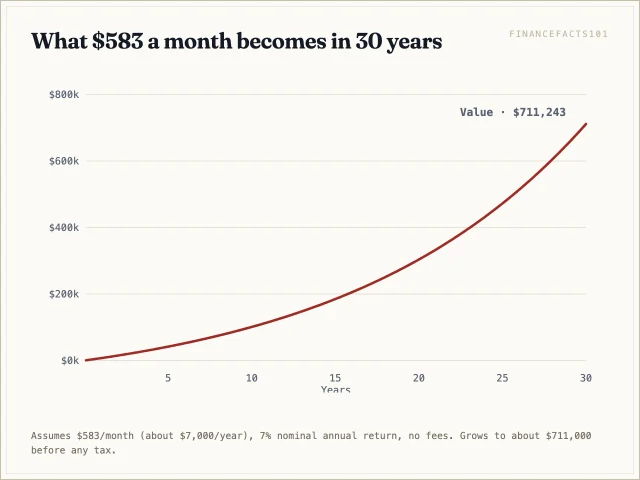
About $711,000. Now the fair comparison — and "fair" matters, because the classic mistake is comparing a $7,000 Roth contribution to a $7,000 traditional contribution while ignoring that the traditional one also hands you a $1,680 tax deduction. To hold your out-of-pocket cost equal, give both sides the same $7,000 of pre-tax budget:
- Traditional: the full $7,000 a year goes in (the deduction means it costs you $7,000 pre-tax). It grows to $711,000, and withdrawals are taxed at your retirement rate.
- Roth: you pay 24% tax first, leaving $5,320 a year ($443 a month) to invest. It grows to 76% of $711,000 — about $541,000 — and you keep all of it.
Run three futures for your retirement marginal rate:
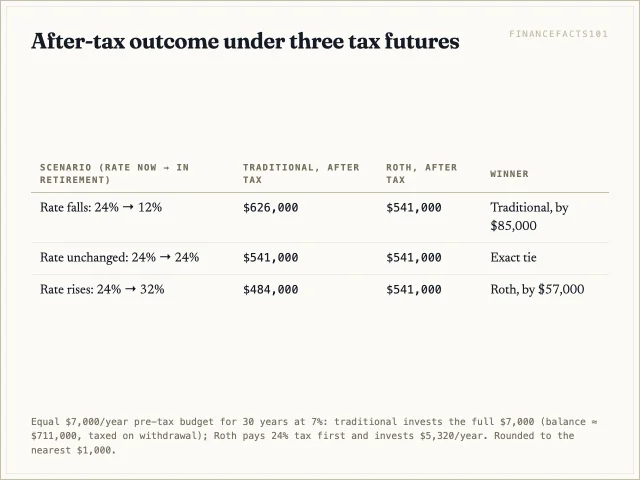
Check the arithmetic yourself: $711,000 × (1 − 0.12) = $625,900. $711,000 × 0.76 = $540,500 — identical to the Roth, to the dollar, because multiplication commutes: taxing money before growth or after growth at the same rate produces the same result. $711,000 × 0.68 = $483,600, which is $57,000 short of the Roth.
The lesson is blunt. Neither account is "better." The traditional IRA is a bet that your rate falls; the Roth is a bet that it holds or rises. At identical rates, the outcome is identical.
Where the crossover sits — and what bends it
Plot the traditional IRA's after-tax value against the retirement tax rate and the crossover appears exactly at today's rate, 24% in our example:
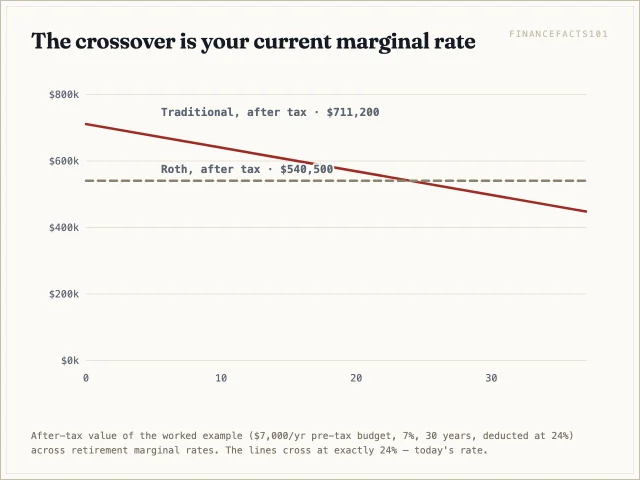
Real life bends this clean picture in both directions.
Toward traditional: withdrawals do not all land at your marginal rate. A retiree with no other ordinary income fills the standard deduction ($16,100 single for 2026), then the 10% and 12% brackets, before any dollar touches 22%. So the effective rate on traditional withdrawals is often well below the marginal rate you deducted at — a genuine structural edge if the IRA is your main income source.
Toward Roth: three quiet forces. First, at the contribution cap, $7,500 in a Roth is worth more than $7,500 in a traditional IRA because it is $7,500 of after-tax money — the Roth effectively shelters more per dollar of limit. Second, required minimum distributions force taxable income out of a traditional IRA on the IRS's schedule, not yours. Third, today's rates are historically low and legislated; future Congresses set future rates, and the Roth is insurance against the upside.
2026 limits and income phase-outs
For 2026 the contribution limit is $7,500 across all your IRAs combined, plus a $1,100 catch-up if you are 50 or older — $8,600 total. That catch-up is indexed for inflation for the first time, per the IRS's 2026 retirement limits announcement.

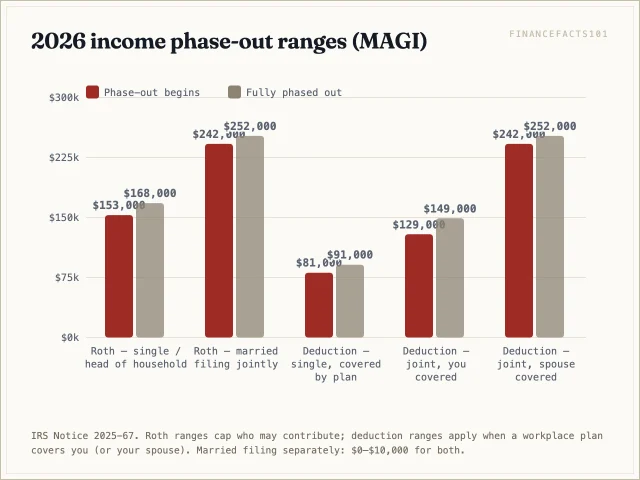
Roth eligibility phases out with modified adjusted gross income (MAGI). For 2026, per IRS Notice 2025-67: single filers and heads of household phase out between $153,000 and $168,000; married filing jointly between $242,000 and $252,000; married filing separately between $0 and $10,000 — a near-total bar for that status. Inside a range, your allowed contribution shrinks pro rata; Publication 590-A has the worksheet.
Contributions for 2026 can be made until the tax-filing deadline in April 2027, and you need compensation at least equal to what you contribute.
The deduction rules when a workplace plan covers you
The traditional IRA has no income cap on contributing — only on deducting, and only if you (or your spouse) are covered by a workplace plan such as a 401(k). For 2026:
- Not covered, spouse not covered: full deduction at any income.
- Single or head of household, covered: deduction phases out from $81,000 to $91,000 of MAGI.
- Married filing jointly, you are covered: $129,000 to $149,000.
- Married filing jointly, only your spouse is covered: $242,000 to $252,000.
- Married filing separately, either covered: $0 to $10,000.
Above the top of your range, you can still contribute — but with no deduction, which deletes the traditional IRA's entire advantage. A nondeductible contribution creates after-tax basis that must be tracked on Form 8606 forever, and its earnings are still taxed on withdrawal: the worst of both accounts, unless it is step one of a backdoor Roth. If you are in this position and Roth-eligible, the Roth wins by default.
RMDs: the traditional IRA comes with an expiration date
A traditional IRA does not let you defer forever. Under SECURE 2.0 you must start required minimum distributions at age 73 — the first by April 1 of the year after you reach 73, per the IRS RMD rules — and the start age is scheduled to rise to 75 in 2033 for those born in 1960 or later. Miss one and the excise tax is 25% of the shortfall, reduced to 10% if corrected promptly.
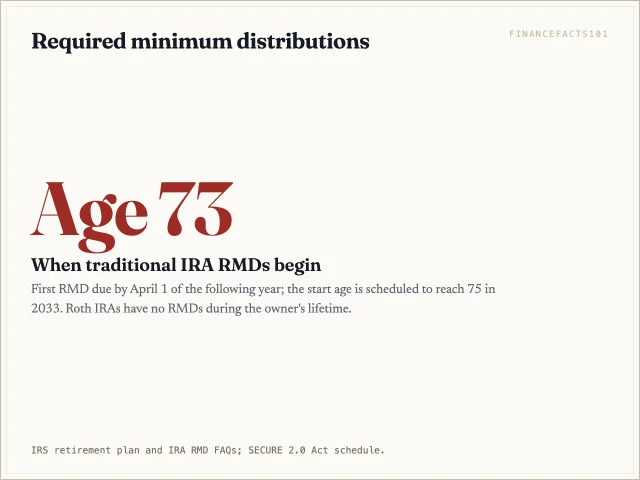
A Roth IRA has no distributions required during the owner's lifetime. That single asymmetry is why retirees with large traditional balances sometimes face RMDs bigger than they want — taxable income that can raise Medicare premiums and push Social Security into taxation — while Roth owners choose their own timing, or never withdraw at all.
The two 5-year rules
The Roth's 0% withdrawal rate has waiting periods, and there are two separate clocks that people constantly conflate.
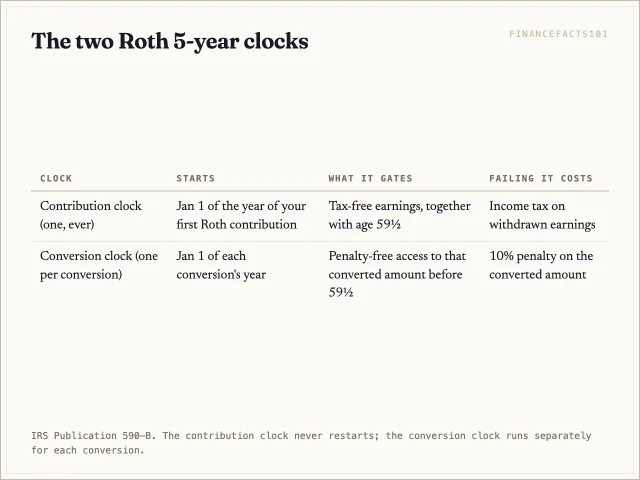
The contribution clock starts January 1 of the year of your first Roth contribution ever, and it gates tax-free earnings: a qualified distribution requires both age 59½ and five years since that first contribution. Open a Roth at 58 and your earnings are not tax-free at 59½ — you wait until 63. The clock does not restart for later contributions or new accounts.
The conversion clock runs separately for each conversion and gates the 10% penalty: converted amounts withdrawn within five years of that conversion, before age 59½, are penalized even though they are not taxed again. The full mechanics, including how the clocks work for inherited Roths, are in the 5-year rule in IRAs: Roth vs inherited and in Publication 590-B.
The backdoor Roth when you earn too much
Above $168,000 single or $252,000 joint, the front door is closed — but the conversion door has no income limit. The backdoor Roth is simply a nondeductible traditional contribution followed by a conversion:
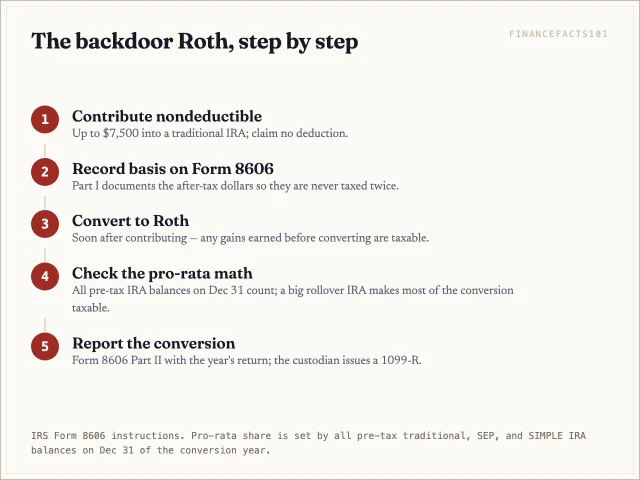
Both legs ride on Form 8606: Part I records the nondeductible basis, Part II reports the conversion. Skip the form and the IRS has no record that tax was already paid — see Form 8606 filing requirements for what goes wrong.
The trap is the pro-rata rule. A conversion cannot cherry-pick after-tax dollars; the IRS treats all your traditional, SEP, and SIMPLE IRA balances as one pot. Say you hold $93,000 of pre-tax IRA money from an old 401(k) rollover and add a $7,500 nondeductible contribution: your basis is $7,500 of a $100,500 pot, so 92.5% of any conversion is taxable — the "backdoor" just triggered roughly $6,940 of income on a $7,500 conversion. The standard fix is rolling the pre-tax balance into a current 401(k) first, leaving only basis behind. The full playbook is in the backdoor Roth IRA strategy for high-income earners.
Early access: reaching the money before 59½
The accounts differ sharply if life intervenes before retirement.
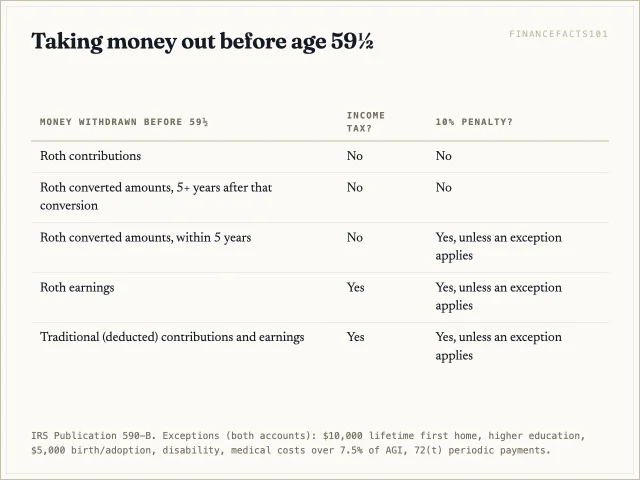
Roth withdrawals follow ordering rules that work in your favor: contributions come out first, and they come out any time, tax-free and penalty-free — you already paid tax on them. Converted amounts come next (penalty-free after each conversion's 5-year clock), and earnings come out last. A traditional IRA has no such layer: every withdrawal of deducted money and earnings is ordinary income plus a 10% additional tax before 59½.
Both accounts share the statutory penalty exceptions: up to $10,000 lifetime for a first home, higher-education costs, up to $5,000 per child for birth or adoption, disability, unreimbursed medical expenses above 7.5% of AGI, health-insurance premiums while unemployed, and substantially equal periodic payments under section 72(t). The tax side of every distribution lands on a 1099-R — how Form 1099-R reports retirement distributions covers the codes. The distribution rules in full are in IRS Publication 590-B.
What your heirs inherit
Since the SECURE Act, most non-spouse beneficiaries must empty an inherited IRA within 10 years. The tax treatment inside that window is where the accounts split. An inherited traditional IRA is a bundle of untaxed income: your heirs pay ordinary income tax on every withdrawal, often during their own peak earning years — a $500,000 traditional IRA landing on a child in the 32% bracket is worth roughly $340,000 after federal tax. An inherited Roth still must be emptied in 10 years, but the withdrawals are tax-free (once the original owner's 5-year contribution clock has run), and the balance compounds untaxed for the full decade.
Add the RMD asymmetry — a Roth owner never has to draw the account down — and the Roth is the stronger account to die with. Surviving spouses have better options on both sides, including treating the account as their own; details are in Publication 590-B.
Common mistakes
- Comparing unequal dollars. $7,000 Roth vs $7,000 traditional ignores the deduction. If you would not invest the tax savings, the traditional side quietly loses its edge — the deduction only helps if it is saved, not spent.
- Contributing to a Roth over the income limit. Excess contributions draw a 6% excise tax for every year they stay in. The fix is a timely withdrawal or recharacterization before the filing deadline.
- Nondeductible contributions with no Form 8606. Without the form, you will pay tax twice on the same dollars, and reconstructing basis years later is painful.
- Converting on top of a big pre-tax IRA. The pro-rata rule turns a "tax-free" backdoor into mostly taxable income, as the $93,000 example above shows.
- Pulling converted money within five years, before 59½. No new tax, but a 10% penalty most people never see coming.
- Married filing separately by default. The $0–$10,000 phase-out ranges make MFS nearly incompatible with both the Roth and the deduction.
- Forgetting the spousal IRA. A non-working spouse can fund a full IRA from the working spouse's compensation on a joint return — a doubled household limit that goes unused.
The decision framework
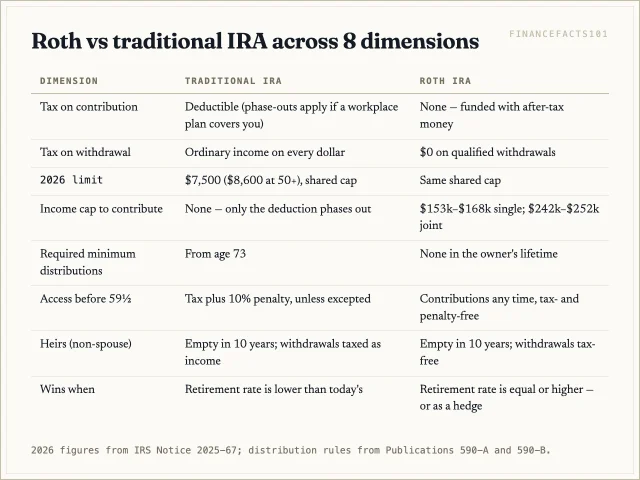
Put the pieces in order:
- Estimate rate-now vs rate-later. Early career, 10–12% bracket, income heading up: Roth, and it is not close — you are buying a 0% retirement rate at a 12% price. Peak earnings at 32–35% with a modest expected retirement income: traditional, because you will likely withdraw at an effective rate far below what you deduct at.
- Check eligibility. Over the Roth phase-out? Backdoor (after clearing pre-tax IRA balances). Covered by a 401(k) and over the deduction phase-out? The traditional deduction is gone, so Roth or backdoor by default.
- Break ties toward Roth. At equal rates the math ties, so the tiebreakers decide: no RMDs, more effective shelter at the cap, penalty-free access to contributions, tax-free inheritance, and insurance against higher future rates.
- Uncertain? Split. Nothing requires one answer. $3,750 into each buys "tax diversification" — a pre-tax pool to fill low brackets in retirement and a Roth pool for everything above them, whatever rates do.
The honest summary: if you can name your bracket today and make a sober guess about retirement, the table above makes the choice for you. If you cannot guess, the Roth is the more forgiving mistake.
FAQ
Can I contribute to both a Roth and a traditional IRA in the same year?
Yes. The $7,500 limit for 2026 ($8,600 at 50+) is a combined cap across all your traditional and Roth IRAs, split however you like — $4,000 in one and $3,500 in the other is fine. Each side still applies its own rules: the Roth portion is subject to the MAGI phase-out, and the traditional portion's deductibility depends on workplace-plan coverage.
Is a Roth conversion the same as a Roth contribution?
No. A contribution is new money, capped at $7,500 and income-limited. A conversion moves existing traditional IRA money to a Roth: no dollar limit, no income limit, but the pre-tax amount converted is taxable income in the conversion year and starts its own 5-year penalty clock. Conversions are how high earners fund Roths and how retirees manage future RMDs.
What happens if my income lands inside a phase-out range?
Your allowed Roth contribution (or traditional deduction) shrinks proportionally through the range. A single filer at $160,500 of MAGI in 2026 — halfway through the $153,000–$168,000 Roth range — can contribute about half the limit. Publication 590-A's worksheets compute the exact figure; anything contributed above it is an excess contribution taxed at 6% per year until removed.
How late can I make a 2026 contribution?
Until the federal filing deadline in mid-April 2027 — and the deadline is not extended by filing an extension. Contributions made January through April can be designated for either the prior or current tax year, so tell your custodian which year you mean.
Sources
- IRS, 401(k) limit increases to $24,500 for 2026, IRA limit increases to $7,500
- IRS, Notice 2025-67: 2026 amounts relating to retirement plans and IRAs
- IRS, Tax inflation adjustments for tax year 2026 (Rev. Proc. 2025-32)
- IRS, Publication 590-A: Contributions to Individual Retirement Arrangements
- IRS, Publication 590-B: Distributions from Individual Retirement Arrangements
- IRS, Retirement plan and IRA required minimum distributions FAQs
- IRS, About Form 8606, Nondeductible IRAs
- IRS, Exceptions to tax on early distributions
 Next entry · No. 5,932How Much It Costs to Refinance a Mortgage
See also
-
 No. 5,987
21 Oct 2026
19 min
Should I Do a Backdoor Roth IRA? How to Avoid the Pro-Rata Tax
Retirement
-
 No. 304
09 Apr 2024
23 min
Maximizing Retirement Savings with a Backdoor Roth IRA: A Strategy for High-Income Earners
Personal Finance
-
 No. 5,989
23 Oct 2026
17 min
Brokerage Account vs Roth IRA: Where Should You Invest?
Investments
-
 No. 5,977
11 Oct 2026
18 min
529 vs Roth IRA for College: Which Should You Use?
Personal Finance
-
 No. 5,969
03 Oct 2026
19 min
Should I Do a Roth Conversion in 2026? How Much to Convert
Retirement
-
 No. 2,534
14 Jan 2025
20 min
Understanding Individual Retirement Accounts (IRAs): A Comprehensive Guide for Professional and Institutional Investors
Investments