Should I Do a Backdoor Roth IRA? How to Avoid the Pro-Rata Tax
Earn over $168,000 single or $252,000 joint in 2026? A backdoor Roth IRA moves $7,500 in tax-free, unless a pre-tax IRA makes 90% of it taxable.
A backdoor Roth IRA is worth doing in 2026 if your modified AGI is above the Roth limits, which per the IRS's November 13, 2025 announcement phase out between $153,000 and $168,000 for single filers and $242,000 and $252,000 for married couples filing jointly. It works cleanly only if you hold no pre-tax money in any traditional, SEP or SIMPLE IRA on December 31 of the year you convert. With a clean slate, a $7,500 nondeductible contribution converted to a Roth costs nothing in tax; with a $67,500 rollover IRA left on the books, 90 percent of the same conversion is taxable under the pro-rata rule, and the usual fix is to roll that pre-tax IRA into a 401(k) before year-end.
The rest of this guide shows the two steps, the Form 8606 lines that prove the tax was already paid, what does and does not count in the December 31 balance, what Congress has said about the step-transaction worry, and a worked example run four ways.
This is general information built on stated assumptions — 2026 IRS limits and brackets, a hypothetical single filer, federal tax only — not personal tax advice. A conversion cannot be undone, so check your own year-end IRA statements before you move money.
Who this is for — and who it is not for
This guide is for a US earner whose income is too high to contribute to a Roth IRA directly, who has taxable compensation at least equal to the contribution, and who either has no pre-tax IRA money or has a workplace plan that will take it. In the phase-out band — $153,000 to $168,000 single, $242,000 to $252,000 joint — you can make a reduced direct contribution and run the remainder through the back door.
It is not for anyone under the phase-out: contribute to the Roth directly and skip the paperwork. It is not the right first move if you have not yet captured your full 401(k) match, which is a better return than any tax wrapper — see the 401(k) employer match guide. If neither you nor your spouse is covered by a workplace plan, a traditional contribution is deductible at any income, so the real question is Roth versus traditional, covered in Roth vs traditional IRA. And if you hold a six-figure pre-tax IRA and no plan will accept it, the back door may cost more than it returns; the section on converting the whole IRA runs those numbers.
The 2026 limits that send you to the back door
The IRS released the 2026 figures in IR-2025-111, with the technical detail in Notice 2025-67. The IRA contribution limit is $7,500, plus a $1,100 catch-up for anyone 50 or older, for $8,600. That limit is shared between traditional and Roth IRAs, and it cannot exceed your taxable compensation for the year.
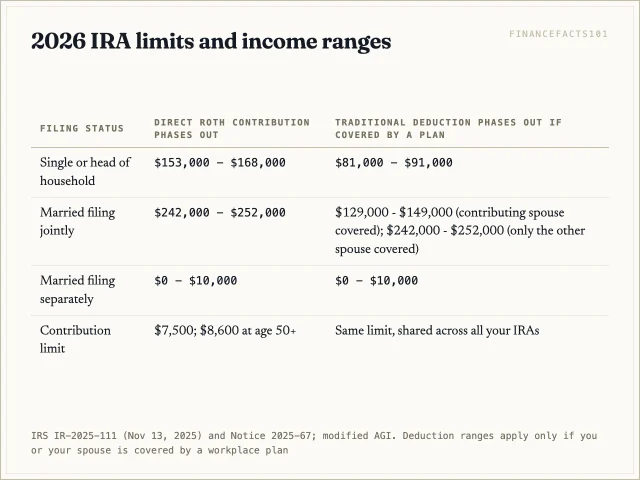
Two separate income tests matter. The Roth test decides whether you can contribute directly. The deduction test decides whether a traditional contribution is deductible. A single filer covered by a 401(k) loses the deduction entirely above $91,000, so anyone above the Roth range who is also covered by a plan is making a nondeductible contribution anyway. The back door turns that otherwise awkward money into Roth money.
Married filing separately is the harsh case: if you lived with your spouse at any time during the year, the Roth phase-out is $0 to $10,000 and, per IR-2025-111, is "not subject to an annual cost-of-living adjustment"; IRS Publication 590-A sets out the lived-with-your-spouse rule.
How a backdoor Roth IRA works: two steps and one form
There is no special account called a backdoor Roth. It is two ordinary transactions. The route opened in 2010, when, as the IRS put it in Fact Sheet 2011-01, "income limits no longer apply to rollovers or conversions to Roth IRAs".
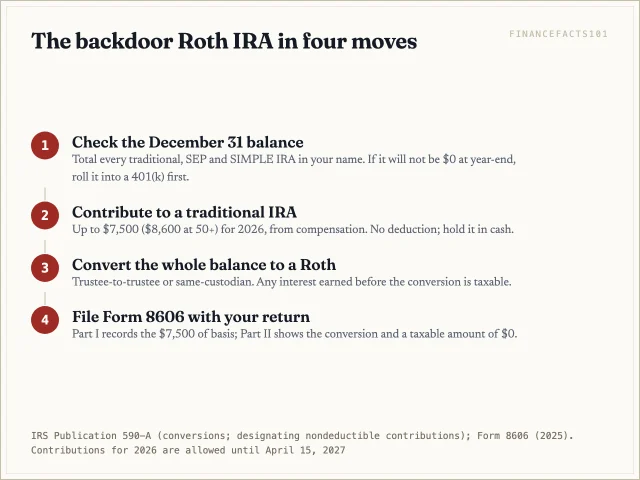
Step one: a nondeductible traditional IRA contribution. Anyone with compensation can contribute to a traditional IRA, at any age, and there is no income limit on the contribution itself — only on the deduction. If you are not covered by a workplace plan and the contribution would be deductible, Publication 590-A says that "when you file, you can even designate otherwise deductible contributions as nondeductible contributions."
Step two: a conversion. You move the balance from the traditional IRA to a Roth IRA, by trustee-to-trustee transfer or same-custodian redesignation. Publication 590-A says you include in income whatever you "would have had to include in income" had you simply withdrawn it. For after-tax dollars, that is nothing.
Two details keep the second step clean. Hold the contribution in cash until it converts: any interest or gain between deposit and conversion is pre-tax money and is taxed on the way in. And convert the whole traditional balance, so nothing is left behind to earn more taxable growth.
Form 8606: the paperwork that keeps the tax at zero
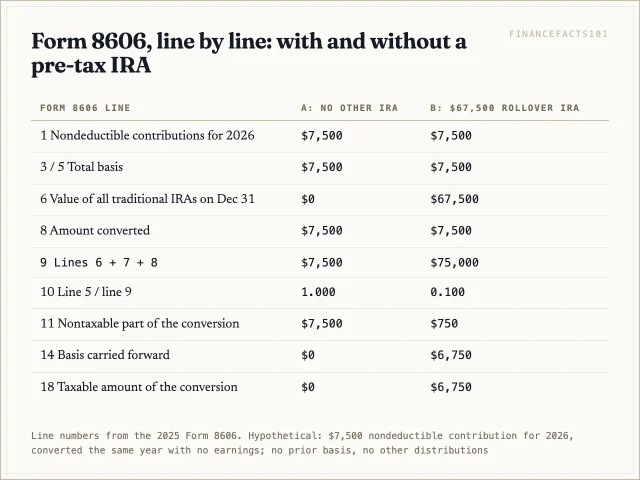
Form 8606 is where the IRS learns that your contribution was already taxed. Part I records the nondeductible contribution and works out how much of any conversion is a return of that basis. Part II reports the conversion and its taxable amount, which flows to line 4b of Form 1040.
Skip the form and the conversion looks fully taxable, because the custodian's 1099-R does not know your basis. The Form 8606 instructions add a $50 penalty for failing to file when you made a nondeductible contribution and $100 for overstating one, each unless you show reasonable cause. Keep every Form 8606 you file: the basis on line 14 carries forward until it is used. Older filing problems are covered in Form 8606 filing requirements.
A note on dates: the form and instructions quoted here are the 2025 editions, the latest the IRS has published as of October 2026, so the line numbers in this guide follow the 2025 form. Check them against the 2026 form when it comes out.
The pro-rata rule: why one old IRA spoils the backdoor
You cannot pick which dollars you convert. 26 U.S.C. 408(d)(2) says "all individual retirement plans shall be treated as 1 contract," with values "computed as of the close of the calendar year." Roth IRAs are kept in a separate pot of their own, and Form 8606 line 6 asks only for traditional IRAs. The 2017 conference report states the rule for this case plainly: "All traditional IRAs of an individual are treated as a single contract for purposes of recovering basis in the IRAs."
Form 8606 turns that into arithmetic. Line 10 divides your basis by the sum of three numbers: the December 31 value of all your traditional IRAs, plus any other distributions that year, plus the amount you converted. That fraction of the conversion is tax-free and the rest is taxable.
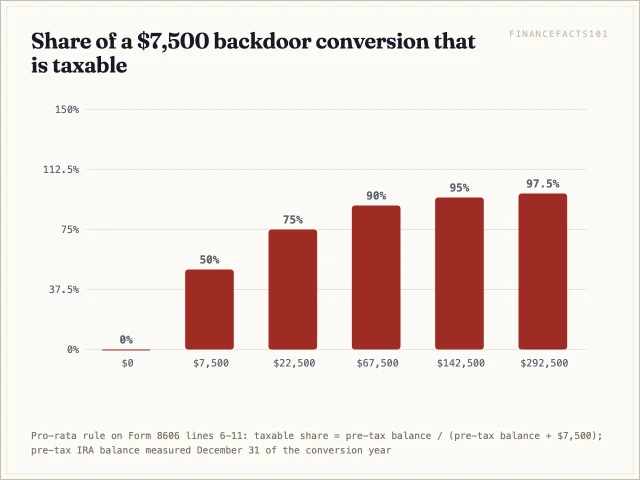
The curve is steep. A pre-tax balance equal to the contribution makes half the conversion taxable; a $67,500 balance makes 90 percent taxable; at $292,500 almost all of it is. The tax is not lost money: the basis you did not use stays on Form 8606 and comes out tax-free later. But the clean, untaxed Roth contribution you were after is gone, and a growing basis has to be tracked for decades.
What counts in the December 31 balance
The test date is December 31 of the year you convert, not the conversion date. A rollover from an old 401(k) into an IRA in November can therefore make a February conversion taxable after the fact.
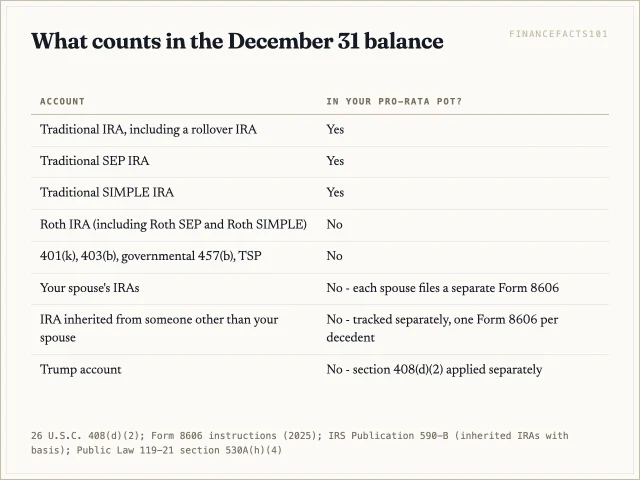
The Form 8606 instructions spell out that "traditional IRA" includes traditional SEP IRAs and traditional SIMPLE IRAs, so a self-employed person's SEP is in the pot. Roth IRAs are not, and neither is money inside a 401(k), 403(b) or 457(b). An IRA you inherited from someone other than your spouse stays separate: Publication 590-B says you cannot combine its basis with your own, and the instructions require a separate Form 8606 for each decedent's IRA. Each spouse is tested alone, on a separate Form 8606, so your spouse's rollover IRA does not touch your ratio.
The 2025 tax law added one more exclusion. Public Law 119-21, which created Trump accounts for children, says section 408(d)(2) "shall be applied separately with respect to Trump Accounts and other individual retirement plans."
Worked example: Jordan's backdoor with and without a rollover IRA
Jordan Hale is 41, single, with 2026 AGI of $195,000. That is above the $168,000 Roth ceiling, and Jordan is covered by a 401(k) at work, so the traditional contribution is nondeductible. After the $16,100 standard deduction from Rev. Proc. 2025-32, taxable income is $178,900. That is inside the 24 percent bracket, which runs to $201,775 for a single filer in 2026, leaving $22,875 of room.
In February 2026 Jordan contributes $7,500 to a traditional IRA, holds it in cash, and converts all $7,500 a week later. Nothing is earned in between. The only thing that changes across four versions of the year is what else sits in Jordan's traditional IRAs on December 31, 2026.
A — no other IRA. Form 8606 line 6 is $0, line 9 is $7,500, the ratio is 1.000 and the whole $7,500 is basis. Taxable amount: $0.
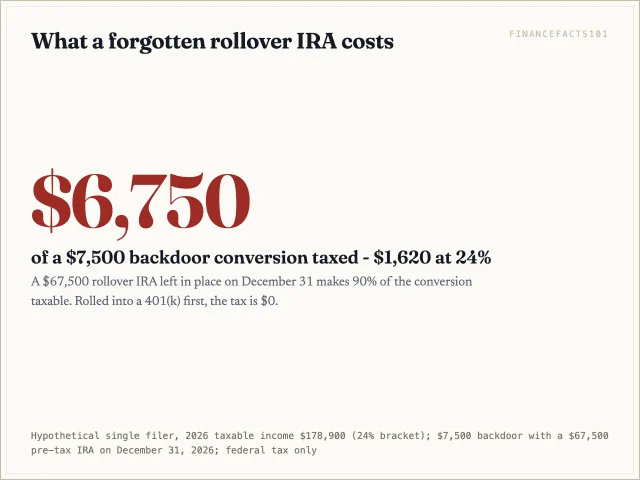
B — a $67,500 rollover IRA from a former employer, left alone. Line 6 is $67,500 and line 9 is $75,000, so the ratio is 0.100. Only $750 of the conversion is tax-free. The other $6,750 is taxable at 24 percent, adding $1,620 of federal tax, and $6,750 of basis stays behind in the rollover IRA.
C — the same $67,500 rolled into Jordan's 401(k) in November. On December 31 the traditional IRA total is $0 again, so the result matches A: $0 of tax.
D — the rollover IRA converted as well. Converting all $75,000 empties the IRA. The ratio is still 0.100, but now it applies to $75,000: $7,500 is tax-free and $67,500 is taxable. That pushes taxable income to $246,400, through the top of the 24 percent bracket and $44,625 into 32 percent. The extra tax is $19,770, an average of 29.3 percent.
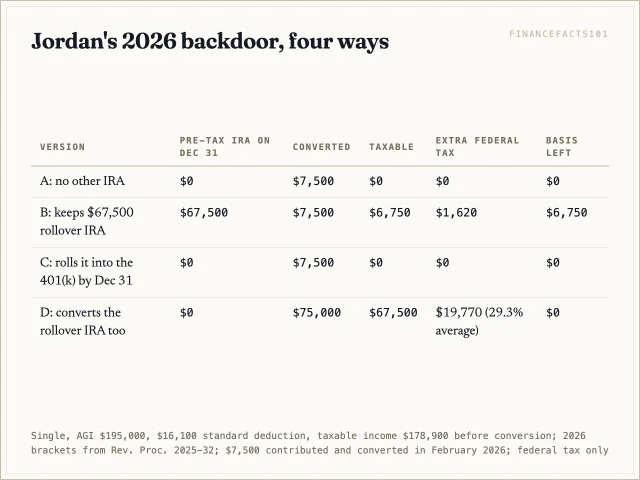
The ranking is clear. C costs nothing and keeps the full backdoor every year from now on. B costs $1,620 this year and every later year it is repeated, with a basis that keeps growing. D is a large, mostly voluntary conversion of pre-tax money — a decision in its own right, tested two sections down.
Clearing the balance: roll pre-tax IRA money into a 401(k)
The standard cure is to move pre-tax IRA money into an employer plan, where it no longer counts. Publication 590-A says the part of a traditional IRA distribution "that you can roll over is the part that would otherwise be taxable," and that qualified plans "may, but aren't required to, accept such rollovers." So the first call is to your plan administrator: does the 401(k) accept roll-ins from IRAs?
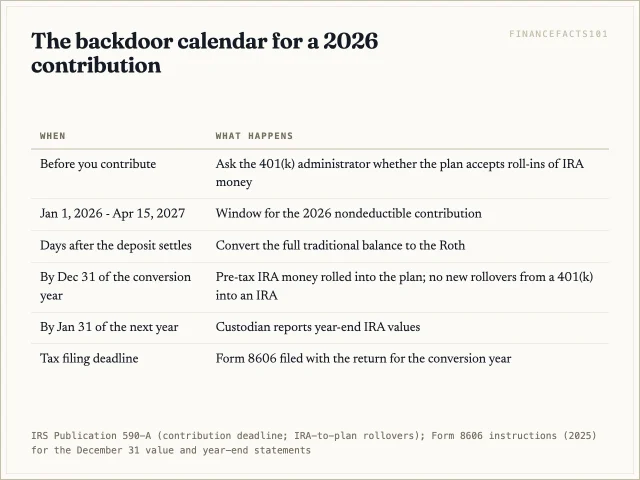
The rule also lets you leave your basis behind. Publication 590-A describes a special rule that treats a rollover into an employer plan as consisting only of pre-tax money, as long as what you leave in your IRAs is at least equal to your basis. If Jordan rolls the $67,500 out before converting, the $7,500 of after-tax money stays put, ready to convert tax-free.
Three cautions. Ask for a direct trustee-to-trustee transfer, so the money never passes through your hands and no 60-day deadline applies. A traditional SIMPLE IRA can be rolled into a 401(k) only after your first two years of participation, per the Form 8606 instructions. And a 401(k) has its own investment menu and fees, so compare them before you move a large balance. A self-employed person with a SEP can open a solo 401(k) that accepts roll-ins and move the SEP there, then make future employer contributions to the 401(k) instead of the SEP.
When the 401(k) won't take it: convert the pre-tax IRA instead?
If no plan will accept the rollover, the remaining options are B (accept the pro-rata tax each year), D (convert the whole IRA), or skip the backdoor. D is an ordinary Roth conversion question, so the Roth conversion calculator can test it. Enter $67,500, Jordan's 29.3 percent average rate on the slice, 24 years to age 65, a 7 percent return and tax paid from outside funds.
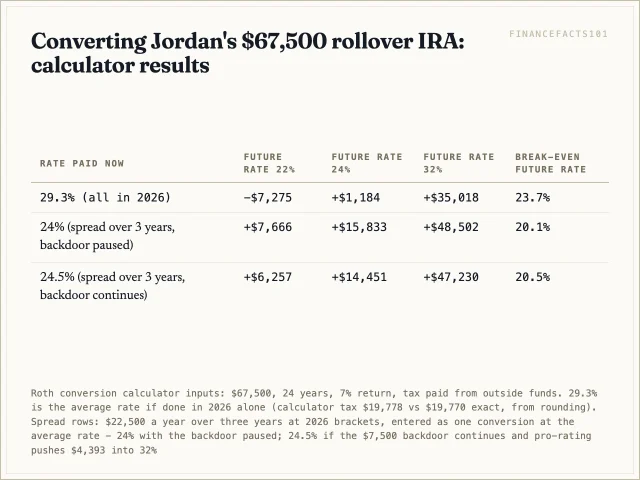
Done in one year, converting the rollover IRA breaks even at a 23.7 percent future rate. It loses $7,275 if Jordan retires into the 22 percent bracket and wins $35,018 at 32 percent. Spread over three years at $22,500 a year with the backdoor paused, every slice stays in the 24 percent bracket, the break-even drops to roughly 20.1 percent and it wins even at 22. Keep the $7,500 backdoor running in those years and the pro-rata rule changes the slices: $27,000 is taxable in year one, $4,125 past the $22,875 of 24 percent room, then $23,143 and $17,357. The total is still $67,500, but the tax is $16,551, an average of 24.5 percent, and the break-even is about 20.5 percent. Both spread runs are approximations, because the calculator treats the whole $67,500 as converted today; brackets are held at 2026 levels and growth is ignored. Once every pre-tax dollar has been converted, every basis dollar has been recovered too; the ratio only decides when.
The broader trade-offs of converting pre-tax money — bracket filling, Medicare surcharges, the low-income years before RMDs — are in the Roth conversion guide.
Is the step-transaction doctrine a risk?
The step-transaction doctrine is a court-made rule under which a series of planned steps can be taxed as the single transaction they add up to. The worry is that a nondeductible contribution followed at once by a conversion is "really" a direct Roth contribution by someone over the income limit. That would be an excess contribution, which Publication 590-A taxes at 6 percent for each year it stays in the account.
What Congress has said is narrow but on point. In the joint explanatory statement for the 2017 tax law (H. Rept. 115-466, dated December 15, 2017, footnotes 268 and 269), the conferees, describing present law, wrote: "Although an individual with AGI exceeding certain limits is not permitted to make a contribution directly to a Roth IRA, the individual can make a contribution to a traditional IRA and convert the traditional IRA to a Roth IRA."
That is legislative history. It describes the law as the conferees understood it; it is not a statute, a regulation or an IRS ruling, and it does not bind the IRS or a court. We found no IRS regulation, ruling or notice that addresses the two-step sequence by name, either to approve it or to challenge it. Congress has also considered closing the route: the version of H.R. 5376 that passed the House on November 19, 2021 would have barred conversions from any IRA holding after-tax money, starting in 2022. That provision was not enacted: H.R. 5376 became the Inflation Reduction Act of 2022, Public Law 117-169, without it.
The practical reading: no rule requires a waiting period between the steps, and the main risk is getting the pro-rata math wrong, not the sequence. Some people still let a few days pass, which costs nothing if the money sits in cash.
The 5-year rules that do and do not apply
Roth IRAs have two separate five-year clocks, and the backdoor only touches one of them in the normal case.
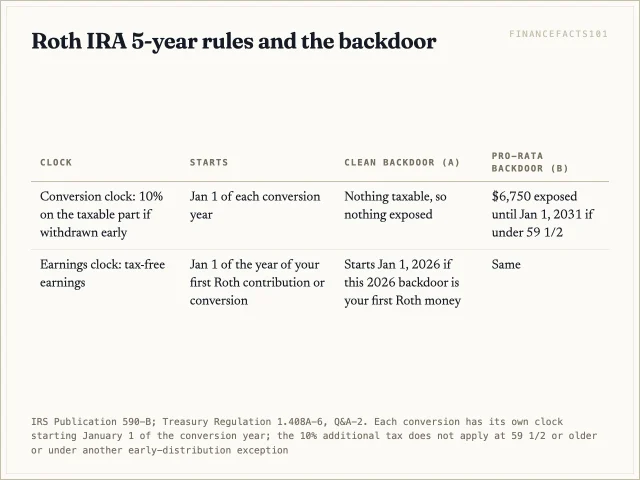
The conversion clock is a penalty rule, not an income tax. Publication 590-B says that if you take money out within five years of a conversion, starting January 1 of the conversion year, you "must generally pay the 10% additional tax on any amount attributable to the part of the amount converted ... that you had to include in income." A clean backdoor includes nothing in income, so there is nothing to recapture. Jordan's version B is different: the $6,750 taxable part of the 2026 conversion stays exposed until January 1, 2031, if Jordan is under 59½.
The other clock governs earnings. Under Treasury Regulation 1.408A-6, Q&A-2, the five-year period for qualified distributions begins on January 1 of the first year you made a regular Roth contribution or, if earlier, your first conversion. A first backdoor in 2026 starts that clock for all your Roth IRAs. The full mechanics are in the 5-year rule in IRAs.
The mega backdoor Roth, in brief
The mega backdoor works inside a 401(k) rather than an IRA. Some plans accept after-tax employee contributions on top of regular deferrals, up to the overall cap on additions to your account. Notice 2025-67 sets that cap at $72,000 for 2026.
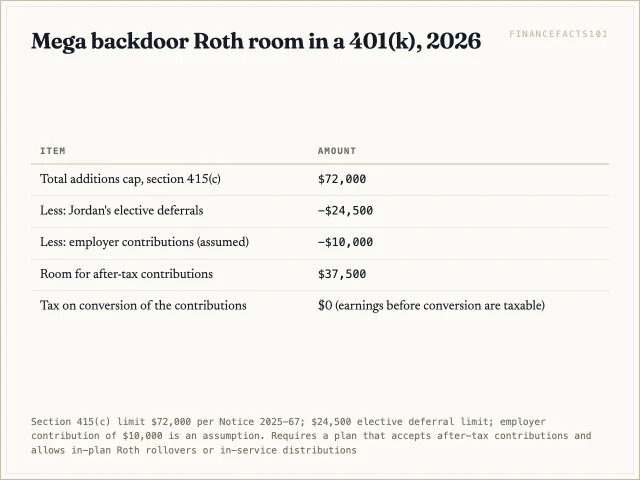
If Jordan defers the $24,500 maximum and the employer adds $10,000, there is $37,500 of room for after-tax money. That money then needs a route to Roth status. One route is an in-plan Roth rollover, which Notice 2013-74 covers. The other is an in-service distribution to a Roth IRA, where Notice 2014-54 lets after-tax amounts go to a Roth IRA and the pre-tax earnings to a traditional IRA. The IRS's page on rollovers of after-tax contributions adds that you cannot pull only the after-tax money from an account and leave the rest. Any partial distribution must carry a share of the pre-tax amounts.
All of this depends on your plan document. Many plans offer neither after-tax contributions nor in-service conversions, and earnings before conversion are taxable. The IRA aggregation rule does not reach money inside a 401(k), which has its own allocation rules described above, so the IRA backdoor and the mega backdoor can run side by side.
Is the backdoor worth the trouble?
For a high earner with a clean slate, yes, but the edge builds slowly. Compare $7,500 a year in a Roth with the same money in a taxable index fund. Assume a 7 percent return, 1.5 points of it qualified dividends taxed at 15 percent each year, and the fund sold after 24 years with gains also taxed at 15 percent. Rev. Proc. 2025-32 applies that 15 percent rate to single filers with taxable income between $49,450 and $545,500.
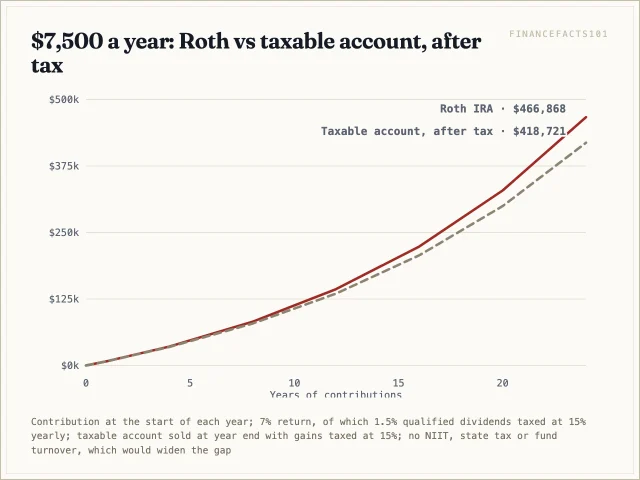
After 24 years Jordan has put in $180,000. The Roth is worth $466,868, and the taxable account $418,721 after tax, a gap of $48,147, or 10.3 percent. The assumptions favour the taxable side: they leave out the 3.8 percent net investment income tax above $200,000 of single MAGI, state tax and fund turnover. The Roth also has no required distributions in the owner's lifetime, which the taxable account matches but a traditional IRA does not.
The cost of the back door is an hour a year and one form. If the pro-rata rule applies and cannot be cleared, the arithmetic changes: each year you are converting mostly pre-tax money at your top rate, which is a conversion decision, not a free Roth contribution.
The decision, step by step
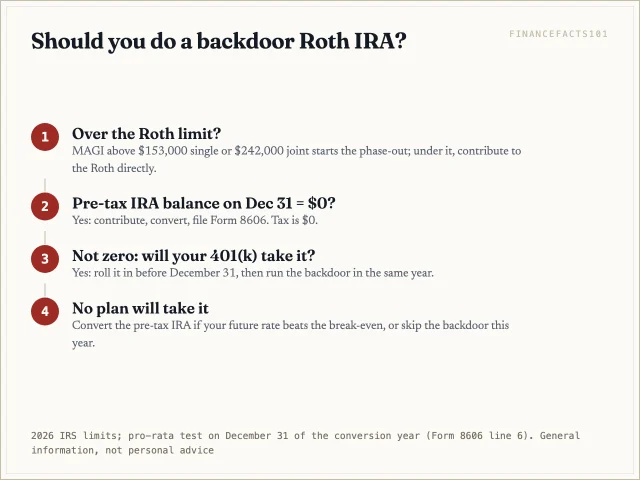
Start with the December 31 test. List every traditional, SEP and SIMPLE IRA in your name and its expected year-end value. If the total is zero, contribute, convert the full balance once the deposit settles, and file Form 8606 with your return. If it is not zero, call your 401(k) administrator before you contribute. If the plan takes roll-ins, move the pre-tax money first and run the backdoor in the same calendar year. If it does not, decide whether converting the pre-tax IRA is worth it at your rates, and run the backdoor only once that IRA is empty.
FAQ
Can I do a backdoor Roth IRA if I have a SEP IRA?
Yes, but the SEP counts in the December 31 balance, because the Form 8606 instructions define "traditional IRA" to include traditional SEP IRAs. With $67,500 in a SEP, 90 percent of a $7,500 backdoor conversion would be taxable. The usual fix for a self-employed person is a solo 401(k) that accepts roll-ins: move the SEP into it by direct transfer before December 31 and make future employer contributions to the 401(k).
Do I have to wait between the contribution and the conversion?
No rule sets a waiting period. The 2017 conference report language describes the two-step route as allowed under present law, and we found no IRS guidance requiring a gap. What matters is that the deposit has settled and that you convert the whole balance, including any interest earned, which is taxable.
What if I make my 2026 contribution in early 2027?
You can contribute for 2026 until April 15, 2027. If you convert in 2027, the conversion is a 2027 event: it goes on your 2027 Form 8606, and the pro-rata test uses your December 31, 2027 balance. The contribution itself is still reported for 2026, on line 1 of the 2026 form, which carries it forward as basis.
Does my spouse's IRA affect my pro-rata calculation?
No. The test covers IRAs in your own name. Each spouse files a separate Form 8606, so one spouse's rollover IRA does not make the other's conversion taxable, even on a joint return. Each spouse needs their own compensation-backed contribution, and a joint return can use the working spouse's pay for a non-working spouse's IRA.
What happens if I forgot to file Form 8606 for an old nondeductible contribution?
You can file it late for that year. The Form 8606 instructions set a $50 penalty for not filing, unless you can show reasonable cause. Without the form, your basis is undocumented, and a later conversion or withdrawal would be treated as fully taxable — paying tax twice on the same dollars.
Sources
- IRS, IR-2025-111: 401(k) limit increases to $24,500 for 2026, IRA limit increases to $7,500 — 2026 IRA limit, catch-up, Roth and deduction phase-out ranges
- IRS, Notice 2025-67 — 2026 retirement plan limits, including the $72,000 section 415(c) limit
- IRS, Rev. Proc. 2025-32 — 2026 single brackets, $16,100 standard deduction, 15% capital gains range
- IRS, Fact Sheet 2011-01, 2010 changes offer expanded tax benefits — income limits no longer apply to Roth conversions
- IRS, Publication 590-A — contributions, designating nondeductible contributions, conversions, rollovers from an IRA to an employer plan, 6% excess-contribution tax
- IRS, Publication 590-B — 5-year rule on conversions, inherited IRAs with basis
- IRS, Form 8606 (2025) and Instructions for Form 8606 — line-by-line pro-rata calculation, December 31 value, penalties
- US Code, 26 U.S.C. 408 — section 408(d)(2), all IRAs treated as one contract at year-end values
- Congress, H. Rept. 115-466, Tax Cuts and Jobs Act conference report — footnotes 268 and 269 on contributing to a traditional IRA and converting
- Congress, H.R. 5376 as passed by the House (117th Congress) — section 138311, the proposed limit on converting after-tax amounts
- Congress, Public Law 119-21 — section 530A(h)(4), Trump accounts aggregated separately
- Treasury, 26 CFR 1.408A-6 — when the 5-year period for qualified Roth distributions begins
- IRS, Notice 2013-74 — in-plan Roth rollovers
- IRS, Notice 2014-54 and Rollovers of after-tax contributions in retirement plans — splitting after-tax and pre-tax amounts in a plan distribution
- IRS, Questions and answers on the net investment income tax — $200,000 single threshold
 Next entry · No. 5,988Credit Union vs Bank: Which Is Better for You?
See also
-
 No. 5,969
03 Oct 2026
19 min
Should I Do a Roth Conversion in 2026? How Much to Convert
Retirement
-
 No. 5,931
03 Sep 2026
14 min
Roth vs Traditional IRA: Which Saves You More Tax
Taxation
-
 No. 5,982
16 Oct 2026
16 min
HSA vs 401(k): Where Should Your Next Dollar Go?
Retirement
-
 No. 5,979
13 Oct 2026
17 min
Roth 401(k) vs Traditional 401(k): Which Should You Choose?
Retirement
-
 No. 304
09 Apr 2024
23 min
Maximizing Retirement Savings with a Backdoor Roth IRA: A Strategy for High-Income Earners
Personal Finance
-
 No. 5,984
18 Oct 2026
17 min
Are Annuities Worth It? What They Pay, What They Cost
Retirement