Credit Union vs Bank: Which Is Better for You?
Credit unions averaged 5.44% on 60-month car loans vs 7.41% at banks (NCUA, Dec 2025), $1,659 less on $30,000. Where banks still win, and why.
For borrowing, a credit union is usually the better choice: in the NCUA's latest credit union vs bank rate comparison, taken on December 26, 2025, the average 60-month new-car loan cost 5.44% at credit unions and 7.41% at banks, a gap that saves about $1,659 of interest on a $30,000 loan. For saving, the answer splits: credit unions paid more on certificates (2.95% against 2.29% on a one-year $10,000 term), but banks paid more on plain savings (0.32% against 0.19%), and both are insured to the same $250,000.
So the honest answer to "credit union or bank?" depends on three things: whether you can join a credit union at all, whether you are about to borrow, and how much you rely on branches and apps when you travel. This guide prices each one, runs a worked example of a $30,000 car loan and a $10,000 savings balance at average rates, and ends with a decision table. Scope honesty first: this is general information built on stated assumptions and published averages, not personal advice, and the rate you are offered depends on your credit and the institution.
Credit Union vs Bank: The Short Answer
The NCUA publishes a quarterly table, drawn from S&P Global Market Intelligence data, of national average rates on 23 loan and deposit products at banks and credit unions. Its 2025 Q4 edition is the latest the agency has posted as of early October 2026; NCUA has not posted any 2026 edition. On that table, credit unions were cheaper on every one of the 13 loan products, by 0.24 points on a 30-year mortgage up to 2.69 points on a classic credit card. They paid more on every certificate term and on money market accounts. Banks paid more on regular savings and on interest checking.
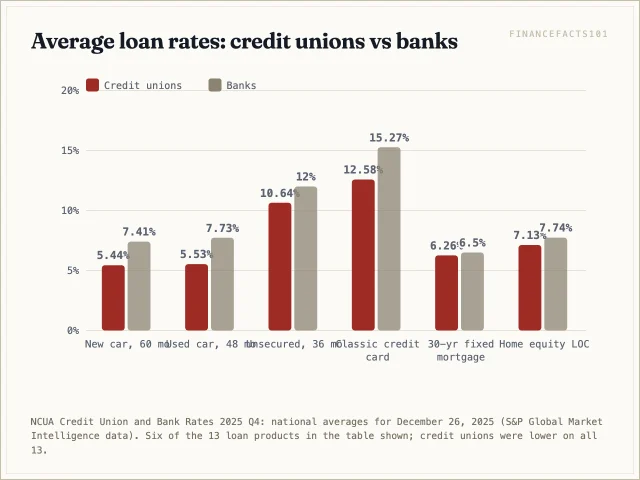
That pattern, cheaper loans with mixed deposit rates, is the core of the decision. The reader who gains most is someone about to finance a car or carrying a card balance; the reader who gains least only needs checking and savings, where the averages slightly favor banks and the differences are a few dollars a year.
Who This Is For — and Who It Isn't
This guide is for a US consumer choosing where to keep checking and savings, or choosing a lender for a car loan, personal loan or credit card. It assumes balances under $250,000 at any one institution and ordinary credit, and it compares national averages, which is where a first decision should start.
It is not a ranking of individual credit unions or banks, and it is not for business banking, where product menus differ. It does not cover where to find the very highest savings rates; top online banks and credit unions both pay far above either average, and that comparison lives in the guide to high-yield savings vs CDs. If your credit is damaged, the averages here understate what you will be quoted at either kind of lender.
Who Owns It: Members vs Shareholders
A bank is a company owned by shareholders, who expect a return on their capital. A credit union is a cooperative owned by its depositors, called members. NCUA's consumer site describes credit unions as not-for-profit institutions run by member-elected volunteer boards that return earnings to members as lower fees, higher savings rates and lower loan rates. That is the agency's description of the model, not a promise about any single credit union.
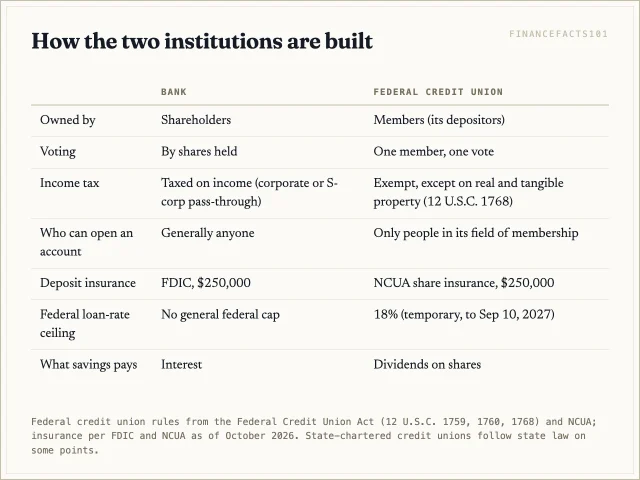
Two legal details make the difference concrete for federal credit unions. Control is one member, one vote: under the Federal Credit Union Act, "Irrespective of the number of shares held, no member shall have more than one vote." And federal credit unions are exempt from federal, state and local taxation, apart from tax on their real estate and tangible property. A bank is taxed on its income, at the corporate level or, for the many small banks organized as S corporations, through its shareholders, and it must earn a return on equity, which helps explain why the pricing gap exists and why it has persisted.
The vocabulary differs too: savings is a "share" account, interest is a "dividend," and a CD is a "share certificate." Functionally they are the same products.
Field of Membership: Can You Join?
A bank will open an account for almost anyone. A credit union can only serve people inside its "field of membership." Federal credit unions hold one of three charter types: single common bond (one employer or association), multiple common bond (several groups), or community (a defined local area or rural district). In practice, the NCUA lists the routes as your employer, a family member who belongs, where you live, work, worship or attend school, or membership in a group such as a school, labor union or homeowners' association.
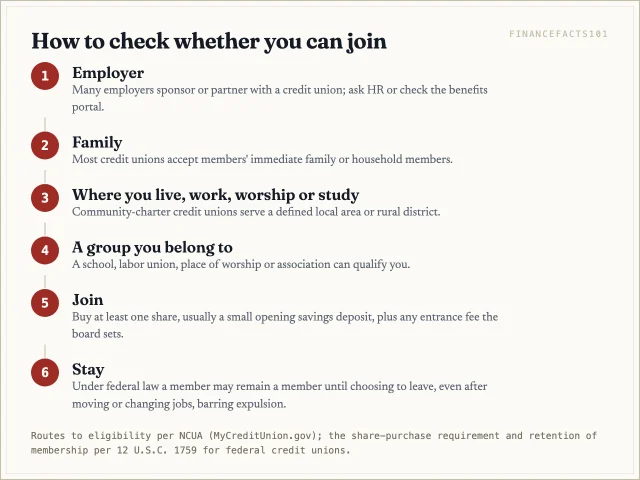
Joining has a small mechanical cost. The membership statute requires each member to subscribe to at least one share and pay the initial installment, plus an entrance fee if the board sets one; in practice this is usually a small opening deposit in a savings account that you keep. The same statute adds a useful protection: once you become a member you may remain one until you choose to leave, except in the narrow cases where the act allows expulsion. Change jobs or move away and, under the federal statute, you can usually keep the account.
Eligibility can still be the deciding fact. As one example, Navy Federal Credit Union, a large military-affiliated credit union, lists active-duty service members, veterans, Department of Defense civilians and their immediate families. If nothing in your work, family, address or affiliations qualifies you for a credit union you want, the comparison ends here.
Insurance: NCUA and FDIC Both Stop at $250,000
On safety there is no difference worth choosing on. The FDIC insures deposits at banks to $250,000 per depositor, per FDIC-insured bank, for each account ownership category. The NCUA's National Credit Union Share Insurance Fund covers individual accounts at a federally insured credit union up to $250,000, a member's interest in all joint accounts combined up to $250,000, and IRAs separately up to $250,000. Both funds are backed by the full faith and credit of the United States.
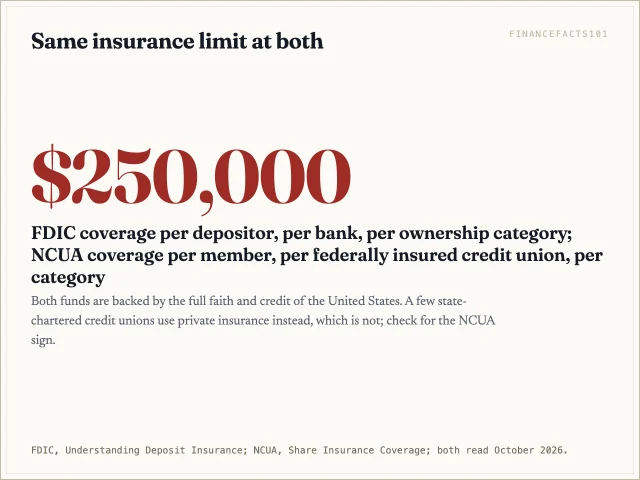
The FDIC says "no depositor has lost a penny of FDIC-insured funds" since 1933; the NCUA says "No one has lost a single penny of insured deposits at a federally insured credit union."
One exception to check: the NCUA notes that several state-chartered credit unions are insured by private insurers, and that coverage is not backed by the full faith and credit of the United States. Look for the official NCUA sign, or search the credit union in NCUA's locator. The ownership-category rules for getting past $250,000 are covered in the deposit accounts guide and the site's entry on the NCUA.
Loan Rates: Where Credit Unions Win Clearly
The loan gap in December 2025 was wide. Credit unions averaged 5.44% on 60-month new-car loans against 7.41% at banks, 5.53% against 7.73% on 48-month used-car loans, 10.64% against 12.00% on 36-month unsecured loans, and 12.58% against 15.27% on classic credit cards. Mortgages were closer: 6.26% against 6.50% on a 30-year fixed.
The gap is not fixed. Across the 16 quarters from March 2022 to December 2025, the 60-month new-car gap ran from 0.51 points (December 2023) to 1.97 points (December 2025) and averaged about 1.3 points.
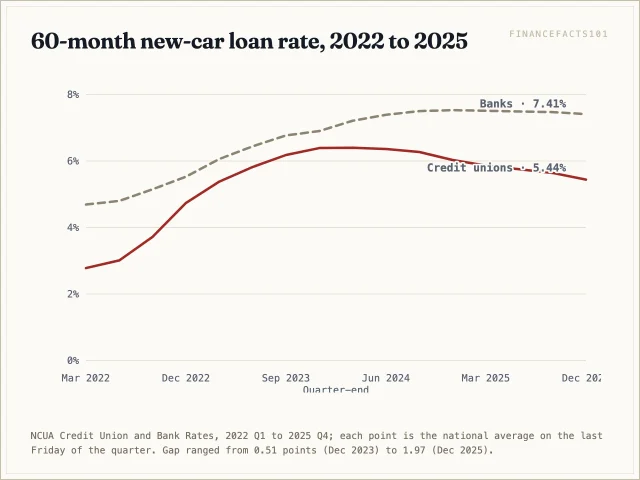
The line shows why. Credit union car-loan rates rose quickly in 2022 and 2023 as the Fed hiked, narrowing the gap, then fell from 6.40% in March 2024 to 5.44% by December 2025 while bank rates barely moved. The Fed's own consumer credit release gives a newer read on the bank side: commercial banks' average 60-month new-car rate was 7.14% in the May 2026 survey, published September 8, 2026. Both readings predate the FOMC's September 16, 2026 move, when it raised the federal funds target range to 3-3/4 to 4 percent, so treat these averages as a baseline and get current quotes.
Deposit Rates: Certificates Yes, Basic Savings No
On the deposit side the picture is mixed, and it has been mixed for years. In December 2025 credit unions paid 2.95% on a one-year $10,000 certificate against 2.29% at banks, 2.83% against 2.11% at five years, and 0.74% against 0.52% on a $2,500 money market account. Banks paid 0.32% on regular savings against 0.19% at credit unions, and 0.20% on interest checking against 0.15%.
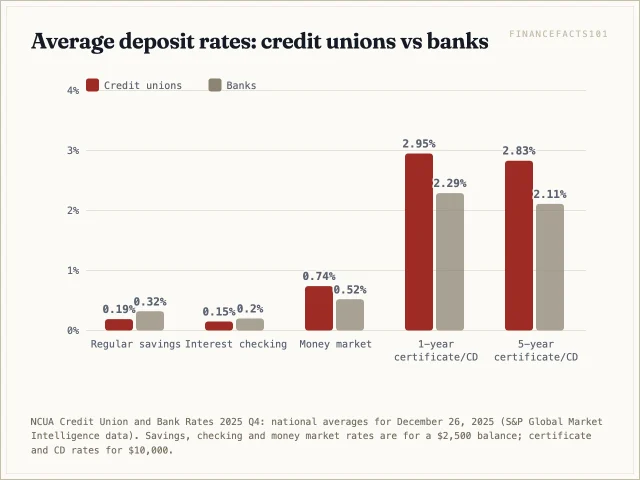
The savings result is not a one-quarter fluke. In every quarterly table from June 2022 through December 2025, banks' average regular savings rate was above credit unions'. NCUA's own consumer page says that credit unions, "On average," offer higher savings rates; on its certificate and money market data that is true, and on its passbook-savings data it is not.
One caution about averages. The FDIC's "national rate" for savings, 0.37% as of September 21, 2026, blends banks and credit unions, and the top online accounts tracked in the site's savings guides pay roughly ten times that. For a saver, the account and institution you pick move the yield far more than the charter does.
The 18% Ceiling on Federal Credit Union Loans
Federal credit unions face a legal price cap that banks do not. Under the loan interest rate rule, federal credit unions may not lend at more than 15% a year "inclusive of all finance charges," unless the NCUA Board sets a higher temporary maximum for up to 18 months. The Board has kept that temporary maximum at 18%, and in an extension announced on February 6, 2026, following what NCUA's letter to credit unions calls a December Board action, it extended the 18% ceiling to September 10, 2027.
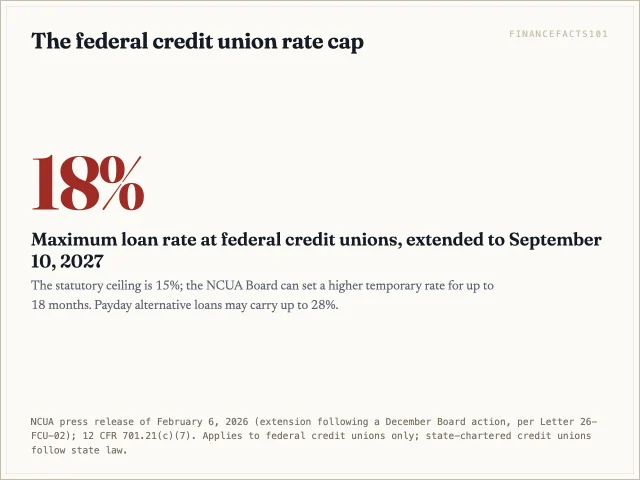
The exceptions matter. The cap applies to federal credit unions only; state-chartered credit unions follow their state's law. And federal credit unions may charge up to 28% on payday alternative loans, which the rule limits to $200 to $1,000 over one to six months (PAL I) or up to $2,000 over one to twelve months (PAL II), each with an application fee of no more than $20.
For comparison, the Fed's G.19 release of September 8, 2026 put commercial banks' average rate on credit card accounts assessed interest at 22.15% for the second quarter of 2026, a level a federal credit union card cannot reach. The same rule gives federal credit union borrowers one more right: you may repay a loan early, in whole or in part, "without penalty."
Worked Example: A $30,000 Car Loan and $10,000 in Savings
Name the assumptions. You finance $30,000 for a new car over 60 months, and you keep $10,000 in savings for a year. Every rate is a national average from the NCUA's December 26, 2025 table, all from the same day: 5.44% at a credit union and 7.41% at a bank on the loan; for the savings, the averages for regular savings, money market and a one-year certificate. Payments use the standard amortization formula, the same one in the site's auto loan calculator.
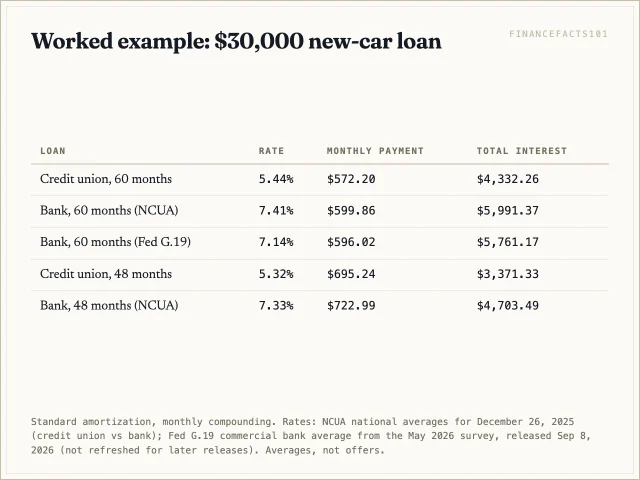
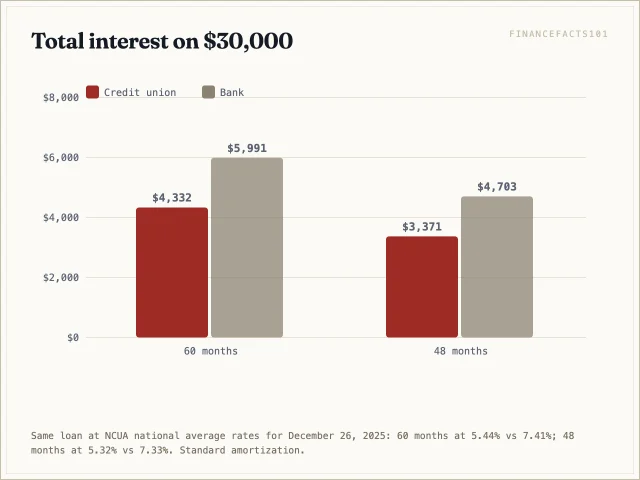
At 5.44%, the payment is $572.20 and total interest over five years is $4,332.26. At 7.41%, the payment is $599.86 and total interest is $5,991.37. The credit union saves $27.66 a month and $1,659.11 over the loan, $551.00 of it in the first year alone ($1,499.50 of interest against $2,050.50). At 48 months the rates are 5.32% and 7.33%, and the gap is $1,332.16. Against the Fed's newer 7.14% bank average, the 60-month saving shrinks to $1,428.91, still well over a thousand dollars.
Now the $10,000. Treating each average as a one-year yield, regular savings earns $19 at a credit union and $32 at a bank. A money market account earns $74 against $52. A one-year certificate earns $295 against $229.
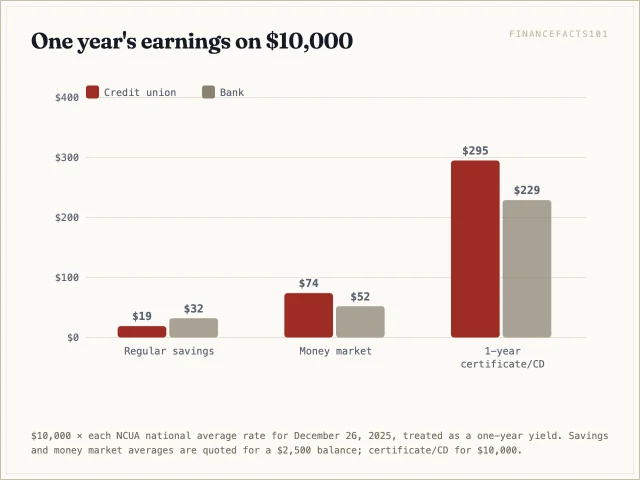
Put together for year one, a member who borrows and buys a certificate at the credit union comes out $617 ahead ($551 + $66). One who borrows there but leaves the savings in a regular account comes out $538 ahead ($551 − $13). Either way, the loan supplies $551 of the advantage, and the savings choice moves the total by tens of dollars.
Two cautions. Averages are not offers, and the cheapest auto loans at any institution go to the best credit. And if the car qualifies for the 2025–2028 federal deduction for car loan interest, the deduction trims both loans' net cost; the lower-rate loan still costs less, because a lower rate means less interest to deduct. The conditions are set out in the car loan term guide.
Fees: What the Big-Bank Survey Shows, and What Credit Unions Charge
The bank side of the fee question is measured. In the site's survey of checking account fees at the 30 largest US banks, read from each bank's own fee documents in September 2026, 27 of the 30 still charge an overdraft fee on their standard account, at a median of $35. Eleven charge no monthly fee, the median monthly fee is $8, every fee recorded has a stated waiver, and the median charge for using another bank's ATM is $3.
The credit union side is harder to pin down, and it is not "no fees." Credit unions charge overdraft and NSF fees too. In its research note on 2024 call report data, the NCUA found that among the 444 credit unions with more than $1 billion in assets that reported the data for the third quarter of 2024, overdraft and NSF fees made up a median 3.5% of total revenue in the first three quarters of that year, and the credit unions collecting more of those fees did not appear to charge less for other services. Since the March 31, 2025 call report, the NCUA no longer publishes that fee income for individual credit unions.
So compare fee schedules, not charters. Read the overdraft fee, the daily cap and the no-fee cushion on both schedules. The Regulation E opt-in for debit card and ATM overdrafts applies at banks and credit unions alike, and the overdraft fee guide shows how to turn it off and get a fee refunded.
Branches and ATMs: CO-OP Shared Branching
Branch reach is the bank's traditional advantage if you want one brand's branch in every city. Credit unions close much of that gap through shared branching. In the CO-OP network, a member of a participating credit union can walk into another participating credit union and make deposits, withdrawals and transfers, or check a balance, as at home. Great Lakes Credit Union, one participant, describes the network in May 2026 as more than 5,600 branch locations and nearly 30,000 ATMs, and cites CO-OP's count of 62 million members across 1,688 credit unions with access, about half of all credit union members. Point Credit Union, another participant, cites over 30,000 surcharge-free ATMs and 5,000-plus shared branches.
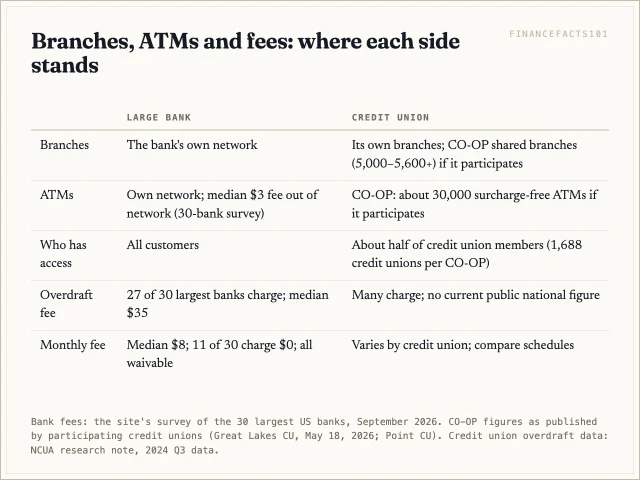
Note the qualifier: only about half of credit union members can use CO-OP, so confirm that the credit union you are joining participates. The services Great Lakes lists are transactions; confirm anything beyond that, such as opening a new account, with your own credit union.
Technology and Convenience Trade-Offs
Technology is where size shows most, and it cuts by institution rather than by charter. A national bank with millions of customers can spread the cost of its app, card controls, real-time alerts and instant transfers across all of them; a credit union with a few thousand members can find that harder to match. Feature sets vary from one institution to the next, so compare the specific app rather than assuming either way.
Before you switch, test what you use weekly: mobile deposit limits and hold times, peer-to-peer payments, external transfer speed, and whether you can open a certificate or apply for a loan entirely online. If you travel abroad, ask about foreign transaction fees on the cards.
There is also a middle path most people overlook: you do not have to choose one. Keeping checking at a large bank for reach and an app you like, while financing a car or holding certificates at a credit union, captures most of the rate advantage. A loan does not require moving your paycheck, only joining, which usually means that small opening share deposit.
Credit Union or Bank: The Decision Framework
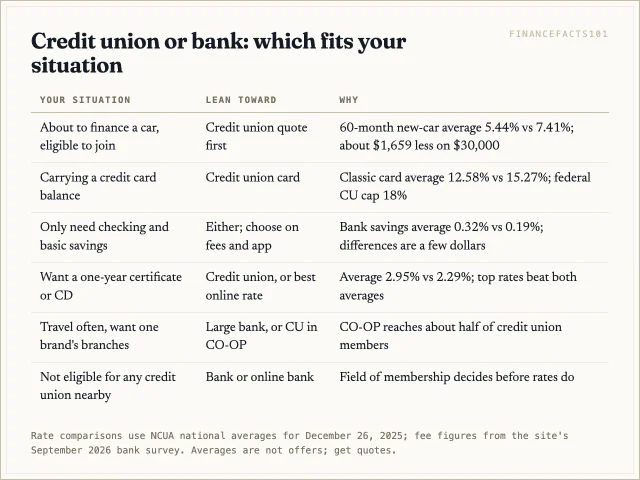
Start with eligibility, because no rate matters if you cannot join. Then ask whether you are about to borrow. If you are, get a credit union quote alongside your bank's and the dealer's: credit union new-car loans averaged about 1.3 points cheaper across the 16 quarters from 2022 through 2025. If you only need everyday accounts, the averages give no strong reason to move; choose on fees, access and the app, and put serious savings wherever the best rate is. Run each quoted rate through the auto loan calculator before you sign.
FAQ
Is my money as safe in a credit union as in a bank?
Yes, if the credit union is federally insured. The NCUA's Share Insurance Fund covers $250,000 per member per ownership category, the same $250,000 FDIC coverage banks carry, and both are backed by the full faith and credit of the United States. A few state-chartered credit unions use private insurers instead; check for the NCUA sign or search NCUA's locator.
Are credit union loan rates always lower than bank rates?
On average, yes: in the NCUA's December 26, 2025 table, credit unions were cheaper on all 13 loan products compared, including 5.44% against 7.41% on a 60-month new-car loan. But averages are not offers. Your quote depends on credit, term and the individual lender, so compare at least one credit union and one bank before you borrow.
Can I join a credit union if I don't work for a specific employer?
Often, yes. Many credit unions hold community charters open to anyone who lives, works, worships or attends school in an area, and many accept relatives of members or members of an associated group. Under federal law, once you join a federal credit union you can generally stay a member even if you later move or change jobs.
Do credit unions charge overdraft fees?
Many do. The NCUA found overdraft and NSF fees made up a median 3.5% of total revenue at the 444 large credit unions that reported them for the third quarter of 2024. Check the specific fee schedule; among the 30 largest banks, the median overdraft fee was $35 as of September 2026.
Sources
- NCUA, Credit Union and Bank Rates 2025 Q4 — national average rates for December 26, 2025 (S&P Global Market Intelligence data); earlier quarters from the same series, 2022 Q1 to 2025 Q3
- NCUA, Share Insurance Coverage — $250,000 coverage; privately insured state-chartered credit unions
- FDIC, Understanding Deposit Insurance — $250,000 per depositor, per bank, per ownership category
- FDIC, National Rates and Rate Caps — national savings rate, September 21, 2026
- NCUA, NCUA Board Extends Loan Interest Rate Ceiling (February 6, 2026) and Letter 26-FCU-02
- eCFR, 12 CFR 701.21 — 15% statutory ceiling, temporary rates, payday alternative loans, early repayment
- US Code via GovInfo, 12 U.S.C. 1759 (membership), 12 U.S.C. 1760 (one member, one vote), 12 U.S.C. 1768 (taxation)
- NCUA, Field-of-Membership Expansion — the three federal charter types
- NCUA (MyCreditUnion.gov), What is a Credit Union?
- NCUA, Observations from the NCUA's New Data on Non-sufficient Funds and Overdraft Fees (January 2025)
- NCUA, Hauptman Announces Changes to NCUA's Overdraft/NSF Fee Collection (March 3, 2025)
- Federal Reserve, Consumer Credit G.19 (released September 8, 2026) — commercial bank new-car and credit card rates
- Federal Reserve, FOMC statement, September 16, 2026 — target range raised to 3.75–4.00%
- Navy Federal Credit Union, Membership eligibility — one credit union's field of membership
- Great Lakes Credit Union, What Is a Shared Branch Credit Union? (May 18, 2026) — CO-OP network figures
- Point Credit Union, CO-OP Branches & ATMs
 Next entry · No. 5,987Should I Do a Backdoor Roth IRA? How to Avoid the Pro-Rata Tax
See also
-
 No. 5,955
19 Sep 2026
20 min
Deposit Accounts: Checking vs Savings vs Money Market vs CD
Banking
-
 No. 3,370
22 Mar 2025
21 min
National Credit Union Administration (NCUA) Overseeing Federal Credit Unions: Understanding Its Role & Importance
Finance Policy
-
 No. 5,953
18 Sep 2026
17 min
Adjustable-Rate CDs: What the Bump-Up Option Really Costs
Banking
-
 No. 5,930
02 Sep 2026
14 min
High-Yield Savings vs CDs: Where Cash Earns More
Personal Finance
-
 No. 5,437
08 Sep 2025
14 min
Variable-Rate Certificate of Deposit (CD): How Adjustable-Rate CDs Work
Finance Policy
-
 No. 658
16 May 2024
22 min
Understanding Certificates of Deposit (CDs) and Their Benefits
Investments