Car Loan Term: 48, 60, 72 or 84 Months - Which to Choose
Pick the shortest car loan term you can afford. On $39,000, 60 months at 7% costs $7,335 in interest; 84 months at an illustrative 8.7% costs $13,210.
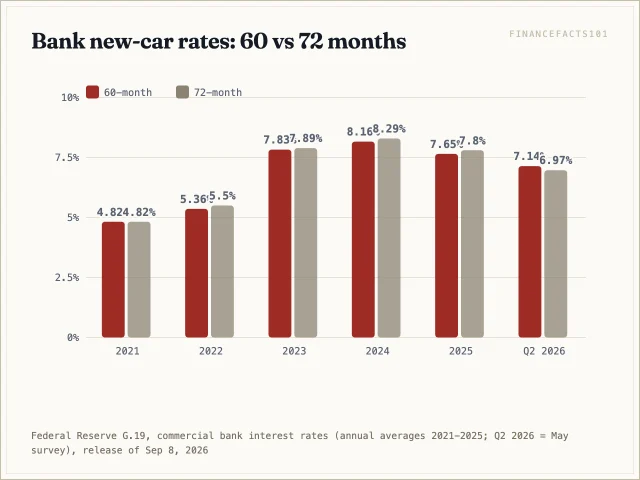
Choose the shortest car loan term whose payment fits your budget, which for many buyers means 48 or 60 months: on a $39,000 loan at 7%, each extra year adds $1,500 to $1,600 of interest, and you can owe more than the car is worth for up to about two years at 72 months and three and a half at 84. As of the Federal Reserve's September 8, 2026 consumer credit release, commercial banks' average new-car rate was 7.14% on 60-month loans and 6.97% on 72-month loans (surveyed in May 2026), so at banks the term barely moves the average rate; the real price of a long term is the extra interest, the negative equity, and the rate step-ups some lenders add past 72 months.
The rest of this guide runs the arithmetic for 48, 60, 72 or 84 months, shows when a longer term is rational, and sets out exactly who can use the new federal deduction for car loan interest.
Scope honesty: this is general information built on one stated example and rates published between December 2025 and September 2026, not personal advice. Your own quote, credit and state tax will change every number.
Who this is for — and who it is not for
This guide is for someone in the US financing a new or used car for personal use, holding a quote with several term options. It is most useful if a salesperson has already asked "what monthly payment are you comfortable with?", because that question is how buyers end up at 84 months without deciding to.
It is not for leases, which are priced on residual value rather than an amortizing balance, or for business vehicles, where depreciation deductions change the math. If you are behind on an existing car loan, start with your lender's hardship options instead.
Car loan rates now: what the official data shows
The most authoritative rate series is the Federal Reserve's G.19 consumer credit release. Its commercial-bank figures are simple averages of each bank's most common rate in the first week of the middle month of each quarter, so the September 8, 2026 release reflects May. That matters, because the Federal Open Market Committee raised the federal funds target range to 3.75%-4.00% on September 16, after the survey. Read the May numbers as pre-hike readings.
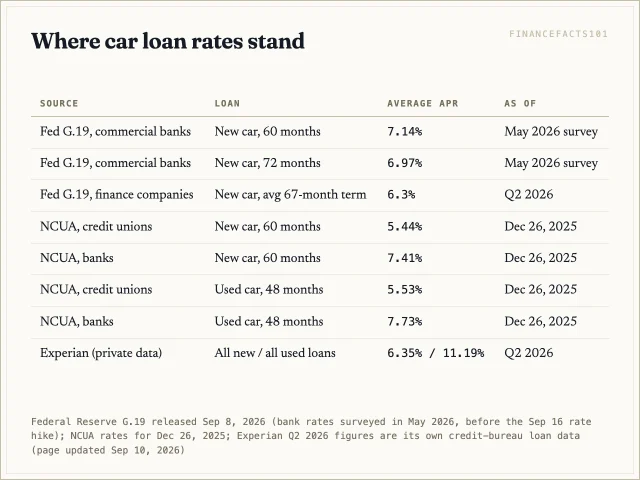
Credit unions were well below banks at the end of 2025: the NCUA's rate comparison for December 26, 2025 had 60-month new-car loans at 5.44% at credit unions and 7.41% at banks. Used cars cost more to finance: Experian's private data put the average used-car APR at 11.19% in the second quarter of 2026, against 6.35% for new. And credit score moves the rate far more than term does — Experian's new-car averages ran from 4.41% for scores above 780 to 16.11% for 500 and below.
Long terms are now normal. The G.19 shows finance companies, including automakers' captive lenders, averaging 6.3% on new-car loans in the second quarter of 2026, with a 67-month average term.
The worked example: one car, four terms
The rest of the guide uses one purchase, run the same way as our auto loan calculator: a $40,000 new car, 6.5% sales tax ($2,600), $400 of title and doc fees, and $4,000 down with no trade-in. The amount financed is $40,000 + $2,600 + $400 − $4,000 = $39,000.
At a single 7.0% APR — close to the G.19 bank averages — the monthly payment is $933.90 over 48 months, $772.25 over 60, $664.91 over 72 and $588.61 over 84.
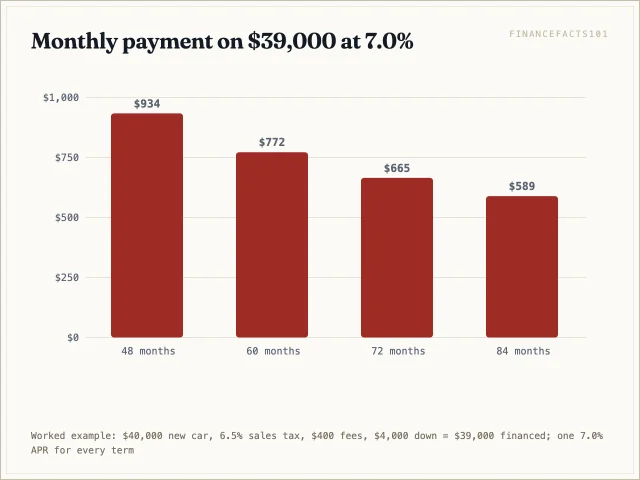
The formula is standard amortization: payment = A × i(1+i)^N / ((1+i)^N − 1), with A the amount financed, i the monthly rate (7.0% ÷ 12) and N the months. The calculator's menu stops at 72 months; the 84-month figures use the same formula.
Stretching from 48 to 84 months cuts the payment by $345 a month. That is the whole appeal of a long loan. The question is what it costs.
Total interest by term at the same price
Multiply each payment by its number of months and subtract the $39,000 borrowed. At 7.0% throughout, interest is $5,827 at 48 months, $7,335 at 60, $8,874 at 72 and $10,444 at 84. Each additional year adds between $1,508 and $1,570.
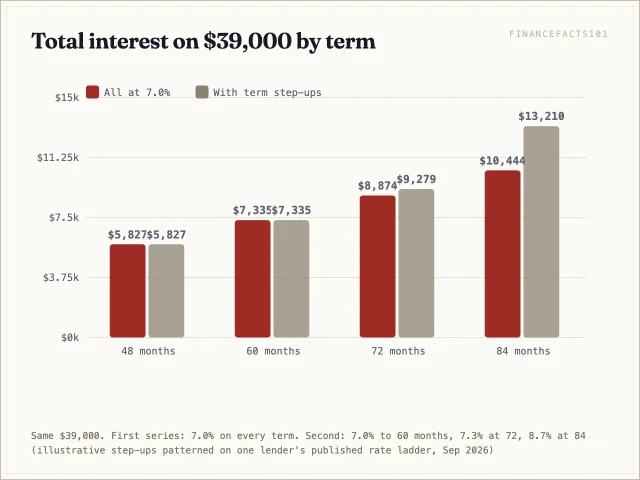
The steady increment is the part buyers underestimate. Going from 60 to 84 months lowers the payment by $184 but raises total interest by $3,109 — about $17 of extra interest for each $1 cut from the monthly payment. The Federal Trade Commission's car-financing guide puts it bluntly: "lower monthly loan payments often require longer terms and higher interest rates, which will substantially increase your overall cost."
The mechanism: interest is charged on the outstanding balance each month, and a longer term keeps the balance higher for longer. Our explainer on annual percentage rate covers how the rate itself is built.
Longer terms often carry a higher rate
The same-rate comparison is the kind version. The FTC notes that longer loans "like 72 or 84 months" "may have high rates," but the official averages show the effect is uneven. At commercial banks, the G.19 72-month rate has sat within about a quarter point of the 60-month rate every year since 2021, and in May 2026 it was slightly lower (6.97% against 7.14%). The NCUA data show a small step between 48 and 60 months: 5.32% versus 5.44% at credit unions, 7.33% versus 7.41% at banks.
The bigger step shows up past 72 months on individual lenders' rate sheets. As one example, Navy Federal Credit Union, a large credit union with membership eligibility rules, published these "as low as" rates on September 27, 2026, for borrowers with excellent credit:
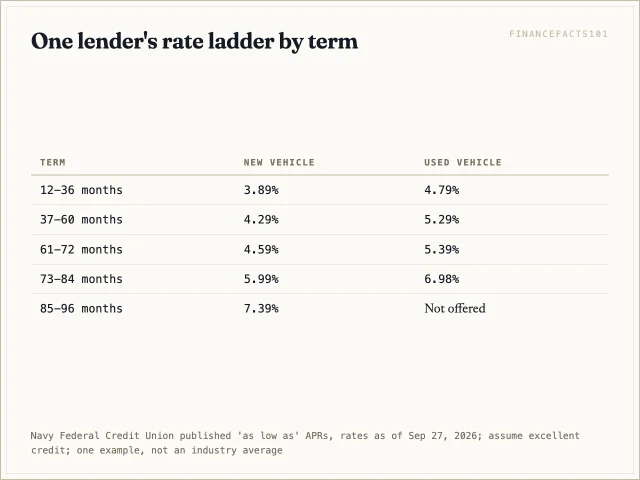
There, moving from the 61-72 month tier to 73-84 months adds 1.40 points on a new car. Applying a similar pattern to the worked example (7.0% to 60 months, 7.3% at 72, 8.7% at 84) pushes 84-month interest to $13,210 — $5,875 more than 60 months, for a payment only $151 lower, at $621.55. Ask your lender for the rate at each term, not just the payment.
There is a second, quieter rate effect. The CFPB's 2024 study of negative equity in auto lending found that borrowers who rolled negative equity into a new loan had both the longest average term (73 months) and the lowest average credit score (704) of the groups it compared. Long terms and high rates travel together partly because the people who need a low payment are often the ones lenders charge more.
Being upside down: depreciation against your balance
Being upside down, or having negative equity, means owing more than the car would fetch if you sold or traded it. It happens because a car loses value fastest in its first year, while an amortizing loan pays down principal slowest in its first years.
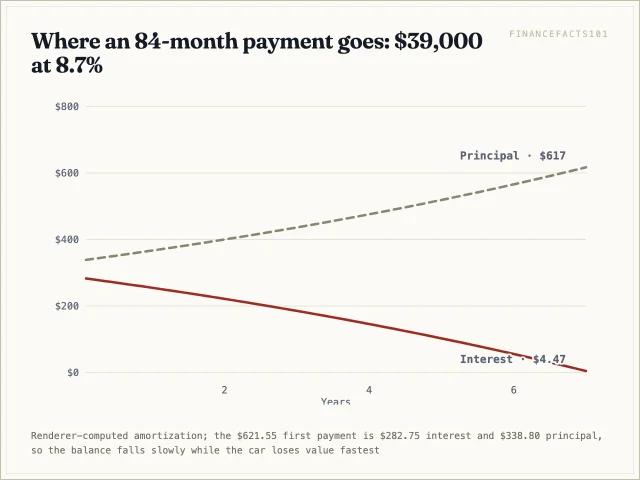
On the 84-month loan at 8.7%, the first $621.55 payment is $282.75 interest and only $338.80 principal; the 48-month loan's first payment retires $706.40 of principal.
For the car's value, this guide uses an explicit assumption: a 20% drop in year one, then about 13.9% a year, which leaves the car worth 44% of its price after five years. That endpoint matches AAA's 2026 Your Driving Costs estimate: $4,422 a year of depreciation on a $39,376 average new car, measured to trade-in value after five years and 75,000 miles. Real cars vary by model and mileage; check yours with a pricing guide like those in our Blue Book explainer.
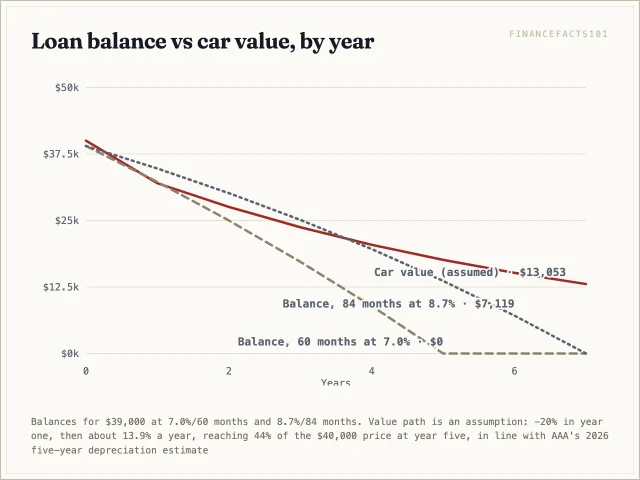
On those assumptions, the 48-month loan is never underwater. The 60-month loan is underwater through month 13, and never by more than $249. The 72-month loan at 7.3% is underwater through month 25. The 84-month loan at 8.7% stays underwater through month 44, peaking at $2,829.
Negative equity costs nothing while you keep the car and keep paying. It bites when the car is totaled or stolen, or when you trade it in early, which is where it compounds. In the CFPB's 2018-2022 data, 11.6% of loans rolled in negative equity from a prior car, averaging $5,073 on new-car deals.
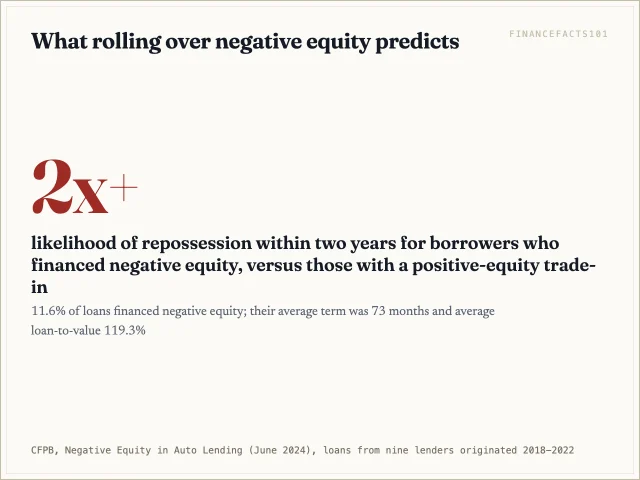
Those borrowers were more than twice as likely as borrowers with a positive-equity trade-in to have their account assigned to repossession within two years. The share is up from a year earlier: Edmunds, a private car-shopping site, reported that 29.6% of trade-ins toward new cars in the second quarter of 2026 carried negative equity, averaging $6,884. The CFPB's guidance on trading in a car that is not paid off is to learn your payoff amount and trade-in value first; rolling the balance forward makes the new loan more expensive.
Gap insurance: what it covers and where to buy it
Gap coverage pays the difference between what your auto insurer pays for a totaled or stolen car and what you still owe, as the CFPB's auto loan key terms define it. In the worked example, a total loss in month 24 of the 84-month loan would leave a gap of about $2,600 if the insurer paid the assumed value; the 48-month buyer would have no gap at all.
That makes gap coverage close to essential on a 72- or 84-month loan with little down, and close to pointless on a 48-month loan with 20% down. Three details matter:
- Where you buy it. Dealer gap coverage is usually priced once and financed with the car, so you pay interest on it. The CFPB's guide notes that "your own auto insurance company may offer GAP insurance, credit insurance, or other alternatives," and that add-on prices are negotiable; the FTC adds, "It's ok to say no to add-ons, and to ask the price."
- What it covers. Gap contracts differ, and each lists what it will not pay. Read the exclusions, especially if the loan includes a balance rolled over from a previous car.
- Cancelling and refunds. The CFPB's guide to taking control of your auto loan says that, other than features you choose for the vehicle, "you have the right to cancel add-ons at any point during the life of your loan, and this could save you money." When a loan ends early, the unearned part of a financed add-on may be refundable, and the CFPB has reported servicers failing to request or apply GAP refunds, for example after repossession. Ask for the refund in writing.
Our explainer on gap insurance in auto financing covers the product. The point here is narrower: gap coverage treats a symptom of a long term, while a shorter term or bigger down payment removes the gap itself.
The payment-versus-total-cost trade
None of this makes a long term always wrong. A lower payment buys flexibility, and sometimes that is worth more than the interest.
The clearest is debt-to-income. Mortgage lenders count your car payment in your back-end ratio. On a $95,000 salary ($7,917 a month gross), the worked payment is 11.8% of gross at 48 months and 7.9% at 84 months (at the illustrative 8.7% rate). If you are applying for a mortgage soon and sit near a lender's limit, that four-point gap can decide the application; test each payment in the debt-to-income calculator.
The second is a promotional rate. If a manufacturer's finance arm offers 0% or near-0% APR on a long term, the interest argument disappears and only depreciation risk remains. Check whether the promotion replaces a cash rebate, and compare both on total cost.
The third is liquidity. Taking a lower payment and sending the difference to savings can be sensible if you have no cushion; our emergency fund guide covers how big it should be. A term chosen to "make room" for a pricier car is the opposite case: a longer loan on more car.
If you take a longer term for any of these reasons, extra principal payments shorten the loan and cut interest — provided the contract allows them without a penalty. The CFPB explains that your contract and state law decide whether you can pay off an auto loan early, and suggests asking about prepayment penalties before you sign. Whether extra dollars go to the car or to other debt is a ranking question covered in our debt avalanche vs snowball guide; a 7% car loan usually ranks below any credit card.
The 20/4/10 rule of thumb
A widely repeated rule of thumb says: put at least 20% down, finance for no more than four years, and keep total car costs under 10% of gross income. It is not a regulation or a lender requirement, and versions differ on whether the 10% covers only the payment and insurance or also fuel and maintenance. The CFPB's own guide sets a looser marker on term, noting that "Some financial advisers recommend keeping your auto loan to five years or less, because the longer the loan, the more likely you will owe more than the vehicle is worth." Treat the rule as a quick stress test, not as law.
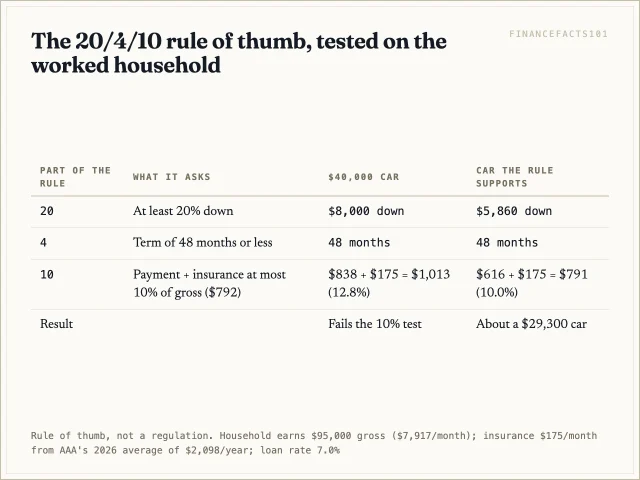
For the worked household at $95,000 gross, with insurance at $175 a month (AAA's 2026 average of $2,098 a year), the $40,000 car fails: even with $8,000 down, the 48-month payment of $838 plus insurance is $1,013, or 12.8% of gross. The car that passes the rule is about $29,300 with $5,860 down: $25,745 financed at 7.0% over 48 months is a $616 payment, plus $175 of insurance, $791, just inside the $792 limit.
That is the rule's real value: it tests whether the car is the right price for your income. When only a 72- or 84-month term fits the budget, the problem is the price, not the term.
The 2025-2028 car loan interest deduction, condition by condition
The One Big Beautiful Bill Act created a temporary deduction for car loan interest. Treasury and the IRS published final regulations (T.D. 10054) in the Internal Revenue Bulletin of September 21, 2026, following proposed rules on December 31, 2025. The conditions are narrower than the "no tax on car loans" shorthand suggests.
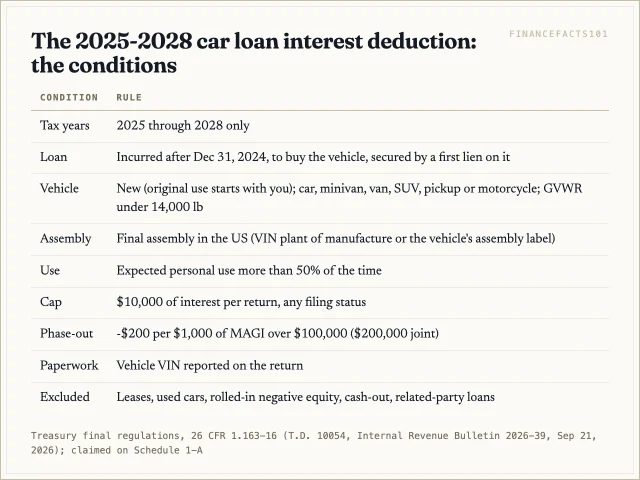
Under the final rules, the interest must be paid in a tax year from 2025 through 2028, on a loan incurred after December 31, 2024, to buy the vehicle and secured by a first lien on it. The vehicle must be new — its original use must begin with you — and be a car, minivan, van, SUV, pickup or motorcycle with a gross vehicle weight rating under 14,000 pounds and final assembly in the United States. You can rely on the plant of manufacture shown in the VIN or the final assembly point on the vehicle's label. At the time you borrow, you must expect personal use more than 50% of the time, by you, your spouse or certain relatives.
The limits: no more than $10,000 of interest per return regardless of filing status. The deduction that remains after that cap is then reduced by $200 for each $1,000 (or part of $1,000) of modified adjusted gross income above $100,000, or $200,000 on a joint return; the reduction comes off the deduction itself, not the cap, so a single filer with $140,000 of MAGI loses $8,000 and typically deducts nothing. You must report the vehicle's VIN on the return. The deduction is available whether you itemize or take the standard deduction, and the IRS says it is claimed on the new Schedule 1-A.
The exclusions matter for the term decision. Leases, used cars, fleet loans, salvage-title vehicles and loans from related parties do not qualify. Rolled-in negative equity from a trade-in is not qualifying debt, and any down payment is applied first to that negative equity; financed sales tax, fees, service contracts and gap coverage bought with the car do count. A refinance keeps qualifying only up to the old loan's balance, and only while it is secured by a first lien on the same car.
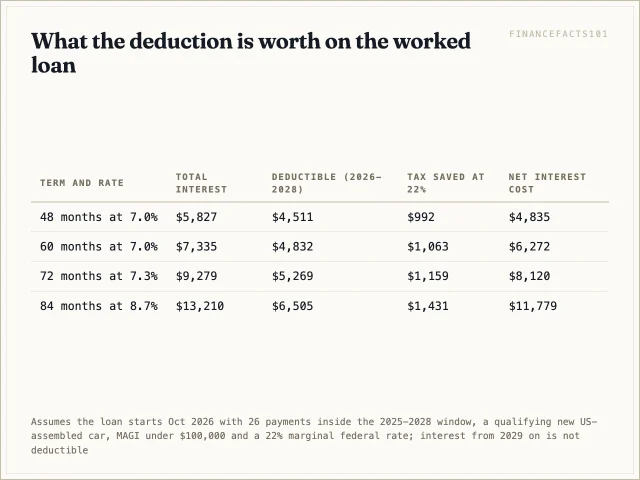
The deduction reduces taxable income; it does not refund interest. If the worked car qualifies, the loan starts in October 2026 and your marginal rate is 22%, the 84-month loan's deductible interest through 2028 is $6,505, worth $1,431 — leaving $11,779 of interest, against $6,272 for the 60-month loan after the same deduction. A longer term earns a bigger deduction only by producing more interest.
Refinancing later: an exit, not a plan
Refinancing rescues a long loan when rates fall or credit improves, but it works best for the loans that need it least.
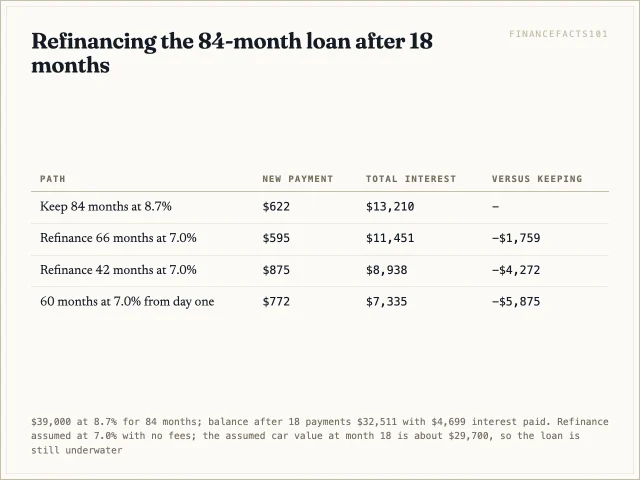
Take the 84-month loan at 8.7%. After 18 payments the balance is $32,511 and $4,699 of interest is already paid. Refinancing at 7.0% over the remaining 66 months lowers the payment to $595 and saves $1,759. Refinancing into 42 months, finishing when a 60-month loan would have, saves $4,272. Even that best case leaves total interest at $8,938, still $1,603 more than taking 60 months at 7.0% on day one.
Three catches. At month 18 the car is worth about $29,700 on this guide's assumptions, so the loan is still underwater, which can mean a higher refinance rate or a refusal. A refinance is a new loan with a new term, and stretching the payment again can raise the total. And paying off the old loan can trigger a prepayment fee if the contract has one, as the CFPB notes. Refinance to shorten or cheapen the loan, not to lengthen it.
Which car loan term should you choose: 48, 60, 72 or 84 months?
The choice comes down to one test: what is the shortest term whose payment fits your budget with your emergency fund intact?
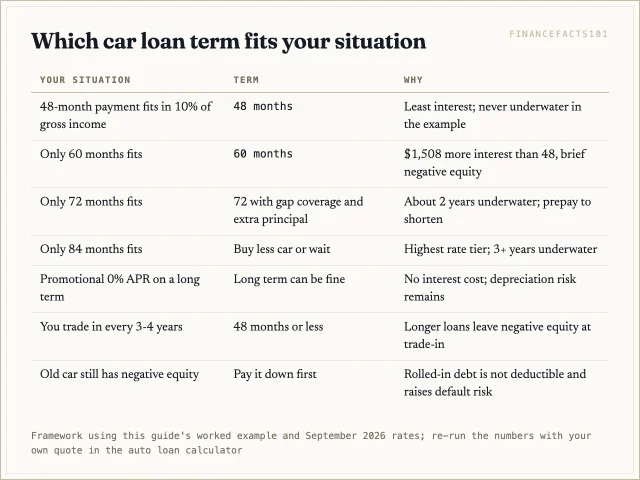
If 48 months fits, take it: it costs the least and, in the worked example, never leaves you underwater. If only 60 fits, that is a reasonable loan; the extra $1,508 of interest is the price of a $162 lower payment. If only 72 fits, compare your insurer's gap price with the dealer's, buy the cheaper one, and send extra principal whenever you can, aiming to finish in five years.
If only 84 fits, the payment is saying the car is too expensive for your income right now. The honest options are a cheaper car, a larger down payment, a used car on a shorter loan, or keeping your current car another year. The exception is a genuine near-zero promotional rate.
Whatever you choose, negotiate the price before the term, bring a credit union or bank pre-approval, and ask for the total of payments at each term in writing.
FAQ
Is a 72-month car loan a bad idea?
Not automatically, but it costs more and keeps you underwater longer. On $39,000 at 7.0%, 72 months costs $1,539 more interest than 60, and in this guide's example the balance exceeds the car's value for about two years. It is defensible with a strong down payment, a rate no higher than the 60-month rate, gap coverage and a plan to prepay.
What is the average car loan term right now?
Experian's private data put the average new-car loan at 69.5 months in the second quarter of 2026. The Federal Reserve's G.19 shows finance companies' average new-car term at 67 months in the same quarter, on an average $41,705 financed.
Can I deduct the interest on my car loan?
Only for tax years 2025 through 2028, and only if the loan was taken out after 2024 to buy a new, US-assembled car, SUV, van, pickup or motorcycle for mostly personal use, secured by a first lien on the car. The deduction is capped at $10,000 a year, phases out above $100,000 of modified AGI ($200,000 joint), and requires the VIN on your return. Used cars and leases do not qualify.
Is 84 months ever the right car loan term?
Rarely. It makes sense mainly when the lender offers a near-zero promotional APR, you plan to keep the car well past the loan, and you have savings to cover a gap. In the worked example, 84 months at an illustrative 8.7% costs $5,875 more interest than 60 months at 7.0% and stays underwater for more than three years.
Sources
- Federal Reserve, Consumer Credit - G.19 (release of September 8, 2026; bank rates surveyed May 2026)
- Federal Reserve, FOMC statement of September 16, 2026
- NCUA, Credit Union and Bank Rates 2025 Q4 (rates for December 26, 2025)
- IRS, Internal Revenue Bulletin 2026-39: T.D. 10054, final regulations on qualified passenger vehicle loan interest (September 21, 2026)
- IRS, Treasury, IRS provide guidance on the new deduction for car loan interest (IR-2025-129, December 31, 2025)
- IRS, New Schedule 1-A and Form 1040 instructions (IR-2026-28, March 2, 2026)
- CFPB, Negative Equity in Auto Lending (June 2024)
- CFPB, Should I trade in my car if it's not paid off?
- CFPB, Auto loan key terms
- CFPB, Overcharging for add-on products on auto loans (May 2022)
- CFPB, Can I prepay my loan at any time without penalty?
- CFPB, Take control of your auto loan (March 2024)
- FTC, Financing or Leasing a Car (July 2022)
- AAA, Your Driving Costs 2026 fact sheet (September 2026; industry estimate)
- Experian, Average Car Loan Interest Rates by Credit Score (Q2 2026 data; Experian credit-bureau loan data)
- Experian, Average Car Payment (Q2 2026 data; Experian credit-bureau loan data)
- Navy Federal Credit Union, Auto loan rates (rates as of September 27, 2026; one lender's example)
- Edmunds, Q2 new-vehicle purchases with negative equity trade-ins (July 16, 2026; private data)
 Next entry · No. 5,972Lease or Buy a Car? The 3-, 6- and 10-Year Cost Math
See also
-
No. 5,972
06 Oct 2026
18 min
Lease or Buy a Car? The 3-, 6- and 10-Year Cost Math
Personal Finance
-
 No. 2,954
17 Feb 2025
20 min
Understanding Loans: The Essential Guide to Obtaining and Repaying a Loan
Personal Finance
No. 2,954
17 Feb 2025
20 min
Understanding Loans: The Essential Guide to Obtaining and Repaying a Loan
Personal Finance -
 No. 5,962
26 Sep 2026
12 min
Biweekly Mortgage Payments: The Saving Is Real, the Fee Is Not
Mortgage
No. 5,962
26 Sep 2026
12 min
Biweekly Mortgage Payments: The Saving Is Real, the Fee Is Not
Mortgage -
 No. 5,961
25 Sep 2026
12 min
Extra Mortgage Payments: What $200 a Month Actually Saves
Mortgage
No. 5,961
25 Sep 2026
12 min
Extra Mortgage Payments: What $200 a Month Actually Saves
Mortgage -
 No. 748
01 Jun 2024
19 min
Understanding Consumer Credit in Financial Services: Installment vs Revolving
Credit & Loans
No. 748
01 Jun 2024
19 min
Understanding Consumer Credit in Financial Services: Installment vs Revolving
Credit & Loans -
 No. 704
24 May 2024
21 min
Collateral: Understanding the Importance and Types of Assets Used as Security for Loans
Business Strategy
No. 704
24 May 2024
21 min
Collateral: Understanding the Importance and Types of Assets Used as Security for Loans
Business Strategy