Lease or Buy a Car? The 3-, 6- and 10-Year Cost Math
Buying a $40,000 SUV and keeping it 6 years costs about $13,100 less than back-to-back leases; over 3 years the two roughly tie. The math and the fine print.
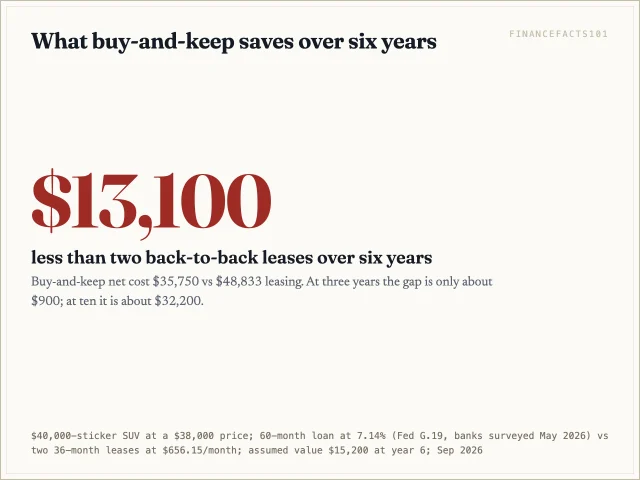
If you would keep a car six years or longer, buying it costs less than leasing: on a $40,000 SUV financed at the 7.14% bank rate the Federal Reserve reported for mid-2026, buy-and-keep costs about $35,750 over six years against $48,833 for two back-to-back leases, and the gap grows to about $32,200 over ten years. Whether to lease or buy a car is only a close call if you would replace it every three years anyway, where the two land within about $900 of each other.
The rest of this guide shows where those numbers come from — how a lease payment is built, what mileage caps, gap coverage and early termination cost, and what federal law makes the dealer disclose — using one named car, stated assumptions and rates dated September 2026.
Scope, stated once: this is general information built on the assumptions written out below, not personal advice; prices, lease programs and rates change monthly.
Who this is for — and who it is not for
This guide is for a US household choosing how to pay for its next new car for personal use: someone comparing a dealer's lease quote with a loan quote on the same vehicle, or someone coming off a lease and wondering whether to sign another one. It assumes you drive a typical 10,000 to 15,000 miles a year and have the credit to qualify for either.
It is not for used-car shoppers, whose prices and financing work differently, or for fleet and commercial leases, which fall outside the consumer protections described below. If the car is mainly for your business, the tax section gives the high-level rules and points to the IRS; a tax adviser should run your actual numbers. And if the real question is how long a loan to take once you have decided to buy, our guide to choosing a car loan term covers the 36-versus-72-month trade-off in detail.
Lease or buy a car: what you are actually paying for
A loan and a lease both put you in a new car for a monthly payment, but they pay for different things. A loan pays for the whole car, and when it ends you own an asset worth something. A lease pays only for the part of the car's value you use up during the term, plus a rent charge on the money tied up in it, and when it ends you hand the car back with nothing.
The CFPB's plain-language comparison puts the trade the same way: lease payments are generally lower, but they build no ownership unless you exercise a purchase option, and most leases cap your mileage. That lower payment is real. It is also the reason leasing costs more over time: you are always paying for a car's steepest years of depreciation, and never for the cheap years that follow.
How a lease payment is built
Every closed-end car lease is priced with the same arithmetic, and federal Regulation M requires the lessor to disclose its pieces, item by item, as the lease's payment calculation. Three inputs drive it: the capitalized cost, the residual value and the money factor.
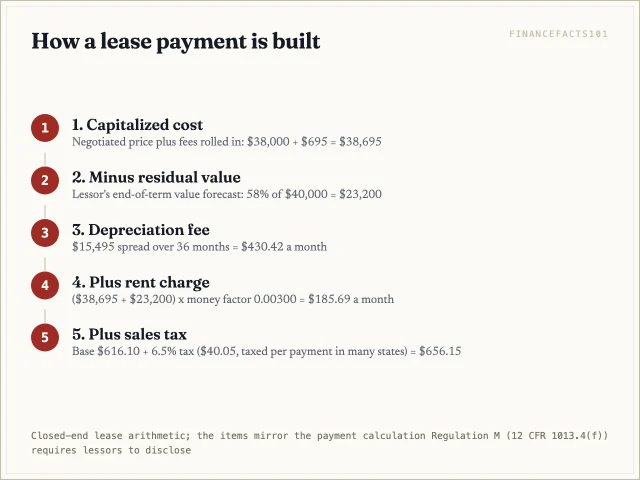
The capitalized cost is the price of the car inside the lease — the number you negotiate, exactly as you would negotiate a purchase price, plus any fees rolled in, such as an acquisition fee. The residual value is the lessor's forecast of what the car will be worth at the end of the term. The difference between them is the depreciation you pay for, spread evenly over the months. On top of that sits the rent charge, which Regulation M describes as the amount charged in addition to the depreciation, and then your state's sales tax, which in many states is charged on each monthly payment rather than on the whole car.
Here is the full build for this guide's example: a new midsize SUV with a $40,000 sticker price, negotiated to $38,000, leased for 36 months with 12,000 miles a year.
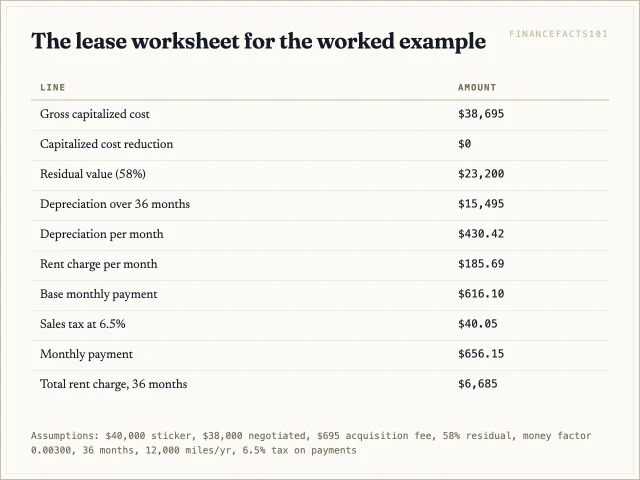
The depreciation fee is $15,495 spread over 36 months, or $430.42. The rent charge is $185.69. Together they make a base payment of $616.10, and 6.5% sales tax takes it to $656.15. Once you can rebuild the dealer's number, you can see which input to push on.
The money factor: an interest rate in disguise
Leases quote their financing cost as a money factor, a small decimal such as 0.00300. Multiply it by 2,400 to get the approximate annual rate: 0.00300 × 2,400 = 7.2%. The 2,400 comes from the rent-charge formula itself. Adding the capitalized cost and the residual and multiplying by the money factor is the same as charging a monthly rate on the average balance, and converting that to an annual percentage works out to multiplying by 2,400.
Federal rules do not require a lease to state an APR the way a loan must, and they forbid calling a lease rate an "annual percentage rate"; when a lessor does quote a percentage rate in lease documents or ads, Regulation M § 1013.4(s) requires it to carry the notice that "this percentage may not measure the overall cost of financing this lease." Ask for the money factor in writing anyway, convert it, and compare it with the loan rate you could get on the same car.
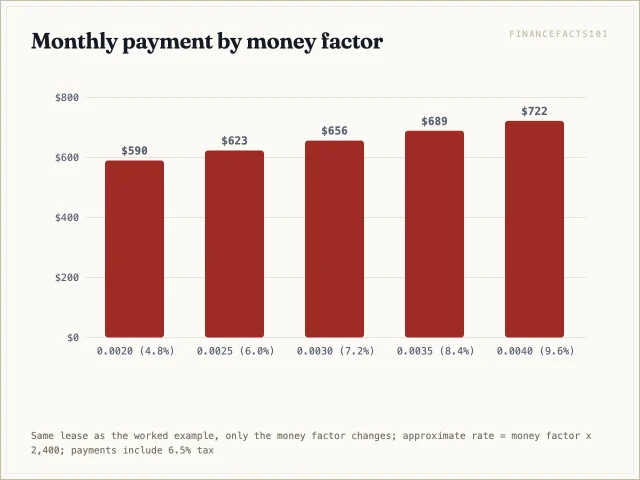
Each 0.0005 step in the money factor — about 1.2 percentage points of equivalent rate — moves this lease's payment by about $33 a month, or roughly $1,190 over 36 months. Before signing, ask whether the quoted money factor is the lessor's base rate for your credit tier or includes a dealer markup; the answer tells you whether there is room to negotiate.
Residual value: the number that sets the payment
The residual value matters more than most shoppers realize, because the depreciation fee is the largest line in the payment. A higher residual means the lessor expects the car to hold its value, so you pay for less depreciation. Our entry on residual value covers the general concept; in car leasing it is set by the lessor, usually as a percentage of the sticker price, and it is not negotiable the way the capitalized cost is.
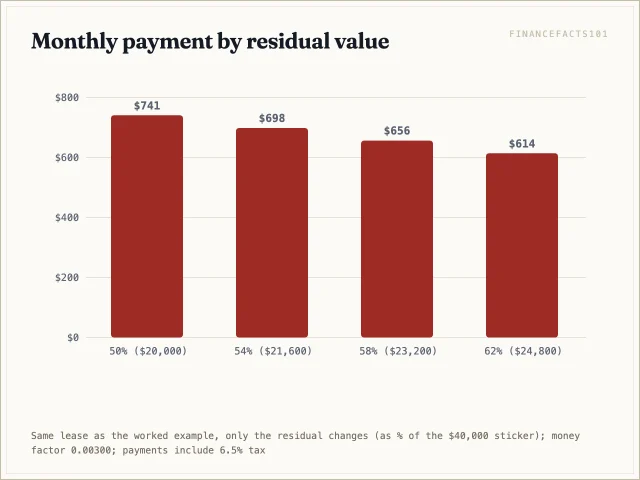
Moving the residual from 58% to 62% of the $40,000 sticker cuts the taxed payment from $656.15 to $613.93. Dropping it to 50% pushes the payment to $740.59. This is why the same car can lease cheaply from one lessor and expensively from another, and why a car with a strong resale record is usually the better lease. The CFPB also points out that the residual sets your buyout price at the end, so a generous residual that lowers the payment makes buying the car later more expensive.
All of this applies to the standard closed-end lease, where the lessor carries the risk that the car is worth less than the residual at the end. An open-end lease shifts that risk to you, so read which kind you are signing.
The worked example: a $40,000 SUV, leased or bought
To compare fairly, both paths use the same car at the same negotiated price, and every assumption is written down.
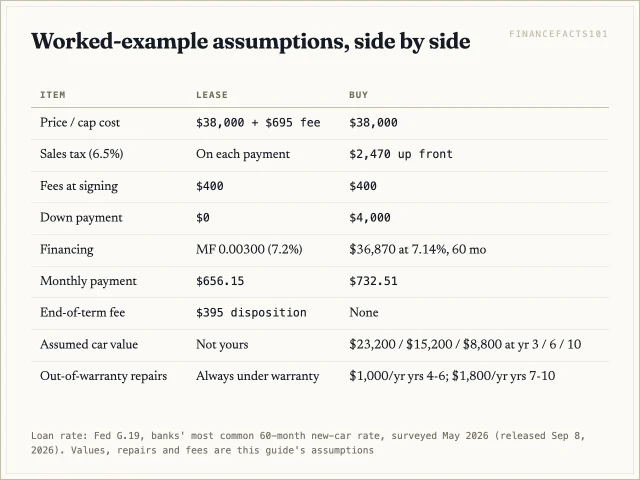
The lease is the one built above: $656.15 a month, $400 of title, registration and dealer fees at signing, and a $395 disposition fee at each turn-in. Acquisition and disposition fees vary by lessor; Regulation M requires the lease to itemize them, so check yours.
The purchase uses the paired auto loan calculator's method. The $38,000 price plus $2,470 of sales tax at 6.5% plus the same $400 of fees is $40,870; a $4,000 down payment leaves $36,870 to finance. At 7.14% for 60 months — the average of banks' most common 60-month new-car rates, surveyed in May 2026 and published in the Federal Reserve's G.19 consumer credit release of September 8, 2026 — the payment is $732.51 and total interest is $7,080. That rate predates the Fed's September 16, 2026 increase to a 3.75%–4.00% target range, so new quotes may run slightly higher. The same release puts the average finance-company new-car loan at 6.3% over 67 months on $41,705 financed, so our example sits in the normal range.
For the buyer, "cost" means every dollar paid out, minus what the car is still worth at the end, plus any loan balance still owed. For the lessee, it is simply every dollar paid out, because there is nothing to sell.
Total cost over 3, 6 and 10 years
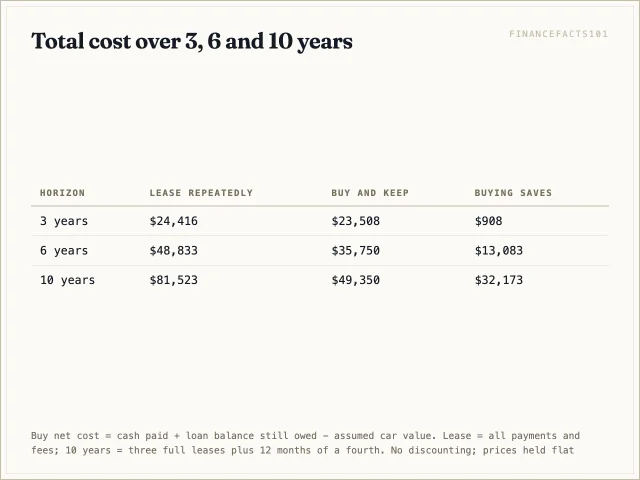
At three years the two paths nearly tie. The buyer has paid $30,370 in cash, still owes $16,337, and holds a car worth an assumed $23,200 — the same figure as the lessor's residual — for a net cost of $23,508. The lessee has paid $24,416. The buyer comes out about $900 ahead, but would have to sell or trade the car to collect it, and that sale costs time and usually some money.
At six years the story changes. The loan was paid off in year five, the car is worth an assumed $15,200, and the buyer has also paid $3,000 for out-of-warranty repairs, for a net cost of $35,750. The lessee, on a second identical lease, has paid $48,833. Buying saves about $13,100.
At ten years the buyer has absorbed $10,200 of assumed repairs and owns a car worth about $8,800, for a net cost of $49,350. The lessee has paid $81,523 across three full leases and the first year of a fourth. The gap is about $32,200.
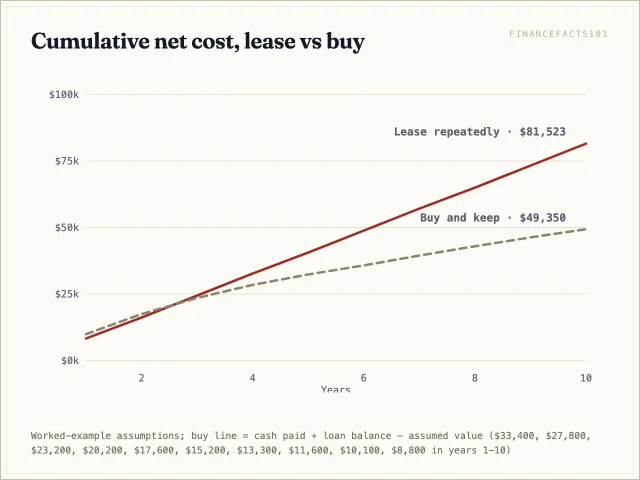
Leasing is cheaper in years one and two, when the buyer's car loses value fastest; buying pulls ahead from year three, once each extra year costs only repairs and a slower slide in value.
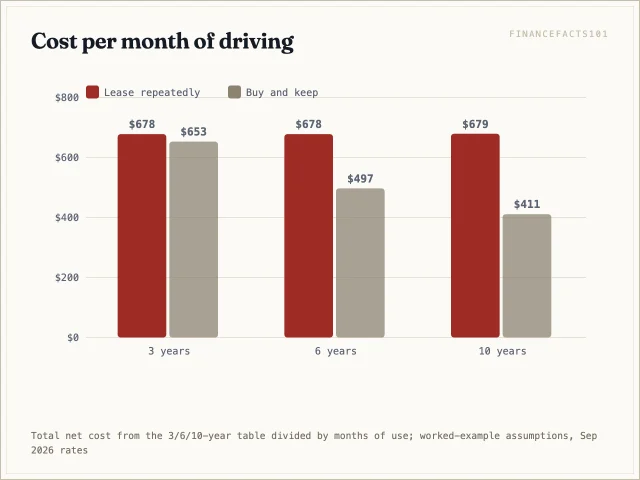
Per month of driving, the lease costs about $678 at any horizon; the owned car falls from $653 to $497 to $411.
Two honest caveats. First, this ignores the time value of money: the buyer spends $4,000 up front and a larger payment for five years. Discounting every cash flow at 4% a year — our assumption for what the buyer's cash could otherwise earn — shrinks the gaps to about $300 at three years, $9,300 at six and $22,000 at ten, which changes none of the conclusions. Second, the model holds car prices flat for every future lease. If new-car prices keep rising, each later lease costs more and the ten-year gap widens. To see what the $13,100 six-year difference would grow to if invested, run it through the true cost of a purchase calculator.
Mileage limits and excess-wear charges
A lease prices the residual on an assumed mileage, so going over it costs money. The CFPB notes that most leases limit you to 10,000 to 15,000 miles a year. The per-mile charge for going over is written into your contract; as one example, Toyota Financial Services says its rate is typically $0.15 per mile on its leases, and other lessors set their own rates.
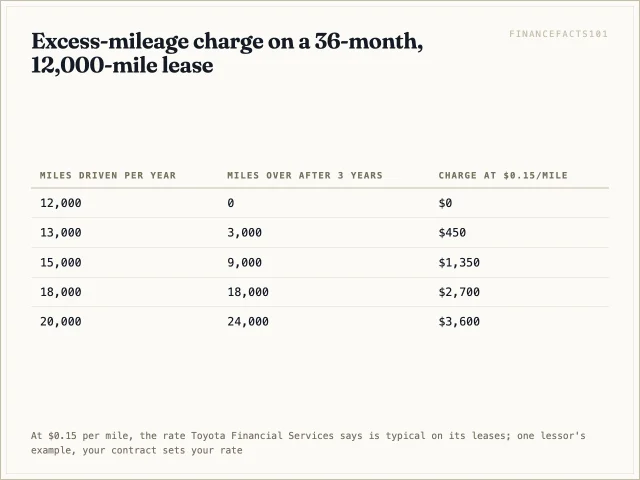
On our 12,000-mile lease, a driver who actually covers 15,000 miles a year returns the car 9,000 miles over and owes $1,350. At 20,000 miles a year the charge reaches $3,600, about four times the three-year gap between the two paths in our example — though a buyer driving that much would also see a lower resale value. Toyota also notes that the mileage allowance can be raised before you sign but not after you take the car, so estimate honestly at the start and price extra miles into the contract if you need them.
Excess wear is the second end-of-lease charge. Regulation M requires the lessor to state its wear-and-use standards (if any), which must be reasonable, and to include a notice that you may be charged for wear beyond normal use. What counts as normal is the lessor's call, so photograph the car before you return it and ask whether your lessor offers a pre-return inspection, which lets you repair small damage yourself before the lessor prices it.
Gap coverage: who needs it
If a car is totaled or stolen, insurance pays its actual cash value, not what you owe. Guaranteed asset protection — gap — is optional coverage that pays the difference, and the CFPB's gap explainer notes it is offered on both purchases and leases. You only need it while you owe more than the car is worth.
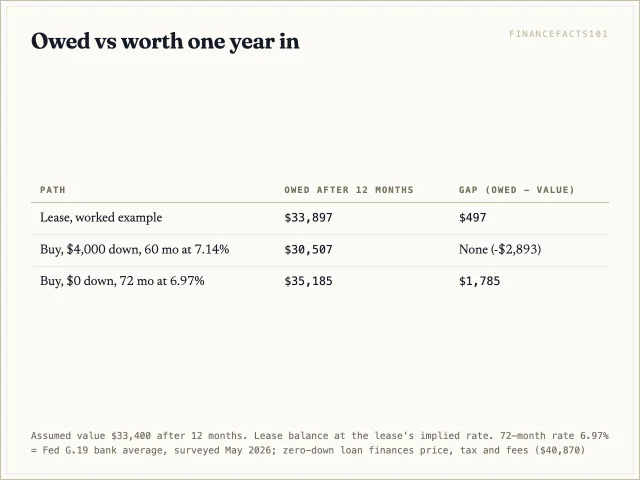
In our example, a year into the lease the balance the lessor would claim is about $33,900 against a car worth about $33,400, so a small gap exists. The buyer who put $4,000 down on a 60-month loan owes $30,507 against the same $33,400 and has no gap at all. The buyer who financed everything, taxes and fees included, over 72 months at 6.97% — the Fed's May 2026 bank survey average for that term — owes about $35,200, roughly $1,800 underwater. Some lease contracts already include a gap waiver, so read yours before buying coverage twice. Where to buy gap on a loan, and what dealer-financed gap costs, is covered in our car loan term guide. Our older entry on gap insurance covers the product itself.
Ending a lease early
Leases are expensive to leave. Regulation M requires every consumer lease to state the conditions for ending early and the charge, or the method for calculating it, which must be reasonable; a motor vehicle lease must also print a warning substantially similar to this one from § 1013.4(g): "Early Termination. You may have to pay a substantial charge if you end this lease early. The charge may be up to several thousand dollars. The actual charge will depend on when the lease is terminated. The earlier you end the lease, the greater this charge is likely to be."
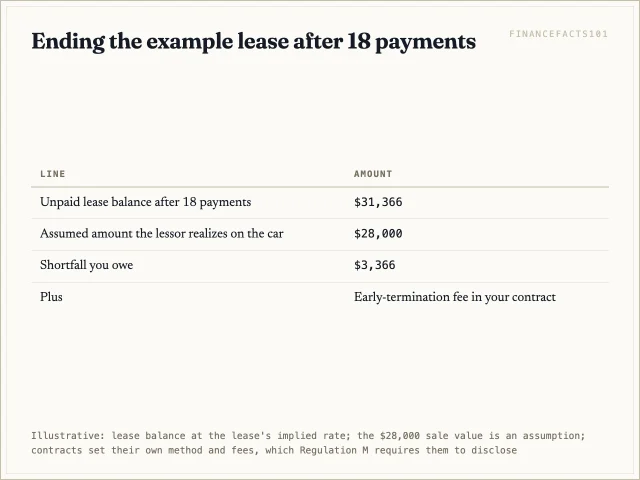
The mechanics usually work like a payoff. After 18 payments, the unpaid lease balance in our example, computed at the lease's implied rate, is about $31,400. If the lessor then sells the car for $28,000, a wholesale figure we assume for illustration, you owe the roughly $3,400 shortfall plus whatever early-termination fee your contract sets. Before paying that, compare two alternatives: a lease transfer to another driver, if your lessor allows it, and a mid-lease buyout followed by a sale, which can work when used-car prices are high.
A buyer who needs out sells the car and pays off the loan; if it is worth less than the balance, the shortfall is the same kind of bill, which is one more reason to put money down.
Buying out your lease
Many car leases include an option to buy the car, and Regulation M requires the lease to say whether one exists and, if so, the price at the end of the term — or the price or method for figuring it during the term. The end-of-lease price is usually the residual value plus any purchase-option fee, and your state may charge sales tax on it.
The decision is a comparison with the market. In our example the buyout is $23,200 plus fees. If comparable used SUVs are selling for $26,000 when the lease ends, buying at the residual captures about $2,800 of value before fees and any tax. If they sell for $21,000, hand the car back and let the lessor absorb the loss; that is the protection a closed-end lease sells you.
What Regulation M makes the dealer disclose
The federal Consumer Leasing Act, implemented by the CFPB's Regulation M, covers a lease of a car to an individual primarily for personal, family or household use for more than four months, as long as the total contractual obligation does not exceed a threshold that adjusts every year with inflation. For leases signed in 2026 that threshold is $73,400, up from $71,900; a lease whose total obligation is above it is exempt. The definition is in § 1013.2. Our example's roughly $24,000 obligation is well inside the rules.
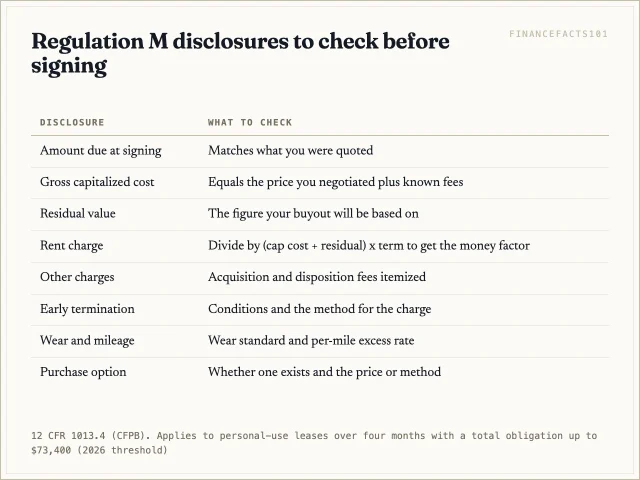
The disclosures come before you sign, and they make a lease quote checkable. If the dealer only quotes a monthly payment, ask for the full disclosure form; the payment alone hides every input you can negotiate.
Business use and taxes: the high-level rules
Tax treatment can tilt the decision, but only at a high level here. If you use a car for business, IRS Publication 463 explains that you can deduct only the business-use portion of a lease payment, and payments on a contract that is really a purchase are not deductible as lease payments. For leases beginning in 2026, higher-value cars also carry an "inclusion amount" that trims the deduction; the IRS table in Rev. Proc. 2026-15 starts at a fair market value of $62,000, so our $40,000 SUV falls below it.
The alternative is the standard mileage rate: 72.5 cents per mile for business driving from January through June 2026 and 76 cents from July 1, 2026, per the IRS's standard mileage rates page. IRS Topic 510 adds two timing rules: for an owned car you must choose the mileage rate in the first year the car is used for business, and for a leased car, if you choose it, you must use it for the entire lease period, including renewals.
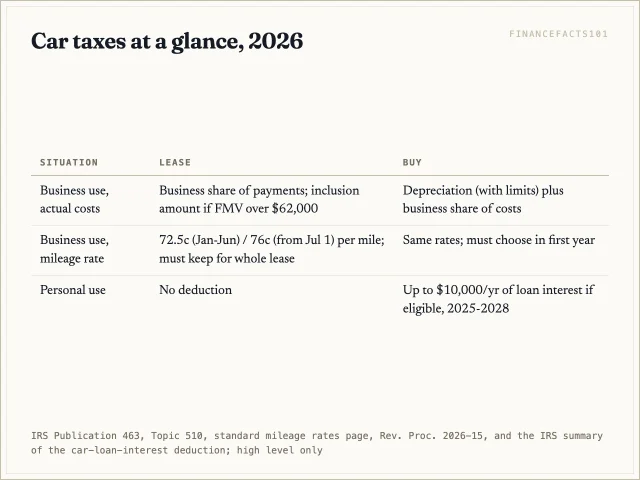
For personal cars, one new rule favors buying. For 2025 through 2028, individuals may deduct up to $10,000 a year of interest on a loan for a qualifying new, US-assembled vehicle for personal use, phasing out above $100,000 of modified adjusted gross income ($200,000 joint), and the IRS summary states that lease payments do not qualify (conditions in our car loan term guide). Our worked example ignores this deduction; for an eligible buyer it would trim the buy side further.
When leasing is the right call
Leasing fits if you would replace the car every two or three years regardless, since at that horizon the costs nearly tie and the lease removes the chore and risk of selling. It fits if you drive well under the mileage cap, if you value always being under the factory warranty, if a lessor is subsidizing a model with a high residual or a low money factor, or if you are wary of a technology whose resale value is hard to predict, which is where the closed-end lease's guarantee is worth most.
Buying fits if you drive a lot, if you keep cars past the loan, if you are hard on interiors, or if you want the option to stop making car payments. The cheapest years of ownership come after the loan is paid off. Plan for the repairs that come with it; an emergency fund sized to your essential spending is what keeps a $1,800 repair year from landing on a credit card, and that guide shows how to size and place one.
The decision, step by step
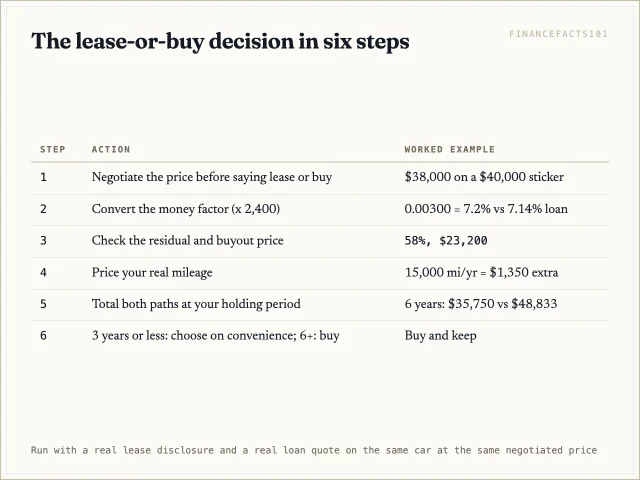
Total both paths at the number of years you honestly expect to keep the car. If that number is three, choose on convenience. If it is six or more, buying has a five-figure head start.
FAQ
Is it cheaper to lease or buy a car?
Over three years the two usually come close: in our $40,000 SUV example, buying and selling at year three nets about $900 less than leasing. Over six years buying and keeping is about $13,100 cheaper, and over ten years about $32,200 cheaper, because the owner stops paying for depreciation's steepest years and eventually stops making payments at all.
How do I convert a money factor to an interest rate?
Multiply it by 2,400. A money factor of 0.00300 is roughly a 7.2% annual rate, and 0.00250 is roughly 6.0%. Compare that with the loan rate you could get on the same car; in the Federal Reserve's May 2026 survey, banks' most common 60-month new-car rates averaged 7.14%.
Can I negotiate a car lease?
Yes. The capitalized cost is negotiable exactly like a purchase price, and it is the single biggest lever on the payment. The money factor can sometimes be negotiated down to the lessor's base rate, and fees and the mileage allowance can be adjusted before signing. The residual value is usually set by the lessor and is not negotiable.
What happens if I go over my lease mileage?
You pay the per-mile charge in your contract for every mile over the total allowance when you return the car. Toyota Financial Services, as one example, says its rate is typically $0.15 per mile, so 9,000 miles over costs $1,350. If you buy the car at lease end instead of returning it, the mileage charge generally does not apply, though you pay the buyout price.
Do I need gap insurance on a lease?
Only if the contract does not already include a gap waiver and you would owe more than the car is worth if it were totaled, which is most likely in the first year or two. Check the lease before buying separate coverage, and if you need it, compare the dealer's price with your auto insurer's.
Sources
- Consumer Financial Protection Bureau, What should I know about leasing versus buying a car? (last reviewed September 12, 2023)
- Consumer Financial Protection Bureau, 12 CFR § 1013.4, Content of disclosures (Regulation M)
- Consumer Financial Protection Bureau, 12 CFR § 1013.2, Definitions (Regulation M)
- Consumer Financial Protection Bureau, Consumer Leasing (Regulation M) Annual Threshold Adjustments (2026 threshold $73,400, published December 15, 2025)
- Consumer Financial Protection Bureau, What is Guaranteed Asset Protection (GAP) insurance? (last reviewed March 8, 2024)
- Federal Reserve, G.19 Consumer Credit release (September 8, 2026; bank rates surveyed May 2026)
- Federal Reserve, FOMC statement, September 16, 2026 (target range raised to 3-3/4 to 4 percent)
- Internal Revenue Service, Publication 463, Travel, Gift, and Car Expenses (2025 edition)
- Internal Revenue Service, Topic no. 510, Business use of car
- Internal Revenue Service, Standard mileage rates (2026 business rates)
- Internal Revenue Service, Rev. Proc. 2026-15 (inclusion amounts for leases beginning in 2026)
- Internal Revenue Service, One, Big, Beautiful Bill Act: tax deductions for working Americans and seniors (car loan interest deduction)
- Toyota Financial Services, What if I go over my mileage allowance? (one lessor's excess-mileage rate)
 Next entry · No. 5,973How Much Do I Need to Retire? Spending, Social Security and the 4% Rule
See also
-
 No. 5,971
05 Oct 2026
18 min
Car Loan Term: 48, 60, 72 or 84 Months - Which to Choose
Personal Finance
No. 5,971
05 Oct 2026
18 min
Car Loan Term: 48, 60, 72 or 84 Months - Which to Choose
Personal Finance -
 No. 5,942
13 Sep 2026
19 min
How Long It Takes to Pay Off a Credit Card at $8,000 and 22.15%
Personal Finance
No. 5,942
13 Sep 2026
19 min
How Long It Takes to Pay Off a Credit Card at $8,000 and 22.15%
Personal Finance -
 No. 5,939
11 Sep 2026
14 min
Emergency Fund: How Much and Where to Keep It
Personal Finance
No. 5,939
11 Sep 2026
14 min
Emergency Fund: How Much and Where to Keep It
Personal Finance -
 No. 5,936
08 Sep 2026
14 min
Debt Avalanche vs Snowball: Which Pays Off Faster
Personal Finance
No. 5,936
08 Sep 2026
14 min
Debt Avalanche vs Snowball: Which Pays Off Faster
Personal Finance -
 No. 161
07 Apr 2024
19 min
Understanding an Amortization Schedule: Breaking Down the Components of Your Loan Payments
Personal Finance
No. 161
07 Apr 2024
19 min
Understanding an Amortization Schedule: Breaking Down the Components of Your Loan Payments
Personal Finance -
 No. 5,965
29 Sep 2026
12 min
Cash-Out Refinance vs HELOC: The Blended-Rate Math on $50,000
Mortgage
No. 5,965
29 Sep 2026
12 min
Cash-Out Refinance vs HELOC: The Blended-Rate Math on $50,000
Mortgage