How Long It Takes to Pay Off a Credit Card at $8,000 and 22.15%
Minimums on $8,000 at 22.15% take 20 years and $13,268 of interest. What freezing the payment, adding $50, or a 0% transfer each save.
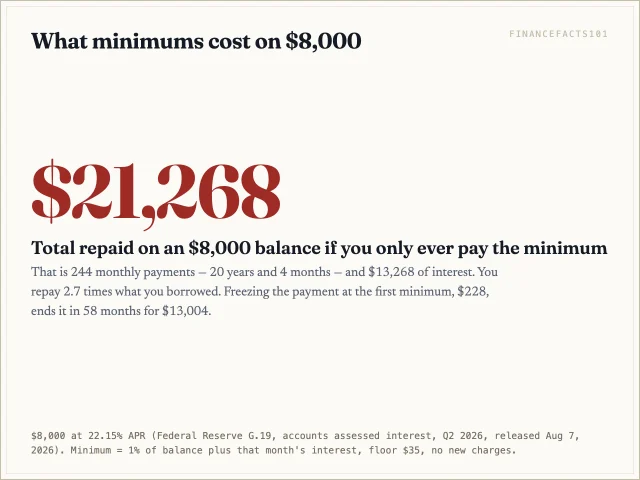
You owe $8,000 on a card at 22.15% and the statement asks for $228. Send exactly that and nothing more, and how long it takes to pay off a credit card stops being an abstraction: 244 payments, 20 years and 4 months, and $21,268 handed over on an $8,000 balance. Freeze the payment at that same $228 rather than letting it shrink every month, and the card is gone in 58 months for $13,004 — a difference of $8,264 in interest and more than fifteen years of your life, before you have looked at a single 0% offer.
That is the decision this guide answers: how much to send each month, and whether to move the balance. Everything below is built on $8,000 at 22.15% APR — the Federal Reserve's G.19 consumer credit release put the average rate on credit card accounts assessed interest at 22.15% for the second quarter of 2026, published August 7, 2026, with the all-accounts average at 20.94%. This is general information with its assumptions stated in the open, not personal advice; your card's APR, minimum formula and fees are in your own agreement and they are what actually govern.
How Long It Takes to Pay Off a Credit Card, Priced Three Ways
Three habits, one balance, one interest rate. The first lets the minimum payment fall as the balance falls, which is what happens by default when you pay whatever the statement asks. The second freezes the dollar amount at $228 — the first minimum — and never lowers it. The third pays $278, fifty dollars more.
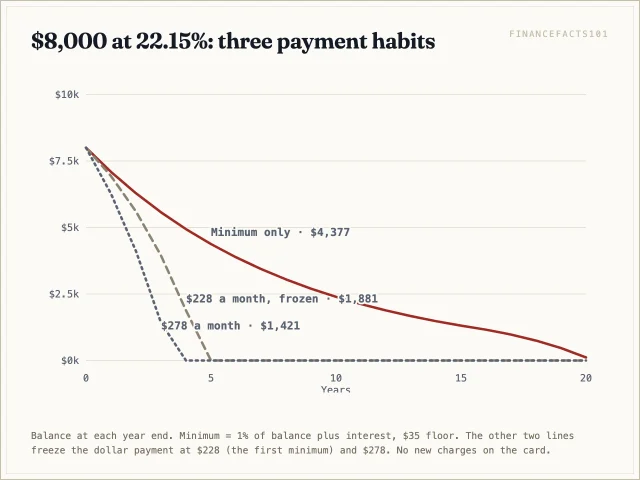
The gap is not subtle. After ten years of paying every minimum on time, never missing, never charging another dollar, you still owe $2,395 and have already paid $15,951. The frozen $228 payment cleared the same debt in year five. The $278 payment cleared it in year four, at a total interest cost of $3,515 against the minimum path's $13,268.
Nothing changed but the payment. Same card, same rate, same borrower. That is the lever; the rest of this guide is how to pull it, and when a transfer or a loan pulls it harder. Run your own balance and APR through the credit card payoff calculator — your chart will have this shape.
Who This Is For — and Who It Isn't
This is for someone carrying a revolving balance between roughly $2,000 and $30,000 on one to three cards, who can cover the minimums and has some room — even $25 a month — to do better. It assumes you are not adding new charges to the card you are paying down, because a payoff plan and an active spending habit on the same account cancel each other out.
It is not for someone who pays in full every month: clear the statement balance inside the grace period and you are borrowing at 0%, so the APR is irrelevant to you. It is not for medical debt, which has its own billing and charity-care rules. And it is not for someone who cannot make the minimums at all — skip to the credit counseling section, because no arithmetic here helps when the payment itself is out of reach. The debt-to-income calculator is a blunt but useful first read on which group you are in.
One caveat on sequencing. With no cash buffer at all, throwing every spare dollar at the card and re-charging the next car repair is a treadmill; a small starter buffer alongside the payoff usually beats a pure payoff, and the sizing argument is in the guide on how big an emergency fund should be.
How the Minimum Payment Is Actually Calculated
Issuers rarely use a flat percentage on its own. The common structure is a small slice of the principal — typically 1% — plus that month's interest and any fees, subject to a floor of about $25 to $35. Some use 2% plus interest; a few use a flat 2% or 3% with no interest add-on. Your card agreement states which, and the explainer on minimum monthly payments covers the variants.
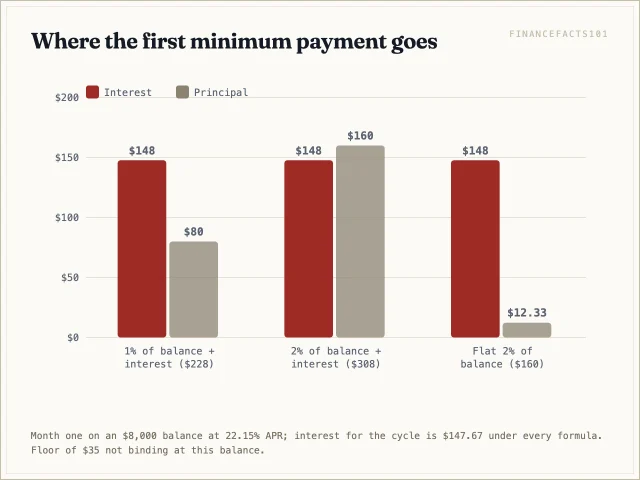
Look at what that structure does in month one. Interest on $8,000 at 22.15% is $147.67. Under 1%-plus-interest the minimum is $227.67, of which $80.00 — one percent of the balance — touches the principal. Under 2%-plus-interest the payment is $307.67 and $160.00 reaches principal, which is why that formula clears the same debt in 12 years instead of 20.
The flat-percentage version is the quiet menace. A flat 2% of $8,000 is $160, of which $147.67 is interest, leaving $12.33 against the balance. Above about a 24% APR a flat 2% minimum does not even cover the interest and the balance grows while you pay — the structural reason regulators pushed issuers toward interest-covering formulas after 2005, and why "2% minimum" and "1% plus interest" behave nothing alike.
The Credit Card Minimum Payment Trap Is a Shrinking Payment
Here is the mechanism almost no article names. Under a 1%-plus-interest formula, the share of your payment that reaches principal is fixed — and it is fixed low. Principal is 1% of the balance; interest is 1.8458% of the balance (22.15% divided by twelve). So principal is 0.01 ÷ (0.01 + 0.018458) of every dollar you send: 35 cents, month after month, for fifteen years. Sixty-five cents of every minimum payment is rent.
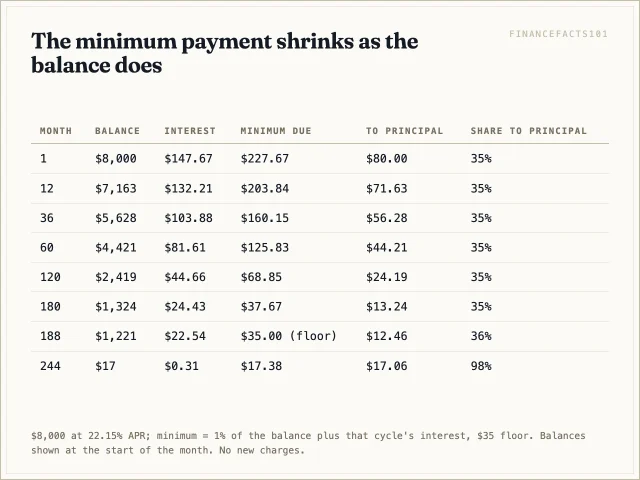
The credit card minimum payment trap is therefore not a high payment that never ends. It is a payment that gets smaller exactly as fast as your balance does, holding the ratio constant and the finish line at a fixed distance. Month one asks for $227.67, month 60 for $125.83, month 120 for $68.85. Each looks like progress; none changes the 35% split. Only at month 188, when the balance hits $1,221 and 1%-plus-interest falls below the $35 floor, does the floor start doing real work.
That is the whole reason freezing the payment is so powerful. Paying $228 in month 120 instead of the $68.85 the statement asks for is not heroic; it is simply refusing the discount the issuer keeps offering you.
The CARD Act Box on Your Statement, and How to Read It
You do not have to take my arithmetic on faith, because Congress made the issuer print it. Since the CARD Act of 2009, Regulation Z section 1026.7(b)(12) requires a repayment disclosure on every periodic statement where a balance is carried, computed under the formulas in Appendix M1. It shows how long minimum payments would take, what they would cost in total, and the fixed monthly payment that would clear the balance in 36 months.
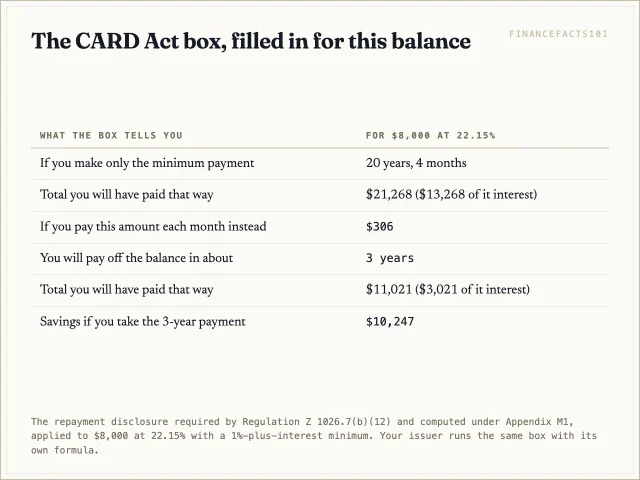
For our balance the three-year payment is $306 and the comparison is stark: $11,021 total versus $21,268, a $10,247 difference printed on your own bill each month. The box also carries a toll-free number for credit counseling referrals.
Two things it does not tell you, and both matter. First, as the CFPB spells out in its answer on what the three-year box means, the figures assume no future purchases. Keep spending on the card and the three-year payment will not clear it in three years. Second, the box offers only two speeds. There is nothing magic about 36 months, and the section below prices every speed in between.
Daily Periodic Rate: Why the Meter Runs Every Day
Your APR is an annual sticker price, but the charge is computed daily. Issuers divide the APR by 365 (some by 360) to get a daily periodic rate, then apply it to the average daily balance across the billing cycle. The CFPB's explanation of how card interest is calculated is blunt about the consequence: without a grace period, the sooner you pay, the less you owe.
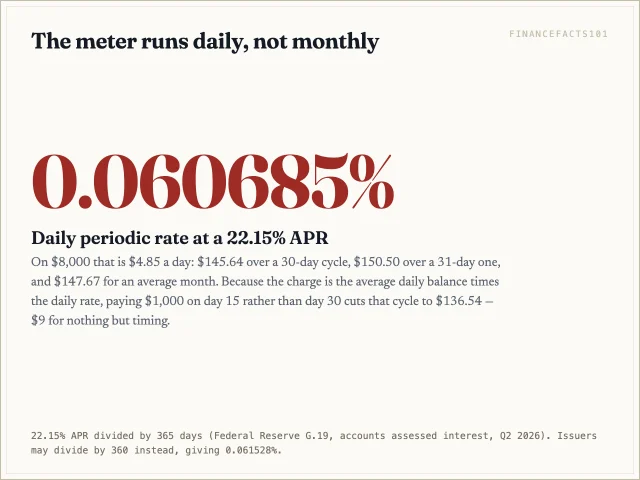
At 22.15% the daily rate is 0.060685%, or $4.85 a day on $8,000. Two consequences. One, timing is free money: a $1,000 payment made on day 15 of a 30-day cycle rather than day 30 drops the average daily balance from $8,000 to $7,500 and cuts that cycle's interest from $145.64 to $136.54 — about $100 a year for moving a calendar entry.
Two, the grace period dies the moment you revolve. On most cards, once you carry a balance, new purchases accrue interest from the transaction date until you pay the statement in full for two consecutive cycles — the engine described in the piece on the power of compound interest, running the wrong way. What the posted rate does and does not include is covered in the explainer on annual percentage rate.
What Each Extra $50 a Month Buys
This is the table to keep. Baseline is the frozen $228 payment; each row adds a fixed amount on top and holds it to the end.
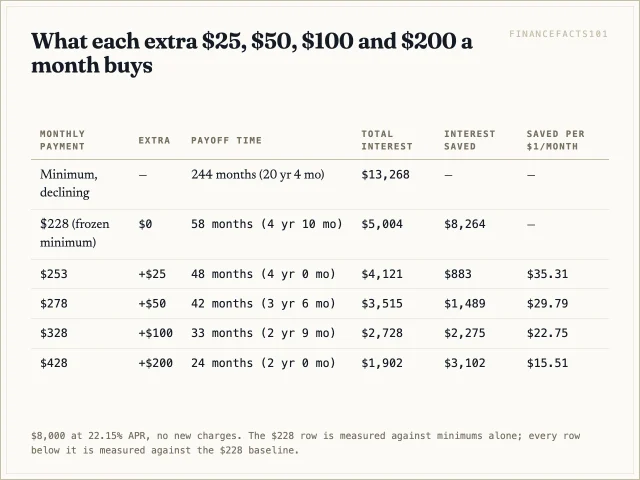
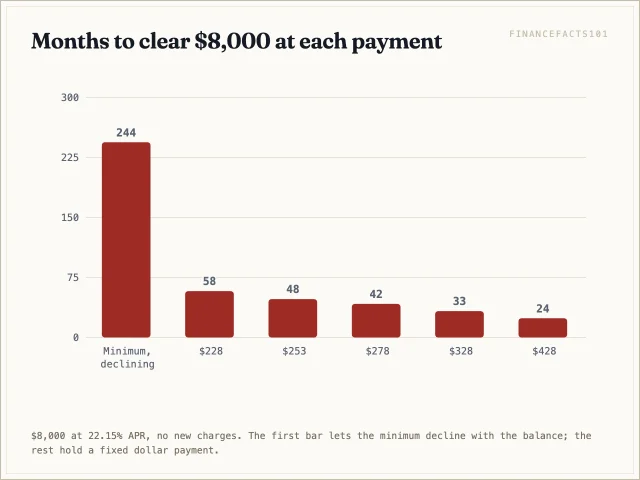
Read the last column, because it is the one nobody prints. The first $25 a month is worth $883 of avoided interest — $35.31 saved for every dollar of monthly commitment. The next $25 is worth $606 more. Stepping from $328 to $428 buys another $827, but that is $8.27 per dollar committed rather than $35. Extra payments have sharply diminishing returns, and the returns are highest at the very start, when the balance is largest and the daily rate is grinding on the most money.
The practical reading: if you can find $25 a month, find it now rather than waiting until you can find $200. And if you are choosing between $50 extra on the card at 22.15% and $50 extra into savings at 4%, the card wins by roughly five to one — not a close call, and not dependent on any forecast.
The Three-Year Payoff, Payment by Payment
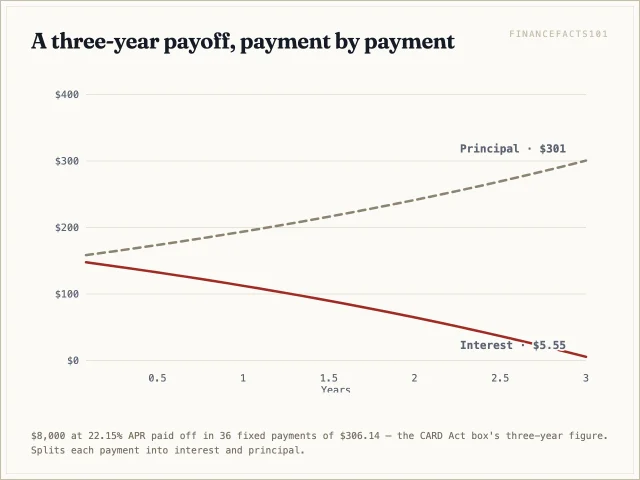
Fix the payment at the CARD Act box's $306.14 and the card behaves like an ordinary installment loan. The split between interest and principal inverts almost immediately: month one is $147.67 interest and $158.48 principal — principal wins from the first payment — and by month 36 it is $5.55 interest against $300.60 principal.
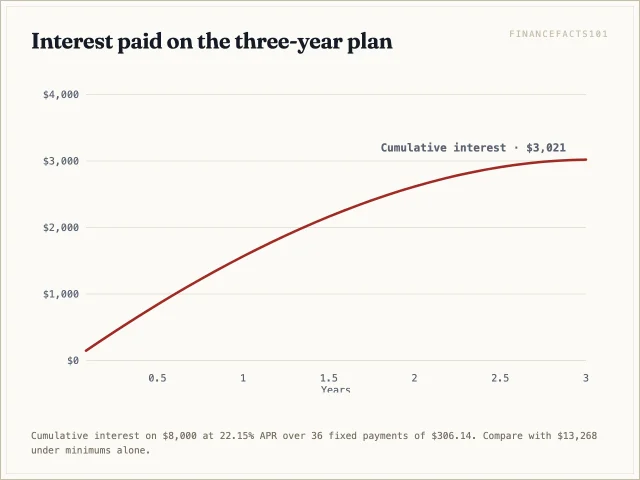
Cumulative interest over the 36 payments comes to $3,021, against $13,268 on the minimum-only path. The curve flattens because every payment permanently shrinks the base the daily rate applies to, and unlike the minimum, the payment does not shrink with it. That is what escaping the trap amounts to: converting a revolving balance into a fixed-payment loan without changing lenders. To test a payment you can actually sustain — $260, $315, whatever your budget bears — the credit card payoff calculator returns the month count and interest total for that exact figure.
0% Balance Transfers With the Fee Priced In
A 0% transfer is the cheapest legitimate route out of card debt for anyone who qualifies, and the fee is what people forget to price. As of September 2026 the long offers run 18 to 21 months at 0%, with fees of 3% to 5%. Several major issuers charge 3% on transfers made in the first 60 to 120 days and 5% after, while Wells Fargo's Reflect card charges 5% on every transfer, so read the fee line of the specific offer before you move a balance.
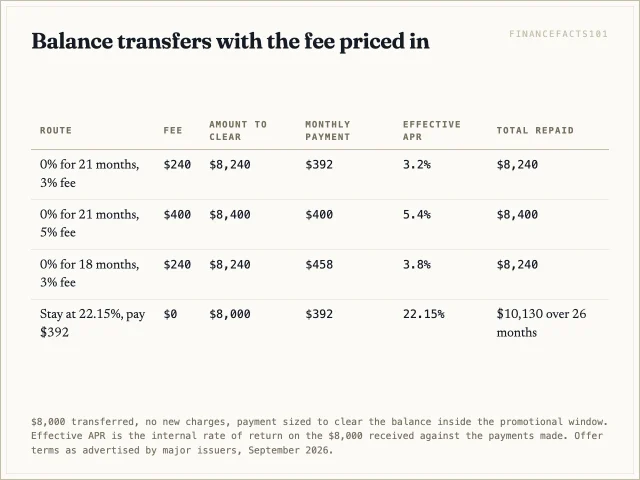
On $8,000 a 3% fee is $240 against $147.67 of interest in a single month: the fee breaks even in 1.6 months. Everything after is savings, which is why the 21-month, 3%-fee route costs an effective 3.2% a year against 22.15% on the card. Even the 5% fee prices at 5.4%.
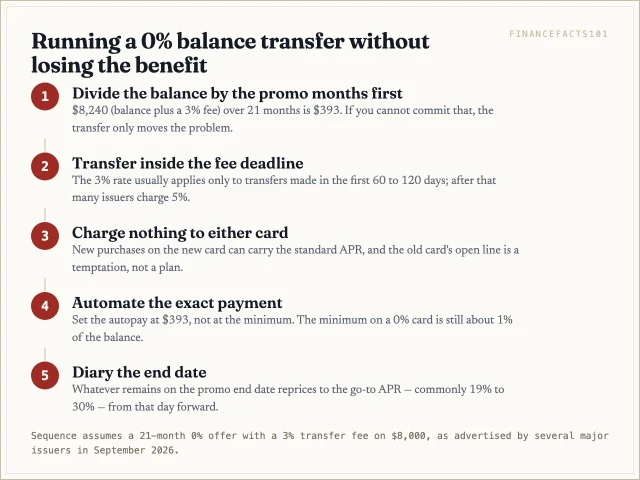
One condition governs all of it: the payment must clear the balance inside the window. $8,240 over 21 months is $393 a month, and paying it means you repay $8,240 total. Pay only the new card's minimum — still about 1% of the balance, roughly $82 — and month 21 arrives with $3,459 still owed, repricing to a go-to APR commonly between 19% and 30%. A transfer you cannot finish is a delay, not a fix. One rule works in your favor: under Regulation Z 1026.53, anything above the minimum must go to the highest-APR balance first, so a purchase accidentally made on the transfer card is attacked before the 0% balance.
The Deferred-Interest Trap, Which Is Something Else Entirely
Do not confuse a 0% promotional APR with deferred interest, the structure common on store and medical financing cards. Under a true 0% promo, interest simply does not accrue during the window and only the remaining balance is repriced afterward. Under deferred interest, interest accrues the whole time and is merely held back — and if any balance remains at the end of the window, or you are more than 60 days late on a payment, the issuer bills all of it, retroactive to the purchase date.
The CFPB's guidance on no-interest-if-paid-in-full offers makes the trap explicit: your minimum payments probably will not clear the balance by the deadline. On $8,000 at a 26.99% deferred rate over 12 months, a $50 shortfall on the final payment can trigger close to $1,200 of back interest. The Bureau has tracked deferred-interest volumes and marketing practices across its biennial Consumer Credit Card Market Report, published December 30, 2025. The defense is arithmetic: divide the balance by the months in the window, subtract one month for safety, and pay that.
Personal Loan Consolidation, Compared Honestly
An unsecured personal loan swaps a revolving balance for a fixed one. The Federal Reserve's G.19 series put the average rate on 24-month bank personal loans at 11.86% in May 2026. On $8,000 over 36 months that is $265 a month, $9,546 repaid, $1,546 of interest — better than any fixed-payment route on the card, worse than a 0% transfer you can finish.
Three honest caveats. That 11.86% is an average; borrowers with scores in the 600s are routinely quoted 18% to 30%, at which point the loan is not obviously better than the card. Many personal loans carry an origination fee of 1% to 8% deducted from the proceeds, so ask for the APR including fees, not the interest rate. And — this is where consolidation most often fails — paying off a card with a loan leaves the card at a zero balance with a full credit line and roughly the habits that filled it the first time.
A loan is the right tool when the quoted APR including fees is meaningfully below your card APR, the term is 60 months or shorter, and you are confident the cards stay unused. Otherwise a fixed payment on the card captures most of the benefit with none of the paperwork.
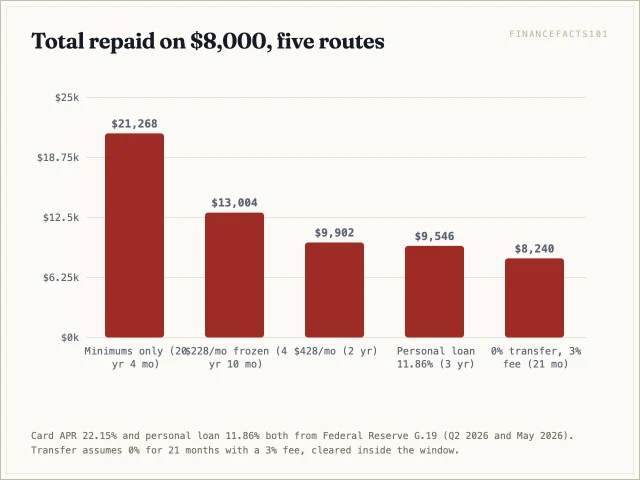
Set the five routes side by side and the ordering is stable: minimums repay $21,268, a frozen $228 payment $13,004, $428 a month $9,902, a 36-month personal loan at 11.86% $9,546, and a completed 0% transfer $8,240. Every one of them beats doing nothing by more than the gap between any two of them.
Pay It Down, Leave It Open
Once the balance is gone, the instinct is to close the account. Usually, do not. Credit utilization — balances divided by total available credit — is a heavily weighted scoring factor, and the CFPB's guidance on closing a credit card is direct: closing an account removes its limit from the denominator, so the same debt elsewhere becomes a higher ratio and your score can fall.
The arithmetic is easy to see. With $8,000 owed against $20,000 of total limits, utilization is 40%. Pay the balance down to $2,000 and it is 10%. Pay it to $2,000 but close a $6,000 card at the same time and it is 14% instead — you did the work and handed back part of the reward. A common target is under 30%, and lower is better.
Closing still makes sense in narrow cases: an annual fee you no longer use, a card you cannot stop spending on, a joint account after a separation. Otherwise leave it open with a small recurring charge on autopay so the issuer does not close it for inactivity. One timing detail catches people out: utilization is reported from the statement balance, so a card you pay in full each month can still report high if you charge heavily before the statement date.
More Than One Card: Which Order to Pay
With several balances the question is where the money above the combined minimums goes. Take $13,000 across three cards — $8,000 at 22.15%, a $1,800 store card at 28.99%, and $3,200 at 19.99% — with $500 a month to spend against combined minimums of $367.
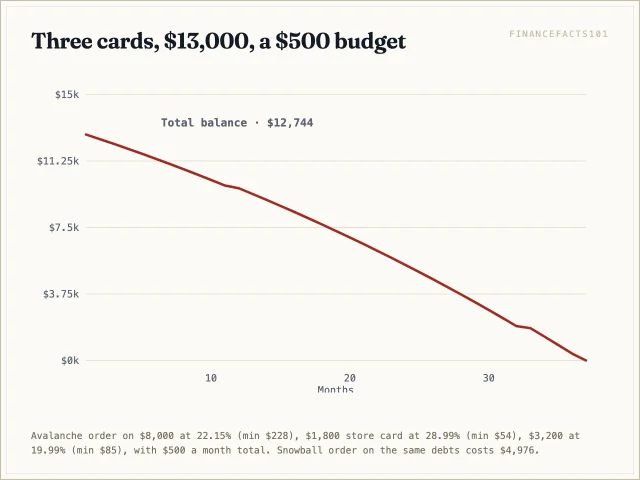
Highest-rate-first (the avalanche) clears everything in 37 months for $4,874 of interest. Smallest-balance-first (the snowball) takes the same 37 months and costs $4,976, so the mathematically optimal order wins by $102 here — real, but smaller than the value of a method you will actually stick to. The full argument is in debt avalanche vs snowball, and your own set goes through the debt payoff calculator; with wider rate spreads the avalanche's edge grows quickly.
When the Honest Answer Is Credit Counseling
If the combined minimums exceed what you can pay, none of the above applies: no payment plan works when the payment is unaffordable, and a transfer needs a score you probably no longer have. What does work is a nonprofit credit counseling agency and, if it fits, a debt management plan — the agency negotiates concessions with your issuers, typically APRs cut to the 6% to 10% range plus waived fees, you make one monthly payment to the agency, and the cards close for the duration.
The FTC's guidance on how to get out of debt is worth reading before you call anyone, because the sector holds both genuine nonprofits and predators. Its warnings are specific: nonprofit status alone guarantees nothing about fees or legitimacy, no legitimate counselor recommends a plan before reviewing your finances in detail, and anyone demanding payment before doing any work is running a scam. Interview more than one and ask for the fee schedule in writing.
Expect a plan to run three to five years, expect the closed accounts to shorten your average account age, and expect the credit report to note the plan. Those are real costs — smaller than twenty years of minimum payments, and far smaller than default.
The Decision, in One Table
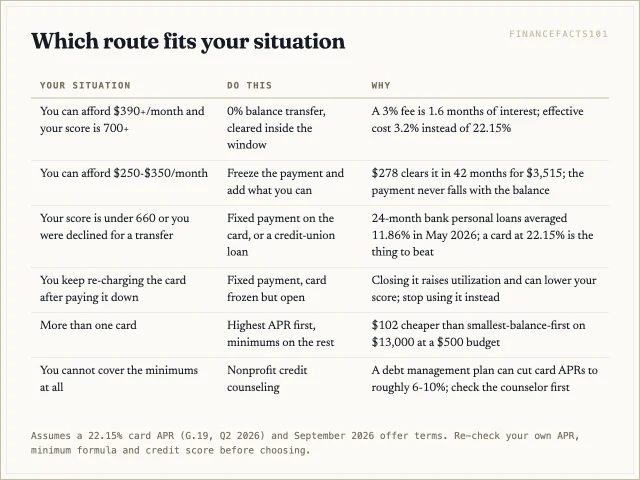
If you do one thing after reading this: look up the exact minimum your statement asks for, set an automatic payment for that amount as a fixed dollar figure, and never let it fall again. On $8,000 at 22.15% that change alone is worth $8,264 and fifteen years. The extra $50, the transfer, the loan — all optimization on top of a decision you can make in four minutes tonight.
FAQ
How long does it take to pay off $8,000 in credit card debt?
At 22.15% APR with a 1%-plus-interest minimum and a $35 floor, minimums alone take 244 months — 20 years and 4 months — and cost $13,268 in interest. Paying off $8,000 of credit card debt in reasonable time means fixing a dollar payment: $228 clears it in 58 months, $306 in 36, $428 in 24, with interest of $5,004, $3,021 and $1,902 respectively.
Why does paying the minimum take so long if the balance is going down?
Because the minimum goes down with it. Under the standard 1%-plus-interest formula, principal is 1% of the balance and interest about 1.85% of it, so exactly 35 cents of every dollar reaches the debt — permanently. The payment shrinks in step with the balance, holding that ratio and the finish line constant. Freezing the dollar amount breaks the pattern.
Is a balance transfer worth the fee?
On $8,000 at 22.15%, a 3% fee is $240 — about 1.6 months of interest — so it pays for itself in under two months and prices out at an effective 3.2% APR over a 21-month window. It is worth it only if you can pay $393 a month to clear $8,240 inside that window; on the new card's minimum alone you reach the end still owing about $3,459 at the go-to rate.
Should I close the card after I pay it off?
Usually not. Closing removes that card's limit from your utilization ratio, so remaining balances look like a larger share of available credit and your score can fall. Keep it open with a small autopaid recurring charge unless it carries an annual fee you do not use, or you cannot stop spending on it.
What if I cannot afford the minimum payments at all?
Contact a nonprofit credit counseling agency rather than trying anything here. A debt management plan can cut card APRs to roughly 6% to 10% and consolidate the payments, at the cost of closing the accounts for three to five years. Check the agency against the FTC's warning signs first: no upfront fees, no plan recommended without a full review of your finances, a written fee schedule.
Sources
- Federal Reserve, G.19 Consumer Credit release — 22.15% average APR on accounts assessed interest, 20.94% across all accounts, Q2 2026, released August 7, 2026; 24-month personal loan rate 11.86%, May 2026
- CFPB, Regulation Z § 1026.7, Periodic statement — the CARD Act repayment disclosure
- CFPB, Regulation Z Appendix M1, Repayment Disclosures — the formulas behind that box
- CFPB, Regulation Z § 1026.53, Allocation of payments — excess payments go to the highest-APR balance first
- CFPB, What the three-year payoff box on my statement means
- CFPB, How does my credit card company calculate the interest I owe? — daily periodic rate and average daily balance
- CFPB, No interest if paid in full: deferred interest offers
- CFPB, Does it hurt my credit to close a credit card?
- CFPB, The Consumer Credit Card Market report — biennial review, December 30, 2025
- FTC, How To Get Out of Debt — counseling, debt management plans, scam signs
- Bankrate, Best balance transfer cards, September 2026 — 0% window lengths and transfer fees
- FRED, St. Louis Fed, Commercial bank interest rate on 24-month personal loans — the G.19 personal loan series
 Next entry · No. 5,943Capital Gains Tax on Stocks: The One Day That Costs $1,800
See also
-
 No. 5,975
09 Oct 2026
19 min
Balance Transfer vs Personal Loan: Which Clears Card Debt Cheaper
Personal Finance
-
 No. 5,980
14 Oct 2026
21 min
Pay Off Debt or Invest? Compare Two After-Tax Rates
Personal Finance
-
 No. 5,936
08 Sep 2026
14 min
Debt Avalanche vs Snowball: Which Pays Off Faster
Personal Finance
-
 No. 815
13 Jun 2024
19 min
Understanding Your Credit Card Balance and its Impact on Your Credit Score
Personal Finance
-
 No. 5,280
26 Aug 2025
20 min
Understanding Universal Default: What You Need to Know About This Credit Card Provision
Personal Finance
-
 No. 955
07 Jul 2024
20 min
Understanding Delinquent Account Credit Cards: Consequences and Mitigation Strategies
Personal Finance