Balance Transfer vs Personal Loan: Which Clears Card Debt Cheaper
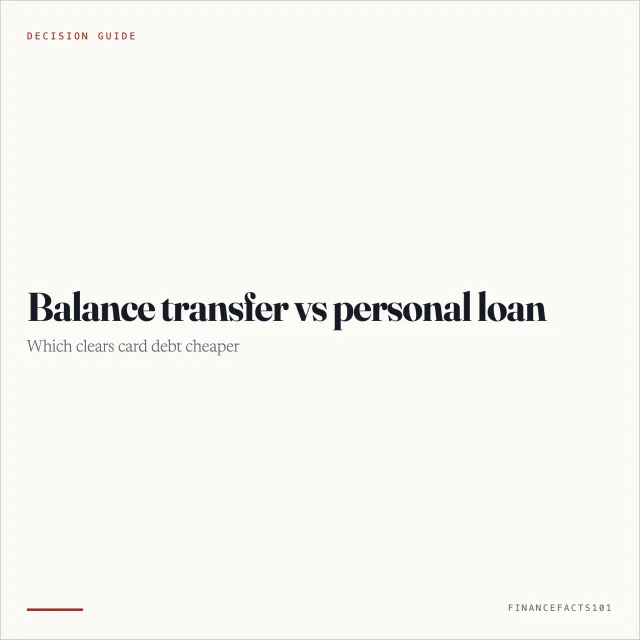
A 0% transfer with a 5% fee clears $12,000 of card debt for $600 to $1,168; an 11.86% personal loan costs $2,320. The break-even is about $255 a month.
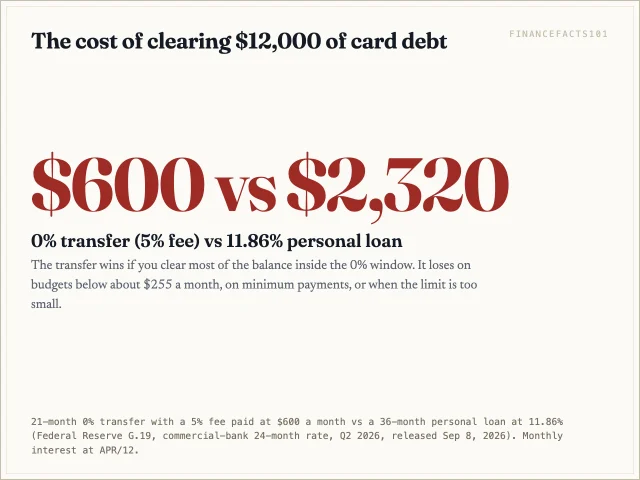
A 0% balance transfer card is usually the cheaper way to pay off credit card debt, provided you can clear most of the balance before the promotional window closes. On $12,000 of card debt, a 21-month 0% card with a 5% fee costs $600 if you pay $600 a month, while a 36-month personal loan at 11.86% (the Federal Reserve's average rate on 24-month bank personal loans for the second quarter of 2026, published in the G.19 release of September 8, 2026) costs $2,320 in interest. The balance transfer vs personal loan answer flips in three situations: you can only afford about $255 a month or less on that $12,000, you would pay only the new card's minimum, or you cannot get a credit limit big enough to move the whole balance.
This guide prices both routes on one named balance, shows the federal rules that govern a 0% promotion and what happens the day it ends, works out each break-even, and walks through the credit-score effects. Everything below is general information built on stated assumptions and on rates and offers checked in late September 2026. It is not personal advice, and the offer you are actually approved for is the one that counts.
Balance Transfer vs Personal Loan: Two Ways to Refinance the Same Debt
Both routes swap a balance charging around 22% for something cheaper. What they swap it for differs.
A balance transfer moves the debt onto a new credit card that charges 0% for a set period, usually 15 to 21 months, in exchange for a one-time fee of 3% to 5% of the amount moved. The debt stays revolving. There is no required payoff date, and the minimum payment is small. When the window closes, whatever is left starts accruing at the card's ordinary variable APR.
A personal loan pays the cards off with a fixed-rate installment loan: one rate, one payment, one last payment date, usually two to seven years out. Some lenders take an origination fee out of the money they send you. Nothing expires and nothing reprices, but you pay interest from the first day.
The CFPB's guidance on consolidating credit card debt (last reviewed September 2, 2026) warns about both: promotional transfer rates are temporary, and a lower loan payment can simply mean a longer term.
Who This Is For — and Who It Isn't
This guide is for someone carrying $3,000 to $30,000 on one or more credit cards at a typical rate of around 22%, who can make every payment on time and wants to know which refinancing route costs less. It assumes a credit profile good enough to be offered both. Top 0% offers and the better loan rates generally go to applicants with good or better credit.
It is not for someone whose combined minimums already exceed what they can pay. Neither product fixes that; a nonprofit credit counselor is the next step, covered in how long it takes to pay off a credit card along with deferred-interest store cards. Choosing which of several debts to pay first is debt avalanche vs snowball. Home-equity loans are out of scope too: they secure card debt against your house, which the CFPB warns can end in foreclosure.
What 0% Offers Look Like in September 2026
The numbers below come from each issuer's own pages, checked September 27, 2026. They are examples of what is on offer, not an industry standard, and issuers change them without notice.
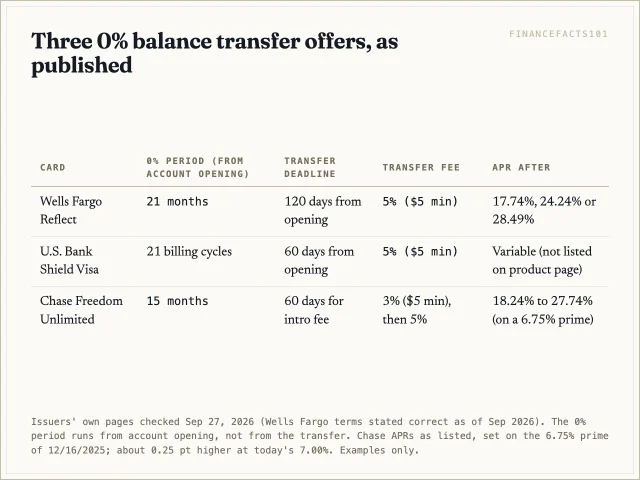
Wells Fargo's Reflect terms give a "0% introductory APR for 21 months from date of account opening" on transfers requested within 120 days, a fee of 5% of each transfer ($5 minimum), and afterwards a variable APR of 17.74%, 24.24% or 28.49% depending on creditworthiness. That rate is the U.S. prime rate, 7.00% on the page's date, plus a margin of 10.74, 17.24 or 21.49 points. The U.S. Bank Shield Visa offers 0% for 21 billing cycles on transfers made within 60 days, also at 5%. The Chase Freedom Unlimited pricing page offers 0% "for the first 15 months that your Account is open" and a cheaper intro fee: $5 or 3%, whichever is greater, on transfers made within 60 days, then $5 or 5%. Its listed 18.24% to 27.74% afterwards is, in the page's words, "based on the 6.75% Prime Rate as of 12/16/2025"; with the same margins on today's 7.00% prime it would be 18.49% to 27.99%.
Three details in the fine print matter more than the headline. The fee is added to the balance: moving $12,000 at 5% puts $12,600 on the new card, and Wells Fargo states that the transfer plus fees cannot exceed your available credit. You cannot move a balance within the same bank; Wells Fargo excludes its own accounts. And transferred balances accrue interest from the transaction date, as both Chase and Wells Fargo state, so a transfer requested after the 60- or 120-day deadline starts at the regular APR on day one. Keep paying the old card until the transfer posts, which Wells Fargo says takes about two weeks. And transfer early: on all three cards the 0% clock starts when the account opens, not when the transfer lands, so a transfer made in month three gets fewer 0% months. The worked example below assumes the transfer is made at opening.
Longer window or cheaper fee? On $12,000 the 15-month, 3% card costs $360 if you pay $824 a month. The 21-month, 5% card costs $600 at $600 a month. The two break even at about $600 a month. Pay more than that and the cheaper fee wins; pay less and the extra six months at 0% is worth more than the two points of fee.
What Personal Loans Cost Now
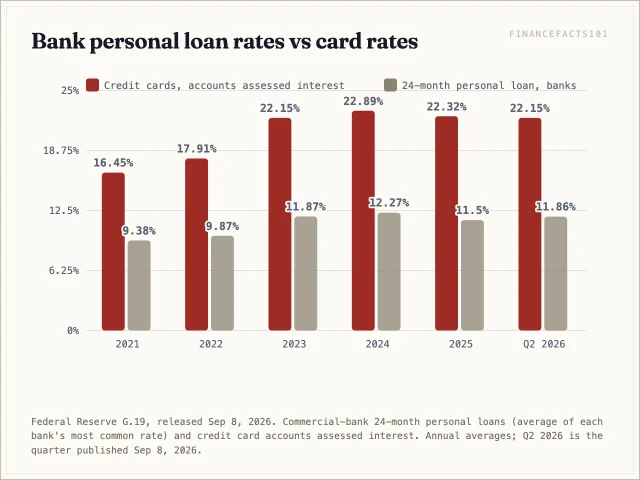
The Federal Reserve's G.19 release reports the average rate on 24-month personal loans at commercial banks each quarter. The figure for the second quarter of 2026, in the release of September 8, 2026, is 11.86%, against 22.15% on credit card accounts that were charged interest. The Fed's footnote explains how that loan rate is built: it is a simple, unweighted average of each bank's most common rate, measured in the first calendar week of the middle month of the quarter. So it is a typical bank rate in May 2026, not the rate every applicant gets, and online lenders are not in it. The G.19's finance-company rates cover only new-car loans, so there is no official finance-company personal-loan figure.
That rate also predates the Federal Reserve's September 16, 2026 decision to raise the federal funds target range to 3-3/4 to 4 percent. The prime rate moved from 6.75% to 7.00% the next day and stood there on the Fed's H.15 release through September 24. Variable card APRs follow prime, so most cards now cost about a quarter point more than the G.19 averages; the prime rate guide traces that pass-through. A fixed-rate personal loan is priced once, at origination. A newer G.19, released in early October, adds third-quarter rates; check it for the current average.
Individual lenders publish much wider ranges than the average. Best Egg lists APRs of 6.99% to 35.99%, including an origination fee of 0.99% to 9.99% that is taken out of the loan proceeds, and a fee of at least 4.99% on terms of four years or longer. Discover Personal Loans advertises no fees of any kind but says its loans cannot be used to pay any Capital One account directly, Discover cards included. LightStream states no fees or prepayment penalties. Compare offers on the APR, which includes the fee, not the interest rate alone.
The Worked Example: $12,000 at 22.15%, Four Routes
The assumptions: the balance is $12,000 on cards charging 22.15%, the G.19 average. The budget is about $400 a month. Interest is calculated monthly at APR/12, the same method as the site's credit card payoff calculator. There are no new charges and every payment is on time.
- Stay on the card at $400 a month. The first month's interest is $221.50, so only $178.50 of the payment reduces the debt. Payoff takes 45 months and $5,647 of interest.
- Personal loan, 36 months at 11.86%, no fee. The payment is $397.77, you repay $14,320 in total, and the interest is $2,320. The last payment date is fixed on day one.
- Balance transfer, 21 months at 0%, 5% fee, $400 a month. The fee is $600, so $12,600 moves to the new card. Twenty-one payments of $400 clear $8,400. The remaining $4,200 moves to the card's ongoing rate. At the 24.24% middle tier it takes 12 more payments and $568 of interest. Total cost: $1,168, over 33 months.
- The same transfer at $600 a month. $12,600 divided by 21 is $600, so the balance hits zero in the last 0% month. Total cost: $600, over 21 months.
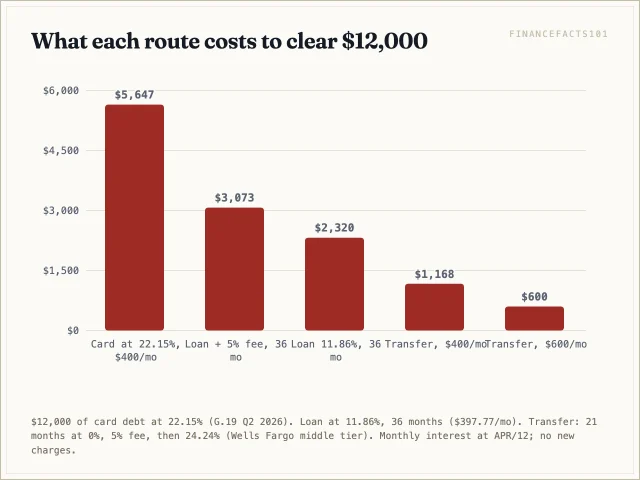
The surprising row is the third. At the same $400 a month as the loan, with a third of the balance still owed when the promotion ends, the transfer costs about half as much. In the top 28.49% tier it costs $1,289 over 34 months, still well under the loan.
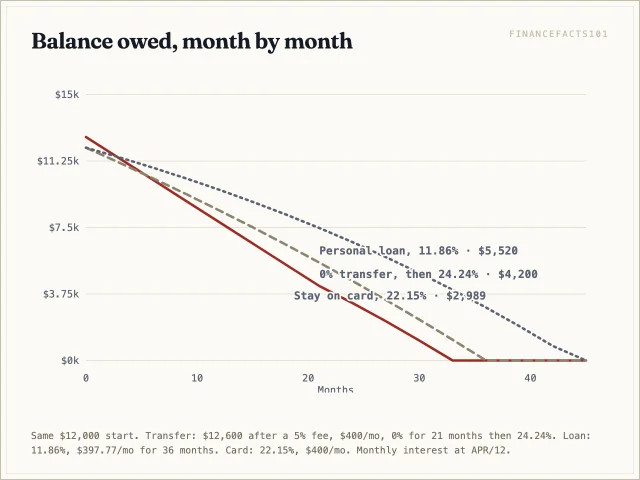
The transfer balance falls by the full $400 a month because none of it goes to interest; the loan's falls more slowly at first. The loan's advantage is that it reaches zero on a known date whatever happens to rates or to your promotional terms.
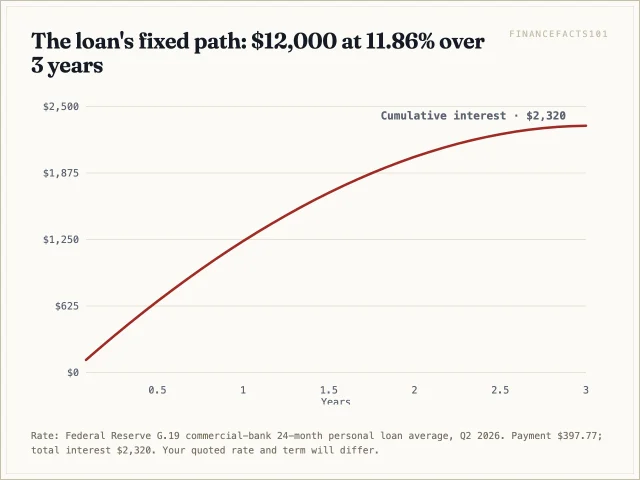
Run your own stay-on-the-card numbers in the credit card payoff calculator, or several cards in the debt payoff calculator.
The Origination Fee, Priced Properly
An origination fee is taken out of the money the lender sends. With a 5% fee, a $12,000 loan pays out $11,400 and leaves $600 of card debt behind. To clear the full $12,000 you would need to borrow $12,632.
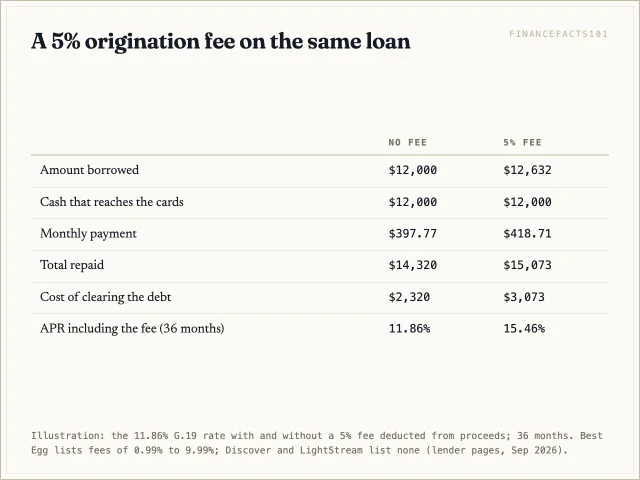
At the same 11.86% rate over 36 months, the payment rises to $418.71 and the total repaid to $15,073. The cost of clearing the debt goes from $2,320 to $3,073, and the true APR over those 36 months, counting the fee, is 15.46%. That is the number to compare against a transfer. Because the fee is paid once, it weighs more on a short loan, which is why a no-fee loan at a slightly higher rate can beat a fee loan at a lower one.
What Happens When the 0% Window Closes
On the first day after the promotional period, whatever balance is left starts accruing at the rate the issuer disclosed before you opened the account. In the example, the remaining $4,200 on the Wells Fargo terms begins accruing at 17.74%, 24.24% or 28.49%, plus any change in prime between now and then. The first month at 24.24% costs $84.84.
A true 0% promotion is not charged retroactively. That is the difference from a deferred-interest offer, where interest builds up in the background and all of it is billed if a single dollar is left at the deadline. The credit card payoff guide covers that trap in detail.
The real damage comes from paying only the minimum. Assume the new card asks for interest plus 1% of the balance, with a $40 floor (U.S. Bank's own transfer calculator uses $40 or 1%). Then $12,600 falls only to about $10,203 by month 21. From there, a minimum that shrinks with the balance at 24.24% takes the payoff to 280 months and about $19,420 in fees and interest. That is far worse than simply paying $400 a month on the old card. A transfer makes paying debt down cheaper only if you pay it down.
If a balance remains, the fallbacks are a second transfer (another 3% to 5% fee, another application, no guarantee of approval) or a personal loan for what is left, and a $4,200 loan is easier to get than a $12,000 one.
The CARD Act Rules That Protect a 0% Promotion
Regulation Z, which implements the Credit CARD Act of 2009, makes a 0% promotion harder to lose than its reputation suggests, though not everything is protected.
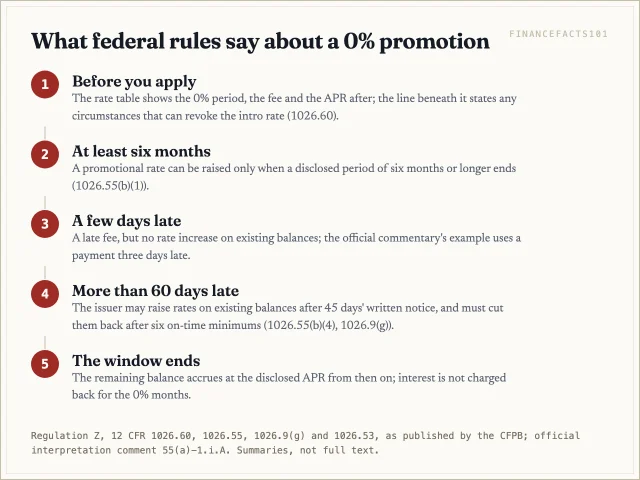
The six-month floor. Under 12 CFR 1026.55(b)(1), an issuer may raise a promotional rate only "upon the expiration of a specified period of six months or longer," and only if it disclosed the period and the rate that follows in advance. The CFPB's answer on introductory rates sums it up: the rate stays in place for at least six months unless you are more than 60 days late.
Being a few days late is not the same as being 60 days late. The official interpretation of § 1026.55 includes a worked example, comment 55(a)-1.i.A. A payment arrives three days late during a six-month promotional rate, and the issuer is "prohibited by § 1026.55 from increasing the rates" on the existing balances. Once a required minimum payment is more than 60 days late, § 1026.55(b)(4) lets the issuer raise the rate on existing balances, promotional ones included. It must first give written notice at least 45 days before the increase and must lower the rate again after six consecutive on-time minimum payments. A merely late payment still costs a late fee (up to $40 on the Wells Fargo terms) and can harm your credit. Chase's pricing page lists a penalty APR of up to 29.99% for a missed minimum that "could potentially remain in effect indefinitely"; the federal limits above still govern existing balances, and § 1026.55(b)(3)(iii) bars advance-notice increases in an account's first year.
Read the line under the rate table. Section 1026.60 requires the application disclosure to state, directly beneath the table, the circumstances, if any, under which the introductory rate can be revoked. Read that line before you apply.
Payment allocation, and why new purchases hurt. Under § 1026.53, any amount above the minimum must go "first to the balance with the highest annual percentage rate." The minimum payment itself is not covered by that rule. Wells Fargo and U.S. Bank both say they apply it to lower-rate balances first, which on a transfer card means the 0% balance.
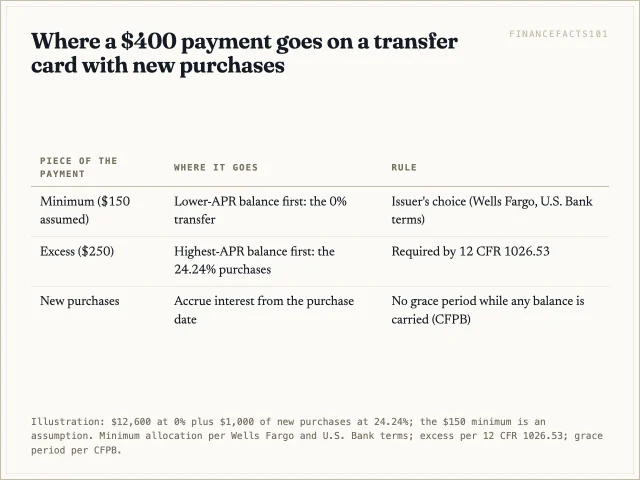
New purchases cost more than the allocation rule suggests. The CFPB explains that on most cards, while you carry any balance month to month, including a 0% transferred balance, new purchases accrue interest from the date you make them. The clean setup: move the debt to the transfer card and put no new purchases on it.
Where Each One Wins: The Break-Even
At what payment does the answer change? Here both routes get the same monthly budget, and the loan's term is whatever that budget pays off.
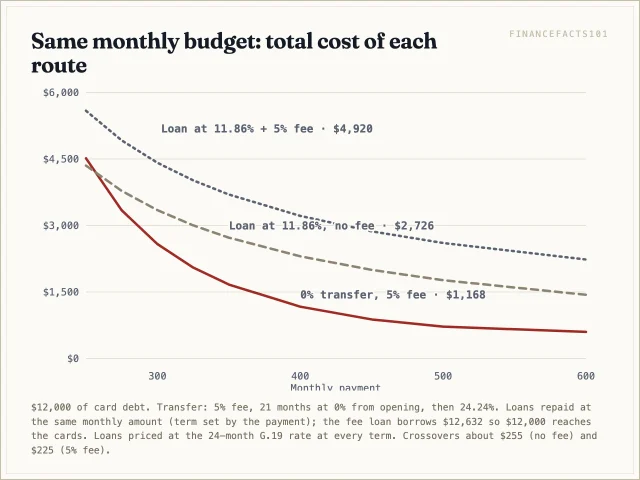
Against an 11.86% no-fee loan, the 21-month, 5% transfer (with 24.24% afterwards) is cheaper at any budget above about $255 a month on $12,000. At exactly that payment both take 64 months and cost $4,214. The transfer card still owes $7,237 when the promotion ends, 57% of what was moved. At the 28.49% top tier the break-even rises to about $290. Against the same 11.86% loan with a 5% origination fee (borrowing $12,632 to clear $12,000), the transfer wins down to about $225. A simple rule follows: if you will still owe more than about half the transferred balance when the 0% period ends, the loan is probably cheaper.
The second break-even runs the other way. How cheap would a loan have to be to beat a transfer you actually finish?
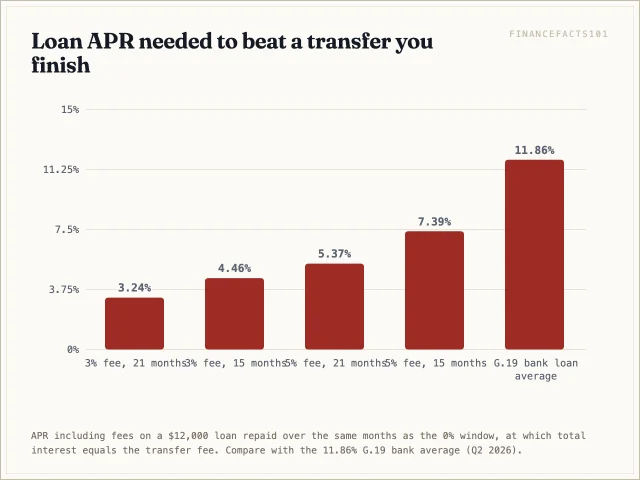
To beat a 5% fee over 21 months, a loan repaid over the same 21 months needs an APR, fees included, below about 5.37%. To beat the 3%, 15-month offer it needs about 4.46%. Neither is close to 11.86%. A transfer completed on time beats any personal loan at current rates; the loan's case is insurance against a budget below the break-even, a limit too small to move everything, or a promotion lost to a 60-day delinquency.
Credit Score Effects: Utilization, Inquiries, New Accounts
Both routes start with a credit application and change utilization in different ways. An illustrative profile: $12,000 owed on existing cards with $20,000 of total limits, and a new transfer card approved with a $13,000 limit.
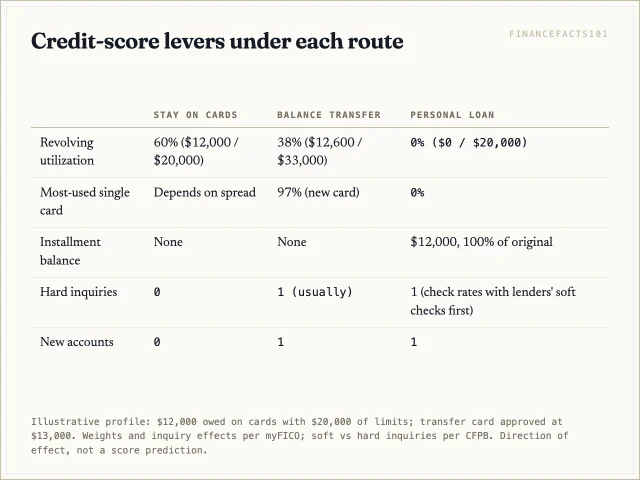
Utilization. myFICO puts amounts owed at 30% of a FICO Score, with revolving utilization (card balances divided by card limits) at its center. The loan route takes revolving utilization from 60% to 0%, because the debt moves to an installment account. That loan starts at 100% of its original amount, which FICO also considers, and falls as you pay it. The transfer route adds a limit, so overall utilization drops from 60% to about 38% ($12,600 of $33,000). The new card itself, though, is 97% used, a near-maxed account the combined figure hides, and myFICO notes that more accounts carrying balances can signal risk too. The entry on card balances and your score explains the ratio. Either way, keep paid-off cards open; closing them removes their limits and pushes utilization back up.
Inquiries. Each application usually means a hard inquiry. The CFPB notes that most scoring models consider how recently and how often you apply, while soft inquiries, such as a lender's prescreening or your own credit check, do not. Lenders such as Best Egg and Discover say checking your rate with them does not affect your score. myFICO says one additional inquiry takes fewer than five points off most people's FICO Scores, counts for one year and stays on the report for up to two. Its rate-shopping treatment, which counts several applications as one, applies to mortgage, auto and student loans. Credit cards and personal loans are not on that list, so compare loan offers through prequalification before you formally apply. There is more in the hard inquiries entry.
New account age. Either route adds one new account, lowering your average account age equally, so it does not separate the two.
The Failure Mode Both Share: Spending the Freed-Up Limit
Either route leaves the old cards at zero with their full limits free. The CFPB's consolidation guidance makes the point that consolidating without changing spending habits tends to fail. If $3,000 of new charges builds up on those cards within a year, you are paying the refinanced debt and a new balance, and none of the math above holds.
The loan at least locks the pace on the refinanced debt: a fixed payment and a set end date. On the transfer card, the small minimum forces nothing, which is why this guide's rule rests on the payment you will actually make, not the one you intend to. Automate the amount that clears the balance, $600 a month on the example transfer, and leave the old cards at home rather than closing them.
The Decision
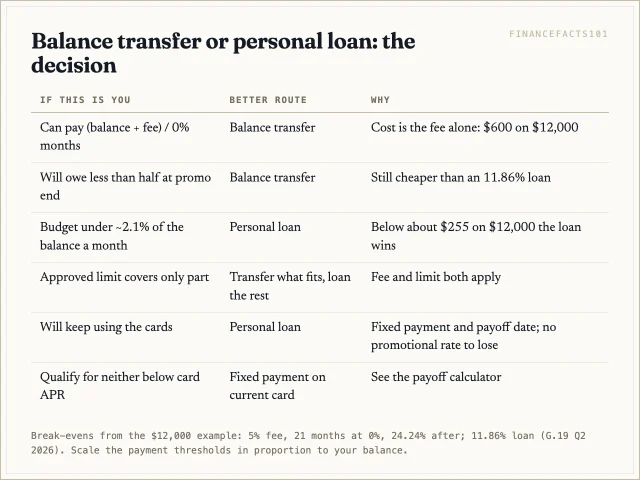
Start with the payment you can reliably make. Divide the balance plus the transfer fee by the months in the best 0% window you are offered. If you can pay that, or come close enough that less than half the balance will be left at the end, take the transfer. It is the cheapest option by a wide margin. If your budget spreads the debt over five years or more, if the approved limit covers only part of the balance, or if you know a revolving line will not stay at zero, take the lowest-APR personal loan you can find, fees included, with the shortest term you can afford. If you qualify for neither at a rate below your current card APR, a fixed payment on the existing card is the fallback. The credit card payoff guide shows what that costs at each payment level.
FAQ
Is a balance transfer or a personal loan better for paying off credit card debt?
A balance transfer is cheaper when you can repay most of the balance within the 0% window. On $12,000, a 21-month, 5% transfer costs $600 to $1,168 at $600 or $400 a month, against $2,320 for a 36-month loan at 11.86%. A personal loan is better when your budget is below about $255 a month on that balance, when you would pay only minimums, or when you cannot get a big enough credit limit.
What happens to my balance transfer if I pay late?
A payment that is a few days late does not end a 0% promotion on the existing balance under Regulation Z. You still owe a late fee, and it can hurt your credit. Once a minimum payment is more than 60 days late, the issuer can raise the rate on all balances after 45 days' written notice, and must lower it again after six consecutive on-time payments. Check the revocation terms printed beneath your offer's rate table.
Does a personal loan hurt my credit more than a balance transfer card?
Not necessarily. Both usually add a hard inquiry, which myFICO says costs most people fewer than five points, and both add a new account. The loan moves the debt out of revolving utilization completely. The transfer lowers overall utilization but leaves one card nearly maxed out. Paying on time matters more than which route you choose.
How much is a balance transfer fee?
Usually 3% to 5% of the amount moved, with a small dollar minimum, added to the new balance. As of September 2026, Wells Fargo Reflect and U.S. Bank Shield charge 5%, and Chase Freedom Unlimited charges 3% on transfers made within 60 days of opening and 5% after. On $12,000, that is $360 to $600.
Sources
- Federal Reserve, G.19 Consumer Credit, released September 8, 2026: 24-month personal loan rate 11.86% and credit card rate 22.15% (accounts assessed interest), Q2 2026
- Federal Reserve, FOMC statement, September 16, 2026: target range raised to 3-3/4 to 4 percent
- Federal Reserve, H.15 Selected Interest Rates: bank prime loan rate 7.00%, September 18–24, 2026
- CFPB, Regulation Z § 1026.55, Limitations on increasing APRs and official interpretation
- CFPB, Regulation Z § 1026.53, Allocation of payments
- CFPB, Regulation Z § 1026.9, Subsequent disclosure requirements: 45-day notice of a penalty rate increase
- CFPB, Regulation Z § 1026.60, Credit and charge card applications: introductory-rate revocation disclosure
- CFPB, How long can I keep a low rate on a balance transfer?
- CFPB, Do I pay interest on new purchases after a 0% balance transfer?
- CFPB, What do I need to know about consolidating my credit card debt?
- CFPB, What is a credit inquiry?
- Wells Fargo, Reflect Card Important Credit Terms: stated correct as of September 2026
- U.S. Bank, Shield Visa Card
- Chase, Freedom Unlimited pricing and terms
- Best Egg, Personal loans: APR and origination fee ranges
- Discover, Personal loans
- LightStream, Home page loan terms
- myFICO, How owing money impacts your credit score
- myFICO, Credit checks and inquiries
 Next entry · No. 5,976I Bonds vs EE Bonds: Which Savings Bond Should You Buy?
See also
-
 No. 5,942
13 Sep 2026
19 min
How Long It Takes to Pay Off a Credit Card at $8,000 and 22.15%
Personal Finance
No. 5,942
13 Sep 2026
19 min
How Long It Takes to Pay Off a Credit Card at $8,000 and 22.15%
Personal Finance -
 No. 5,980
14 Oct 2026
21 min
Pay Off Debt or Invest? Compare Two After-Tax Rates
Personal Finance
No. 5,980
14 Oct 2026
21 min
Pay Off Debt or Invest? Compare Two After-Tax Rates
Personal Finance -
 No. 5,936
08 Sep 2026
14 min
Debt Avalanche vs Snowball: Which Pays Off Faster
Personal Finance
No. 5,936
08 Sep 2026
14 min
Debt Avalanche vs Snowball: Which Pays Off Faster
Personal Finance -
 No. 955
07 Jul 2024
20 min
Understanding Delinquent Account Credit Cards: Consequences and Mitigation Strategies
Personal Finance
No. 955
07 Jul 2024
20 min
Understanding Delinquent Account Credit Cards: Consequences and Mitigation Strategies
Personal Finance -
 No. 815
13 Jun 2024
19 min
Understanding Your Credit Card Balance and its Impact on Your Credit Score
Personal Finance
No. 815
13 Jun 2024
19 min
Understanding Your Credit Card Balance and its Impact on Your Credit Score
Personal Finance -
 No. 5,280
26 Aug 2025
20 min
Understanding Universal Default: What You Need to Know About This Credit Card Provision
Personal Finance
No. 5,280
26 Aug 2025
20 min
Understanding Universal Default: What You Need to Know About This Credit Card Provision
Personal Finance