I Bonds vs EE Bonds: Which Savings Bond Should You Buy?
I bonds pay 4.26% (0.90% fixed) and EE bonds 2.40% through Oct 31, 2026. EE doubles in 20 years, about 3.5%; I bonds win over 20 years if inflation tops 2.6%.
For bonds issued through October 31, 2026, I bonds pay a 4.26% composite rate (a 0.90% fixed rate plus inflation) and EE bonds pay a fixed 2.40%, but an EE bond held 20 years is guaranteed to double, about 3.5% a year. In the I bonds vs EE bonds decision, the I bond wins over 20 years if CPI-U inflation averages more than about 2.6% a year, and it wins over 5 years unless inflation falls below about 1.5%. The EE bond wins only if you are certain to hold it the full 20 years and inflation runs cooler than that.
Both rates reset on November 1, 2026, and the new ones are not known as this guide publishes on October 10. The September inflation reading that sets the new I bond rate comes out on October 14. This guide covers how each bond earns, works through $10,000 in each held 5 and 20 years, and sets out the lockup, the purchase limits, the taxes, and how both compare with TIPS and T-bills. Scope honesty: this is general information built on stated assumptions and on rates as of late September 2026. It is not personal advice.
I Bonds vs EE Bonds: One Issuer, Two Different Promises
Both are US savings bonds, sold only electronically through TreasuryDirect and backed by the Treasury. Both earn interest monthly, compound it every six months, earn for up to 30 years, and cannot be sold to anyone else. You redeem them with the Treasury at their accrued value, so their price never falls. Treasury's own EE-and-I comparison table lists the same tax treatment, the same 12-month minimum hold, and the same three-month interest penalty for both.
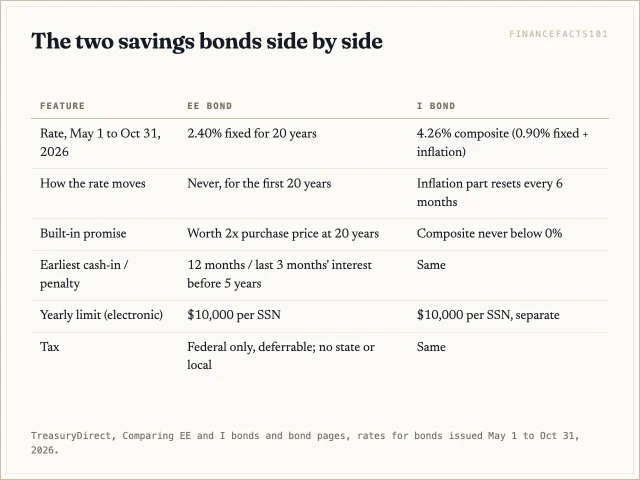
The difference is what each one promises. An I bond promises to keep pace with the CPI-U and add a small real return on top: the fixed rate, 0.90% for bonds issued May through October 2026. An EE bond promises a fixed nominal rate, 2.40% now, plus a one-time top-up that makes the bond worth twice what you paid if you hold it 20 years. The I bond protects your purchasing power. The EE bond guarantees a dollar amount, and inflation decides what that amount will buy. The legacy entries on Series I bonds and Series EE bonds cover the history. This guide is about choosing between them today.
Who This Is For, and Who It Isn't
This guide is for a US saver who has money that can sit untouched for at least a year and probably five or more: a college fund, a mid-term reserve above your emergency cushion, or a slice of a conservative portfolio. It is especially relevant if you pay state income tax, because savings bond interest is exempt from it. It is also relevant if you might use the money for tuition and your income is under the education-exclusion limits covered below.
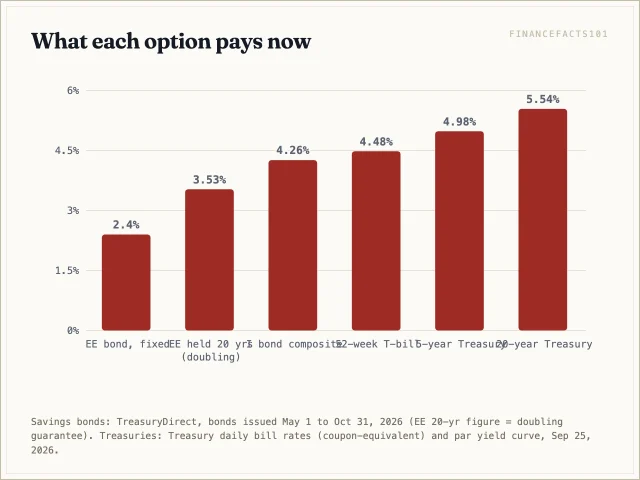
It is not for your emergency fund's first year. A savings bond cannot be cashed at all in its first 12 months, except in declared disaster areas. It is not for anyone trying to move more than $10,000 per person per year into one series. And it is not for anyone chasing the highest nominal yield today: as the rate chart below shows, marketable Treasuries currently pay more than either savings bond. What a savings bond buys you instead is freedom from price risk, tax deferral, and, for the I bond, a floor under your purchasing power.
How the I Bond Rate Is Built
An I bond's composite rate has two parts. The fixed rate is set when you buy and never changes for the bond's 30-year life. The inflation rate resets every six months for every I bond ever issued. According to TreasuryDirect's I bond rate page, the inflation rate is based on changes in the non-seasonally adjusted CPI-U, and the two parts are combined with a formula: fixed rate + (2 × semiannual inflation rate) + (fixed rate × semiannual inflation rate).
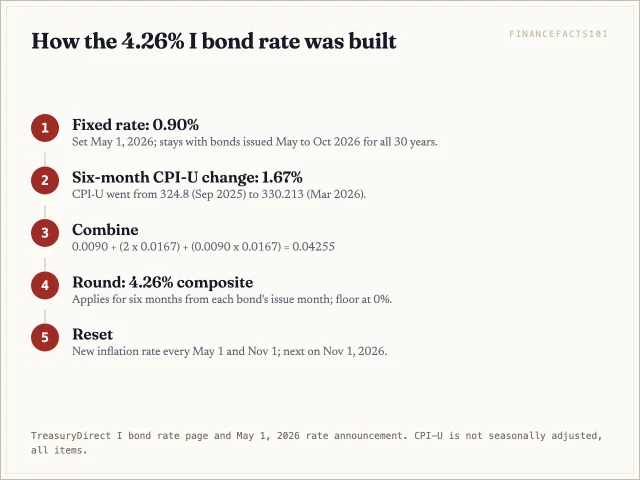
For bonds issued May 1 to October 31, 2026, Treasury's May 1 announcement gives the inputs. The CPI-U rose from 324.8 in September 2025 to 330.213 in March 2026, a six-month change of 1.67%. Plugging in: 0.0090 + (2 × 0.0167) + (0.0090 × 0.0167) = 0.04255, rounded to 4.26%. If inflation turned negative enough to push the composite below zero, Treasury stops it at zero, so the bond's value never shrinks.
Two timing details matter. First, the composite applies for six months from your bond's own issue month, not from the announcement. A bond issued in October 2026 earns 4.26% through March 2027 and picks up the November-announced inflation rate on April 1, 2027. Second, the fixed rate is the only part you lock in. Treasury has set it anywhere from 0.00% (every reset from May 2020 through May 2022) to 1.30% (November 2023 and May 2024) over the past decade. At 0.90%, today's fixed rate sits in the upper half of that range.
How the EE Bond Earns: 2.40% and the 20-Year Doubling
An EE bond bought today earns a fixed 2.40% for its first 20 years, per TreasuryDirect's page for EE bonds issued since May 2005. At 2.40% compounded every six months, $10,000 grows to only about $16,115 by year 20. The guarantee is what closes the gap: Treasury promises the bond will be worth at least twice its purchase price at 20 years and will "make a one-time adjustment, if necessary" to make that true. Doubling in 20 years works out to about 3.53% a year, compounded annually.
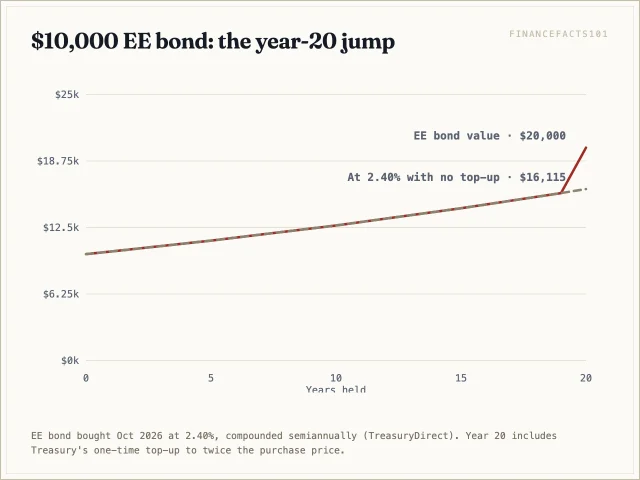
That top-up is a cliff, not a slope. Cash the bond at 19 years and you get about $15,735. Wait one more year and you get $20,000, so the 20th year is worth roughly $4,265 on a $10,000 bond. Anyone who might need the money before 2046 should value an EE bond at 2.40%, not 3.5%. At 2.40% it is the lowest rate in the chart above.
After 20 years, the bond keeps earning its original rate for 10 more years unless Treasury announces new terms before the 20-year mark, and you are free to cash it once it has doubled. If nothing changes, $20,000 compounding at 2.40% reaches about $25,389 at 30 years. Treasury says the doubling guarantee applies to every EE bond bought since June 2003.
The Worked Example: $10,000 in Each, Held 5 and 20 Years
Here are the assumptions. You buy $10,000 of EE bonds and $10,000 of I bonds in TreasuryDirect in October 2026. That is allowed, because each series has its own $10,000 limit. The EE bond earns 2.40%, compounded semiannually. For the I bond, the future inflation rate is unknown, so the example runs three cases, each held constant for the whole period: 3.34% a year (the current 1.67% semiannual rate continuing), 2.5%, and 2.0%. Each case keeps the 0.90% fixed rate and applies Treasury's formula and rounding. The results are before tax, and neither bond is cashed early.
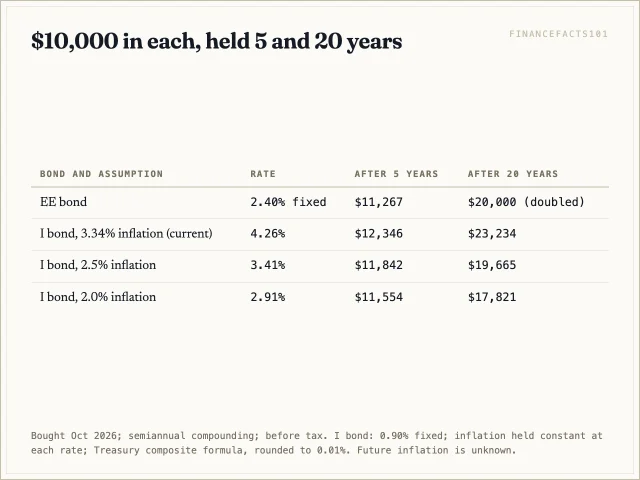
At 5 years (October 2031), the EE bond is worth $11,267. The I bond is worth $12,346 if inflation stays at 3.34%, $11,842 at 2.5%, and $11,554 at 2.0%. Five years is also the point where the early-redemption penalty ends, so these are clean numbers. Over 5 years the I bond beats the EE bond in every case shown, because the EE bond's doubling is still 15 years away. The I bond loses at 5 years only if inflation averages below about 1.5%.
At 20 years (October 2046), the EE bond is worth exactly $20,000. The I bond is worth $23,234 at 3.34% inflation, $19,665 at 2.5%, and $17,821 at 2.0%. Check the first case yourself: a 4.26% composite is 2.13% per half-year, and 1.0213 raised to the 40th power is 2.3234.
Now compare purchasing power. With the fixed rate at 0.90%, the I bond ends up worth roughly $11,970 of current purchasing power whatever inflation does, because the inflation part of its rate cancels out price rises. The EE bond's $20,000 is a nominal promise. Deflated the same half-yearly way, at 2.0% inflation it buys what about $13,433 buys today. At 2.5% it buys about $12,168 worth, and at 3.34% about $10,311 worth. The EE bond comes out ahead only when inflation is low. The I bond comes out ahead whenever inflation surprises on the high side.
The Crossover: How Much Inflation Makes Each One Win
The deciding number is the inflation rate at which an I bond held 20 years reaches exactly $20,000. For the value to double in 40 half-years, the composite has to be about 3.50%. With the fixed rate at 0.90%, that takes semiannual inflation of about 1.29%, or about 2.58% a year. If inflation averages more than that over 20 years, the I bond wins. If it averages less, the EE bond's guarantee wins.
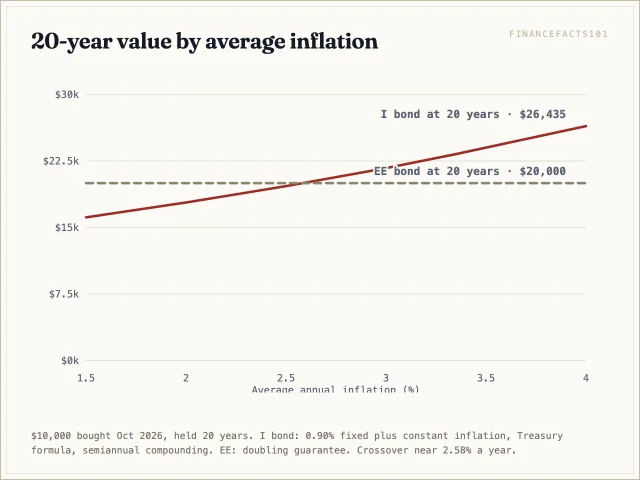
The crossover is close to two outside reference points. In the site's inflation calculator, CPI-U went from 188.9 in 2004 to 313.689 in 2024, an average of 2.57% a year. Run through the I bond formula with today's 0.90% fixed rate, that history, held as a constant 2.57% rate, would have left the I bond at about $19,900, within 1% of the EE bond's $20,000. The bond market is making a similar forecast. On September 25, 2026, the 20-year nominal Treasury yielded 5.54% and the 20-year real (TIPS) yield was 3.08%, per Treasury's par yield curve and real yield curve. That implies roughly 2.46% inflation, though the gap between the two yields also carries risk premiums. On market pricing, the 20-year choice is close to even. The difference is in the bad outcomes. If inflation runs hot, the EE bond loses purchasing power. If inflation runs cold, the I bond gives up only some of the extra dollars you could have had.
The Rules You Buy Into: Lockup, Penalty and the $10,000 Limit
The mechanics are the same for both series, per TreasuryDirect's cashing rules. You cannot redeem either bond in its first 12 months. After that you can, but if the bond is less than 5 years old you lose the last three months of interest. Cash at 18 months and you receive 15 months of interest. The one exception to the 12-month hold is for owners in officially declared disaster areas, for whom Treasury waives the first-year hold.
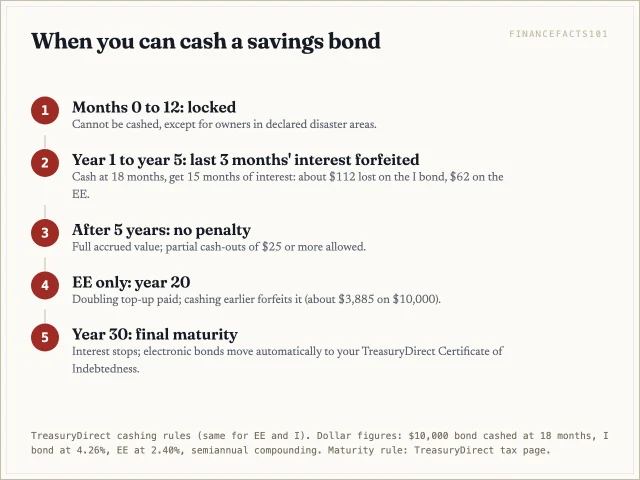
On a $10,000 bond cashed at 18 months, the penalty costs about $112 on the I bond at 4.26% and about $62 on the EE bond. That is small next to the lost EE top-up if you leave before year 20. Electronic bonds can be partly redeemed, in amounts of $25 or more, as long as at least $25 stays in the account.
The purchase limit is $10,000 in electronic EE bonds plus $10,000 in electronic I bonds per Social Security number per calendar year, as set out on Treasury's spending-limits page. The limit counts against the first-named owner. Gifts count toward the recipient's limit in the year they are delivered, not the giver's. A child in a linked account has their own limit, and an entity account, such as a trust or business, has its own. A married couple can therefore put $20,000 a year into each series, $40,000 in total. The old workaround of buying paper I bonds with a federal tax refund is gone: TreasuryDirect says that as of January 1, 2025, you can no longer buy paper Series I savings bonds with your tax refund. New EE and I bonds are electronic only.
Taxes: Deferral, No State Tax, and the Education Exclusion
Savings bond interest is subject to federal income tax but exempt from state and local income tax, per TreasuryDirect's tax page. Federal estate, gift and excise taxes still apply, as do state estate or inheritance taxes. The state exemption is worth a lot in a high-tax state. On the EE bond's $10,000 of interest over 20 years, a 5% state tax you avoid is $500.
The federal deferral is the bigger lever. Under IRS Publication 550, a cash-method taxpayer can postpone reporting savings bond interest until the bond is cashed, disposed of, or reaches final maturity. Alternatively, you can report the increase in value every year. Whichever method you choose applies to all your EE and I bonds. Deferral lets the tax compound in your favor for up to 30 years. It also lets you time the income, for example cashing in a low-income year after retirement. The EE doubling top-up is interest like the rest, so at 20 years a 22% bracket owes about $2,200 of federal tax on the EE bond. On the 3.34%-inflation I bond, which earned $13,234, the bill is about $2,911.
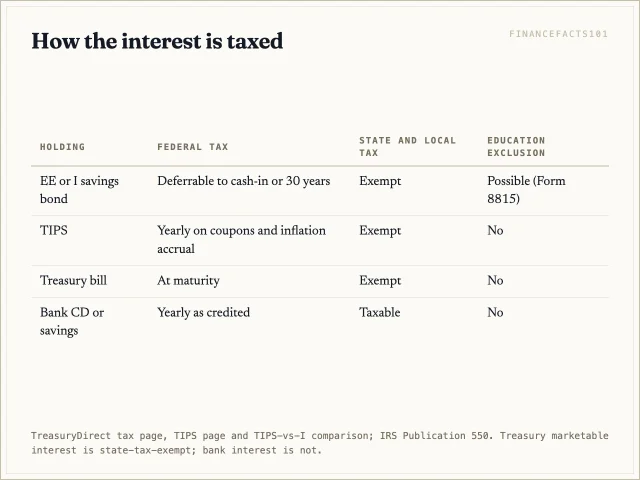
The education exclusion can make the interest federally tax-free as well. Under Form 8815, you can exclude savings bond interest from income when you cash EE or I bonds issued after 1989 and pay qualified higher education expenses in the same year. Qualifying expenses are tuition and required fees for yourself, your spouse, or a dependent, or contributions to a 529 plan or Coverdell account. Room and board do not count. The conditions are strict. You must have been at least 24 when the bond was issued, and the bond must be in your name, or yours and your spouse's. TreasuryDirect's education page warns that a bond registered to the child will not qualify. You cannot file married filing separately. The same expenses cannot also be used for an education credit. If the proceeds exceed your qualifying expenses, only a proportional share of the interest is excluded.
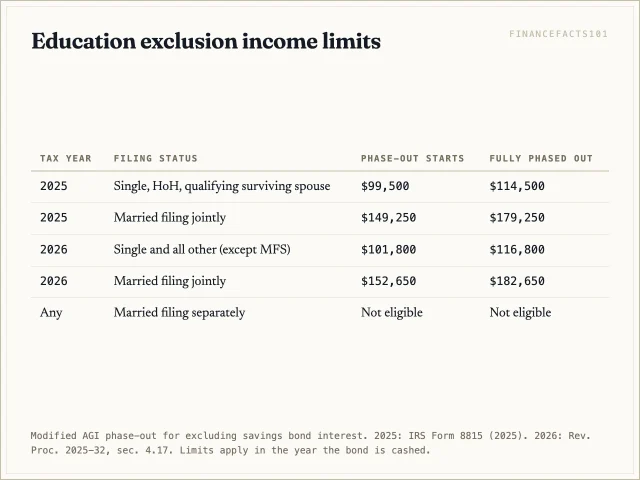
Income limits apply in the year you cash the bond, not the year you buy it. For 2026, Rev. Proc. 2025-32 starts the phase-out at modified AGI above $101,800 for single and other filers and $152,650 for joint filers. The exclusion is gone entirely at $116,800 and $182,650. The limits are adjusted for inflation each year, so a parent buying now for tuition due in 2040 is betting on where their income will sit against the 2040 limits.
Against TIPS: More Real Yield, Less Shelter
Treasury Inflation-Protected Securities are the marketable relative of the I bond. Their principal rises with CPI-U, they pay a fixed real coupon every six months, and at maturity you receive the greater of the adjusted or the original principal, per TreasuryDirect's TIPS page. The current difference is large. On September 25, 2026, the 5-year real yield was 2.64%, the 10-year 2.83%, and the 20-year 3.08%, against the I bond's 0.90% fixed rate. On $10,000 over 20 years, the 2.18-point real gap compounds into several thousand of today's dollars.
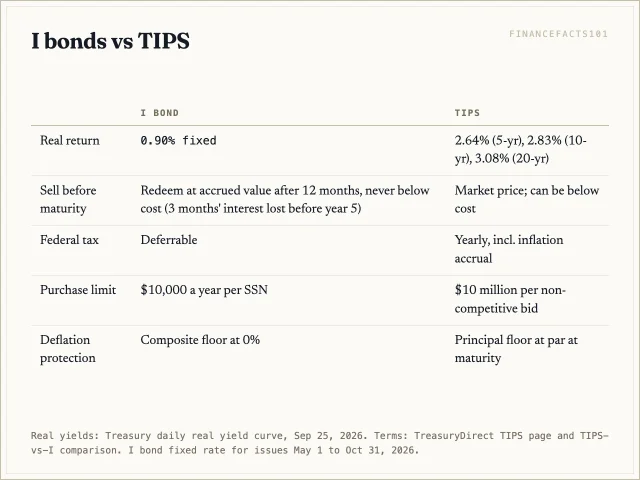
TIPS give up three things for that yield, as Treasury's TIPS-versus-I-bond comparison sets out. First, both the coupons and the yearly inflation adjustment to principal are federally taxable each year, even though the adjustment is not paid out until maturity. Second, a TIPS sold before maturity sells at the market price, which falls when real yields rise. An I bond is redeemed with the Treasury at its accrued value, never below what you paid, less three months' interest before year 5. Third, TIPS come only in 5-, 10- and 30-year terms at auction. The I bond keeps the edge on tax deferral, flexibility and the education exclusion, and TIPS allow up to $10 million per non-competitive bid instead of $10,000 a year. For inflation-protected money held in a tax-advantaged account, TIPS currently win on yield. For a taxable account, the I bond's shelter narrows the gap. That annual tax on unpaid inflation gains is why, in this guide's view, TIPS fit best inside an IRA or 401(k). More detail is in the legacy entry on TIPS.
Against T-Bills, CDs and Savings Accounts
For money you might need within a year, neither savings bond is the right tool, because of the 12-month lockup. On September 25, 2026, the 26-week bill paid 4.36% and the 52-week bill 4.48% (coupon-equivalent), per Treasury's daily bill rates. Those rates reflect the Federal Reserve's September 16 increase to a 3.75%–4.00% federal funds target. Like savings bonds, bills are exempt from state tax. The trade-offs between bills and bank CDs are covered in T-bills vs CDs, and between savings accounts and CDs in high-yield savings vs CDs. This guide does not repeat them.
In short, a 52-week bill pays more than the I bond's first six months and far more than the EE bond's 2.40%, and it has no lockup beyond its term. What bills do not offer is inflation protection beyond one year, tax deferral beyond one year, or a guaranteed doubling. Savings bonds suit money with a multi-year job. Bills, CDs and savings accounts suit money on a shorter clock.
Timing: The November 1, 2026 Reset
Treasury sets new savings bond rates every May 1 and November 1. For I bonds, the November inflation component is the percentage change in CPI-U over the six months from March to September 2026, per 31 CFR part 359, Appendix C. The Bureau of Labor Statistics publishes September CPI on October 14, 2026, four days after this guide publishes. So neither the new inflation component nor the new fixed rate is known yet, and the new EE rate is not known either. As a partial check, BLS CPI-U data show the index at 334.980 in August, up 1.44% from March's 330.213. September's reading will decide whether the new six-month figure lands above or below May's 1.67%.
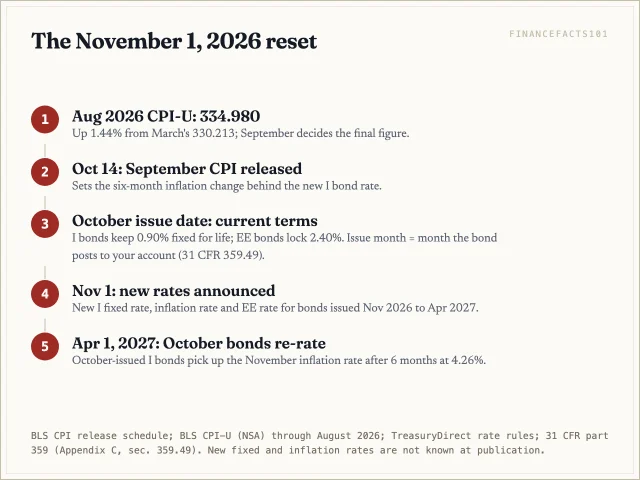
What you can control is the fixed rate. Any I bond issued in October 2026 keeps 0.90% for 30 years, and TreasuryDirect says I bonds earn interest from the first day of the month you buy them. The catch is the issue date. Under 31 CFR 359.49, a TreasuryDirect bond's issue date is the first day of the month in which it posts to your account, not the day you place the order. A purchase that has not posted before November begins gets a November issue date and November's terms, so leave a margin rather than ordering at the last moment. Buying in November gets you whatever fixed rate Treasury announces, which could be higher or lower. Nobody outside Treasury knows which. The same applies to the EE rate. Because the EE bond's 20-year value is the guaranteed doubling in either case, the EE rate matters mostly to people who cash out early.
The Decision Framework
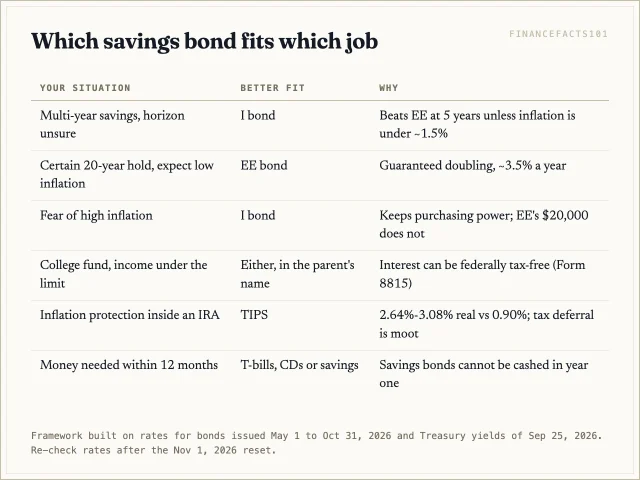
For most savers weighing I bonds vs EE bonds today, the I bond is the default. It beats the EE bond at 5 years in all but a low-inflation scenario, it protects purchasing power at any horizon, and its 4.26% first-six-month rate is competitive for money you won't need for a year. The EE bond is a narrow, specific tool. It fits someone who will hold for exactly 20 years or more, who expects inflation to average below about 2.6%, and who values a fixed dollar target, such as a 2046 obligation of a known size. If your real goal is the highest inflation-protected yield and the money sits in an IRA, compare TIPS first. If you might need the money within a year, look at bills, CDs or savings accounts.
To check the numbers yourself, the compound interest calculator does not offer semiannual compounding. Enter each bond's effective annual rate with yearly compounding instead: 2.4144% for the EE bond and 4.3054% for an I bond at a constant 4.26% composite. At whole years the results match the tables above.
FAQ
Is it better to buy I bonds or EE bonds right now?
For most horizons, I bonds. At the rates for bonds issued through October 31, 2026 (4.26% composite with a 0.90% fixed rate, against 2.40% for EE), the I bond comes out ahead at 5 years unless inflation averages under about 1.5%, and at 20 years unless it averages under about 2.6%. The EE bond wins only for a buyer certain to hold 20 years through a low-inflation period.
What will the I bond rate be on November 1, 2026?
It is not known as of this guide's October 10 publication. Treasury announces the new fixed rate and inflation rate on November 1, and the inflation part depends on September CPI-U, which BLS releases October 14. CPI-U had risen 1.44% from March through August 2026.
Can I still buy paper I bonds with my tax refund?
No. TreasuryDirect states that since January 1, 2025, you can no longer buy paper Series I bonds with a tax refund. New I and EE bonds are electronic only, up to $10,000 of each series per Social Security number per calendar year. Gifts count toward the recipient's limit in the year they are delivered.
Do I lose money if I cash a savings bond early?
You cannot cash either series in the first 12 months, except in declared disaster areas. Between 1 and 5 years you forfeit the last three months of interest, which is about $112 on a $10,000 I bond at 4.26%. Principal is never at risk. The bigger early-exit cost is on EE bonds: cashing before 20 years forfeits the doubling top-up, which is worth about $3,885 on a $10,000 bond at year 20.
Are savings bonds tax-free for college?
The interest can be, if you meet all of Form 8815's conditions. You must have been 24 or older when the bond was issued, and it must be registered to you or you and your spouse, not the child. You must pay qualifying tuition and fees in the year you cash it, file any status except married filing separately, and have modified AGI below the limit. For 2026 the phase-out runs from $101,800 to $116,800 for single filers and from $152,650 to $182,650 for joint filers.
Sources
- TreasuryDirect, I bonds interest rates: 4.26% composite, 0.90% fixed, 1.67% semiannual inflation for bonds issued May 1–October 31, 2026; composite formula; fixed-rate history
- TreasuryDirect, Fiscal Service announces new savings bonds rates, May 1, 2026: CPI-U 324.8 (September 2025) to 330.213 (March 2026); EE 2.40%
- TreasuryDirect, EE bonds issued since May 2005: the 20-year doubling guarantee and one-time adjustment
- TreasuryDirect, Comparing EE and I bonds
- TreasuryDirect, Cashing savings bonds and Affected by a disaster
- TreasuryDirect, How much can I spend on savings bonds?
- TreasuryDirect, Using your income tax refund to buy paper savings bonds: discontinued January 1, 2025
- TreasuryDirect, Tax information for EE and I bonds and Using bonds for higher education
- TreasuryDirect, Treasury Inflation-Protected Securities and Comparison of TIPS and Series I savings bonds
- US Treasury, Daily par yield curve rates, daily real yield curve rates and daily bill rates: values for September 25, 2026
- IRS, Form 8815 (2025): education exclusion conditions and qualifying expenses
- IRS, Rev. Proc. 2025-32, section 4.17: 2026 phase-out ranges for the savings bond education exclusion
- IRS, Publication 550: reporting options for savings bond interest
- Bureau of Labor Statistics, CPI release schedule and CPI-U, all items, not seasonally adjusted
- eCFR, 31 CFR part 359, Appendix C (inflation rate uses the six months ending each March and September) and section 359.49 (issue date of a book-entry I bond)
- Federal Reserve, FOMC statement, September 16, 2026: target range raised to 3.75%–4.00%
 Next entry · No. 5,977529 vs Roth IRA for College: Which Should You Use?
See also
-
 No. 5,367
02 Sep 2025
20 min
Understanding U.S. Savings Bonds: A Safe Investment Option for Institutional Investors
Investments
No. 5,367
02 Sep 2025
20 min
Understanding U.S. Savings Bonds: A Safe Investment Option for Institutional Investors
Investments -
 No. 4,619
03 Jul 2025
18 min
Understanding Series EE Bonds: A Comprehensive Guide for Institutional Investors
Business Finance
No. 4,619
03 Jul 2025
18 min
Understanding Series EE Bonds: A Comprehensive Guide for Institutional Investors
Business Finance -
 No. 5,968
02 Oct 2026
18 min
T-Bills vs CDs vs High-Yield Savings: Where 3-12 Month Cash Goes
Investments
No. 5,968
02 Oct 2026
18 min
T-Bills vs CDs vs High-Yield Savings: Where 3-12 Month Cash Goes
Investments -
 No. 4,049
17 May 2025
21 min
Capital Preservation: A Conservative Investment Strategy for Maximizing Wealth Preservation
Investments
No. 4,049
17 May 2025
21 min
Capital Preservation: A Conservative Investment Strategy for Maximizing Wealth Preservation
Investments -
 No. 3,500
03 Apr 2025
21 min
Non-Marketable Securities: Understanding the Risks and Rewards of Illiquid Investments
Investments
No. 3,500
03 Apr 2025
21 min
Non-Marketable Securities: Understanding the Risks and Rewards of Illiquid Investments
Investments -
 No. 2,784
04 Feb 2025
17 min
Liability Driven Investment: Minimizing Risk and Generating Returns for Pension Funds and Individual Clients
Investments
No. 2,784
04 Feb 2025
17 min
Liability Driven Investment: Minimizing Risk and Generating Returns for Pension Funds and Individual Clients
Investments