529 vs Roth IRA for College: Which Should You Use?
Money sure to go to college belongs in a 529: $300 a month for 18 years at 6% leaves $114,288, all tax-free. When a Roth IRA wins, under 2026 rules.
For money you expect to spend on your child's education, use a 529 plan: its growth comes out federally tax-free for qualified costs, and under 2026 rules those costs include up to $20,000 a year of K-12 expenses on top of college. The 529 vs Roth IRA choice tips toward the Roth only as a backup — Roth contributions come back tax- and penalty-free at any age, but earnings withdrawn before 59½ are taxed, and every tuition dollar comes out of a retirement account capped at $7,500 a year in 2026.
The gap is measurable. A parent who saves $300 a month for 18 years at a 6% return ends with $114,288 either way; spent on college, the 529 delivers all of it, while the Roth route loses about $10,900 to federal tax on the earnings at a 22% bracket. The rest of this guide covers where that answer flips: a child who skips college, a state with no 529 deduction, a family chasing need-based aid, and the SECURE 2.0 rule that lets up to $35,000 of leftover 529 money move into the child's own Roth IRA.
One line of scope honesty: this is general information built on stated assumptions — a hypothetical 6% return, a 22% federal bracket, 2026 federal rules as of September 2026 — not personal tax or financial-aid advice.
529 vs Roth IRA: The Answer in Numbers
Both accounts let investments grow without annual tax. The difference is which withdrawals are free. A 529 is free for education and penalised for everything else; a Roth IRA is free for retirement and partly taxed for everything else, education included.
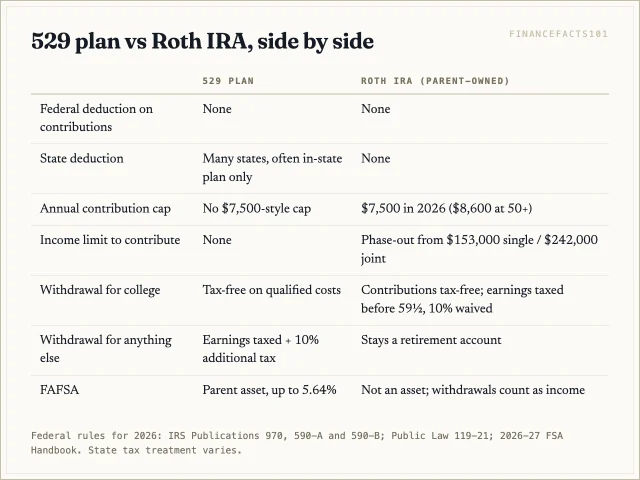
That table is the whole decision in miniature. Neither account gives a federal deduction on the way in. The 529 wins on the college withdrawal itself, and often on a state deduction; the Roth wins on flexibility, on financial-aid asset treatment, and on what happens if the child never enrolls. The sections below price each of those differences in dollars.
Who This Is For — and Who It Isn't
This guide is for a US parent with earned income who can set aside a regular monthly amount for a child aged 0 to 12, and who is deciding which account to open first. It assumes you are already capturing any employer 401(k) match, because a match is an instant return neither account below can beat.
It is not for the family whose retirement saving is behind. If you are not yet putting the full $7,500 into an IRA or a healthy share of pay into a workplace plan, fund your own retirement first; students can borrow for college, and nobody lends for retirement. The choice between Roth and traditional contributions for your own retirement is its own decision, worked through in Roth vs traditional IRA. It is also not a guide for grandparents writing a single large cheque, for families above the 2026 Roth income limits (direct Roth contributions are closed to them), or for anyone paying down student loans already — repayment choices are in student loan repayment plans.
How a 529 Is Taxed, and What Counts as Qualified
A 529 plan — the IRS calls it a qualified tuition program — is funded with after-tax money. IRS Publication 970 is blunt about the front end: "You can't deduct either payments or contributions to a QTP." The benefit is at the back end: "No tax is due on a distribution from a QTP unless the amount distributed is greater than the beneficiary's adjusted qualified education expenses."
Qualified higher-education expenses cover tuition, fees, books, supplies and required equipment; computers and internet access used mainly by the student; room and board for students enrolled at least half-time, within the school's cost-of-attendance allowance or its own housing charge if higher; registered-apprenticeship costs; and up to $10,000 of lifetime student-loan payments for the beneficiary or a sibling. The same publication lets you change the beneficiary to another family member — a sibling, a cousin, even yourself — with no income-tax consequence, which is what keeps a 529 from being stranded if one child does not need it.
One coordination rule matters in practice. You can still claim the American opportunity credit in a year you take tax-free 529 money, but not on the same dollars. Pub 970's own example has parents claim a $2,500 credit based on $4,000 of expenses; those $4,000 then come out of the pool the 529 withdrawal can cover tax-free. Pay the first $4,000 of tuition from cash or income, and the 529 for the rest.
The 2026 Changes: $20,000 for K-12 and a Longer List of Costs
The One Big Beautiful Bill Act, enacted July 4, 2025 as Public Law 119-21, made two separate changes to K-12 spending from a 529, with two different start dates.
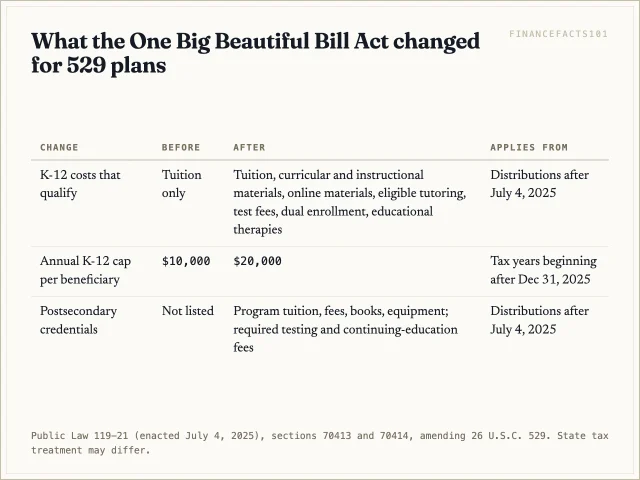
First, section 70413(a) rewrote the list of K-12 costs. Before, only tuition qualified. For distributions made after July 4, 2025, the list covers tuition; curriculum and curricular materials; books or other instructional materials; online educational materials; tutoring outside the home by a tutor who is not related to the student and is a licensed teacher, has taught at an eligible institution, or is a subject-matter expert; fees for standardized achievement tests, Advanced Placement exams and college-admission exams; dual-enrollment fees; and educational therapies for students with disabilities.
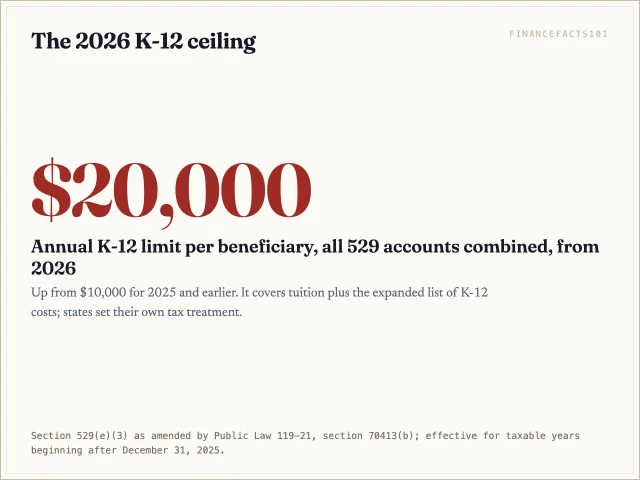
Second, section 70413(b) doubled the annual cap. The statute strikes "$10,000" and inserts "$20,000" in section 529(e)(3), effective for "taxable years beginning after December 31, 2025." So the ceiling for 2025 was still $10,000 — which is why the 2025 edition of Pub 970 shows $10,000 — and it is $20,000 per beneficiary for 2026 onward, aggregated across every 529 that pays for that child.
Section 70414 added a third category for distributions after July 4, 2025: qualified postsecondary credentialing expenses — tuition, fees, books and equipment for recognized credential programs, plus testing fees needed to obtain or keep a recognized credential and continuing-education fees needed to keep one, including state-issued occupational and professional licenses. For a child who heads into a trade rather than a degree, that widens the 529's usefulness considerably.
A caution on states: federal law changed; your state's tax code may not have followed. New York's plan says its tax department "has not yet determined" whether the expanded K-12 and credentialing expenses are qualified for state purposes, and it says deductions may be recaptured on withdrawals used for K-12 tuition. Check your own state's treatment before spending 529 money on anything but college.
State Tax Deductions: Where the 529 Gets a Head Start
There is no federal deduction, but many states with an income tax give one for contributions — often only to their own plan. Three examples, each from the state program's own materials, show how much the rules vary.
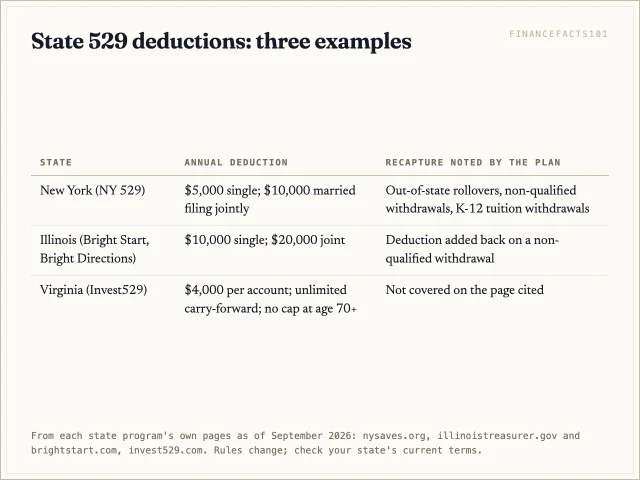
New York's plan allows up to $5,000 a year, or $10,000 married filing jointly, and warns the deduction can be recaptured on rollovers to another state's plan, non-qualified withdrawals, or K-12 tuition withdrawals. Illinois allows $10,000 single and $20,000 joint across its Bright Start and Bright Directions plans, and Bright Start's taxpayer guide says deductions are added back to Illinois income on a non-qualified withdrawal. Virginia's Invest529 works per account: up to $4,000 per account per year, unlimited carry-forward, and unlimited in one year for owners 70 and older.
In dollars, the deduction is worth your state marginal rate times what you put in. At a hypothetical 5% state rate, deducting $3,600 a year saves $180 a year, or $3,240 over 18 years. That is real money, but modest — which is why a high-fee in-state plan can still lose to a cheap out-of-state plan over 18 years. The site's guide to tax-deductible investments places this deduction alongside the others available in 2026.
When the Money Isn't Spent on School
The 529's weakness is the exit. Pub 970 says that on a taxable distribution "you must also pay a 10% additional tax on the amount included in income." Only the earnings portion is taxable; your contributions come back tax-free because they were never deducted federally. The state may add its own recapture on top.
The 10% additional tax does not apply when the beneficiary dies or becomes disabled; to the extent the withdrawal does not exceed a tax-free scholarship, veterans' educational assistance or employer-provided educational assistance; for attendance at a US military academy, up to the cost of that education; or when the amount is taxable only because the same expenses were used for the American opportunity or lifetime learning credit. Income tax on the earnings is still owed in the scholarship case — only the 10% is waived.
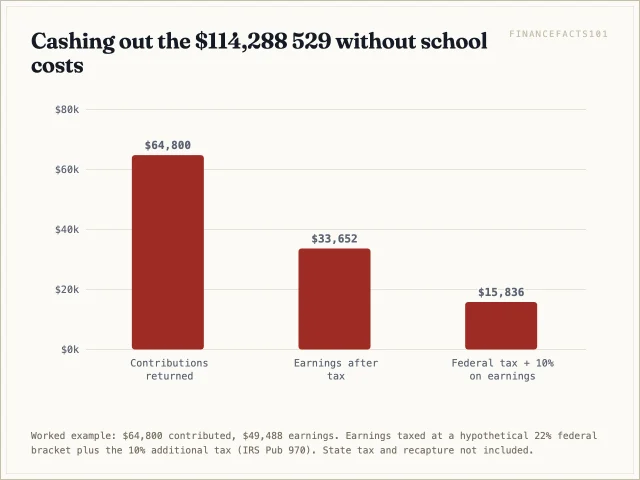
On the worked account below, a full non-qualified cash-out of $114,288 carries $49,488 of earnings. At a 22% bracket plus the 10% additional tax, that is $15,836 of federal tax, leaving $98,452. That is the worst case, and it is rarer than it sounds: switching the beneficiary to a sibling, holding the money for graduate school, or using the Roth rollover below each avoid it.
The Escape Hatch: Up to $35,000 Into the Child's Roth IRA
SECURE 2.0 added a way out for leftover money. For distributions after 2023, IRS Publication 590-A lets a 529 beneficiary roll money into a Roth IRA in their own name, subject to five conditions.
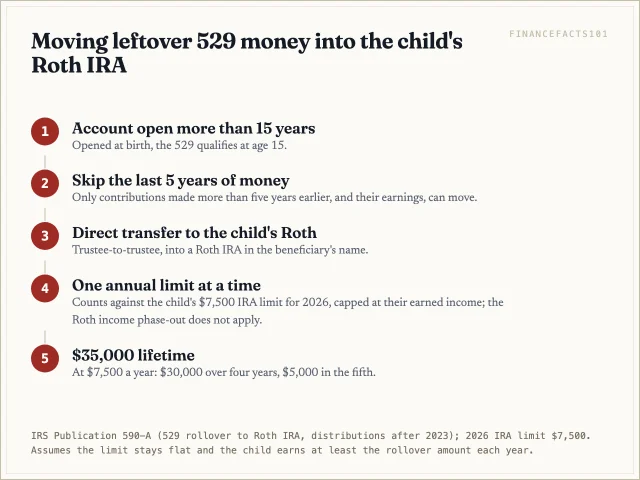
The rollover must be a direct trustee-to-trustee transfer to a Roth IRA for the beneficiary. The 529 account must have been open for more than 15 years. The amount cannot exceed contributions made more than five years before the transfer, plus the earnings on them. Each year's rollover counts against the beneficiary's annual Roth IRA limit — $7,500 for 2026 — together with any other IRA contributions they make, and lifetime rollovers cannot exceed $35,000. Section 408A(c)(3)(E) of the tax code switches off the Roth income phase-out for these rollovers, but an IRA contribution limit never exceeds the person's taxable compensation for the year, so a beneficiary with no earned income generally cannot receive one.
At the 2026 limit, moving the full $35,000 takes five years: four years at $7,500 and a fifth at $5,000, assuming the limit does not rise and the child earns at least that much each year. The 15-year clock is the reason to open a 529 early, even with $25 — an account opened at birth clears it at 15.
How a Roth IRA Pays for College
A Roth IRA is a retirement account with a generous side door. Under the ordering rules in IRS Publication 590-B, withdrawals come from your regular contributions first, and a return of contributions is not included in gross income at any age. Earnings come last.
Earnings are tax-free only in a qualified distribution: five years after your first Roth contribution and on or after age 59½ (or on death, disability, or a first-home purchase up to $10,000). Most parents of a college student are younger than that, so any earnings they withdraw are ordinary income. What the higher-education exception removes is only the 10% additional tax, to the extent the withdrawal does not exceed qualified costs that year — tuition, fees, books, supplies, equipment, and room and board for at-least-half-time students — for you, your spouse, or your or your spouse's children or grandchildren. The current edition of Pub 590-B also lists K-12 tuition and related costs under this exception.
Two consequences follow. A parent who is already 59½ with a five-year-old Roth — one who had a child at 41, say — can withdraw earnings tax-free, which erases the 529's tax edge. And any parent can take out only contributions, leave the earnings compounding for retirement, and pay the rest of the bill another way.
The 2026 Roth Limits That Cap This Route
The 2026 IRA contribution limit is $7,500, plus a $1,100 catch-up at 50 or older, per the IRS 2026 limits announcement. Roth eligibility phases out between $153,000 and $168,000 of modified AGI for single filers and heads of household, and between $242,000 and $252,000 for married couples filing jointly, per the same announcement and IRS Notice 2025-67.
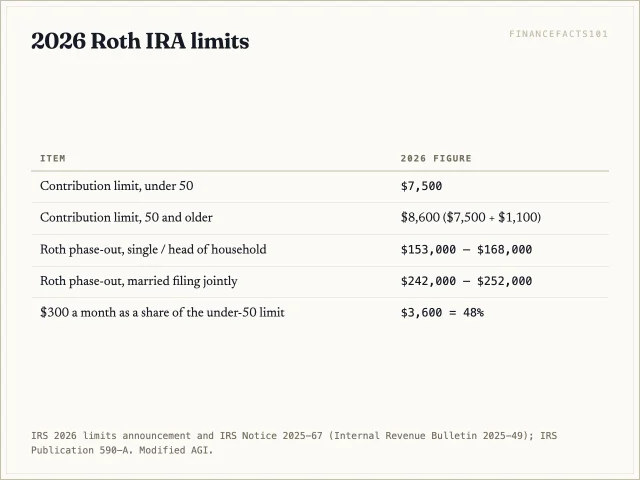
The limit is the Roth route's real cost. $300 a month is $3,600 a year — 48% of the 2026 cap — and the cap is one pool: every dollar earmarked for tuition is a dollar of retirement saving you cannot make up later. A 529 is not bound by that $7,500 cap. The mechanics of the phase-outs, the backdoor route and the deduction rules are in Roth vs traditional IRA, and the Roth vs traditional IRA calculator prices what those retirement dollars are worth decades out.
Worked Example: $300 a Month for 18 Years
The assumptions, named so you can change them: a parent saves $300 at the end of every month for 18 years (216 deposits, $64,800 in total), invested in the same diversified fund either way, earning 6% a year as an effective annual rate — the same monthly compounding the savings goal calculator uses. The parent is under 59½ when the child enrolls and in the 22% federal bracket. Fees, state taxes and financial aid are left out here and handled separately.
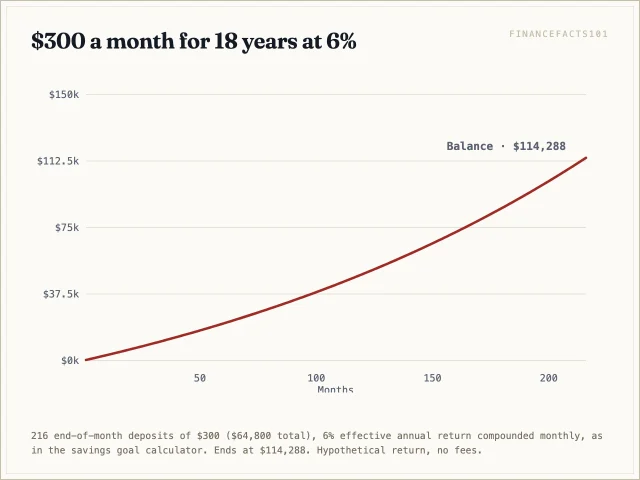
Both accounts reach $114,288: $64,800 of deposits and $49,488 of growth. Type a $114,288 goal, 18 years, $0 saved and 6% into the savings goal calculator and it returns the same $300 a month. What differs is what each account hands over.
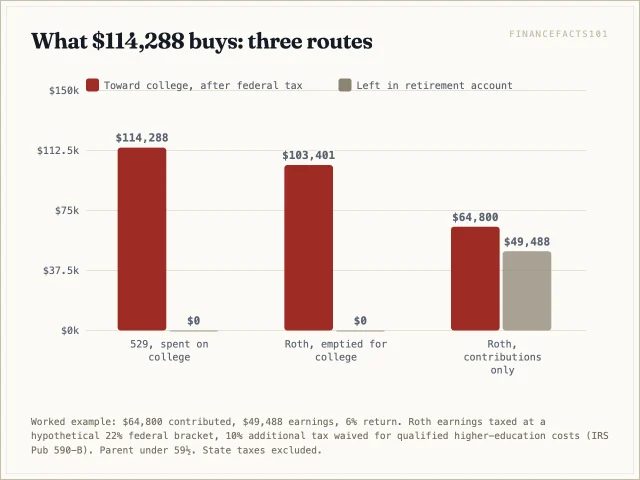
Spent on qualified college costs, the 529 delivers the full $114,288 with no federal tax. The Roth, emptied for the same bills, returns the $64,800 of contributions tax-free and the $49,488 of earnings as taxable income: $10,887 of federal tax at 22%, no 10% additional tax, $103,401 left. That $10,887 is the 529's advantage in the case it was built for — before any state deduction, which at a 5% state rate adds another $3,240.
The Roth's better play is the partial one. Withdraw only the $64,800 of contributions for college and leave $49,488 in the account. At the same 6%, that grows to about $158,715 in 20 more years, tax-free in retirement. The college fund is smaller, but no money was lost to tax.
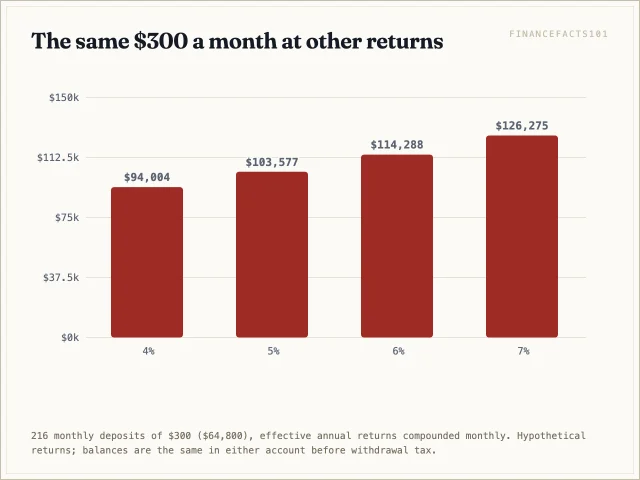
The return assumption moves the balance a lot — $94,004 at 4%, $126,275 at 7% — but not the ranking. Higher returns mean more earnings, which widens the 529's tax advantage on a college withdrawal and deepens the penalty on a non-qualified one.
FAFSA: How Each Account Is Counted
The federal aid formula treats the two accounts in opposite ways: the 529 counts as an asset, the Roth counts only when money comes out.
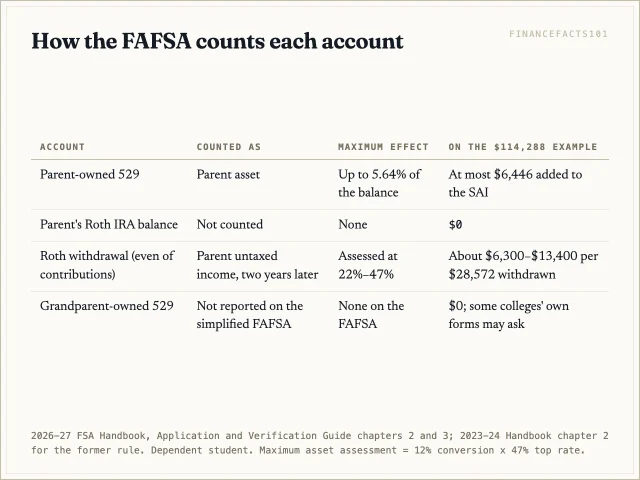
A 529 owned by a parent for a dependent student is reported as a parental investment, per the 2026-27 FSA Handbook. In the Student Aid Index formula, parental net worth above an asset protection allowance is multiplied by a 12% conversion rate and then assessed at 22% to 47% — at most 5.64% of the balance. On the full $114,288, that is at most $6,446 added to the SAI. Families whose 2024 AGI was under $60,000 and who meet the tax-schedule conditions, or who received a means-tested federal benefit, report no assets at all.
Retirement accounts are the reverse. The handbook says the value of "noneducation IRAs" is "not counted as an asset, but distributions do count as income" — the formula adds untaxed IRA distributions, excluding rollovers, to parent income. That includes a Roth withdrawal of your own contributions. Take out a quarter of the $114,288 balance, $28,572, in one year and the FAFSA built on that year's tax return adds roughly $6,300 to $13,400 to the SAI, depending on where the family sits on the 22%-to-47% scale.
Timing softens this. The 2026-27 FAFSA uses 2024 tax data, two years back. For a student who starts in the fall and finishes in four years, withdrawals from January of sophomore year onward land on tax years no FAFSA will read — unless the student later files one for graduate school.
Grandparent-owned 529s used to be the trap. Under the 2023-24 handbook, distributions from a 529 owned by someone other than the parent or student counted as untaxed student income. The simplified FAFSA's income formula now draws only on tax-return items, and an account the student or parent does not own is not reported as their asset — so a grandparent's 529 is invisible to the federal formula. Colleges that use their own aid forms may still ask about it.
Where the Crossover Sits
On a qualified college withdrawal, the 529 wins or ties on federal tax: its tax-free treatment beats a taxed Roth withdrawal by your bracket times the earnings, and ties only when the Roth earnings would come out untaxed anyway — a parent past 59½ with a five-year-old Roth. So the crossover is not about tax rates. It is about the probability that the money is not spent on education.
Use the worked numbers. The 529's edge in the college case is $10,887 of federal tax plus $3,240 of state deduction — $14,127. Its cost in the no-college case, if you cash out, is $15,836 of federal tax and penalty; the state's recapture of the deduction just returns the $3,240 it gave, so it nets out against the Roth, which simply stays a retirement account. Weigh $14,127 against $15,836 and the 529 comes out ahead as long as the chance of a full cash-out is below about 47% (about 41% in a state with no deduction). For most families it is far lower, because a sibling, graduate school, a trade credential or the $35,000 rollover absorbs most leftover money.
The picture shifts in three cases: you live in a state with no 529 deduction, which narrows the edge to $10,887 and the break-even to about 41%; you are not yet maxing your own retirement saving, so the Roth dollars do double duty; or you expect to qualify for need-based aid, where a small 529 asset hit and a well-timed Roth withdrawal both matter less than the income on your tax return.
The Decision Framework
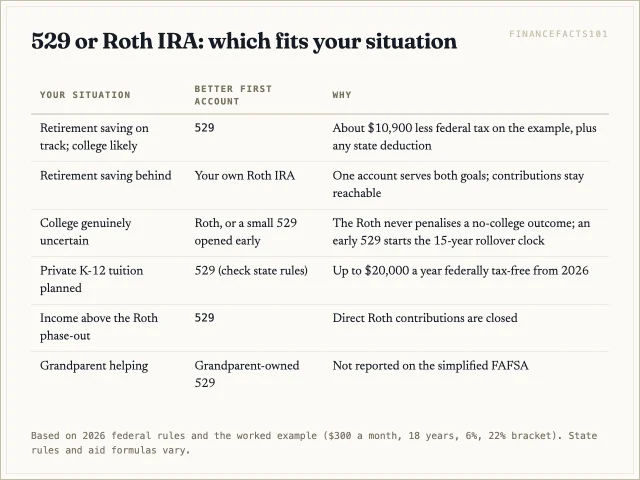
For most families the order is simple. Capture the 401(k) match. If your own retirement saving is behind — you cannot yet afford both the college amount and your planned IRA or 401(k) contributions — put the college money in your own Roth first; it serves both goals and keeps the choice open. Once your retirement saving is on track, route dedicated college money to a 529, starting with your state's plan if it offers a deduction and reasonable fees. Open the 529 early to start the 15-year rollover clock. Then decide each year, not once.
FAQ
Can I use a Roth IRA for my child's college without penalty?
Yes, up to a point. Your contributions come out tax- and penalty-free at any age. Earnings withdrawn before 59½ are exempt from the 10% additional tax to the extent they pay qualified higher-education costs that year, but they are still taxed as ordinary income unless the distribution is qualified — age 59½ plus five years since your first Roth contribution.
How much can I withdraw from a 529 for K-12 in 2026?
Up to $20,000 per beneficiary for the year, across all 529 accounts for that child, under the One Big Beautiful Bill Act's change to section 529(e)(3) for taxable years beginning after December 31, 2025. The cap for 2025 was $10,000. Qualifying K-12 costs now include tuition, curricular and instructional materials, eligible tutoring, test fees, dual enrollment and educational therapies; your state may not treat all of them as qualified.
What happens to a 529 if my child doesn't go to college?
You can change the beneficiary to another family member, keep it for graduate school or a trade credential, roll up to $35,000 into the child's Roth IRA over several years if the account is more than 15 years old, or withdraw it. A non-qualified withdrawal taxes the earnings as ordinary income plus a 10% additional tax, with exceptions for scholarships, death, disability and military-academy attendance.
Does a 529 hurt financial aid more than a Roth IRA?
As an asset, yes: a parent-owned 529 is assessed at up to 5.64% on the FAFSA, while retirement account balances are not counted. But Roth withdrawals count as parent income on the FAFSA two years later, assessed at 22% to 47%, so a Roth used during the early college years can cost more aid than a 529.
Sources
- IRS, Publication 970, Tax Benefits for Education — 529 tax treatment, qualified expenses, the 10% additional tax and its exceptions, credit coordination, beneficiary changes
- IRS, Publication 590-A, Contributions to IRAs — 529-to-Roth rollover conditions and the 2026 IRA limits
- IRS, Publication 590-B, Distributions from IRAs — Roth ordering rules, qualified distributions, the higher-education exception
- IRS, 401(k) limit increases to $24,500 for 2026, IRA limit increases to $7,500 — 2026 IRA limit and Roth phase-out ranges
- IRS, Notice 2025-67, Internal Revenue Bulletin 2025-49 — 2026 retirement plan and IRA amounts
- US Government Publishing Office, Public Law 119-21 (One Big Beautiful Bill Act) — sections 70413 and 70414, K-12 expenses, the $20,000 limit, credentialing expenses
- US Department of Education, 2026-27 FSA Handbook, Filling Out the FAFSA Form — 529 and retirement-account reporting
- US Department of Education, 2026-27 FSA Handbook, Student Aid Index and Pell Grant Eligibility — asset conversion rate, income assessment rates, asset-reporting exemptions
- US Department of Education, 2023-24 FSA Handbook, Filling Out the FAFSA — the former treatment of 529s owned by others
- NY 529 College Savings Program, Why Choose NY 529 — New York deduction and recapture
- Illinois State Treasurer, College Savings and Bright Start, Illinois Taxpayer Guide — Illinois deduction and add-back
- Virginia529, Invest529 Tax Benefits — Virginia per-account deduction
 Next entry · No. 5,978Checking Account Fees by Bank (2026): Overdraft, NSF and Monthly Fees at the 30 Largest Banks
See also
-
 No. 5,931
03 Sep 2026
14 min
Roth vs Traditional IRA: Which Saves You More Tax
Taxation
No. 5,931
03 Sep 2026
14 min
Roth vs Traditional IRA: Which Saves You More Tax
Taxation -
 No. 304
09 Apr 2024
23 min
Maximizing Retirement Savings with a Backdoor Roth IRA: A Strategy for High-Income Earners
Personal Finance
No. 304
09 Apr 2024
23 min
Maximizing Retirement Savings with a Backdoor Roth IRA: A Strategy for High-Income Earners
Personal Finance -
 No. 5,973
07 Oct 2026
16 min
How Much Do I Need to Retire? Spending, Social Security and the 4% Rule
Retirement
No. 5,973
07 Oct 2026
16 min
How Much Do I Need to Retire? Spending, Social Security and the 4% Rule
Retirement -
 No. 5,969
03 Oct 2026
19 min
Should I Do a Roth Conversion in 2026? How Much to Convert
Retirement
No. 5,969
03 Oct 2026
19 min
Should I Do a Roth Conversion in 2026? How Much to Convert
Retirement -
 No. 5,980
14 Oct 2026
21 min
Pay Off Debt or Invest? Compare Two After-Tax Rates
Personal Finance
No. 5,980
14 Oct 2026
21 min
Pay Off Debt or Invest? Compare Two After-Tax Rates
Personal Finance -
 No. 1,839
13 Nov 2024
18 min
Goal-Based Investing: Achieving Life Goals through Tailored Wealth Management
Personal Finance
No. 1,839
13 Nov 2024
18 min
Goal-Based Investing: Achieving Life Goals through Tailored Wealth Management
Personal Finance