Student Loan Repayment Plans: Cheapest Payment vs Cheapest Total
On $45,000 at 6.52%, RAP costs $27,563 more than the Standard plan if you pay in full — and saves $24,171 if you reach PSLF. Same plan, opposite answer.
Pick the wrong one and a $45,000 federal balance costs you $27,563 more than it had to. Federal student loan repayment plans answer two different questions and almost every guide blurs them: the plan with the lowest monthly payment is almost never the plan with the lowest total cost, and which one you should want depends entirely on whether you are heading for forgiveness or for payoff.
If you will repay in full, your job is to minimise interest and the fastest fixed plan wins. If you are on a credible path to Public Service Loan Forgiveness, your job is the opposite — minimise every dollar paid before month 120, because the rest is written off. Same borrower, same loans, same menu, opposite answer. This is general information built on the rules in force as of September 2026 and the assumptions named in each example, not personal advice.
Student Loan Repayment Plans: Cheapest Monthly and Cheapest Overall Are Different Plans
Take Maya: $45,000 of federal Direct loans at 6.52%, the fixed rate on undergraduate Direct loans first disbursed between July 1, 2026 and June 30, 2027 per the Department of Education's rate announcement of June 4, 2026. She earns $62,000, files single, no dependents.
On the 10-year Standard plan she pays $511.42 a month and $61,371 in total. On the Repayment Assistance Plan she pays $310.00 — $201 less — and, if she keeps paying until the balance clears, $88,934 in total. Lowest payment and lowest total are two different plans, and $27,563 separates them.
Now change one fact. Maya works for a county health department. After 120 qualifying payments of $310 she has paid $37,200 and the remaining $33,958 is forgiven tax-free. The plan that cost her $27,563 now saves her $24,171. Nothing about the loan changed — only the exit.
Who This Is For — and Who It Isn't
This is for someone with federal Direct loans choosing a repayment plan, most likely because a servicer notice arrived, a grace period ended, or the SAVE wind-down forced the question. It assumes a balance somewhere between $10,000 and $150,000.
It is not for private student loans, which have none of this — no income-driven option, no statutory forgiveness, no federal deferment rights — as the entry on federal versus private student loans sets out. It is not for Parent PLUS borrowers, excluded from the Repayment Assistance Plan entirely and needing their own route through consolidation into IBR. And it is not tax advice: the treatment of forgiven balances changed on January 1, 2026 in a way that deserves a preparer.
The Plan Menu Actually in Effect, September 2026
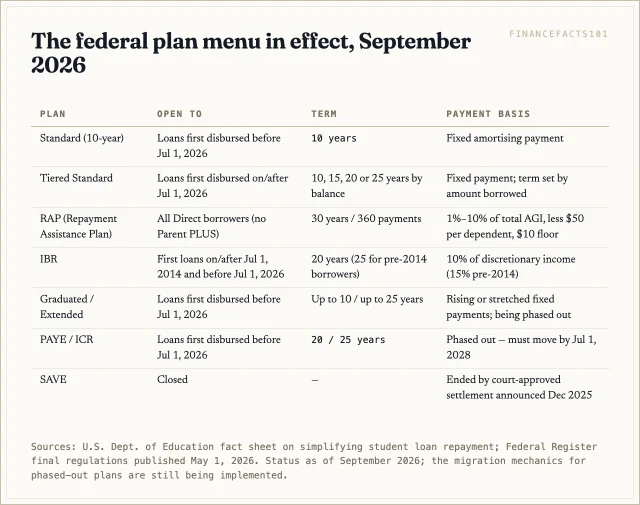
The menu changed more in the last eighteen months than in the previous fifteen years, so start from what exists rather than what you remember.
SAVE is gone. The Department announced a settlement with Missouri in December 2025 ending the plan; interest on loans parked in the SAVE forbearance resumed on August 1, 2025, and from July 2026 servicers began sending roughly 7.5 million borrowers notices giving at least 90 days to pick a legal plan before being placed in one.
Two new plans opened on July 1, 2026: the Repayment Assistance Plan (RAP) and the Tiered Standard plan, created by P.L. 119-21 and implemented through the Department's final regulations published May 1, 2026. What you can choose depends on one date — when your loans were first disbursed:
- Before July 1, 2026: Standard (10-year), Graduated, Extended, IBR, ICR, PAYE, and RAP.
- On or after July 1, 2026: Tiered Standard and RAP only.
The older income-driven plans are on a clock. Per the Department's fact sheet, borrowers in phased-out plans have until July 1, 2028 to move to RAP, Tiered Standard, or IBR. The honest caveat: the servicer-level mechanics of that migration are still being implemented, and pieces of the rewrite have drawn litigation. Check your servicer's notice and the Department's IDR court-actions page before acting on any deadline you read anywhere, this page included.
The Standard Plan Is the Total-Cost Baseline
Every comparison starts from the 10-year Standard plan, the cheapest way to clear a federal loan in full: fixed payment, 120 months, no income test, no annual recertification.
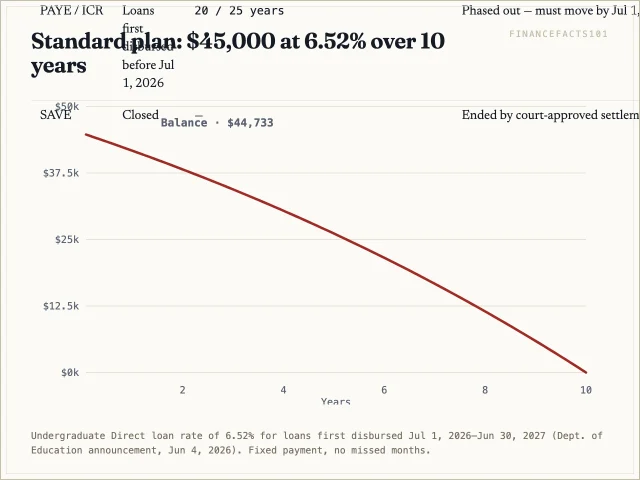
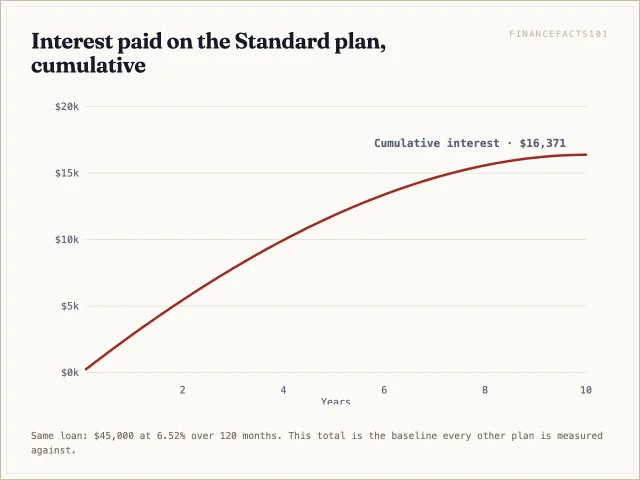
Maya's $45,000 at 6.52% amortises to $511.42 a month. Over 120 payments she pays $16,371 of interest — 36% of what she borrowed. Every plan that stretches the term beats that on affordability and loses to it on cost.
The Tiered Standard plan, for loans disbursed on or after July 1, 2026, sets the term by balance instead: under $25,000 is 10 years, $25,000 to under $50,000 is 15, $50,000 to under $100,000 is 20, and $100,000 or more is 25. Maya's $45,000 lands in the 15-year tier — $392.49 a month, $70,649 total. Lower payment, $9,278 more interest. The pattern repeats down the whole menu.
How RAP Calculates Your Payment
RAP breaks with every income-driven plan before it: the payment is a percentage of your entire adjusted gross income, with no poverty-line subtraction. The percentage climbs in $10,000 bands.
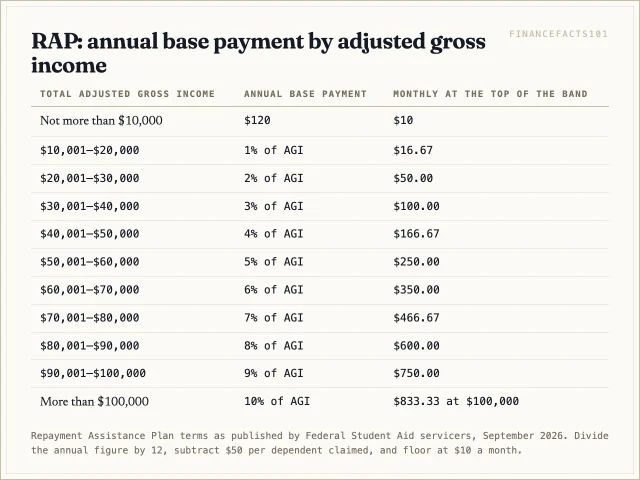
Take the annual figure, divide by 12, subtract $50 per dependent claimed on your federal return, and floor the result at $10 a month. Maya's $62,000 sits in the $60,001–$70,000 band at 6%: $3,720 a year, $310.00 a month.
Two protections make RAP genuinely different from what it replaces. Unpaid interest is waived: if your required payment is smaller than the month's interest accrual, the shortfall is not charged and not added to your balance. And if a full on-time payment does not reduce principal by at least $50, the Department contributes the difference up to $50, so a paying borrower's balance always falls. The Repayment Assistance Plan terms set forgiveness at 360 qualifying payments — 30 years — and RAP payments count toward PSLF. It covers Direct Subsidized and Unsubsidized loans, Grad PLUS, and Direct Consolidation loans containing no Parent PLUS component.
How IBR Calculates Your Payment — and Why the Poverty Line Matters
Income-Based Repayment uses the older architecture: a percentage of discretionary income, defined as your AGI minus 150% of the HHS poverty guideline for your family size and state.
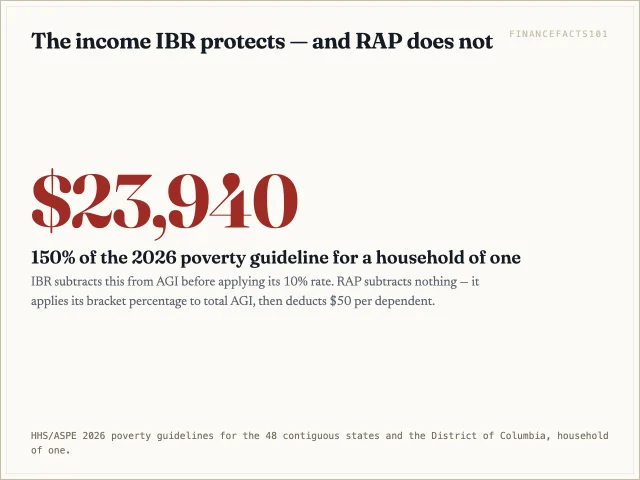
The 2026 poverty guideline for one person in the 48 contiguous states and DC is $15,960; 150% of that is $23,940, and every dollar below it is protected. Maya's discretionary income is $62,000 − $23,940 = $38,060. At 10% that is $3,806 a year, or $317.17 a month.
The percentage and the term turn on when you first borrowed: first loans on or after July 1, 2014 and before July 1, 2026 pay 10% over 20 years, and pre-2014 borrowers pay 15% over 25. Either way the payment is capped at the 10-year Standard amount, and P.L. 119-21 removed the old partial-financial-hardship gate. IBR is closed to anyone whose first loan is disbursed on or after July 1, 2026.
At Maya's income RAP and IBR land within $7 a month of each other — a coincidence of her numbers, not a rule. The formulas diverge sharply at low incomes, as a later section shows.
Which Student Loan Repayment Plan Is Cheapest — Maya's $45,000
Assumptions on the table: $45,000, 6.52%, $62,000 AGI held flat, single, no dependents, no missed payments, no forgiveness.
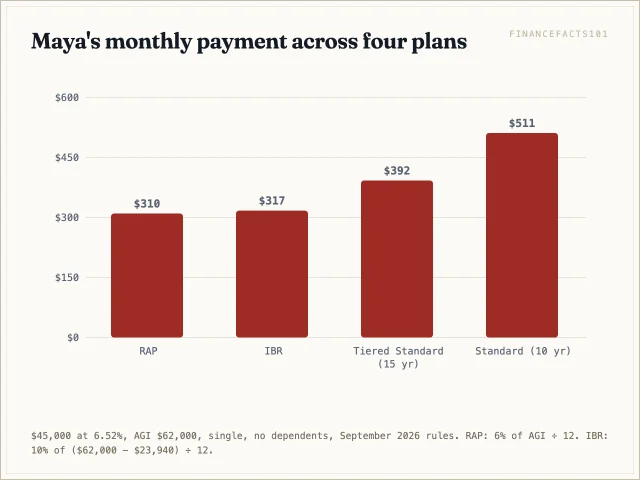
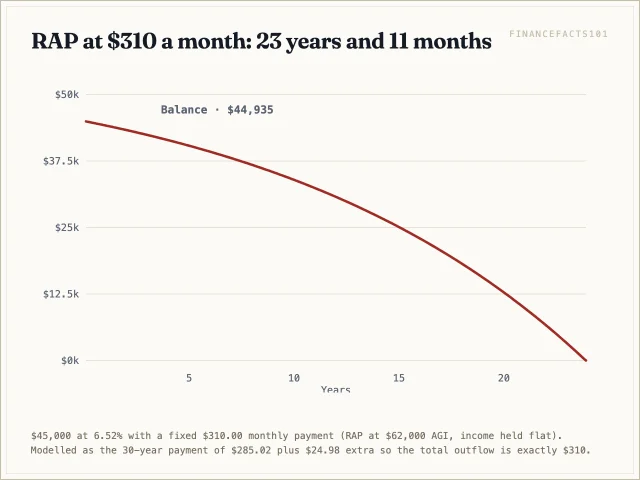
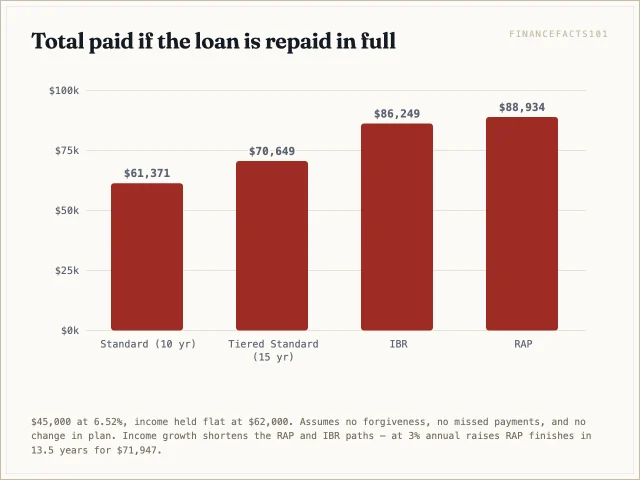
At $310 a month, Maya's balance takes 287 months — 23 years and 11 months — to clear, and costs $43,934 of interest, $88,934 in total. IBR's $317.17 clears it in 272 months for $86,249; Standard's $511.42 in 120 for $61,371. Ranked by monthly payment the order is RAP, IBR, Tiered Standard, Standard. Ranked by total cost it reverses exactly.
The flat-income assumption overstates the gap, and it is worth saying by how much. Run the same RAP path with 3% annual raises, recomputing the payment each year as the bracket climbs, and Maya clears the loan in 13.5 years having paid $71,947 — still $10,576 more than Standard. Income growth shrinks the penalty for going income-driven; it does not erase it. Run your own balance and rate through the student loan calculator rather than borrowing Maya's.
Income-Driven Repayment vs Standard When Forgiveness Is the Plan
Everything above assumes the loan gets paid. Now assume it does not.
Public Service Loan Forgiveness writes off the remaining balance after 120 qualifying monthly payments made while working full time — an average of 30 hours a week — for a qualifying employer. The test is the employer, not the job title: government at any level, and 501(c)(3) non-profits. Neither the payments nor the employment need be consecutive.
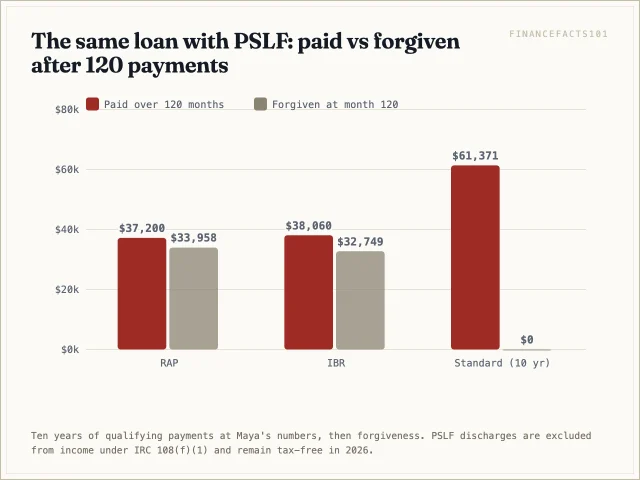
The Standard plan technically qualifies for PSLF and is practically useless for it, because 120 Standard payments retire the loan — nothing is left to forgive. That is the whole logic of the flip. On RAP, Maya pays $37,200 across those ten years and $33,958 is written off. On Standard she pays $61,371 and receives nothing. The lowest qualifying payment is worth $24,171 to her.
The trap: PSLF only pays if you finish. Leave public service at year seven and you have made 84 small payments, watched interest accrue, and face a larger balance with 20-plus years of RAP ahead. Certify your employer annually rather than discovering at year ten that a stretch of it did not count.
Forgiveness Timelines and the Tax Bill Nobody Budgets For
Three timelines, not interchangeable: PSLF at 120 payments, IBR at 240 or 300 depending on when you first borrowed, RAP at 360.
The tax treatment is where this gets expensive, and it changed on January 1, 2026. The American Rescue Plan Act's exclusion applied only to loans forgiven after December 31, 2021 and on or before December 31, 2025. It expired. Per the Taxpayer Advocate Service, a balance forgiven under an income-driven plan in 2026 or later is generally cancellation-of-debt income, reported on Form 1099-C and taxed at your marginal rate — mechanics in IRS Publication 4681.
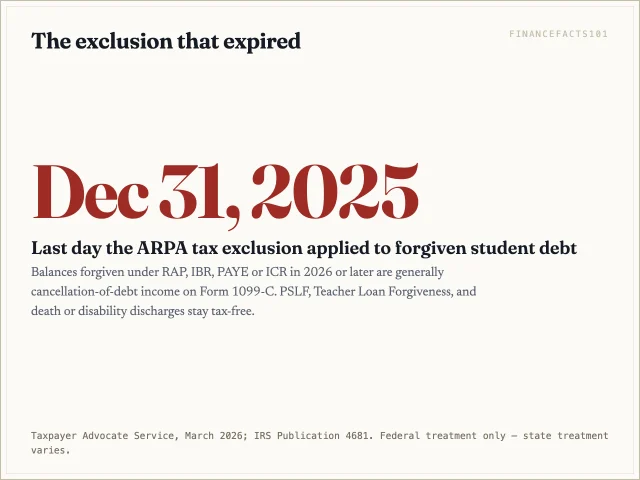
PSLF, Teacher Loan Forgiveness, and discharges for death or total and permanent disability stay permanently tax-free. Nothing else does, unless Congress acts. Plan on the bill: a $60,000 balance forgiven at year 20 in a 22% bracket costs $13,200 the following April, and nothing is withheld for you.
Interest Capitalisation and When It Actually Bites
Capitalisation adds accrued unpaid interest to principal, after which it earns interest itself. The 2023 regulations removed every trigger not required by statute: entering repayment, exiting forbearance, and leaving an income-driven plan other than IBR no longer capitalise. What still does, as of September 2026:
- Leaving the IBR plan, or being found no longer eligible to make income-based payments under it. This is statutory and cannot be waived.
- Exiting a period of deferment on unsubsidized loans.
- Consolidating, which folds outstanding accrued interest into the new principal by design.
Under RAP the question mostly dissolves, because unpaid interest is waived rather than accrued. Under IBR it does not: outside the three-year subsidy on subsidized loans, unpaid interest accumulates quietly and lands on your principal the moment you switch plans or miss a recertification.
Where RAP and IBR Diverge: the Low-Income Case
Change one input to see how far apart the formulas sit. Same $45,000 at 6.52%, but AGI of $38,000.
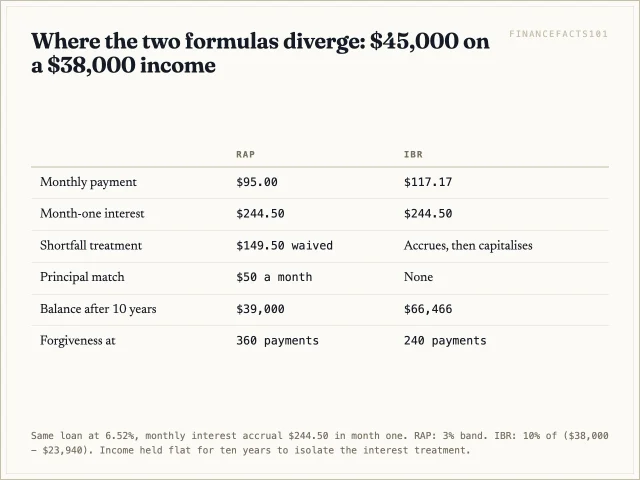
RAP's 3% band gives $1,140 a year, $95.00 a month. IBR's discretionary income is $38,000 − $23,940 = $14,060, so 10% is $1,406 a year, $117.17 a month. IBR asks $22 more and is far worse. The loan accrues $244.50 of interest in month one; under RAP the $149.50 shortfall is waived and the $50 principal match still applies, so the balance falls $50. Under IBR the shortfall accrues into a growing balance.
Hold both for ten years at that income and the RAP balance is $39,000 against IBR's $66,466. Here the lower payment is the cheaper plan — the reverse of Maya's case — because the interest waiver, not the payment size, does the work. Whenever your required payment is below your monthly interest accrual, compare interest treatment first and payment second.
Consolidation: What It Resets and What It Keeps
A Direct Consolidation Loan rolls multiple federal loans into one. It is the only route by which FFEL and Perkins loans become eligible for RAP, IBR, and PSLF, and the only route by which a Parent PLUS borrower reaches IBR.
What it does not do is save money. The new rate is the weighted average of the rates consolidated, rounded up to the nearest one-eighth of one percent — it can raise your rate slightly and never lowers it. Outstanding accrued interest capitalises into the new principal. There is no fee.
The payment count is what people get wrong. For consolidations completed on or after September 1, 2024, prior qualifying payments carry over as a weighted average of the counts on the loans combined — so a large loan with few qualifying payments drags down the blended count of a small one carrying many. Check your counts before you consolidate, not after.
Refinancing to a Private Lender Is a One-Way Door
This is the single most consequential mistake available to a federal borrower, and it is marketed as a good idea.
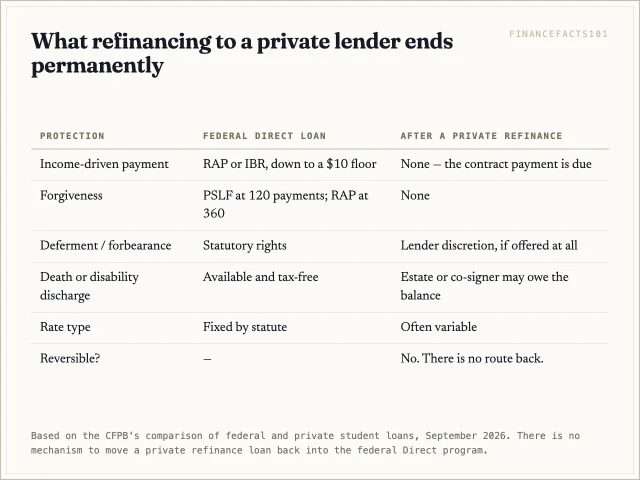
Refinancing means a private lender pays off your federal loans and issues you a private one. The federal loans cease to exist — no undo, no hardship exception, no reconsolidation back into the Direct program. The CFPB's comparison of federal and private loans lays out what you trade away: income-driven repayment, PSLF and IDR forgiveness, statutory deferment and forbearance rights, death and disability discharge, and a fixed rate that cannot float upward.
The pitch is a lower rate. Price it honestly: cutting 6.52% to 5.25% on $45,000 over 10 years saves about $3,400 of interest — real money, and roughly one-seventh of what PSLF was worth to Maya. The borrowers for whom refinancing genuinely works are a narrow set: high stable income, private-sector career, balance small relative to earnings, no intention of ever using an income-driven plan, and an emergency fund deep enough to absorb a job loss. If that is not all five, do not do it.
Deferment, Forbearance, and the July 2027 Cutoff
Both pause payments; the difference is who pays the interest. In deferment the government covers interest on subsidized loans; in forbearance it never does, and interest accrues on everything — the distinction set out in the entry on deferment and forbearance and in the Department's guide to temporary relief options.
A pause is almost always worse than a low income-driven payment. A $10 RAP payment keeps the forgiveness clock running and triggers the interest waiver; a forbearance stops the clock and lets interest pile up. The pause options are also narrowing: for loans first disbursed on or after July 1, 2027, P.L. 119-21 eliminates the economic hardship and unemployment deferments outright and caps discretionary forbearance at nine months in any 24-month period. Earlier loans keep the current rules.
Federal loans default at 270 days of missed payments, and the CFPB warns that default can bring garnishment of wages, tax refunds, and Social Security payments. A $10 payment is always available and always better than silence.
Who Should Just Pay It Off Fast
Some readers should close this page and attack the balance. The profile is specific: private-sector work with no PSLF path, a balance below about one year's gross income, a rate at or above 6.52%, a funded emergency fund, and an employer retirement match already captured.
For that borrower every income-driven feature is a cost, not a benefit. Maya on Standard pays $16,371 of interest; adding $150 a month to her $511.42 payment clears the loan in 7 years 2 months for $11,332 — $5,039 saved for money she could already afford. Federal debt at 6.52% sits above most mortgage rates and below most card rates, putting it in the middle of an avalanche ordering of your debts; the sequencing is covered in repayment strategies for student loans and mortgages. Check the payment against your income with the debt-to-income calculator and model the extra in the student loan calculator.
The Decision, in Order
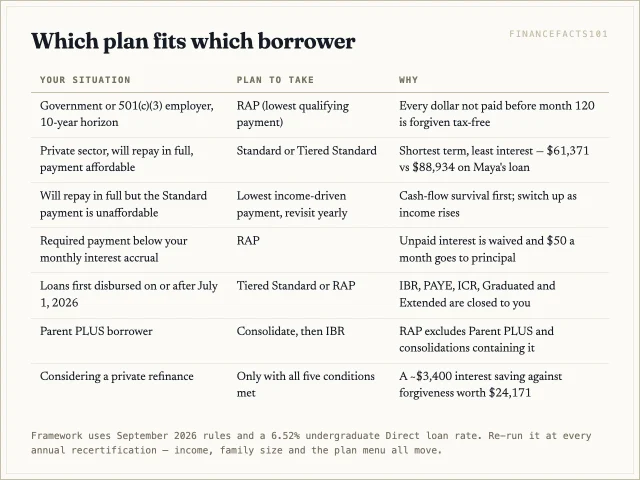
Four questions in sequence and the plan falls out. Are your loans federal Direct? If not, none of this applies. Do you work for a government or 501(c)(3) employer and intend to for ten years? If yes, take the lowest qualifying payment available — almost always RAP — and certify employment annually. If you will repay in full, can you afford the Standard or Tiered Standard payment without crowding out an emergency fund or a retirement match? If yes, take it. If not, compare your required income-driven payment against your monthly interest accrual: below it, RAP's waiver wins; above it, take whichever formula gives the lower number.
The plan you pick is not permanent. What is permanent is refinancing away from the federal system, and consolidating without checking your payment counts. Get those two right and the rest is arithmetic you redo every year.
FAQ
Which student loan repayment plan is cheapest overall?
For a borrower who repays in full, the 10-year Standard plan: shortest term, least interest. On $45,000 at 6.52% it costs $61,371 against $88,934 on RAP at a flat $62,000 income. For a borrower who reaches PSLF or IDR forgiveness, the cheapest plan is whichever produces the lowest qualifying payment, because the remainder is written off.
Can I still enrol in SAVE, PAYE, or ICR?
No to SAVE — ended by a court-approved settlement announced in December 2025. PAYE and ICR remain open only to borrowers whose loans were first disbursed before July 1, 2026, and are being phased out; July 1, 2028 is the deadline to move to RAP, Tiered Standard, or IBR.
Is forgiven student debt taxable in 2026?
Federally, yes for income-driven forgiveness. The American Rescue Plan exclusion covered discharges through December 31, 2025 only, so balances forgiven under RAP, IBR, PAYE, or ICR from 2026 onward are generally cancellation-of-debt income. PSLF, Teacher Loan Forgiveness, and death or disability discharges remain tax-free. State treatment varies.
Does switching plans restart my forgiveness clock?
Switching between income-driven plans does not erase payments already counted. Consolidating can: for consolidations on or after September 1, 2024 the new loan is credited with a weighted average of the counts on the loans combined, which can move your total up or down. Check your counts on StudentAid.gov first.
What happens if my income-driven payment is $0?
A $0 calculated payment still counts as a qualifying payment on IBR, so the clock keeps running. RAP applies a $10 monthly floor. Either is worth far more than a forbearance, which stops the clock entirely while interest accrues.
Sources
- U.S. Department of Education, Fact Sheet: Simplifying Student Loan Repayment — RAP, Tiered Standard tiers, and the July 1, 2028 transition deadline
- U.S. Department of Education, Next Steps for Borrowers Enrolled in the SAVE Plan — the SAVE wind-down and 90-day notices
- Federal Register, Reimagining and Improving Student Education — Federal Student Loan Program Final Regulations, May 1, 2026
- Federal Student Aid, Standard Repayment Plan and IDR court actions
- Federal Student Aid, Repayment Assistance Plan (RAP) terms — AGI bands, $50 dependent reduction, $10 floor, interest waiver, $50 principal match, 360 payments
- Federal Student Aid, Income-Based Repayment (IBR) — discretionary income definition, 10%/15% and 20/25-year terms
- Federal Student Aid, Public Service Loan Forgiveness — 120 qualifying payments and the employer test
- Federal Student Aid, Loan Consolidation and Get Temporary Relief
- FSA Partners, Interest Rates for Direct Loans Disbursed July 1, 2026 – June 30, 2027 — 6.52% undergraduate, 8.07% graduate, 9.07% PLUS
- HHS/ASPE, 2026 Poverty Guidelines — $15,960 for a household of one in the 48 contiguous states and DC
- Taxpayer Advocate Service, What to Know about Student Loan Forgiveness and Your Taxes, March 2026 — expiry of the ARPA exclusion on December 31, 2025
- IRS, Publication 4681, Canceled Debts — cancellation-of-debt income and Form 1099-C
- CFPB, Federal vs private student loans and student loan repayment tips — protections lost on refinancing, and the 270-day default line
 Next entry · No. 5,947HSA vs FSA: Which One to Fund at Open Enrollment
See also
-
 No. 5,980
14 Oct 2026
21 min
Pay Off Debt or Invest? Compare Two After-Tax Rates
Personal Finance
-
 No. 5,936
08 Sep 2026
14 min
Debt Avalanche vs Snowball: Which Pays Off Faster
Personal Finance
-
 No. 5,942
13 Sep 2026
19 min
How Long It Takes to Pay Off a Credit Card at $8,000 and 22.15%
Personal Finance
-
 No. 4,786
16 Jul 2025
22 min
Student Loan Forgiveness: Types, Requirements, and Application Process
Education
-
 No. 1,235
16 Aug 2024
22 min
Understanding Education Loans: Federal vs Private Student Loans and Debt Management Strategies
Education
-
 No. 6,004
07 Nov 2026
21 min
Fixed Annuity vs CD: Which Pays More and Which Is Safer?
Retirement