Pay Off Debt or Invest? Compare Two After-Tax Rates
Pay off debt or invest? Cards at 22.15% go first; debt under about 3.9% after tax never gets prepaid. A worked example prices the middle.
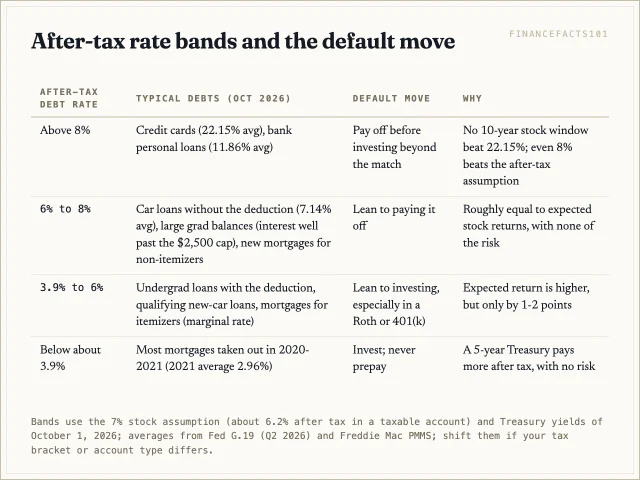
To decide whether to pay off debt or invest, compare the debt's after-tax interest rate with the after-tax return you can expect: as of October 1, 2026, a credit card (22.15% average APR on accounts charged interest, per the Federal Reserve's G.19 release of September 8, 2026) should be paid off before you invest anything beyond an employer match, and a debt that costs less than a Treasury pays after tax (about 3.9% on a five-year note for someone in the 22% bracket) should not be prepaid at all. Between those lines, roughly 3.9% to 8% after tax, sit most student loans, car loans and newer mortgages, and in the worked example below prepaying them costs about $2,000 over ten years if stocks earn a steady 7% but comes out about $3,200 ahead in a decade like 2000–2009.
That middle band is where most of the arguing happens, and it is where the guide spends most of its arithmetic. The extremes take a paragraph each.
One line of scope honesty: this is general information built on stated assumptions (a named household, a 7% stock-return assumption, tax rules for 2026 and market rates dated October 1, 2026), not personal advice. Swap in your own rates and bracket; the method carries over even where the numbers do not.
Who this is for — and who it is not for
This guide is for a household that covers every minimum payment, has money left over each month, and is deciding where the extra goes: an extra loan payment or an investment account. It assumes the debts are fixed-rate or close to it and that the person will still be paying them for a few years.
It is not for someone who cannot make the minimums. That is a hardship problem, and the moves are different: calling lenders, nonprofit credit counseling, sometimes bankruptcy. It is also not about the order in which to pay several debts, which the debt avalanche vs snowball guide settles with its own example. And if you are working toward Public Service Loan Forgiveness or an income-driven forgiveness date, extra payments on those federal loans are usually money handed back to the government; the student loan repayment plans guide covers that case.
Pay off debt or invest: the two after-tax rates
Paying a debt early earns exactly its interest rate, guaranteed, from the day you pay. If the interest is not tax-deductible, that rate is also your after-tax return, because the money you stop paying in interest was never deductible in the first place. If the interest is deductible, the true cost is lower: multiply the rate by one minus your marginal tax rate, but only for the part of the interest the deduction actually covers.
Investing earns an expected return that is neither guaranteed nor tax-free. In a taxable brokerage account, long-term gains on index funds are taxed when sold, at no more than 15% for most filers, and for 2026 the 0% rate applies only to taxable income up to $49,450 single or $98,900 joint, per the IRS's Revenue Procedure 2025-32. Qualified withdrawals from a Roth IRA are untaxed; inside a traditional 401(k) the tax is deferred.
The comparison needs two yardsticks. The first is a risk-free one: on October 1, 2026, the Treasury's daily par yield curve put the one-year note at 4.44%, the five-year at 5.01% and the ten-year at 5.24%. After 22% federal tax those pay 3.46%, 3.91% and 4.09%. Any debt cheaper than that should not be prepaid, because a Treasury beats it with no risk at all. The second yardstick is a stock assumption. This guide uses 7% a year, the figure the site's emergency fund and 401(k) guides use, compounded monthly as the compound interest calculator does. Held ten years in a taxable account and taxed at 15% on the gain at sale, 7% works out to about 6.2% a year after tax, expressed like an APR so it compares directly with loan rates (about 6.4% as an effective annual return).
Here are both yardsticks against the debts of the worked household, Jordan: single, income of $78,000, 22% bracket, no state income tax, taking the standard deduction.
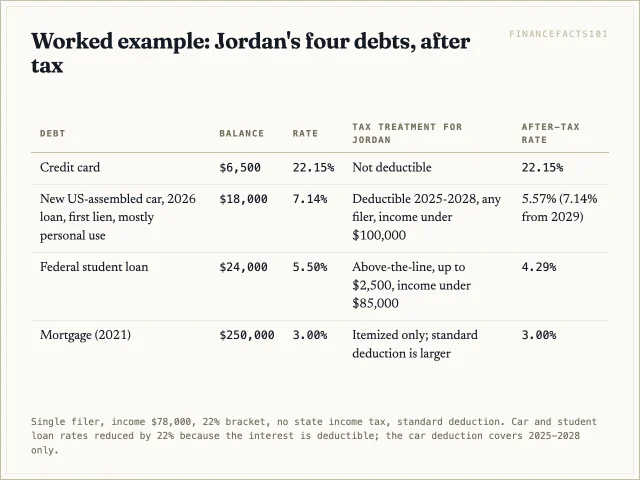
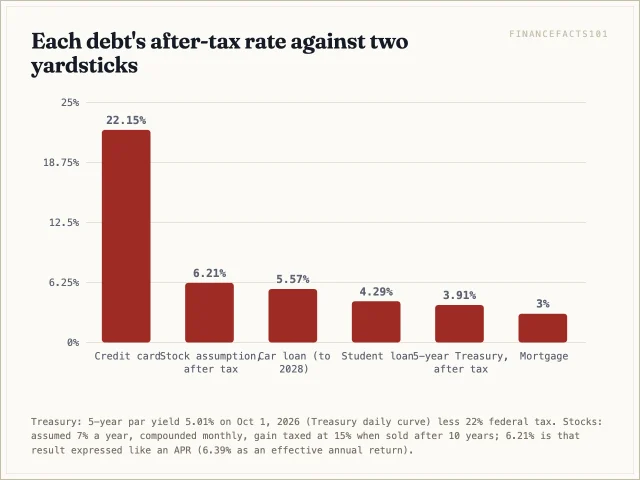
The card is an easy call and so is the mortgage. The car loan and the student loan sit between the Treasury yield and the stock assumption, which is the definition of a judgment call.
The guaranteed side and the risky side are different kinds of number
A 22.15% card payoff and a 7% stock assumption are not two points on the same scale. One is a contract; the other is an average that arrives with years of losses mixed in. The SEC's investor guidance puts the first case flatly in its Ten Things to Consider Before You Make Investing Decisions: "There is no investment strategy anywhere that pays off as well as, or with less risk than, merely paying off all high interest debt you may have."
History shows how wide the spread around 7% is. In NYU Stern's long-run dataset of S&P 500 total returns (Aswath Damodaran's historical returns on stocks, bonds and bills, January 2026 update), the index lost money in 26 of the 98 calendar years from 1928 through 2025, and its annualized return over the ten years 2000–2009 was −0.95%. The worst ten-year window, starting in 1929, returned −1.67% a year.
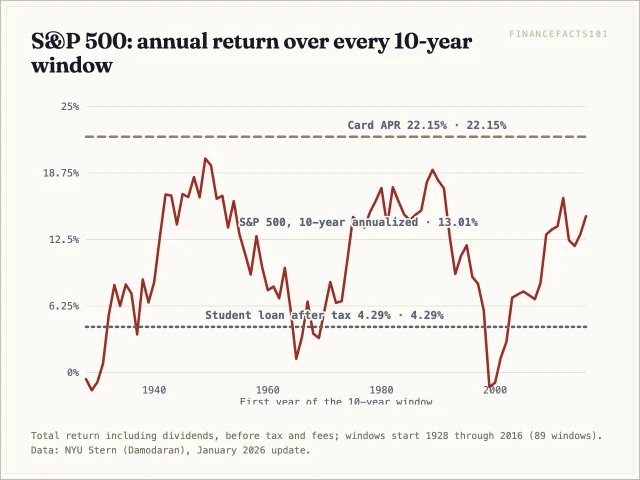
Lay each debt's after-tax rate against those 89 rolling ten-year windows, with the 15% tax taken off the stock gain, and the asymmetry becomes countable.
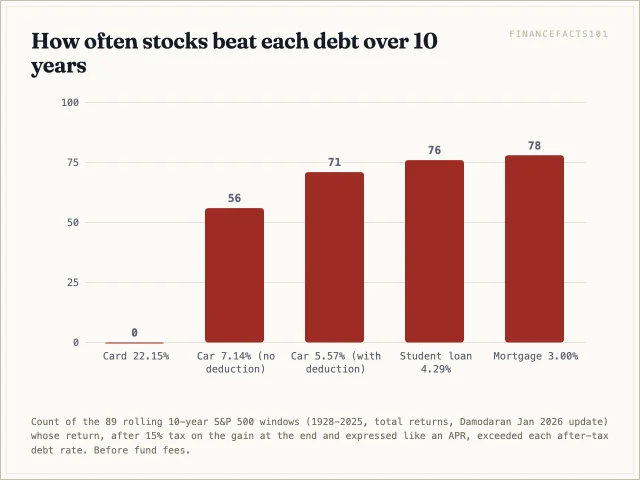
Stocks never beat the card over any ten-year stretch, not once in 89. They beat Jordan's 4.29% student loan in 76 of 89 windows, which sounds decisive until you notice the other 13: a one-in-seven chance of finishing a decade behind a payoff that was certain. Both the counts and the debt rates are expressed like APRs. The 7% assumption itself sits below the historical median (about 9.4% a year after tax across these windows, on the same basis), deliberately: the last century of US stocks is a single and unusually good sample, and a decision rule should not depend on repeating it.
The order of operations
The rate comparison only applies to money that is genuinely spare. Two things come before it, and the existing guides cover both, so here they get a summary and a link.
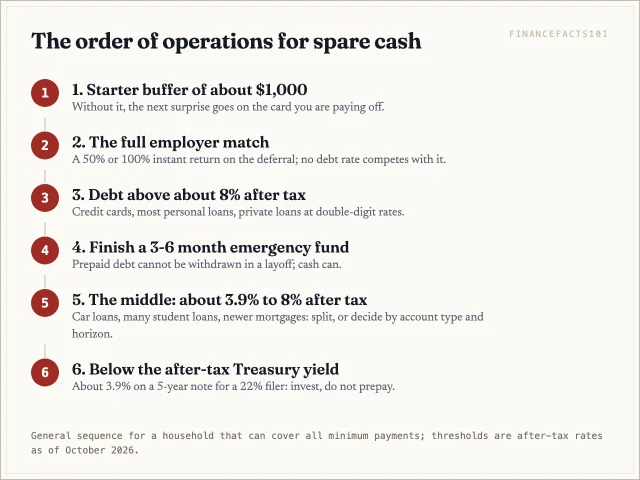
First, a starter buffer of about $1,000, because without one the next car repair lands on the card you are trying to clear; the emergency fund guide sizes the full fund at three to six months of essential spending and explains why it sits in insured cash rather than stocks. Second, the full employer match. The SEC calls an unclaimed match "passing up 'free money' for your retirement savings", and the 401(k) employer match guide explains why it ranks even ahead of a 22% card: a year of forgone match on a typical salary costs more than a year of interest on a typical balance.
After those, debt above about 8% after tax goes next, then the rest of the emergency fund, and only then the middle cases. The full fund comes after the high-rate debt and before the middle for a liquidity reason, covered under behavioral factors below: a prepaid loan cannot be withdrawn in a layoff.
Credit cards: the rate no portfolio matches
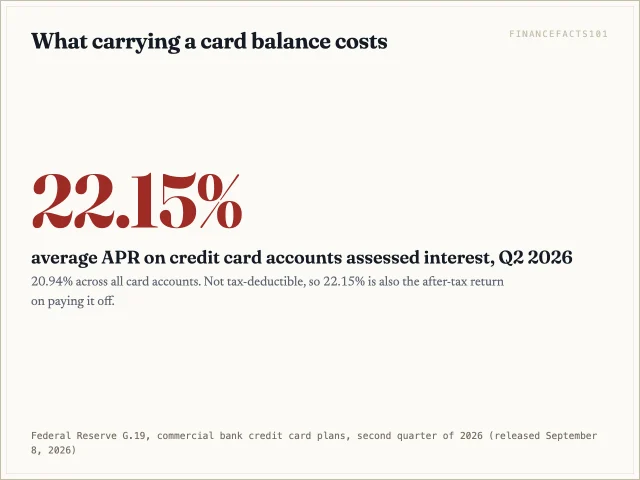
The Federal Reserve's G.19 consumer credit release of September 8, 2026 put the average credit card APR at 22.15% on accounts that were charged interest and 20.94% across all accounts, for the second quarter of 2026. Card interest on personal spending is not deductible (IRS Topic 505 lists it among nondeductible personal interest), so 22.15% is the after-tax return on every dollar sent to the balance.
That average predates the latest rate move. On September 16, 2026 the FOMC raised the federal funds target range a quarter point to 3.75%–4.00%, and the prime rate has been 7.00% since September 17 on the Fed's H.15 release. The CFPB lists a rise in the index a variable card rate is tied to, such as the prime rate, as one of the situations in which an issuer may raise your rate. Card debt is getting more expensive, not less.
The cost of leaving Jordan's $6,500 card on its $195 payment while the spare $600 goes to investing is easy to price.
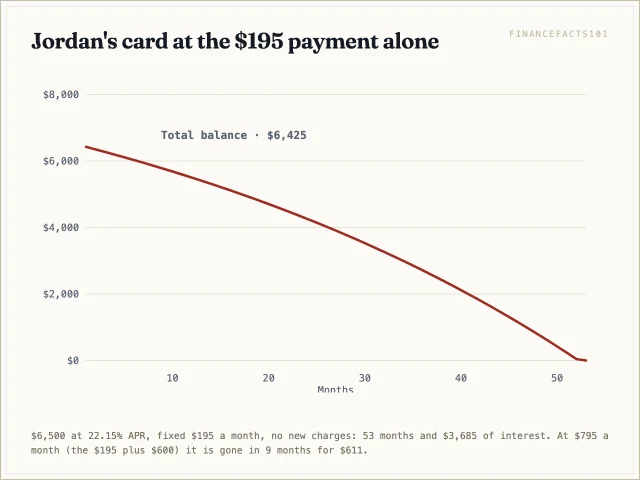
At $195 a month the card takes 53 months and $3,685 of interest. With the $600 added it is gone in 9 months for $611. The $3,073 saved is the 22.15% rate at work, and the S&P 500 has not matched that rate over any ten-year window since 1928. Carrying a balance is common: in the Fed's 2025 Survey of Household Economics and Decisionmaking, 45% of cardholders said they carried a balance at least once in the prior 12 months. The same logic covers bank personal loans, which G.19 puts at 11.86% for 24-month loans; if a 0% transfer could cut the rate, the balance transfer vs personal loan guide prices the fee.
Student loans: the $2,500 deduction and where it stops
Student loan interest is deductible without itemizing. Per IRS Topic 456, you deduct the lesser of $2,500 or the interest actually paid, as an adjustment to income, provided you are legally obliged to pay the interest, are not filing married-separately, and nobody claims you as a dependent. For 2026 the deduction begins to phase out above $85,000 of modified adjusted gross income ($175,000 joint) and disappears at $100,000 ($205,000 joint), per Revenue Procedure 2025-32. The 2025 tax law left this deduction unchanged.
Two consequences follow. Jordan, at $78,000 with $24,000 at 5.50%, pays about $1,320 of interest a year, all deductible, so the loan costs 5.50% × 0.78 = 4.29% after tax. A borrower in the same 22% bracket and under the $85,000 phase-out, with $60,000 of graduate debt at 8.07% (the Direct Unsubsidized rate for graduate loans first disbursed July 2026 through June 2027, per Federal Student Aid's rate announcement) pays about $4,842 of first-year interest, and only $2,500 of it is deductible: the after-tax cost is about 7.15%, not 6.29%. The cap pushes large balances back toward paying them down.
Jordan's 5.50% is the undergraduate rate for loans first disbursed July 2023 through June 2024, per the FSA announcement for that year; real balances usually mix several years' rates. The 2026–27 undergraduate rate is 6.52%, which is 5.09% after the deduction. Whether to prepay federal loans also depends on the repayment plan: a borrower whose balance will be forgiven gains nothing from paying it faster.
Car loans: a deduction through 2028, for new US-built cars only
The 2025 tax law, Public Law 119-21, section 70203, created a deduction for interest on car loans, and it changes the after-tax rate for some buyers. The rules, from the enacted text, IRS Topic 505 and the final regulation, 26 CFR 1.163-16 (T.D. 10054, published September 8, 2026): the loan must have been taken out after December 31, 2024, secured by a first lien on the vehicle, to buy a new vehicle (original use starting with you) whose final assembly was in the United States. The vehicle must be a car, minivan, van, SUV, pickup or motorcycle with a gross vehicle weight rating under 14,000 pounds, and you must expect, when you take out the loan, that it will be used for personal purposes more than 50% of the time. The deduction is capped at $10,000 of interest per tax return regardless of filing status, so a married couple filing jointly with two qualifying loans shares one $10,000, and it shrinks by $200 for each $1,000 (or part of $1,000) of modified adjusted gross income above $100,000, or $200,000 on a joint return. Refinancing keeps the deduction only up to the old loan's balance. It applies for tax years 2025 through 2028 only, it is available whether or not you itemize, and the VIN goes on the return. Used cars and leases do not qualify.
The Fed's G.19 puts the average 60-month new-car loan at a commercial bank at 7.14% for the second quarter of 2026. Jordan's loan qualifies, so it costs 7.14% × 0.78 = 5.57% after tax through 2028 and the full 7.14% from 2029. A used-car loan at the same rate costs 7.14% from day one. That swing moves the same loan from one band to the next.
Mortgages: the 2026 standard deduction sets the real rate
The extra mortgage payment guide works the prepay-or-invest comparison on a $320,000 loan and finds the break-even is the mortgage rate itself, beaten after tax and in sequence. What it does not tabulate is when the interest deduction changes that rate, and in 2026 the answer for most households is that it does not.
Mortgage interest is deductible only if you itemize, on up to $750,000 of acquisition debt for homes bought after December 15, 2017 (IRS Topic 505); Public Law 119-21 made that limit permanent. Itemizing only pays when the total beats the standard deduction, which Revenue Procedure 2025-32 sets at $16,100 single and $32,200 joint for 2026. The same law raised the state and local tax deduction cap to $40,400 for 2026, reduced by 30% of modified adjusted gross income above $505,000 but not below $10,000.
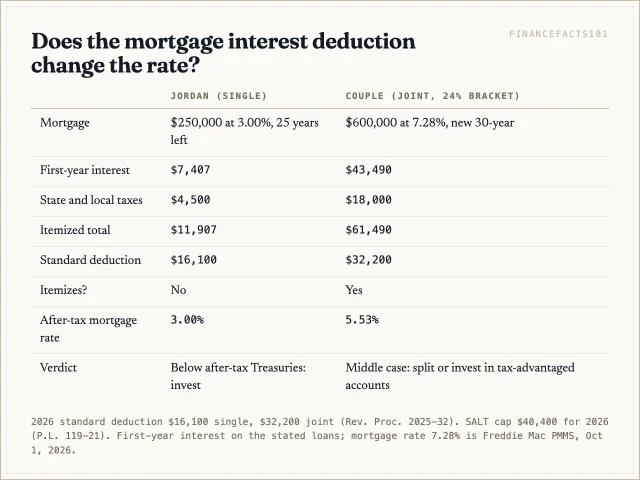
Jordan's $250,000 left at 3.00% generates about $7,407 of interest in the first year; with $4,500 of property tax the total is $11,907, short of $16,100. The deduction is worth nothing, the mortgage costs 3.00%, and that is below the 3.91% a five-year Treasury pays after tax. Prepaying it would be a mistake even for someone who will never own a stock.
The second household is a married couple with $300,000 of income and a new $600,000 mortgage at 7.28%, the Freddie Mac PMMS 30-year average on October 1, 2026. First-year interest of about $43,490 plus $18,000 of state and local tax clears the $32,200 standard deduction easily, their taxable income lands in the 24% bracket, and the mortgage costs about 5.53% after tax on each extra dollar prepaid, as long as they still itemize. That is a middle case, and close to the 6.2% after-tax stock assumption.
The worked example: Jordan's $600 a month, three ways
Jordan has a $12,000 emergency fund, defers enough to get the full 401(k) match, and has $600 a month left after the minimums, from January 2027. The debts are the card ($6,500 at 22.15%, $195 a month), the car ($18,000 at 7.14%, 48 payments of $432.21 left) and the federal student loan ($24,000 at 5.50%, 120 payments of $260.47 on the standard plan, no forgiveness in view). The car-loan deduction rests on stated assumptions: Jordan bought the car new in 2026, its final assembly was in the United States (the VIN's plant code shows it), it is a car under the 14,000-pound weight limit, the loan is secured by a first lien on it, and Jordan expects more than 50% personal use; the interest, about $1,155 in 2027, is far below the $10,000 per-return cap, and Jordan's $78,000 income is below the $100,000 point where the phase-out starts. The 3.00% mortgage is paid on schedule in every plan and drops out of the comparison. Total outlay is $1,487.68 a month for ten years, $178,521.60, in every plan.
The investments go into a total-market stock index fund in a taxable account at the 7% assumption. The tax refunds from the car and student loan deductions are counted once, as cash invested each December; a plan that pays those loans faster earns smaller refunds, and the comparison carries that cost. At the end of 2036 the fund is sold and the gain taxed at 15%. Dividend taxes along the way and fund fees are ignored, which flatters investing slightly.
Plan one, invest first: minimums on everything, $600 a month into the fund. Plan two, card first: the $600 goes to the card until month 9, then the $795 freed goes to the fund while the car and student loan run to schedule. Plan three, all debt first: highest rate first until all three are gone in month 37, then the whole $1,487.68 goes to the fund.
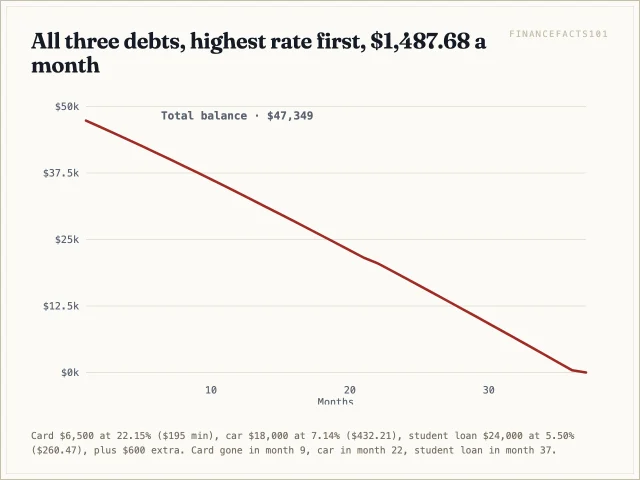
Debt-first pays about $5,100 of interest in total; card-first pays $10,612; invest-first pays $13,686. At a steady 7%, card-first ends with the most, $158,908, against $156,933 for all-debt-first and $155,290 for invest-first. Paying the car and student loan early saved $5,535 of interest and cost $1,056 of tax refunds, but the money that went into them missed months of compounding at 7% that card-first did not. The tool version of this schedule is the debt payoff calculator, where these three debts and the $600 extra can be entered directly.
What happens when markets do not average 7%
A steady 7% is the assumption, not the experience. The same three plans plus a half-and-half split, replayed through two real decades of S&P 500 total returns including dividends (NYU Stern/Damodaran, January 2026 update, data through 2025) and at a steady 4%, rank differently. In the replays the 2000 return is applied to 2027, 2001 to 2028 and so on through 2009 to 2036 (likewise 2015–2024 onto 2027–2036), each year's return spread evenly across its months:
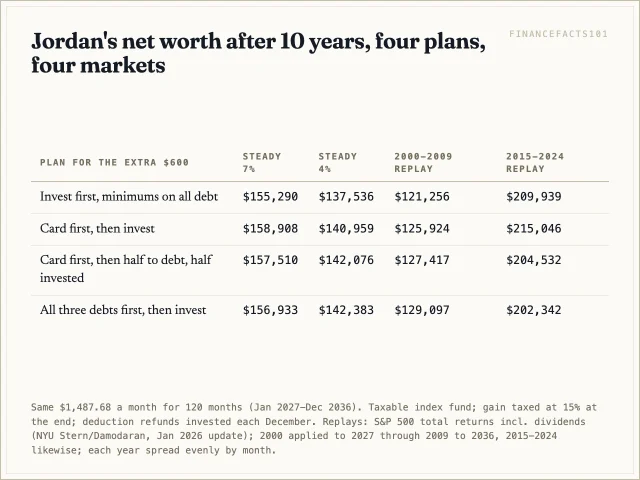
Card-first beats invest-first in every column, by $3,423 to $5,107: there is no realistic market in which carrying 22.15% debt pays. The middle debts are the ones that flip. In a 2015–2024 replay, card-first finishes $12,704 ahead of all-debt-first; in a 2000–2009 replay, all-debt-first finishes $3,173 ahead of card-first. The half-and-half plan (card first, then half the spare cash to the remaining debts and half invested) never wins and never comes last, which is the point of it.
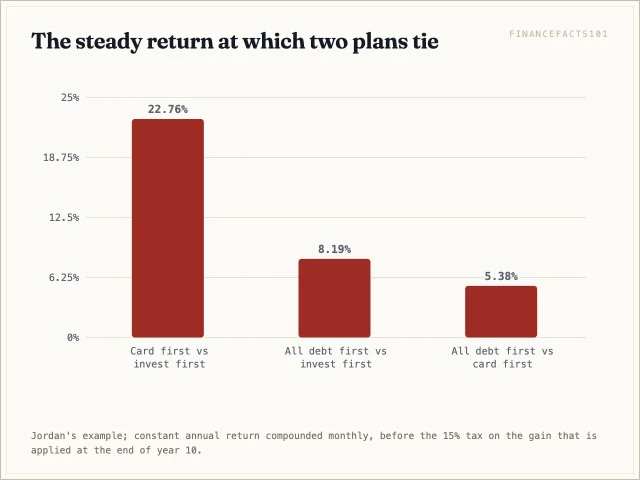
The crossovers make the trade explicit. Investing before the card only wins if stocks earn about 22.8% a year, every year. Paying the car and student loans early beats investing whenever stocks return less than about 5.4% a year over the decade. That 5.4% sits between the two loans' after-tax costs (4.29% and 5.57%, rising to 7.14% in 2029), which is the after-tax rate rule showing up again inside the arithmetic.
The middle cases: about 3.9% to 8% after tax
For debt between the after-tax Treasury yield and about 8%, no rule settles it on the numbers, so these four questions decide it.
Which account would the investing happen in? Jordan's comparison uses a taxable account, where 7% becomes about 6.2% after tax. In a Roth IRA, whose 2026 limit is $7,500 under IRS Notice 2025-67, qualified growth is untaxed and the full 7% counts, which tilts a 5% to 6% debt toward investing. A taxable account tilts the same debt toward paying.
How long is the horizon? Ten-year S&P 500 windows ranged from −1.7% to +20.1% a year; three-year windows in the same data ranged from −27.3% a year (1930–1932) to +30.8% (1995–1997). A debt with three years left is closer to a short-term bond decision than a stock one.
Does the deduction expire? Jordan's car loan is 5.57% through 2028 and 7.14% after. A loan that crosses bands on a known date deserves a plan that switches on that date.
How safe is the income? Prepaid principal is gone for good, while a fund can be sold. A household with one income in a cyclical industry should weight liquidity more heavily than the rate spread suggests.
Splitting is a legitimate answer, not a cop-out. In Jordan's table the split plan landed within $1,400 of the best plan in the two steady-return columns and within $10,600 of the best in either historical replay. If you cannot say which way the four questions point, split.
Behavioral factors, stated honestly
The spreadsheet assumes a person who invests every dollar on schedule and never sells in a panic. Real people differ from that person in predictable directions, and the honest way to use these factors is to say which way each one pushes, not to pretend they settle the answer.
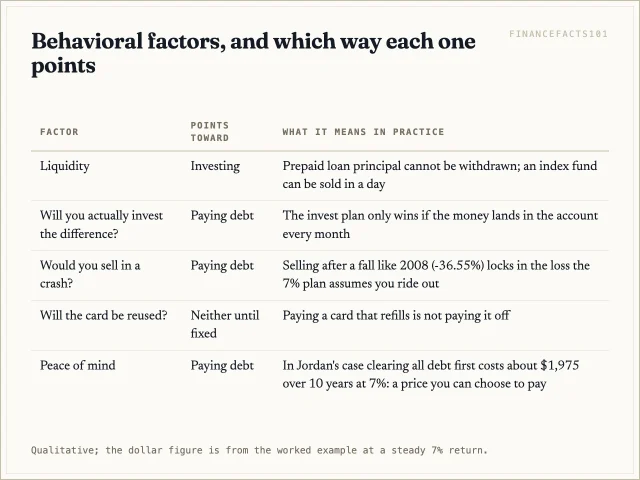
Two cut toward paying debt. The invest-first plan only beats debt-first if the spare money actually reaches the account every month and stays through a fall like 2008's −36.55%. Someone who has sold after a drop before should treat the middle band as debt territory. And the certainty of a payoff has a value, but it also has a price, and it can be named: in Jordan's case, clearing all three debts first costs about $1,975 over ten years at a steady 7%. Paying $200 a year for a debt-free date is a defensible purchase as long as it is a choice and not an accident.
One cuts the other way, and one cuts across both. Liquidity favors investing, because a fund can be sold and a prepaid car loan cannot be un-paid. And paying a card that refills is not paying it off at all: if the balance comes back, the issue is spending, and no allocation plan fixes it.
The decision, step by step
Work it once with your own statements. List every debt with its rate, then convert each to an after-tax rate: no change for cards and personal loans, the deduction applied to student loans (within the $2,500 cap and the income limits), to qualifying new-car loans through 2028, and to mortgages only if your itemized total beats $16,100 or $32,200. Then place each debt in a band.
- Build the starter buffer and take the full employer match.
- Pay off everything above about 8% after tax, highest rate first.
- Finish the emergency fund to three to six months of essentials.
- For debts from about 3.9% to 8%, pick by account type, horizon, deduction dates and income safety, or split.
- Invest ahead of anything below the after-tax Treasury yield, and never prepay it.
Re-run the numbers when a rate resets, a deduction ends, your bracket changes, or the Treasury yield moves far enough to pull a debt across the 3.9% line.
FAQ
Should I pay off debt or invest if my employer matches my 401(k)?
Take the full match first, then pay down high-rate debt. A match of 50% or 100% is an instant return no loan rate competes with over a one-year horizon, and the SEC's investor guidance calls passing it up turning down "free money". After the match, a credit card at the 22.15% G.19 average beats any expected market return, so extra cash goes to the card before more retirement saving.
Is it better to pay off student loans or invest?
It depends on the after-tax rate and the plan. A 5.50% federal loan for someone who can deduct all the interest at 22% costs 4.29%, close to a five-year Treasury after tax and below the 6.2% after-tax stock assumption, so investing (especially in a Roth IRA) has the edge. Graduate balances whose interest runs past the $2,500 cap, private loans at higher rates, or borrowers above the $100,000 single phase-out limit should lean toward paying. Anyone on track for forgiveness should not prepay.
Should I pay off my mortgage early or invest?
Only if its after-tax rate is high. Most mortgages taken out in 2020 and 2021 carry rates near 3% (Freddie Mac's weekly average was 3.11% across 2020 and 2.96% across 2021), below what a Treasury pays after tax in October 2026, so prepaying them loses money even against a risk-free alternative. A new loan at 7.28% costs that full rate for a household on the standard deduction and about 5.5% for one that itemizes in the 24% bracket, which puts it in the middle band where a split is reasonable. The extra mortgage payment guide prices the year-by-year effect.
What interest rate is high enough to pay off debt first?
About 8% after tax is the line in this guide: above it, paying the debt beats the after-tax stock assumption before risk is even counted, and the card average of 22.15% is nearly three times that line. Below the after-tax Treasury yield, about 3.9% on October 1, 2026 for a 22% filer, invest instead. In between, the answer depends on account type, horizon and how you behave in a falling market.
Sources
- Federal Reserve, G.19 Consumer Credit, release of September 8, 2026 — Q2 2026 card APRs (22.15% assessed interest, 20.94% all accounts), 24-month personal loans 11.86%, 60-month new-car loans 7.14%
- Federal Reserve, FOMC statement, September 16, 2026 — target range raised to 3.75%–4.00%
- Federal Reserve, H.15 Selected Interest Rates — bank prime loan rate 7.00%
- Federal Reserve, Economic Well-Being of U.S. Households in 2025: Credit — 45% of cardholders carried a balance at least once in the prior 12 months
- U.S. Treasury, Daily Treasury Par Yield Curve Rates, 2026 — October 1, 2026: 1-year 4.44%, 5-year 5.01%, 10-year 5.24%
- IRS, Internal Revenue Bulletin 2025-45 (Rev. Proc. 2025-32) — 2026 standard deduction, brackets, capital gains thresholds, student loan interest phase-out
- IRS, Topic 456, Student loan interest deduction
- IRS, Topic 505, Interest expense — nondeductible personal interest, the 2025–2028 car loan interest deduction, the $750,000 mortgage limit
- IRS, 401(k) limit increases to $24,500 for 2026, IRA limit increases to $7,500 (Notice 2025-67)
- Treasury and IRS, T.D. 10054, Car Loan Interest Deduction, 91 FR 57214 (September 8, 2026) — final regulation 26 CFR 1.163-16: first lien, original use, US final assembly, vehicle types and 14,000-pound limit, more-than-50% personal use, $10,000 per return
- U.S. Government Publishing Office, Public Law 119-21 — sections 70108 (mortgage interest limit), 70120 (SALT cap), 70203 (car loan interest)
- Federal Student Aid, Interest rates for Direct Loans first disbursed July 1, 2026 – June 30, 2027 and July 1, 2023 – June 30, 2024
- SEC, Ten Things to Consider Before You Make Investing Decisions
- CFPB, When can my credit card company increase my interest rate?
- Freddie Mac, Primary Mortgage Market Survey — 30-year fixed average 7.28% on October 1, 2026; 2021 average 2.96%
- NYU Stern (Aswath Damodaran), Historical Returns on Stocks, Bonds and Bills — S&P 500 annual total returns 1928–2025, January 2026 update (secondary source)
 Next entry · No. 5,979Roth 401(k) vs Traditional 401(k): Which Should You Choose?
See also
-
 No. 5,936
08 Sep 2026
14 min
Debt Avalanche vs Snowball: Which Pays Off Faster
Personal Finance
No. 5,936
08 Sep 2026
14 min
Debt Avalanche vs Snowball: Which Pays Off Faster
Personal Finance -
 No. 5,946
15 Sep 2026
17 min
Student Loan Repayment Plans: Cheapest Payment vs Cheapest Total
Credit & Loans
No. 5,946
15 Sep 2026
17 min
Student Loan Repayment Plans: Cheapest Payment vs Cheapest Total
Credit & Loans -
 No. 5,942
13 Sep 2026
19 min
How Long It Takes to Pay Off a Credit Card at $8,000 and 22.15%
Personal Finance
No. 5,942
13 Sep 2026
19 min
How Long It Takes to Pay Off a Credit Card at $8,000 and 22.15%
Personal Finance -
 No. 5,975
09 Oct 2026
19 min
Balance Transfer vs Personal Loan: Which Clears Card Debt Cheaper
Personal Finance
No. 5,975
09 Oct 2026
19 min
Balance Transfer vs Personal Loan: Which Clears Card Debt Cheaper
Personal Finance -
 No. 815
13 Jun 2024
19 min
Understanding Your Credit Card Balance and its Impact on Your Credit Score
Personal Finance
No. 815
13 Jun 2024
19 min
Understanding Your Credit Card Balance and its Impact on Your Credit Score
Personal Finance -
 No. 5,965
29 Sep 2026
12 min
Cash-Out Refinance vs HELOC: The Blended-Rate Math on $50,000
Mortgage
No. 5,965
29 Sep 2026
12 min
Cash-Out Refinance vs HELOC: The Blended-Rate Math on $50,000
Mortgage