401(k) Employer Match: How Much of Your Salary to Defer
On $85,000 with a 100%/50% match, deferring 5% instead of 3% adds $850 of free match a year — about $86,400 over 30 years at 7%.
Your employer is holding a few thousand dollars a year that belongs to you the moment you defer enough of your own salary to trigger it. The 401(k) employer match is the least ambiguous decision in retirement saving, and the arithmetic is brutal on anyone who stops short: on $85,000 of pay with the common "100% of the first 3% plus 50% of the next 2%" formula, deferring 5% of salary captures the whole $3,400, while stopping at 3% forfeits $850 every year — about $86,400 of ending balance across a 30-year career at a 7% return.
This guide answers one question — how much to contribute to a 401(k) — by building a priority ladder with the match as the unarguable first rung, then arguing honestly about what the next dollar should buy. It covers both match formula shapes, vesting, the 2026 IRS limits, the front-loading trap that can silently cost match dollars even when you max out, and what half a point of fund fees costs over thirty years.
Scope honesty: this is general information built on stated assumptions and IRS limits as of September 2026, not personal advice. Your plan document governs, and plan documents differ.
The 401(k) employer match is the best-priced money you will ever be offered
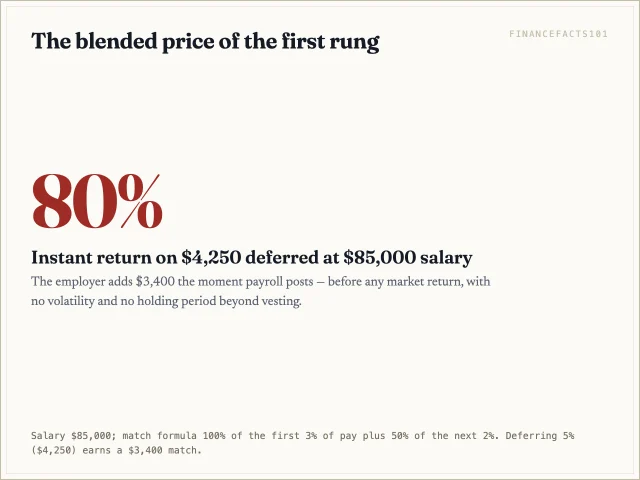
Price the first rung properly and every argument after it gets easier. Under a 100%-of-the-first-3% formula, each dollar you defer up to 3% of pay is met by an employer dollar — a 100% return credited the moment the payroll file posts, before the market has done anything. The next tier, 50 cents on the dollar for the next 2% of pay, returns 50%. Blended across the $4,250 you must defer on an $85,000 salary, the $3,400 match is an instant 80% return.
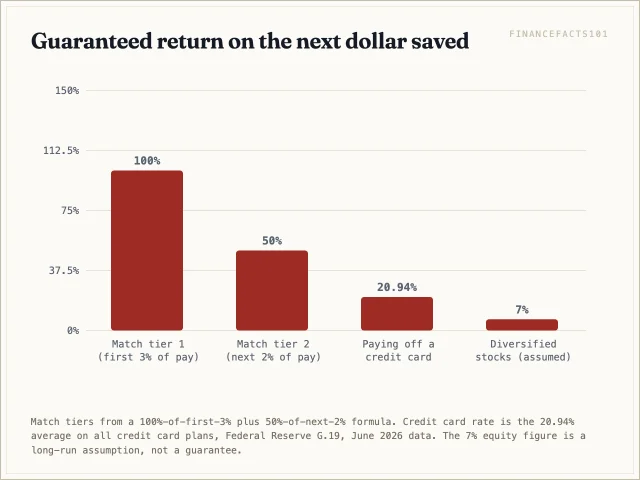
Nothing else in personal finance clears that bar. The Federal Reserve's G.19 release put the average rate on credit card plans at 20.94% for June 2026 (22.15% on accounts assessed interest), which makes paying off a card the second-best guaranteed return most households can get — and it is a fifth of what the first match tier pays. The match has no volatility, no sequence risk, and no holding period beyond vesting.
Who this is for — and who it is not for
This is for a US employee with access to a 401(k) that matches. About 70% of private industry workers had access to a defined contribution plan in March 2025, per the Bureau of Labor Statistics employee benefits program — most, though not all, of those plans match. It assumes a paycheck that clears your fixed costs and a real choice about your deferral percentage.
It is not for you if you carry a card balance at 22% and your plan does not match: without a match the ordering flips and the card wins. Nor if your emergency reserve is zero and your job is unstable — 401(k) money is expensive to reach before 59½, and a forced withdrawal at a 22% marginal rate plus a 10% penalty undoes years of tax deferral. Size the reserve first; our guide on how big an emergency fund should be works that number. And it is not for self-employed savers, whose solo 401(k) and SEP rules need separate treatment; the architecture is in defined contribution plans.
How match formulas actually work
Two shapes cover most plans, and they are not equivalent. The IRS 401(k) plan overview describes the mechanic plainly: the plan document permits the employer to contribute, say, 50 cents for each dollar an employee defers, capped at a stated percentage of pay.
The tiered or basic safe-harbor match pays 100% of the first 3% of pay plus 50% of the next 2%: maximum 4% of pay, and you must defer 5% to get all of it. The flat-rate match pays 50% of contributions up to 6% of pay: maximum 3% of pay, and you must defer 6%. Notice the trap in that pairing — the plan with the higher required deferral rate pays the smaller match.
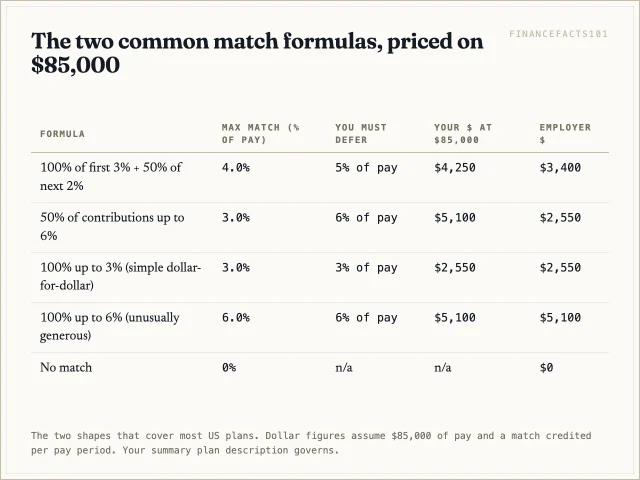
The number to extract from your summary plan description is not the headline percentage. It is the pair: the maximum match as a percentage of pay, and the deferral rate that reaches it. A "generous 100% match!" capped at 2% of pay is worth less than a "modest 50% match" capped at 6%.
One structural note for high earners. Traditional plans must pass annual nondiscrimination tests, and a plan that fails can refund deferrals to highly compensated employees after year end — see ADP and ACP testing. Safe-harbor plans buy their way out of those tests by promising a minimum match that is, per the IRS, fully vested when made. If your plan is safe harbor, the vesting section below mostly does not apply to you.
The exact percentage of salary you must defer
Match caps are stated as a percentage of pay, not as a dollar figure, and almost always applied per pay period. That produces the most common mistake in the whole subject: people set a dollar amount, or a percentage tuned to last year's salary, and drift below the threshold after a raise.
Set a percentage, never a dollar amount, and set it at or above the match cap. On the tiered formula, 5% is the number. On the flat 50%-up-to-6% formula, 6% is the number. A percentage-based election scales with a mid-year raise automatically; a dollar-based one does not.
Run your own plan's shape through the 401(k) calculator before you change your payroll election — the gap between a 5% and a 6% floor is worth thousands a year in employer money at some plans and nothing at others.
The worked example: $85,000, and the cost of stopping two points short
Fixed assumptions: salary $85,000, held flat; match of 100% of the first 3% plus 50% of the next 2%; 7% annual return compounded monthly; a 30-year horizon.
Defer 5% and you put in $4,250 a year ($354.17 a month) while the employer adds $3,400 ($283.33 a month) — $7,650 a year into the account.
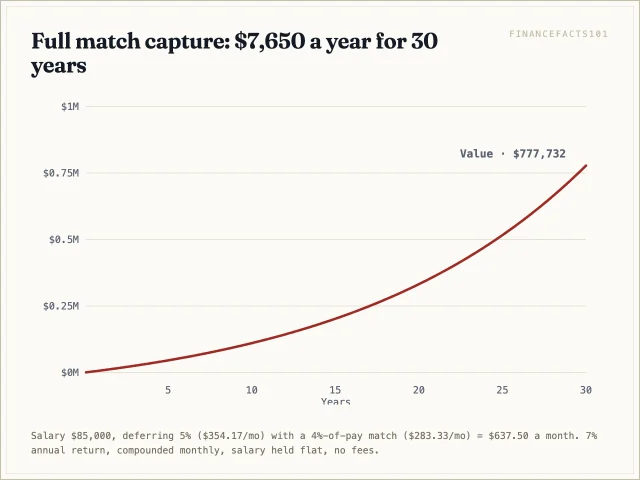
That path ends at about $777,700. Now defer 3% instead. Your own contribution falls to $2,550 and the match falls to $2,550 — the whole first tier, none of the 50-cent tier — for $5,100 a year, ending at about $518,500. The two-point shortfall costs $259,200.
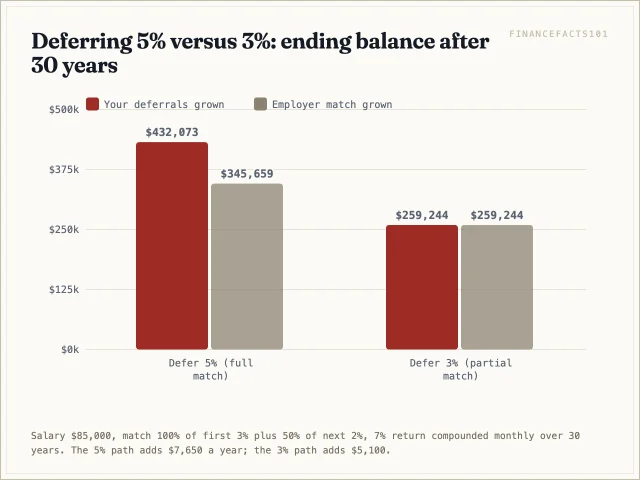
Split that number, because the halves are morally different. Roughly $173,000 is your own money you chose to spend instead of save — a real trade-off, defensible if the cash bought something. The other $86,400 is match you were offered and declined. That is the figure to carry around.
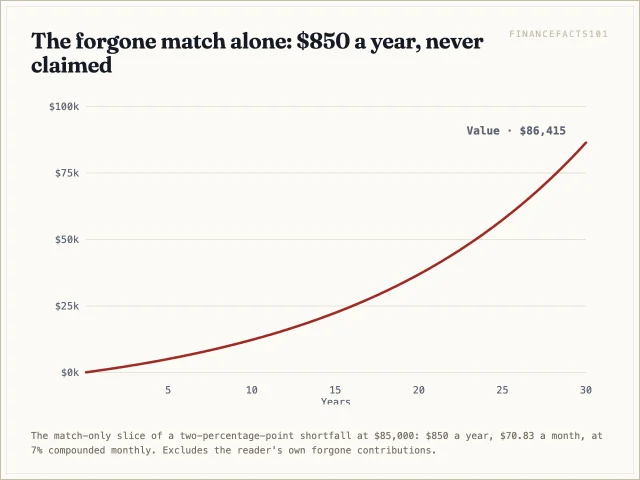
The forgone match alone — $850 a year, $70.83 a month — compounds to about $86,400 over thirty years at 7%, crossing $10,000 inside the first decade. Nothing about that curve requires a market view; it requires only that you moved a slider two percentage points.
Vesting: the match is not yours until it is
Your own deferrals are always 100% yours. Employer contributions are not, until you have logged the service the plan requires. The IRS vesting rules and the Department of Labor's participant booklet, What You Should Know About Your Retirement Plan, set out the two legal maxima for matching contributions: three-year cliff — nothing, then 100% at three years of service — or six-year graded, typically 0% in year one, then 20 points a year to 100% at six.
At $3,400 of match a year growing at 7%, the employer-funded slice of your balance is worth about $3,500 after one year, $7,300 after two, $11,300 after three, $15,600 after four, $20,300 after five and $25,300 after six.
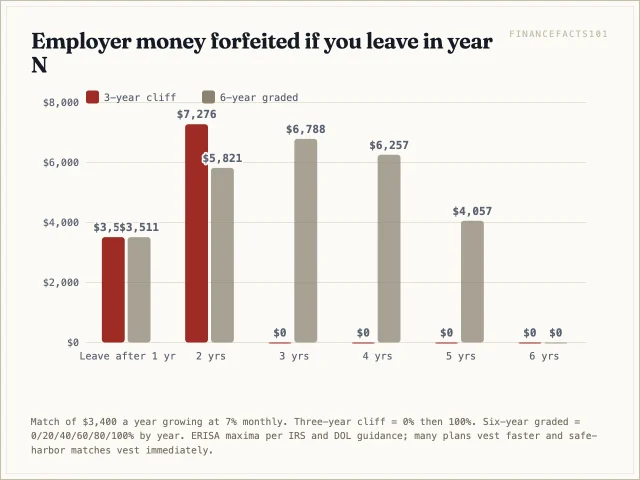
The crossover runs opposite to most people's intuition. A cliff schedule is far worse if you leave before year three — quit at 2 years and 11 months and you forfeit the whole $11,300, versus about $6,800 under a graded schedule. A graded schedule is worse from year three onward, because the cliff plan has already paid you in full while the graded plan is still clawing back 40% at four years ($6,300) and 20% at five ($4,100). Weighing a job offer against a departure date, that is a quantifiable number in the negotiation — one you can price with the retirement calculator.
Two practical points. Vesting counts service, not contributions, so an employee who never deferred a dollar was still accruing service. And forfeiture touches only the employer money and its growth; your own deferrals leave with you regardless.
What the 2026 limits actually cap
The limits cap the whole exercise, and they are not the same number as the match. Per IRS Notice 2025-67, the 2026 employee elective deferral limit is $24,500, up from $23,500 in 2025.
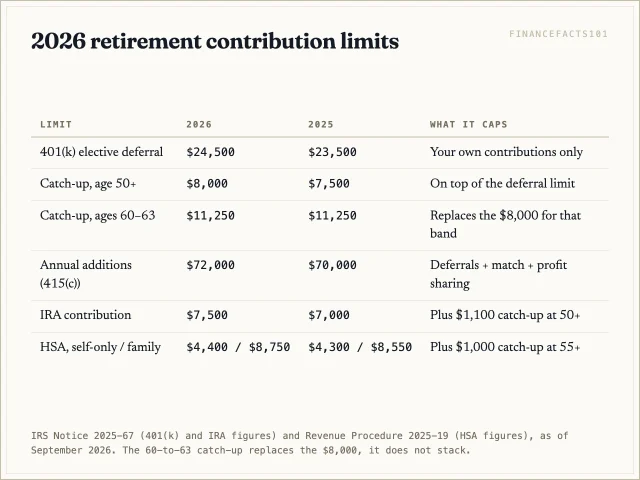
Catch-up contributions sit on top, and the tiers have gotten complicated. Workers 50 and over can add $8,000 in 2026. Workers who turn 60, 61, 62 or 63 during 2026 get the SECURE 2.0 enhanced catch-up of $11,250 instead of — not in addition to — the $8,000, per the IRS catch-up contributions page. The overall annual additions limit under section 415(c), counting your deferrals plus the match plus any profit-sharing, is $72,000 for 2026, per the IRS contribution limits page.
One rule change lands this year: under SECURE 2.0, participants whose prior-year Social Security wages from the same employer exceeded $150,000 must make catch-up contributions as Roth, not pre-tax, starting in 2026.
For the $85,000 earner here, the $24,500 limit is 28.8% of gross pay. It does not constrain a 5% match capture at all; it binds only on savers pushing 25–30% deferral rates. Which is exactly the reader the next section is about.
The front-loading trap: how maxing out in July can cost you match dollars
Here is the point almost nobody covers, and it costs real money. If your plan credits the match per pay period with no true-up, hitting the $24,500 annual limit early stops your deferrals — and stopping your deferrals stops your match.
Work it on the $85,000 salary. Monthly pay is $7,083, and the match is capped at 4% of that month's pay: $283.33 a month, $3,400 a year. Set your deferral to 50% of pay, $3,541.67 a month, to bank the limit early, and you hit $24,500 partway through the seventh month. From August onward you defer nothing — so you earn no match for five months.
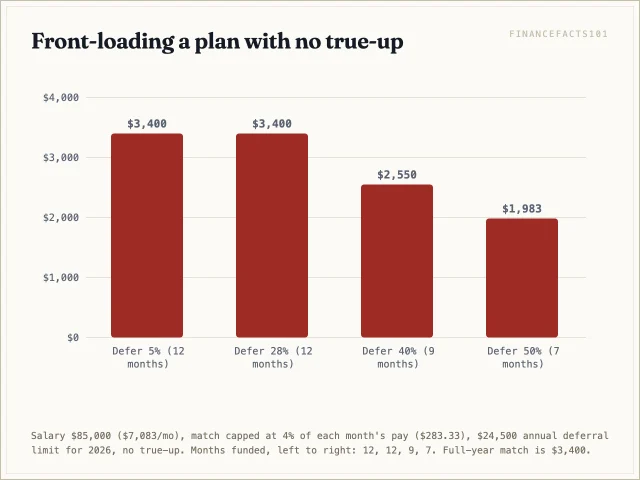
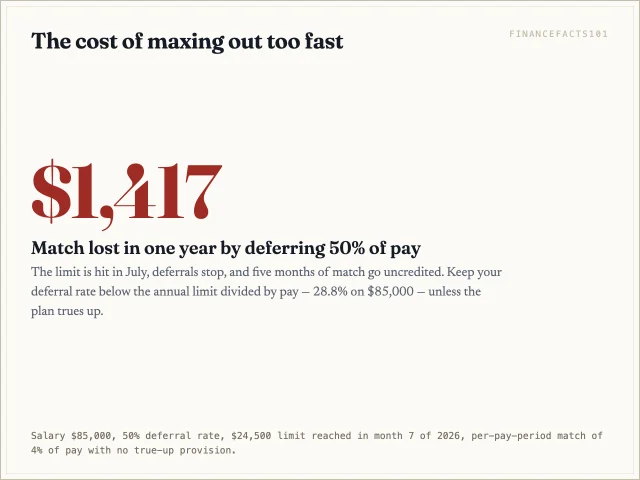
Seven months of match at $283.33 is $1,983. You lost $1,417 of employer money, in one year, by being more aggressive about saving. At a 40% deferral rate you fund nine months and lose $850. At 28% you stretch to twelve months and lose nothing.
The general rule: your deferral percentage should not exceed the annual limit divided by your annual pay unless the plan has a true-up. On $85,000 that ceiling is 28.8%. On $150,000 it is 16.3%. On $250,000 it is 9.8%. Above those rates you are trading match dollars for a few months of extra time in the market — a bad trade at any plausible return.
True-ups: the one plan-document sentence worth finding
A true-up provision is the fix. Plans with one recalculate the match at year end against your annual deferrals rather than your per-period deferrals, then deposit whatever shortfall the per-period method created — usually in Q1 of the following year. With a true-up, front-loading is harmless. Without one, it is expensive.
There is no way to guess which you have. ERISA requires plans to give participants a summary plan description in plain language covering how benefits are calculated, and the SPD is where this lives; the DOL's types of retirement plans overview and the participant booklet cited above both point at that document as governing. Search it for "true-up", "true up" or "annual match", or send your plan administrator one sentence: "Is the employer match calculated per pay period or trued up annually?" Keep the answer in writing.
If the answer is per-pay-period with no true-up, cap your deferral percentage below the limit-to-pay ratio so contributions run all twelve months — and re-check it every January and after every raise, since the ratio moves when either number moves.
The contribution ladder: what the next dollar buys after the match
The match is the first rung and it is not close. What follows is more arguable, but this ordering holds for most households.
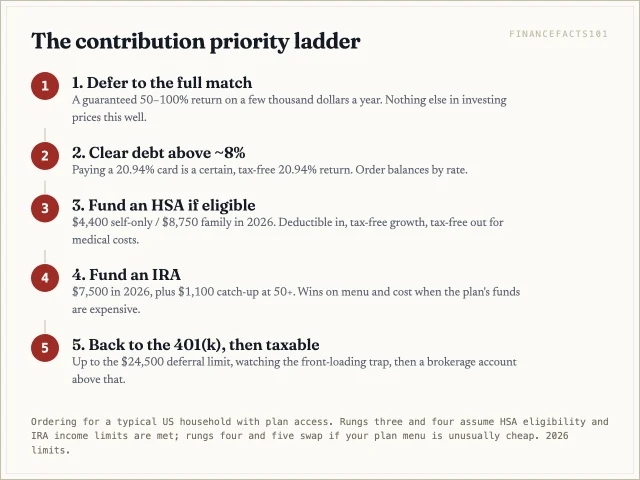
Rung one: defer to the full match. A guaranteed 50–100% return. Do this before anything else with savable income, including paying down a credit card — a year of card interest on a typical balance costs less than a year of forgone match.
Rung two: kill debt above roughly 8%. Paying a 20.94% card is a guaranteed, tax-free 20.94% return, and nothing in a diversified portfolio offers that with certainty. Order the balances by rate; avalanche versus snowball makes that case and the honest behavioural counter-argument.
Rung three: fund an HSA if eligible. The 2026 limits are $4,400 self-only and $8,750 family under IRS Revenue Procedure 2025-19, plus $1,000 catch-up at 55. Deduction in, tax-free growth, tax-free out for medical costs — strictly better treatment than the 401(k).
Rung four: an IRA, up to $7,500 in 2026 ($1,100 catch-up at 50+). It outranks extra 401(k) money on menu and cost: an IRA can hold a 0.03% index fund where plan menus often bottom out ten to fifty times higher. If your menu is cheap, this rung and the next swap.
Rung five: back to the 401(k), up to $24,500, then a taxable brokerage. To see where a savings rate lands you, run it through the 401(k) calculator or, for the "when could I stop contributing" version, the Coast FIRE calculator.
Traditional or Roth deferral
This is a separate decision from how much, and it does not affect the match — employer matching money is traditional pre-tax in most plans regardless of how you elect your own deferrals, though SECURE 2.0 now lets plans offer a Roth match if you elect it and pay the tax. The rule of thumb: defer pre-tax if your current marginal rate is higher than the rate you expect in retirement, Roth if it is lower, split if you have no strong view. The full argument is in Roth vs traditional IRA and, for the plan-side version, the Roth 401(k); the Roth vs traditional calculator prices it against your own bracket.
Fees: what an expense ratio costs over 30 years
Plan menus are where a good contribution rate goes to die quietly. Fees come out of returns before you ever see a statement line, which is why the Department of Labor publishes A Look at 401(k) Plan Fees for participants at all.
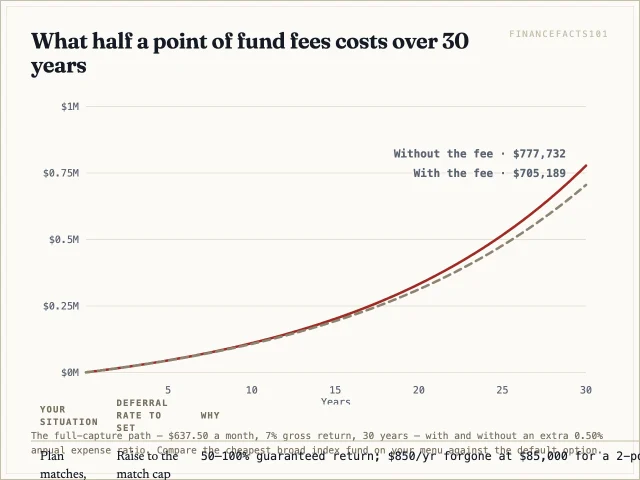
Take the full-capture path — $637.50 a month, 7% gross, 30 years. At zero cost it ends near $777,700. Pay half a percentage point more than the cheapest fund on your menu and it ends at about $705,200: a $72,500 gap, 9.3% of the balance, for a decision that takes ten minutes. At a full point of extra cost the gap is roughly $137,400, or 17.7%.
So: capture the match, pick the cheapest broad index fund on the menu, then check the plan's administrative fee on your quarterly statement. The same arithmetic applied to advisory fees is worked in what an advisory fee actually costs, and you can rerun it on your own numbers with the compound interest calculator.
Setting your actual number
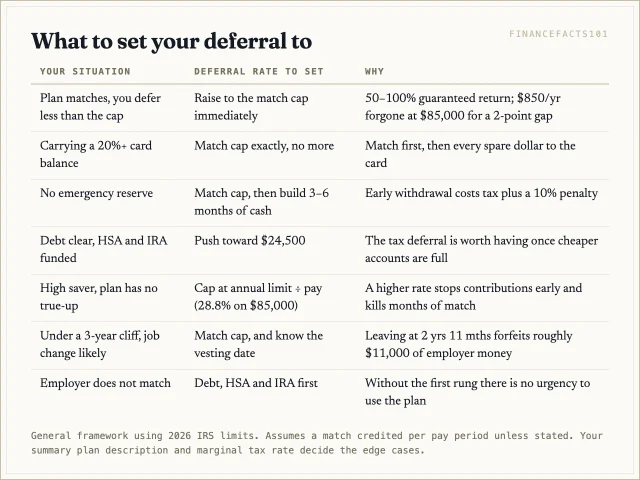
The short version. Find your plan's maximum match as a percentage of pay and the deferral rate that reaches it, then set your election at least that high, expressed as a percentage. Confirm whether the plan trues up; if not, keep your rate below the annual limit divided by pay. Learn your vesting schedule and, if it is a cliff, know the date. Then walk the ladder: match, high-rate debt, HSA, IRA, back to the plan.
For the $85,000 earner here that is a 5% floor, a 28.8% ceiling absent a true-up, and $3,400 a year of employer money. Everything above 5% is a genuine trade-off between present and future consumption. Everything below it is money left behind.
FAQ
What percentage should I contribute to get the full 401(k) match?
Whatever percentage your plan's formula caps out at — commonly 5% under "100% of the first 3% plus 50% of the next 2%", or 6% under "50% up to 6%". Read the cap in your summary plan description and set your payroll election to at least that percentage rather than a dollar amount, so it keeps pace with raises.
Does the employer match count against the $24,500 limit?
No. The $24,500 elective deferral limit for 2026 applies only to your own contributions. Employer matching money counts against the separate section 415(c) annual additions limit of $72,000, which combines deferrals, match and profit-sharing. Almost nobody on a middle income bumps that ceiling.
Can I lose my employer match if I quit?
You can lose the unvested part. Under a three-year cliff, leaving at 2 years and 11 months forfeits 100% of employer contributions and their growth — about $11,300 on a $3,400-a-year match at 7%. Under a six-year graded schedule you keep 20 points more each year. Safe-harbor matches are fully vested when made. Your own deferrals are never forfeitable.
Is it bad to max out my 401(k) early in the year?
It can be. If your plan credits the match per pay period with no true-up, hitting the $24,500 limit in July means you contribute nothing from August onward — and earn no match those months. On $85,000, deferring 50% of pay costs about $1,417 of match in a single year. Ask your administrator whether the plan trues up before front-loading.
What if my employer doesn't match at all?
Then the first rung disappears and high-rate debt moves to the top, followed by an HSA and an IRA. Without a match there is no urgency to use the 401(k) specifically until the cheaper, more flexible accounts are full — unless the plan menu is unusually good.
Sources
- IRS, 401(k) limit increases to $24,500 for 2026, IRA limit increases to $7,500 — Notice 2025-67 cost-of-living adjustments
- IRS, Retirement topics — 401(k) and profit-sharing plan contribution limits — the $72,000 section 415(c) annual additions limit for 2026
- IRS, Retirement topics — Catch-up contributions — $8,000 at 50+, $11,250 for ages 60–63
- IRS, Retirement topics — Vesting — cliff and graded schedules
- IRS, 401(k) resource guide — plan participants, 401(k) plan overview — matching formulas and safe-harbor immediate vesting
- IRS, Revenue Procedure 2025-19 — 2026 HSA contribution limits of $4,400 and $8,750
- US Department of Labor, What You Should Know About Your Retirement Plan — ERISA vesting maxima and the summary plan description
- US Department of Labor, A Look at 401(k) Plan Fees — plan and investment fees participants pay
- US Department of Labor, Types of retirement plans — ERISA plan categories and 401(k) mechanics
- Federal Reserve, G.19 Consumer Credit release — 20.94% average credit card rate, June 2026 data
- Bureau of Labor Statistics, Employee Benefits in the United States — 70% of private industry workers had access to a defined contribution plan, March 2025
 Next entry · No. 5,942How Long It Takes to Pay Off a Credit Card at $8,000 and 22.15%
See also
-
 No. 5,982
16 Oct 2026
16 min
HSA vs 401(k): Where Should Your Next Dollar Go?
Retirement
-
 No. 5,979
13 Oct 2026
17 min
Roth 401(k) vs Traditional 401(k): Which Should You Choose?
Retirement
-
 No. 6,002
05 Nov 2026
17 min
Roll Over 401(k) or Leave It in the Plan? How to Decide
Retirement
-
 No. 5,998
01 Nov 2026
17 min
401(k) Loan vs Hardship Withdrawal: Which Is Less Costly?
Retirement
-
 No. 5,950
17 Sep 2026
17 min
Thrift Savings Plan: How Much to Contribute, Which Fund, and Whether to Roll It Out
Retirement
-
 No. 4,211
31 May 2025
18 min
Understanding Qualifying Annuities: A Comprehensive Guide for Institutional Investors
Investments