Roll Over 401(k) or Leave It in the Plan? How to Decide
Leave an old 401(k) if it is cheap or you left at 55+; if not, roll it to a low-cost IRA. Cashing out $85,000 at 38 costs $28,156 of 2026 federal tax.
Roll over 401(k) or leave it in the old plan? Leave it if the plan's all-in cost is low, you may need the money between 55 and 59½, or you hold company stock; otherwise move it by direct rollover to a low-cost IRA or your new employer's plan, and almost never cash it out. Under the rules in force on October 9, 2026, cashing out an $85,000 balance costs a 38-year-old single earner with $68,500 of other taxable income $28,156 in federal income tax and the 10% additional tax, and the plan withholds only $17,000 of it.
Between staying and rolling, fees usually decide. In the worked example below, the same $85,000 grows to $521,555 by 65 in an IRA holding index funds at 0.05% a year, $489,619 in an old plan costing 0.30%, and $389,522 in an advised IRA costing 1.20%.
This is general information built on stated assumptions (federal tax only, 2026 brackets, an assumed 7% return before fees, rules as of October 9, 2026), not personal advice. Your plan's documents decide which options you actually have.
Who this is for — and who it is not for
This guide is for anyone who has left, or is about to leave, an employer and has a vested balance in its 401(k), 403(b) or governmental 457(b) plan.
It is not for a pension offering a lump sum (an annuity-versus-cash question), for heirs of an inherited 401(k), who follow separate rules, or for the Thrift Savings Plan, which has its own. And if you still owe on a plan loan, read the 401(k) loan guide first: leaving the job can turn the balance into a taxable offset unless you roll the same amount over by your tax-return due date.
Roll over 401(k) or leave it: the four options side by side
The IRS's page on leaving a job lists four choices: leave the money in the plan, roll it to a new employer's plan, roll it to an IRA, or withdraw it.
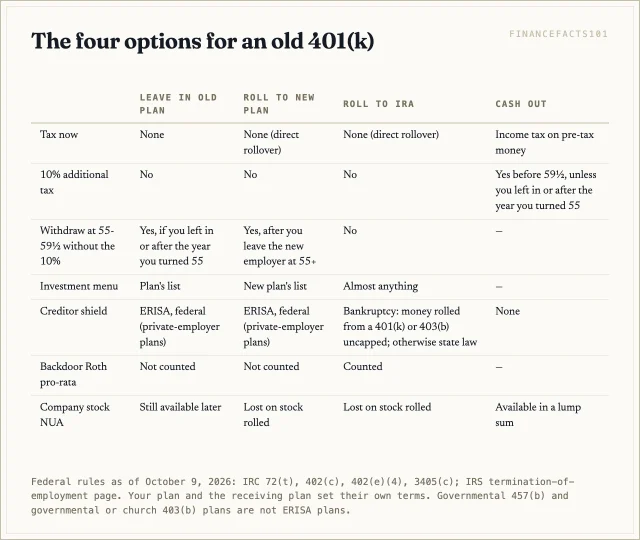
The three tax-free choices differ in cost, investment menu, access before 59½, creditor protection and what they do to a backdoor Roth.
Do you have to roll over your 401(k) when you leave a job?
Usually not. If your vested balance is above $7,000, the plan generally cannot pay you out without your consent until you reach its normal retirement age or 62, whichever is later. That is the rule in IRC 411(a)(11) and the consent regulation, 26 CFR 1.411(a)-11(c)(4).
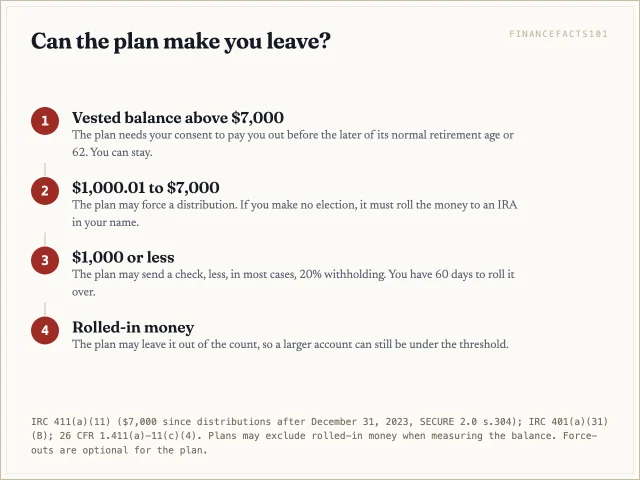
Small balances are different. SECURE 2.0 section 304 raised the force-out ceiling from $5,000 to $7,000 for distributions after December 31, 2023. A plan may cash out a balance up to $7,000 without asking. If the amount is over $1,000 and you make no election, IRC 401(a)(31)(B) requires the plan to send it to an IRA in your name rather than to you. At $1,000 or less it can mail a check, less withholding. The plan may also ignore money you rolled in from elsewhere when it measures the balance, so an account bigger than $7,000 can still be forced out. Parts of the IRS's own web pages still quote the old $5,000 figure; the statute says $7,000.
The Labor Department's safe harbor for these automatic IRAs, 29 CFR 2550.404a-2, calls for an investment "designed to preserve principal", so if your old plan moved money without asking, find the account and decide how to invest it.
Cashing out: 20% withheld, 10% added, the rest due in April
Cashing out is the expensive option, and the withholding hides how expensive. A plan must withhold 20% from any eligible rollover distribution paid to you, under IRC 3405(c). That is a prepayment, not the tax.
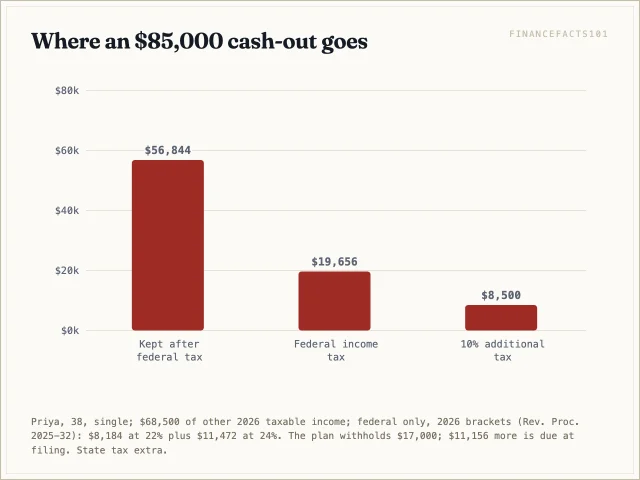
Take Priya, 38 and single, who leaves her job in 2026 after earning $90,000 and deferring $5,400. Her taxable income before any distribution is $68,500 ($90,000 less the deferral and the $16,100 2026 standard deduction). Cashing out $85,000 lifts it to $153,500. Using the 2026 brackets in Rev. Proc. 2025-32, the extra income tax is $19,656: $8,184 on the slice that fills the 22% bracket to $105,700 and $11,472 at 24% above it. The 10% additional tax adds $8,500. Total: $28,156, or 33.1% of the balance, before any state tax.
The plan sends her a check for $68,000. She still owes $11,156 when she files. Left in a plan costing 0.30%, the same $85,000 would have grown to about $489,600 by 65 at the assumed return.
The rule of 55: the strongest reason to leave money in the plan
The 10% additional tax does not apply to plan distributions "made to an employee after separation from service after attainment of age 55", per IRC 72(t)(2)(A)(v). The IRS applies it if you leave "during or after the year" you turn 55, and at 50 or after 25 years of service for qualified public safety employees. Publication 575 adds the limit people miss: separate at 49 and wait until 55, and the exception does not apply.
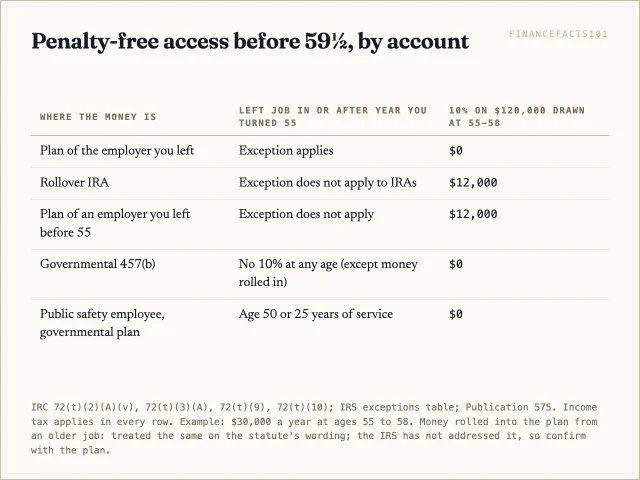
Section 72(t)(3)(A) says this exception does not apply to IRAs. Roll the balance to an IRA at 55 and the protection is gone until 59½. Someone who needs $30,000 a year at 55, 56, 57 and 58 would pay $12,000 of additional tax drawing it from an IRA, and none from the plan. The exception covers only the plan of the employer you left in or after that year, and money rolled into it from an older job is, on the statute's plain wording, treated the same once it sits there. The IRS has not addressed that point directly, so confirm it with the plan, which must also allow the withdrawal. Money left in an even older plan does not qualify.
Governmental 457(b) plans go further: their distributions are outside the 10% additional tax at any age, except for money rolled in from a 401(k) or IRA, under section 72(t)(9). Rolling a 457(b) into an IRA gives that up.
Direct vs indirect rollover: the 60-day rule and the 20% trap
A direct rollover moves the money plan-to-IRA or plan-to-plan, with no withholding: the IRS says "No taxes will be withheld from your transfer amount" (rollovers page). A check made payable to the new custodian for your benefit counts as direct.
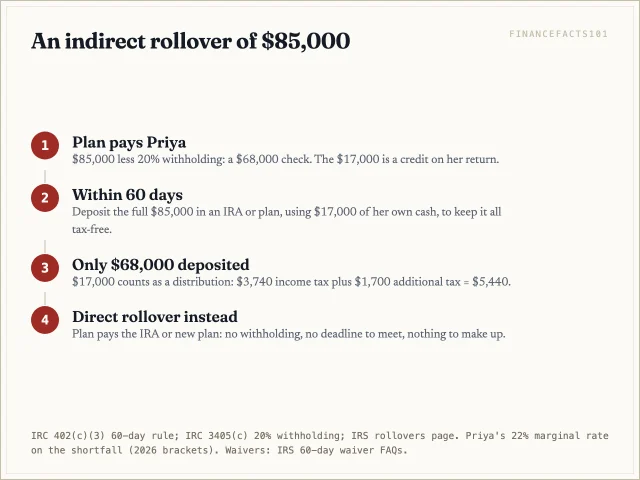
An indirect rollover pays you, and IRC 402(c)(3) gives you until the 60th day after you receive it to deposit it. The 20% is withheld anyway. If Priya takes her $85,000 this way, she receives $68,000; to roll over the full amount she must find $17,000 elsewhere within 60 days and wait for the withholding to come back as a credit on her return. If she deposits only the $68,000, the missing $17,000 is a distribution: $3,740 of income tax at her 22% rate plus $1,700 of additional tax, $5,440 in all.
Miss the 60 days and the routes back are an automatic waiver when a financial institution erred, a private letter ruling, or self-certification for listed reasons such as illness, all set out in the IRS's 60-day waiver FAQs.
The one-rollover-per-year rule applies to IRA-to-IRA only
IRC 408(d)(3)(B) limits you to one 60-day rollover from an IRA in any 12-month period, counted across all your IRAs since 2015. The IRS's rollovers page says the limit does not apply to plan-to-IRA, plan-to-plan or IRA-to-plan rollovers, to conversions, or to trustee-to-trustee transfers.
So you can roll three old 401(k)s into one IRA in the same month. The rule bites only when you later take a check from an IRA and redeposit it; a second such rollover within a year is taxable, and the IRS says it cannot waive that.
Worked example: $85,000 in four homes over 27 years
Priya's $85,000 sits in her old plan's index fund. The plan's fee disclosure shows an all-in cost of 0.30% a year including recordkeeping. Her choices, with assumed all-in costs: stay at 0.30%; roll to her new employer's plan at 0.20%; roll to an IRA holding broad index funds at 0.05%; or roll to an IRA run by an adviser at 1.00% plus 0.20% fund costs, 1.20%. She adds nothing to this money; her new contributions go to the new plan either way. The return is 7% a year before costs, compounded monthly as the site's 401(k) calculator does, for 27 years to age 65.
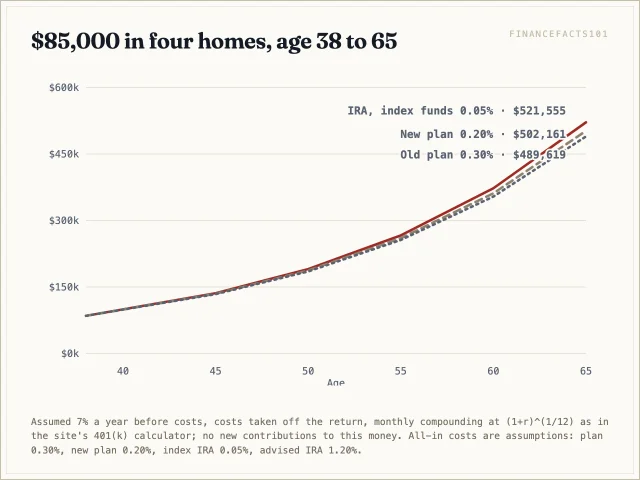
At 65 the results are $521,555 in the low-cost IRA, $502,161 in the new plan, $489,619 in the old plan and $389,522 in the advised IRA. Reproduce the old-plan figure by entering a 6.70% return (7% less 0.30%) and no contributions in the calculator: old plan, and the advised IRA at 5.80%.
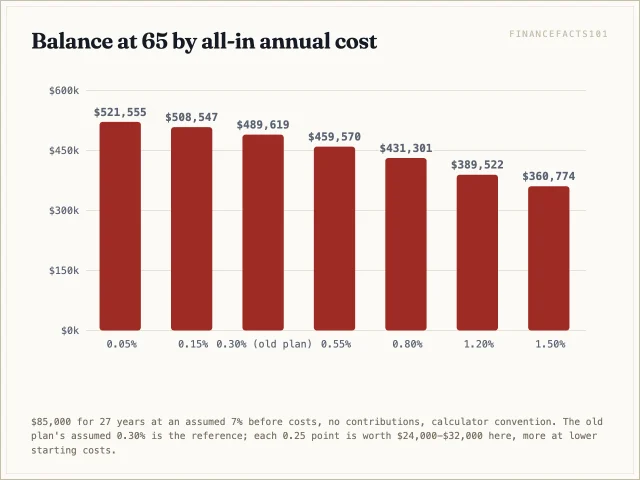
The crossover is the fee itself. Moving from 0.30% to 0.05% is worth $31,936 by 65. Moving to 1.20% costs $100,097, about a fifth of the old-plan balance, so the adviser's portfolio would have to beat the plan's index fund by 0.90 percentage points a year, every year, just to tie. The Labor Department's 401(k) fee booklet makes the same point with its own example: over 35 years, a one-point difference in fees cuts a $25,000 balance at retirement "by 28 percent". What a 1% advisory fee buys, and when it is worth paying, is the subject of the advisory fee guide.
What plans and IRAs really charge, and who is selling the rollover
The Investment Company Institute, the fund industry's trade group, found that 401(k) participants in equity mutual funds paid an average expense ratio of 0.27% in 2025 (ICI, July 2026), against 0.40% for equity mutual funds industrywide (ICI, March 2026). ICI notes that recordkeeping fees may be charged outside those ratios, so read your plan's annual fee disclosure for the all-in figure. An IRA can be cheaper or far dearer, depending on what you buy and who advises.
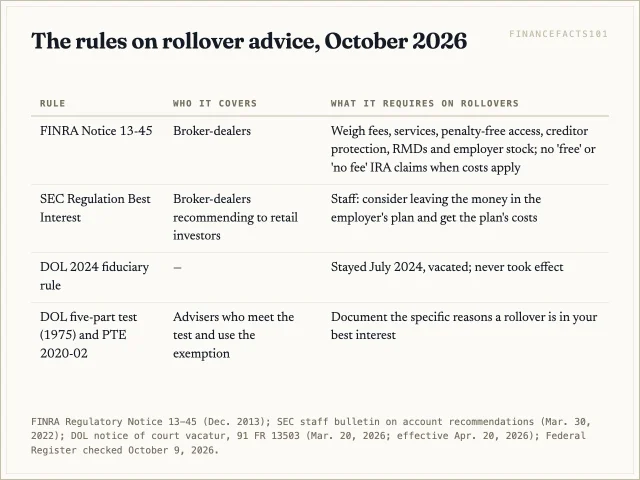
The person recommending a rollover is often paid by it. FINRA's Regulatory Notice 13-45 (December 2013) reminds broker-dealers that a rollover recommendation must weigh fees, services, penalty-free withdrawals, creditor protection, required distributions and employer stock, and that a firm "may not claim that its IRAs are 'free' or carry 'no fee'" when the investor will incur costs. The SEC staff's 2022 bulletin on account recommendations under Regulation Best Interest says it would be difficult to call a rollover recommendation in your best interest "if you do not consider the alternative of leaving the retail investor's investments in their employer's plan".
The Labor Department's stricter 2024 fiduciary rule never took effect. Two Texas federal courts stayed it in July 2024, the appeal was dismissed in November 2025, and the Department's notice of court vacatur, published March 20, 2026, confirmed that the 1975 five-part test still governs. Advisers who are fiduciaries under that test and rely on the exemption PTE 2020-02 must still document the specific reasons a rollover is in your best interest. As of October 9, 2026, the Federal Register showed no new proposal to redefine fiduciary advice.
Creditor protection: ERISA plan vs IRA
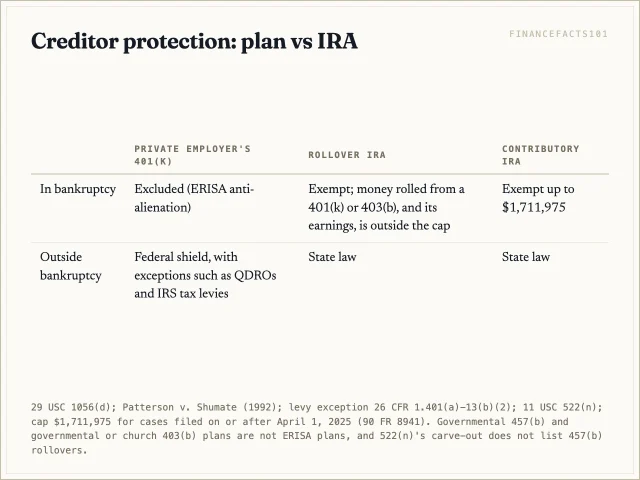
Money in a private employer's 401(k) is shielded from most creditors by federal law (29 USC 1056(d)), while an IRA is protected in bankruptcy, with money rolled over from a 401(k) or 403(b) outside the $1,711,975 cap that applies to contributory IRAs in cases filed from April 1, 2025 (Judicial Conference adjustment), and outside bankruptcy only as far as your state's law allows. Governmental 457(b) and governmental or church 403(b) plans are not ERISA plans, and the cap's carve-out does not name 457(b) rollovers, so if a lawsuit is a real risk read the umbrella insurance guide, which covers these rules and what liability coverage protects instead.
Company stock: check net unrealized appreciation before rolling anything
If your 401(k) holds your employer's shares at a big gain, rolling them over forfeits a tax break for good. Under IRC 402(e)(4), when the stock comes out in kind as part of a lump-sum distribution, the net unrealized appreciation (NUA) is not taxed until you sell, and then as long-term capital gain. Only the plan's cost basis in the shares is ordinary income now.
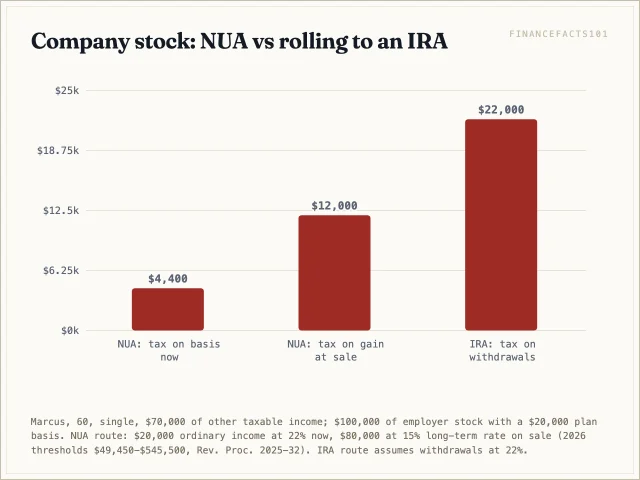
Take Marcus, 60 and single, with $70,000 of other taxable income and $100,000 of company stock whose basis in the plan is $20,000. Taking the shares in kind adds $20,000 of ordinary income, $4,400 of tax at 22%. When he sells, the $80,000 gain is taxed at 15% (his taxable income sits between the 2026 single thresholds of $49,450 and $545,500): $12,000. Total, $16,400. Rolled into an IRA instead, the full $100,000 is ordinary income on withdrawal: $22,000 if he can draw it at 22%, $23,286 if he takes it all in one year. Under 55 at separation, the 10% additional tax would apply to the $20,000 basis but not to the NUA.
The conditions are strict. Publication 575 defines a lump-sum distribution as your entire balance from all the employer's plans of one kind, paid within one tax year, after you leave the job, reach 59½ or die (or, for the self-employed, become disabled). The rest of the account can be rolled to an IRA in the same year; the stock goes to a taxable brokerage account. The older NUA explainer walks through the mechanics.
Roth 401(k) money: the Roth IRA's five-year clock does not carry over
Roth 401(k) money can roll to a Roth IRA, and the trap is the clock. Under 26 CFR 1.408A-10, Q&A-4, a Roth IRA's five-year period for qualified distributions begins with your first Roth IRA contribution or the year of the rollover, whichever is earlier, and is "determined independently" of the years you spent in the Roth 401(k).
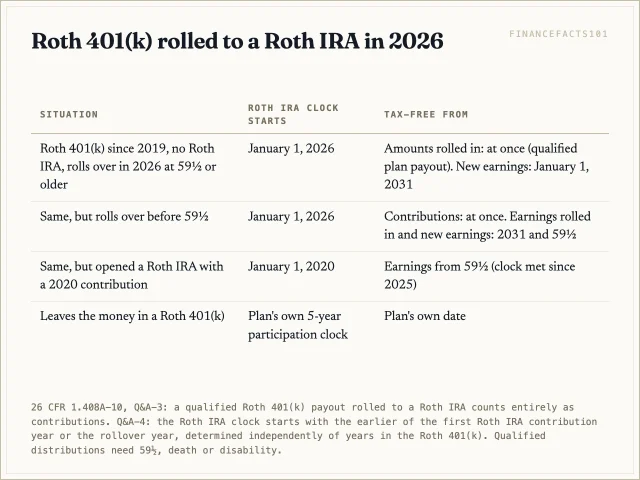
So someone who has made Roth 401(k) deferrals since 2019 but has never had a Roth IRA, and rolls over in 2026, starts a new clock on January 1, 2026. If the plan payout was itself qualified (59½ and five years in the Roth 401(k)), Q&A-3 treats everything rolled in as contributions, which come out tax-free at any time; only earnings made inside the Roth IRA wait until 2031. Roll over before 59½ and the earnings you bring with you also wait until 2031 and 59½. Anyone who already has a Roth IRA, even a small one, uses that older start date. If you have Roth 401(k) money, open and fund a Roth IRA now, if you are eligible, to start the clock. Roth 401(k)s no longer have lifetime required minimum distributions, which removed the old reason to rush this rollover; the Roth 401(k) guide covers the rest.
The backdoor Roth problem: a rollover IRA counts against you
If you earn too much to contribute to a Roth IRA directly (2026 phase-out: $153,000 to $168,000 single, per the IRS), the backdoor route of contributing to a traditional IRA and converting depends on having no other pre-tax IRA money on December 31. A pre-tax 401(k) rolled into an IRA lands right in that pot.
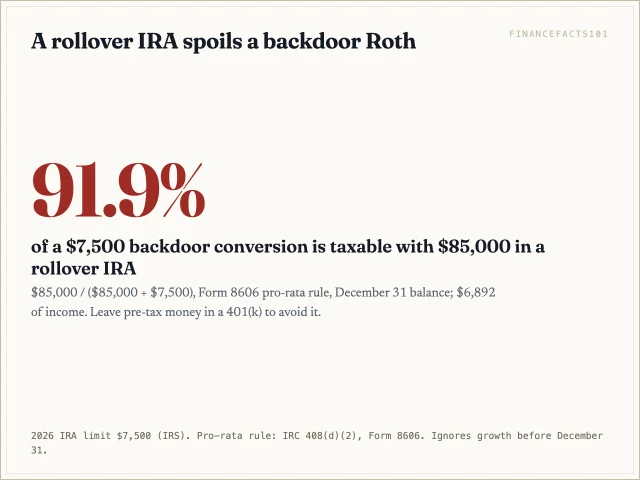
With $85,000 in a rollover IRA, a $7,500 backdoor conversion is 91.89% taxable: $6,892 of income. Leaving the money in a 401(k), or rolling it into your new plan, keeps it out of the calculation; the backdoor Roth guide works through the pro-rata rule and how to clear it.
Rolling into your new employer's plan
You can roll one 401(k) into another if the new plan accepts it; the IRS says a plan "is not required to accept rollover contributions". Use a direct rollover.
The new plan wins when it is cheap and you want one account. It also keeps money out of the backdoor-Roth pot, enlarges the base for a future plan loan, and, on the usual reading of the statute, lets the rule of 55 cover it when you later leave this employer. While you still work there and own no more than 5% of the company, the IRS RMD FAQs let workplace-plan money wait past the usual RMD age until you retire. The IRA wins on choice: any fund or ETF. It also lets you send after-tax 401(k) money to a Roth IRA and the pre-tax money to a traditional IRA in one distribution, as the IRS's after-tax rollover page explains.
The decision, step by step
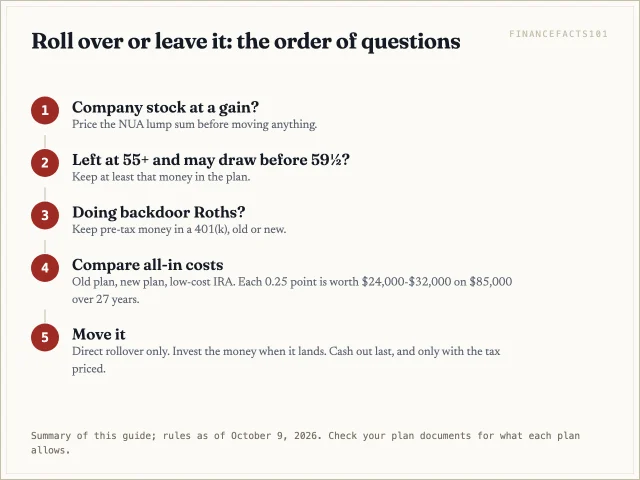
Go in order. Company stock at a large gain? Price the NUA route first. Left at 55 or later and likely to draw before 59½? Keep at least that money in the plan. Doing backdoor Roths? Keep pre-tax money in a 401(k). Otherwise pick the cheapest home you will actually manage and move the money by direct rollover. Cash out only if you need the money and have priced the tax.
FAQ
Is it better to roll over a 401(k) or leave it?
It depends on cost and access. A cheap old plan, or one you can draw from penalty-free between 55 and 59½, is usually worth keeping; an expensive one usually loses to a direct rollover into a low-cost IRA or your new plan. In the worked example, a 0.25-point lower cost was worth $31,936 over 27 years, while a 0.90-point higher one cost $100,097.
When should I roll over my 401(k)?
There is no deadline unless your balance is $7,000 or less and the plan forces it out. Roll over when you have opened the receiving account, confirmed it accepts the money, and checked for company stock and Roth money. Do it as a direct rollover, and invest the money once it arrives; a rollover usually lands as cash.
Can I roll over one 401(k) to another?
Yes, if the new plan accepts roll-ins, which it does not have to. Ask for a direct rollover so nothing is withheld. Plan-to-plan rollovers are not limited by the one-rollover-per-year rule.
What happens if I miss the 60-day rollover deadline?
The amount not redeposited is taxable, and before 59½ usually also subject to the 10% additional tax. The IRS can waive the 60-day limit for events beyond your control, automatically when a financial institution made the error, or through self-certification for listed reasons.
Sources
- Internal Revenue Code section 72 (72(t)(2)(A)(v) separation at 55; 72(t)(3)(A) not for IRAs; 72(t)(10) public safety), U.S. Code 2024 edition, govinfo
- Internal Revenue Code section 401 (401(a)(31) direct rollovers and automatic rollover of force-outs over $1,000)
- Internal Revenue Code section 402 (402(c)(3) 60-day rule; 402(c)(4) eligible rollover distributions; 402(e)(4) net unrealized appreciation)
- Internal Revenue Code section 408 (408(d)(3)(B) one rollover per year)
- Internal Revenue Code section 411 (411(a)(11) $7,000 consent threshold, SECURE 2.0 section 304)
- Internal Revenue Code section 3405 (3405(c) 20% withholding)
- eCFR, 26 CFR 1.411(a)-11, paragraph (c)(4), consent until normal retirement age or 62
- eCFR, 26 CFR 1.408A-10, Q&A-4, Roth IRA five-year period after a designated Roth rollover
- IRS, Retirement topics: termination of employment
- IRS, Rollovers of retirement plan and IRA distributions (direct rollovers, withholding, the IRA one-rollover-per-year rule)
- IRS, FAQs relating to waivers of the 60-day rollover requirement
- IRS, Retirement topics: exceptions to tax on early distributions
- IRS, Publication 575, Pension and Annuity Income (separation from service; employer securities and lump-sum distributions)
- IRS, Rollovers of after-tax contributions in retirement plans
- IRS, Retirement plan and IRA required minimum distributions FAQs
- IRS, Rev. Proc. 2025-32 (2026 brackets and capital gains thresholds)
- IRS, Tax inflation adjustments for tax year 2026 ($16,100 standard deduction)
- IRS, 401(k) limit increases to $24,500 for 2026, IRA limit increases to $7,500 (Roth IRA phase-out)
- FINRA, Regulatory Notice 13-45, rollovers to IRAs (December 2013)
- SEC, Staff Bulletin: Account Recommendations for Retail Investors (March 30, 2022)
- Department of Labor, Retirement Security Rule: Notice of Court Vacatur, 91 FR 13503 (March 20, 2026)
- Department of Labor, A Look at 401(k) Plan Fees
- 29 USC 1056(d), ERISA anti-alienation
- 11 USC 522 (522(n) IRA cap, rollover amounts excluded)
- Judicial Conference, Adjustment of certain dollar amounts ($1,711,975 from April 1, 2025)
- Investment Company Institute, The Economics of Providing 401(k) Plans, 2025 (July 2026; secondary source)
- Investment Company Institute, Mutual fund and ETF fees remained near historic lows in 2025 (March 25, 2026; secondary source)
 Next entry · No. 6,003How Much Disability Insurance Do I Need? The Take-Home Math
See also
-
 No. 5,998
01 Nov 2026
17 min
401(k) Loan vs Hardship Withdrawal: Which Is Less Costly?
Retirement
-
 No. 5,982
16 Oct 2026
16 min
HSA vs 401(k): Where Should Your Next Dollar Go?
Retirement
-
 No. 5,987
21 Oct 2026
19 min
Should I Do a Backdoor Roth IRA? How to Avoid the Pro-Rata Tax
Retirement
-
 No. 5,979
13 Oct 2026
17 min
Roth 401(k) vs Traditional 401(k): Which Should You Choose?
Retirement
-
 No. 5,970
04 Oct 2026
17 min
Required Minimum Distributions: When to Start, How Much, and How to Cut the Tax
Retirement
-
 No. 5,941
12 Sep 2026
16 min
401(k) Employer Match: How Much of Your Salary to Defer
Retirement