Standard Deduction vs Itemize: The 2026 Break-Even Math
Itemize for 2026 only if Schedule A beats $16,100 single or $32,200 joint, plus up to $2,000 of new cash-gift deduction you give up. Three households worked.
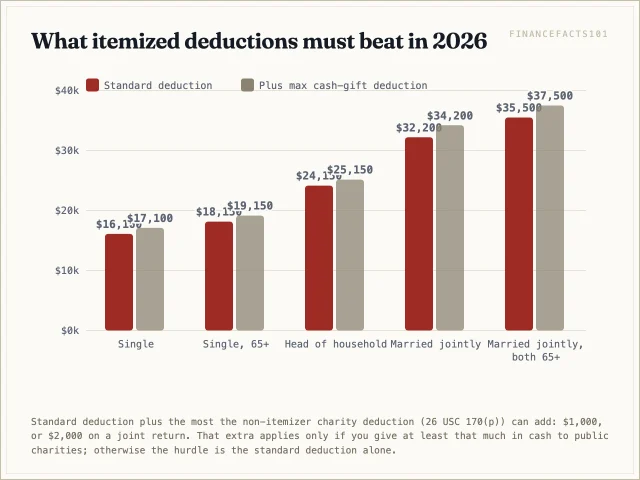
Take the standard deduction for tax year 2026 unless your itemized deductions add up to more than $16,100 single, $24,150 as head of household or $32,200 married filing jointly, the IRS amounts in effect as of October 2026. From 2026 the bar sits higher still for anyone who gives cash to charity, because only people who take the standard deduction can also deduct up to $1,000 of those gifts, or $2,000 on a joint return. That is the whole standard deduction vs itemize decision in one line: add up Schedule A after its limits, and itemize only if it beats the standard deduction plus the charity deduction you would give up.
The rest of this guide puts numbers on every limit that decides the total, works three households through both paths with the 2026 brackets, and shows when bunching two or three years of giving into one year through a donor-advised fund turns a near miss into a saving. It is general information built on stated assumptions, not personal tax advice.
Standard deduction vs itemize: what changed for 2026
Three sets of rules moved at once. The Revenue Procedure 2025-32 inflation adjustments set the 2026 standard deduction and brackets. Public Law 119-21, the July 2025 tax law the IRS now calls the Working Families Tax Cuts, raised the state and local tax (SALT) cap, made the $750,000 mortgage limit permanent, added a 0.5% floor on itemized charitable gifts, capped the value of itemized deductions in the top bracket, and revived and enlarged the charity deduction for people who do not itemize. And four new deductions arrived that you take on either path: one for people 65 and older, and ones for tips, overtime and car-loan interest.
The net effect pulls in two directions. A larger SALT cap pushes some homeowners in high-tax states over the line; the non-itemizer charity deduction and the new charity floor push others back under it. The IRS's own test has not changed: itemize if your allowable itemized deductions are greater than your standard deduction, or if you cannot use the standard deduction. What changed is what "greater" now has to clear.
Who this is for — and who it is not for
This guide is for US residents filing a 2026 federal return who want to know which path costs less tax: renters wondering whether anything they pay counts, homeowners with a mortgage near the line, retirees with large medical bills or regular giving, and high earners in high-tax states who meet the SALT phase-down.
It is not a state tax guide: state returns have their own rules on itemizing, so check your state's instructions. It does not cover business deductions, which belong on Schedule C and are not itemized deductions at all. And it does not rank savings vehicles: deductions for 401(k), IRA and HSA contributions reduce income before either path is chosen, which the tax-deductible investments guide sets out.
One rule catches married couples filing separately. If one spouse itemizes, the other's standard deduction is zero, so both must itemize, under 26 USC 63(c)(6).
The 2026 standard deduction, by filing status
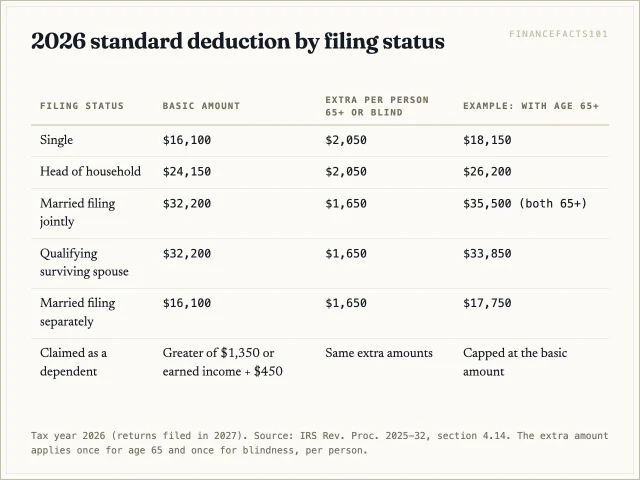
The basic amounts come straight from section 4.14 of Rev. Proc. 2025-32: $32,200 for married couples filing jointly and surviving spouses, $24,150 for heads of household, and $16,100 for single filers and married people filing separately. Each person who is 65 or older by the end of the year, or blind, adds $1,650 if married or a surviving spouse, or $2,050 if unmarried; someone both 65 and blind adds it twice. A married couple both 65 or older therefore starts at $35,500, and a single filer of 65 at $18,150. Someone who can be claimed as a dependent gets the greater of $1,350 or earned income plus $450, never more than the regular amount.
These figures apply to the return you file in 2027. The IRS publishes the next year's amounts each autumn (the 2026 release, IR-2025-103, came on October 9, 2025), so a household planning a 2027 bunch should check whether the 2027 revenue procedure is out before running its own numbers.
The real hurdle: the standard deduction plus the cash-gift deduction
Section 70424 of the law rewrote 26 USC 170(p). Starting with tax year 2026, a person who does not itemize can deduct cash gifts to qualifying public charities, up to $1,000, or $2,000 on a joint return. According to the IRS page on the new law, gifts to donor-advised funds and supporting organizations do not qualify, noncash gifts such as clothing or stock do not qualify, and prior-year carryovers do not count.
That deduction disappears the moment you itemize, so it belongs on the standard side of the comparison. A couple who gives at least $2,000 a year in cash has a 2026 hurdle of $34,200, not $32,200. A couple who gives nothing has the plain $32,200 hurdle. The middle case is the one people miss: an itemized total of $33,000 looks like a win against $32,200 and is actually a $1,200 loss for a household that writes $2,000 of checks to charity.
What counts on Schedule A in 2026
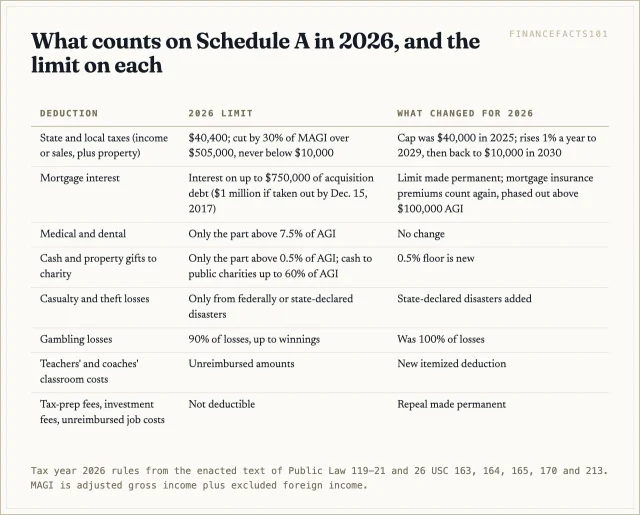
Itemized deductions are not "everything you spent." Four lines carry nearly all the weight for most households: state and local taxes, mortgage interest, medical costs and charity, and each has its own limit that applies before you compare anything. The Schedule A walkthrough covers what goes on the form; the sections below cover the limits that decide the total.
Smaller items rarely tip the balance, but three changed for 2026. Personal casualty losses still count only when caused by a declared disaster, and the law now accepts state-declared disasters as well as federal ones. Gambling losses are deductible at 90% of the loss, and only up to winnings. And unreimbursed classroom costs for teachers and coaches become an itemized deduction, while the old miscellaneous deductions, such as tax-preparation and investment fees, stay repealed for good.
The SALT cap: $40,400 for 2026, and the phase-down above $505,000
You may deduct state and local income taxes or, if you elect, general sales taxes instead, plus real estate and personal property taxes, as IRS Topic 503 lists. Section 70120 of the law replaced the old $10,000 cap with an "applicable limitation amount": $40,000 for 2025, $40,400 for 2026, then 101% of the prior year's figure through 2029 (about $40,804 for 2027), and $10,000 again from 2030. The cap is the same for single and joint filers; married people filing separately get half the cap and half the income threshold below.
The cap shrinks for high earners. For 2026 it is reduced by 30% of modified adjusted gross income above $505,000 (the threshold also rises 1% a year), but never below $10,000. MAGI here means adjusted gross income plus any foreign income excluded under sections 911, 931 or 933.
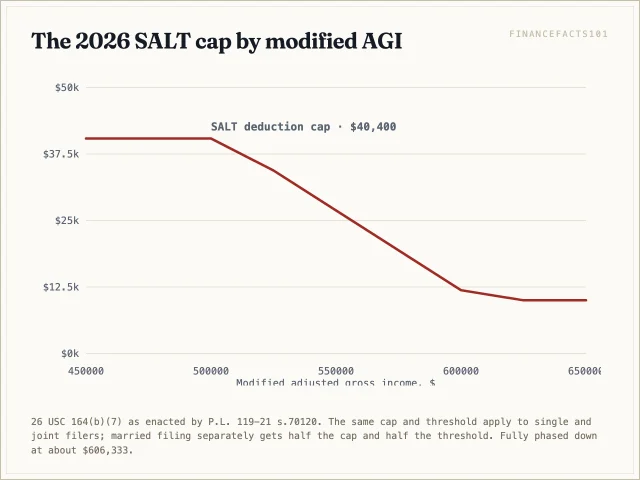
The phase-down creates a band, from $505,000 to about $606,333 of MAGI, where every extra $1,000 of income also removes $300 of deduction. For a couple in the 32% bracket, that makes the true federal rate on income in the band about 41.6%, before state tax. Above the band the floor holds at $10,000, and the cap stops moving.
Mortgage interest: the $750,000 limit and why the deduction fades
Interest on up to $750,000 of acquisition debt, meaning loans used to buy, build or substantially improve a main or second home, is deductible; $375,000 if married filing separately. Loans taken out on or before December 15, 2017 keep the older $1 million limit. Section 70108 of the law made those limits permanent, and interest on home-equity debt used for anything other than buying or improving the home stays non-deductible. IRS Publication 936 has the worksheets for splitting a balance above the limit.
One item returns in 2026. The 2025 edition of Publication 936 says the deduction for mortgage insurance premiums has expired; section 70108 switched the expiry off for tax years after 2025, so qualified premiums count as mortgage interest again. The income phase-out in 26 USC 163(h)(3)(E) still applies: 10% of the premiums is lost for each $1,000 (or part of $1,000) of AGI above $100,000, so nothing is left above $109,000. Policies issued before 2007 do not qualify.
The mortgage is also the deduction that shrinks on its own. Each payment carries less interest than the last, so a household that itemizes in year three can drift back to the standard deduction by year eight without changing anything.
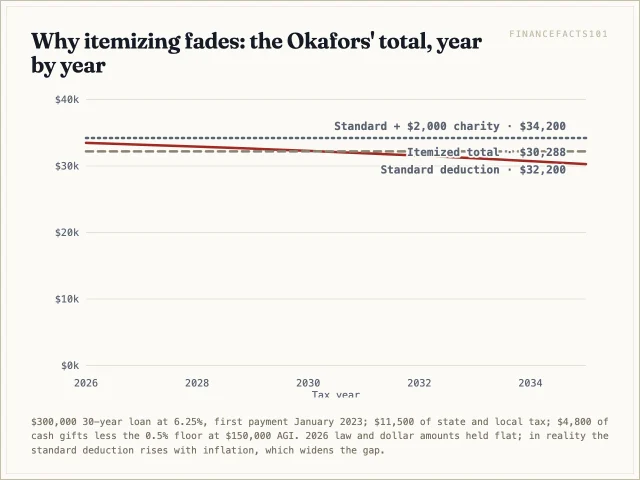
The interest in that chart comes from the loan schedule of the Okafors in the worked example: $17,928 in 2026 falling to $14,738 in 2035. The extra mortgage payment guide explains why the lost deduction is no argument against paying the loan down early.
Medical expenses above 7.5% of AGI
Under 26 USC 213(a), only unreimbursed medical and dental costs above 7.5% of adjusted gross income count. At $50,000 of AGI the first $3,750 is ignored; at $120,000, the first $9,000. That floor is why medical costs rarely matter for working households and often matter for retirees, a year with surgery, or long-term care. Publication 502 lists what counts, including Medicare Part B and Part D premiums, which many retirees overlook. Insurance reimbursements, and costs paid from an HSA or FSA, do not count.
Charity: a 0.5% floor if you itemize, $1,000 or $2,000 if you do not
Section 70425 added 26 USC 170(b)(1)(I): from 2026, an itemizer's charitable deduction is allowed "only to the extent that the aggregate of such contributions exceeds 0.5 percent of the taxpayer's contribution base," which for most people is their AGI. At $150,000 of AGI the first $750 of gifts produces nothing. That amount is generally lost, not carried forward, unless the year's gifts also run into the percentage-of-AGI limits; the same section kept the 60%-of-AGI ceiling for cash gifts to public charities.
The non-itemizer deduction has no floor: the amended 170(p) is computed without regard to (b)(1)(I). So the same $1,200 gift is worth $1,000 of deduction to a single filer on the standard path and $877 to that filer as an itemizer at $64,600 of AGI.
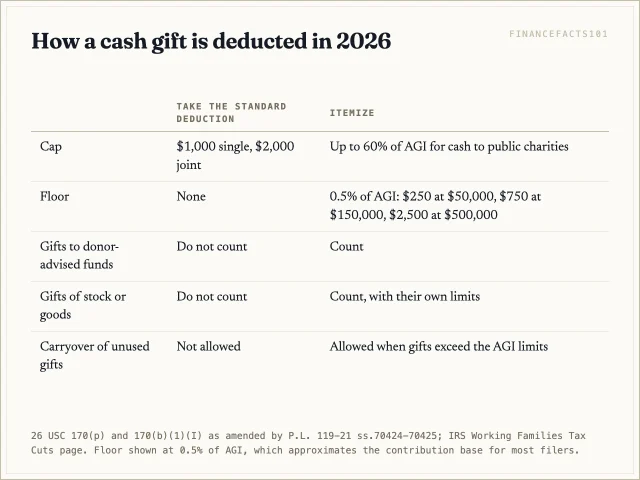
Publication 526 holds the record-keeping rules, which apply on both paths: a bank record or written receipt for any cash gift, and a contemporaneous written acknowledgment from the charity for any single gift of $250 or more.
Deductions you get either way: senior, tips, overtime and car-loan interest
Four deductions created by the 2025 law are not itemized deductions. Section 63(b) now lists them alongside the standard deduction, so you subtract them whichever path you take, and they never belong in the comparison. The IRS fact sheet on the new deductions says of each that it "is available for both itemizing and non-itemizing taxpayers."
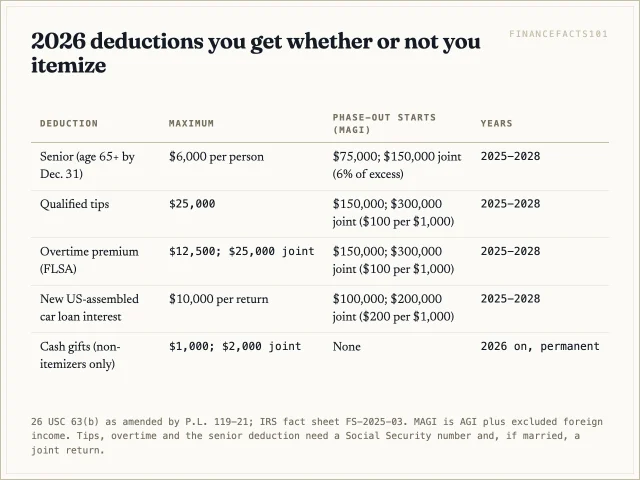
The tips deduction covers voluntary cash or charged tips in occupations the IRS lists as customarily tipped, up to $25,000, and is unavailable to anyone working in a specified service business. The overtime deduction covers only the premium the Fair Labor Standards Act requires, the "half" in time-and-a-half, up to $12,500 or $25,000 joint. Both shrink by $100 for each $1,000 of MAGI above $150,000 ($300,000 joint), require a Social Security number, require married couples to file jointly, and end after 2028.
Interest on a loan for a new, US-assembled car bought for personal use is deductible up to $10,000 a return from 2025 through 2028, reduced above $100,000 of MAGI ($200,000 joint). The conditions are strict, and the car loan term guide and the pay off debt or invest guide work through them; for this decision, all that matters is that it sits outside Schedule A.
The senior deduction and the 65-plus standard deduction
The senior deduction in 26 USC 151(d)(5)(C) is "$6,000 for each qualified individual," meaning the filer and, on a joint return, a spouse who is 65 by the end of the year. The law says that $6,000 amount is "reduced (but not below zero) by 6 percent" of MAGI above $75,000, or $150,000 on a joint return. Because the reduction applies to each person's $6,000, a couple who are both 65 lose 12 cents of deduction per dollar above $150,000 and nothing remains at $250,000. It applies to tax years beginning before January 1, 2029.
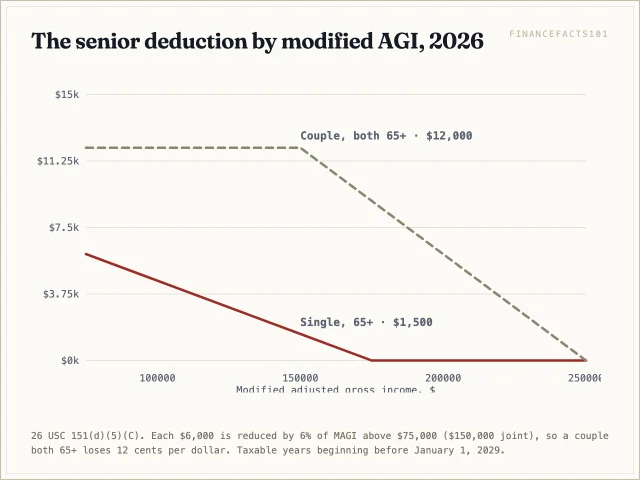
It stacks on top of the older extra standard deduction for age, which itemizers do not get. That combination is why older households rarely itemize. Take the Brennans, both 67 and filing jointly, with $96,000 of AGI including the taxable part of their Social Security, $7,400 of property tax, $2,600 of state income tax, $11,500 of medical costs including Medicare premiums, $5,000 a year of cash gifts and no mortgage.
Itemizing gives them $10,000 of SALT, $4,300 of medical costs above the $7,200 floor and $4,520 of gifts above the $480 floor: $18,820. The standard path gives $35,500 plus $2,000 for their gifts. With the $12,000 senior deduction on both paths, their taxable income is $46,500 on the standard path and $65,180 itemizing; the tax is $5,084 against $7,325.60. Even three years of giving bunched into one year, $15,000, lifts the itemized total only to $28,820. For them the cash-gift deduction is worth $240, the senior deduction $1,440, and from age 70½ a qualified charitable distribution from an IRA does better than either, as the required minimum distributions guide shows.
The worked example: three households, computed
Each household below was run through both paths with the 2026 brackets in a script, and the tax is federal income tax before credits. Credits such as the child tax credit come off afterwards and are the same on both paths, so they do not change the answer.
Maya is single, 34 and rents. She earns $68,000 and puts $3,400 into her 401(k), for an AGI of $64,600. She has $2,700 of state income tax withheld and gives $1,200 in cash to charities. Itemizing gives $2,700 plus $877 of gifts above the $323 floor: $3,577. The standard path gives $16,100 plus $1,000. Her taxable income is $47,500 and her tax $5,452, against $8,137.06 if she itemized. The new cash-gift deduction alone saves her $120 at 12%.
The Okafors file jointly with $165,000 of wages, put $15,000 into 401(k)s and have an AGI of $150,000. Their $300,000, 30-year mortgage at 6.25%, first payment January 2023, charges $17,927.52 of interest in 2026. They pay $5,400 of property tax and $6,100 of state income tax and give $4,800 a year in cash. Itemized: $11,500 of SALT, $17,927.52 of interest and $4,050 of gifts above the $750 floor, for $33,477.52. That is $1,277.52 more than the $32,200 standard deduction, and still the wrong choice: the standard path, with the $2,000 cash-gift deduction, is $34,200. Taxable income of $115,800 gives a tax of $14,900, against $15,058.95 if they itemized, so itemizing would cost them $158.95.
The Levins file jointly with $560,000 of AGI in a high-tax state. They pay $33,000 of state income tax and $15,000 of property tax, and their SALT cap is $40,400 minus 30% of $55,000, or $23,900. Their $720,000 mortgage on the same terms as the Okafors' charges $43,026.04 of interest in 2026, and they give $25,000, of which $22,200 clears the $2,800 floor. Itemized: $89,126.04. Taxable income falls from $525,800 to $470,873.96, and tax from $121,568.50 to $103,591.67, a saving of $17,976.83. The phase-down costs them $16,500 of deduction, or $5,280 of tax at 32%.
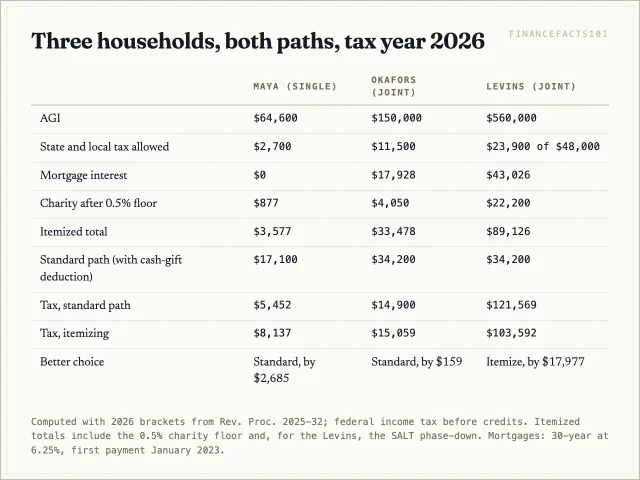
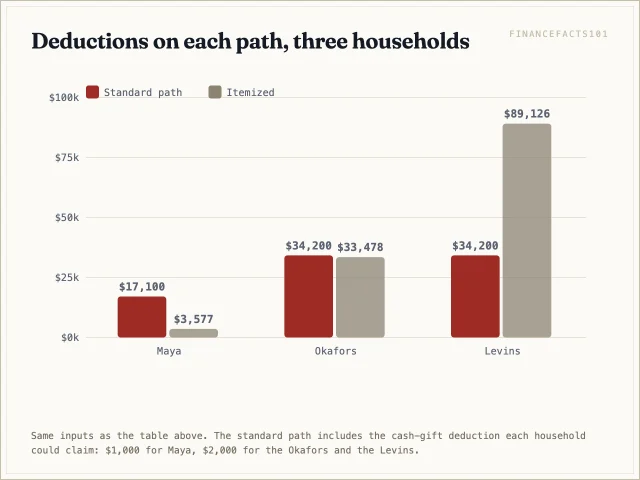
The pattern holds well beyond these three. Renters almost never itemize, because the only large Schedule A items are housing-related. Homeowners with a mid-sized mortgage sit near the line and should check every year. Large mortgages, high state taxes or heavy giving clear it easily, and the bigger question for them is the phase-down and the top-bracket cap.
Bunching: two or three years of giving in one year
Because the choice is made every year, a household near the line can alternate: pack deductible spending into one year and itemize, then take the standard deduction in the next one or two. Charity is the easiest item to move, and a donor-advised fund makes it practical. You contribute to the fund in the bunch year and take the deduction then; the fund's sponsor, a public charity, takes legal control of the money, and you recommend grants to charities over the following years. The IRS donor-advised fund page describes the structure, and Publication 526 requires a written acknowledgment from the sponsor that it has "exclusive legal control" over what you gave.
Run it for the Okafors over 2026 to 2028, holding 2026 amounts flat. Giving $4,800 a year by check, they take the standard path all three years: $14,900 of tax each year, $44,700 in total. If they instead put $14,400 into a donor-advised fund in December 2026, their 2026 itemized total is $43,077.52 and their tax $12,946.95. In 2027 and 2028 they take the plain $32,200 standard deduction (gifts into a fund do not qualify for the cash-gift deduction) and pay $15,340 each year. Three-year total: $43,626.95, or $1,073.05 less, while charities receive the same $14,400.
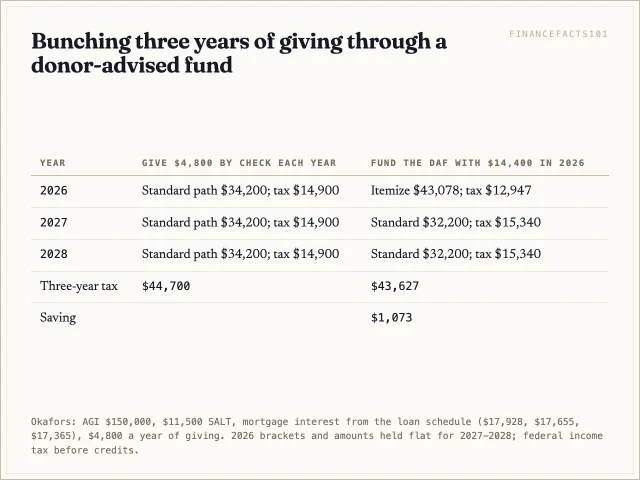
A split works out the same here: $10,400 into the fund in 2026 and $2,000 of checks straight to charities in each later year gives the same $43,626.95, because every dollar of deduction in this example saves tax at 22% either way. It matters only where the bunch would push you into a different bracket.
Bunching works when the itemized total is within a few thousand dollars of the line and the household gives enough to move. It fails for the Brennans, whose $35,500 starting point is too far away. Property tax can sometimes be bunched too, but an IRS advisory on prepayments is clear that prepaying is deductible only if the tax has been assessed by the local government before you pay it. Medical costs can be timed only to a point; an elective procedure in a bunch year is the usual example.
The 37% bracket: the 2/37 rule cuts each dollar to about 35 cents
Section 70111 rewrote 26 USC 68. From 2026, itemized deductions are reduced by 2/37 of the lesser of the deductions themselves or the amount by which taxable income plus those deductions exceeds the start of the 37% bracket, which is $768,700 for joint filers and $640,600 for single filers in 2026. The cut is applied after every other limit. When all of your deductions sit inside the 37% band, each dollar saves 35 cents instead of 37. The IRS's 2026 inflation release describes it as a limit "on the tax benefit from itemized deductions for those taxpayers in the highest tax bracket."
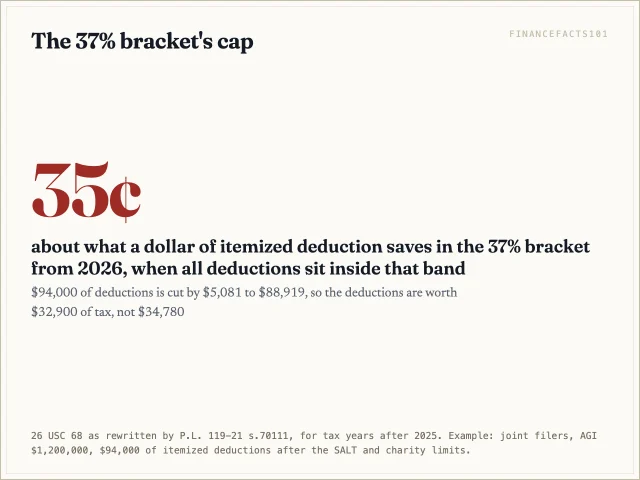
The example in the figure is a couple with $1,200,000 of AGI: SALT held at the $10,000 floor, $40,000 of mortgage interest and $50,000 of gifts, of which $44,000 clears the $6,000 floor. Their $94,000 of deductions is cut by $5,081.08 to $88,918.92. Itemizing still saves them $20,246 against the standard path; without the rule it would have saved $22,126. The standard deduction is not cut, so when all of a household's deductions fall inside the 37% band the break-even rises slightly, to about $34,040 of itemized deductions for joint filers, or $36,154 for a couple who would otherwise claim the full $2,000 cash-gift deduction. The rule does not touch the senior, tips, overtime or car-loan deductions, which are not itemized deductions.
Choosing each year, and checking it against your paycheck
The take-home pay calculator assumes the standard deduction, so its federal tax figure is the standard-path answer. If your Schedule A total beats your standard path, subtract the difference from its taxable income, multiply by your marginal rate, and you have roughly what itemizing saves; a household that itemizes by a wide margin can also adjust its W-4 so less tax is withheld during the year rather than waiting for a refund.
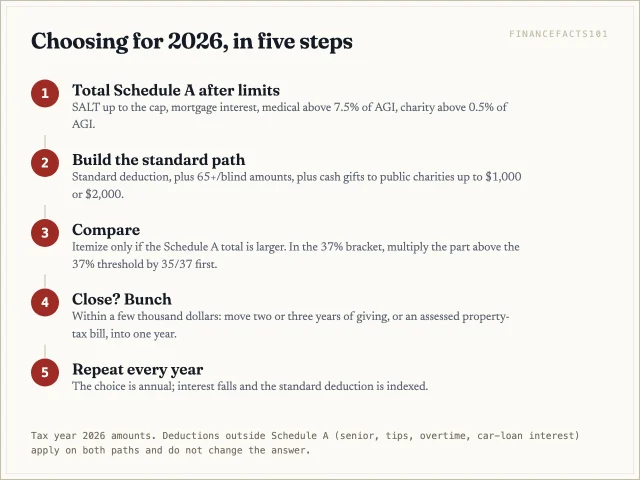
For most people the decision takes ten minutes with last year's return: total the four big Schedule A lines after their limits, compare with the standard deduction plus your cash gifts up to $1,000 or $2,000, and itemize only if the total is larger. If it is within a few thousand dollars, think about bunching before December 31.
FAQ
Is it better to take the standard deduction or itemize in 2026?
Whichever is larger, after limits. For 2026 that means itemizing only if your Schedule A total beats $16,100 single, $24,150 head of household or $32,200 married filing jointly, plus up to $1,000 or $2,000 of cash gifts to charity that you could deduct on the standard path. Higher thresholds apply if you are 65 or older or blind.
Can I take the standard deduction and still deduct charity?
Yes, from 2026. Non-itemizers can deduct up to $1,000 of cash gifts to qualifying public charities, or $2,000 on a joint return, under 26 USC 170(p). Gifts to donor-advised funds and supporting organizations do not count, and neither do gifts of goods or stock.
Do I need to itemize to get the $6,000 senior deduction?
No. The senior deduction, like the tips, overtime and car-loan interest deductions, is taken on either path. It is $6,000 for each person who is 65 or older by the end of the year, reduced by 6% of modified AGI above $75,000 ($150,000 joint), and it runs from 2025 through 2028. Married couples must file jointly to claim it.
Why did my itemized total beat the standard deduction but itemizing still lost?
Usually because the new cash-gift deduction was on the other side. If you give at least $2,000 in cash as a couple, the standard path is worth $34,200, not $32,200, so an itemized total between those two numbers loses. The 0.5% charity floor also trims itemizers' gifts.
Can I switch between itemizing and the standard deduction each year?
Yes. The choice is made on each year's return, which is what makes bunching work. Married couples filing separately must match: if one itemizes, the other's standard deduction is zero.
Sources
- IRS, Internal Revenue Bulletin 2025-45 (Rev. Proc. 2025-32) — 2026 standard deduction, additional amounts for age and blindness, dependent amount, tax brackets
- IRS, Tax inflation adjustments for tax year 2026 (IR-2025-103, October 9, 2025) — 37% bracket thresholds and the top-bracket limit on itemized deductions
- U.S. Government Publishing Office, Public Law 119-21 — sections 70102 (standard deduction), 70103 (senior deduction), 70108 (mortgage interest and insurance premiums), 70109-70110 and 70114 (casualty, miscellaneous and wagering), 70111 (2/37 rule), 70120 (SALT cap), 70201-70203 (tips, overtime, car-loan interest), 70424-70425 (charity)
- IRS, Working Families Tax Cuts — non-itemizer charity deduction and its exclusions
- IRS, Fact sheet FS-2025-03: deductions for working Americans and seniors — tips, overtime, car-loan interest and senior deduction, available whether or not you itemize
- IRS, Topic 501, Should I itemize?
- IRS, Topic 503, Deductible taxes
- IRS, Publication 936, Home Mortgage Interest Deduction (2025 edition)
- IRS, Publication 502, Medical and Dental Expenses (2025 edition)
- IRS, Publication 526, Charitable Contributions (2025 edition)
- IRS, Donor-advised funds
- IRS, Advisory on prepaid real property taxes (IR-2017-210)
- Legal Information Institute, 26 USC 63, 68, 163, 170 and 213 — current text of the Code sections as amended
 Next entry · No. 6,002Roll Over 401(k) or Leave It in the Plan? How to Decide
See also
-
 No. 925
02 Jul 2024
21 min
Understanding Tax Deductions: What They Are and How They Work
Taxation
-
 No. 5,951
17 Sep 2026
18 min
Tax-Deductible Investments: What Actually Cuts Your 2026 Tax Bill
Taxation
-
 No. 4,571
29 Jun 2025
20 min
Understanding Schedule A (Form 1040 or 1040-SR): Itemized Deductions for U.S. Taxpayers
Taxation
-
 No. 5,948
16 Sep 2026
20 min
Self-Employment Tax: How Much of Every Payment to Set Aside
Taxation
-
 No. 2,567
17 Jan 2025
24 min
Understanding Itemized Deductions: A Comprehensive Guide for Institutional Investors
Taxation
-
 No. 782
07 Jun 2024
17 min
Understanding Corporate Tax Rates and Deductions: A Comprehensive Guide for Institutional Investors
Taxation