Is Long-Term Care Insurance Worth It? Costs, Odds and the Couple Math
Is long-term care insurance worth it? A 60-year-old couple was quoted $4,591-$7,173 a year in 2026; a shared nursing-home room ran $114,975 in 2025.
Is long-term care insurance worth it? For a couple with savings in the middle range it usually is: in July 2026 a 60-year-old Illinois couple was quoted $4,591 to $7,173 a year for $165,000 of benefits each, growing 3% a year, while a shared nursing-home room cost a national median of $114,975 a year in 2025. It usually is not worth it if two years of care would use up your savings, because Medicaid then becomes the backstop, or if you could pay for a five-year stay ($647,875 for a private room at 2025 prices) without hurting the healthy spouse.
This guide prices the odds, the costs and your own capacity to pay, then runs them for Tom and Ellen Ruiz, a hypothetical couple aged 60 with $900,000 saved.
One line of scope honesty: this is general information built on stated assumptions (a hypothetical couple, premium quotes from July 2026, care costs from the 2025 survey, 2026 federal rules), not personal advice. Premiums depend on your health, your state and the insurer, and Medicaid rules differ by state.
Who this is for — and who it is not for
This is for people in their 50s and early 60s, single or married, with a few hundred thousand to a couple of million dollars saved beyond the home, deciding whether to buy while they are healthy enough to qualify.
It is not for you if you are already on Medicaid, if Social Security is your only income, or if you have trouble paying for essentials; the NAIC's Shopper's Guide to Long-Term Care Insurance says not to buy in those situations. Medicaid trusts and state-specific planning need an elder-law attorney. How much you need for retirement itself is in how much you need to retire; this guide adds the care risk on top.
How likely you are to need long-term care, and for how long
The best federal estimate is the Department of Health and Human Services' ASPE research brief, Long-Term Services and Supports for Older Americans: Risks and Financing, 2022, revised in August 2022. For people turning 65 between 2021 and 2025, it projects that 56% will develop a disability serious enough to need long-term care: help with at least two activities of daily living, such as bathing or dressing, expected to last 90 days, or supervision for severe cognitive impairment. That is the same trigger a tax-qualified policy uses.
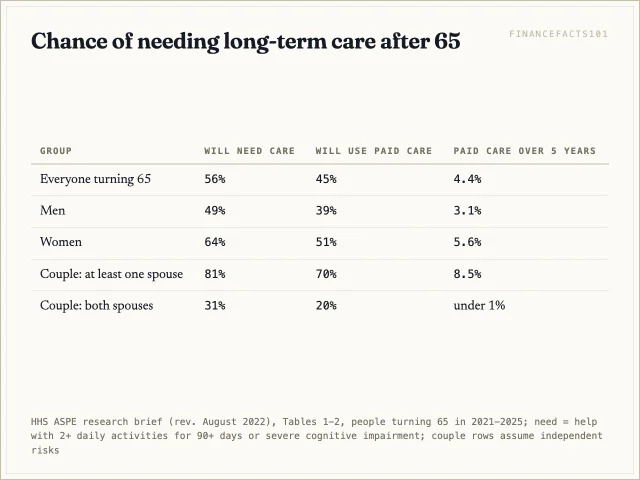
Women face more risk than men, 64% against 49%, largely because they live longer. For a couple, the chance that at least one of you needs care is about 81%, if the two risks are treated as independent.
Needing care is not paying for it. Family provides most help, and only 45% of 65-year-olds are projected to use paid care, usually briefly.
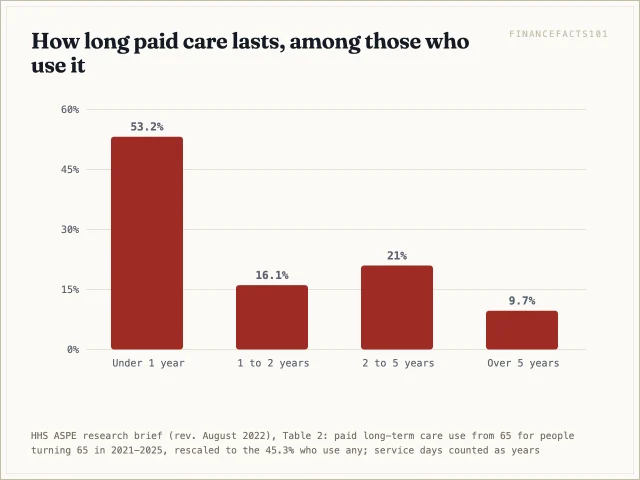
Of people who use any paid care, about 53% use less than a year of it and 69% less than two years. Only 4.4% of all 65-year-olds are projected to use five years or more. The brief puts average lifetime paid care at $120,900 per person in 2020 dollars, but 14% of people pay at least $100,000 out of pocket. Insurance is for that tail, not the average.
What long-term care costs in 2026
The price you would be insuring comes from the CareScout Cost of Care Survey. CareScout, a Genworth subsidiary, collected more than 25,000 rates from about 16,000 provider surveys between July and November 2025 and released the national medians on March 2, 2026.
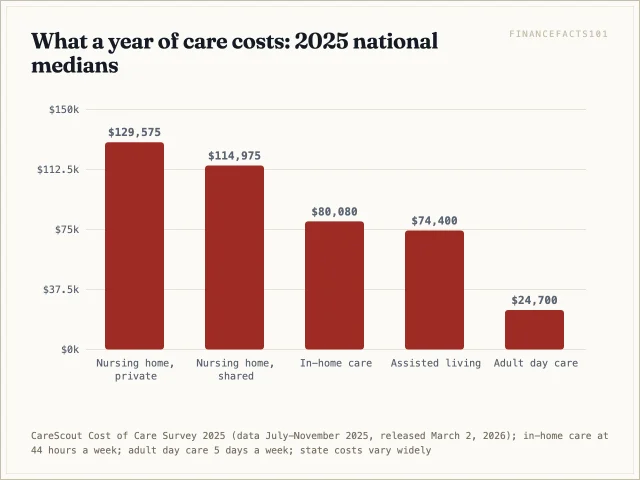
A shared nursing-home room cost $315 a day, $114,975 a year; a private room $355 a day, $129,575. Assisted living ran $6,200 a month. In-home help cost $35 an hour, $80,080 a year at 44 hours a week. Growth slowed in 2025, with most settings up 1% to 5%. Medians hide wide state gaps, so check your state's figures before choosing a benefit amount.
What Medicare pays for, and what it does not
Medicare.gov says Medicare and most health insurance, including Medigap, don't pay for long-term care services, in a nursing home or in the community, and that "You pay all costs for non-covered services, including most long-term care."
Medicare covers short-term skilled care instead. Its skilled nursing facility rules require an inpatient hospital stay of at least three days in a row and a need for daily skilled care.
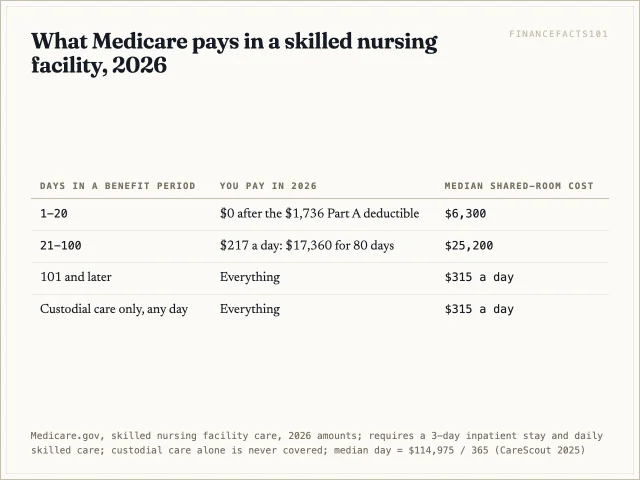
In 2026 you pay $0 for days 1 to 20 after the $1,736 Part A deductible (unless you already paid it in that benefit period), $217 a day for days 21 to 100, and everything from day 101. A full 100 days costs $17,360 in coinsurance, plus any deductible. Home health coverage is similar: part-time skilled care for homebound patients, usually up to 8 hours a day and 28 hours a week combined, and never 24-hour care or help with bathing and dressing when that is the only care you need. Medicare's premiums are covered in our IRMAA guide.
Medicaid: the spend-down and the five-year look-back
Medicaid is the largest payer of long-term care, 43% of the total in the ASPE projections, but only after your money is mostly gone. Each state sets its own limits within federal rules. Many states use the SSI resource limit, $2,000 in 2026 for a single person, as their Medicaid asset limit; others allow more. "Spend-down" means paying for care from your own income and assets until they are under your state's limits, which the NAIC guide describes as the usual path into Medicaid nursing-home coverage.
Married couples get more room. A CMS bulletin dated December 9, 2025 sets the 2026 range for the community spouse's protected resources at $32,532 to $162,660, with each state choosing where in that range it sits.
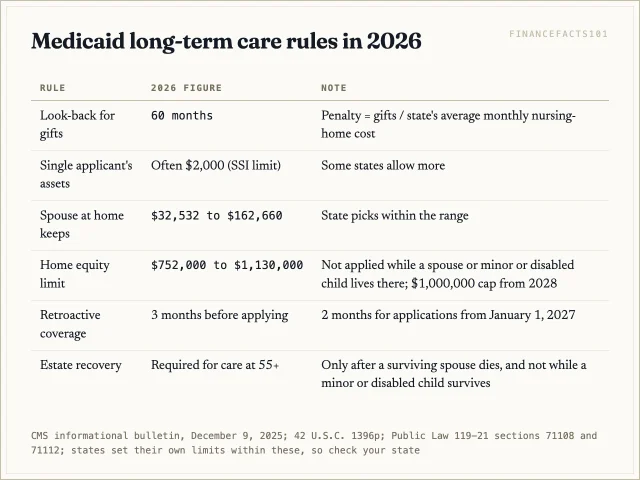
Giving assets away does not work quickly. Under 42 U.S.C. 1396p(c), the state looks back 60 months from your application for transfers made for less than fair market value. The penalty is months of ineligibility: the amount given away divided by the average monthly private-pay nursing-home cost in your state. At the national median of $9,581 a month, a $100,000 gift to a child would cost about 10.4 months of coverage. Transfers to a spouse are exempt.
The home is usually exempt too, but only up to an equity limit: $752,000 in 2026, or up to $1,130,000 where the state opts for more, and the limit does not apply while a spouse or a minor or disabled child lives there. Under Public Law 119-21, the 2025 budget law, that state option is capped at $1,000,000 from 2028 for homes not on agricultural land, and for applications from January 1, 2027, coverage for older applicants reaches back two months before the application instead of three. The same federal statute also requires states to seek repayment from the estates of people who received Medicaid long-term care at 55 or older, but only after any surviving spouse has died and only if no minor or disabled child survives.
What long-term care insurance costs: 2026 premium examples
A widely used premium benchmark is the 2026 AALTCI Long-Term Care Insurance Price Index, published in July 2026 by the American Association for Long-Term Care Insurance, an industry group. Its figures are examples, not offers. For an Illinois couple, both 60, buying a $165,000 initial pool of benefits each that grows 3% a year compounded, it collected five insurers' prices as of July 20, 2026.
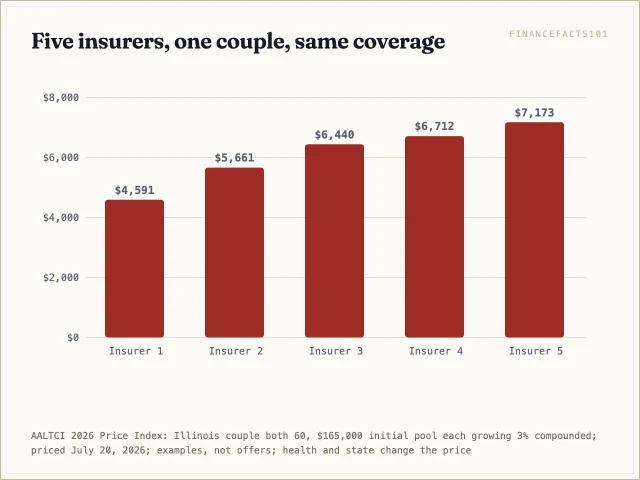
The cheapest was $4,591 a year for the couple; the most expensive, $7,173, or 56% more for nearly identical coverage. The index's summary puts a couple both 55 at $5,010 a year (its detailed age-55 table shows $5,050) and a couple both 65 at $7,030, each for $165,000 of initial benefits growing 3% a year, and a single 60-year-old woman at $4,450 for $165,000 of initial benefits. Delay costs twice: the premium rises with age, and a new diagnosis can lead an insurer to decline you.
What a policy buys: the benefit pool, inflation and the waiting period
A traditional policy pays a daily or monthly benefit until a total pool runs out. The Ruiz quotes buy $165,000 each, about 1.4 years of a shared nursing-home room or 2.2 years of assisted living at 2025 prices. The pool grows 3% a year, so at 85 it would be $345,473 each.
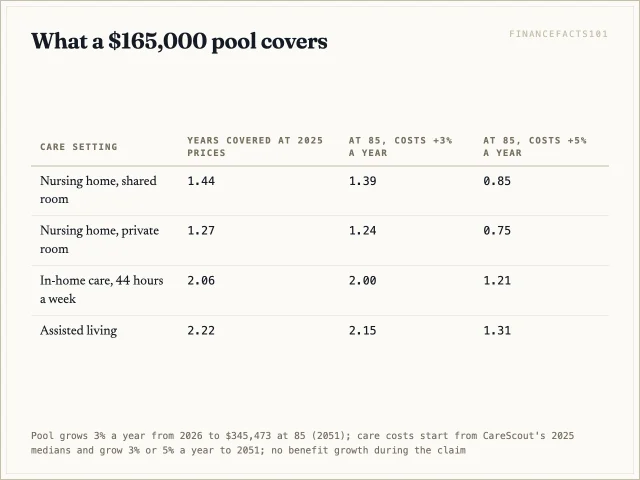
If care costs rise 3% a year, the age-85 pool still covers 1.39 years of a shared nursing-home room; at 5%, only 0.85 years. Benefits start only after an elimination period, which the NAIC guide says can be 20 to 100 days, paid by you.
How many years of long-term care insurance do you need?
The ASPE figures suggest a pool worth two to three years of care in your area covers most claims. About 69% of paid-care users need less than two years, and only about 10% need more than five.
Buying for the five-year tail costs much more, for a risk that about 8.5% of couples face by the same figures: at least one spouse using more than five years of paid care. The cheaper path is two to three years of cover with savings as the reserve beyond it, plus a shared-care rider, which lets one spouse draw on the other's unused benefits.
Premium increases: the risk you keep
A traditional policy's premium is not guaranteed. The NAIC guide explains that long-term care insurance is guaranteed renewable, meaning you can keep it if you pay, but "This is not a guarantee that you can renew at the same premium." Insurers can raise premiums for an entire class of policies, but not because you filed a claim or your health changed.
The NAIC's rule of thumb is that you may not be able to afford a policy if premiums will be more than 7% of your income, and it says to buy only if you could also absorb future increases. If an increase comes, ask what reduced-benefit options the insurer offers instead of paying more.
Is long-term care insurance worth it for a couple at 60? A worked example
Tom and Ellen Ruiz are both 60, live in Illinois and earn $140,000 a year. They have $900,000 saved for retirement, add $2,000 a month, and plan to retire at 67 on $84,000 a year in 2026 dollars with $4,200 a month of combined Social Security. They weigh the $4,591 policy, the lowest AALTCI Illinois quote, against investing the premium at 5%, below the 10-year Treasury yield of 5.24% on October 9, 2026, per Treasury's daily yield curve.
The premium is 3.28% of their income, under the NAIC's 7%. Paid from 60 to 84, it totals $114,775. Invested instead, those payments would be worth $230,071 at 85. The two pools would be worth $690,947 by then, three times as much, but only if care is needed.
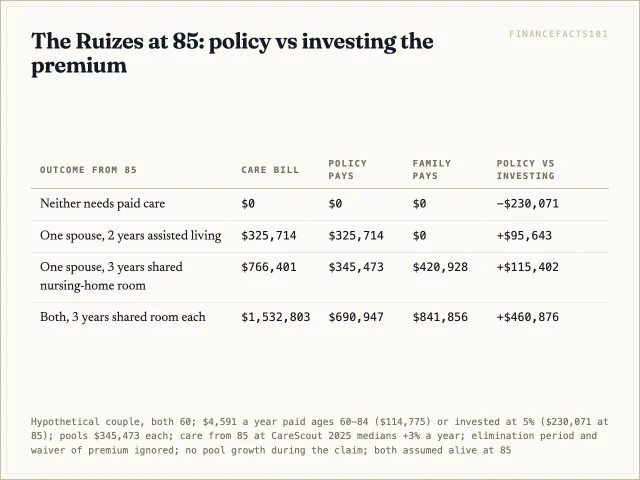
The break-even depends on the setting. The $230,071 fund buys 0.93 years of a shared nursing-home room at 85, assuming care costs grow 3% a year, 1.33 years of full-time home care or 1.43 years of assisted living. So the policy pays for itself with about a year of nursing-home care, or about a year and a half of home care or assisted living. By ASPE's figures for 65-year-olds, treating the spouses as independent, at least one spouse uses a year or more of paid care of any kind about 38% of the time, and two years or more about 26% of the time. The odds that the policy pays back therefore sit between about 26% and 38%: near 38% if the care is in a nursing home, and about a third for home care or assisted living if care spells are spread evenly within ASPE's one-to-two-year band. ASPE counts paid care in service days, and part-time home care costs less, which pulls the true odds toward the low end. If neither spouse needs care, they are $230,071 behind.
If the premium rose 50% at 70, a hypothetical increase, they would pay $149,208 by 85, the invested alternative would reach $282,081, and the break-even would rise to about 1.1 years of nursing-home care.
Self-insuring: what the retirement calculator shows
Our retirement calculator tests whether the Ruizes could carry the risk themselves. Enter age 60, retirement at 67, $900,000 saved, $2,000 a month, a 6% return, $84,000 of spending, 2.5% inflation and $4,200 a month of Social Security.
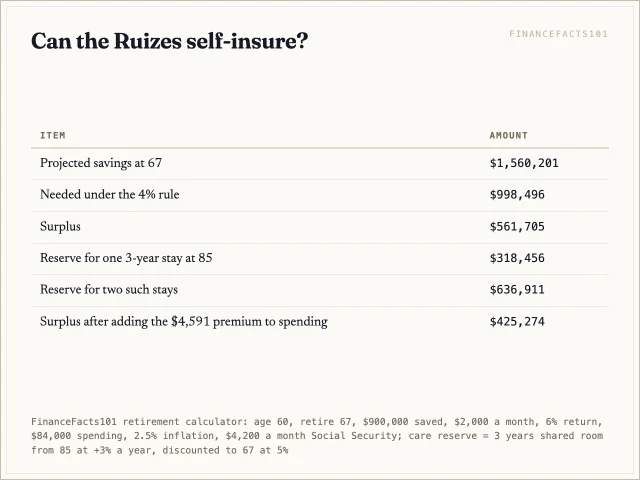
It projects $1,560,201 at 67 against $998,496 needed under the 4% rule, a surplus of $561,705. A three-year stay in a shared room starting at 85 would cost $766,401 at 3% cost growth; set aside at 67 and earning 5%, that takes $318,456. The surplus covers one such stay, but not two, which would take $636,911.
Adding the $4,591 premium to their spending raises the target by $136,431, a slight overstatement because the calculator inflates all spending; they stay $425,274 above it. The verdict for the Ruizes: buy the lowest-priced comparable policy, ideally partnership-qualified, and keep the surplus as the reserve beyond the pool.
Hybrid life and long-term care policies
A hybrid, also called linked-benefit or combo, is permanent life insurance or an annuity with a long-term care rider. The NAIC guide explains that care benefits are paid by accelerating the death benefit: on a $100,000 policy, using $60,000 for care leaves $40,000 for heirs. An extension-of-benefits rider can keep paying after the death benefit is used up.
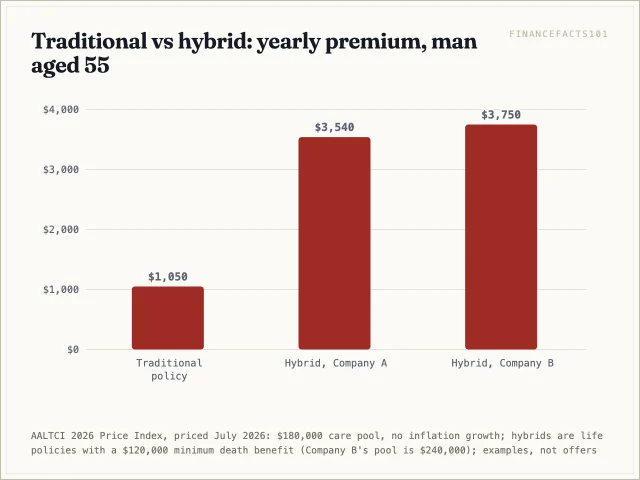
You pay for that money-back feature. In AALTCI's July 2026 example for a 55-year-old man, a traditional $180,000 pool with no inflation growth cost $1,050 a year; linked-benefit policies with a $180,000 or $240,000 pool and a $120,000 minimum death benefit cost $3,540 to $3,750. Hybrids suit people who hate the idea of premiums for nothing; check whether the premium is guaranteed and whether the care benefit grows with inflation.
Two tax rules matter. Under 26 U.S.C. 1035, an existing life insurance or annuity contract can be exchanged tax-free for a qualified long-term care contract. And under section 7702B(e), the care rider is treated as a separate contract, and charges for it taken from the cash value are not deductible medical expenses. Permanent life insurance is covered in term vs whole life, annuities in are annuities worth it.
State partnership programs: keeping assets and still getting Medicaid
A partnership policy is a traditional policy approved under a state program. Under 42 U.S.C. 1396p(b)(1)(C)(iii), Medicaid disregards assets equal to the benefits the policy paid. If the Ruizes' policy paid out $345,473, they could keep that much more and still qualify.
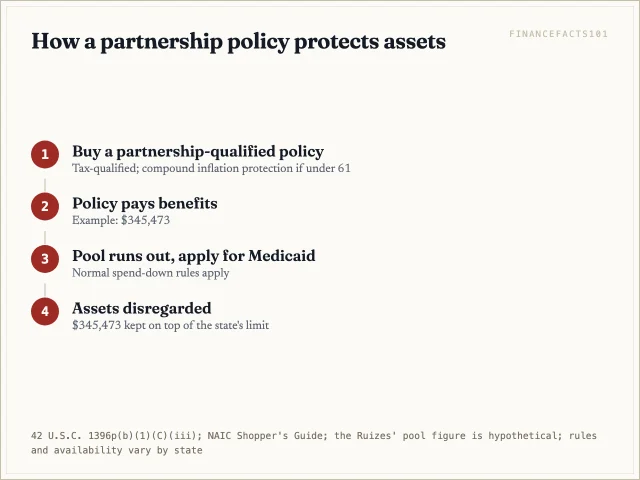
The policy must be tax-qualified, bought while living in the state, with compound annual inflation protection if the buyer is under 61 and some inflation protection from 61 through 75. The NAIC notes the inflation rule differs in California, Connecticut, Indiana and New York, and that not every state offers these policies. Ask whether a quote is partnership-qualified.
Tax: the 2026 premium deduction limits
Premiums for a tax-qualified policy count as medical expenses up to an age-based limit per person. Revenue Procedure 2025-32 sets the 2026 limits by age at the end of the year.
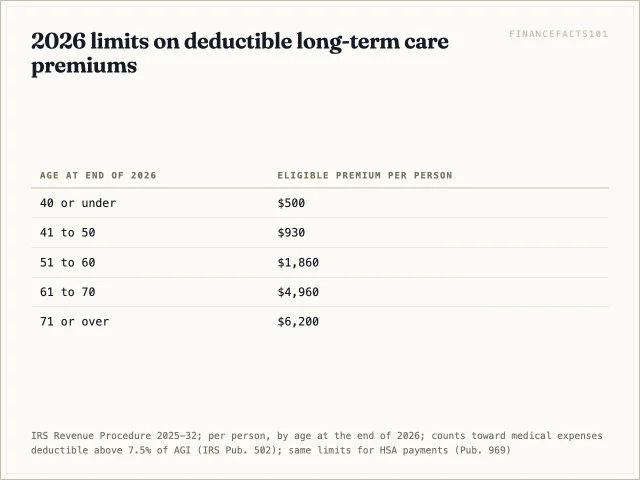
Under IRS Publication 502, you deduct medical expenses on Schedule A only above 7.5% of adjusted gross income. The Ruizes each pay $2,295.50; if they are still 60 at the end of 2026, only $1,860 each counts, and their 7.5% floor is $10,500, so they get no deduction unless other medical bills are large. Better routes exist. Publication 969 lets an HSA pay long-term care premiums tax-free up to the same limits (see HSA vs 401(k)). Self-employed people can deduct the eligible amount above the line, figured on Form 7206 (see self-employment tax).
For distributions after December 29, 2025, a 401(k) or other defined contribution plan may also allow penalty-free withdrawals for certified long-term care premiums, if the plan offers it. Per IRS Notice 2026-33, the 2026 cap is the least of the premium, 10% of the vested balance or $2,600; the money is still taxable, and IRAs cannot make these distributions. Benefits from a tax-qualified policy are generally tax-free; for policies paying a set daily amount, up to $430 a day in 2026 or your actual costs if higher. The IRS had not published 2027 limits as of October 9, 2026.
Who should self-insure: the asset bands
The NAIC says buyers should have many assets or a good income they want to protect, and premiums they can afford even after increases. In numbers, using CareScout's 2025 medians, the bands for savings beyond the home look like this.
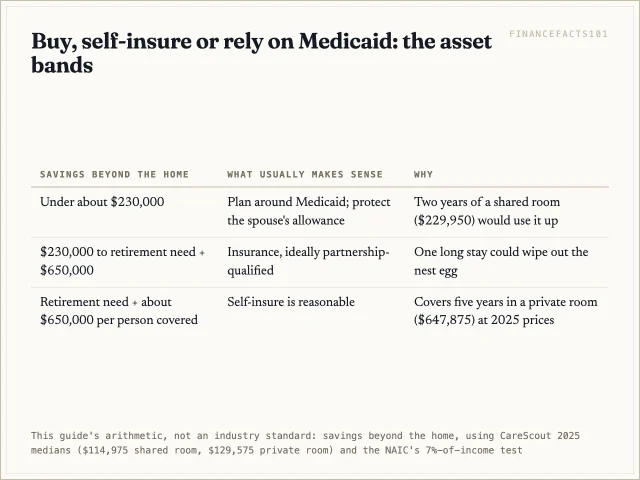
These bands are this guide's arithmetic, not an industry standard. Below about $230,000, two years of nursing-home care at 2025 prices would exhaust the savings, so Medicaid is the realistic backstop; protect the healthy spouse with the state's resource allowance instead of paying premiums. Above your retirement need plus about $650,000 for each person you want covered, enough for five years in a private room at 2025 prices, self-insuring is reasonable. In between, where the Ruizes sit, insurance does its job: it protects a nest egg that one long stay could wipe out.
The decision, step by step
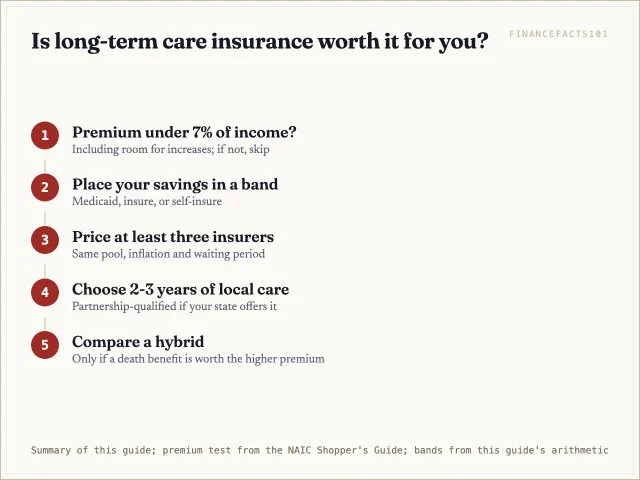
If the premium fits under 7% of your income with room for increases, and your savings sit between the bands, price a policy now, while your health still qualifies.
FAQ
Is long-term care insurance a good idea?
For people with moderate savings who want to protect them, usually yes: for a couple, a policy turns a roughly 38% chance that one spouse uses a year or more of paid care into a known premium. It is a poor idea if the premium crowds out essentials, if you would qualify for Medicaid quickly anyway, or if you could fund five years of care without risk to a spouse.
What does long-term care insurance cost?
AALTCI's July 2026 index summary puts a couple both 55 at $5,010 a year combined for $165,000 of benefits each growing 3% a year (its detailed age-55 table shows $5,050), and a couple both 65 at about $7,030. Five insurers quoted an Illinois couple at 60 between $4,591 and $7,173 for the same coverage, so compare several.
Is long-term care insurance worth the cost for couples?
Often, yes. By ASPE's figures about 70% of couples will have at least one spouse who uses paid care, and the real risk is one spouse's care draining the money the other needs to live on. In AALTCI's 2026 age-55 table, a couple's policy with level benefits was priced at $2,080 a year, less than the $2,450 two singles would be quoted, and shared-care riders let one spouse use the other's unused pool.
Does Medicare pay for a nursing home?
Only for short-term skilled care, usually after a qualifying three-day hospital stay (some ACOs and Medicare Advantage plans waive that rule): up to 100 days per benefit period, with $217 a day of coinsurance from day 21 in 2026. Custodial care, help with bathing, dressing and eating, is not covered at all, which is most nursing-home care.
Sources
- HHS ASPE, Long-Term Services and Supports for Older Americans: Risks and Financing, 2022 (research brief by Johnson and Dey, PDF revised August 2022): probability, duration, paid use and costs of care
- Medicare.gov, Long-term care: what Medicare and Medigap do not cover
- Medicare.gov, Skilled nursing facility care: 2026 Part A deductible $1,736 and $217 daily coinsurance
- Medicare.gov, Home health services: part-time and intermittent care limits
- CMS, CMCS Informational Bulletin: 2026 SSI, Spousal Impoverishment, and Medicare Savings Program Resource Standards (December 9, 2025)
- GovInfo, 42 U.S.C. 1396p: look-back, transfer penalty, estate recovery, home equity limit and partnership policies
- GovInfo, Public Law 119-21 (July 4, 2025), sections 71108 and 71112
- GovInfo, 26 U.S.C. 1035: tax-free exchanges into qualified long-term care contracts
- IRS, Revenue Procedure 2025-32: 2026 eligible premium limits and the $430 per diem limit
- IRS, Publication 502 (2025), Medical and Dental Expenses: 7.5% floor; qualified contract rules; self-employed deduction
- IRS, Publication 969 (2025): HSAs may pay long-term care premiums
- IRS, Notice 2026-33: qualified long-term care distributions from retirement plans
- NAIC, A Shopper's Guide to Long-Term Care Insurance (revised 2019)
- US Treasury, Daily Treasury Par Yield Curve Rates, October 2026: 10-year 5.24% on October 9, 2026
- CareScout, Cost of Care Survey: 2025 national medians, released March 2, 2026
- American Association for Long-Term Care Insurance, 2026 Long-Term Care Insurance Price Index (updated July 2026)
- Cornell LII, 26 U.S.C. 7702B: qualified contracts, per diem limit and riders on life insurance
 Next entry · No. 6,001Standard Deduction vs Itemize: The 2026 Break-Even Math
See also
-
 No. 5,974
08 Oct 2026
18 min
Term vs Whole Life Insurance: Which Is Better for Me?
Insurance
-
 No. 5,935
07 Sep 2026
17 min
How Much Life Insurance You Actually Need
Insurance
-
 No. 631
11 May 2024
20 min
Understanding Cash Value Life Insurance: Pros, Cons, and How It Works
Insurance
-
 No. 19
28 Mar 2024
19 min
Understanding Accidental Death Benefits: What They Are and How They Differ from AD&D
Insurance
-
 No. 5,995
29 Oct 2026
21 min
Medicare IRMAA: How It Is Calculated and How to Avoid It
Retirement
-
 No. 5,973
07 Oct 2026
16 min
How Much Do I Need to Retire? Spending, Social Security and the 4% Rule
Retirement