HDHP vs PPO: Which Health Plan Is Better for You?
HDHP vs PPO: with average employer plans, the HDHP costs $576 a year less for one person and $2,897 less for a family. The two-number test for your own plans.
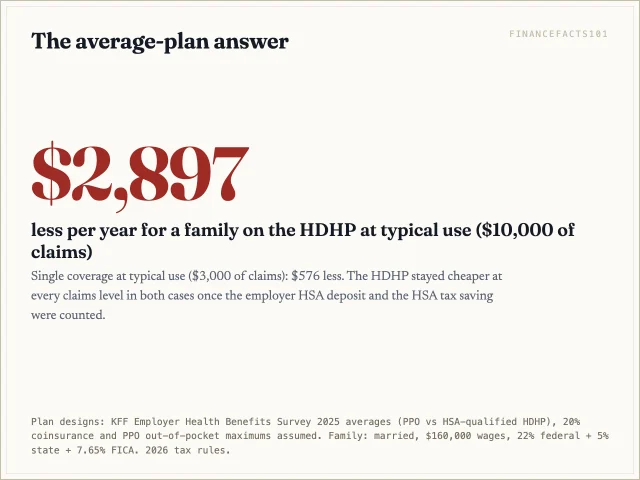
HDHP vs PPO comes down to one comparison: premiums plus expected out-of-pocket costs, minus your employer's HSA deposit and the tax the HSA saves you. Run through the average employer plans in KFF's 2025 survey (the latest published as of October 9, 2026) and 2026 tax rules, the HSA-qualified high-deductible plan comes out cheaper at every level of use we tested: $576 a year cheaper for one person at typical use and $2,897 cheaper for a family. The PPO wins when your employer's version of the HDHP is thin, meaning a small premium gap, no HSA money and a much higher out-of-pocket maximum. In that case a single person with more than about $2,800 of claims a year is better off in the PPO.
Below is a two-number test that tells you which kind of plan pair you have, worked through for a single person and a family. Figures are for the 2026 plan year unless marked 2027, checked October 9, 2026. This is general information built on stated assumptions, not personal advice.
Who this is for — and who it is not for
This guide is for someone under 65 choosing between a PPO and an HSA-qualified high-deductible plan. That might be in an employer's benefits window, or on HealthCare.gov or a state Marketplace, where bronze plans became HSA-eligible in 2026. You need four numbers from each plan's summary of benefits and coverage (premium share, deductible, coinsurance, out-of-pocket maximum) and a rough idea of last year's medical bills.
It is not for anyone enrolled in Medicare, because Medicare enrollment drops your HSA contribution limit to zero for every month you are covered (IRS Publication 969). And if the PPO is the only plan that covers a specialist or drug you depend on, stop here: no cost table outweighs losing access to that care.
HDHP vs PPO: what you are actually choosing between
A PPO usually charges more premium, has a lower deductible, and often charges flat copays for office visits and drugs that you pay before the deductible is met. A high-deductible health plan charges less premium, makes you pay the full allowed amount for most non-preventive care until the deductible is met, and opens the door to a Health Savings Account. In practice the labels overlap, because many HSA-qualified plans run on a PPO network. What you are really choosing is a cost-sharing design, not a network.
The HSA is what makes the comparison close. Money you put in through payroll skips federal income tax, most state income tax and the 7.65% Social Security and Medicare tax. It pays your deductible tax-free, and unspent money stays yours. Our HSA vs FSA guide explains the accounts themselves, and our HSA vs 401(k) guide asks where the next savings dollar should go. This guide asks only which plan costs you less this year.
The 2026 and 2027 numbers that define an HDHP
To count as HSA-qualified for 2026, a plan needs a deductible of at least $1,700 for self-only coverage or $3,400 for family coverage. Its out-of-pocket costs (deductibles, copays and coinsurance, not premiums) can be no more than $8,500 or $17,000. The HSA contribution limits that go with it are $4,400 and $8,750. All come from Rev. Proc. 2025-19. The 2027 figures are already final in Rev. Proc. 2026-24 (Internal Revenue Bulletin 2026-25).
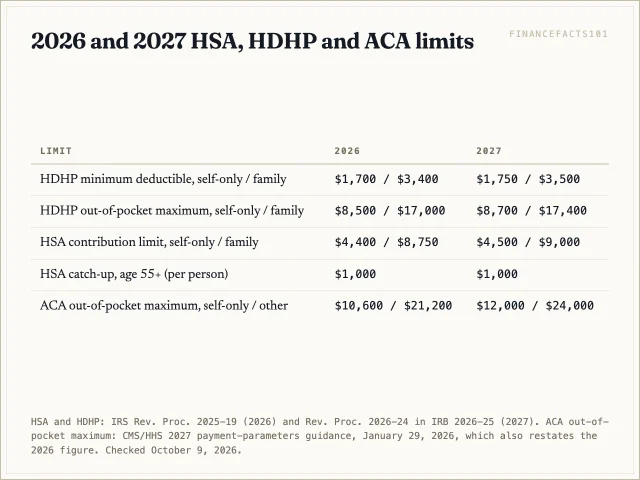
Every non-grandfathered plan, PPO or HDHP, also has to respect the Affordable Care Act's cap on in-network cost sharing. For 2026 that cap is $10,600 for self-only coverage and $21,200 for anything else. For 2027 it rises to $12,000 and $24,000, according to HHS's payment-parameters guidance of January 29, 2026. The ACA cap is higher than the HSA ceiling, so a PPO's worst year can legally cost more than an HSA-qualified plan's. The bronze-plan rule described below is the exception on the HDHP side.
Family plans have one more trap. If a family plan has a per-person deductible inside the family deductible, that per-person amount must also be at least the family minimum ($3,400 in 2026). Otherwise the plan is not an HDHP and nobody on it can contribute to an HSA (Publication 969). Check this before you assume a family "HDHP" qualifies.
What the average plans look like
The best public benchmark for employer plans is the KFF Employer Health Benefits Survey. The 2025 edition, released October 22, 2025, was the latest published as of October 9, 2026. In it, the average worker in a PPO paid $1,514 a year toward single coverage and $7,075 toward family coverage. The average worker in an HSA-qualified HDHP paid $1,319 and $5,634.
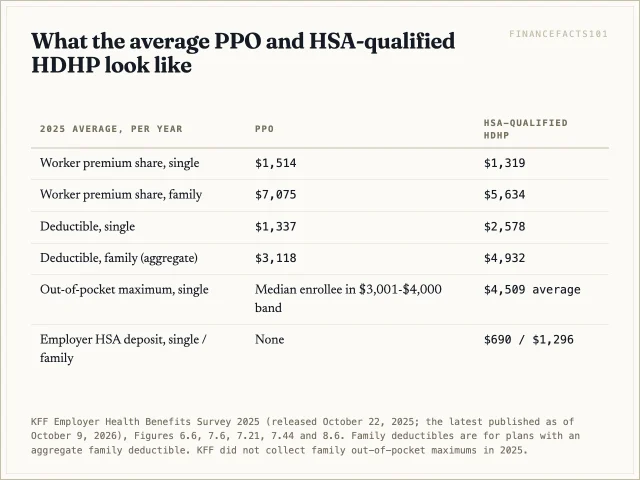
The single premium gap is $195; the family gap is $1,441. Employers add an average of $690 (single) or $1,296 (family) to the HSA, and those averages include the 14% to 15% of workers whose employer puts in nothing. The deductibles run the other way: $2,578 against $1,337 for single coverage, and $4,932 against $3,118 for an aggregate family deductible. Those are the plan inputs below. KFF gives a $4,509 average out-of-pocket maximum for single HSA-qualified plans but only a distribution for PPOs, so we assume $3,500, the band holding the median PPO enrollee. KFF collected no family maximums in 2025; we assume $7,000 (PPO) and $9,000 (HDHP).
The total-cost formula, written once
Each cash flow appears exactly once:
- PPO cost = your premium share + out-of-pocket costs.
- HDHP cost = your premium share + out-of-pocket costs − employer HSA deposit − the tax saved on your own HSA contributions.
Out-of-pocket costs are claims up to the deductible plus coinsurance above it, capped at the out-of-pocket maximum. "Claims" means allowed amounts for non-preventive, in-network care; preventive care is free on both plans, so it drops out.
The tax saving is counted only on HSA dollars you actually need to pay this year's bills: out-of-pocket costs minus the employer deposit, up to the contribution limit. Funding the full limit saves more, but that extra is a savings decision, and counting it here would flatter the HDHP. The HSA vs FSA calculator uses the same tax formula as this guide (contribution × federal + state + 7.65% FICA), so you can check the tax piece on your own numbers.
One simplification: premiums are pre-tax under both plans, so the premium gap is worth less in take-home pay than its sticker amount. For the worked family the $1,441 gap is worth about $942, narrowing the family margins below by about $500.
Worked example: one person at low, typical and high use
Assumptions, all stated. A single filer earns $85,000 in wages and pays the $1,319 HDHP premium share pre-tax through payroll. After that premium and the 2026 standard deduction of $16,100, about $67,600 of taxable income is left ($85,000 − $1,319 − $16,100 = $67,581), inside the 22% bracket that runs from $50,400 to $105,700 (IRS 2026 inflation adjustments). Every HSA contribution in these scenarios stays within that bracket. The state tax is a flat 5% and follows federal HSA rules. HSA money goes in through payroll, which also skips the 7.65% FICA tax, so each HSA dollar saves 34.65 cents. Both plans charge 20% coinsurance. The three use levels are $600 of claims (a few visits and generic prescriptions), $3,000 (a specialist workup with imaging) and $30,000 (a surgery with a hospital stay).
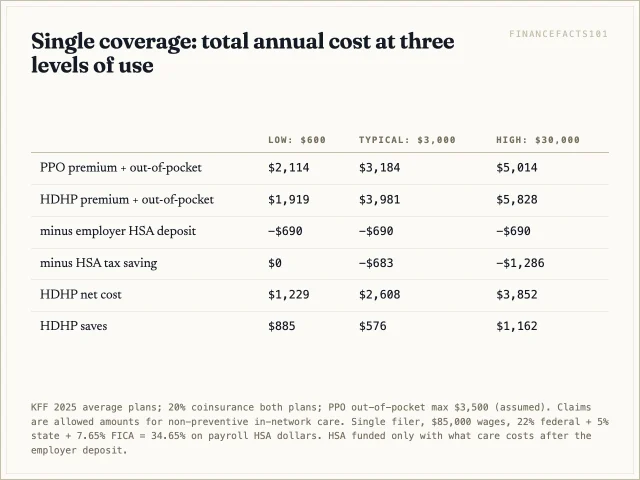
At $600 of claims, both plans leave you paying the full $600, because neither deductible is met. The HDHP's lower premium and the $690 deposit make it $885 cheaper. The $90 left over stays in your HSA.
At $3,000 the PPO's deductible is met early. You pay $1,337 plus 20% of the remaining $1,663, or $1,669.60. The HDHP makes you pay its $2,578 deductible plus 20% of $422, or $2,662.40. On out-of-pocket costs alone the PPO is ahead. But the employer's $690 covers part of the HDHP bill, and you put the other $1,972.40 through the HSA, saving $683.44 in tax. The HDHP's net cost is $2,607.96 against $3,183.60 for the PPO.
At $30,000 both plans hit their out-of-pocket maximums. The HDHP's $4,509 cap is $1,009 worse than the PPO's $3,500, but the head start and the tax saving more than cover it. Only $3,710 can go into the HSA after the employer's $690 uses up the rest of the $4,400 limit. That saves $1,285.52, and the HDHP still comes out $1,161.52 ahead.
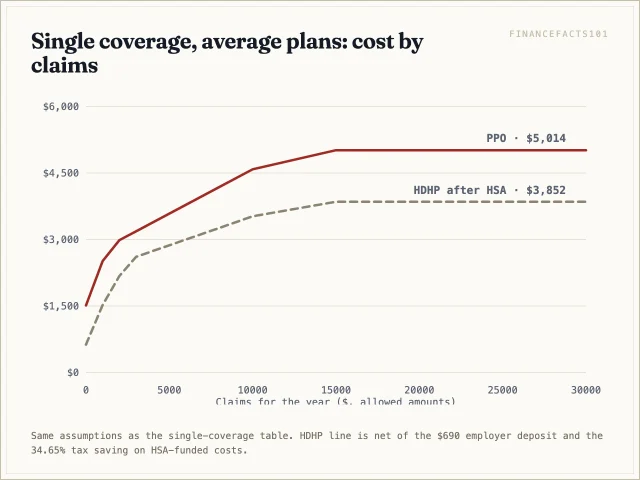
The closest point comes right where the HDHP deductible runs out, at about $2,580 of claims, the HDHP is ahead by only $547. Take away the tax saving and the PPO actually wins above about $2,444 of claims, but by no more than $124 a year. Most of the HDHP's edge in this pair comes from the HSA tax treatment, not from the plan design.
Worked example: a family at three levels of use
Assumptions. A married couple filing jointly earns $160,000 in combined wages. After the $5,634 pre-tax premium share and the $32,200 standard deduction they have about $122,200 of taxable income ($160,000 − $5,634 − $32,200 = $122,166), inside the 22% bracket that runs from $100,800 to $211,400. They pay the same 5% state tax and 7.65% FICA, so again each HSA dollar saves 34.65 cents. The use levels are $2,500 of claims, $10,000 (a child's broken arm plus routine specialist care) and $60,000 (a hospital admission).
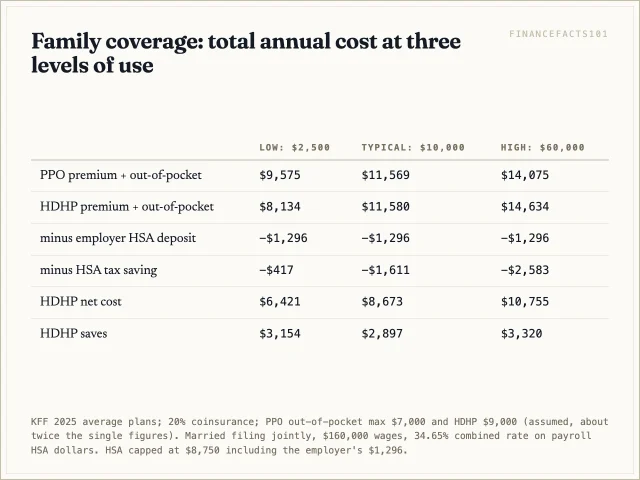
The family pair is not close. Before a single claim, the HDHP family is $2,737 ahead: a $1,441 lower premium plus the $1,296 deposit. The worst-case gap between the out-of-pocket maximums is $2,000, so the head start covers it even before tax. With the tax saving, the HDHP is $3,154 cheaper at $2,500 of claims, $2,897 cheaper at $10,000 and $3,320 cheaper at $60,000. At the high level, $7,454 of HSA contributions (the $8,750 family limit minus the employer's $1,296) saves $2,582.81 in tax.
Families earning less get a smaller tax saving but the same answer. At $90,000 of joint wages the couple is in the 12% bracket. The HDHP's margin at typical use falls from $2,897 to $2,432, still a clear win.
When the PPO wins: the thin-HDHP case
Averages hide a lot of spread. KFF found that 33% of employers offering single coverage through an HSA-qualified plan put nothing into the HSA. Some employers also price the two plans only a few hundred dollars apart. Take a thin HDHP of that kind: a premium $200 below the PPO, a $3,400 deductible, 30% coinsurance, a $7,000 out-of-pocket maximum and no employer deposit. The PPO and the tax assumptions stay the same as in the single example.
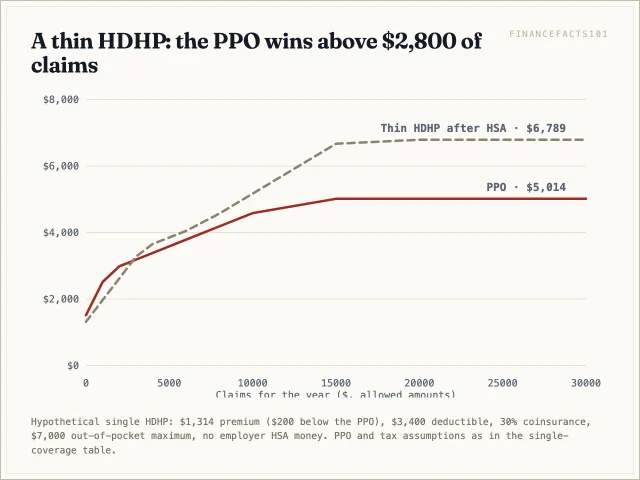
Now the answer flips at $2,800 of claims. Below that, the HDHP's premium edge and the tax saving win. Above it, the PPO's earlier coinsurance and lower maximum take over. In a $30,000 year the PPO is $1,775.40 cheaper, even after the HDHP holder saves $1,524.60 of tax by contributing the full $4,400. A family version (premium $500 lower, $7,000 deductible, 30% coinsurance, $12,000 maximum, no deposit) crosses over at $6,603 of claims. In a $60,000 year that family pays $1,468.12 more on the HDHP.
The two-number screen for your own plans
You don't need a spreadsheet to tell which kind of pair you have. Work out two numbers from the plan summaries:
- Head start: the PPO premium minus the HDHP premium, plus the employer HSA deposit.
- Worst-case gap: the HDHP's out-of-pocket maximum minus the PPO's.
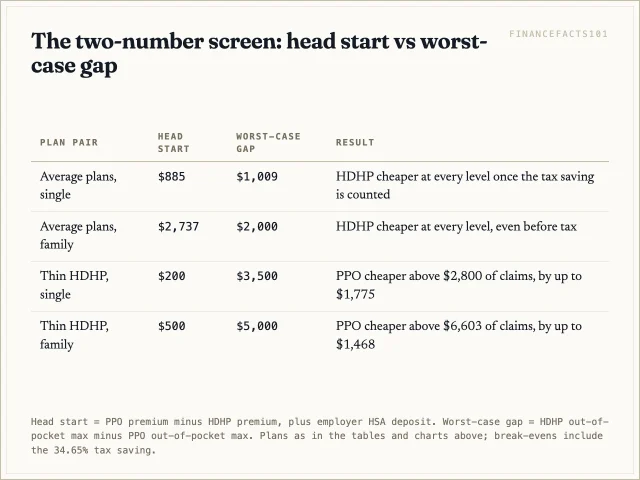
If the head start is at least as large as the worst-case gap, the HDHP is cheaper even in your worst year. Below the PPO's deductible the HDHP is always cheaper as long as its premium is lower, because both plans make you pay the full bill there. In between, the tax saving covers most or all of the difference. If the head start is far smaller than the worst-case gap, there is a claims level above which the PPO wins. In our two thin-plan examples it fell between the two plans' deductibles. Compare it with last year's explanation-of-benefits totals, and if you expect a birth, a surgery or a new long-term prescription, price that year, not an average one.
The tax saving depends on your bracket and your state
The HSA's value scales with your marginal rate. For the single worker, each payroll HSA dollar saves 34.65 cents at 22% federal. At 12% federal it saves 24.65 cents, and at $50,000 of wages the HDHP's typical-use margin shrinks from $576 to $378. Two cases shrink the saving further:
- Contributions made outside payroll. If you contribute directly instead of through a payroll plan, you still get the income tax deduction but lose the 7.65% FICA exclusion. Publication 969 says employer HSA contributions, including amounts you elect through a cafeteria plan, are generally not subject to employment taxes. That covers the self-employed and Marketplace buyers.
- States that don't follow the federal treatment. California and New Jersey tax HSA contributions differently from the IRS. Our HSA vs 401(k) guide covers the state exceptions. If you live there, set the state rate to zero in the tax math.
Cash flow: the deductible arrives before the savings do
The cost comparison is an annual total. The bills are not annual. A $2,578 deductible can arrive in February, when payroll has put only a few hundred dollars into the HSA. Some employers deposit their share up front and others spread it over the year. Ask which yours does. You can pay out of pocket and reimburse yourself from the HSA later. But under Publication 969, expenses incurred before your HSA is established are not qualified medical expenses, so open the account before you need care, not after.
If you couldn't produce the HDHP deductible in cash on short notice, the HDHP's average win may become a card balance. Our emergency fund guide sizes the buffer: three to six months of essential spending, held in a high-yield savings account.
What the 2025 law changed for HDHPs and HSAs
Public Law 119-21, enacted July 4, 2025, changed three HSA rules in sections 71306 to 71308.
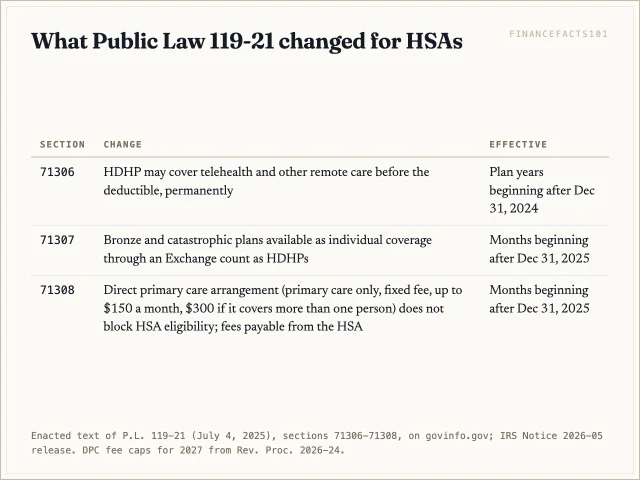
Section 71306 lets an HDHP cover telehealth and other remote care with no deductible, permanently, for plan years beginning after December 31, 2024. Section 71307 adds bronze and catastrophic plans "available as individual coverage through an Exchange" to the definition of a high-deductible health plan, from January 2026. The IRS release on Notice 2026-05 says these plans qualify whether or not they meet the general HDHP definition. They need not be bought through the Exchange. Section 71308 lets someone in a direct primary care arrangement keep HSA eligibility, provided the arrangement charges only a fixed periodic fee for primary care and the fees total no more than $150 a month ($300 if it covers more than one person). Primary care here excludes procedures needing general anesthesia, prescription drugs other than vaccines, and lab services not typical of a primary care office. It also lets those fees be paid from the HSA. Rev. Proc. 2026-24 keeps those caps at $150 and $300 for 2027.
The bronze rule is the one that matters most for Marketplace shoppers. A bronze plan's out-of-pocket maximum can sit anywhere up to the ACA cap of $10,600 in 2026, above the $8,500 HSA ceiling, and still count as an HDHP. The two-number screen works the same way, minus the employer deposit and the FICA saving.
Open enrollment timing and switching mid-year
Most employer plans let you choose once a year, in a window the employer sets, usually in the autumn for a January plan year. According to HealthCare.gov's dates-and-deadlines page, as checked on October 9, 2026, open enrollment for 2027 coverage runs from November 1, 2026 to January 15, 2027. December 15 is the last day to enroll for coverage starting January 1, and enrollments made from December 16 to January 15 start February 1. State-run Marketplaces can set their own dates.
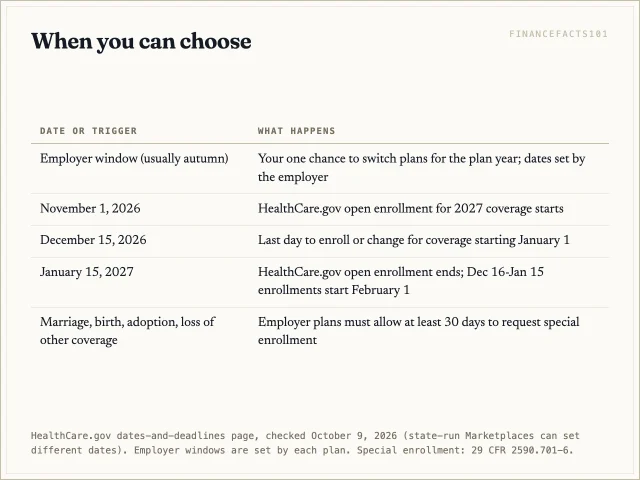
After the window closes, a change generally needs a qualifying life event. For employer plans, federal rules require at least 30 days after a marriage, birth, adoption or loss of other coverage to request special enrollment (29 CFR 2590.701-6). For 2027 plans, use the 2027 column of the limits table and your employer's 2027 premiums; the method doesn't change.
What the cost math leaves out
Three things can outweigh the arithmetic:
- Copays. Many PPOs charge flat copays for office visits and prescriptions that never touch the deductible. KFF's averages across all plan types, for workers with copays, are $27 (primary care) and $45 (specialist). Our model runs every PPO claim through the deductible, which overstates the PPO's cost for someone whose care is mostly office visits.
- Your prescription formulary. A drug that costs $40 a month on a PPO copay can cost its full price under an HDHP until the deductible is met. Check the drug's tier on both plans.
- Spousal coverage. If your spouse has a general-purpose health FSA that can reimburse your expenses, you generally can't contribute to an HSA at all, because that FSA counts as other coverage for you (see "Other employee health plans" in Publication 969).
The decision, step by step
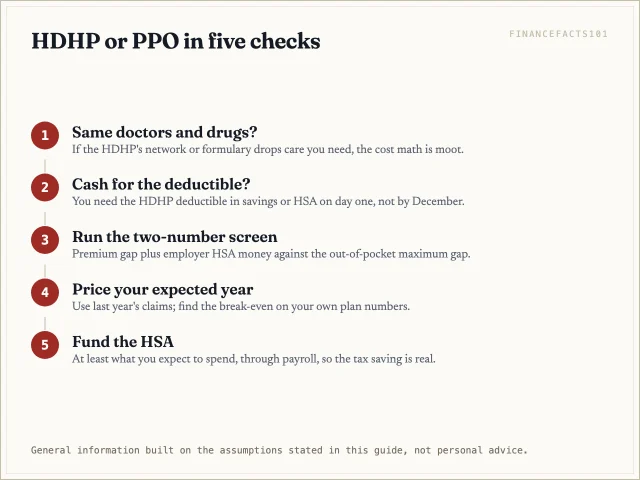
Access to care comes first and cash for the deductible second. With average-shaped plans, the HDHP then wins for low, typical and high users alike. With a thin HDHP, the PPO is the safer choice for anyone expecting claims above the crossover, which in our examples was only a few thousand dollars.
FAQ
Is an HDHP or a PPO better for a family?
With average employer plans, the HDHP. The average HSA-qualified family plan costs workers $1,441 less in premium and adds a $1,296 HSA deposit; in our model the HDHP family came out $2,897 ahead at $10,000 of claims and $3,320 ahead in a $60,000 year. Check the per-person deductible rule and each family member's drugs and specialists.
Is a high deductible health plan worth it if I have a chronic condition?
It depends on the screen, not the condition. If your spending reliably reaches both out-of-pocket maximums, the HDHP wins when its head start is at least the worst-case gap; the tax saving widens the margin. Also check the IRS preventive-care rules in Publication 969, which let an HDHP cover some chronic-condition care, such as continuous glucose monitors for people diagnosed with diabetes, before the deductible.
What if I don't fund the HSA?
Then you give up most of the HDHP's advantage. In the single example the HDHP still wins at low use, but without the tax saving the PPO is cheaper above about $2,444 of claims. Put in at least what you expect to spend, through payroll. Many employers let you change payroll HSA contributions during the year, so check your plan's rules.
Can I switch from a PPO to an HDHP in the middle of the year?
Usually not without a qualifying event such as marriage, a birth or loss of other coverage. Federal rules require at least 30 days after those events for employer-plan special enrollment. HSA eligibility is tested on the first day of each month, so a mid-year switch gives you a pro-rated contribution limit unless the last-month rule applies, and that rule comes with a 13-month testing period.
Sources
- IRS, Rev. Proc. 2025-19 (2026 HSA limits and HDHP thresholds)
- IRS, Internal Revenue Bulletin 2026-25, Rev. Proc. 2026-24 (2027 HSA limits, HDHP thresholds and direct primary care fee caps)
- HHS/CMS, Premium Adjustment Percentage, Maximum Annual Limitation on Cost Sharing ... for the 2027 Benefit Year (January 29, 2026; 2026 and 2027 ACA out-of-pocket maximums)
- U.S. Congress, Public Law 119-21, enacted text, sections 71306-71308
- IRS, Treasury, IRS provide guidance on new tax benefits for HSA participants (Notice 2026-05)
- IRS, Tax year 2026 inflation adjustments (brackets and standard deduction)
- IRS, Publication 969, Health Savings Accounts and Other Tax-Favored Health Plans
- HealthCare.gov, Dates and deadlines (checked October 9, 2026)
- eCFR, 29 CFR 2590.701-6, special enrollment periods
- KFF, 2025 Employer Health Benefits Survey (released October 22, 2025; plan-type tables in Sections 6, 7 and 8)
 Next entry · No. 6,000Is Long-Term Care Insurance Worth It? Costs, Odds and the Couple Math
See also
-
 No. 5,947
15 Sep 2026
18 min
HSA vs FSA: Which One to Fund at Open Enrollment
Healthcare Finance
-
 No. 5,982
16 Oct 2026
16 min
HSA vs 401(k): Where Should Your Next Dollar Go?
Retirement
-
 No. 2,064
06 Dec 2024
20 min
Understanding Health Insurance: Types, Workings, and Key Components for Professional Investors
Healthcare Finance
-
 No. 5,940
12 Sep 2026
17 min
Take-Home Pay on a $100,000 Salary: What You Actually Keep in 2026
Taxation
-
 No. 4,038
16 May 2025
20 min
Understanding Preferred Provider Organizations (PPOs): What They Are, How They Work, and Their Costs
Healthcare Finance
-
 No. 3,824
29 Apr 2025
20 min
Understanding Out-of-Pocket Expenses: Business and Healthcare Perspectives
Healthcare Finance