Emergency Fund: How Much and Where to Keep It
Most households need 3-6 months of essential spending - $10,950 to $21,900 in our worked example - in an HYSA near 4.2%, not checking at 0.07%.
Three months of essential expenses or six — that is the decision this guide settles, along with where the money should sit and when a bigger buffer starts costing you real returns. How much emergency fund you actually need is not a slogan; it is a number you can calculate from your own budget in about twenty minutes, and for the worked household below it comes out to $10,950 at the three-month mark and $21,900 at six.
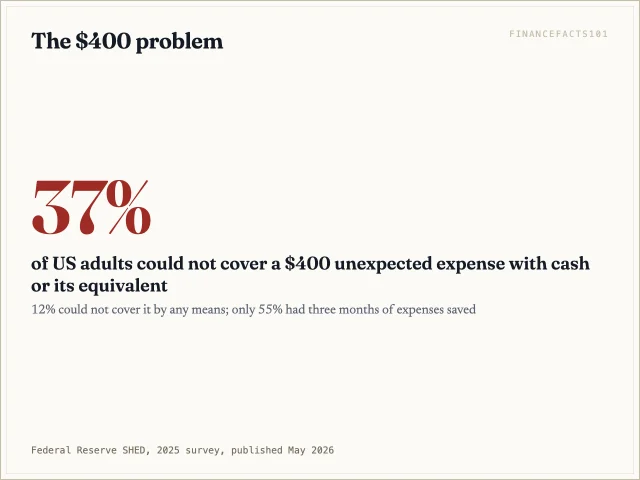
The stakes are not hypothetical. In the Federal Reserve's latest Survey of Household Economics and Decisionmaking, covering 2025 and published in May 2026, 37 percent of US adults said they could not cover a $400 unexpected expense with cash, savings, or a card paid off at the next statement — and 12 percent could not cover it by any means at all. Only 55 percent had three months of expenses set aside. If you are reading this to fix that, the build path from zero is covered too.
One line of scope honesty before the numbers: this is general information built on stated assumptions — a specific worked household, rates as of late August and early September 2026 — not personal advice. Swap in your own figures where they differ.
Who this is for — and who it is not for
This guide is for a US household that pays its bills from employment income and is either building a cash buffer from scratch or wondering whether the one it has is the right size. That includes the person with $400 in checking and the person with $60,000 in a savings account earning 0.38 percent who suspects both numbers are wrong.
It is not for someone managing cash inside a business, holding a buffer against margin calls, or living on portfolio withdrawals in retirement — retirees sizing cash against sequence-of-returns risk are solving a different problem with different math. And if your immediate issue is high-interest debt collection or imminent eviction, triage comes before buffer-building; a fund is what prevents the next crisis, not what solves the current one.
What an emergency fund is for — and what it is not
An emergency fund covers expenses that are unpredictable in timing and size: a job loss, an ER visit with a $2,800 out-of-network bill, a transmission that fails at 92,000 miles, a roof leak the week after closing. The common thread is that you could not have put the expense on a calendar. The broader case for holding one at all is laid out in our primer on building a financial safety net; this guide is about sizing and placement.
What it is not for: expenses you can see coming. Car registration, holiday gifts, the annual insurance premium, a planned move — these are predictable, and they belong in sinking funds: small, named savings buckets you fill monthly in advance. A $1,200 premium due every June is $100 a month, not an emergency. Households that skip this distinction drain the emergency fund three times a year for things a calendar could have caught, then conclude that emergency funds "don't work."
Months of what: essential expenses, not income
The most common sizing error is multiplying gross income by three. The right base is essential monthly spending — what it costs to keep the household running if the paycheck stops — because that is the bill an emergency actually presents.
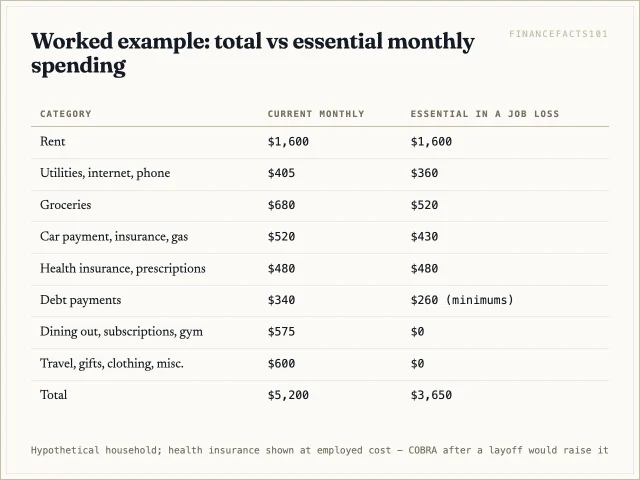
Take a concrete household: total spending of $5,200 a month. Strip out dining ($430), travel and gifts ($300), subscriptions and gym ($145), clothing and personal ($190), miscellaneous ($110), and trim groceries, transport, utilities, phone, and debt payments down to minimums. Essential spending lands at $3,650.
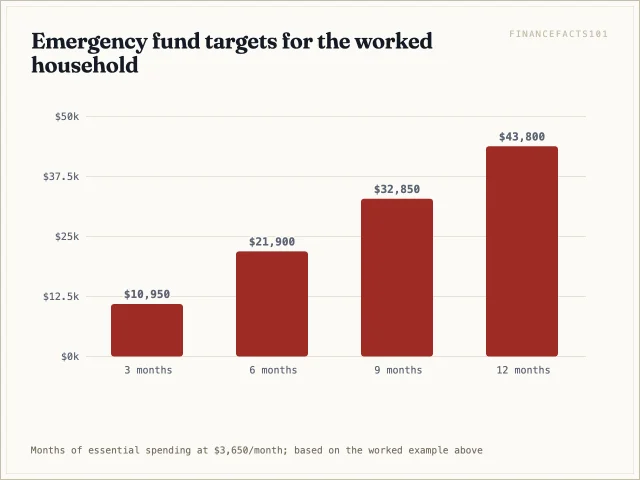
The targets follow directly: three months is $10,950, six months is $21,900, nine is $32,850, twelve is $43,800. Against a gross-income base of, say, $7,500 a month, the three-month figure would have been $22,500 — more than double the real number, and discouraging enough that many people never start.
Two honest caveats on the essential column. Health insurance is listed at its employed cost; COBRA after a layoff can run $600 to $800 a month for a single person and more for a family, so if your job is the risk you are insuring against, size that line up. And "trim to minimums" assumes you actually would cut dining to zero in a crisis — most households cut hard but not perfectly, so treat $3,650 as a floor and the gap to $5,200 as your cushion inside the cushion.
How much emergency fund you need: the real framework
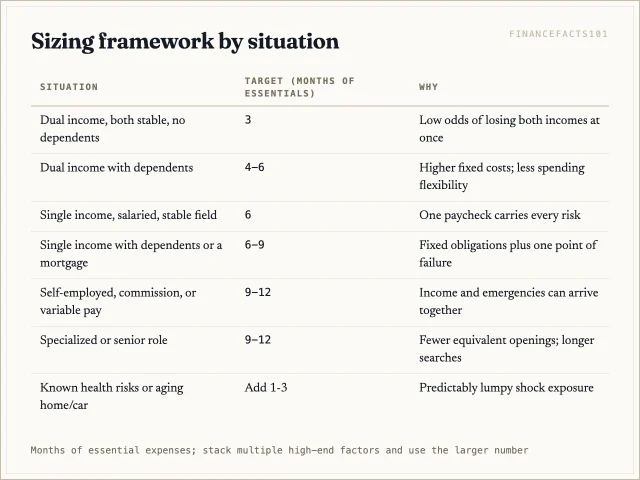
Three-to-six months of essential expenses is the standard rule of thumb, and the CFPB's emergency fund guide is deliberately more flexible than that — the right amount "depends on your situation," and even a few hundred dollars measurably reduces the chance a shock turns into debt. The useful question is what moves you toward three and what moves you toward twelve.
Toward the low end: two stable incomes in different industries (the odds of losing both at once are low), no dependents, good employer-subsidized health coverage, in-demand generalist skills, and other liquid assets you could tap without selling at a loss. A dual-income couple of nurses with no kids can defend a three-month fund.
Toward the high end: a single income, dependents, variable or commission-based pay, self-employment, a specialized or senior role where equivalent openings are rare, a health condition with unpredictable costs, or a mortgage on one income. Each factor independently lengthens either the odds of a shock or the time to recover from one. Stack three of them and nine to twelve months is not paranoia; it is arithmetic.
What unemployment data says about the number
The three-versus-six debate has an empirical anchor: how long joblessness actually lasts. Per the Bureau of Labor Statistics' Employment Situation, the median duration of unemployment stood at about 11 weeks in July 2026 — roughly two and a half months. That is the median: half of unemployed workers were out longer, and BLS reported that 1.8 million people — 25.5 percent of the unemployed — had been out 27 weeks or more.
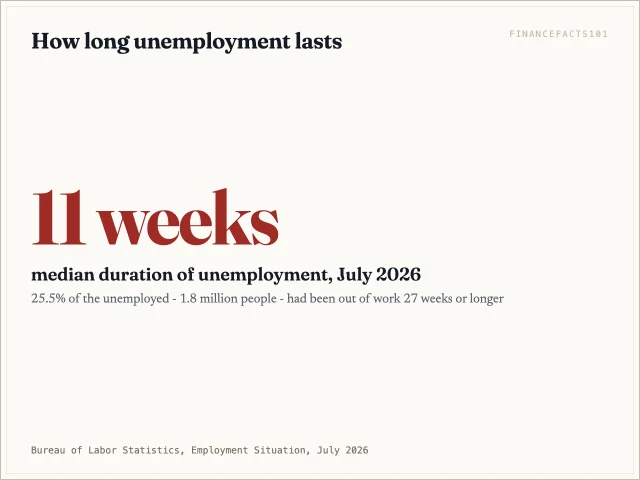
Read those two numbers together and the standard advice stops being arbitrary. Three months covers the median spell with a small margin. Six months covers most spells. And the one-in-four chance of a six-month-plus search is exactly why specialized workers, older workers, and single earners — the groups overrepresented in long-duration unemployment — belong at the high end of the range. Unemployment insurance helps but rarely closes the gap: state benefits typically replace only a fraction of prior wages, cap out, and in most states end at 26 weeks.
Where to keep it: a high-yield savings account by default
The default answer is a high-yield savings account at an FDIC-insured online bank. As of September 1, 2026, top widely available HYSAs pay roughly 4.2 to 4.5 percent APY (per NerdWallet's and Fortune's rate surveys), while the FDIC's national average savings rate — dragged down by the big branch banks where most deposits sit — was 0.38 percent as of August 17, 2026, and interest checking averaged 0.07 percent.
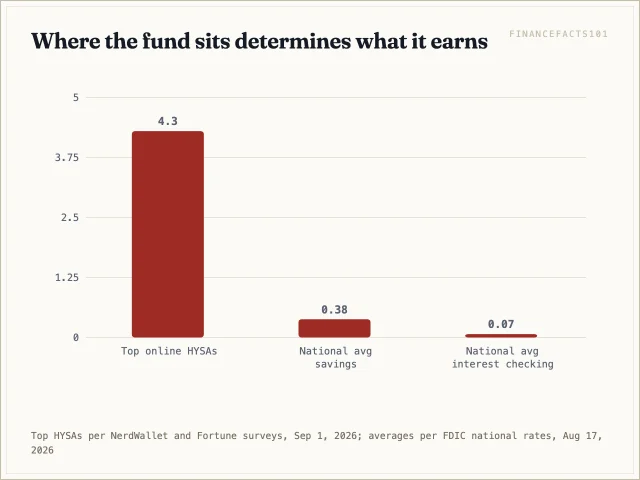
On the six-month fund of $21,900, that spread is not cosmetic: about $940 a year at 4.3 percent versus $83 at the national average and $15 in average interest checking. The mechanics of why APY compounds in your favor are covered in our explainer on annual percentage yield. Money market accounts (0.63 percent national average) and no-penalty CDs are reasonable substitutes for part of the fund; a standard 12-month CD at the 1.71 percent national average is not, since early-withdrawal penalties of three to six months' interest tax the exact moment you need the money.
Rate caveat, dated plainly: HYSA rates float with the Federal Reserve's policy rate and were drifting down in late 2026. Chase the top decile, not the top name — a 0.1 percent difference on $21,900 is $22 a year, not worth an account migration.
The tiering plan: three buckets, three speeds
You do not need all six months reachable in sixty seconds. Match access speed to the order you would actually spend:
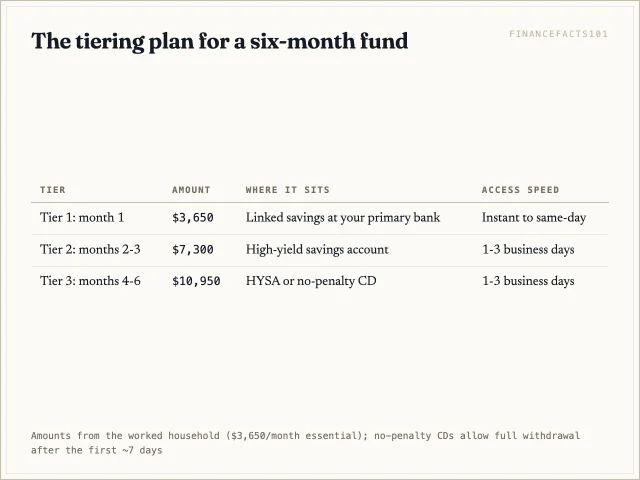
Tier 1 is one month of essentials — $3,650 here — in a savings account at the same institution as your checking, where transfers land instantly or same-day. A linked savings account does this cleanly and adds an overdraft backstop. Tier 2, months two and three ($7,300), goes to the high-yield account; online-bank transfers take one to three business days, which is fine for week-two expenses. Tier 3, months four through six ($10,950), can sit in the HYSA or a no-penalty CD, which locks a rate while keeping principal accessible after the first week.
The structure earns money and discipline at once: the instant tier handles true surprises, and the two-day delay on the rest is a speed bump against spending the fund on a couch.
Why not stocks — and why not checking
The argument for investing the fund — "cash loses to inflation" — fails on correlation. Layoffs cluster in downturns, which is precisely when stocks are cheap. In 2022 the S&P 500 fell about 18 percent and investment-grade bonds fell about 13 percent in the same twelve months, while layoffs spread through the tech sector; a six-month fund held in a 60/40 portfolio would have shrunk to roughly a five-month fund by the time it was needed. Selling into that drawdown converts a paper loss into a permanent one — the same sequence risk that makes liquid versus illiquid asset distinctions matter. An emergency fund's job is to be worth its face value on the worst day of your year, and only insured cash makes that promise.
Checking fails for the opposite reason: at the FDIC-average 0.07 percent, $21,900 earns $15 a year — versus roughly $940 in a top HYSA — and money pooled with spending cash gets spent. The fund needs its own account, its own name, and a real yield.
Building it from zero: $1,000, then autopilot
From zero, the first target is a $1,000 starter buffer — enough to absorb the most common shocks (a tire, a copay, a deductible) without touching a credit card. The CFPB's evidence-backed strategies are unglamorous and effective: automate a fixed transfer on payday, split your direct deposit, and route windfalls like tax refunds straight to the fund.
At $300 a month into an account paying 4.2 percent APY, the renderer-computed path looks like this:
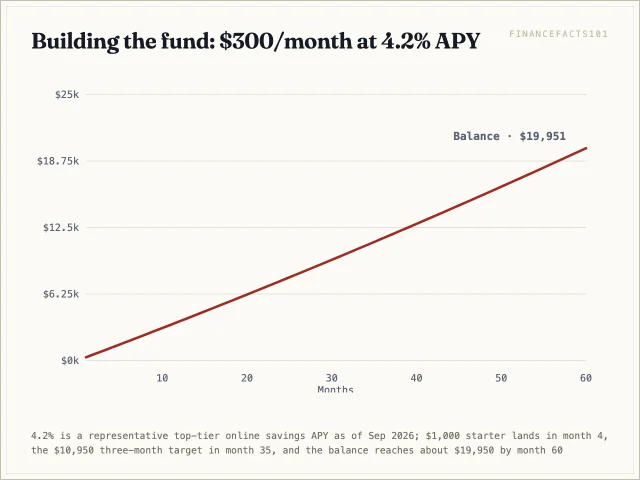
The $1,000 starter lands in month 4. The three-month target of $10,950 arrives in month 35 — just under three years — about two months sooner than the 37 months straight saving would take, because interest is doing quiet work. After five years the balance is roughly $19,950, and the full six-month target of $21,900 crosses in month 66. If that timeline feels long, the honest levers are the deposit and the windfalls, not the rate: one $2,000 tax refund a year cuts the six-month timeline by nearly two years.
The cost of holding too much
Past your target, cash stops buying safety and starts costing growth. Suppose the worked household holds twelve months ($43,800) when six ($21,900) covers its actual risk. The question is what the surplus $21,900 does over the next decade in each home.
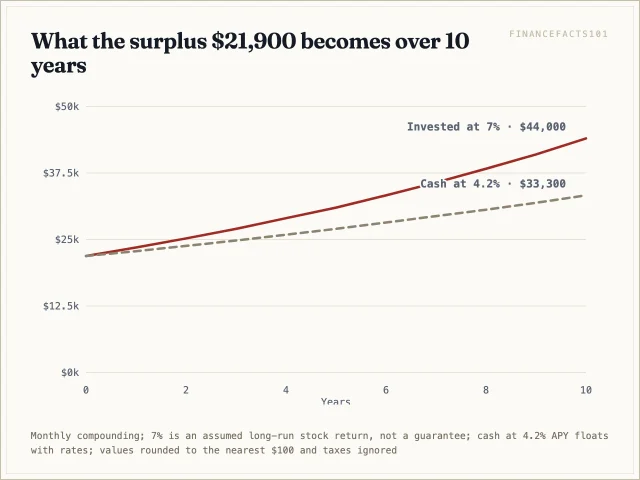
Invested in a diversified stock portfolio returning an assumed 7 percent annually, $21,900 grows to about $44,000 in ten years. Left in cash at 4.2 percent, it reaches about $33,300. The gap is roughly $10,700 — real money paid for insurance the household already had.
The caveats, stated squarely: 7 percent is a long-run assumption, not a promise, and a bad first decade can shrink or erase the gap; today's 4.2 percent cash yield is unusually generous by post-2008 standards and will float down if rates fall, which widens the gap; and both paths owe taxes outside sheltered accounts. The point survives the caveats — over ten-year horizons, surplus cash has historically been the expensive choice — but the word is surplus. Nobody should thin a right-sized fund to chase the spread.
Credit is a bridge, not a fund
A credit card is a legitimate 30-day bridge: it buys the transmission today while your Tier 2 transfer clears, at zero cost if paid within the grace period. Carried past the statement, the same balance costs 20-plus percent APR — the SHED's 37 percent who could not cover $400 with cash are disproportionately financing shocks at exactly those rates. A HELOC is cheaper but can be frozen or reduced by the lender in a downturn, which is the moment you would need it. Raiding a 401(k) sits at the bottom of the list; the tax bill and penalty math behind hardship withdrawals makes them a last resort, not a plan. Credit determines when you can pay. Only the fund determines whether you can.
FDIC coverage in two minutes
Keep the fund inside insurance limits: the FDIC insures up to $250,000 per depositor, per insured bank, per ownership category, and NCUA coverage mirrors this at credit unions. A joint account doubles the limit to $500,000. No emergency fund in this guide approaches those numbers, but confirm the institution itself is insured — the FDIC's BankFind tool takes a minute — especially with fintech apps that hold deposits through partner banks, where coverage depends on the pass-through arrangement. The mechanics are covered in our FDIC guide.
Spending it without guilt — and the refill rule
A fund you are afraid to spend is a fund that has failed differently. The test for spending is three questions: is it unexpected, is it necessary, is it urgent? A blown head gasket passes; a Black Friday television fails on the first question; new brakes fail on none — that was a sinking-fund item, but pay it and fix the sinking fund later rather than financing brakes at 24 percent.
The refill rule: after any withdrawal, restart the same automatic transfer that built the fund, at the same amount, until the balance is back to target. A $3,000 repair at $300 a month is a ten-month rebuild. That is the system working — the alternative was $3,000 of card debt compounding against you.
Common mistakes
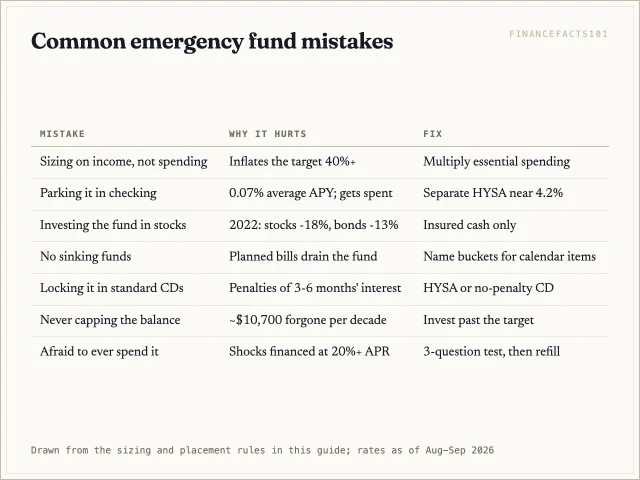
The pattern behind most of them is the same: treating the fund as either an investment (chasing yield into risk) or a slush account (no boundary between buffer and spending). It is neither. It is insurance you self-issue, and its premium is measured in forgone returns — which is exactly why both undersizing and oversizing are real errors.
The decision, step by step
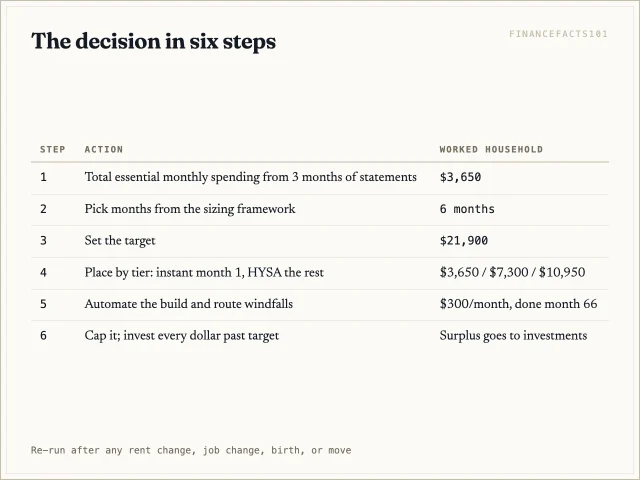
Work it once with real numbers: list essential monthly spending from three months of statements, pick a month-count from the framework above, open the high-yield account, set the automatic transfer, and put a calendar note to re-run the numbers after any rent change, birth, job change, or move. The fund is finished when the balance equals the target — after that, every new dollar belongs somewhere that pays better.
FAQ
Is $1,000 enough of an emergency fund?
It is enough to start, not to finish. A $1,000 buffer absorbs the common small shocks — the Fed's SHED data shows 37 percent of adults could not cover even $400 with cash in 2025 — but it does not cover a median 11-week unemployment spell, which for the worked household above costs about $9,200 in essential spending. Treat $1,000 as milestone one on the way to three months of essentials.
Should I build the emergency fund before paying off debt?
Build the $1,000 starter first, since without it every surprise becomes new debt. After that, pay minimums on everything and attack balances above roughly 8 to 10 percent APR before growing the fund further — a guaranteed 24 percent "return" from killing card debt beats 4.2 percent in savings. Resume building toward three to six months once high-rate balances are gone.
Does a money market account or no-penalty CD beat an HYSA?
They are close substitutes, not upgrades. The FDIC national average for money market accounts was 0.63 percent in August 2026, but top online money market accounts pay HYSA-like rates; a no-penalty CD locks today's rate while keeping the money reachable, which is useful for Tier 3 if you expect rates to fall. Ordinary CDs, with early-withdrawal penalties of three to six months' interest, are the wrong tool for money whose defining feature is unscheduled need.
Where should self-employed people keep a 12-month fund?
Same placement, bigger number: instant-access first month, HYSA for the core, and no-penalty CDs or a Treasury-bill ladder for the back half, since a 12-month fund has tranches you predictably will not touch for months. Four-week T-bills add state-tax exemption on interest, which matters in high-tax states. The size, not the vehicle, is what changes with irregular income.
Sources
- Federal Reserve, Economic Well-Being of U.S. Households in 2025 — Savings and Investments (SHED, published May 2026)
- Federal Reserve, press release announcing the 2025 SHED report (May 13, 2026)
- FDIC, National Rates and Rate Caps (rates as of August 17, 2026)
- FDIC, Deposit Insurance (coverage limits)
- Bureau of Labor Statistics, The Employment Situation (July 2026 release)
- Bureau of Labor Statistics, The Economics Daily: 1.8 million people unemployed 27 weeks or longer in July 2026
- CFPB, An essential guide to building an emergency fund (updated October 2025)
- NerdWallet, Best High-Yield Savings Accounts of September 2026 (market rate survey)
- Fortune, Top high-yield savings rates, September 1, 2026 (market rate survey)
 Next entry · No. 5,940Take-Home Pay on a $100,000 Salary: What You Actually Keep in 2026
See also
-
 No. 1,262
20 Aug 2024
19 min
Emergency Funds: Building a Financial Safety Net for Unexpected Expenses
Personal Finance
-
 No. 5,930
02 Sep 2026
14 min
High-Yield Savings vs CDs: Where Cash Earns More
Personal Finance
-
 No. 5,985
19 Oct 2026
20 min
Money Market vs Savings: Account, Fund or High-Yield Savings?
Banking
-
 No. 5,968
02 Oct 2026
18 min
T-Bills vs CDs vs High-Yield Savings: Where 3-12 Month Cash Goes
Investments
-
 No. 5,980
14 Oct 2026
21 min
Pay Off Debt or Invest? Compare Two After-Tax Rates
Personal Finance
-
 No. 5,972
06 Oct 2026
18 min
Lease or Buy a Car? The 3-, 6- and 10-Year Cost Math
Personal Finance