Take-Home Pay on a $100,000 Salary: What You Actually Keep in 2026

A single filer in Colorado keeps $75,488 of a $100,000 salary in 2026 — $2,903 a paycheck. The full stack, state by state, and the levers that move it.
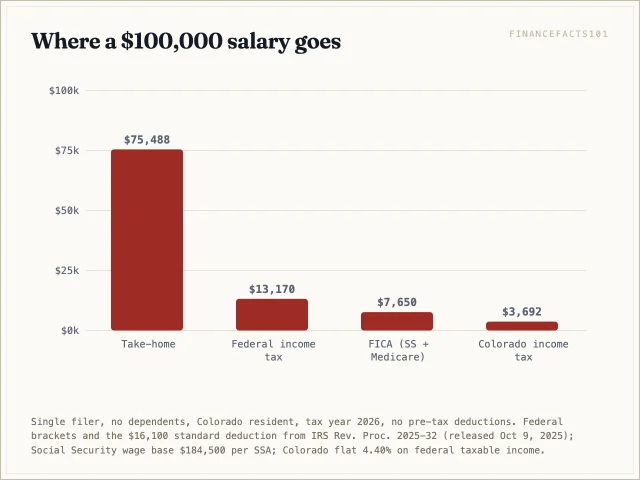
A single filer with no dependents, living in Colorado and taking the standard deduction, keeps $75,488 of a $100,000 salary in tax year 2026 — $2,903.40 in a biweekly bank deposit. That is the take-home pay on a $100,000 salary once federal income tax, FICA and state income tax have taken their cut, and it is 75.5 cents of every gross dollar. Move the same person to Texas and it becomes $79,180. Have them defer 10% into a 401(k) and the deposit drops to $2,620.32 while their net worth goes up.
This guide builds the whole stack line by line with 2026 figures, shows how far the answer travels across states and filing statuses, and prices the two levers a salaried employee actually controls. Scope honesty first: this is general information built on stated assumptions — one earner, W-2 wages only, no dependents, no itemized deductions, no equity compensation — not personal advice. Run your own numbers in the take-home pay calculator as you read.
The Take-Home Pay on a $100,000 Salary, Line by Line
The $100k salary after taxes question is really three questions stacked — federal income tax, FICA, state income tax — and each of the three is charged on a different base. That last point is where most of the confusion starts.
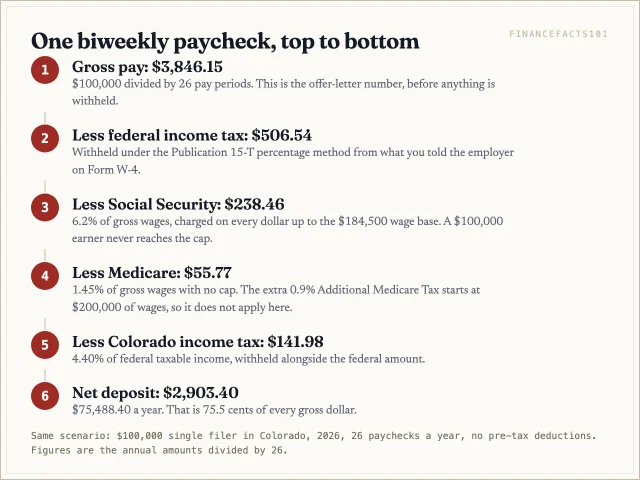
Federal income tax is charged on taxable income — gross pay minus pre-tax deductions minus the standard deduction. FICA is charged on gross wages, with no deduction of any kind. State income tax is charged on whatever base your state defines, which in Colorado happens to be the federal taxable-income figure and in Pennsylvania is gross compensation with nothing subtracted at all. Three taxes, three bases, one paycheck.
Divide the annual take-home by 2,080 hours and the $48.08-an-hour job pays $36.29 an hour net. That is the number worth comparing between offers, and the salary-to-hourly calculator will do the conversion for any schedule.
Who This Is For — and Who It Is Not For
This is for a US employee earning or being offered around $100,000 in W-2 wages who wants the arithmetic rather than a slogan: someone weighing an offer, setting a 401(k) percentage during open enrolment, or trying to work out why the paycheck is smaller than the salary divided by 26.
It is not for the self-employed or a 1099 contractor, whose FICA equivalent is self-employment tax at 15.3% — both halves — on 92.35% of net earnings. It is not for anyone with meaningful RSU vesting, bonus income withheld at supplemental rates, itemized deductions, or dependents claimed on the W-4, all of which move the answer by thousands. And it is not a state-tax guide: the section below covers the shape of the spread, not the credits and local add-ons that decide the last few hundred dollars.
The Federal Income Tax: $13,170 on $83,900
Start by subtracting the standard deduction. For 2026 it is $16,100 for a single filer, $32,200 for married filing jointly and $24,150 for head of household, per the IRS inflation adjustments for tax year 2026 issued in Revenue Procedure 2025-32 on 9 October 2025. Those amounts are indexed annually, so the 2027 figures will differ; check the IRS standard deduction page before applying them to another year. The site's entry on the standard deduction covers when itemizing beats it.
That leaves $83,900 of taxable income, which is then sliced into brackets.
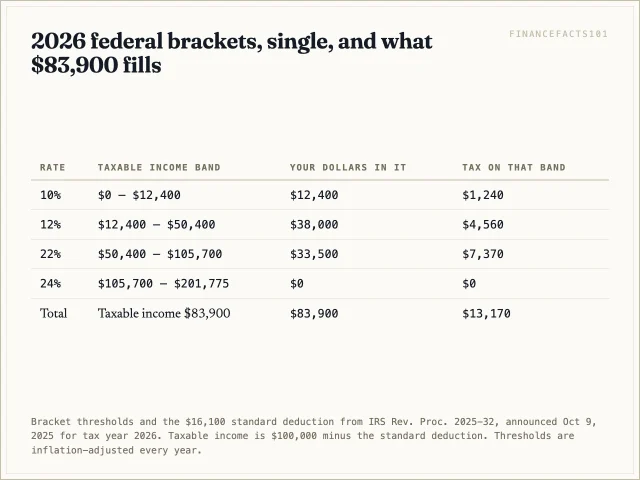
$1,240 plus $4,560 plus $7,370 is $13,170. Notice what the table makes obvious and a headline rate hides: only $33,500 of the salary — a third of it — is ever touched by the 22% rate. The first $16,100 is taxed at nothing at all.
Marginal vs Effective: The 22% That Is Really 13.2%
The marginal rate is the rate on your next dollar. The effective rate is total tax divided by total income. On this salary the federal marginal rate is 22% and the effective federal rate is 13.17%. Add FICA and Colorado and the all-in effective rate is 24.5%.
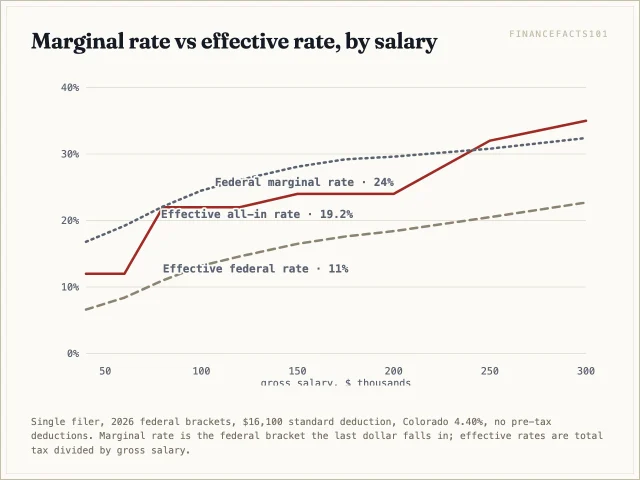
The gap is not a technicality, and confusing the two drives real mistakes: people decline overtime, refuse raises, or skip a bonus because "it'll all go to tax." It will not. The difference between the two rates is the entire reason a progressive system does not punish earning more.
Use each rate for the job it is built for. The marginal rate answers forward-looking questions — what a raise, a side gig, or a 401(k) dollar is worth. The effective rate answers backward-looking ones: what the year actually cost. Calling 22% "my tax rate" overstates what you paid by about nine percentage points.
The gap never closes as income climbs, either. At $300,000 the effective federal rate is 22.7% against a 35% marginal, because the cheap brackets keep working underneath no matter how high the top one goes.
FICA: The 7.65% Nobody Budgets For
FICA is the flattest tax in the stack and the one most people forget when they estimate a paycheck. The employee share is 6.2% for Social Security and 1.45% for Medicare — 7.65% combined — per IRS Topic 751. Your employer pays the same again, which never appears on your stub but is unmistakably part of what you cost.
On $100,000 that is $6,200 plus $1,450, or $7,650 — more than half of what the federal income tax takes, charged from the very first dollar with no deduction whatsoever.
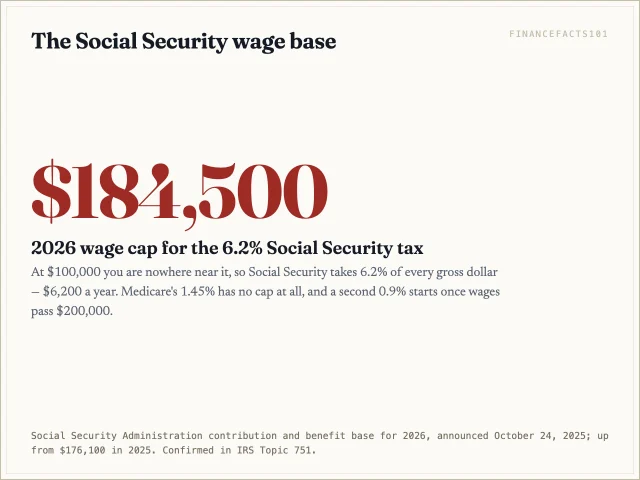
Social Security stops at the wage base; Medicare does not.
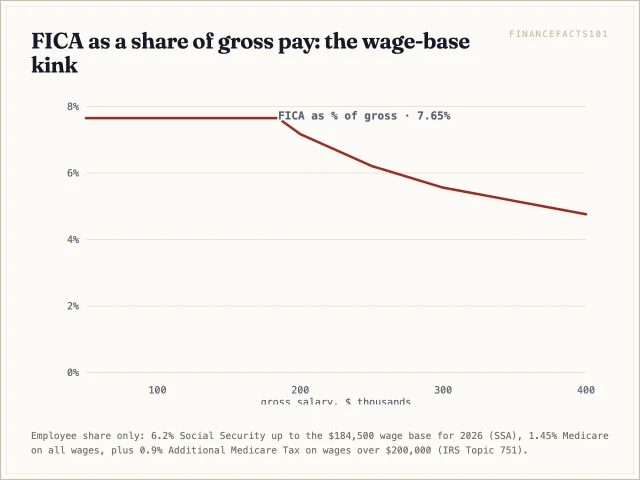
Two thresholds matter and neither bites at this salary. Social Security's 6.2% applies only up to $184,500 of wages in 2026, so FICA is a flat 7.65% of gross for anyone under that and a shrinking share above it — 6.21% at $250,000, 4.76% at $400,000. Going the other way, an Additional Medicare Tax of 0.9% applies to wages over $200,000, and your employer must start withholding it at that point regardless of your filing status — which is why two-earner couples sometimes owe a little extra at filing. The payroll tax entry covers the employer side.
State Tax: A $4,800 Spread on the Same Job
Nine states levy no tax on wage income: Alaska, Florida, Nevada, New Hampshire, South Dakota, Tennessee, Texas, Washington and Wyoming. The rest range from Arizona's 2.5% flat rate to California's 13.3% top marginal rate, and fifteen states now use a single flat rate.
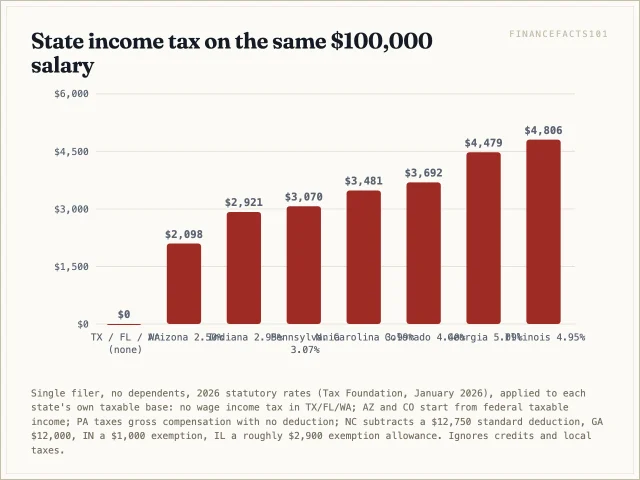
Our Colorado filer pays $3,692 — 4.40% of the same $83,900 of federal taxable income. The identical job in Texas pays $0, worth $3,692 a year of extra take-home, and in Illinois roughly $4,806. That is the honest headline of state comparison: a spread of about $4,800 a year on this salary, or 4.8% of gross, and that is income tax alone. Property and sales taxes are not in the chart, and states without an income tax generally lean harder on both.
Two wrinkles worth knowing. Pennsylvania taxes gross compensation with no standard deduction, and it does not exempt 401(k) elective deferrals — a Pennsylvanian pays the 3.07% on money that never appears in federal taxable income, per the state's gross compensation guidance. And several states cut rates on 1 January 2026: Georgia to 5.09%, Indiana to 2.95%, Kentucky to 3.5%, according to the Tax Foundation's 2026 changes summary. State schedules move faster than federal ones, so confirm yours for the current year.
Filing Status Moves the Answer by $6,239
Nothing else on this page changes take-home as much for as little effort as the filing status box.
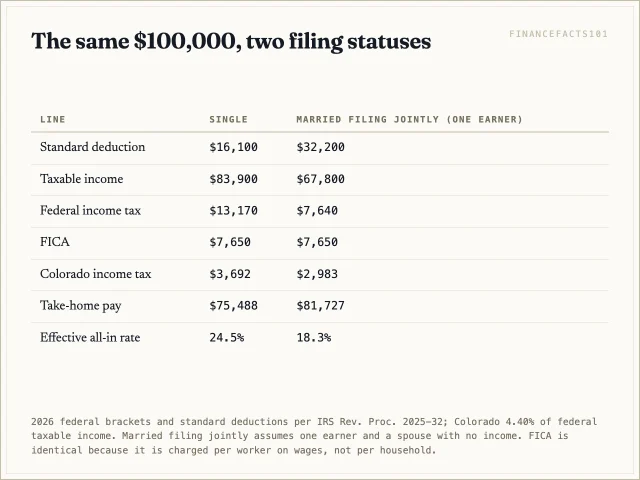
A single earner supporting a non-working spouse keeps $81,727 instead of $75,488 — $6,239 more on the identical salary, because the standard deduction doubles and the 12% and 22% bands roughly double with it. Head of household sits between the two. FICA does not move at all, because it is charged per worker on wages rather than per household on income.
The trap is symmetric: two people each earning $100,000 and marrying do not get this benefit, because their combined $200,000 lands in the same brackets it would have anyway. The single-earner household is where marriage is worth real money in the tax code.
The 401(k): The Only Big Lever You Control
Federal brackets, FICA rates and your state's schedule are all fixed. What you can change is how much of the salary is taxable at all, and the 401(k) is the largest of those levers. The 2026 elective deferral limit is $24,500, up from $23,500, with an $8,000 catch-up at 50 and up, per IRS Notice 2025-67.
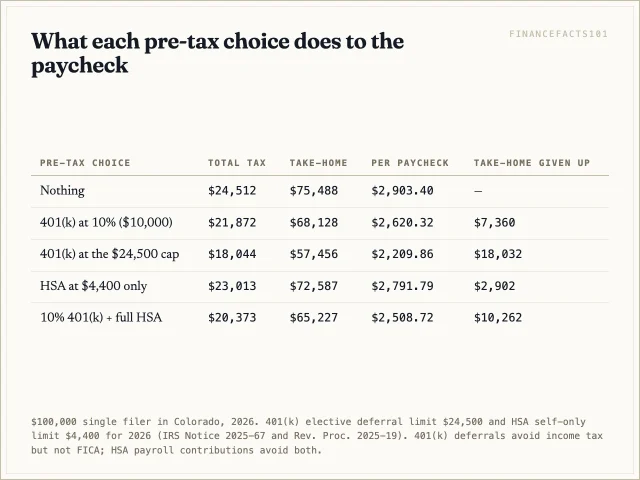
Read the last column carefully, because it is the sentence people get wrong. Deferring $10,000 does not cost $10,000 of take-home. It costs $7,360 — the paycheck falls from $2,903.40 to $2,620.32 — because the $10,000 skipped 22% federal tax and 4.40% Colorado tax on the way past. Each pre-tax dollar costs 73.6 cents of spendable money.
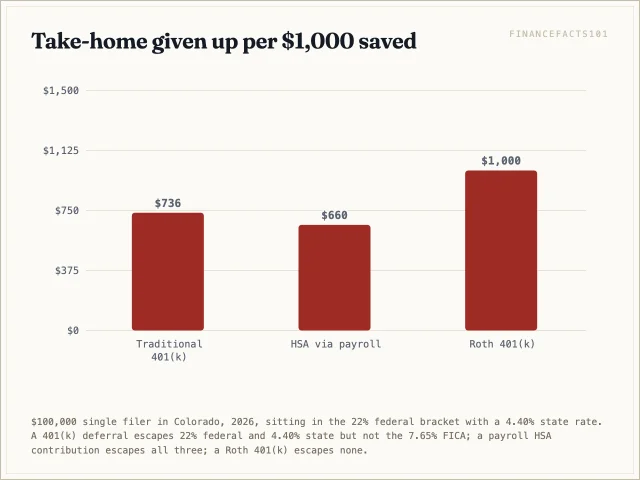
That is the arithmetic behind "it costs less than you think," and it scales: the full $24,500 deferral costs $18,032 of take-home, still 73.6 cents on the dollar, because the whole amount comes off the top of the 22% bracket. What it does not escape is FICA. Social Security and Medicare are charged on gross wages before any 401(k) deferral, which is why the FICA line is identical in every row of that table.
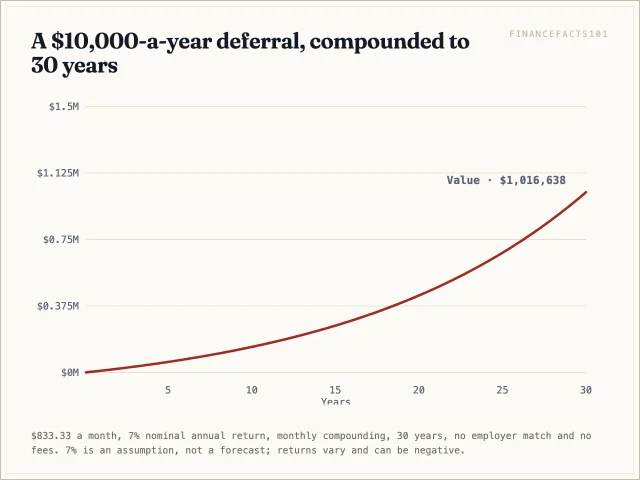
Ten thousand a year at a 7% nominal return compounds to about $1,016,600 over thirty years — from $7,360 a year of forgone spending. Seven percent is an assumption, not a promise. Model your own with the 401(k) calculator, and if you are deciding between pre-tax and Roth treatment, the Roth vs traditional comparison frames it as a bet on your bracket now against your bracket later — at a 22% marginal rate today that bet is genuinely close.
The HSA Beats the 401(k) Per Dollar
If your health plan qualifies, the HSA is the better-priced account, and almost nobody ranks it first. The 2026 limit is $4,400 for self-only coverage and $8,750 for family coverage.
Contributed through payroll under a cafeteria plan, an HSA dollar escapes federal income tax, state income tax and FICA. That is the whole 7.65% the 401(k) cannot dodge. At our filer's rates, $1,000 into an HSA costs $660 of take-home against $736 for the 401(k) — and the full $4,400 contribution costs $2,902 while cutting the tax bill by $1,498. Contribute the same money from your bank account instead and you get the income-tax deduction but lose the FICA saving, which is a needless $337 given away. Publication 969 sets out the eligibility rules; the HSA vs FSA calculator handles the choice when your employer offers both.
The ordering that follows is unglamorous but hard to argue with: capture the full employer 401(k) match first, because a 50% match on the first 6% of pay is $3,000 of free money for $4,416 of forgone take-home; then fill the HSA; then push the 401(k) higher if cash flow allows.
A Raise Never Costs You Money
The bracket myth deserves a funeral with numbers. Crossing into a higher bracket raises the rate only on the dollars above the line, never on the dollars below it.
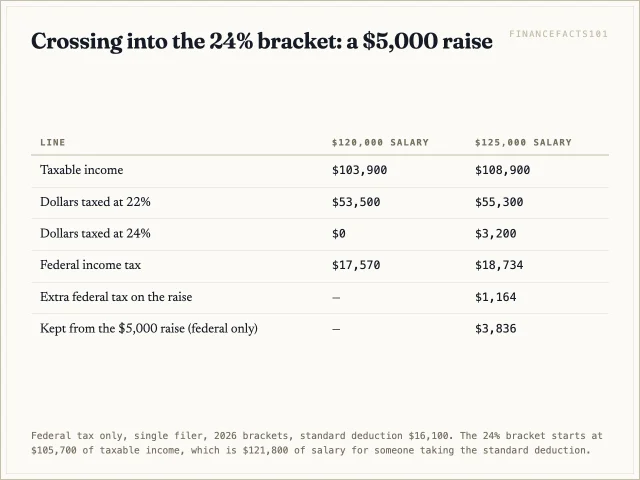
For a single filer taking the 2026 standard deduction, the 24% bracket begins at $105,700 of taxable income, which is $121,800 of salary. Earn $121,800 and your last dollar is taxed at 22 cents. Earn $121,801 and that extra dollar is taxed at 24 cents — a total tax increase of 24 cents. There is no cliff, no step, no penalty for the crossing itself.
Scale it up and the myth looks worse. A raise from $120,000 to $125,000 pushes $3,200 into the 24% band and adds $1,164 of federal tax. You keep $3,836 of the $5,000 federally, or $3,234 after Colorado and FICA — about 65 cents on the dollar. Less than the full raise, yes; more than zero by a wide margin, and refusing it to "stay in the bracket" costs you every one of those dollars. The marginal rate explainer works through the mechanism.
What the W-4 Actually Controls
The Form W-4 does not change what you owe. It changes only how much is withheld each payday, and therefore whether April brings a refund or a bill. The employer feeds your entries into the withholding tables in Publication 15-T; the tax itself is settled on the return.
Filing status and the dependents box do most of the work. Step 2 matters when you hold a second job or a spouse works, because each employer otherwise withholds as though its salary were your only income, and the pair of you ends up short. Steps 4(a), 4(b) and 4(c) add other income, extra deductions, or a flat dollar amount per paycheck. That is the whole mechanism — dials on timing, set out in the W-4 guide.
Why a Big Refund Is a Bad Outcome
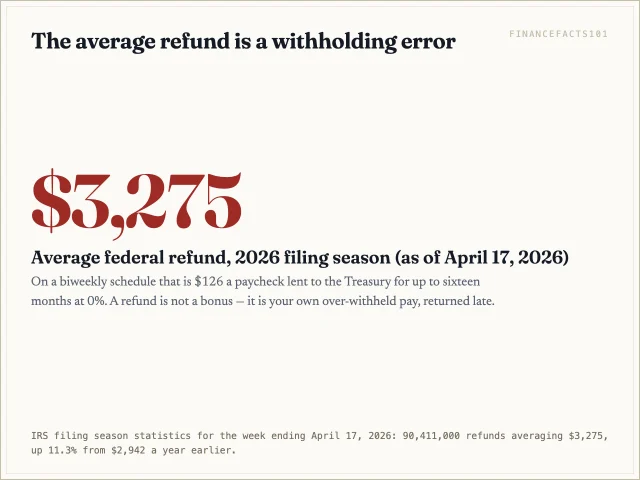
The average federal refund in the 2026 filing season was $3,275 as of 17 April 2026, per IRS filing season statistics, across 90.4 million refunds. That average is an over-withholding of roughly $126 per biweekly paycheck, held by the Treasury for up to sixteen months and returned without a cent of interest.
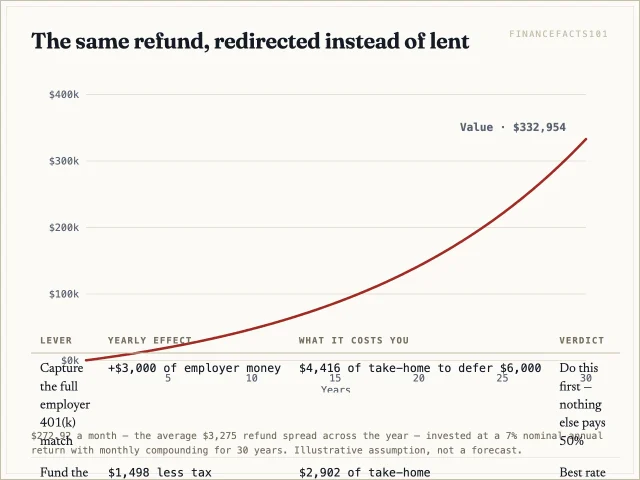
Redirect that same $272.92 a month at a 7% assumed return and thirty years of it is worth about $333,000. Parked in a 4% savings account it earns only about $60 a year, so the interest is not the point — the point is $126 a paycheck that could have cleared a 22% credit card balance or reached an employer match. The site's note on under- versus over-withholding covers both failure modes.
The target is a small balance either way, because a large underpayment can carry a penalty. Run the IRS Tax Withholding Estimator after any pay change, marriage or job switch, adjust Step 4(c), and check the next stub.
The $100,000 Offer Is Not $100,000 of Compensation
Your employer's cost is higher than your salary, and your benefit is higher than your take-home. The employer pays a matching $7,650 of FICA on your wages; add a 50% match on the first 6% of pay and the package costs $110,650 before a dollar of health insurance. The Bureau of Labor Statistics employer cost survey put private-industry benefits at $14.01 an hour against $32.60 of wages in March 2026 — about 30% of total compensation.
Run it the other way and the job returns more than the deposit suggests. Defer 6% to capture the match and take-home is $71,072; add back the $6,000 you deferred and the $3,000 the employer put in, and the salary delivers $80,072 of value. The commute, the equipment and the unpaid hours still come off that, which is what the real hourly wage calculator is for.
What to Change First
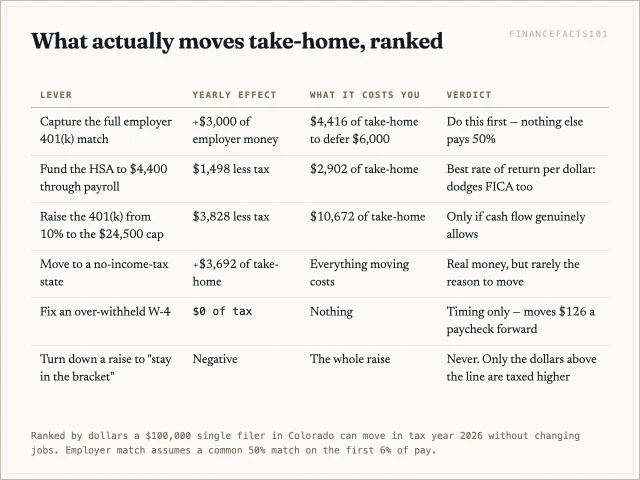
How much of $100,000 you actually keep comes down to three moves, in this order. Set the 401(k) percentage high enough to capture the entire employer match; that is the highest-return decision available and it takes one form. Fund the HSA through payroll if you are eligible, because it is the only account that dodges all three taxes. Then, and only then, decide whether to push the 401(k) toward $24,500 — the tax saving is real but it is not free, and $10,672 of take-home is a lot of cash flow to surrender.
Everything else is smaller or slower. Fixing an over-withheld W-4 moves timing, not tax. Moving state is worth $3,692 a year here — real money, and almost never the deciding factor by itself. Before you change anything, put your own salary, state rate and deferral percentage into the take-home pay calculator and read the per-paycheck line. That is the number that hits the account.
FAQ
How much is $100,000 a year after taxes?
For a single filer with no dependents taking the standard deduction in tax year 2026, about $75,500 in a mid-rate state like Colorado — $2,903 per biweekly paycheck — and about $79,200 in a state with no income tax. That splits into $13,170 of federal income tax, $7,650 of FICA and $3,692 of Colorado tax. Dependents, itemized deductions, a second income or local taxes will move it.
What is my tax bracket on a $100,000 salary?
The 22% federal bracket, for a single filer in 2026: taxable income of $83,900 falls inside the $50,400–$105,700 band. But 22% is the rate on your next dollar, not on your income. Your effective federal rate is 13.2%, and the all-in effective rate including FICA and a 4.40% state tax is 24.5%.
Does contributing to a 401(k) save me Social Security tax?
No. Elective deferrals to a traditional 401(k) reduce federal and most state income tax but not FICA — Social Security and Medicare are charged on gross wages before the deferral comes out. A payroll HSA contribution is the exception: it escapes income tax and FICA, which is why $1,000 into an HSA costs $660 of take-home while $1,000 into a 401(k) costs $736.
Will a raise push me into a higher bracket and leave me worse off?
No. Only the dollars above the threshold are taxed at the higher rate. For a 2026 single filer the 24% bracket starts at $121,800 of salary; earning one dollar more than that costs 24 cents in extra federal tax. A $5,000 raise from $120,000 adds $1,164 of federal tax and leaves you $3,836 better off federally.
Should I aim for a tax refund?
No — aim for close to zero. The average 2026 refund of $3,275 was about $126 per biweekly paycheck lent to the government at 0% for up to sixteen months. Under-withholding can trigger a penalty, so the target is a small balance in either direction: run the IRS Tax Withholding Estimator after any pay or family change and adjust Step 4(c) of your W-4.
Sources
- IRS, Tax inflation adjustments for tax year 2026 — Rev. Proc. 2025-32, 9 October 2025: 2026 brackets and the $16,100 standard deduction
- IRS, Standard deduction — amounts by filing status
- IRS, Topic 751, Social Security and Medicare withholding rates — 6.2%, 1.45%, and the $184,500 wage base for 2026
- IRS, Additional Medicare Tax questions and answers — the 0.9% surcharge above $200,000 of wages
- IRS, 401(k) limit increases to $24,500 for 2026 — Notice 2025-67
- IRS, Publication 969, Health Savings Accounts — HSA eligibility and limits
- IRS, About Form W-4 and Publication 15-T — the withholding mechanism
- IRS, Tax Withholding Estimator
- IRS, Filing season statistics, week ending 17 April 2026 — 90,411,000 refunds averaging $3,275
- Bureau of Labor Statistics, Employer Costs for Employee Compensation — March 2026: $14.01 of benefits per hour against $32.60 of wages
- Tax Foundation, 2026 state tax changes and 2026 state income tax rates — the state rates used here
- Pennsylvania Department of Revenue, Gross compensation — why 401(k) deferrals stay taxable in PA
 Next entry · No. 5,941401(k) Employer Match: How Much of Your Salary to Defer
See also
-
 No. 5,201
19 Aug 2025
20 min
Underwithstanding Taxes: Underwithholding vs Overwithholding
Taxation
-
 No. 4,843
21 Jul 2025
17 min
Understanding Take-Home Pay: Differences Between Gross Income and Net Income
Personal Finance
-
 No. 5,948
16 Sep 2026
20 min
Self-Employment Tax: How Much of Every Payment to Set Aside
Taxation
-
 No. 173
07 Apr 2024
25 min
The Annualized Income Installment Method: Optimizing Tax Payments for Fluctuating Incomes
Taxation
-
 No. 5,999
02 Nov 2026
17 min
HDHP vs PPO: Which Health Plan Is Better for You?
Healthcare Finance
-
 No. 5,980
14 Oct 2026
21 min
Pay Off Debt or Invest? Compare Two After-Tax Rates
Personal Finance