Self-Employment Tax: How Much of Every Payment to Set Aside
A freelancer with $78,000 of net profit owes $16,186 of federal tax for 2026 — 20.8% of profit. Here is the set-aside percentage and the quarterly schedule.
Set aside 30% of your profit from every payment that lands, and send a quarter of the year's total to the IRS four times a year. That is the answer for a freelancer or contractor whose 2026 net profit will fall between roughly $60,000 and $150,000, and the reason the number is that high is self-employment tax: 15.3% of net earnings, both halves of Social Security and Medicare, owed before a single dollar of income tax is counted. For the worked example this guide carries all the way through — $90,000 of revenue, $12,000 of expenses, $78,000 of net profit, single filer, no other income — the federal bill is $16,186, which is 20.8% of profit and 18.0% of every dollar invoiced.
Everything below uses tax year 2026 figures, verified against IRS and SSA pages in September 2026. It is general information built on stated assumptions, not personal advice; your state, your filing status and your deductions will move these numbers.
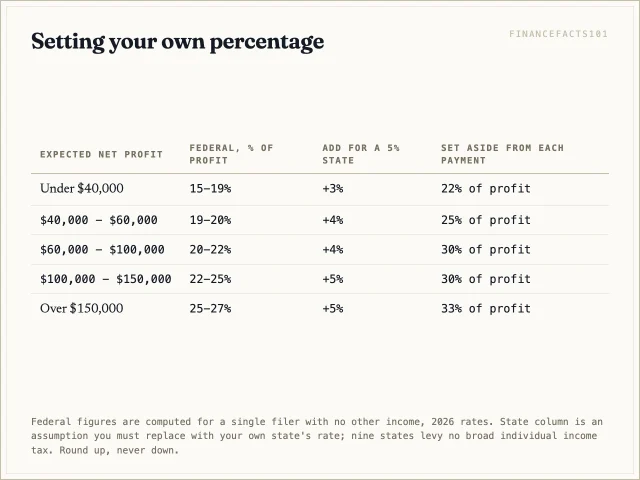
The Set-Aside: 30% of Profit, and Why It Is Not 15.3%
The 30% figure freelancers quote each other is close to right for the wrong reasons. It is not the tax rate; it is a reserve percentage with a deliberate cushion.
Federal tax on $78,000 of net profit is $16,186 — $11,021 of SE tax and $5,165 of income tax, or 20.8%. A 5% state income tax adds roughly $2,800, taking the total to about 24% of profit. The remaining six points absorb the two things that reliably go wrong in year one: expenses you thought you could deduct and cannot, and a fourth quarter that earns more than the first three.
If your expenses run about 13% of revenue as Maya's do, 30% of profit is 26% of each payment. Move it on the day the money arrives, into an account you do not touch. Run your own figures through the self-employment tax calculator before committing to a percentage.
Who This Is For — and Who It Isn't
This is for someone paid on a Form 1099-NEC or 1099-MISC with nothing withheld: a freelance designer, a contract developer, a consultant, a driver, an Etsy seller, a nurse picking up agency shifts. It assumes a US sole proprietor or single-member LLC filing Schedule C — the default shape for most people who start earning this way, covered in the entry on sole proprietorships and their taxation.
It is not for partnerships or existing S corporations, whose owners get a K-1 rather than a Schedule C. It is not a state tax guide: rates, thresholds and business taxes vary too much to generalise, and nine states have no broad individual income tax at all. And it is not a substitute for a preparer once profit clears six figures, at which point the fee pays for itself in a single decision.
Self-Employment Tax Is 15.3%, and It Sits On Top of Income Tax
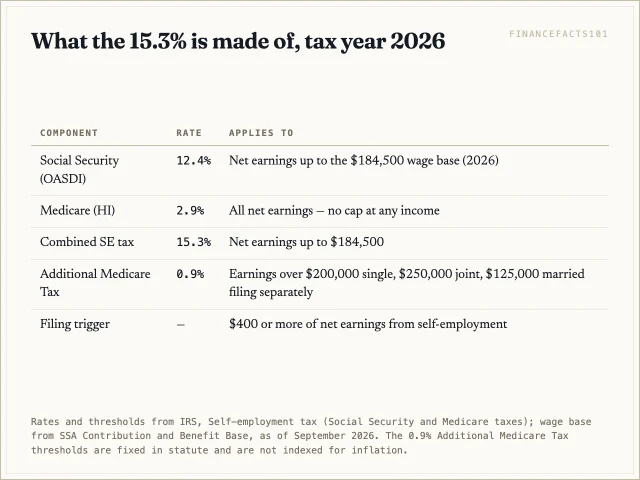
An employee earning $78,000 sees 7.65% taken for Social Security and Medicare. Their employer pays a matching 7.65% they never see. When you work for yourself you are both parties, so you owe the whole 15.3% — that is what self-employment tax is, and it is the single largest surprise in the first year of freelancing. Per the IRS self-employment tax page, the rate splits into 12.4% for Social Security and 2.9% for Medicare.
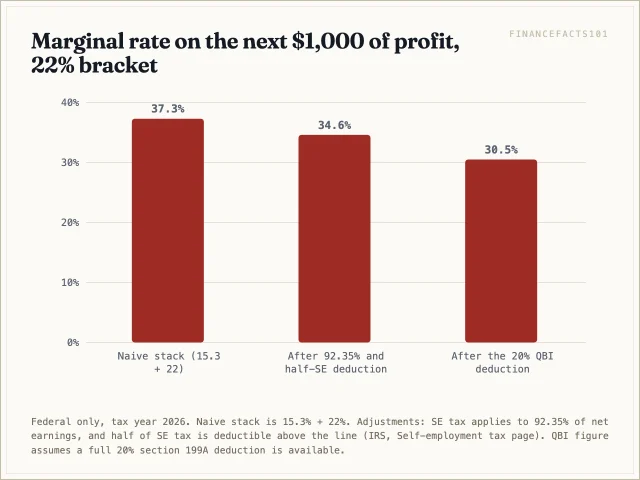
Now stack it. Someone whose marginal income falls in the 22% bracket looks at 15.3% plus 22%, which is 37.3% on the next dollar of profit before any state tax. That is the number worth being frightened by, and it is the reason a freelancer who prices work at their old salary rate ends up poorer — the topic of the real hourly wage calculator.
But 37.3% is not what you actually pay, because two adjustments cut it.
The Two Adjustments That Cut the Bite
First, SE tax is not charged on your whole profit. It is charged on 92.35% of it. The 7.65% haircut exists to mirror the employer half of FICA, which an employer would have deducted before your wage was set. On $78,000 of profit the SE tax base is $72,033, not $78,000, and the marginal SE rate is therefore 15.3% x 0.9235 = 14.13%.
Second, half of the SE tax you compute comes off your income above the line, on Schedule 1 — no itemising required. Maya's $11,021 of SE tax produces a $5,511 deduction, dropping her AGI to $72,489 before the standard deduction is even applied.
Put the two together and the marginal rate for a 22%-bracket freelancer falls from 37.3% to 34.6%. Add the qualified business income deduction, covered below, and it falls again to 30.5% — still worse than a W-2 employee's 29.65% marginal on the same dollar, but nearly seven points better than the naive stack.
The one threshold that catches beginners the other way: the filing trigger is $400. Net earnings of $400 or more from self-employment obliges you to file a return and Schedule SE, per IRS Publication 334, even if you would otherwise owe nothing and even if no 1099 was issued.
The Wage Base, the Medicare Cap and the 0.9% Surtax
The 12.4% Social Security half stops. For 2026 the Social Security contribution and benefit base is $184,500, up from $176,100 in 2025. Because the base applies to net earnings rather than profit, you need $199,783 of Schedule C profit before the Social Security portion caps out — a threshold most freelancers never reach.
The 2.9% Medicare half never stops. It applies to every dollar of net earnings, at any income. And above $200,000 of earnings for a single filer, $250,000 filing jointly, or $125,000 married filing separately, an Additional Medicare Tax of 0.9% is added. Those three thresholds are written into statute and are not indexed to inflation, so more people cross them every year.
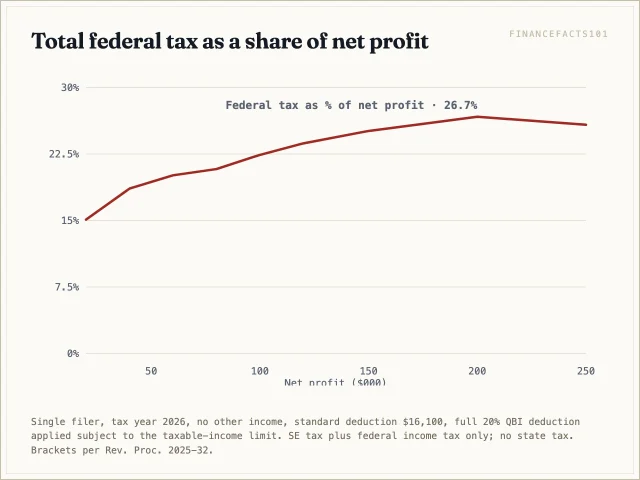
The curve above is the practical takeaway. Federal tax rises from about 15% of profit at $20,000 to about 27% at $200,000, then dips slightly as the wage base caps the Social Security portion. That dip is the only place in this system where earning more lowers your average rate.
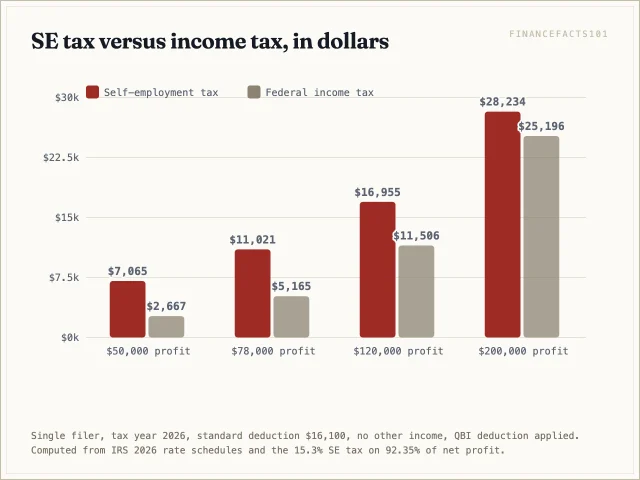
Notice which bar dominates at the low end. At $50,000 of profit, SE tax is $7,065 and income tax is $2,667 — SE tax is nearly three times larger. Freelancers who budget for "taxes" by thinking about brackets are budgeting for the smaller of the two bills.
Schedule C: Why a Deduction Is Worth More Than You Think
Everything above starts from one number: Schedule C net profit. Revenue minus ordinary and necessary business expenses. That number is the base for SE tax and the starting point for income tax, which means every legitimate deduction cuts both.
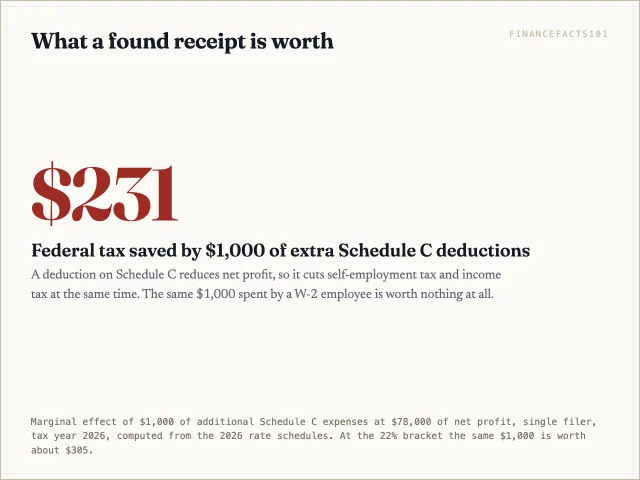
At Maya's income, $1,000 of expenses she failed to record costs her $231 in tax she did not have to pay; at the 22% bracket it is about $305. Bookkeeping is not administrative hygiene, it is a paid job with an hourly rate. A freelancer who spends four hours a quarter reconciling a business account and finds $4,000 of forgotten software subscriptions, phone bills, professional insurance and conference travel has earned roughly $920 for sixteen hours of work, tax-free. Two rules make that possible: open a separate business account on day one, and keep receipts rather than just the card statement.
Home Office and Mileage, Priced Accurately
These two attract more bad advice than anything else in the freelance tax world, so here they are precisely.
The home office deduction requires regular and exclusive use of a space as your principal place of business. Exclusive means exactly that: a spare room used only for work qualifies, the dining table does not. Employees cannot claim it at all. If you qualify, the simplified option pays $5 per square foot up to 300 square feet — a $1,500 ceiling, no depreciation, no recapture when you sell. A 200-square-foot office is worth $1,000 that way; the regular method, apportioning actual rent, utilities and insurance by business-use percentage, often beats it but drags depreciation recapture behind it.
Mileage has a wrinkle in 2026. The IRS set the business standard mileage rate at 72.5 cents per mile from January 1, 2026 in Notice 2026-10, then revised it upward mid-year: the standard mileage rates page shows 76 cents per mile effective July 1, 2026, in response to fuel prices. A freelancer with 6,000 business miles split evenly across the year deducts 3,000 x $0.725 plus 3,000 x $0.76 = $4,455, worth about $1,027 in tax at Maya's marginal rate. Split your log at June 30, or you will understate the deduction.
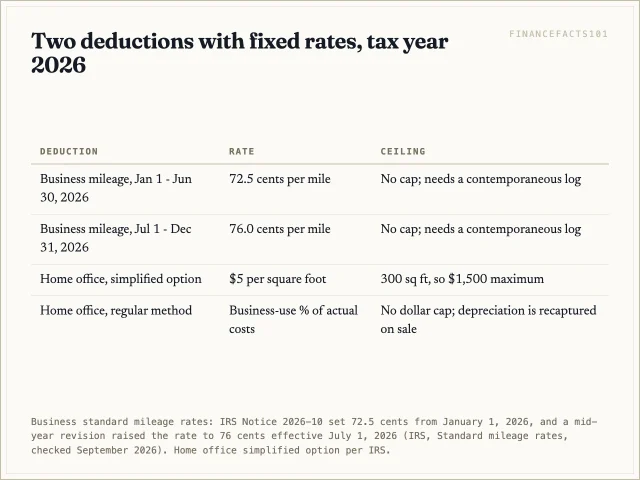
Commuting from home to a regular workplace is never deductible. Driving between client sites, or from a qualifying home office to a client, is.
The QBI Deduction Is Now Permanent
The section 199A qualified business income deduction lets most pass-through owners deduct up to 20% of business income, and it was originally scheduled to expire at the end of 2025. It did not. Public Law 119-21 made it permanent, and Revenue Procedure 2025-32 sets the 2026 parameters: threshold amounts of $201,750 for single filers and $403,500 for joint filers, above which limits based on W-2 wages and specified service trades begin to phase in.
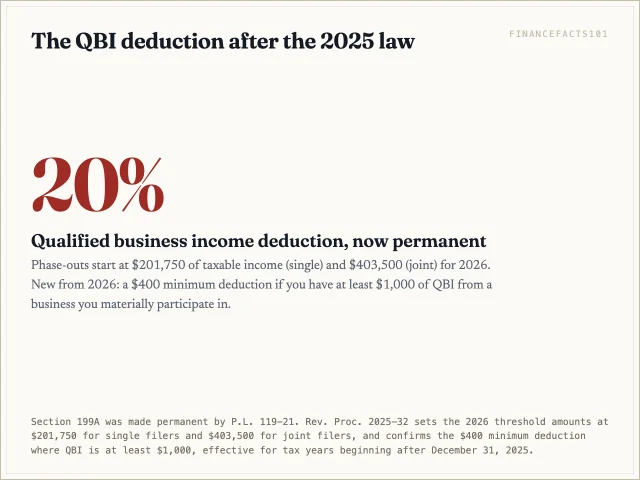
Two details matter below the threshold. The deduction is the lesser of 20% of QBI or 20% of taxable income minus net capital gain, and for someone with no other income the second limit usually binds — Maya's 20% of QBI is $14,498, but 20% of her taxable income is $11,278, so $11,278 is what she gets. And from 2026 there is a floor: at least $1,000 of QBI from a business you materially participate in earns a minimum $400 deduction. The IRS QBI page explains how the components fit together, though check its update date — the newsroom copy has lagged the statute.
Maya's Year: $90,000 In, $16,186 Out
Named assumptions: Maya Ellison, freelance UX designer, single, no dependents, no other income, no state tax shown. She collected $90,000 in 2026 and had $12,000 of documented business expenses — software, a laptop she expensed in full, professional liability insurance, an accountant, and 6,000 business miles.
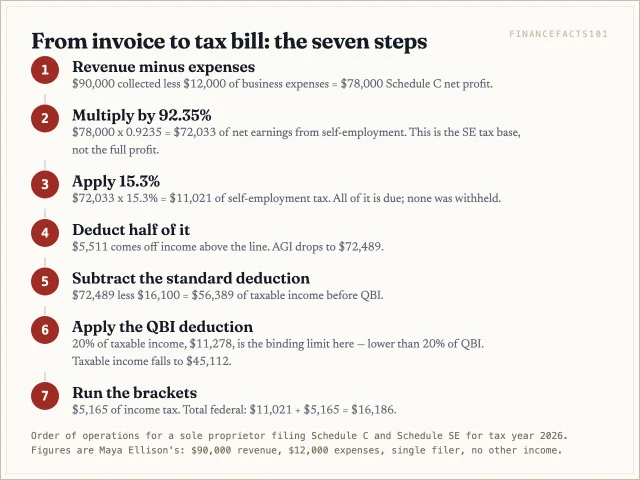
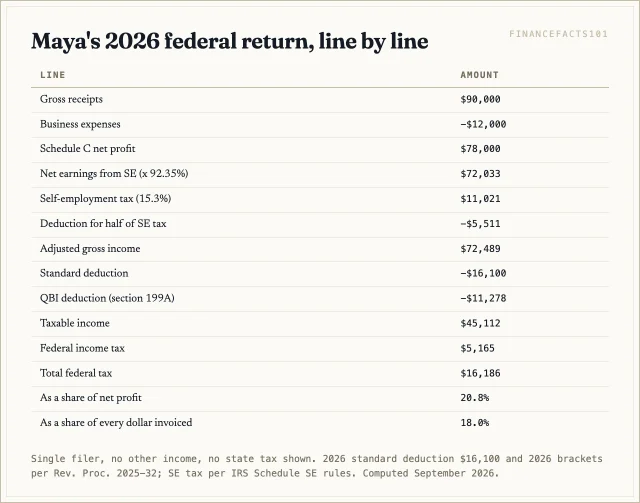
Read the last two lines together. Her federal tax is 20.8% of profit but 18.0% of everything she invoiced, because the expenses came off first. Both numbers are useful: the first is what she sets a reserve against, the second is what she should mentally deduct when a client offers a rate.
Two things this example leaves out. Her state may take another $2,000 to $4,000, which she must add. And there is no health insurance premium deduction here — an above-the-line write-off that reduces income tax though not SE tax, and often the largest single adjustment on a freelancer's return.
Quarterly Estimated Taxes: The Dates and the Safe Harbors
Nobody withholds anything from a 1099 payment, so the US pay-as-you-go system expects you to do it yourself. Per the IRS estimated taxes page, you generally must make payments if you expect to owe $1,000 or more when the return is filed. Maya, at $16,186, is comfortably over.
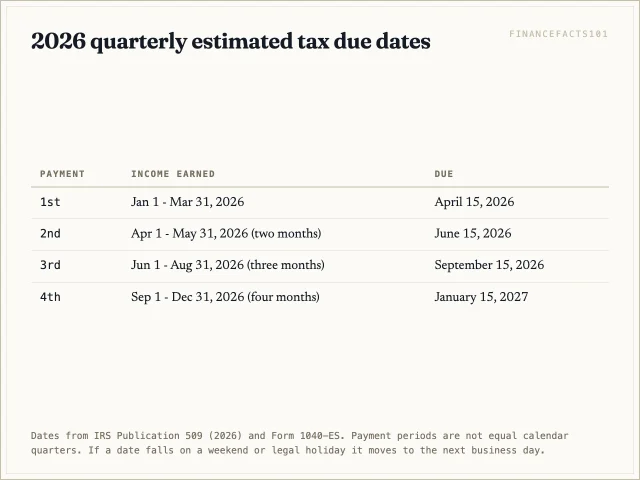
Look at the payment periods, not just the dates: they are not equal quarters. The second covers two months and the fourth covers four. Missing this is why people who divide their income by 12 and pay monthly still end up short on June 15.
Now the part that makes quarterly estimated taxes manageable. You do not have to forecast this year's income correctly. IRS Topic 306 and Publication 505 set out a safe harbor: pay 90% of the current year's tax, or 100% of the tax shown on last year's return, whichever is smaller, and no penalty applies. Where prior-year AGI exceeded $150,000 ($75,000 if married filing separately), the prior-year figure rises to 110%.
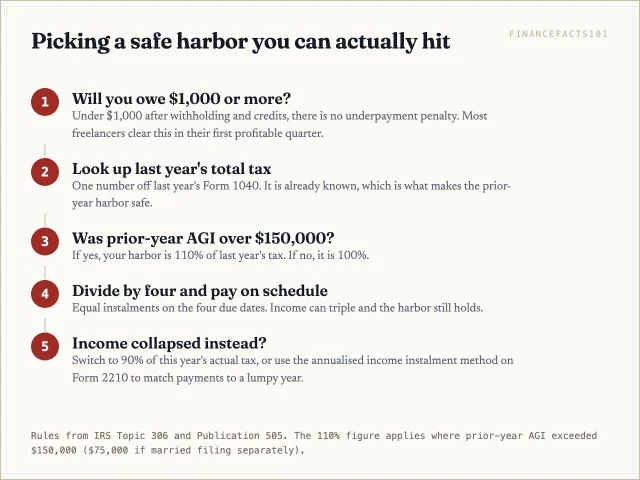
The prior-year harbor is the practical answer, because it is a number you already know. If Maya's 2026 tax is $16,186 and her 2027 income doubles, four payments of $4,047 in 2027 — 100% of the prior year — still shield her from penalty. She will owe a large balance on April 15, 2028, but no penalty on it. If income falls instead, the 90%-of-current-year route or the annualised instalment method on Form 2210 fits the shape of the year better; the mechanics are in the entry on annualized income for fluctuating earnings.
Where does the money sit between payments? Not in checking. Maya's $16,186 split into twelve transfers of $1,349 into a savings account paying 4.10% APY compounds to about $16,490 over a year.
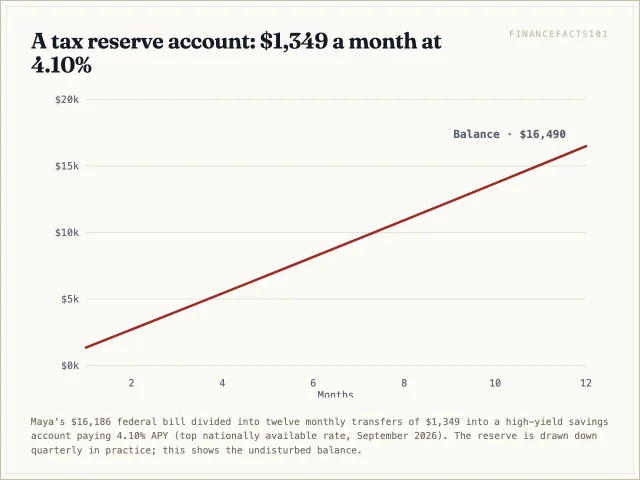
That reserve is not your emergency fund, and the two belong in different accounts. Where to park it is the subject of high-yield savings versus CDs — for tax money liquidity wins outright, because the withdrawal dates are already on the calendar.
What the Underpayment Penalty Actually Costs
The penalty is not a fine. It is interest, computed period by period on the amount each instalment fell short, at the federal short-term rate plus three points. Per the IRS quarterly interest rates table, the non-corporate underpayment rate ran 7% in the first quarter of 2026, 6% in the second, and 7% in the third and fourth.
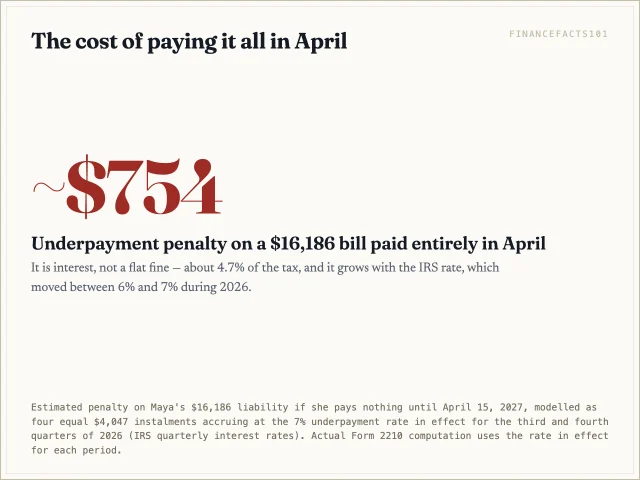
If Maya ignored all four dates and paid the entire $16,186 on April 15, 2027, the penalty is roughly $754 — about 4.7% of the bill. Worth stating plainly rather than catastrophising: the penalty for missing quarterly estimated taxes is a bad interest rate, not a disaster. Reaching April owing $16,186 you have already spent is the actual failure mode.
Two escape valves exist. Withholding — from a job, a spouse's job, a pension, or an IRA distribution — is treated as paid evenly across the year no matter when it happened, so December withholding retroactively fixes an underpaid March. And the IRS may waive the penalty for casualty, disaster, or unusual circumstances, or where you retired after 62 or became disabled during the year.
Using a W-2 Spouse's Withholding Instead
That evenly-spread rule is the most useful trick in this article for a married freelancer. If your spouse has a W-2 job, you can skip estimated payments entirely by increasing their withholding to cover your liability.
The mechanism is Form W-4, step 4(c): an extra dollar amount withheld from each paycheck. Maya's $16,186, spread over 24 semi-monthly pay periods, is $675 per cheque. Because withholding counts as paid ratably through the year, a couple who realises in October that they are $12,000 short can raise 4(c) for the last two months and still land inside the safe harbor with no penalty — something four separate estimated payments cannot retroactively achieve.
The trade-off is cash flow: the money leaves earlier and more evenly, and out of the spouse's paycheque rather than the business account. Model the change with the take-home pay calculator before filing the new W-4, so the smaller paycheque is not a surprise.
Retirement Accounts Cut Income Tax, Never SE Tax
This is the correction that matters most, because plenty of advice implies otherwise: a deductible retirement contribution reduces your income tax and does nothing whatsoever to your self-employment tax. SE tax is computed on Schedule C profit before any retirement deduction. Contributing $20,000 to a SEP-IRA does not save you $3,060 of SE tax; it saves you nothing on that line.
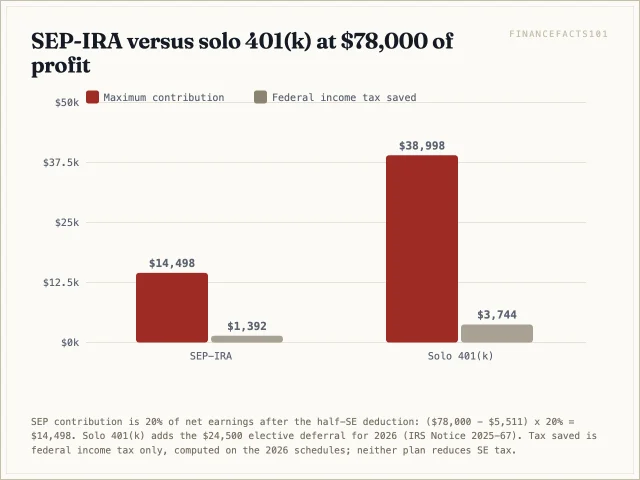
Within income tax, the choice of vehicle is worth thousands. A SEP-IRA contribution for a sole proprietor is 20% of net earnings after the half-SE deduction — for Maya, ($78,000 − $5,511) x 20% = $14,498, against a 2026 ceiling of $72,000. A solo 401(k) allows that same employer contribution plus the $24,500 employee elective deferral for 2026, taking her to $38,998. The federal income tax saved is $1,392 with the SEP and $3,744 with the solo 401(k).
Note the modest saving relative to the contribution — about 9.6% on the solo 401(k) dollars, because Maya sits in the 12% bracket and each deferred dollar also shrinks her QBI deduction. A freelancer in that bracket has a serious case for Roth contributions instead, the argument laid out in Roth versus traditional IRA and worth modelling alongside the 401(k) calculator. At the 24% bracket and above, the deduction wins comfortably. One deadline is worth calendaring, and it moved in 2023: a sole proprietor with no employees can now open a new solo 401(k) after the year ends and still make first-year employee deferrals, as long as they are made by the tax return's due date without extensions (IRS Publication 560, "Plans established after the end of tax year"). In the plan's later years, the deferral election for a year must be made by December 31 of that year, even though the money can go in later.
The S-Corp Election, Honestly
The pitch is straightforward. Elect S corporation status, pay yourself a salary, and the profit distributed above that salary escapes self-employment tax entirely. The catch is that the salary must be reasonable — the IRS position is that distributions must be treated as wages to the extent they are reasonable compensation for services rendered, judged on training, duties, hours, comparable pay and several other factors. A one-person consultancy paying its owner $15,000 and distributing $90,000 is not doing tax planning; it is inviting reclassification, back payroll taxes and penalties.
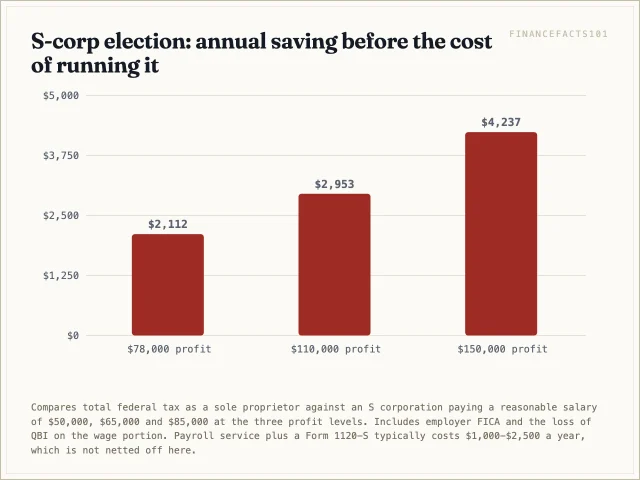
Run it properly and the savings are real but smaller than the pitch suggests, because the wage portion still bears full FICA, the employer half is a corporate expense, and W-2 wages reduce the QBI base. At $78,000 of profit with a $50,000 salary, the federal saving is about $2,112 a year. At $110,000 with a $65,000 salary it is $2,953. At $150,000 with an $85,000 salary, $4,237.
Now subtract the cost of running one: a payroll service, quarterly Forms 941, a separate Form 1120-S, state registration and franchise fees. That commonly runs $1,000 to $2,500 a year, plus the hours. Below roughly $80,000 of net profit the election is generally a net loss once the paperwork is priced; between $80,000 and about $120,000 it is a genuine toss-up turning on your state's fees and your tolerance for filings; above that the arithmetic gets steadily more convincing. Before electing, read the background on independent contractors, sole proprietorships and partnerships — the entity choice affects far more than this one tax.
Setting Your Own Percentage
Four inputs decide how much tax freelancers owe, and you can estimate all four in ten minutes: expected net profit, filing status, state rate, and any W-2 income in the household. Run them through the self-employment tax calculator, take the federal total, add your state, divide by expected profit, and round up to the next whole five points.
Then automate it. One transfer on the day each payment clears, into a separate account, and four calendar reminders for April 15, June 15, September 15 and January 15. Recompute in July, when half the year's revenue is known and there is still time for two more instalments to absorb the correction. A freelancer who does those three things has already outperformed most of the trade, where the standard practice is discovering the number in April.
FAQ
How much tax do freelancers owe on $50,000 of profit?
About $9,732 of federal tax for 2026 as a single filer with no other income — $7,065 of self-employment tax and $2,667 of income tax, or 19.5% of profit. Add your state's income tax on top. Note the shape: SE tax is nearly three times the income tax at that level, which is the opposite of what most people expect.
Do I have to pay quarterly estimated taxes in my first year?
If you expect to owe $1,000 or more when you file, yes. But the prior-year safe harbor is unusually generous in a first year: if you had little or no tax liability the year before, 100% of that small number is your required payment, so a first full year of freelancing often carries no penalty at all. Check your prior-year Form 1040 total tax line before assuming otherwise.
Does an LLC reduce self-employment tax?
No. A single-member LLC is disregarded for federal tax purposes and its owner files the same Schedule C and Schedule SE as an unincorporated sole proprietor. An LLC buys liability separation, not a lower tax bill. Only an S corporation election changes the SE tax arithmetic, and it does so at the cost of payroll compliance.
What happens if I never received a 1099 for some work?
You still owe tax on it. The $400 net-earnings threshold applies to your actual income, not to what was reported to the IRS, and clients frequently miss the reporting rules or fall under the payer threshold. Report all business income on Schedule C; the deductions that offset it are yours either way.
Can I deduct my health insurance premiums?
Generally yes — premiums for medical, dental and qualifying long-term care coverage for you and your family, as an above-the-line adjustment limited to net profit from the business, and unavailable for any month you were eligible for an employer plan through a job or a spouse's job. It reduces income tax but not self-employment tax.
Sources
- IRS, Self-employment tax (Social Security and Medicare taxes) — the 15.3% rate, its 12.4%/2.9% split, the 92.35% base, the half-SE deduction, the $400 threshold and the 0.9% Additional Medicare Tax thresholds
- SSA, Contribution and Benefit Base — the $184,500 Social Security wage base for 2026
- IRS, Publication 334, Tax Guide for Small Business — Schedule C net profit and the $400 filing requirement
- IRS, Estimated taxes — the $1,000 threshold and the pay-as-you-go rules
- IRS, Publication 505, Tax Withholding and Estimated Tax — safe harbors and the 110% rule above $150,000 of prior-year AGI
- IRS, Topic 306, Penalty for underpayment of estimated tax — the 90%/100% rules, waivers, and Form 2210
- IRS, Publication 509, Tax Calendars (2026) — the 2026 instalment due dates
- IRS, Quarterly interest rates — the 6-7% non-corporate underpayment rates through 2026
- IRS, IRS sets 2026 business standard mileage rate at 72.5 cents per mile — Notice 2026-10
- IRS, Standard mileage rates — the mid-year revision to 76 cents effective July 1, 2026
- IRS, Home office deduction and the simplified option — exclusive-use test and the $5 per square foot, 300 sq ft ceiling
- IRS, Internal Revenue Bulletin 2025-45, Rev. Proc. 2025-32 — 2026 brackets, the $16,100 standard deduction, and the section 199A threshold amounts and $400 minimum deduction
- IRS, Qualified business income deduction — the components and limits of the 20% deduction
- IRS, Tax inflation adjustments for tax year 2026 — the 2026 rate schedules
- IRS, 401(k) limit increases to $24,500 for 2026 — Notice 2025-67 contribution limits, including the $72,000 annual additions cap
- IRS, One-participant 401(k) plans and SEP contribution limits
- IRS, S corporation compensation and medical insurance issues — the reasonable compensation standard
 Next entry · No. 5,949Lump Sum vs Dollar-Cost Averaging: What Waiting Costs on $120,000
See also
-
 No. 4,581
30 Jun 2025
20 min
Understanding the Self-Employed Contributions Act (SECA) Tax: A Comprehensive Guide for Professional and Institutional Investors
Business Finance
-
 No. 6,001
04 Nov 2026
19 min
Standard Deduction vs Itemize: The 2026 Break-Even Math
Taxation
-
 No. 5,951
17 Sep 2026
18 min
Tax-Deductible Investments: What Actually Cuts Your 2026 Tax Bill
Taxation
-
 No. 5,940
12 Sep 2026
17 min
Take-Home Pay on a $100,000 Salary: What You Actually Keep in 2026
Taxation
-
 No. 5,766
06 Oct 2025
21 min
Understanding Withholding: A Comprehensive Guide for Professional and Institutional Investors
Taxation
-
 No. 3,329
19 Mar 2025
18 min
Understanding the Nanny Tax: Obligations and Benefits for Employers and Employees
Taxation