Tax-Deductible Investments: What Actually Cuts Your 2026 Tax Bill

Investments are not tax-deductible; contributions are. Maxing a 401(k) plus a family HSA cuts a 22%-bracket couple's 2026 tax bill by $7,984.
There is almost no such thing as tax-deductible investments. An investment — a fund, a stock, a bond, a rental property — is an asset you own, and owning an asset has never been deductible. What is deductible is a contribution to certain accounts, plus a short list of investment expenses, and getting that distinction right is worth real money: a married couple in the 22% bracket who max a 401(k) at $24,500 and a family HSA at $8,750 in 2026 cut their federal tax bill by $7,984, while the same $33,250 put into a brokerage account cuts it by nothing at all.
If you searched for this, your instinct is sound. The question underneath — how do I use investing to pay less tax — is real and has a ranked answer. This guide gives that ranking: the contributions that reduce taxable income, the mechanisms constantly mistaken for deductions, the two expenses still deductible in 2026, and why most readers get nothing from itemising anyway. Scope honesty first: this is general information built on stated assumptions and 2026 federal figures, not personal advice, and it ignores state tax.
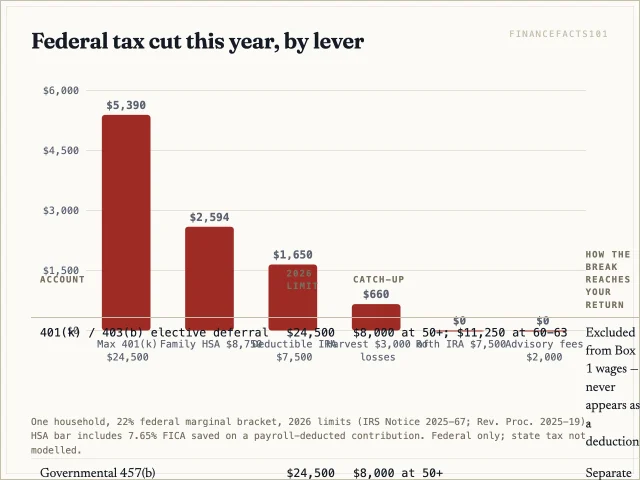
Tax-Deductible Investments Versus Deductible Contributions
The chart above is the whole article in one image. Six things a reader might file under "tax-deductible investments"; the tax cut for a 22%-bracket household runs from $5,390 down to zero. Two bars are zero for reasons worth stating plainly: a Roth IRA contribution buys nothing this year, and investment advisory fees stopped being deductible in 2018 — permanently, as the section below explains.
Notice what the winning bars have in common. Every one is a contribution to an account, not a purchase of an asset. Inside the 401(k) you can hold the same index fund you would have held in the brokerage account. The fund is not what earns the deduction. The wrapper is.
Who This Is For — and Who It Isn't
This is for a US taxpayer with earned income, a workplace plan or self-employment income, and $5,000 to $80,000 a year to direct toward long-term saving. It assumes you file an ordinary individual return, take the standard deduction or sit close to the line, and want the ranking rather than a definition.
It is not for the reader whose real question is estate planning, oil and gas partnerships, conservation easements, or opportunity zones. Those do generate deductions, and they carry audit risk and illiquidity that dwarf the tax benefit for most households. Nor is it a state-tax guide: state treatment of 529 plans, HSAs and municipal bonds varies too much. And it is not advice about whether to save more — only about where the next dollar should land.
Rung 1: The Contributions That Genuinely Reduce Taxable Income
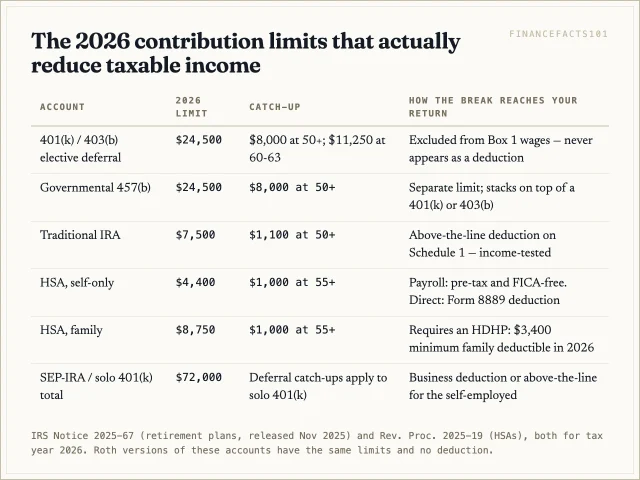
Start with the mechanic nobody explains. A 401(k) or 403(b) deferral is not a deduction on your return at all — the money is simply left out of Box 1 of your W-2. You never claim it and it never touches Schedule A, which is why it works whether or not you itemise, and why it is the largest lever most employees have. The 2026 elective deferral limit is $24,500, with an $8,000 catch-up from age 50 and $11,250 for ages 60 to 63.
Employer money is separate and, dollar for dollar, better than any deduction. A 50% match on the first 6% of pay is a 50% return before the market does anything, which is why the employer match outranks every deduction below.
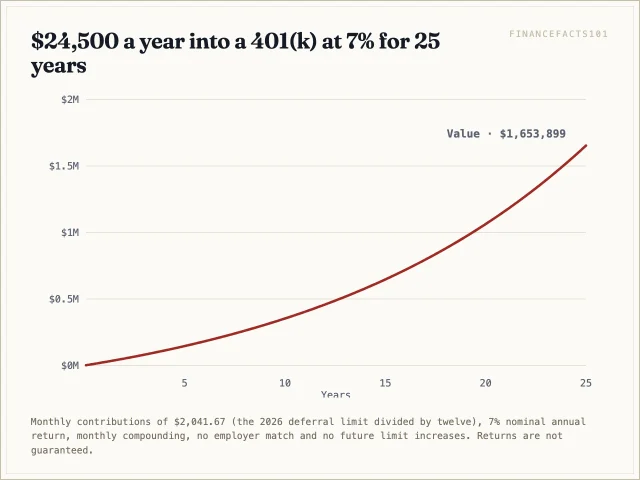
Twenty-five years of maxed deferrals at a 7% return puts in $612,500 of contributions and finishes near $1.65 million — and the deduction is not the point of that chart, the shelter is. Run your own deferral against your own pay with the 401(k) calculator.
The traditional IRA, and the phase-out that quietly kills it
The IRA limit rises to $7,500 in 2026 with a $1,100 catch-up at 50. Whether that contribution is deductible depends on one question: is anyone in the household covered by a workplace retirement plan?
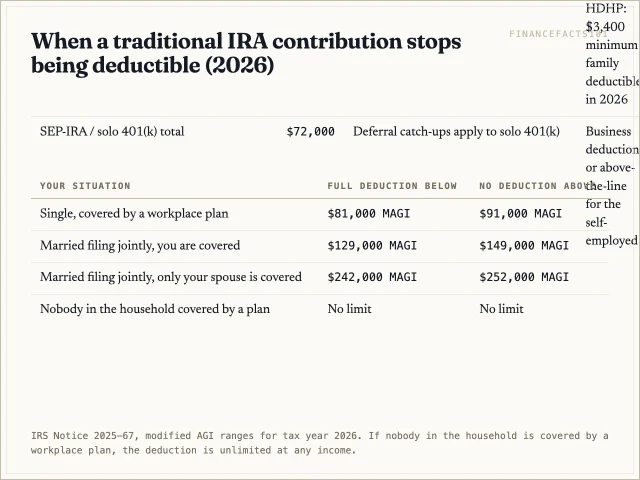
If nobody is covered, the deduction is unlimited at any income. If you are covered, it phases out between $81,000 and $91,000 of modified AGI single, $129,000 to $149,000 joint. Above the range you can still contribute, but non-deductibly — which means filing Form 8606 to track basis, and usually converting straight to a Roth instead. The trade-off is worked through in Roth vs traditional IRA, priced by the Roth vs traditional IRA calculator, with the pre-tax mechanics in the traditional IRA entry.
The HSA is the only account that is deductible three times
Everything else on this list is taxed once, going in or coming out. The health savings account is taxed neither: contributions are excluded from income, growth is untaxed, and qualified medical withdrawals are untaxed — the arrangement in IRS Publication 969. The 2026 limits are $4,400 self-only and $8,750 family under Revenue Procedure 2025-19, plus $1,000 at 55 or over, and they require a high-deductible plan — at least $1,700 self-only or $3,400 family deductible.
One detail is worth $669 a year and almost nobody mentions it. Contribute through payroll under a cafeteria plan and the money escapes Social Security and Medicare tax as well as income tax: 7.65% on top of your marginal rate. Write a cheque to the HSA custodian instead and you get the income-tax deduction on Form 8889 but pay the FICA. On $8,750 that difference is $669.38.
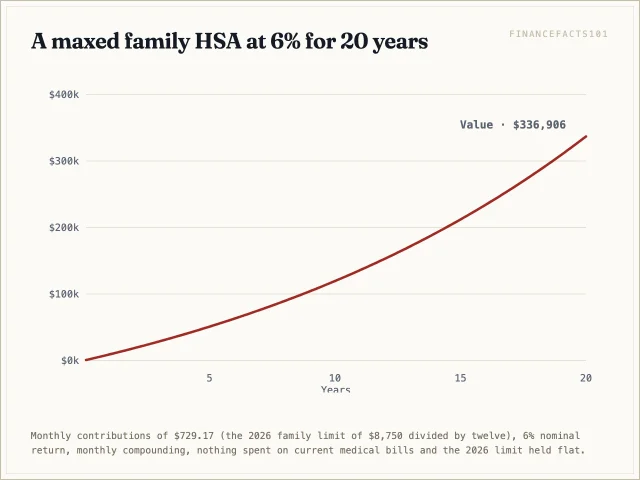
Left invested rather than spent, $8,750 a year at 6% for twenty years turns $175,000 of contributions into roughly $337,000. After 65 the penalty falls away: non-medical withdrawals are simply taxed as ordinary income, making an unspent HSA a second traditional IRA with a medical escape hatch. Price it against the alternative with the HSA vs FSA calculator and read HSA vs FSA first — the choice is not symmetric, because FSA money mostly expires.
Self-employed, and the 457(b) stack
Self-employment raises the ceiling sharply. A SEP-IRA or solo 401(k) can absorb up to $72,000 in 2026 — the section 415(c) annual additions limit set by IRS Notice 2025-67 — deducted as a business expense or above the line, per Publication 560. The solo 401(k) gets there faster at modest income because it stacks a $24,500 employee deferral on the employer profit-sharing piece. None of it reduces self-employment tax on the deferral side, a common and expensive misreading.
Government and non-profit employees get a quieter advantage: a governmental 457(b) carries its own $24,500 limit stacking on top of a 403(b), so a public-hospital physician with both can defer $49,000 before catch-ups.
Rung 2: The Things That Cut Tax But Are Not Deductions
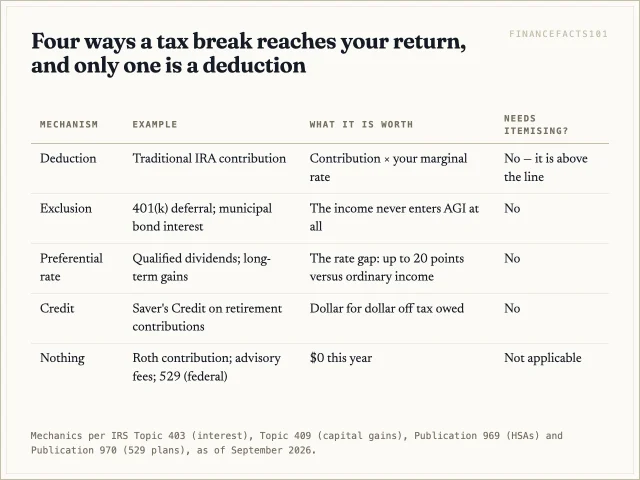
Four distinct mechanisms get filed under one word. A deduction shrinks taxable income and is worth its size times your marginal rate. An exclusion keeps income off the return entirely. A preferential rate taxes income that does enter, but more gently. A credit comes off the tax itself and is worth most per dollar. The entry on what tax deductions are and how they work covers the first in depth.
Roth accounts are the cleanest example of the confusion. A Roth 401(k) deferral appears in Box 1 of your W-2 and cuts this year's tax by exactly zero. What it buys is decades of untaxed growth and withdrawal — often the better trade for someone in the 12% bracket today who expects the 22% bracket later, but not a deduction.
Municipal bond interest is excluded, not deducted
Interest from most municipal bonds is exempt from federal income tax, so comparing a muni yield to a Treasury yield head-to-head is meaningless. The comparison that works is the taxable-equivalent yield: tax-free yield divided by one minus your marginal rate.
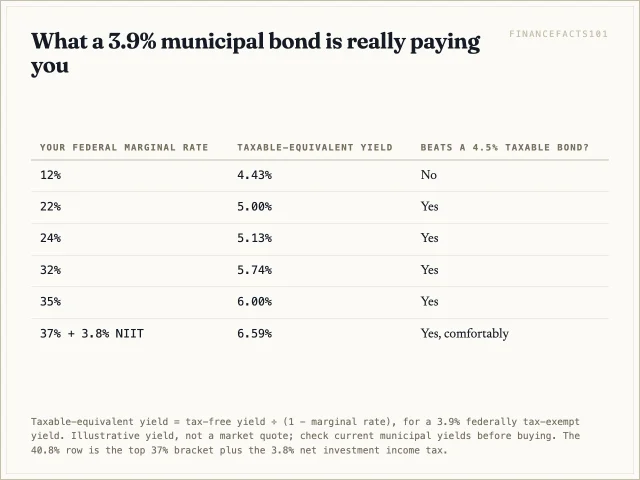
At 12% a 3.9% muni is worth 4.43% taxable — losing to a 4.5% corporate bond. At 22% it is worth exactly 5.00% and wins. At the top rate plus the 3.8% net investment income tax, which bites above $200,000 of modified AGI single or $250,000 joint, it is worth 6.59%. Munis are a bracket-dependent product; below roughly 22% they are not worth the yield give-up.
Long-term gains and qualified dividends have their own rate schedule
Hold an appreciated asset more than a year and the gain is taxed at 0%, 15% or 20% instead of your ordinary rate, per IRS Topic 409; qualified dividends follow the same schedule. Selling at eleven months rather than thirteen turns a 15% tax into a 22% one on the identical gain — the cost of two months' impatience. Mechanics in capital gains tax on stocks; the capital gains tax calculator prices a specific sale.
529 plans: nothing federally, often something at home
Be precise here, because the internet is not. There is no federal deduction for 529 contributions — growth and qualified-education withdrawals are tax-free, but the contribution does nothing on your federal return, as Publication 970 sets out. Most states that levy an income tax do offer a deduction or credit, often only for their own state's plan, and a few offer nothing. Check your state's rule before choosing a plan; it is usually worth a few hundred dollars a year.
The 0% Bracket Most People Never Notice
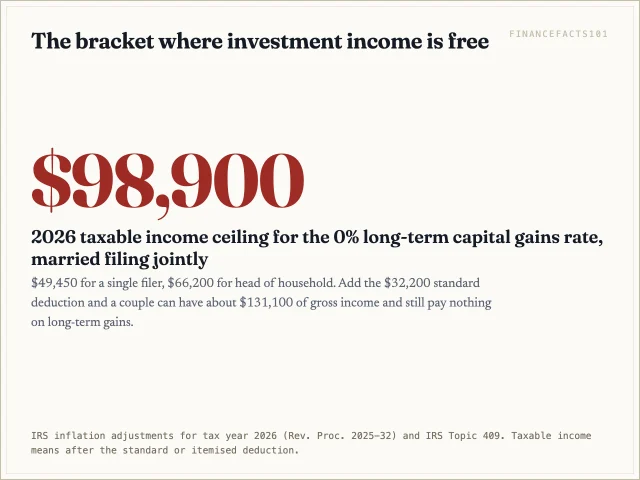
This is the most underused number in the tax code. For 2026 the long-term capital gains rate is zero up to $49,450 of taxable income single and $98,900 joint. Taxable income means after the standard deduction, so a couple can have roughly $131,100 of gross income and still pay nothing federally on a realised long-term gain.
The practical use is gain harvesting in low-income years — a sabbatical, a career break, the gap between retiring at 62 and claiming Social Security at 70. Sell an appreciated holding, pay 0%, buy it straight back, and you have permanently raised your cost basis for free; there is no wash-sale rule on gains. Model it first with the capital gains tax calculator, because the gain counts toward the ceiling that decides its own rate, so a sale starting in the 0% band can finish in the 15% one.
Tax-Loss Harvesting and Its $3,000 Ceiling
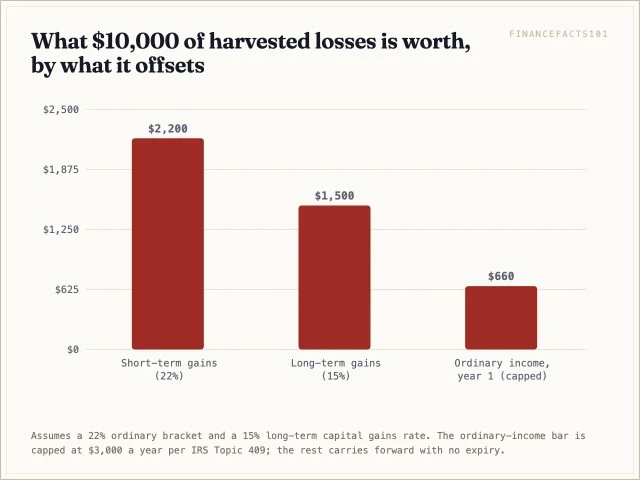
Sell a losing position and the loss offsets capital gains dollar for dollar. Once gains are exhausted, only $3,000 a year can be deducted against ordinary income — $1,500 if married filing separately — with the remainder carried forward indefinitely, per Topic 409 and the capital loss carryover rules.
That ceiling is what people get wrong. A $50,000 loss does not produce a $50,000 deduction; absent gains to offset, it produces $660 of relief this year at 22% and takes sixteen more years to work through. Harvesting is valuable against gains, mildly valuable against income, and never a reason to sell something you wanted to keep. Mind the wash-sale rule: buy a substantially identical security within 30 days either side and the loss is disallowed.
Rung 3: The Investment Expenses Still Deductible in 2026
Two survive, and only two.
Investment interest expense. Borrow to buy taxable investments — a margin loan, usually — and the interest is deductible, but only up to your net investment income for the year and only if you itemise. Claim it on Form 4952 and carry any excess forward. Interest allocable to tax-exempt income, such as borrowing to buy munis, is not deductible at all; Publication 550 has the allocation rules.
Certain business-entity expenses. If your investing genuinely runs through a business or rental activity, its ordinary expenses remain deductible on Schedule C or E. That is a different regime from personal investing and out of scope here.
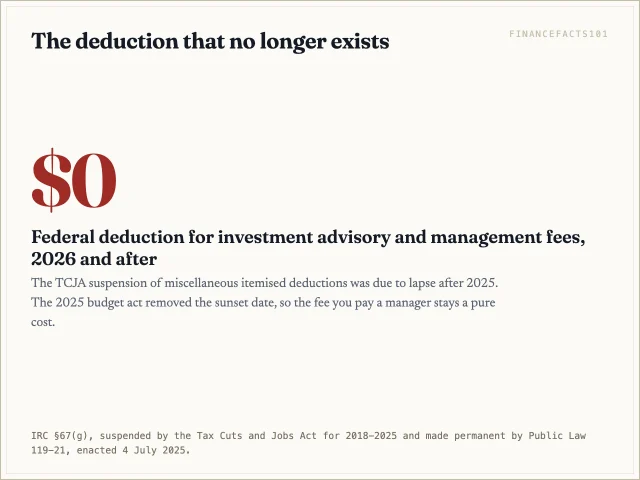
Everything else is gone. Advisory fees, custodial fees, subscription research and safe-deposit boxes were miscellaneous itemised deductions subject to a 2% floor, and the Tax Cuts and Jobs Act suspended them for 2018 through 2025. The obvious assumption was that they would return in 2026. They did not: the 2025 budget act, Public Law 119-21, struck the sunset date and made the suspension permanent. A 1% advisory fee is now a full 1% cost with no offset, which is why the advisory fee drag compounds as it does.
Why Most Readers Get Nothing From Itemising Anyway
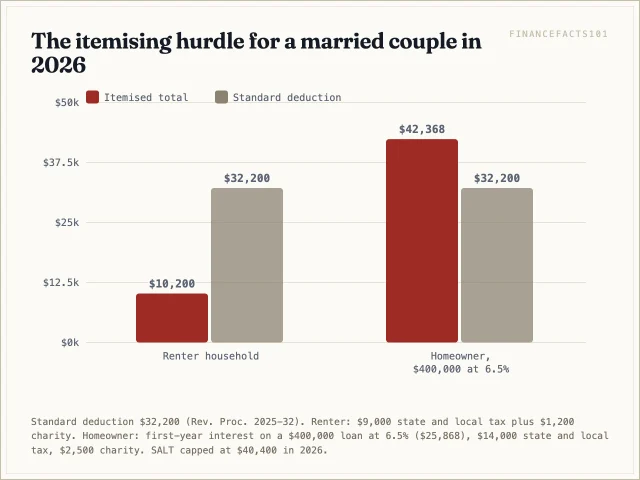
The deductions that do exist only help if you itemise, and the standard deduction has been deliberately high since 2018: $16,100 single and $32,200 married filing jointly for 2026, per the IRS's inflation adjustments for tax year 2026.
Do the arithmetic. Renters paying $9,000 of state and local tax and giving $1,200 to charity have $10,200 of itemised deductions against a $32,200 hurdle — $22,000 short, so no itemised deduction they add changes their tax. Charity is the one exception from 2026: people who take the standard deduction can still deduct up to $1,000 of cash gifts to qualifying charities, or $2,000 on a joint return, under Public Law 119-21, section 70424, so this couple can deduct their $1,200 gift anyway. A couple with a $400,000 mortgage at 6.5% pay $25,868 of interest in year one; add $14,000 of state and local tax and $2,500 of charity and they reach $42,368 and do itemise. Even for them, only the $10,168 above the standard deduction is new — worth $2,237 at 22%, not $9,321.
The state and local cap matters here too: $40,400 for 2026, phasing down for high earners, as the Schedule A guide and itemized deductions entries set out. The upshot is blunt: for most households the itemising route is closed, and every lever that still works — the 401(k), the HSA, the IRA, the preferential rates — works above the line or outside the deduction system entirely.
Asset Location: The Idea Worth More Than Most Deductions
Once you hold a taxable account, a traditional account and a Roth account, a second decision appears that most readers have never met: which holding goes in which wrapper. Identical portfolios can produce very different tax bills.
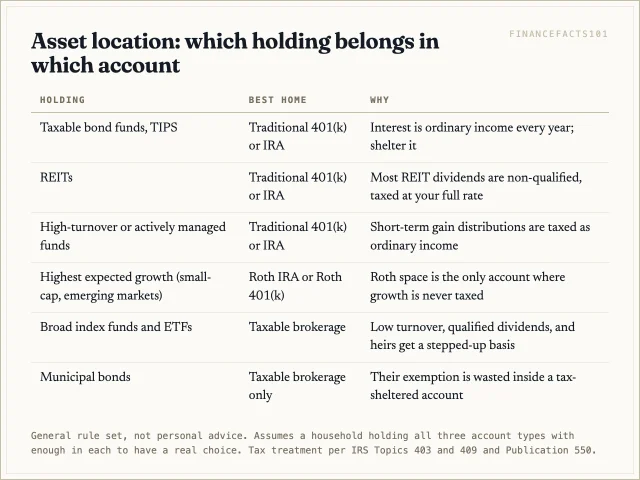
The rule is short. Assets that throw off ordinary income every year — taxable bond funds, TIPS, REITs, high-turnover active funds — belong in the traditional 401(k) or IRA, where that income is invisible until withdrawal. The highest expected growth belongs in the Roth, the only place where growth is never taxed. Broad index funds belong in taxable, where low turnover and qualified dividends cost little and heirs receive a stepped-up basis. Municipal bonds belong in taxable only: their exemption is worthless inside an account that was already sheltered.
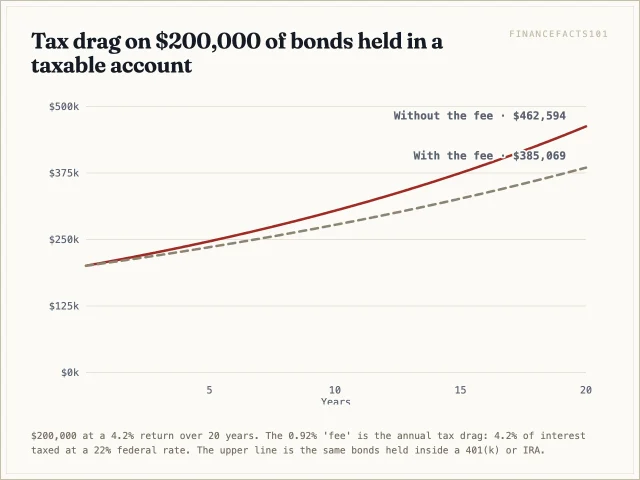
Price it. A $200,000 bond position returning 4.2% pays roughly 4.2% in interest each year; taxed at 22% that is a 0.92% annual drag. Over twenty years the sheltered version reaches about $462,600 and the taxable version about $385,100 — a $77,500 difference from moving the same bonds between two accounts you already own. No contribution, no deduction. Just location.
Worked Example: The Ruiz Household at 22%
Ana and Marco Ruiz file jointly: combined 2026 wages of $185,000 — $110,000 and $75,000 — a family high-deductible health plan, and no itemised deductions worth the trouble. Taxable income before any pre-tax saving is $185,000 − $32,200 = $152,800, inside the 22% bracket that runs from $100,800 to $211,400 on a 2026 joint return. Federal income tax on that: $23,040. They have $33,250 to invest and three ways to do it.
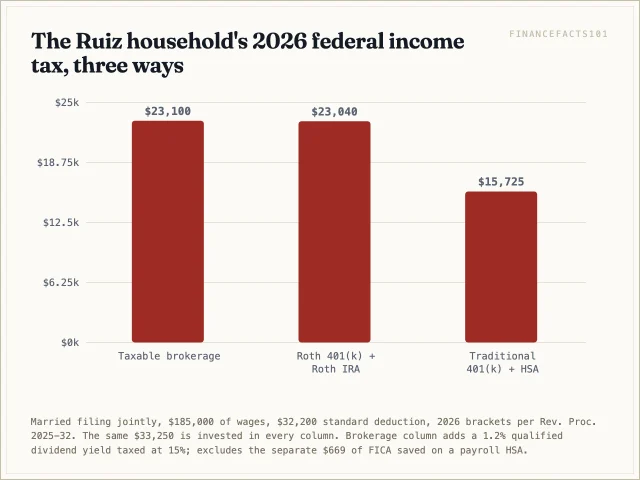
Route one, the brokerage account. They buy a total-market index fund. Deduction: zero. The fund yields about 1.2%, so $399 of qualified dividends arrive and are taxed at 15%. Their bill goes up $60, to $23,100. This is what most people picture when they search for tax-deductible investments, and it is the only route of the three that costs them money this year.
Route two, all Roth. Roth 401(k) plus Roth IRA. Deduction: zero, by design; bill unchanged at $23,040. Every dollar of growth from here is untaxed forever, which may well be the better long-run answer — but it is not what "deductible" means.
Route three, traditional 401(k) plus HSA. Marco defers $24,500 into his 401(k) and the household routes $8,750 through payroll into the family HSA. Taxable income falls to $119,550, still inside the 22% band, and the tax bill falls to $15,725 — a saving of $7,315. The payroll HSA also skips 7.65% of FICA, another $669. Total federal saving: $7,984.
Here is the line that reframes the search. The Ruizes invested $33,250 but needed only $25,266 of after-tax cash to do it, because the government funded the remaining $7,984. They own the same index funds either way. The wrapper made the difference — the take-home pay calculator shows the effect on a specific paycheque.
The Order of Operations
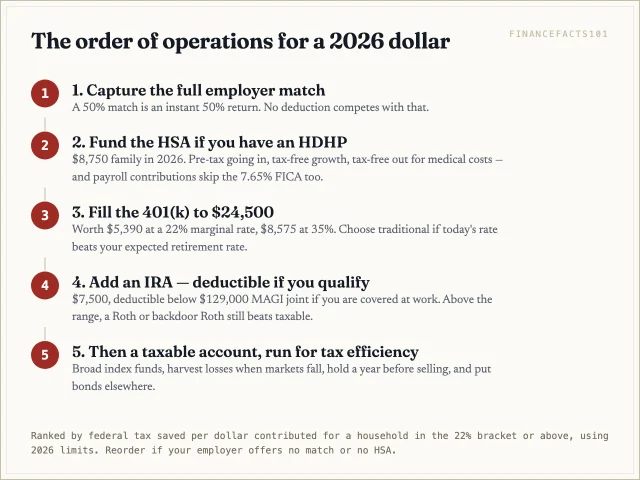
Ranked by tax saved per dollar for a household at 22% or above: employer match first, HSA second, 401(k) to the limit third, IRA fourth, taxable last. The order shifts for two groups. In the 10% or 12% bracket, put the Roth versions ahead of the traditional ones — a deduction at 12% is a poor trade against tax-free withdrawals later. With no HDHP on offer, the HSA rung does not exist and everything moves up one; where open enrolment offers a choice between an HDHP with an HSA and a richer plan with an FSA, the HSA vs FSA calculator settles it on your own premiums and expected medical spending.
Below all of it sits the point. A deduction is a discount on money you were saving anyway. It is never a reason to save money you cannot spare, and never worth buying an investment you would otherwise refuse. If the only argument for a product is its tax treatment, that is the argument against it.
What This Guide Does Not Cover
State income tax, which can shift every calculation above by several points and changes the 529 answer entirely. The saver's credit, worth more per dollar than any deduction for lower-income households. Qualified charitable distributions after 70½, donor-advised funds, appreciated-stock gifting, Roth conversions in low-income years — all real, all worth a separate look. And anything involving a business entity, real estate depreciation, or a trust.
All 2026 figures here come from IRS releases current as of September 2026 and change each year. Check the year before acting on them.
FAQ
Are investments tax-deductible?
No. Buying a stock, fund, bond or property produces no deduction. Deductible items are contributions to a traditional IRA, an HSA, or a self-employed plan; a 401(k) deferral gets the same effect by being excluded from taxable wages rather than deducted. Investment interest on borrowed money stays deductible up to your net investment income if you itemise.
Can I deduct investment advisory or management fees in 2026?
No. Those were miscellaneous itemised deductions subject to a 2% floor, suspended by the Tax Cuts and Jobs Act from 2018, and made permanent by Public Law 119-21 in July 2025 rather than expiring after 2025 as scheduled. Fees paid from inside a retirement account come out of pre-tax dollars, a partial and indirect offset.
How much tax does maxing a 401(k) actually save?
Contribution times your marginal rate. The 2026 limit of $24,500 saves $2,940 at 12%, $5,390 at 22%, $5,880 at 24% and $8,575 at 35%. It is a deferral, not forgiveness — the money is taxed as ordinary income on withdrawal, so the real gain is the rate gap between your working years and retirement, plus decades of untaxed compounding.
Is a Roth IRA tax-deductible?
No, and that is the design. You pay tax on the money now, and neither the growth nor the qualified withdrawal is taxed again. A traditional IRA reverses the order. Which wins depends on whether your marginal rate is higher today or in retirement — which is why both usually deserve a place.
Do 529 plan contributions reduce my federal taxes?
No. There is no federal deduction for 529 contributions; the benefit is tax-free growth and tax-free qualified withdrawals. Most states with an income tax offer their own deduction or credit, often only for the in-state plan, so the answer depends on where you file.
Sources
- IRS, 401(k) limit increases to $24,500 for 2026; IRA limit increases to $7,500 — 2026 deferral, catch-up and IRA limits and the traditional IRA deduction phase-out ranges
- IRS, Notice 2025-67 — 2026 retirement plan dollar limits, including the $72,000 section 415(c) limit
- IRS, Revenue Procedure 2025-19 — 2026 HSA contribution limits and HDHP minimum deductibles
- IRS, Inflation adjustments for tax year 2026 — standard deduction and bracket thresholds
- IRS, Topic 409, Capital gains and losses — long-term rates, the $3,000 ordinary-income cap, and loss carryforward
- IRS, Publication 969, Health Savings Accounts — HSA contribution, growth and withdrawal treatment
- IRS, Publication 550, Investment Income and Expenses — investment interest and tax-exempt interest allocation
- IRS, About Form 4952, Investment Interest Expense Deduction
- IRS, Publication 970, Tax Benefits for Education — 529 plan federal treatment
- IRS, Publication 560, Retirement Plans for Small Business — SEP and solo 401(k) deduction rules
- IRS, IRC 457(b) deferred compensation plans
- IRS, Net investment income tax — the 3.8% surtax thresholds
- GovInfo, Public Law 119-21 — the 2025 budget act that made the suspension of miscellaneous itemised deductions permanent
- SSA, Contribution and benefit base — the 2026 Social Security wage base of $184,500 behind the FICA arithmetic
 Next entry · No. 5,952Overdraft and Insufficient Funds Fees: Get the Refund, Then Stop Paying Them
See also
-
 No. 2,547
15 Jan 2025
18 min
Understanding IRS Publication 550: A Comprehensive Guide for Investors on Taxing Investment Income and Expenses
Taxation
-
 No. 6,001
04 Nov 2026
19 min
Standard Deduction vs Itemize: The 2026 Break-Even Math
Taxation
-
 No. 5,948
16 Sep 2026
20 min
Self-Employment Tax: How Much of Every Payment to Set Aside
Taxation
-
 No. 5,943
13 Sep 2026
17 min
Capital Gains Tax on Stocks: The One Day That Costs $1,800
Taxation
-
 No. 5,931
03 Sep 2026
14 min
Roth vs Traditional IRA: Which Saves You More Tax
Taxation
-
 No. 925
02 Jul 2024
21 min
Understanding Tax Deductions: What They Are and How They Work
Taxation