Overdraft and Insufficient Funds Fees: Get the Refund, Then Stop Paying Them
Overdraft fees average $26.77 and hit $35 at big banks. Ask for the refund first, opt out under Regulation E, then size a buffer to your pay cycle.
If a fee posted to your account this week, the fastest money you will make today is a phone call, because banks reverse overdraft and insufficient funds fees far more often than customers ask them to. The average overdraft fee across surveyed checking accounts was $26.77 as of Bankrate's September 10, 2025 survey, and the median at institutions holding more than $10 billion in assets was $35 in the CFPB's December 2023 market review — so a single successful call is worth roughly a tank of gas, and the second call, the one that changes your account settings, is worth several hundred dollars a year.
This guide does four things in order: gets the fee reversed, separates the two fees readers conflate constantly, turns off the setting that allows most debit-card overdrafts, and sizes the buffer that ends the problem. Scope honesty first: this is general information built on stated assumptions and figures current as of September 2026, not personal advice about your account.
Overdraft and Insufficient Funds Fees: The Refund Call Comes First
Every structural fix below takes days or weeks. The refund takes ten minutes, and the federal regulator that insures your deposits tells you to try it. The FDIC's consumer guidance on overdraft and account fees says it plainly: "Don't be afraid to call your bank and ask if they can waive fees you have incurred, especially if you have not had a lot of fees in the past."
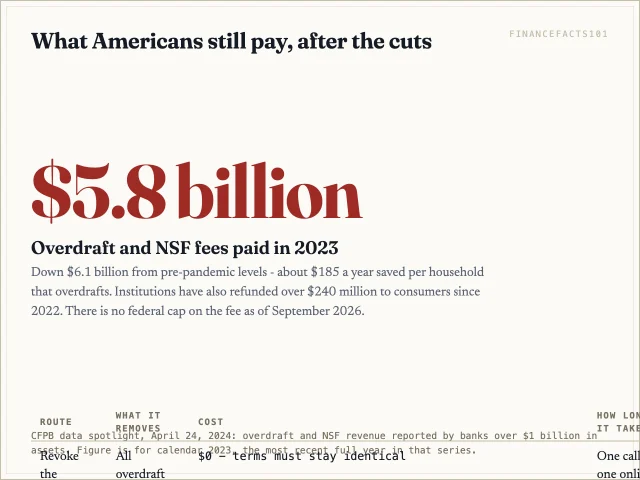
That last clause is the whole game. Retail banks run informal waiver allowances — a first-offense courtesy, or one or two reversals per rolling twelve months — because a $35 reversal is cheaper than losing a direct-deposit customer. Almost nobody claims it. What goes unclaimed shows up in supervision data: since the CFPB raised its supervisory attention on these fees in 2022, institutions have agreed to refund over $240 million to consumers, per its April 24, 2024 data spotlight.
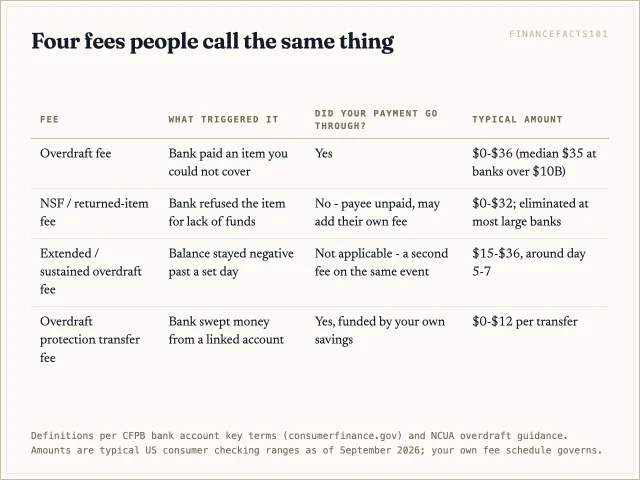
Check which of those four lines actually hit your statement before you call. The agent's script keys off the fee code, and asking to reverse "the overdraft fee" when the charge was a returned-item fee starts you on the back foot.
Who This Is For — and Who It Isn't
This is for someone with a US consumer checking account who was charged in the last 60 days, or who is charged a few times a year and has stopped reading the notifications. It assumes take-home pay arriving on a predictable schedule and bills that post on their own schedule, and that the mismatch between the two is what keeps producing fees.
It is not a guide to disputing an unauthorized transaction — that is a Regulation E error-resolution claim with its own 60-day notice deadline, unrelated to fee waivers. It is not for business or trust accounts, which fall outside the consumer protections cited here. And if overdrafts are a symptom of income that does not cover expenses rather than timing that does not line up, the buffer will not fix it; that is a budget problem, and the first stop is the payment hierarchy in the debt payoff comparison.
Overdraft vs NSF: Two Fees, Two Different Events
Readers use these words interchangeably. Banks do not, and the difference decides what happened to your payment.
An overdraft occurs, in the CFPB's bank account key terms, when you don't have enough money to cover a transaction but the bank pays it anyway. Your rent cleared, your balance is negative, and you owe the fee plus the shortfall. An NSF or non-sufficient funds fee applies when the check or electronic authorization is not paid because the money was not there. The item bounced. Your landlord did not get paid, you still owe the rent, you owe the bank a fee for being declined, and the landlord will likely add a returned-payment fee of their own.
That asymmetry decides which fee to fight. An overdraft fee bought you something. An NSF fee bought you nothing, which is why it is the easier one to argue about and why most large banks have stopped charging it. The mechanics of each are covered in the entries on overdrafts and non-sufficient funds fees.
What the Fees Cost as of September 2026
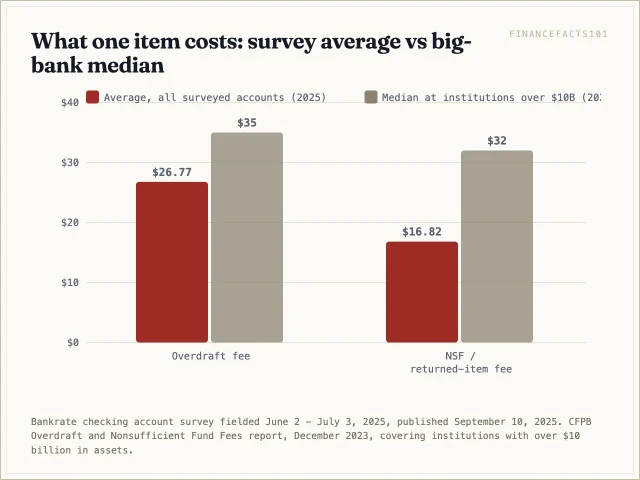
Two credible measurements, and they disagree for a good reason. Bankrate's survey, fielded June 2 to July 3, 2025 and published September 10, 2025, put the average overdraft fee at $26.77 — down 1% from $27.08 the prior year — with 94% of surveyed accounts still charging one, and the average NSF fee at a record-low $16.82, charged by 61% of accounts. The CFPB's December 2023 overdraft and NSF report, looking only at institutions above $10 billion in assets, found a median overdraft fee of $35 and a median NSF fee of $32.
Both are right. The Bankrate average is dragged down by the online banks and Bank On accounts that charge nothing; the CFPB median describes where most people actually bank. At a national brand, plan on $30 to $36 per item, not $26.77.
How to Handle Insufficient Funds Fees: The Script That Works
Call the number on the back of the card, not the branch: front-line phone agents at large banks carry waiver authority up to a set dollar amount, and branch staff usually have to escalate anyway. Then say four things, in this order, and stop talking.
State the fee, the date and the amount, so the agent can find it without a search. Say how long you have banked there and that the account is otherwise in good standing. Ask directly — "I'd like that fee refunded as a one-time courtesy" — using the word courtesy, because that is the internal category the reversal gets booked to. If the first answer is no, ask one calm follow-up: "Can you check whether I have a courtesy reversal available, or escalate to someone who can?" That question, not volume, is what moves an agent whose opening script line is a refusal.
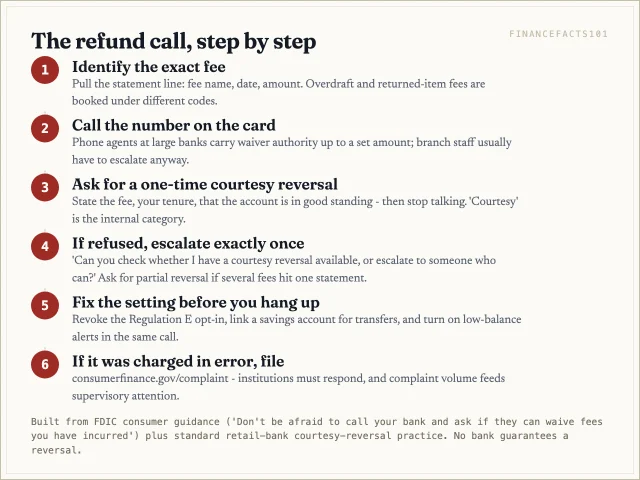
Two conditions raise your odds: the fee is your first in twelve months or more, and you are calling within days rather than after three statement cycles. Two lower them: you have already had a reversal this year, or five fees hit one statement — in which case ask for a partial reversal of two or three, which agents grant far more readily than a clean sweep. If the answer stays no and you believe the fee was charged in error, file at consumerfinance.gov/complaint; institutions must respond, and complaint volume feeds supervisory attention.
Regulation E: The Opt-Out Almost Nobody Uses
Here is the fact that changes the most money for the least effort. Since 2010, a bank may not charge you an overdraft fee on an ATM withdrawal or a one-time debit card purchase unless you affirmatively opted in. The rule lives at 12 CFR 1005.17, implementing the Electronic Fund Transfer Act; the Federal Reserve announced the original final rules on November 12, 2009, and rulemaking authority later moved to the CFPB.
The institution must give you a segregated written notice describing the service and its fees, a real opportunity to consent, and written confirmation stating your right to revoke. You may revoke at any time, in the same manner the bank made available for consenting, and it must act as soon as reasonably practicable. Equally important: banks must give non-opted-in customers identical account terms, conditions and pricing. Opting out cannot cost you anything.
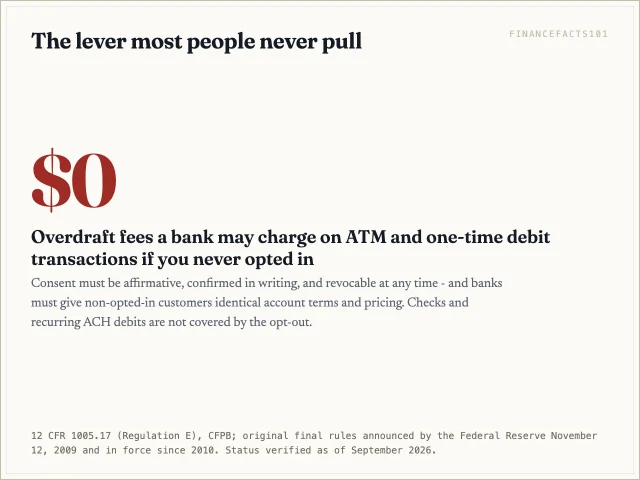
Two limits, stated honestly. The protection covers ATM and one-time debit transactions only — checks, recurring ACH debits and automatic bill payments can still be paid into overdraft and fee'd whether or not you opted in, which is why the buffer still matters afterwards. And the opt-in is not always real: the CFPB's Circular 2024-05 addressed institutions charging these fees without evidence the consumer ever consented. If you do not remember opting in, ask your bank to produce the record. Background sits in the entry on Regulation E.
The Extended Overdraft Fee and the Re-Presentment Problem
Some banks charge a second fee if the balance stays negative — the extended, sustained or continuous overdraft fee. Where it survives it commonly runs $15 to $36, triggered once the account has been negative for roughly five to seven days, on top of the original per-item fee. Check your fee schedule for the exact trigger day, because that number is your deadline: curing on day four instead of day six can be worth more than the original fee.
The second trap is re-presentment. A merchant whose ACH debit bounces will often submit it again days later, and at some institutions each attempt draws its own NSF fee — one bill, three fees. Federal supervisors treated that as a legal risk for several years, then the position moved: the FDIC issued guidance on multiple re-presentment NSF fees in 2022, reissued it as FIL-32-2023, and rescinded it outright on April 10, 2026 in FIL-14-2026, calling it "overly broad in scope." Rescinding guidance does not itself make the practice lawful or unlawful; it removes a supervisory expectation. The practical read as of September 2026 is that no regulator is counting duplicate NSF fees for you. Count them yourself and dispute them.
Overdraft Protection Transfers: The Cheaper Plumbing
Nearly every bank will link your checking account to savings, a second checking account, or a small line of credit and sweep money over when you go short. The transfer fee is typically $0 to $12 per event, and a growing number of banks charge nothing — against $26.77 to $36 for the overdraft it replaces. The FDIC makes the same point: the transfer fee "is typically less than an overdraft charge."
Two cautions. A line-of-credit overdraft is a loan and accrues interest, and at a federal credit union it must be repaid within 45 days under NCUA rules, which the agency spells out in its guidance on overdraft courtesy pay programs. And a linked-savings transfer only works if the savings account has money in it — the same buffer problem, moved one account over. Set the link up anyway; it is free insurance. Details are in the entry on overdraft protection.
Posting Order, and the $191 Million Precedent
Why did one bad morning produce five fees instead of one? Because the order in which a bank posts the day's transactions decides how many land against a negative balance. Sorting debits from highest to lowest — high-to-low posting — drains the balance fastest and maximises the count of items that overdraw. It was standard for years, drew a long run of class actions, and most large banks have abandoned it, but the posting order in your deposit agreement is worth reading.
The related and still-live issue is the timing of the balance itself. In September 2022 the CFPB ordered Regions Bank to pay $191 million — a $50 million penalty and roughly $141 million in redress — for charging overdraft fees on debit purchases authorized while the account showed sufficient funds and settled only after other items posted. That is the "authorize positive, settle negative" pattern, and it is why available balance and ledger balance can tell different stories on the same afternoon; the distinction is unpacked in ledger balance vs available balance. A pending deposit held under funds-availability rules produces the same surprise, as the entry on deposit holds explains.
The Delgado Household: 11 Fees, $415 in a Year
Named assumptions, real arithmetic. The Delgados take home $4,180 a month, split across the 1st and the 15th. Their bank charges $35 per overdraft item and a $15 extended overdraft fee once the account has been negative five days. Between September 2025 and August 2026 they were charged 11 overdraft fees, and two of those episodes ran past the fifth day.
Eleven fees at $35 is $385. Two extended fees at $15 is $30. The year cost them $415, produced entirely by timing.
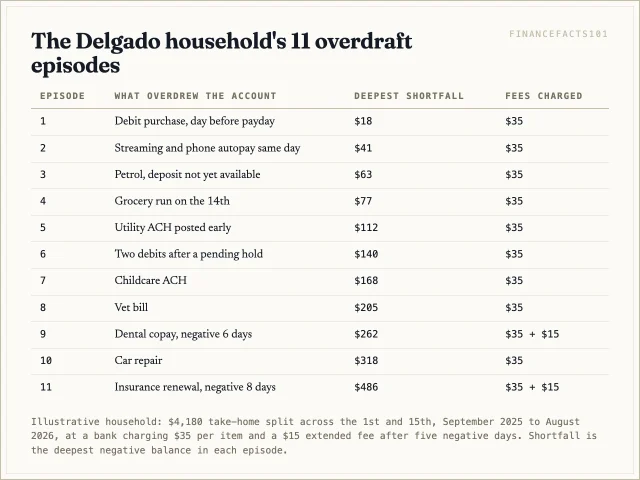
The revealing column is the third one: how far below zero the account actually went. Five of the eleven episodes were short by less than $115, and eight by less than $210. The deepest was $486, in the month the car insurance renewed two days before payday.
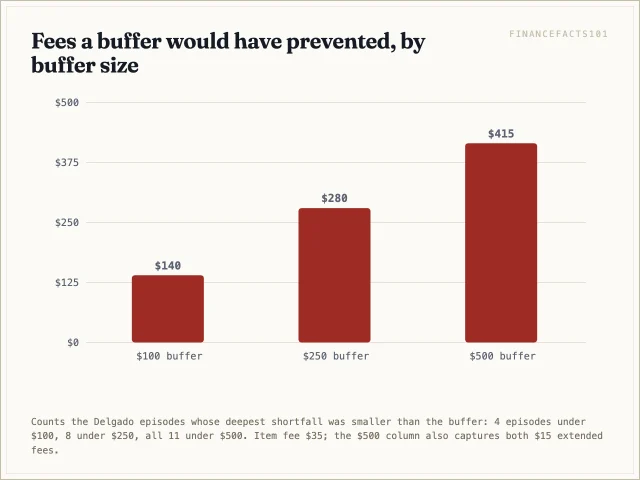
A $100 cushion sitting untouched in checking would have stopped 4 of the 11 fees and saved $140. A $250 cushion would have stopped 8 of them and saved $280. A $500 cushion would have stopped all eleven plus both extended fees — the full $415. The marginal $250 between the middle and top options bought $135 of avoided fees in one year, a 54% return on a balance that was never actually spent.
A $35 Fee on a $12 Coffee, as an APR
Treat one overdraft as what it functionally is: a very short, very expensive loan. You were short $12 at the register, the bank advanced $12, you deposited on Friday and cured the balance three days later, and the finance charge was $35.
The arithmetic is a simple APR: finance charge divided by amount advanced, annualized over the days outstanding. $35 ÷ $12 = 2.9167, times 365 ÷ 3 days, is 35,486%. State the assumption honestly — a non-compounding annualization of one fixed fee, and no lender offers credit on those terms — but the comparison is legitimate, and it is why the CFPB spent a decade treating overdraft as a credit product rather than a service fee.
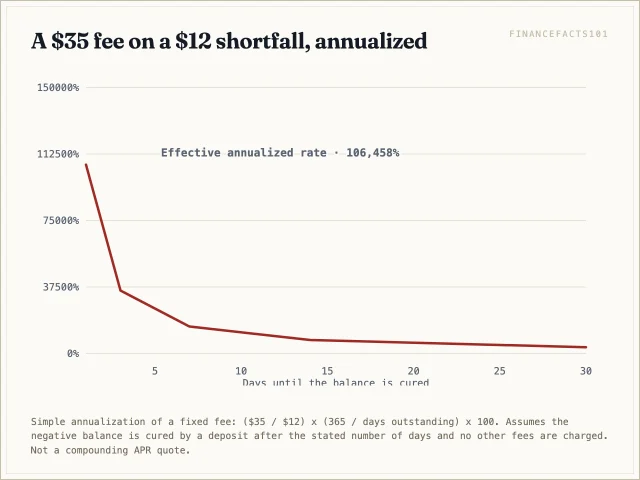
What drives the number is the days outstanding, not the fee. Cure it in a day and the rate is 106,458%; take a month and it is 3,549%, still roughly 145 times the rate on a carried credit card balance. Nothing in consumer credit is more expensive per dollar-day than a small overdraft cured quickly.
Where the Rules Stand as of September 2026
This has moved, and anyone quoting 2024 headlines is a rule behind. In December 2024 the CFPB finalized a rule for institutions above $10 billion in assets, capping the overdraft fee at $5 unless the bank justified more by its actual costs or treated overdraft as credit with Truth in Lending disclosures. It was scheduled to take effect October 1, 2025.
It never did. Congress passed a Congressional Review Act resolution disapproving it — the Senate on March 27, 2025, the House on April 9, 2025 — and the President signed it on May 9, 2025. The consequence runs further than the single rule: under the CRA the agency may not issue a substantially similar regulation without new authorization from Congress, as the Congressional Research Service sets out in its analysis of the repeal. There is no federal cap on overdraft fees as of September 2026, and no regulatory path back to one without legislation.
What is in force deserves precision. The Regulation E opt-in requirement at 12 CFR 1005.17 stands, unaffected by the repeal — that is the lever you still have. Truth in Savings disclosure rules stand. The FDIC's re-presentment guidance is gone as of April 2026, and the CFPB's supervisory posture on these fees has shifted materially since 2024. Treat enforcement as an unreliable backstop rather than a plan: the consumer lever is currently stronger than the regulatory one.
Accounts That Cannot Charge You
The market moved further than the rulebook did. Between 2021 and 2023 much of the industry stopped charging one or both fees, and the CFPB found in an October 11, 2023 report that nearly two-thirds of banks above $10 billion in assets had eliminated NSF fees, wiping out 97% of NSF revenue at that tier and saving consumers almost $2 billion a year.
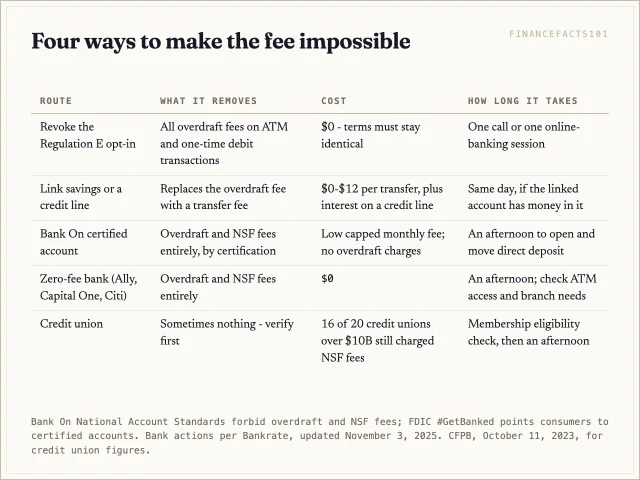
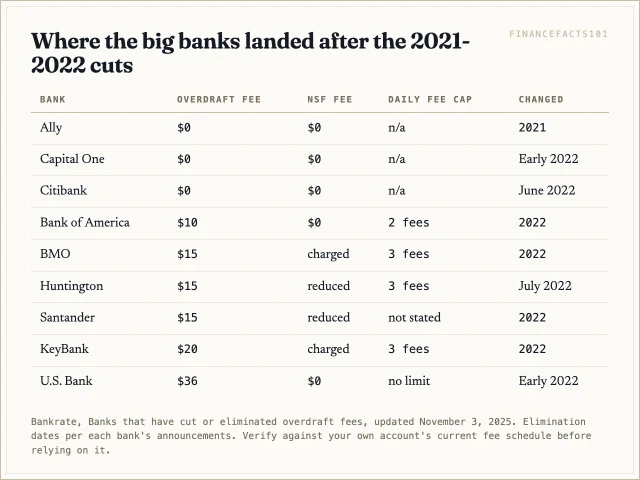
Three routes are open today. Bank On certified accounts are checking accounts independently certified against the Bank On National Account Standards, which forbid overdraft and NSF fees outright and cap monthly costs; the FDIC points consumers to them through its #GetBanked campaign, and they exist at hundreds of banks. Zero-fee banks: Ally eliminated overdraft fees in 2021, Capital One in early 2022 and Citi in June 2022, while Bank of America cut its fee to $10 and dropped NSF fees. Credit unions are a mixed answer, not an automatic one — the same CFPB report found 16 of 20 credit unions above $10 billion still charging NSF fees, including four of the five largest, so check the fee schedule rather than assuming; trade-offs are covered in the entry on the credit union advantage. Switching accounts is the most durable fix on this page, and it costs an afternoon.
ChexSystems: When Overdrafts Cost You the Account
The worst outcome is not the fees; it is losing banking access. If a negative balance goes unpaid and the bank closes the account, that closure and the unpaid balance go to a checking-account screening company — ChexSystems is the largest — and the next bank you apply to sees it. The CFPB explains the mechanism in why was I denied a checking account: an unpaid negative balance from an overdraft on a closed account is a specific reason applications get refused.
Three rights are worth knowing before you need them. A bank that denies you on a screening report must give you an adverse action notice naming the reporting company. You get a free copy of your file from each nationwide screening company once every twelve months. And the company must investigate a written dispute and correct anything inaccurate. If you land here, pay the negative balance first — settled items are reported as settled, and they age out far more usefully than open ones.
Sizing the Buffer to Your Cash-Flow Timing
"Keep more money in checking" is advice with no number in it, which is why it never works. Size the buffer to the actual shape of your month instead.
Pull twelve months of statements and find every day the balance closed below $100, writing down how far below zero it went — that is the third column of the Delgado table. Take the largest single shortfall and round up to the nearest $50. That is your buffer. It is not three months of expenses; it is the worst gap between when a bill posts and when you get paid, usually a fraction of what generic advice suggests. For the Delgados it is $500. For a household whose bills clear on the 3rd and whose pay lands on the 1st, it might be $150.
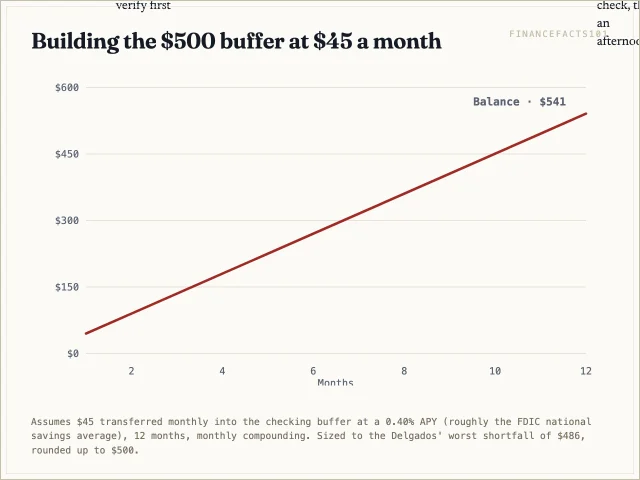
Build it automatically and out of sight. At $45 a month the Delgados reach $496 by month 11 and $541 by month 12 — one year of small transfers to end a $415-a-year problem. Run your own version in the emergency fund calculator, or set a dated target in the savings goal calculator. Keep the buffer in checking rather than savings if your bank's transfer takes a day: a buffer that arrives on Tuesday does not stop a Monday fee.
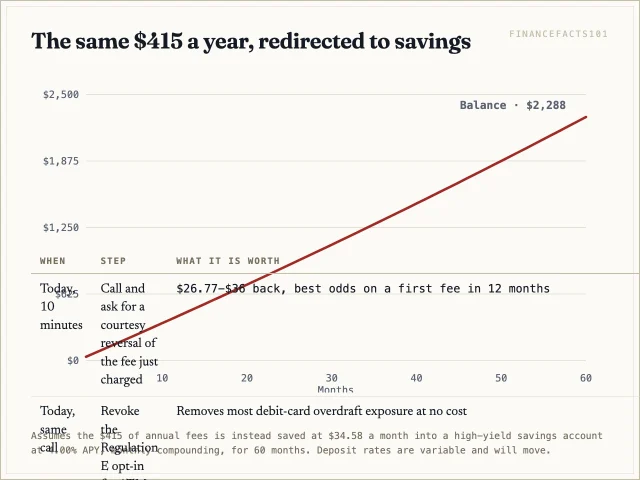
Then redirect what the fees were eating. $415 a year is $34.58 a month; at a 4.00% APY, the kind of rate discussed in high-yield savings vs CDs, that becomes about $423 in year one, $1,319 after three years and $2,288 after five. That is the real cost of the fees — not $415, but the $2,288 of reserve you never had. Once the buffer is built, the same emergency fund calculator sizes the next tier, and the broader target is set out in how big an emergency fund should be.
The Decision, in Order
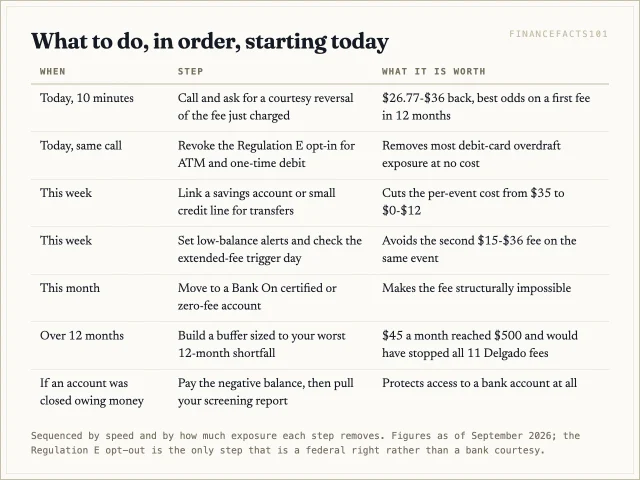
Do them in that sequence. The call today recovers cash already lost. The opt-out and the linked transfer take one online-banking session and remove most future exposure at zero cost. Switching to an account that cannot charge the fee is the permanent answer, and the buffer stops the checks and recurring debits no opt-out covers. To see where the recovered money sits in the wider picture, put it into the net worth calculator.
FAQ
How do I get an NSF fee refund from my bank?
Call the number on your card within a few days of the charge, name the fee, date and amount, say the account is in good standing, and ask for a one-time courtesy reversal. If the agent declines, ask whether a courtesy reversal is available or whether they can escalate. Odds are far better on a first fee in twelve months; if several hit one statement, ask for two or three rather than all.
What is the difference between an overdraft fee and an NSF fee?
An overdraft fee means the bank paid the item anyway and charged you for the advance — your payment went through. An NSF or returned-item fee means the bank refused the item and charged you regardless — your payment did not go through, you still owe the payee, and the payee will usually add a returned-payment fee of their own. Most large banks have eliminated NSF fees; most still charge overdraft fees.
Can I stop overdraft fees on my debit card entirely?
For ATM withdrawals and one-time debit card purchases, yes. Under 12 CFR 1005.17, a bank may only charge those overdraft fees if you affirmatively opted in, and you may revoke that consent at any time at no cost — the bank must give you the same account terms either way. Transactions that would overdraw are then simply declined. Checks and recurring automatic payments are not covered by the opt-out and can still overdraw the account.
Is there a federal cap on overdraft fees in 2026?
No. The CFPB finalized a rule in December 2024 that would have capped the fee at $5 at institutions above $10 billion in assets, but Congress disapproved it under the Congressional Review Act and the President signed the resolution on May 9, 2025. The rule never took effect, and the CRA bars a substantially similar rule without new congressional authorization. Fee levels are set by each institution and vary from $0 to about $36 as of September 2026.
Sources
- CFPB, Bank account key terms — the overdraft versus NSF definitions
- CFPB, 12 CFR 1005.17, Requirements for overdraft services — the Regulation E opt-in and right to revoke
- CFPB, Overdraft and Nonsufficient Fund Fees report, December 2023 — median $35 overdraft and $32 NSF fees at institutions above $10 billion
- CFPB, Overdraft/NSF revenue in 2023, data spotlight, April 24, 2024 — $5.8 billion in 2023, $6.1 billion decline, $240 million refunded
- CFPB, Vast majority of NSF fees have been eliminated, October 11, 2023 — bank and credit union elimination rates
- CFPB, Consumer Financial Protection Circular 2024-05 — improper overdraft opt-in practices
- CFPB, Regions Bank ordered to pay $191 million, September 2022 — authorize-positive, settle-negative fees
- CFPB, Why was I denied a checking account? — ChexSystems, adverse action notices and dispute rights
- CFPB, Submit a complaint
- FDIC, Overdraft and account fees — asking the bank to waive a fee, linked transfers, low-cost accounts
- FDIC, #GetBanked — Bank On certified accounts with no overdraft or NSF fees
- FDIC, FIL-14-2026: Rescission of supervisory guidance on multiple re-presentment NSF fees, April 10, 2026
- Federal Reserve, Final rules prohibiting overdraft fees on ATM and one-time debit transactions, November 12, 2009
- NCUA, Overdraft courtesy pay programs — written policy and 45-day repayment requirements
- Congressional Research Service, Congress Repeals CFPB's Overdraft Rule
- Bankrate, 2025 checking account and ATM fee survey, published September 10, 2025 — $26.77 average overdraft fee, $16.82 average NSF fee
- Bankrate, Banks that have cut or eliminated overdraft fees, updated November 3, 2025
 Next entry · No. 5,953Adjustable-Rate CDs: What the Bump-Up Option Really Costs
See also
-
 No. 3,590
10 Apr 2025
18 min
Understanding Non-Sufficient Funds (NSF) Fees: Charges, Avoidance, and Criticisms
Business Finance
No. 3,590
10 Apr 2025
18 min
Understanding Non-Sufficient Funds (NSF) Fees: Charges, Avoidance, and Criticisms
Business Finance -
 No. 5,955
19 Sep 2026
20 min
Deposit Accounts: Checking vs Savings vs Money Market vs CD
Banking
No. 5,955
19 Sep 2026
20 min
Deposit Accounts: Checking vs Savings vs Money Market vs CD
Banking -
 No. 5,163
16 Aug 2025
22 min
Understanding Uncollected Funds: What They Are, How They Protect Banks and Customers, and Their Criticisms
Banking
No. 5,163
16 Aug 2025
22 min
Understanding Uncollected Funds: What They Are, How They Protect Banks and Customers, and Their Criticisms
Banking -
 No. 5,578
20 Sep 2025
19 min
Waiver of Exemption: Understanding Its History and Modern Regulations in Finance and Investment
Business Finance
No. 5,578
20 Sep 2025
19 min
Waiver of Exemption: Understanding Its History and Modern Regulations in Finance and Investment
Business Finance -
 No. 5,372
03 Sep 2025
20 min
Usury Laws: Understanding Interest Rate Regulations and Their Implications for Investors
Business Finance
No. 5,372
03 Sep 2025
20 min
Usury Laws: Understanding Interest Rate Regulations and Their Implications for Investors
Business Finance -
 No. 5,280
26 Aug 2025
20 min
Understanding Universal Default: What You Need to Know About This Credit Card Provision
Personal Finance
No. 5,280
26 Aug 2025
20 min
Understanding Universal Default: What You Need to Know About This Credit Card Provision
Personal Finance