Adjustable-Rate CDs: What the Bump-Up Option Really Costs
A bump-up CD pays 3.00% where a fixed CD pays 4.25% as of September 2026. That 1.25-point haircut, its break-even, and why a CD ladder wins for free.
You have $25,000 that can sit still for two years, and a bank offers you a choice: 4.25% locked, or 3.00% with the right to raise your rate later if rates climb. That is the entire argument over adjustable-rate CDs, and it is not really an argument about rates. It is an argument about who pays for an option. As of September 2026 the bank prices the right to bump into a 1.25-percentage-point cut in your starting APY — and a plain CD ladder hands you most of the same flexibility for nothing.
This guide separates the four products filed under "adjustable" — bump-up, step-up, variable-rate and callable — prices the haircut in dollars, finds the exact rate move at which a bump-up finally beats a fixed CD, and runs $25,000 through three structures under rising and falling rates. One line of scope honesty first: general information built on stated assumptions and rates as of September 2026, not personal advice.
Adjustable-Rate CDs Are an Option You Pay For
Every adjustable structure is the same trade in different wrapping. You give up yield today for a claim on yield tomorrow, and banks price that claim the way any option seller does — in their own favor.
The numbers, as of early September 2026. Ally's Raise Your Rate CD, the best-known bump-up product, pays 3.00% APY on both its 2-year and 4-year terms (correct as of 09/02/26), and Synchrony's 24-month Bump-Up CD also pays 3.00%. The top nationally available fixed 2-year CDs pay 4.25% to 4.30% — Synchrony 4.25%, Bread Savings 4.25%, Marcus 4.30%. A top high-yield savings account, with no lock at all, pays about 4.10%.
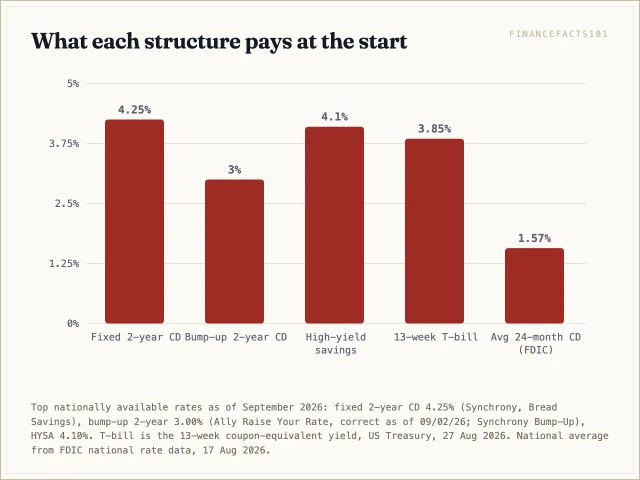
For scale: the FDIC's national rate data, published August 17, 2026, puts the average 24-month CD at 1.57% and the average savings account at 0.38%. The gap between average and top-of-market dwarfs every structural choice in this article. Shop the rate first; argue about the structure second.
Who This Is For — and Who It Isn't
This is for a US saver with roughly $5,000 to $250,000 in cash that has a job to do inside five years, who has been shown a bump-up or step-up CD and wants to know whether the feature is worth its price. It assumes you want zero market risk on this money and already keep a month of spending in checking.
It is not for money you might need next month — that belongs in savings, and the emergency fund calculator plus the guide to emergency fund size settle the amount. It is not investing advice: a lump sum destined for the market is a different question, covered in lump sum vs dollar-cost averaging. And above $250,000 at one institution, your first problem is insurance structure, not yield.
Four Products, One Word: Which "Adjustable" Are You Being Sold?
Most sources blur these together. They are not the same, and the difference is who controls the rate change.
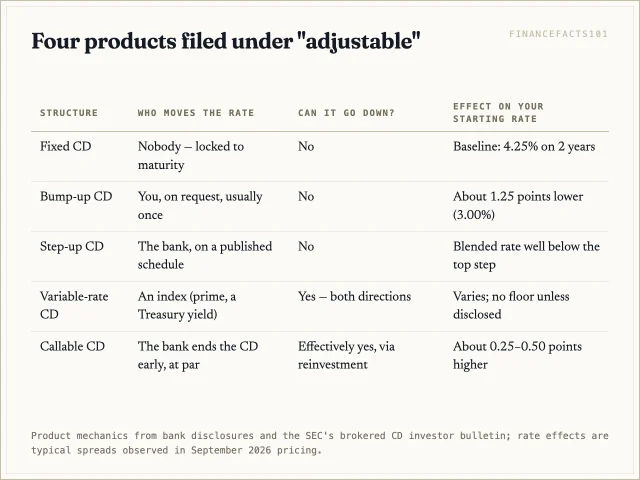
A bump-up CD gives you the option, once (twice on longer terms), and only if you ask. Ally's 2-year Raise Your Rate allows one increase; its 4-year allows two. Nothing happens automatically — forget to watch rates and you keep the low starting rate for the full term. That is the product's quiet failure mode: an option nobody exercises is worth zero.
A step-up CD removes both the initiative and the uncertainty. The bank publishes the whole schedule at account opening — a rate rising at fixed intervals, typically every six or seven months — whether market rates move or not. The number that matters is never the final step; it is the blended rate across the term. A 24-month step-up running 2.50%, 3.00%, 3.50% and 4.00% in six-month blocks looks like it "reaches 4%," but blends to 3.25%. On $25,000 that finishes at $26,677 against $27,214 for the flat 4.25% CD — $537 behind, while advertising a higher headline.
A variable-rate CD ties the rate to an index — prime, a Treasury yield, the bank's own posted rate — and moves in both directions. It is the only structure here that can pay you less than you started with, the tradeoff set out in the entry on the variable-rate certificate of deposit.
A callable CD is the inversion, and the one readers most often misread. The option belongs to the bank, not to you.
The Starting-Rate Haircut, in Dollars
Take the haircut alone, with no rate move at all, and hold $25,000 for 24 months with monthly compounding.
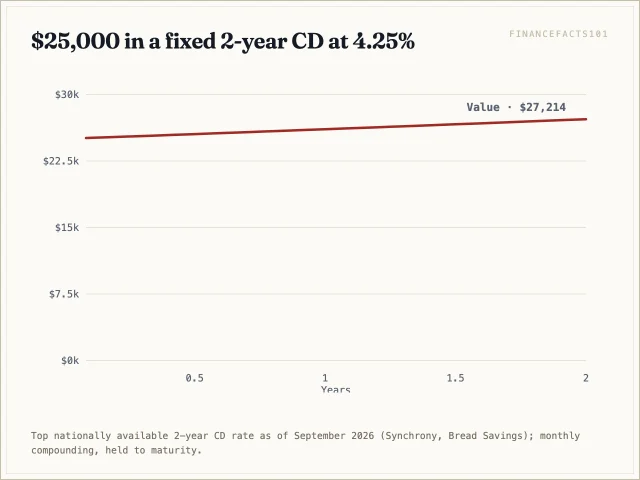
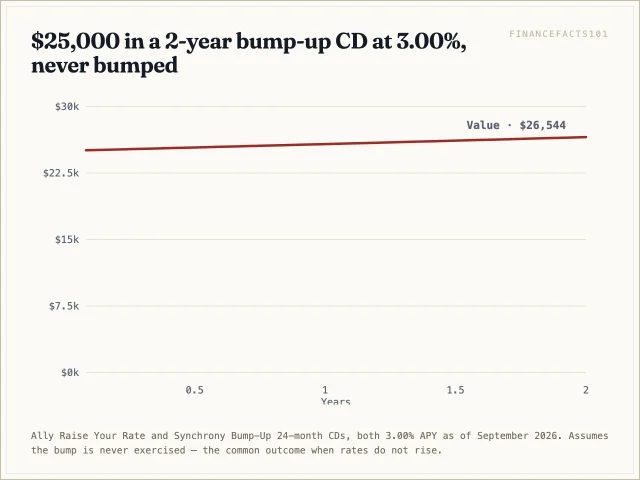
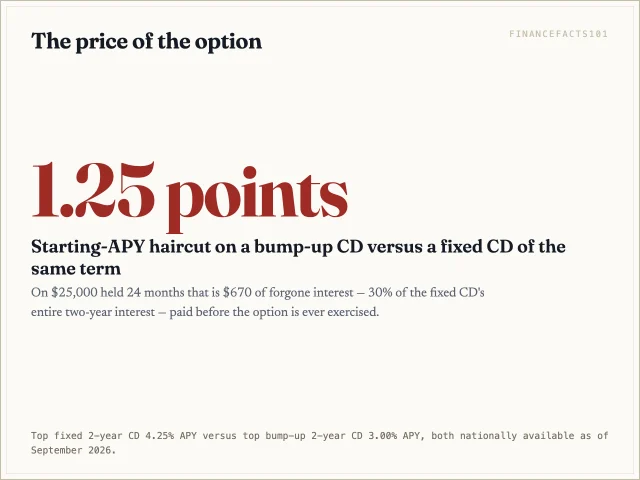
The fixed 2-year CD at 4.25% reaches about $26,083 at twelve months and $27,214 at twenty-four — $2,214 of interest. The bump-up at 3.00%, never bumped, reaches $25,760 and $26,544 — $1,544 of interest. The difference is $670 over two years, about $28 a month, paid in every month before you bump.
Hold that number. The bump-up option costs 30% of the fixed CD's entire interest. Run your own balance and term through the compound interest calculator before treating the feature as a free extra.
The Break-Even: How Far Rates Must Move
Here is the figure most articles will not compute. Buy the 3.00% bump-up, wait for rates to rise, and at month m bump to a new rate R for the remaining term. What does R have to be for the bump-up to merely tie the 4.25% fixed CD you passed on?
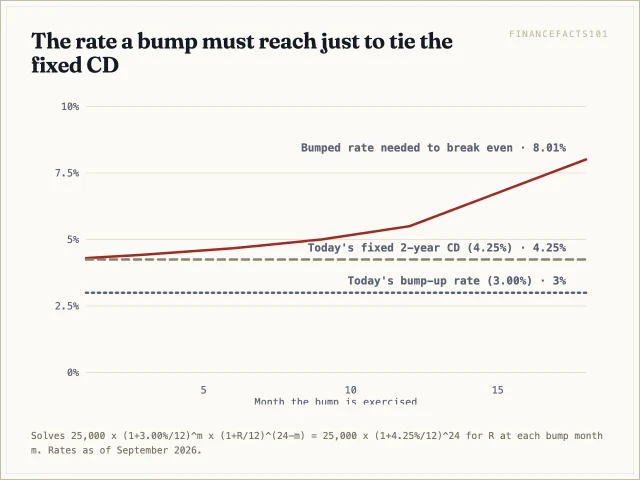
Bump on day one and you need 4.30% — barely above the fixed CD, because you gave up almost nothing. But nobody bumps on day one; you bump when rates have actually moved. Bump at month 6 and you need 4.67%: the bump-up product must rise 1.67 points, which given its 1.25-point discount implies fixed 2-year CDs near 5.9%. Bump at month 12 — the realistic case, since a rate cycle takes time — and you need 5.50%, a 2.50-point rise. Wait until month 18 and no plausible rate does it: 8.01%.
Translate that into Fed terms. On September 16, 2026 the FOMC raised the federal funds target to 3-3/4 to 4 percent, its first hike since 2023 — and it moved by a quarter point, the size three members had dissented for in July. A month-12 break-even of 5.50% needs roughly ten consecutive quarter-point hikes to reach your deposit rate inside a year. That is the bar the bank set when it priced the option.
The CD Ladder Does the Same Job for Free
A CD ladder buys flexibility with maturities instead of yield. Split the money into rungs of staggered terms; as each matures you get cash at par, penalty-free, and reinvest at whatever the market pays that day. That is a bump — on a schedule rather than on request, and costing nothing in starting rate.
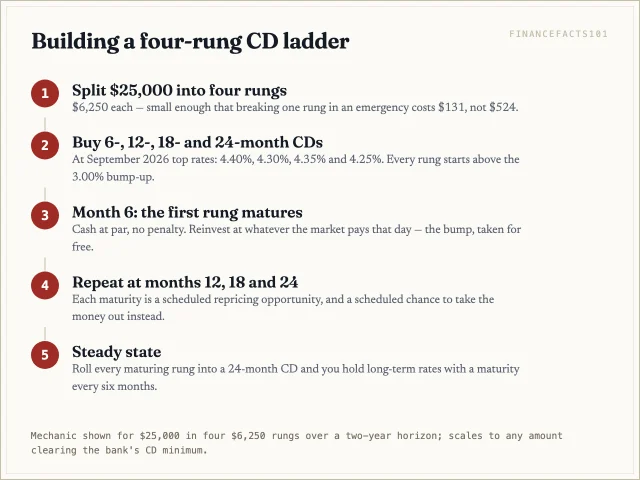
Four rungs of $6,250 each, at the top nationally available rates for each term as of September 2026:
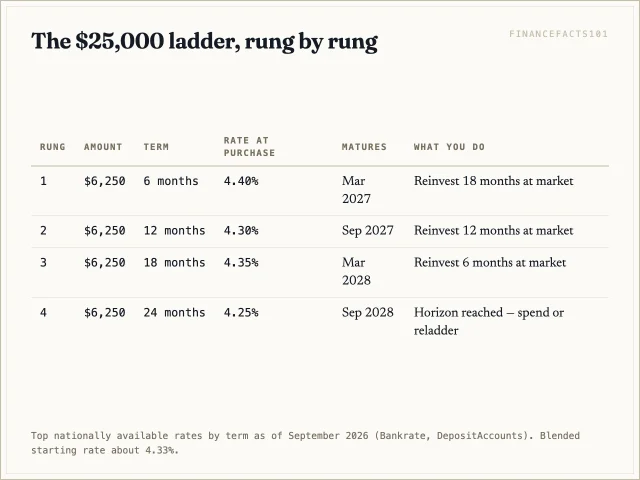
The rungs pay 4.40% (6-month), 4.30% (12-month), 4.35% (18-month) and 4.25% (24-month) — every one above the 3.00% bump-up, for a blended start of about 4.33%. The general mechanic is covered in the entry on laddering fixed income; here the point is narrower. The ladder is the bump-up option, unbundled and given away.
$25,000 Three Ways, Rising and Falling
The worked example. Same $25,000, same 24-month horizon, monthly compounding, three structures: the fixed 2-year at 4.25%, the bump-up at 3.00% with one bump, and the four-rung ladder. Rates move once, at month 6, and stay there.
In the rising scenario every CD rate is 1.5 points higher from month 6 — the bump-up holder bumps to 4.50% for the remaining 18 months, and the ladder reinvests each maturing rung at 5.8% to 5.9%. In the falling scenario every rate is 1.5 points lower; there is nothing to bump to, so the bump-up stays at 3.00% and the ladder reinvests at 2.8% to 2.9%.
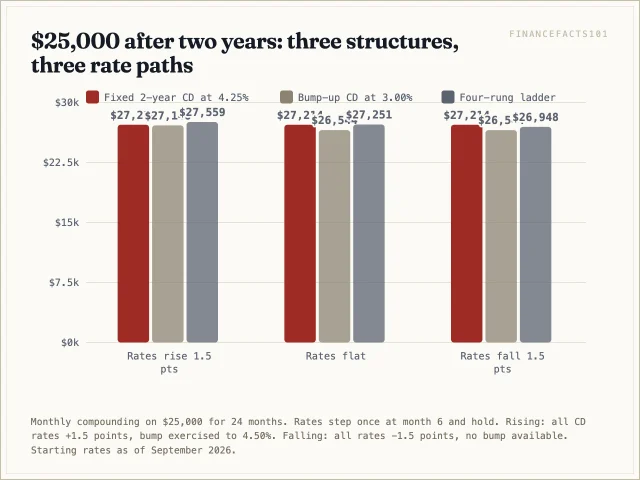
The results are blunt. If rates rise, the ladder ends at $27,559, the fixed CD at $27,214, and the bump-up — after a successful, well-timed bump — at $27,146. It loses by $68 in the scenario it was designed for, and by $413 to the ladder. If rates fall, the fixed CD wins at $27,214, the ladder takes $26,948, the bump-up finishes last at $26,544. Rates flat: ladder $27,251, fixed $27,214, bump-up $26,544.
The bump-up comes third in all three worlds — what a 1.25-point premium buys. The ladder's honest cost shows up too: it gives up $266 to the fixed CD when rates fall, because part of its money reprices downward. That is the real trade, and it runs between the fixed CD and the ladder; the adjustable product is not in the conversation. Test your own amount and horizon in the savings goal calculator before committing to a term.
The Exit Price: Penalties Are the Real Cost of Flexibility
If flexibility is what you are buying, price it directly. Breaking a CD costs a stated number of days or months of interest, charged whether or not you have earned it — a very early exit eats principal.
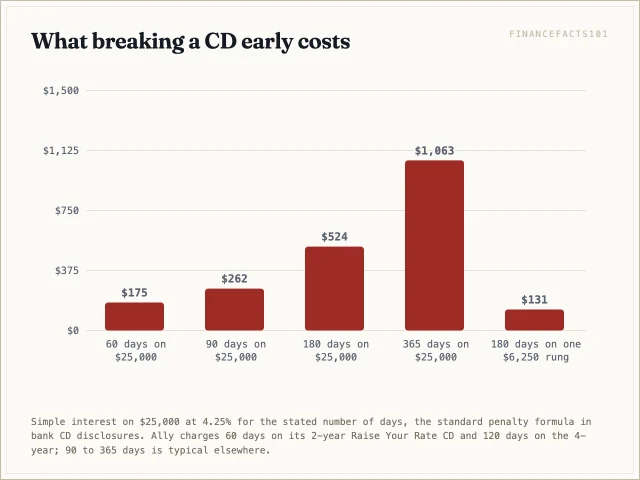
On $25,000 at 4.25%, a 60-day penalty is $175, 90 days is $262, 180 days is $524, and a full 365 days is $1,063. Ally charges 60 days on its 2-year Raise Your Rate CD and 120 days on the 4-year, and does not permit partial withdrawals. Note what that means here: the entire two-year value of the bump-up option, $670, is roughly the cost of breaking a 180-day-penalty CD once.
The ladder wins on this axis too. An emergency at month 9 forces the fixed-CD holder to break the whole $25,000; the ladder holder breaks one $6,250 rung at a 180-day penalty of $131 instead of $524 — and if the emergency lands near a maturity, $0. Sizing that exposure is the same exercise as sizing interest rate risk: ask what the worst realistic path costs, not the expected one.
Callable CDs: The Option Belongs to the Bank
A callable CD pays visibly more than its non-callable twin — typically 25 to 50 basis points — and that premium is easy to misread as a reward. It is a payment: you have sold the bank the right to end the CD early, at par, on its schedule, after a call-protection window that usually runs six months to a year.
Think about when the bank exercises. It calls when rates have fallen and refinancing you is cheap — exactly the moment you would most want to keep a high locked rate. It never calls when rates rise, so you stay locked while everyone else reprices upward. The mechanics, and the asymmetry, match a callable bond.
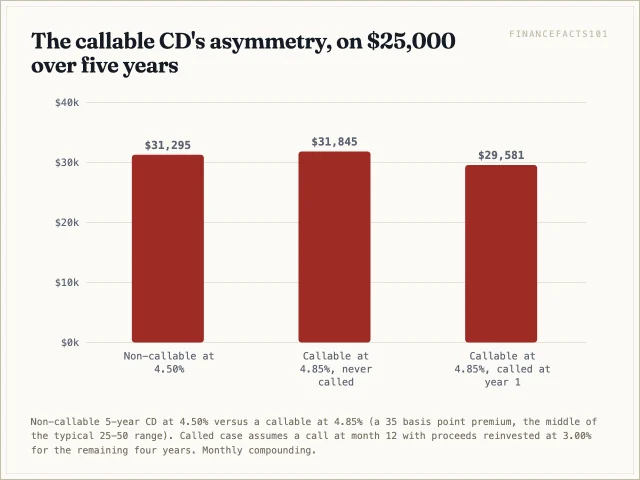
On $25,000 over five years: a non-callable CD at 4.50% finishes at $31,295. A callable at 4.85% never called finishes at $31,845 — you win $550. The same callable, called at month 12 with proceeds reinvested at 3.00% for the remaining four years, finishes at $29,581 — you lose $1,714. You are being paid $550 to accept a $1,714 loss in the one state of the world where the call gets used. The SEC's Brokered CDs investor bulletin is direct: the decision to call is at the issuer's sole discretion, and you may get a worse rate when you reinvest.
Brokered CDs Trade at Market Price, Not Par
Brokered CDs — bought through a brokerage rather than a bank — need their own section because one property overturns the mental model. A bank CD is redeemed at face value minus a penalty. A brokered CD generally has no early-withdrawal option at all; to get out, you sell it on the secondary market at whatever price it fetches.
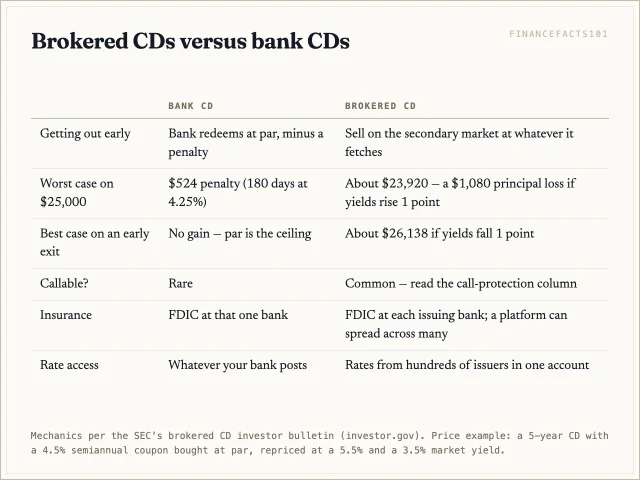
That price behaves like a bond's. A 5-year brokered CD with a 4.5% coupon, bought at par, reprices to about 95.68 if comparable yields rise one point — on $25,000, a sale nets roughly $23,920, a $1,080 loss of principal. If yields fall one point it prices near 104.55, or $26,138. The upside is real, and so is a downside that can exceed a bank CD's penalty; price it the way you would a bond, with the bond yield calculator.
Brokered CDs are still FDIC-insured at the issuing bank, and a platform can spread a large balance across many issuers to multiply coverage — their genuine advantage, along with reaching rates no single bank posts, the territory of jumbo CDs. But "insured" protects you from bank failure, not from a price move on a sale you chose to make.
Insurance: $250,000, and How Ownership Categories Multiply It
None of this is safe money if the bank is not covered. FDIC insurance is $250,000 per depositor, per insured bank, per ownership category; checking, savings and CDs at one bank share one limit inside a category. NCUA share insurance mirrors the number exactly at federally insured credit unions, backed by the full faith and credit of the United States.
The categories are the lever, and they multiply cleanly.
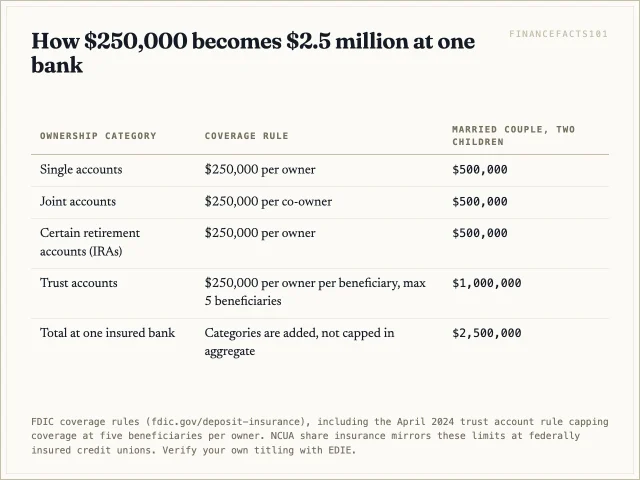
A married couple with two children can carry $2.5 million of coverage at a single bank: $250,000 each in single accounts, $500,000 joint, $500,000 across two IRAs, and $1 million in trust accounts naming the children. Since the FDIC's April 2024 rule change, trust accounts are covered at $250,000 per owner per beneficiary, capped at five beneficiaries — $1.25 million per owner. Titling is what creates coverage, so verify your exact structure with the FDIC's EDIE estimator.
Taxes: Ordinary Income, Including Interest You Cannot Touch
CD interest is ordinary income in the year it is credited, taxed at your marginal rate, with no capital-gains treatment. Banks report anything over $10 on Form 1099-INT, per IRS Topic 403.
The trap sits in multi-year CDs that pay only at maturity: you still owe tax annually. IRS Publication 550 treats a CD maturing in more than one year that pays interest at the end as original issue discount, so a portion enters income each year even though the cash is locked. The 4.25% two-year CD generates about $1,062 of taxable interest in year one; at a 24% marginal rate that is a $255 bill paid from other money. Budget for it, or hold the CD inside an IRA.
One offset: an early-withdrawal penalty appears in box 2 of the 1099-INT and is deductible as an adjustment to income on Schedule 1, no itemizing needed — a $524 penalty nets to about $398 at a 24% rate. The comparison against Treasuries also shifts after tax. As of August 27, 2026, 13- and 26-week Treasury bills yielded 3.85% coupon-equivalent, and bill interest is exempt from state income tax. At a 9.41% state marginal rate, 3.85% exempt equals 4.25% taxable — so in California or New York, T-bills match the best fixed CD and beat the bump-up outright.
When a High-Yield Savings Account Beats All of This
Sometimes none of these products earns its complexity. A top high-yield savings account paid about 4.10% as of September 2026, with no term, no penalty and no option to exercise. Held two years at a flat 4.10%, $25,000 reaches about $27,133.
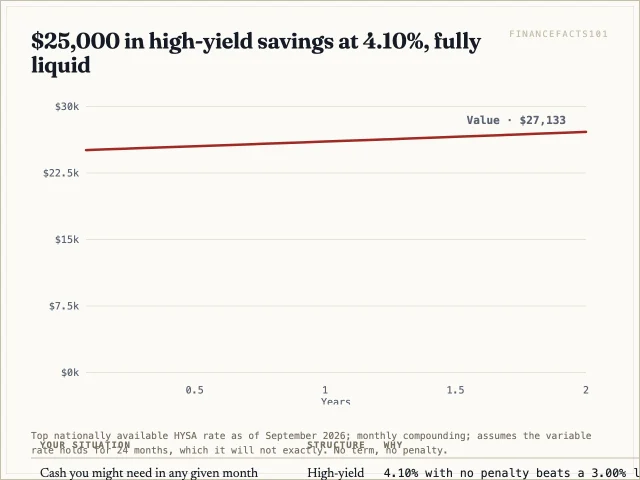
That is $81 behind the locked 4.25% CD and $589 ahead of the bump-up — while staying fully liquid throughout. In the bank's language: the bump-up CD asks you to lock your money for two years and accept less than a savings account pays, in exchange for a lottery ticket on rate hikes. Savings carries the opposite risk — its rate floats down with Fed cuts, which is exactly what a fixed CD or ladder protects against, and that tradeoff is worked through in high-yield savings vs CDs. Against an adjustable CD specifically, savings is not close.
Inflation is the last check. A 4.25% CD is a real gain only if prices rise more slowly; the inflation calculator shows what a rate leaves you after the fact, and the compound interest calculator shows what any of these paths does at your own balance.
The Decision, in One Table
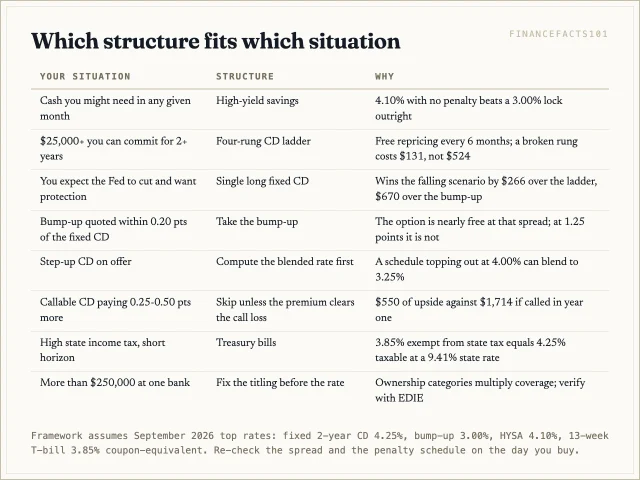
The short version: buy a bump-up or step-up CD only if the quoted rate is within about 0.20 points of the best fixed CD for the same term. At today's 1.25-point spread, no. Prefer a ladder whenever the balance clears four times your bank's CD minimum, because it converts a paid option into a free one. Take a callable CD only if the premium is large enough that being called in year one still leaves you ahead — at 35 basis points it is not. And check two numbers on the day you buy: the fixed-versus-adjustable spread for your exact term, and your bank's published penalty schedule.
FAQ
Is a bump-up CD ever worth it?
Only when the starting-rate discount is small. At a 1.25-point haircut, bumping at month 12 of a two-year term requires the bump-up rate to reach 5.50% — a 2.50-point rise. If a bank quotes a bump-up within about 0.20 points of its fixed CD for the same term, the option is close to free and worth taking. As of September 2026 the actual spread is 1.25 points, and it is not.
What is the difference between a bump-up CD and a step-up CD?
A bump-up CD gives you the right to request a rate increase, usually once, and nothing happens unless you ask. A step-up CD raises the rate on a schedule the bank publishes at account opening, with no action required and no connection to market rates. Judge a step-up by its blended rate, not its highest step — a schedule ending at 4.00% can blend to 3.25%.
Can the bank take back my CD early?
Only if it is callable. A standard bank CD runs to maturity unless you break it. A callable CD lets the issuer end it at par after a call-protection window, and it will, when rates fall and refinancing you is cheap. The extra 25 to 50 basis points is the price of that right, and on a five-year $25,000 CD the loss from being called can run three times the premium you were paid.
Does a CD ladder really replace an adjustable-rate CD?
For the rising-rate case, yes, and at a better starting rate. Each maturing rung is a scheduled chance to reprice at market — the same benefit a bump promises, without giving up 1.25 points to get it. What a ladder does not replicate is full-term protection if rates fall, since maturing rungs reinvest lower. That tradeoff sits between a ladder and a single long fixed CD, not between a ladder and an adjustable CD.
Sources
- FDIC, National Rates and Rate Caps — national average deposit rates, published August 17, 2026 (savings 0.38%, 24-month CD 1.57%)
- FDIC, Deposit Insurance and the EDIE estimator — $250,000 per depositor, per bank, per ownership category, and the 2024 trust account rule
- NCUA, Share Insurance Coverage — the credit-union equivalent
- Federal Reserve, FOMC statement, July 29, 2026 — 3.50–3.75% target range held, three dissents for a hike
- Federal Reserve, FOMC statement, September 16, 2026 — target range raised 0.25 point to 3.75–4.00%, 12–0 vote
- SEC Office of Investor Education, Brokered CDs investor bulletin — call provisions, secondary-market sales, insurance
- SEC, Certificates of Deposit (CDs) — product basics
- IRS, Topic 403, Interest Received and Publication 550 — ordinary-income treatment, OID on CDs over one year, penalty deduction
- CFPB, What is a certificate of deposit?
- TreasuryDirect, Treasury bills and Treasury's daily bill rates — 3.85% coupon-equivalent on 13- and 26-week bills, August 27, 2026
- Ally Bank, Raise Your Rate CD — 3.00% APY as of 09/02/26, one bump on 2-year terms, two on 4-year
- Bankrate, Bump-up CDs and Best 2-Year CD Rates, September 2026
- DepositAccounts, Best 18-Month CD Rates, September 2026 and Best 2-Year CD Rates
- NerdWallet, Synchrony Bank CD rates — 24-month Bump-Up CD at 3.00% APY
 Next entry · No. 5,954Prime Rate Changes: What a Fed Move Costs or Saves You
See also
-
 No. 5,955
19 Sep 2026
20 min
Deposit Accounts: Checking vs Savings vs Money Market vs CD
Banking
No. 5,955
19 Sep 2026
20 min
Deposit Accounts: Checking vs Savings vs Money Market vs CD
Banking -
 No. 5,930
02 Sep 2026
14 min
High-Yield Savings vs CDs: Where Cash Earns More
Personal Finance
No. 5,930
02 Sep 2026
14 min
High-Yield Savings vs CDs: Where Cash Earns More
Personal Finance -
 No. 5,437
08 Sep 2025
14 min
Variable-Rate Certificate of Deposit (CD): How Adjustable-Rate CDs Work
Finance Policy
No. 5,437
08 Sep 2025
14 min
Variable-Rate Certificate of Deposit (CD): How Adjustable-Rate CDs Work
Finance Policy -
 No. 658
16 May 2024
22 min
Understanding Certificates of Deposit (CDs) and Their Benefits
Investments
No. 658
16 May 2024
22 min
Understanding Certificates of Deposit (CDs) and Their Benefits
Investments -
 No. 336
09 Apr 2024
22 min
Understanding Bank Deposits: Types, Functions, and Special Considerations
Banking
No. 336
09 Apr 2024
22 min
Understanding Bank Deposits: Types, Functions, and Special Considerations
Banking -
 No. 5,968
02 Oct 2026
18 min
T-Bills vs CDs vs High-Yield Savings: Where 3-12 Month Cash Goes
Investments
No. 5,968
02 Oct 2026
18 min
T-Bills vs CDs vs High-Yield Savings: Where 3-12 Month Cash Goes
Investments