Prime Rate Changes: What a Fed Move Costs or Saves You
Prime hit 7.00% on Sept 17, 2026, after the first Fed hike since 2023. What reprices, how fast, and the $53,200 line that decides if a move helps or hurts.
A quarter-point Fed move is worth $58 a year to the household in this article; a full point is worth $232. Prime rate changes are the pipe that carries that money to you: prime — 7.00% since September 17, 2026, per the Federal Reserve's H.15 release — is the index written into most variable-rate consumer debt in the United States, and when it moves, your credit card and your home equity line move with it inside a billing cycle or two.
Most coverage explains what prime is. This prices what a change does: which balances reprice, on what timetable, which never move, and the crossover at which a rate cut quietly turns into a pay cut — plus why a hike almost never pays you back across the same line. Scope honesty first — this is general information built on stated assumptions and rates as of September 2026, not personal advice.
What Prime Rate Changes Actually Reprice
The Federal Open Market Committee raised the federal funds target range by a quarter point to 3.75–4.00% on September 16, 2026, by a unanimous 12–0 vote. It was the first increase since July 2023 and the first move of any kind after a nine-month hold; the six moves before it, from September 2024 to December 2025, were all cuts. Prime followed to 7.00% the next day, ending a run at 6.75% that began December 11, 2025. The next scheduled decision is October 28, 2026.
So what the prime rate means for you is not a definition. It is a balance-by-balance question with three parts: which accounts carry a rate written as "prime plus a margin", how large those balances are, and how much cash sits on the other side of the ledger earning a rate that moves the same way, on the bank's schedule rather than a contract's.
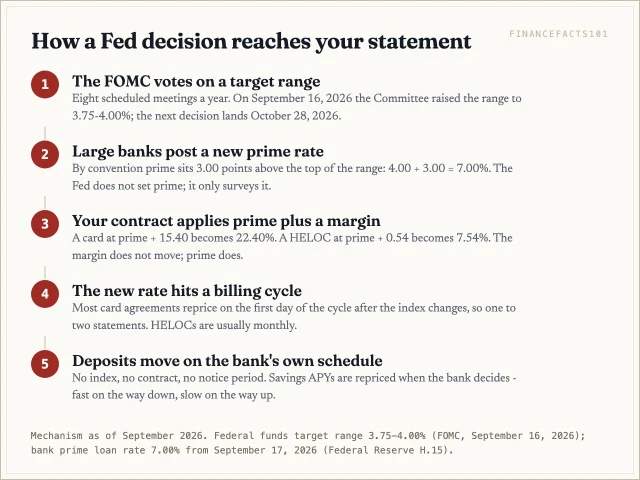
Five links, and only the first belongs to the Federal Reserve. Everything after it is a private contract — which is why "how much will this save me" is answered in your cardholder agreement, not in the Fed's press release.
Who This Is For — and Who It Isn't
This fits a US household carrying at least one variable-rate balance — a credit card, a HELOC, a personal line of credit, a variable private student loan — plus some cash in savings. If that is you, a Fed decision has a dollar value you can compute in five minutes.
It is not for the reader whose debt is entirely fixed: a fixed-rate mortgage, a fixed auto loan, a federal student loan. For that household a prime move changes nothing about existing balances, and the only live question is whether future borrowing gets cheaper. It is also not a forecast — nothing here predicts what the Committee does on October 28 or after, only what to do in either case.
And it is no substitute for reading your own paperwork. Margins vary enormously: at today's 7.00% prime, a HELOC at prime + 0.54 charges 7.54% and a retail card at prime + 22.99 charges 29.99%.
Where Prime Comes From: The Fed Sets a Range, Banks Post the Rate
The most common misconception is that the Fed sets prime. It does not. The Fed sets a target range for the federal funds rate — the overnight rate banks charge each other — and separately publishes a survey of what banks post. H.15 defines the bank prime loan series as a "rate posted by a majority of top 25 (by assets in domestic offices) insured U.S.-chartered commercial banks." Measurement, not instruction.
What makes prime look Fed-set is a convention the largest banks have followed since the mid-1990s: prime equals the Fed's federal funds target plus 3.00 percentage points. Since December 2008, when the Fed began setting a target range instead of a single rate, that has meant the top of the range plus 3.00. Today, 4.00 + 3.00 = 7.00%. Durable, but still a convention — a bank is free to post something else, and the widely quoted Wall Street Journal figure is itself a survey, not an official rate. Background on both benchmarks sits in the entries on the prime rate, the WSJ prime rate and the federal funds rate.
How Fast Prime Moves After an FOMC Decision
Very fast — faster than almost anything else in consumer finance.
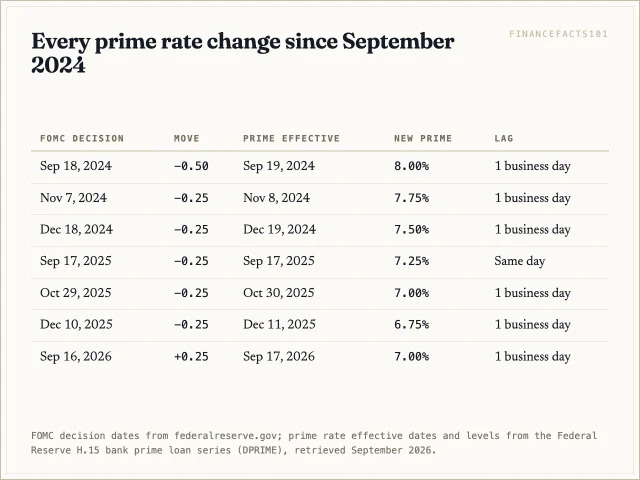
Seven prime changes since September 2024 — six cuts, then the September 2026 hike: in six, prime moved the next business day; once, the same afternoon. There is no lag to plan around at this step. The lag lives further down the chain, in your billing cycle — most card agreements apply the new index on the first day of the cycle beginning after it changes, so the hike announced on September 16 shows up on your October or November statement.
One practical consequence. If you are about to pay off a card and are tempted to wait for rates to come back down, waiting does not help: a quarter point on $8,200 is $20.50 a year, while carrying the balance one more month costs $153. Run your numbers through the credit card payoff calculator and the rate move looks small next to the payment.
What Tracks Prime, and What Doesn't
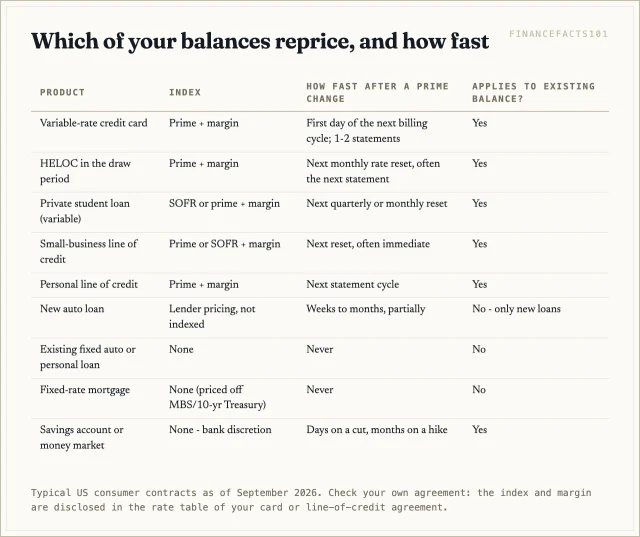
Three lines deserve emphasis. Variable cards and HELOCs in the draw period reprice on your existing balance — money you already owe gets cheaper or dearer, which is unusual, and is why these two accounts dominate the arithmetic. New auto loans are only loosely connected: lenders price them off their own funding costs and captive-finance promotions, so a prime move shows up as slightly better or worse offers weeks later, if at all, and never on the loan you already signed. If you are shopping, the auto loan calculator prices what a half-point better offer is worth over the term — usually less than $500 off the sticker.
And the last line is the one people forget. Deposits have no index at all. Your savings APY is a posted price the bank changes at will.
Your Mortgage Does Not Follow Prime
The most expensive misconception in the category, and 2026 supplies a clean disproof. Prime sat at 6.75% from January 1 through September 16. Over that stretch the 30-year fixed mortgage went from 5.98% in the week of February 26 to 6.71% in the week of September 3 — up 0.73 points with the index everyone watches sitting perfectly still.
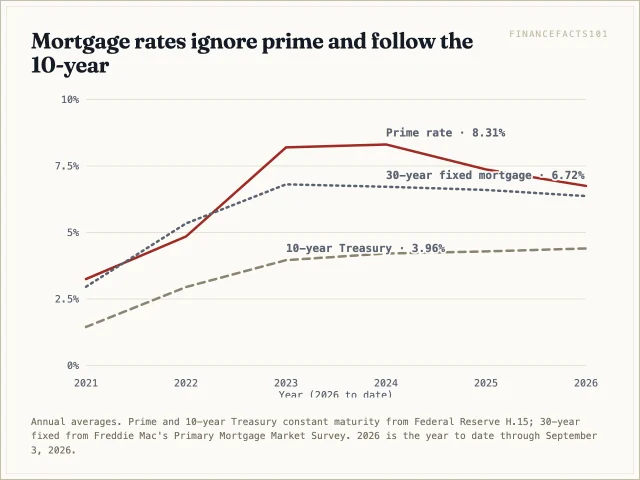
Thirty-year fixed rates are priced off mortgage-backed securities, themselves priced off the 10-year Treasury plus a spread for prepayment and credit risk. The 10-year closed at 4.77% on September 3, 2026 against Freddie Mac's 6.71% — a spread of 1.94 points, wide by historical standards. A Fed cut moves the short end of the curve; the 10-year answers to inflation expectations, term premium and Treasury supply, and can rise on the day the Fed cuts.
The September hike shows the order of events from the other side. The 10-year had already climbed to 5.01% by the day of the decision, and Freddie Mac's 30-year reached 6.95% in the week of September 17 — the mortgage followed the Treasury, which moved before the Fed did.
So do not wait for a Fed cut to refinance. Watch the 10-year instead and price the trade on closing costs and a break-even month — the method is in refinance cost, the arithmetic in the mortgage refinance calculator. Adjustable-rate mortgages are the exception: their resets are indexed, usually to SOFR, per the entry on adjustable-rate mortgages.
SOFR, LIBOR, and Which Index Your Loan Actually Uses
Prime is not the only index. Until 2023 much floating-rate consumer and business credit referenced LIBOR. USD LIBOR's remaining tenors ceased publication after June 30, 2023, and the Federal Reserve's final rule implementing the Adjustable Interest Rate (LIBOR) Act named SOFR-based replacements for contracts with no workable fallback of their own. A variable private student loan or ARM signed before 2023 was almost certainly converted by that rule: it did not become fixed, it changed benchmarks.
The rough division today: prime dominates retail revolving credit — cards, HELOCs, personal and small-business lines — because it is a posted bank rate and simple to disclose. SOFR dominates institutional lending, most ARMs and a large share of variable private student loans. The two move together but not identically: SOFR is a transaction-based overnight rate published by the New York Fed and tracks the effective federal funds rate continuously, while prime jumps in discrete 0.25-point steps. Background in the entries on the LIBOR-to-SOFR transition and variable interest rates. Find your own index the boring way: the rate table on page one of your agreement names it, along with the margin.
The Asymmetry: Your Debt Reprices Faster Than Your Savings
Borrowing rates and deposit rates do not respond symmetrically, and the gap is measurable in the Fed's own data.
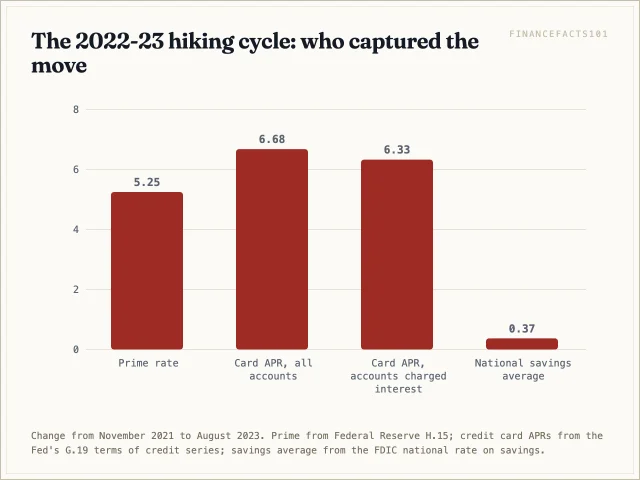
Through the 2022–23 hiking cycle prime rose 5.25 points, from 3.25% to 8.50%. The average credit card APR in the Fed's G.19 consumer credit release rose more — 14.51% to 21.19% on all accounts, a 6.68-point jump, because issuers widened margins on top of the index move. Over the same period the FDIC's national average savings rate went from 0.06% to 0.43%. Households paid 127% of the Fed's move on their cards and collected 7% of it on their savings.
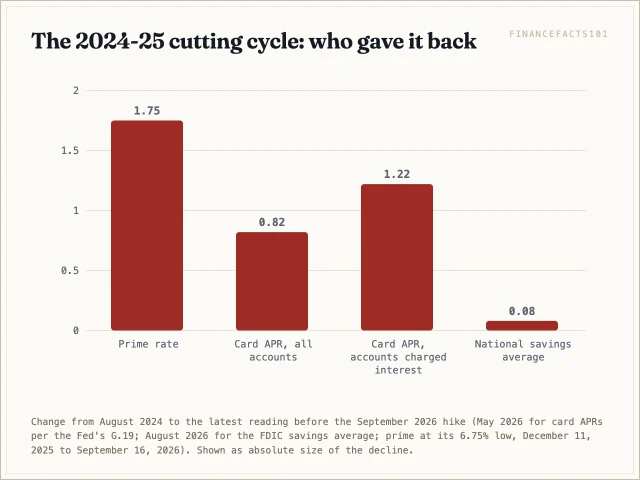
The cutting cycle that ran from September 2024 to December 2025 is the mirror image. Prime fell 1.75 points; the G.19 all-accounts card APR is down 0.82 points (21.76% in August 2024 to 20.94% in May 2026) and the FDIC savings average is down 0.08 through August 2026. Rates went up on the way up and mostly stayed up on the way down.
One honest qualification, because the averages hide it: your variable card APR does move one-for-one with prime, both directions, by contract. The averages diverge because new accounts open at wider margins and issuers reprice margins on new transactions. Two things are happening — a contractual index move you keep, and a margin ratchet you escape only by shopping. The distinction is drawn out in the entry on credit card purchase APR.
The saver's side has no contract at all, and the September hike shows it in real time. Prime rose on September 17, and every prime-linked APR follows by contract at its next billing-cycle reset; the top rate in Yahoo Finance's list of partner savings accounts was still 4.10% on September 23, 2026 — the same rate it paid before the decision. Against the FDIC's 0.37% national average (September 21, 2026 release), that is a spread of nearly four points that exists purely because most balances sit still. Which bank you use matters roughly ten times more than what the Fed does; the comparison lives in high-yield savings vs CDs.
The Reyes Household: A Quarter Point and a Full Point, Both Ways
Name the assumptions and run the numbers.
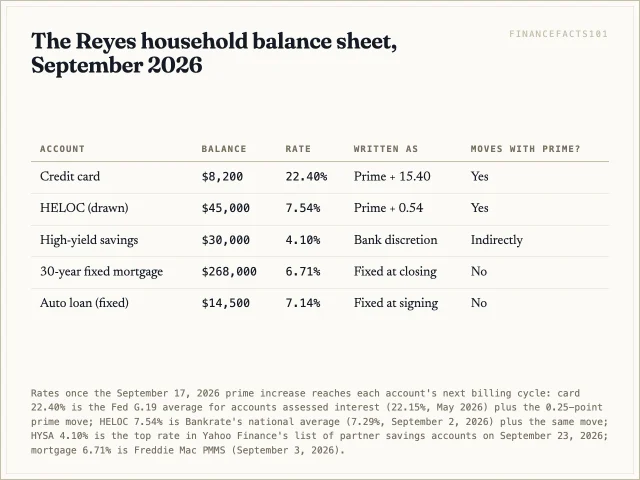
The Reyes household carries $8,200 on a variable card at 22.40% (prime + 15.40), $45,000 drawn on a HELOC at 7.54% (prime + 0.54) and $30,000 in high-yield savings at 4.10%. Both debt rates are a quarter point higher from their first billing cycle after prime rose on September 17 — the card was 22.15%, the Fed's G.19 average for accounts assessed interest, and the HELOC 7.29%, Bankrate's national average on September 2. The savings rate has not moved. They also hold $268,000 on a 6.71% fixed mortgage and $14,500 on a fixed 7.14% auto loan; neither appears again, because neither moves. Prime-linked debt: $53,200. Prime-sensitive cash: $30,000.
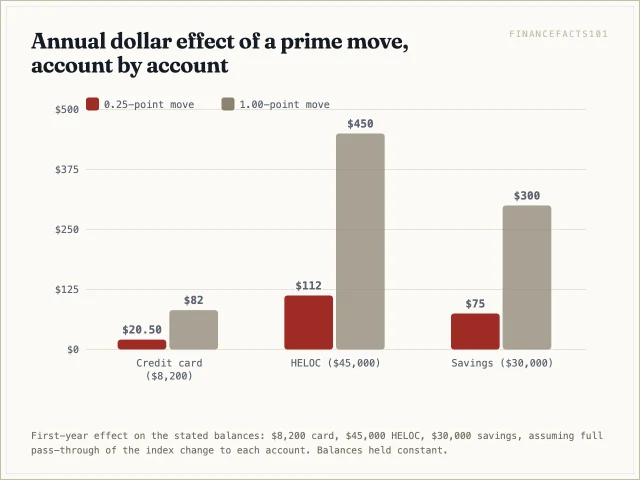
A quarter-point cut, fully passed through, cuts card interest by $20.50, HELOC interest by $112.50 and savings income by $75.00 — net $58.00 a year, about $4.83 a month. A full point cuts $82.00 and $450.00 of cost against $300.00 of lost income, netting $232.00 a year or $19.33 a month.
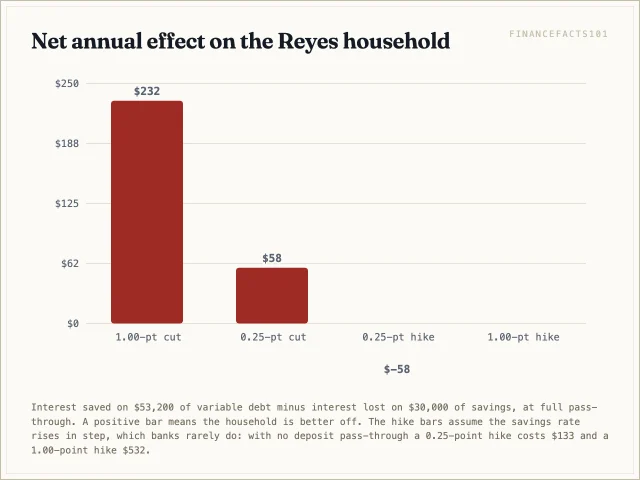
Most people get that headline wrong in both directions. A quarter-point cut is not a windfall; on $53,200 of variable debt it is five dollars a month. A full-point hike is not a catastrophe; it is twenty. The Fed is not the main character in your budget. Your balances are.
Those figures assume both sides move. The real September hike is set to land harder than the $58 above, because only the debt side moves by contract: once the new rates reach the statements, $20.50 more a year on the card and $112.50 more on the HELOC, and — as of September 23 — nothing extra on the savings. That is $133.00 a year, about $11 a month, until the bank reprices the deposit. A full-point hike on the same one-sided terms would cost $532 a year, about $44 a month, not twenty.
Over longer horizons the same points compound. Converted to a 20-year amortizing repayment, the HELOC at 7.54% means a $363.62 monthly payment and about $42,268 of total interest.
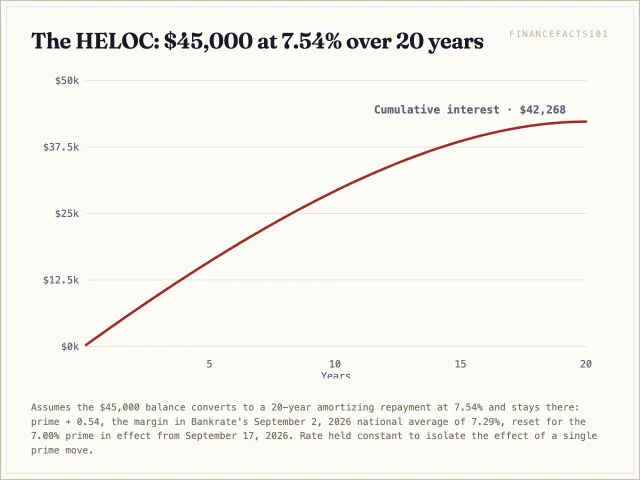
One point lower — 6.54% — drops that to $336.57 a month and $35,776, a $6,492 saving across twenty years. One point higher costs $391.66 and $48,999. That is the largest lever a Fed decision pulls here, and it is invisible on any one statement.
The card is the opposite: high rate, short life, small stakes per point.
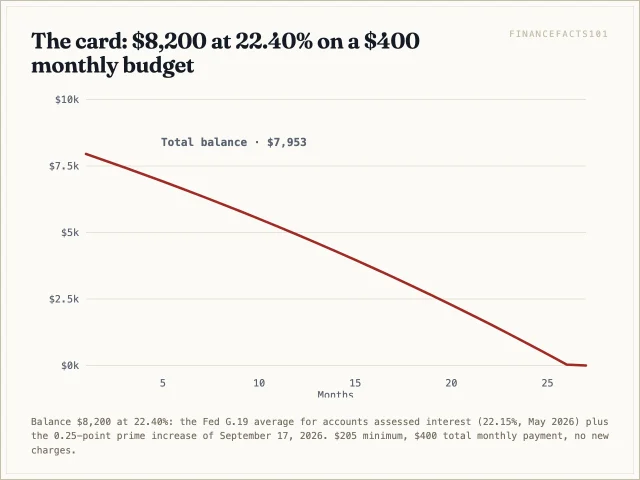
At 22.40% with a $400 monthly payment and no new charges, the $8,200 balance clears in 27 months with about $2,232 of interest — $34 more in total than at the pre-hike 22.15%, where it cleared in 26 months. The 27th month is only a small final payment of $32, and it is already counted in that $34. At 21.40% it clears in 26 months, with $2,098 — the whole one-point cut is worth $134 in total, and the schedule ends in 26 months instead of 27. Paying $500 a month instead clears it in 20 months with $1,681, a $551 saving that beats any plausible Fed decision several times over. That is the argument the credit card payoff calculator makes better than prose can; the ordering question is settled in debt avalanche vs snowball.
The Crossover: When a Cut Costs You, and Why a Hike Rarely Pays
Now the number this article exists to produce.
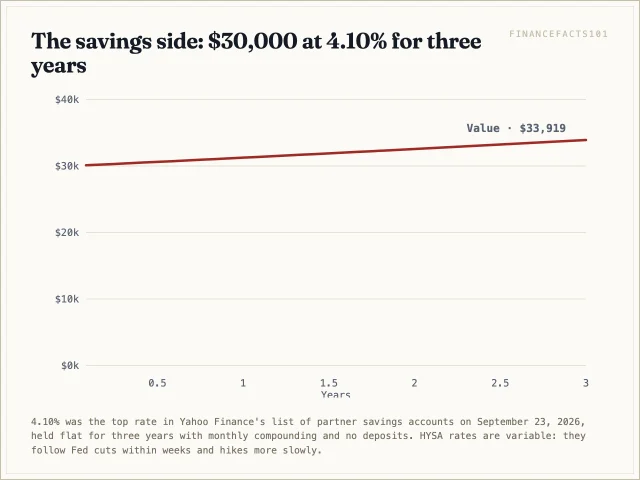
The savings side runs the other way. $30,000 at 4.10%, compounded monthly and left alone, reaches about $33,919 after three years; at 3.10% it reaches $32,920. A one-point cut, if the bank passes it on, costs this household $999 over three years on the cash alone; a one-point rise, passed on in full, adds $1,029.
So the total position depends on which side is bigger. Under equal pass-through, a cut helps whenever variable-rate debt exceeds cash and hurts when cash exceeds debt; on paper, a hike does the reverse. For the Reyes household the crossover is exactly their variable debt:
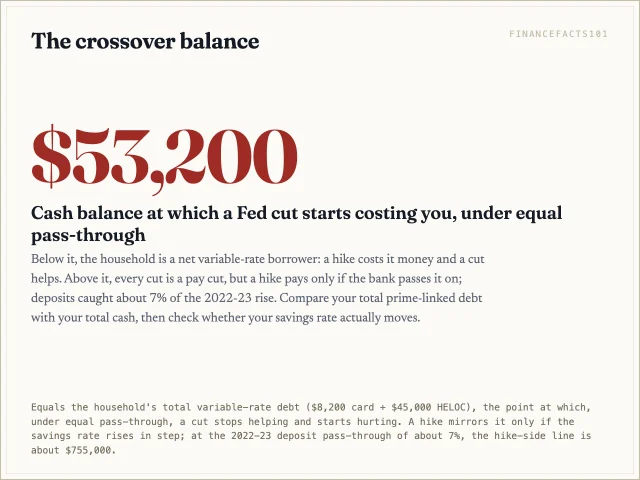
Hold less than $53,200 in cash and every cut is a raise and every hike a pay cut. Hold more and every cut is a pay cut — but a hike pays you only if your bank actually raises your savings rate, which the next paragraph shows is the exception. At $30,000 the Reyes household sits on the borrowing side, so September's hike costs it money either way.
Then adjust for the pass-through your accounts actually deliver, which moves the line both ways. If your card gives back only half a cut in practice — the index falls, but the issuer widens margins on new purchases — while your online bank passes the whole thing on within weeks, the crossover falls to about $49,100 — sticky debt plus an eager deposit account makes cuts worse than the simple rule suggests. Run it the other way and the line disappears: cash in a big-bank account at 0.37% that never moves cannot lose anything, so every cut is pure gain at any balance. The mirror image is the one that matters now: if your savings rate does not move, every hike is a pure cost at any cash balance. Debt reprices by contract; deposits reprice when the bank chooses, and banks pass hikes on slowly. Through 2022–23 the national savings average captured 0.37 of prime's 5.25-point rise, about 7%, and a week after September's hike the top rate in Yahoo Finance's partner list had not moved at all. At that 7% pass-through, the cash balance a hike needs before it pays you is not $53,200 but about $755,000 — 53,200 × 5.25 ÷ 0.37. The only way to get close to the $53,200 line is to move the cash yourself to a bank that raises its rate. Retirees living off cash and short CDs sit on the wrong side of this permanently; for them the rate-cut checklist below is a defensive document, and a hike is good news only once the bank actually passes it on.
What the CARD Act Requires — and What It Doesn't
The 2009 CARD Act, implemented through Regulation Z, gives cardholders 45 days' advance notice before an APR increase or other significant change in terms. It carries an exception most people have never heard of, and it matters exactly here.
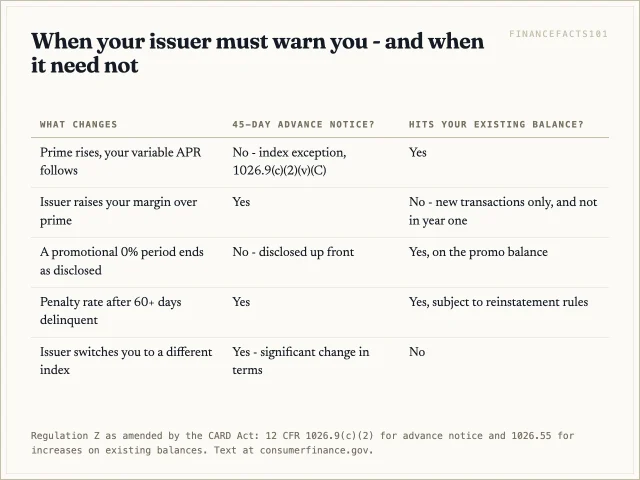
Under 12 CFR 1026.9(c)(2)(v)(C), no advance notice is required when the change is "an increase in a variable annual percentage rate in accordance with a credit card or other account agreement that provides for changes in the rate according to operation of an index that is not under the control of the creditor and is available to the general public." Prime is exactly such an index. So when prime rises, your APR rises with no letter, no notice, and no opt-out.
The parallel rule in 12 CFR 1026.55 generally bars issuers from raising the rate on balances you already carry — with the same index carve-out. Index-driven increases apply to your existing balance. Margin increases generally do not: new transactions only, 45-day letter required, barred outright in the account's first year.
The takeaway is procedural. APR rose and no letter arrived? That was the index, and it is legal. A letter did arrive? That was a margin or term change, and you usually have the right to reject it and pay the balance off at the old rate. The opt-out window is short.
The Rate-Cut Checklist
A cut is not automatically good news, so work the list in order.
- Do nothing on your fixed loans. Refinancing turns on the 10-year Treasury and closing costs, not on prime.
- Confirm the card and HELOC actually repriced. Check the APR box on the next two statements. If prime fell 0.25 and your APR did not, call and ask which index and margin the account uses.
- Re-shop the savings, immediately and annually. This is where cuts hurt and where the biggest fix lives: moving $30,000 from the 0.37% national average to a 4.10% account is worth roughly $1,119 a year, several times any plausible Fed move.
- Consider locking part of the cash. If you expect cuts, a CD locks today's rate; penalty math and the ladder mechanic are in high-yield savings vs CDs.
- Do not enlarge the HELOC draw because it got cheaper. A one-point cut on $45,000 saves $450 a year. Drawing another $20,000 costs $1,308 a year at 6.54%. Cheaper is not free.
The Rate-Rise Checklist
This is the list that applies now: the September 16 hike moved prime to 7.00% on September 17, and every prime-linked balance picks it up at its next billing-cycle reset.
- Price the damage first. Multiply each variable balance by the size of the move. If the answer is under $30 a month, do not restructure your finances around it.
- Attack the highest-rate variable balance. At 22.40% the card is expensive whether or not the Fed moves; the credit card payoff calculator shows what an extra $100 a month does next to a quarter point.
- Consider converting HELOC balances to a fixed rate. Many lenders lock part of the drawn balance. On $45,000, a hiking cycle of the 2022–23 size — 5.25 points — would add $2,363 a year; weigh that against the lock fee. Background in the entry on home equity loans.
- Watch for a promotional-rate expiry disguised as a Fed move. A 0% balance transfer ending is a far larger jump than any single hike.
- Move the savings yourself. Hikes raise deposit rates slowly — the national savings average rose 0.37 points across the 2022–23 cycle, and a week after September's hike the top rate in Yahoo Finance's partner list was the same 4.10% it paid before it. Do not wait for your existing bank.
- Leave the fixed mortgage alone. It is the one part of the balance sheet a hiking cycle cannot touch, which is most of the argument in 15-year vs 30-year mortgage and much of credit card payoff time.
FAQ
How a Fed rate change reaches my accounts: what is the actual chain?
Four steps. The FOMC moves its target range; the largest banks post a new prime, historically within one business day and by the same amount; your card or HELOC recalculates as prime plus its fixed margin; the new APR takes effect on the first day of the next billing cycle. Two to eight weeks, and none of it requires action from you. The latest run-through: the Committee raised the range a quarter point on September 16, 2026, and prime went from 6.75% to 7.00% the next day.
Does a Fed cut lower my mortgage payment?
No, not if it is fixed — a fixed rate is set at closing for the life of the loan. Even for new borrowers the link is weak: prime sat at 6.75% from January until mid-September 2026 while the 30-year fixed rose from 5.98% in late February to 6.71% by early September, because mortgage pricing follows the 10-year Treasury and mortgage-backed spreads. Only an ARM resets, and most now reset against SOFR.
Why did my credit card APR go up without any notice?
Because the CARD Act's 45-day notice rule exempts variable rates that move with a public index the issuer does not control. Regulation Z, at 12 CFR 1026.9(c)(2)(v)(C), lets index-driven increases take effect with no notice, and 12 CFR 1026.55 lets them apply to your existing balance. A margin increase is different: it needs the letter, generally cannot touch balances you already carry, and is barred in the first year.
Should I wait for a Fed cut before paying down my card?
No. On an $8,200 balance at 22.40%, a full point is worth $82 a year while the balance itself costs $1,837 — about $153 every month you keep it. Waiting one month for a quarter-point cut spends that $153 to save $1.71 a month afterward, and the next move is not guaranteed to be a cut: the last one was a hike. Pay it off; let the rate move be a bonus.
I have more savings than debt. Is a Fed cut bad for me?
On the interest line, yes. If your cash exceeds your prime-linked debt, a cut reduces your income by more than it cuts your costs. The fix is not to root for hikes but to widen the gap you actually control: the distance between the 0.37% national savings average and the roughly 4.10% at top accounts as of September 2026 dwarfs any single Fed decision. By the same logic the September hike was good news for you — but only once your bank passes it on.
Sources
- Federal Reserve, H.15 Selected Interest Rates — bank prime loan rate 7.00% from September 17, 2026 (6.75% from December 11, 2025 through September 16, 2026); federal funds effective 3.88% from September 17, 2026; 10-year Treasury 4.77% on September 3 and 5.01% on September 16, 2026 (retrieved September 24, 2026)
- Federal Reserve, FOMC statement, September 16, 2026 — federal funds target range raised 0.25 point to 3.75–4.00%, 12–0 vote
- Federal Reserve, FOMC meeting calendar — 2026 meeting dates including September 15–16 and October 27–28
- Federal Reserve, G.19 Consumer Credit — credit card APR 20.94% all accounts and 22.15% on accounts assessed interest (May 2026); 60-month new car loan 7.14%; 24-month personal loan 11.86%
- Federal Reserve, final rule implementing the Adjustable Interest Rate (LIBOR) Act — SOFR-based benchmark replacements for USD LIBOR after June 30, 2023
- CFPB, Regulation Z § 1026.9 — 45-day advance notice and the variable-rate index exception at (c)(2)(v)(C)
- CFPB, Regulation Z § 1026.55 — limits on rate increases applied to existing balances
- CFPB, What is a home equity line of credit? — HELOC variable-rate mechanics
- FDIC, National Rates and Rate Caps — national average savings rate 0.37% in the September 2026 release (published September 21, 2026), 0.38% in the August 17, 2026 release
- Freddie Mac, Primary Mortgage Market Survey — 30-year fixed 5.98% (week of February 26, 2026), 6.71% and 15-year fixed 6.04% (week of September 3, 2026), 30-year fixed 6.95% (week of September 17, 2026)
- Federal Reserve Bank of New York, SOFR reference rates — publication and methodology of the Secured Overnight Financing Rate
- Bankrate, Current HELOC rates — national average HELOC rate 7.29% as of September 2, 2026
- Yahoo Finance, Best high-yield savings interest rates today, September 23, 2026 — top savings rate among its partner banks 4.10% APY (CIT Bank)
 Next entry · No. 5,955Deposit Accounts: Checking vs Savings vs Money Market vs CD
See also
-
 No. 4,078
20 May 2025
13 min
Prime Rate: What It Is, Who Sets It, and How It Changes
Business Finance
No. 4,078
20 May 2025
13 min
Prime Rate: What It Is, Who Sets It, and How It Changes
Business Finance -
 No. 3,528
05 Apr 2025
20 min
Understanding Noncurrent Liabilities: Types, Importance and Ratios for Professional Investors
Business Finance
No. 3,528
05 Apr 2025
20 min
Understanding Noncurrent Liabilities: Types, Importance and Ratios for Professional Investors
Business Finance -
 No. 5,942
13 Sep 2026
19 min
How Long It Takes to Pay Off a Credit Card at $8,000 and 22.15%
Personal Finance
No. 5,942
13 Sep 2026
19 min
How Long It Takes to Pay Off a Credit Card at $8,000 and 22.15%
Personal Finance -
 No. 5,936
08 Sep 2026
14 min
Debt Avalanche vs Snowball: Which Pays Off Faster
Personal Finance
No. 5,936
08 Sep 2026
14 min
Debt Avalanche vs Snowball: Which Pays Off Faster
Personal Finance -
 No. 5,930
02 Sep 2026
14 min
High-Yield Savings vs CDs: Where Cash Earns More
Personal Finance
No. 5,930
02 Sep 2026
14 min
High-Yield Savings vs CDs: Where Cash Earns More
Personal Finance -
 No. 5,885
16 Oct 2025
18 min
Maximizing Your Credit Score with Zero Balance Cards
Personal Finance
No. 5,885
16 Oct 2025
18 min
Maximizing Your Credit Score with Zero Balance Cards
Personal Finance