Deposit Accounts: Checking vs Savings vs Money Market vs CD
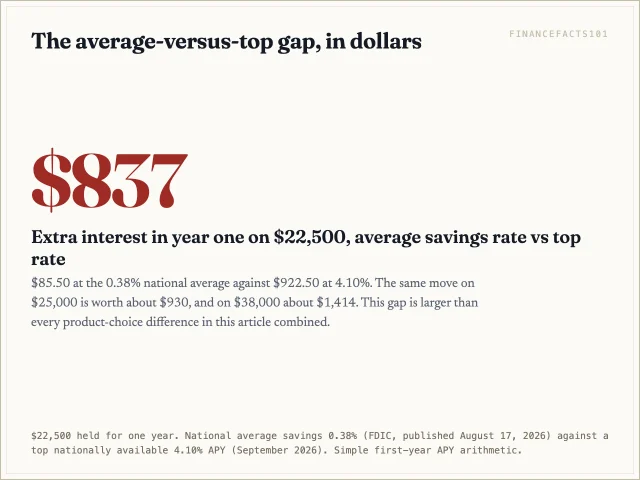
Three jobs, four account types. Moving $22,500 from a 0.38% average savings rate to a 4.10% HYSA earns $837 more a year, as of September 2026.
A household needs three things from its cash and only three: money to spend this month, money it can reach in a hurry, and money already promised to a date on the calendar. The expensive mistake is not picking a bad bank — it is running all three jobs out of one checking account. On $38,000 that costs about $1,306 a year, the gap between $3.80 of interest at a 0.01% checking rate and roughly $1,310 spread across the right deposit accounts at rates available as of September 2026.
This guide answers where to keep your cash by matching money to job rather than listing products. It covers what genuinely separates checking, savings, money market accounts and CDs, the money market account versus money market fund distinction that most sources blur, how insurance actually works, and how long your money really takes to move between banks. One line of scope honesty: general information built on stated assumptions and rates as of September 2026, not personal advice.
Deposit Accounts Do Three Jobs — Sort Your Money First
Start with the jobs, not the account names. Every dollar you hold in cash is doing exactly one of three things, and the right account falls out of the answer.
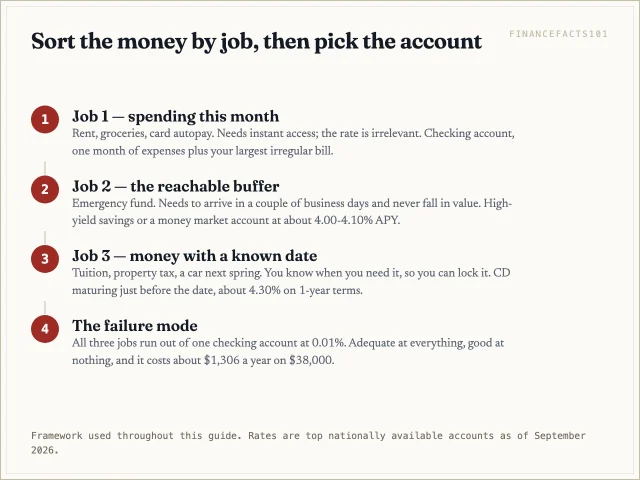
Job one is transactional: rent, groceries, the card autopay. This money must be spendable at 11pm on a Sunday, and the interest it earns is close to irrelevant because the balance is small and always moving. Job two is the reachable buffer — the emergency fund. It has to survive a job loss or a transmission, which means arriving within a couple of business days, not within seconds, and never falling in value. Job three is dated money: a June property-tax bill, a car you will replace next spring, a closing in eighteen months. You know roughly when you need it, which means you can rent it out until then.
People fail at this not from ignorance of CD rates but because one checking account handles all three jobs adequately and none of them well. Inertia is free until you price it.
Who This Is For — and Who It Is Not For
This fits a US household holding somewhere between $5,000 and $250,000 in cash across all its accounts, with a normal mix of bills, a partial or complete emergency fund, and one or two dated expenses inside three years. It assumes you want zero market risk on this money and that you have a bank account already.
It is not for money with a ten-year horizon; over that distance cash reliably trails diversified investments and the question becomes asset allocation. It is not a Treasury guide either: 4- to 52-week T-bills from TreasuryDirect compete for the same dollars, and their state-tax exemption changes the ranking in California or New York. And if you carry credit-card debt at 22%, paying it down beats every rate here by a factor of five — start with the payoff math.
Job One: Checking, and Why It Should Stay Small
A checking account is a demand deposit: the bank owes you the balance on demand, with no notice and no transfer cap. That is the entire product. Everything else — debit card, bill pay, mobile app — is plumbing attached to that promise. The site's entry on demand deposit accounts covers the legal shape; the entry on checking accounts covers the feature set.
What matters is the price. FDIC national rate data published August 17, 2026 puts the average interest checking account at 0.07% APY, and plenty of large branch banks pay 0.01% on ordinary checking or nothing at all. Rate-shopping a checking account is close to pointless; keep the balance small and move the rest.
How small? One month of spending plus a cushion equal to your largest irregular bill. Below that you risk overdrafts, and the median overdraft fee at large institutions was $35 per item according to CFPB market monitoring — one slip erases a month of interest on any balance under about $10,000. See overdrafts and protection and overdraft fees.
Job Two: Savings and Money Market Accounts
Savings accounts and money market accounts are interest-bearing deposits with the same insurance and, in practice, the same liquidity. The genuine differences are narrow: a money market account usually carries cheque-writing privileges and sometimes a debit card, and it more often prices in balance tiers, paying its headline rate only above $10,000 or $25,000. A savings account rarely has either feature. Neither difference is worth much; the rate is worth a lot.
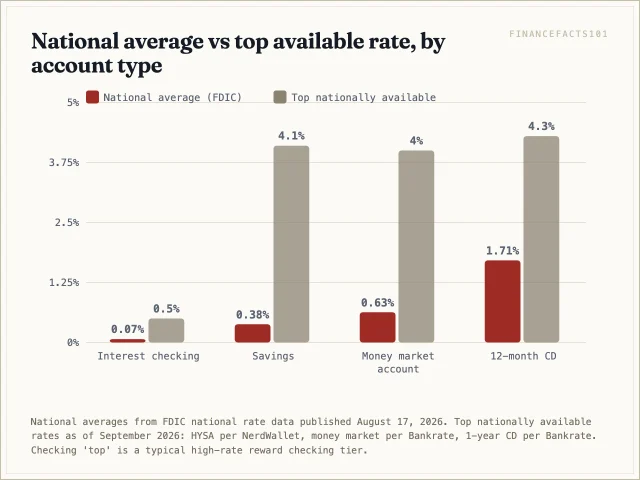
The national average savings rate was 0.38% and the average money market account 0.63% as of the FDIC's August 17, 2026 publication, while the best nationally available accounts paid about 4.10% on high-yield savings and 4.00% on money market accounts as of September 2026. That is not a rounding difference — it is roughly ten times the average.
Money Market Account Is Not Money Market Fund
This distinction matters more than anything else here, and it is the one most sources smear over. A money market account (MMA) is a bank deposit, insured by the FDIC or NCUA to the same $250,000 limit as your checking balance, and the bank owes you your dollars. A money market fund (MMF) is an SEC-registered mutual fund that buys short-term debt. It is an investment, it is insured by nobody, and its share price can fall.
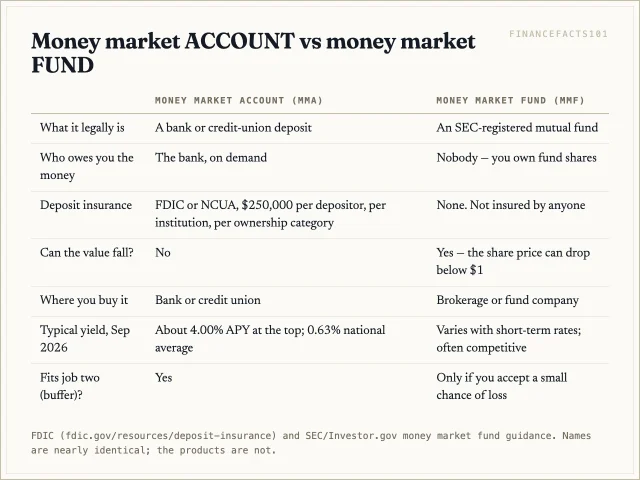
The SEC states it plainly in its money market funds bulletin: money in a money market fund is not guaranteed by the FDIC the way a bank account is, and you can lose some or all of it. The FDIC's list of products it does not insure includes mutual funds, stocks, bonds, annuities, crypto assets and safe deposit box contents.
That does not make money market funds bad — government MMFs at the big brokerages pay competitive yields and have an excellent record. But if the reason you chose cash is that you cannot tolerate a loss, an uninsured fund is a different product with a different promise, and the near-identical name is the trap. The site covers each separately: money market accounts and money market funds.
The Six-Transfer Rule: Dead in Law, Alive at Some Banks
For decades, federal Regulation D capped "convenient transfers" out of a savings or money market account at six per month, and banks charged $5 to $15 for each one over. On April 24, 2020 the Federal Reserve issued an interim final rule deleting that six-per-month limit from the definition of a savings deposit, having already cut reserve requirement ratios to zero. Its savings deposits FAQ confirms the change was permissive, not mandatory, and that the Board has no plans to reimpose the limit.
So what happens now? The rule permits banks to drop the cap; it does not force them. Marcus, Capital One 360, SoFi and American Express National Bank removed withdrawal limits on savings and charge no excess-transaction fee as of September 2026. Ally charges no fee but still caps certain withdrawals and transfers from savings and money market accounts at a combined 10 per statement cycle, and says it will close an account that exceeds the cap more than occasionally. Plenty of other institutions, including large branch banks, kept the six-transfer cap in their deposit agreement as internal policy, still charge $5 to $15 per breach, and some will convert a repeatedly over-limit savings account into checking.
Read the fee schedule, not the history. If your buffer sits somewhere you might tap three times in a bad month, confirm in writing that the cap is gone. Regulation DD, the Truth in Savings rule, requires the institution to disclose those fees up front — see Regulation DD.
APY Versus Interest Rate: Only One of Them Compares
Two banks quote you 4.00%. One means an interest rate compounded daily, the other the annual percentage yield. They are not the same number, and only one is comparable across institutions.
APY folds compounding into a single figure. The CFPB's Regulation DD, Appendix A sets the formula banks must use: APY = 100[(1 + Interest/Principal)^(365/Days in term) − 1]. Because the formula is mandated, one bank's APY is directly comparable to another's. A quoted interest rate is not, because it says nothing about how often interest is added to your balance.
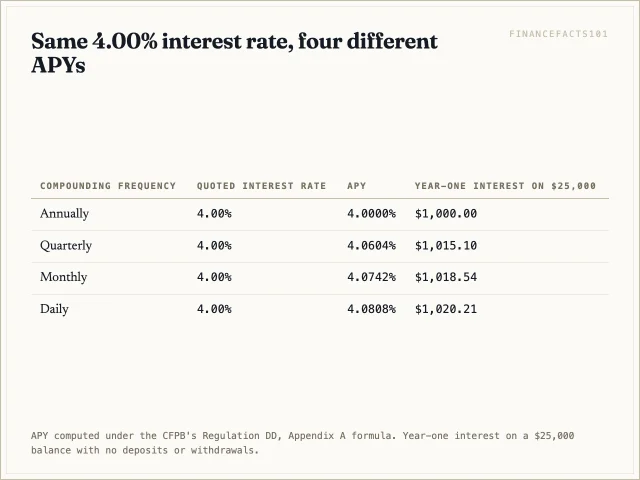
On $25,000, a 4.00% interest rate compounded daily produces $1,020.21 in the first year — a 4.0808% APY — while the same 4.00% compounded annually produces exactly $1,000.00. Twenty dollars is not life-changing, but the principle is: a bank advertising a rate rather than a yield is either careless or hoping you will not check. Regulation DD requires it to state the APY when you ask about rates orally. More cases sit in annual percentage yield; run your own through the compound interest calculator.
Job Three: CDs and Dated Money
A certificate of deposit is the same insured deposit with a term attached: you give up access for a fixed period and get a fixed rate in exchange. As of September 2026 the top nationally available 1-year CDs paid about 4.30% and 5-year CDs about 4.50%, against an FDIC national average 12-month CD of 1.71% — the same average-versus-top gap that shows up everywhere else in banking.
CDs fit job three precisely because job three has a date. If the tuition bill lands in April, a CD maturing in March locks the rate and carries no penalty risk, because you were never going to touch it. Buy a CD with your emergency fund instead and you have converted a liquid asset into an illiquid one, priced at an early-withdrawal penalty of two to twelve months of interest. The full comparison, with penalty schedules at four named banks and a five-rung ladder, is in high-yield savings vs CDs; variable-rate products are covered in adjustable-rate CDs.
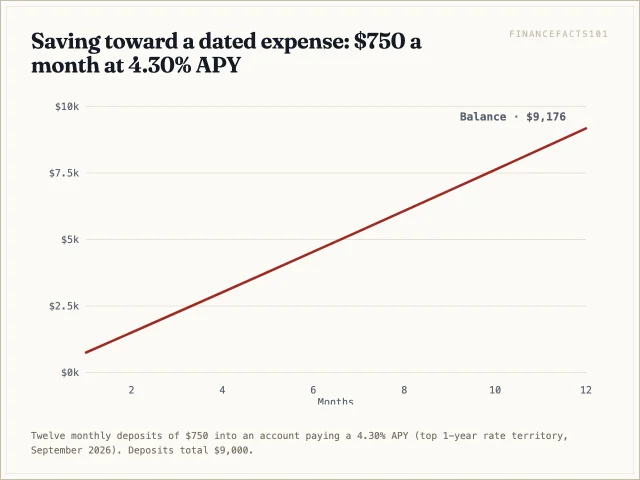
There is a second use of job three that people miss. If the dated expense is still ahead and you are saving toward it, a monthly transfer into a separate account does the same work: $750 a month for twelve months at a 4.30% APY reaches $9,176 against $9,000 of deposits. Modest, but the separate account also keeps the money out of your spending balance, which is worth more than the $176. The savings goal calculator sizes the monthly number for any target and date.
The Ruiz Household: $38,000, Reallocated
Marisol and Dev Ruiz take home $7,400 a month and spend $5,600. They hold $38,000, all of it in one branch-bank checking account paying 0.01%. They have a car to replace in about a year — call it $9,000 — and no other dated expenses.
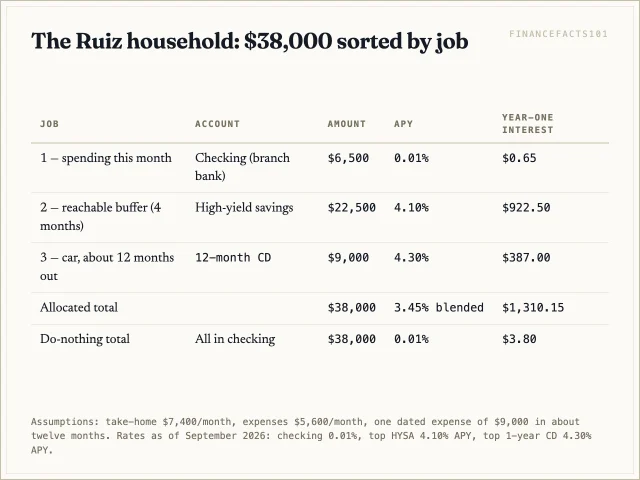
Job one takes $6,500: a bit above one month of spending, which covers the timing mismatch between paycheques and the mortgage. Job two takes $22,500, four months of expenses, into a high-yield savings account at 4.10% APY. Job three takes the remaining $9,000 into a 12-month CD at 4.30% APY, timed to mature just before they need the car.
Year one, do-nothing: $38,000 × 0.01% = $3.80. Year one, allocated: $0.65 on the checking balance, plus $922.50 on the savings, plus $387.00 on the CD = $1,310.15. The difference is $1,306.35, which is roughly two months of their grocery budget, earned by three transfers and about ninety minutes of paperwork.
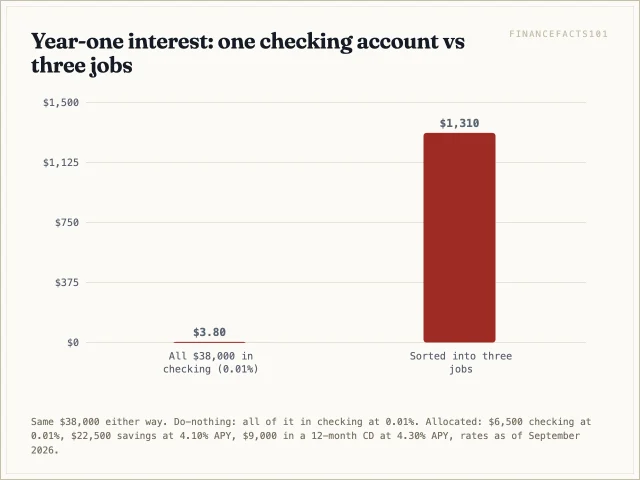
Nothing in that reallocation reduced their access to money. The $6,500 in checking is instantly spendable, the $22,500 in savings arrives in one to three business days by ACH, and the only genuinely locked pot is the $9,000 already committed to a car. That is the argument for sorting cash by job: the liquidity you use costs almost nothing to keep, and the liquidity you never use is expensive to hold.
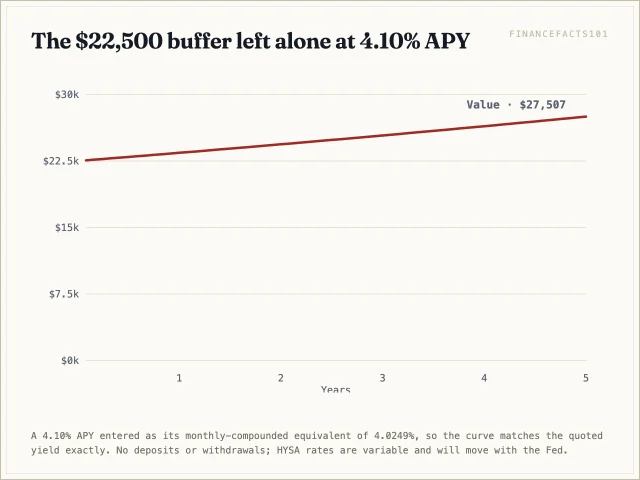
Left alone at 4.10% APY, that $22,500 buffer reaches about $27,507 in five years. Size yours against how big an emergency fund should be and the emergency fund calculator.
Building the Buffer From Zero
Most households do not have $22,500 sitting anywhere, and the account choice moves the finish line.
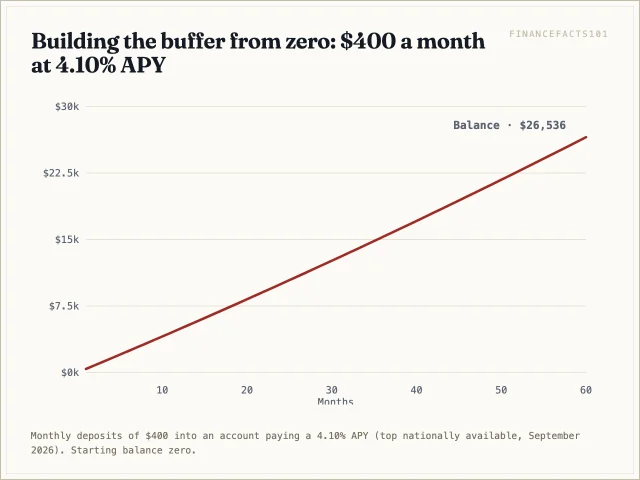
At $400 a month into a 4.10% APY account you clear $4,890 in year one and pass $22,400 at month 52. In a 0.38% account the same $400 takes 56 months — four extra months of exposure, bought for nothing. Run your numbers through the savings goal calculator and check the target with the emergency fund calculator; the second answers "how much", the first "how long".
What "Free" Checking Actually Costs
Monthly maintenance fees are the quiet tax on job one. The 2026 MoneyRates checking fee survey puts the average at $13.95 a month, or $167.40 a year; Bankrate's study of non-interest checking finds $5.47 a month, the two differing mostly because they survey different account types.
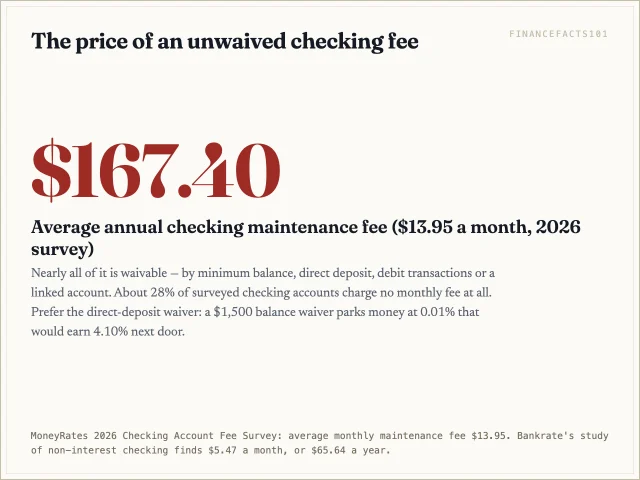
Almost every one of those fees is waivable, and the conditions cluster into four shapes: a minimum daily balance (commonly $500 to $1,500), a minimum monthly direct deposit (commonly $250 to $500), a minimum number of debit transactions, or a linked account relationship. The balance waiver fights the premise of this article — a bank waiving its fee at a $1,500 minimum is charging you to keep $1,500 idle at 0.01% while a savings account down the road pays 4.10% on it. That $1,500 parked to dodge a $167 fee earns $0.15 instead of $61.50, so the waiver still pays, barely; a fee-free account elsewhere pays more than both.
Prefer the direct-deposit waiver over the balance waiver, or find an account with no fee at all: roughly 28% of surveyed checking accounts carry none. Set up the link to savings deliberately — see linked savings accounts.
FDIC and NCUA Insurance: $250,000, and How to Multiply It
Every account discussed here is insured, provided you stay under the limit. FDIC deposit insurance covers $250,000 per depositor, per insured bank, for each account ownership category, and NCUA share insurance provides the identical $250,000 at federally insured credit unions, backed by the full faith and credit of the United States.
The phrase doing the work is per ownership category. There are seven: single, joint, certain retirement accounts, trust, employee benefit plan, business, and government. Deposits in different categories at the same bank are separately insured, which is how a couple can hold well over a million dollars at one institution with full coverage.
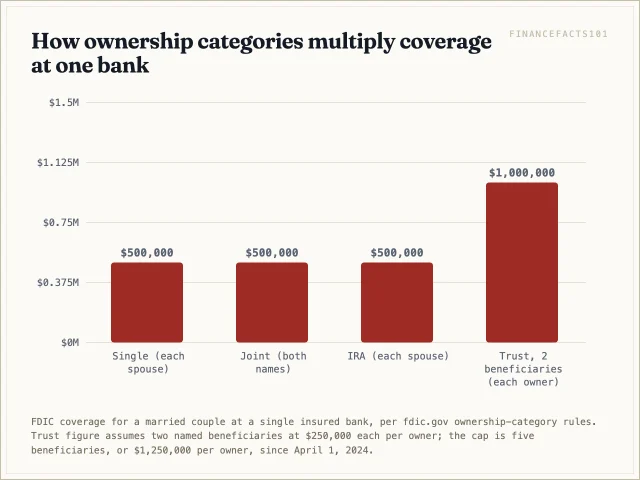
Note the trust rule effective April 1, 2024: trust deposits are insured at $250,000 per beneficiary, capped at five beneficiaries, so $1,250,000 per owner per bank however many you name. Verify your exact titling with the FDIC's EDIE estimator rather than reasoning from a table — the categories interact.
What is not insured matters equally: stocks, bonds, mutual funds including money market funds, annuities, life insurance, municipal securities, crypto assets, and safe deposit box contents, even bought at an insured bank. Treasury bills are not FDIC-insured either, though they carry the government's direct credit — a stronger guarantee, not a weaker one. Background sits in the entries on the FDIC and the NCUA.
Brokered CDs and Sweep Accounts: Where the Insurance Sits
Two common arrangements put a middleman between you and the insured bank. The insurance still works, but through a mechanism worth understanding.
A brokered CD is a bank CD sold through a brokerage, which aggregates customer money and deposits it at issuing banks in its own name. Coverage reaches you by pass-through deposit insurance: the FDIC looks through the broker's account to the underlying owners, provided the records correctly identify each of them. That brings one real advantage — a single brokerage account can spread $1,000,000 across four issuing banks and insure all of it — and one real drawback. Brokered CDs generally cannot be redeemed early; you sell them on a secondary market at whatever price it offers, which can be below par if rates have risen.
A cash sweep moves idle brokerage cash into either partner bank deposits (FDIC-insured, often across several banks) or a money market fund (not insured, though the brokerage account carries SIPC protection against the broker's failure, a different risk entirely). Check which your broker defaults you into and what it pays; sweep yields at several large brokerages have sat far below the 4% available on plain deposits. The mechanics are in sweep accounts.
The caution on both: pass-through insurance depends on accurate records. After the 2024 collapse of the fintech intermediary Synapse, partner banks struggled to reconcile who owned what, and the FDIC responded with a proposed recordkeeping rule for custodial deposit accounts requiring daily reconciliation of beneficial owners. If a non-bank app holds your buffer, know which insured bank actually has the deposit.
How Long the Money Really Takes to Move
This is the constraint that decides whether an online savings account can serve as an emergency fund, and it is almost never stated in the marketing.
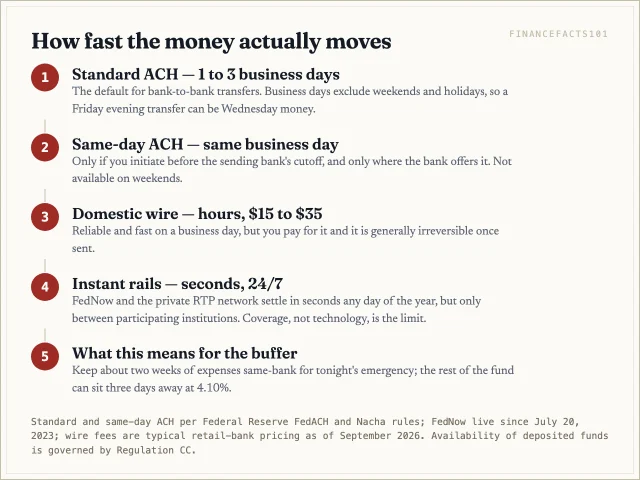
Standard ACH — the automated clearing house network carrying most bank-to-bank transfers — settles in one to three business days. Same-day ACH lands the same business day if you initiate before the cutoff. A domestic wire arrives within hours but typically costs $15 to $35 outbound. Instant rails — the Federal Reserve's FedNow Service, live since July 20, 2023, and the private RTP network — move funds in seconds around the clock, but only between participating institutions, so coverage rather than technology is the binding constraint.
Two rules follow. "Business days" excludes weekends and holidays, so a Friday-evening ACH pull can genuinely be Wednesday money. And direction matters: a transfer pulled by the receiving bank often posts faster than one pushed from the sending side, and new external links frequently face a hold on the first transfer or two. Regulation CC governs when deposited funds must be made available; the Federal Reserve's compliance guide is the reference.
The design answer is a two-layer buffer. Keep about two weeks of expenses in checking or a same-bank savings account for the emergency that needs money tonight, and the rest three days away in the high-yield account. On the Ruiz household that means roughly $2,800 earning nothing instead of $115 a year — the price of being able to fix a boiler on a Saturday.
Online Banks Versus Branch Banks: The Honest Trade-offs
Online banks pay the top rates because they have no branch network to fund, and the gap is not subtle: 4.10% against a 0.38% national average as of September 2026. That case is strong.
The case against is real and rarely stated fairly. You cannot deposit cash at an online bank without a workaround. Wire transfers and cashier's cheques are slower to arrange, which matters at a house closing. Customer service is a phone queue rather than a person who knows you, and a fraud-review lock-out is more disruptive with no branch to walk into. Transfer timing, as above, is the big one for an emergency fund.
The resolution is not a choice but a split: keep the branch relationship for job one and cash handling, the online bank for job two, and link them. Two logins instead of one, and several hundred dollars a year for the inconvenience. The net worth calculator tabulates what they add up to across both.
Checking vs Savings vs Money Market vs CD: The Summary
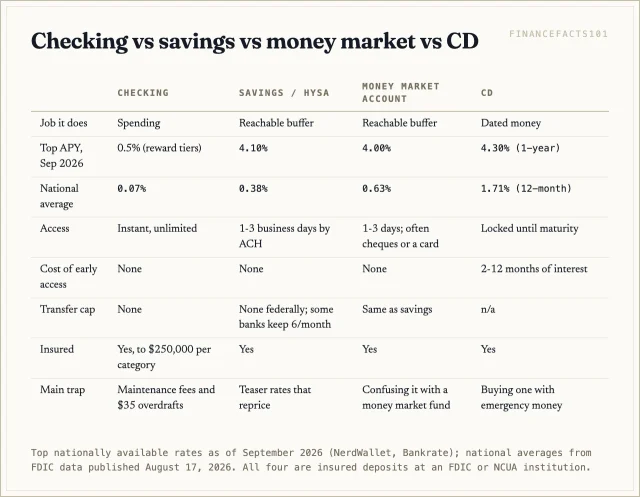
Checking wins on access and loses on everything else, so keep it lean. Savings and money market accounts are the same product in most respects — pick on APY, fee schedule and transfer limits rather than on the name, and do not confuse the account with the fund. CDs win only when the money has a date, and they lose badly when it does not.
One last number outranks every product comparison here: the gap between a national-average rate and a top-available rate is worth roughly $930 a year on $25,000, while the gap between the best savings account and the best money market account is worth about $25. Shop the rate first. Inflation eats whatever you leave behind — the inflation calculator shows what idle cash loses in real terms.
FAQ
Is a money market account safer than a money market fund?
They are not comparable on safety. A money market account is a bank deposit insured by the FDIC or NCUA to $250,000 per depositor, per institution, per ownership category. A money market fund is an SEC-registered mutual fund with no deposit insurance whose share price can fall, though government funds have a strong record. If you cannot tolerate any loss on this money, the account is the product that matches.
Can I still only make six withdrawals a month from savings?
Not as a matter of federal law. The Federal Reserve deleted the six-per-month transfer limit from Regulation D on April 24, 2020 and has no plans to reinstate it. But banks were permitted, not required, to drop the cap, and many kept it as internal policy with $5 to $15 excess-transaction fees. Marcus, Capital One 360, SoFi and American Express have no limit as of September 2026; Ally allows 10 certain withdrawals per statement cycle with no fee but may close an account that exceeds it more than occasionally. Check your deposit agreement.
How much should I keep in checking versus savings?
One month of spending plus your largest irregular bill in checking, the rest of the buffer in high-yield savings. For the Ruiz household spending $5,600 a month, that was $6,500 and $22,500. Leaving an extra $15,000 idle in checking at 0.01% instead of 4.10% costs about $615 a year and buys nothing, because ACH already reaches the savings account in one to three business days.
Does FDIC insurance cover $250,000 total, or per account?
Per depositor, per insured bank, per ownership category — not per account. Three accounts in your own name at one bank share a single $250,000 limit. A joint account with a spouse is a different category covering $250,000 per co-owner, IRAs are another, and trust accounts are insured at $250,000 per beneficiary up to five. Verify your titling with the FDIC's EDIE estimator.
Is a high-yield savings account safe enough for my emergency fund?
Yes on safety, with one operational caveat. The deposit is insured identically to any bank account and the rate is variable rather than risky. The caveat is speed: ACH from an online bank takes one to three business days, so keep roughly two weeks of expenses in checking or a same-bank account for tonight's emergency and the rest in the high-yield account.
Sources
- FDIC, National Rates and Rate Caps — national average deposit rates, published August 17, 2026: savings 0.38%, interest checking 0.07%, money market 0.63%, 12-month CD 1.71%
- FDIC, Understanding Deposit Insurance and the EDIE estimator — the $250,000 limit and the seven ownership categories
- FDIC, Financial Products That Are Not Insured — mutual funds, stocks, annuities, crypto and safe deposit contents
- FDIC, Pass-through Deposit Insurance Coverage — how coverage reaches brokered and custodial depositors
- FDIC, Proposed recordkeeping rule for banks' third-party custodial accounts — the post-Synapse response
- NCUA, Share Insurance Coverage — the $250,000 credit-union parallel
- Federal Reserve, Interim final rule deleting the six-per-month transfer limit from Regulation D, April 24, 2020, and the Savings Deposits FAQ
- Federal Reserve, Regulation CC compliance guide and the FedNow Service
- CFPB, Regulation DD Appendix A — Annual Percentage Yield Calculation and 12 CFR Part 1030, Truth in Savings
- CFPB, Data Spotlight: Consumer experiences with overdraft programs — median $35 overdraft fee at large institutions
- SEC / Investor.gov, Money Market Funds — money market funds are not FDIC-guaranteed
- TreasuryDirect, Treasury Bills — the state-tax-exempt alternative to short CDs
- Bankrate, Best Money Market Account Rates, September 2026 — top MMA rates up to 4.00%
- NerdWallet, Best High-Yield Savings Accounts, September 2026 — top HYSA rates
- MoneyRates, Checking Account Fees Survey 2026 — $13.95 average monthly maintenance fee
- Bankrate, Checking Account Fees — $5.47 average on non-interest checking
 Next entry · No. 5,956Mortgage Prepayment Penalty: Will You Be Charged, and Should You Pay Early Anyway?
See also
-
 No. 5,953
18 Sep 2026
17 min
Adjustable-Rate CDs: What the Bump-Up Option Really Costs
Banking
No. 5,953
18 Sep 2026
17 min
Adjustable-Rate CDs: What the Bump-Up Option Really Costs
Banking -
 No. 5,437
08 Sep 2025
14 min
Variable-Rate Certificate of Deposit (CD): How Adjustable-Rate CDs Work
Finance Policy
No. 5,437
08 Sep 2025
14 min
Variable-Rate Certificate of Deposit (CD): How Adjustable-Rate CDs Work
Finance Policy -
 No. 336
09 Apr 2024
22 min
Understanding Bank Deposits: Types, Functions, and Special Considerations
Banking
No. 336
09 Apr 2024
22 min
Understanding Bank Deposits: Types, Functions, and Special Considerations
Banking -
 No. 5,930
02 Sep 2026
14 min
High-Yield Savings vs CDs: Where Cash Earns More
Personal Finance
No. 5,930
02 Sep 2026
14 min
High-Yield Savings vs CDs: Where Cash Earns More
Personal Finance -
 No. 5,968
02 Oct 2026
18 min
T-Bills vs CDs vs High-Yield Savings: Where 3-12 Month Cash Goes
Investments
No. 5,968
02 Oct 2026
18 min
T-Bills vs CDs vs High-Yield Savings: Where 3-12 Month Cash Goes
Investments -
 No. 1,000
14 Jul 2024
22 min
Understanding Deposits: Meaning, Types, and Working
Business Finance
No. 1,000
14 Jul 2024
22 min
Understanding Deposits: Meaning, Types, and Working
Business Finance