Variable-Rate Certificate of Deposit (CD): How Adjustable-Rate CDs Work
A variable-rate CD's APY moves with an index such as prime or T-bill yields. It beats a 4.40% fixed CD only if its rate averages above 4.40%.
A variable-rate certificate of deposit (CD) is a time deposit whose interest rate can change before it matures. The bank ties the rate to an index, such as the prime rate, a Treasury yield or its own posted CD rate, and resets it on a schedule written into your account agreement. You still commit the money for a fixed term and still pay a penalty to leave early. What you give up is the one thing an ordinary CD guarantees: knowing what you will earn.
That trade is the whole product. When rates rise after you open the account, a variable-rate CD catches some of the rise and a fixed CD does not. When rates fall, it pays you less and the fixed CD keeps paying. The timing matters as of September 2026: the Federal Reserve raised its target range by a quarter point on September 16, its first increase since 2023, so these accounts are getting attention again. This page explains how they work, how "adjustable-rate CDs" differ from each other, how they compare with fixed CDs, and what one would actually have earned under three different rate paths. It is general information with stated assumptions, not advice about your own money.
Variable-Rate Certificate of Deposit (CD), Defined
A CD is, in the CFPB's plain wording, "a type of savings account offered by banks and credit unions" that pays interest in exchange for leaving the money untouched for a set term. Most CDs are fixed: the rate you see on day one is the rate you get until maturity. A variable-rate CD keeps the term and the penalty but lets the rate move.
Three terms show up in almost every variable-rate CD agreement:
- Index: the outside number the rate follows. Common choices are the prime rate, a Treasury bill or note yield, or the bank's own rate for a fixed CD of similar length.
- Margin: the fixed amount added to or subtracted from the index. A CD paying "the 2-year Treasury yield plus 0.25%" has a margin of +0.25; one paying "our 36-month rate minus a small percentage" has a negative margin.
- Reset schedule: when the new rate takes effect. It may be monthly, quarterly, or at only one or two fixed points in the term.
Some agreements add a floor (the rate cannot fall below a stated level) or a cap (it cannot rise above one). Those limits change the product a lot. A CD with a floor at its opening rate can only go up, which makes it behave far more like a bump-up CD than a true variable one.
The SEC's investor education office says a CD's disclosure statement "should outline the interest rate on the CD and say if the rate is fixed or variable". If you cannot find the index, the margin and the reset dates in the paperwork, you do not yet know what you are buying.
Adjustable-Rate CDs: What the Term Actually Covers
People search for "adjustable-rate CDs" and "variable rate CDs" as if they were one product. Banks use the words loosely too, and the label covers at least four structures. The difference is who controls the rate change and whether the rate can fall.
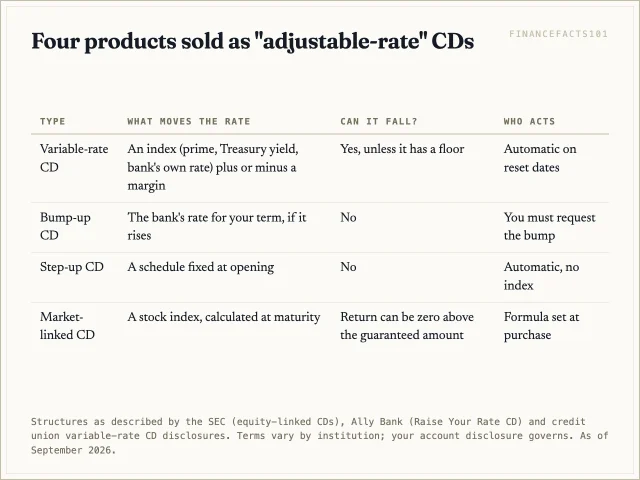
A true variable-rate CD follows its index both ways. It is the only one of the four that can end up paying less than it started with.
A bump-up CD (Ally calls its version "Raise Your Rate") starts at a fixed rate and lets you ask for a higher rate if the bank's rate for that term goes up. As of September 23, 2026, Ally's Raise Your Rate CD pays 3.00% APY, allows one increase on the 2-year term and two on the 4-year, and charges 60 or 120 days of interest to break early. Nothing happens unless you ask.
A step-up CD raises the rate on a schedule published when you open it. There is no index and no uncertainty, only a rising ladder of rates. Judge a step-up by its blended rate over the whole term, never its final step.
A market-linked CD, also called an equity-linked CD, pays a return based on a stock index such as the S&P 500, calculated at maturity. The SEC's page on equity-linked CDs warns that principal is insured but "there is no guarantee that any payment in excess of the guaranteed payment will be paid," that selling before maturity can return less than you paid, and that tax treatment may differ from an ordinary CD. It is sold as a CD but behaves more like a structured investment.
So an "adjustable rate CD," in its usual meaning, is any CD whose rate can change during the term. In the strict sense, it is the first row of that table. Which one you are being offered decides everything else. The site's decision guide on adjustable-rate CDs prices the bump-up option in dollars; this page focuses on the variable structure itself.
How a Variable-Rate CD Works, Step by Step
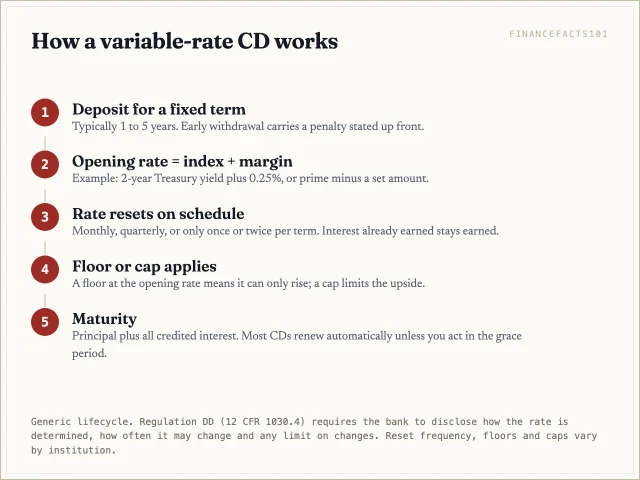
Here is the lifecycle in plain terms. You deposit a lump sum for a stated term, commonly one to five years. The bank sets the opening rate from the index plus or minus the margin. On each reset date it looks up the index again, recalculates, and applies the new rate from that date forward. Interest earned before the reset stays earned; a later drop never claws it back. At maturity you get your principal plus everything credited along the way, and the account usually rolls into a new CD unless you act during the grace period.
Two details catch people out. First, the reset schedule is often sparse. One credit union's variable-rate CD adjusts only twice, at months 12 and 24 of a 36-month term, to "the current rate for the most similar fixed-rate term, minus a small percentage," and never below the opening rate. A rate that adjusts twice in three years responds slowly to a rate cycle that turns in six months.
Second, "the index" may be the bank's own rate. A CD pegged to the bank's fixed-CD rate minus a margin is only as generous as the bank chooses to be; nothing outside the bank forces that rate up. A CD pegged to a public index such as prime or a Treasury yield is at least tied to a number the bank does not control.
Which Indexes Set the Rate, and Where They Stand Now
The index decides how closely your CD tracks the market. As of September 22, 2026, per the Federal Reserve's H.15 selected interest rates, the common candidates stood here:
- Prime rate: 7.00%. Big banks raised it from 6.75% on September 17, 2026, the day after the Fed's hike. A CD indexed to prime almost always uses a large negative margin, because prime is a lending rate, not a deposit rate. When the Fed moves, prime moves by the same amount within a day, so a prime-linked CD passes changes through quickly. The mechanics are in the site's guide to prime rate changes.
- Treasury bill yields: 4.16% (3-month) and 4.26% (6-month), on a constant-maturity basis. T-bill-linked CDs follow short-term market rates closely and move a little before the Fed does.
- 2-year Treasury yield: 4.71%. Useful for 2-year CDs because the index matches the term.
- Consumer Price Index. Some products have been built on inflation. If inflation protection is the goal, the federal government sells it directly: Series I savings bonds issued from May 1 to October 31, 2026 earn a 4.26% composite rate, including a 0.90% fixed rate, per TreasuryDirect, with a $10,000-a-year electronic purchase limit.
- The bank's own posted rate. The least transparent index and, in practice, a common one.
Each index moves on its own timetable, so ask which one you are being offered before comparing the headline rate.
Fixed vs Variable CDs: Comparing the Rates
A fixed CD gives you one known rate for the whole term. A variable CD gives you a starting rate and a formula. To compare them fairly, compare the fixed rate with what the variable CD is likely to average, not just its opening rate.
Start with where rates sit. The FDIC's national rates page, last updated September 21, 2026 and based on end-of-August data, puts the average 24-month CD at just 1.61% and the average savings account at 0.37%. The top 2-year CD in Yahoo Finance's September 23, 2026 roundup of its partner banks paid 4.40% APY. The same money can earn nearly three times the average just by moving banks.
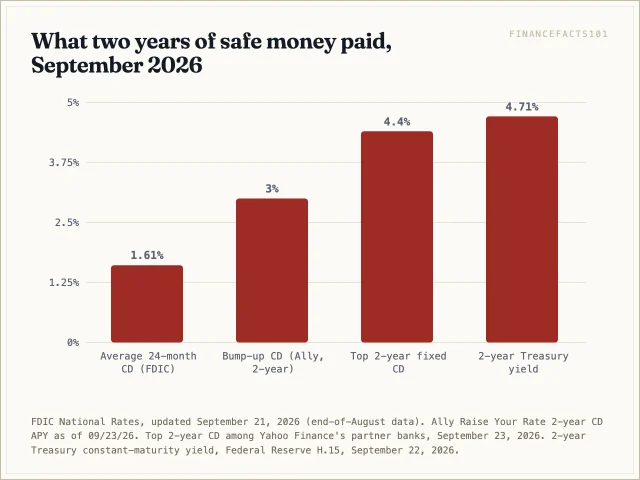
That gap is the first lesson of fixed vs variable CDs: which bank you pick matters more than which structure you pick. A variable CD at a bank paying average rates can still trail a fixed CD at a bank paying top rates in almost any rate path.
The second lesson is the starting discount. Banks usually price rate flexibility into a lower opening rate. Ally's bump-up at 3.00% against a 4.40% fixed CD is a 1.40-point gap as of this week. A true variable CD with a public index may start closer to fixed, or even above it when the yield curve slopes down, but if you are giving something up, the opening rate is where it shows.
In short, variable CD rates vs fixed come down to one question: will the index rise far enough, soon enough, to make up the starting discount? The example below puts dollar figures on that.
A $10,000 Example Under Three Rate Paths
Take $10,000 for 24 months. Option one is a fixed 2-year CD at 4.40% APY. Option two is an illustrative variable CD that opens at 4.00% APY and resets every quarter as its index moves. No specific bank's product is being modeled here; the rates are chosen to sit near today's market so the arithmetic is realistic. Interest compounds at the stated APY and nothing is withdrawn.
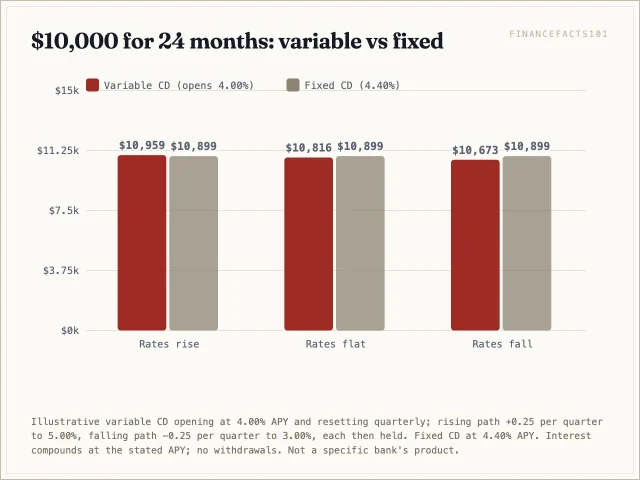
Rates rise. The index climbs a quarter point each quarter for a year, taking the CD from 4.00% to 5.00%, then holds. The variable CD ends at $10,959, or $959 of interest, against $10,899 for the fixed CD. Its rate averaged 4.69% over the term. It wins by $60, even though its rate rose a full point.
Rates stay flat. The variable CD earns 4.00% throughout and ends at $10,816. It loses to the fixed CD by $83, the cost of the starting discount alone.
Rates fall. The index drops a quarter point a quarter to 3.00%, then holds. The variable CD ends at $10,673, $226 behind the fixed CD.
Measured against the fixed CD, the result looks lopsided: a full point of rising rates won by $60, a full point of falling rates lost by $226, and no change at all lost by $83. That imbalance comes from the starting discount, not from the product's payoff. Measured from the flat path, a point up adds $143 and a point down costs $143. The fixed CD's higher opening rate is worth $83 on its own, and every path starts from that deficit. The break-even is simple to state: the variable CD's rate has to average more than 4.40% across the two years, not merely touch it. Since it starts at 4.00%, it needs rates to rise early and stay up. Run your own balance and rates through the compound interest calculator to see how the margin and reset frequency change the answer.
What the Bank Must Disclose Before You Open One
Federal law makes the bank write the formula down. Regulation DD, which implements the Truth in Savings Act, requires four specific disclosures for any variable-rate account under 12 CFR 1030.4(b)(1)(ii), along with the maturity date, the early withdrawal penalty and the renewal policy for any time account.
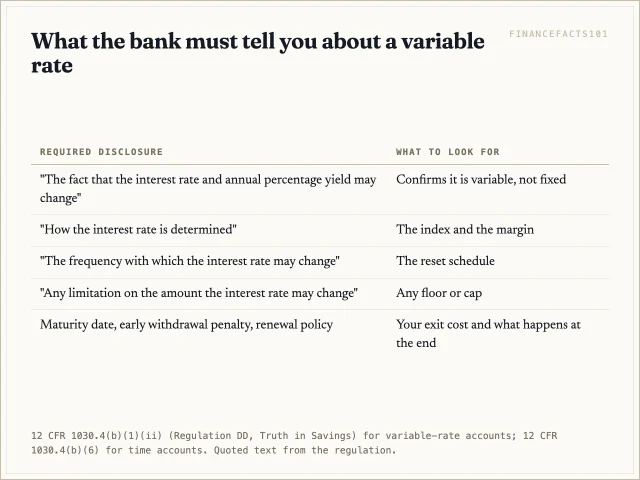
Read those four lines before the rate. "How the interest rate is determined" is where you find the index and margin. "The frequency with which the interest rate may change" is the reset schedule. "Any limitation on the amount the interest rate may change" is where a floor or cap shows up. If a bank cannot give you all four in writing, walk away.
Safety, Early Withdrawal and Taxes
A variable rate does not make a CD riskier to hold. The variability affects your interest, not your principal. FDIC deposit insurance covers deposits at an insured bank up to $250,000 per depositor, per bank, per ownership category, and all your accounts in the same category at one bank share that limit. NCUA share insurance provides the same coverage at federally insured credit unions. The one exception is the market-linked CD, where only the guaranteed amount is insured.
Liquidity is the real constraint. Breaking a CD early costs a penalty set by the bank and disclosed in advance. Penalties are often quoted as days or months of interest; Ally, for example, charges 60 days of interest on its 2-year bump-up CD and 120 days on the 4-year. A variable rate does not soften the penalty, and a large penalty can erase whatever a rising index added.
Taxes work as they do for any CD. Interest is ordinary income in the year it is credited, reported on Form 1099-INT, per IRS Topic 403. The exception is a CD longer than one year that pays interest only at maturity: IRS Publication 550 treats that deferred interest as original issue discount, so you include part of it in income each year even though you receive nothing until the end. A rate that rose partway through the year simply means more taxable interest that year.
When a Variable-Rate CD Makes Sense, and What Else Floats
A true variable-rate CD suits a narrow situation: you can lock the money for the full term, you expect rates to rise soon, and the product's opening rate is close to the best fixed rate for the same term. If the opening discount is large, you need a larger and faster rise just to break even, as the example shows.
Before buying one, consider the alternatives that also move with rates but do not lock your money:
- High-yield savings. The rate floats both ways, like a variable CD, with no term and no penalty. The comparison is laid out in high-yield savings vs CDs.
- Money market funds. Their yields track short-term rates closely, but they are investments, not insured deposits; the differences are covered in the entry on money market funds.
- Treasury bills. Buying a new bill every 13 or 26 weeks resets your yield to the market each time, and the interest is exempt from state income tax.
- A CD ladder. Several fixed CDs maturing at staggered dates give you regular chances to reinvest at current rates, with no discount for the privilege.
- I bonds. For inflation linkage specifically, see the entry on U.S. savings bonds.
Each of these gives you rate flexibility without asking you to lock money at a discounted starting rate.
FAQ
What does "adjustable-rate CD" mean?
It means a certificate of deposit whose interest rate can change before maturity. Banks use it for several products: true variable-rate CDs that follow an index up and down, bump-up CDs that let you request one or two increases, and step-up CDs that rise on a preset schedule. Always check which one you are being offered, because only a true variable CD can pay less than its opening rate.
Is a variable-rate CD FDIC insured?
Yes, if it is a deposit at an FDIC-insured bank. Coverage is $250,000 per depositor, per insured bank, per ownership category, and credit union CDs get the same limit from the NCUA. Variable interest changes your earnings, not the safety of your principal. Market-linked CDs are the exception: the SEC notes that returns above the guaranteed amount are not assured.
How often does a variable-rate CD's rate change?
It depends on the agreement. Some reset monthly or quarterly with their index; others adjust only once or twice over the term. Regulation DD requires the bank to disclose how often the rate may change and any limit on how much, so the answer is in your account disclosure.
Should I choose a fixed or variable CD right now?
Compare the fixed rate with what the variable CD is likely to average, not with its opening rate. In the example above, a variable CD opening at 4.00% beats a 4.40% fixed CD only if rates rise quickly and stay up. If the opening discount is small and you expect rates to keep rising, a variable CD can come out ahead. If not, a fixed CD or a CD ladder is usually the better choice.
Sources
- CFPB, What is a certificate of deposit (CD)? — definition; FDIC and NCUA coverage to $250,000
- CFPB, Regulation DD § 1030.4, Account disclosures — the four variable-rate disclosures in (b)(1)(ii) and the time-account disclosures in (b)(6)
- SEC Office of Investor Education, Certificates of Deposit (CDs) — disclosure should state whether the rate is fixed or variable
- SEC, Equity-Linked CDs — market-linked returns, insurance limits, secondary-market and tax risks
- Federal Reserve, H.15 Selected Interest Rates — prime 7.00%; 3-month 4.16%, 6-month 4.26% and 2-year 4.71% Treasury constant-maturity yields, as of September 22, 2026
- Federal Reserve, FOMC statement, September 16, 2026 — target range raised to 3.75–4.00%
- FDIC, National Rates and Rate Caps — 24-month CD 1.61%, savings 0.37%, last updated September 21, 2026
- FDIC, Deposit Insurance — $250,000 per depositor, per insured bank, per ownership category
- NCUA, Share Insurance Coverage — credit union equivalent
- IRS, Topic 403, Interest Received — CD interest as ordinary income, Form 1099-INT
- IRS, Publication 550, Investment Income and Expenses — a CD with a maturity of more than one year is taxed each year as original issue discount
- TreasuryDirect, I bonds — 4.26% composite rate (0.90% fixed) for bonds issued May 1 to October 31, 2026
- Ally Bank, Raise Your Rate CD — 3.00% APY as of 09/23/26; one bump on 2-year, two on 4-year; 60/120-day penalties
- Together Credit Union, Variable Rate CDs — example of a variable CD with two scheduled adjustments and a floor at the opening rate
- Yahoo Finance, Best CD rates today, September 23, 2026 — top 2-year CD among its verified partner banks at 4.40% APY
 Next entry · No. 5,438Variable Rate Mortgages: Understanding the Risks and Rewards
See also
-
 No. 5,955
19 Sep 2026
20 min
Deposit Accounts: Checking vs Savings vs Money Market vs CD
Banking
No. 5,955
19 Sep 2026
20 min
Deposit Accounts: Checking vs Savings vs Money Market vs CD
Banking -
 No. 5,953
18 Sep 2026
17 min
Adjustable-Rate CDs: What the Bump-Up Option Really Costs
Banking
No. 5,953
18 Sep 2026
17 min
Adjustable-Rate CDs: What the Bump-Up Option Really Costs
Banking -
 No. 5,990
24 Oct 2026
19 min
CD Ladder: Is It Worth It, and How Do You Build One?
Banking
No. 5,990
24 Oct 2026
19 min
CD Ladder: Is It Worth It, and How Do You Build One?
Banking -
 No. 5,988
22 Oct 2026
17 min
Credit Union vs Bank: Which Is Better for You?
Banking
No. 5,988
22 Oct 2026
17 min
Credit Union vs Bank: Which Is Better for You?
Banking -
 No. 5,930
02 Sep 2026
14 min
High-Yield Savings vs CDs: Where Cash Earns More
Personal Finance
No. 5,930
02 Sep 2026
14 min
High-Yield Savings vs CDs: Where Cash Earns More
Personal Finance -
 No. 4,154
26 May 2025
19 min
Understanding the Complexities of Credit Card Purchase Annual Percentage Rate (APR)
Personal Finance
No. 4,154
26 May 2025
19 min
Understanding the Complexities of Credit Card Purchase Annual Percentage Rate (APR)
Personal Finance