Thrift Savings Plan: How Much to Contribute, Which Fund, and Whether to Roll It Out
Contribute 5% every pay period and your agency adds 5% — $4,800 a year on $96,000. TSP expense ratios of 0.034% are why rolling out costs you.
Three decisions sit inside the Thrift Savings Plan, and only one is hard. How much to contribute has a fixed answer: at least 5% of basic pay, every pay period, because that is the exact rate that captures the full agency contribution of 5% — worth $4,800 a year on a $96,000 salary. Which fund to hold is a preference question with a cheap default. The hard one is what to do when you leave, because the TSP's total expense ratios ran 0.034% to 0.051% in 2025, and rolling the balance into an IRA almost always buys more choice at a higher price.
This guide prices all three with 2026 IRS limits and current TSP figures. It is general information on stated assumptions, not personal advice; verify your vesting date, pay schedule, and tax bracket with your payroll office.
What the Thrift Savings Plan Actually Is
The Thrift Savings Plan is the federal government's defined contribution plan — the same legal animal as a private-sector 401(k), but run as one trust holding roughly $1 trillion. That scale is the whole story: it buys institutional index-fund pricing no individual can negotiate.
For a FERS employee it is one leg of three, alongside the FERS basic annuity and Social Security — FERS employees hired on or after January 1, 1984 pay Social Security taxes and earn credits normally, which is what separates FERS from the older CSRS system. The annuity is the defined benefit half. This article is about the leg you control.
Who This Is For — and Who It Isn't
This is for a current FERS civilian employee, a Blended Retirement System (BRS) service member, or anyone who separated with a TSP balance still sitting there — someone choosing a contribution rate, a fund, and eventually a destination.
It is not a CSRS guide: CSRS employees get no automatic contribution and no match, so the first half does not apply to them. It is not tax advice on the Roth-versus-traditional choice at any particular income — that framing lives in Roth vs traditional IRA, the arithmetic in the Roth vs traditional calculator. And for the plan's history and administration rather than its decisions, the site's explainer on the TSP for federal employees covers that ground.
The Match: 5% of Your Pay for 5% of Your Pay
If you are FERS or eligible BRS, your agency puts money in whether you do or not. The Agency/Service Automatic (1%) Contribution equals 1% of basic pay every pay period, deposited from your first paycheck, whether or not you contribute a cent. It is not deducted from your pay and does not reduce your taxable income — it is simply given.
Matching is different: earned per pay period, on the first 5% you defer. The first 3% is matched dollar for dollar; the next 2% at fifty cents on the dollar.
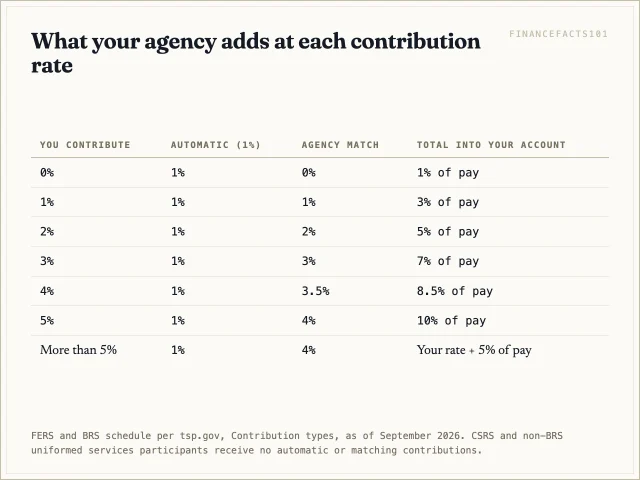
Read the bottom rows carefully. Defer 3% and the agency adds 4% of pay. Defer 5% and it adds 5% — the extra two percentage points of your money buy one more of theirs. Past 5% the agency stops; contributing 15% still yields 5%. Same shape as a private-sector match, priced out in 401(k) employer match, except the automatic 1% has no private analogue.
For a federal employee on $96,000, deferring 5% means $184.62 per pay period out of a $3,692.31 gross — $4,800 a year — and the agency adds $960 automatic plus $3,840 matched. Ten percent of salary lands for five percent of effort.
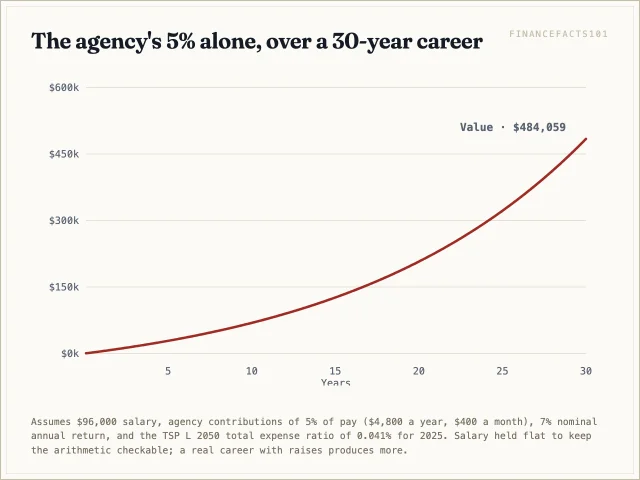
Left alone at 7% nominal for 30 years, the agency's half alone — $400 a month, never your money — compounds to about $484,000 at the L 2050 fund's 0.041% cost.
How Much to Contribute to the TSP Above 5%
Everything past 5% is a normal savings decision with no employer subsidy attached, bounded by the 2026 ceilings.
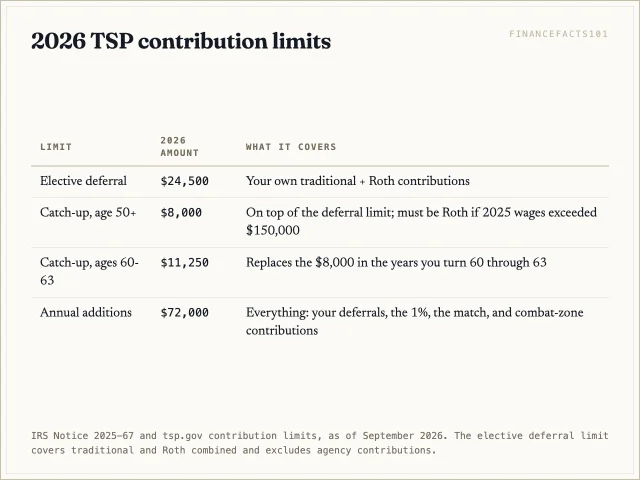
The 2026 elective deferral limit is $24,500, covering traditional and Roth combined and excluding everything the agency puts in. From the year you turn 50, catch-up adds $8,000; in the years you turn 60 through 63 that becomes $11,250, then drops back at 64. New for 2026: if your prior-year wages exceeded $150,000, catch-up contributions must be Roth. The overall annual additions cap is $72,000 under IRS Notice 2025-67.
Now the trap. Matching is computed per pay period, not annually. Elect a large percentage, exhaust the $24,500 early, and every pay period afterward has no employee contribution and therefore no match.
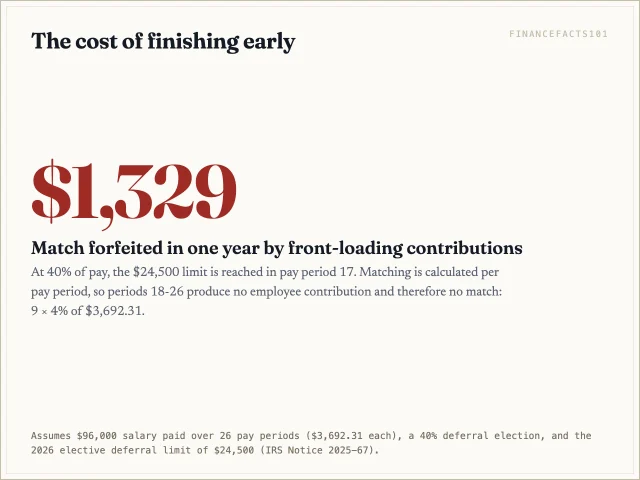
At $96,000 and a 40% election, the limit is reached in pay period 17. Nine matchless pay periods follow, at 4% of $3,692.31 each: $1,329 declined in exchange for nothing. The fix is arithmetic, not restraint — $24,500 divided by 26 is $942.31, so elect a flat $942 per pay period ($24,492 for the year) rather than a percentage that finishes early. Run your own salary through the 401(k) calculator before you file the election.
Vesting: The One Clock That Matters
Two of the three money sources are yours the moment they land. Only the automatic 1% has a waiting period.
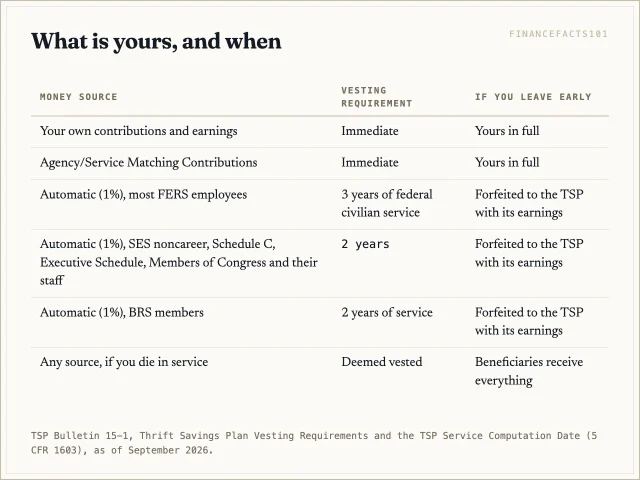
Per TSP Bulletin 15-1, which implements 5 CFR Part 1603, most FERS employees vest in the automatic 1% after three years of federal civilian service; noncareer SES, Schedule C, Executive Schedule appointees, Members of Congress and congressional staff vest at two, as do BRS members. Your own contributions and the agency match are vested immediately, always. Die in service and you are deemed vested regardless of tenure.
Two details people get wrong. Civilian service does not count toward vesting in a uniformed services account and vice versa — separate clocks. And forfeited automatic contributions pay the plan's gross administrative expenses, which is one reason the net administrative ratio comes in below the gross.
Traditional vs Roth TSP — and the Matching Wrinkle
Traditional contributions come out pre-tax and are taxed on withdrawal. Roth contributions are taxed now, and qualified withdrawals — five years after January 1 of your first Roth contribution year, and at 59½ or later — come out tax-free, earnings included.
The wrinkle that surprises nearly everyone: agency contributions always land in your traditional balance, no matter how you designate your own. Elect 100% Roth on a $96,000 salary and you still accumulate $4,800 a year of pre-tax money you will owe tax on later. A "pure Roth" TSP does not exist for anyone receiving a match, so plan for a mixed tax outcome in retirement.
Since January 2026 the TSP also permits Roth in-plan conversions, so traditional money can move to the Roth balance — tax due that year, payable from outside funds. And the Roth balance is exempt from required minimum distributions; the traditional balance is not.
TSP Funds Explained: G, F, C, S, and I
Five individual funds, each an index vehicle with a stated benchmark. Here are the TSP funds explained without the brochure language, with 2025 total expense ratios.
- G Fund — nonmarketable Treasury securities issued specially to the TSP. Principal and interest guaranteed; share price never falls. 0.034%.
- F Fund — the Bloomberg U.S. Aggregate Bond Index. A real bond fund: it loses principal when rates rise. 0.035%.
- C Fund — the S&P 500. Large-cap U.S. equity, roughly 500 companies. 0.035%.
- S Fund — the Dow Jones U.S. Completion Total Stock Market Index: everything publicly traded in the U.S. that is not in the S&P 500. C plus S in market-cap proportion is the whole U.S. market. 0.051%.
- I Fund — the MSCI ACWI IMI ex USA ex China ex Hong Kong Index: developed and emerging markets outside the United States, minus China and Hong Kong. 0.048%.
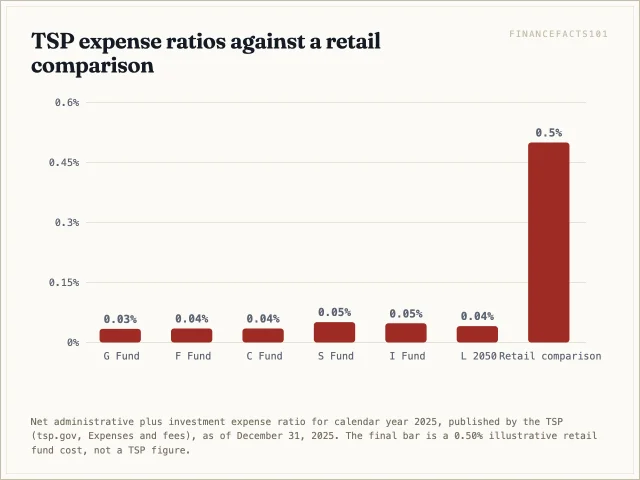
The index fund versus ETF distinction is moot inside the TSP: everything here is a commingled trust priced once daily.
The G Fund Is the One Thing You Cannot Buy Elsewhere
Most of the TSP has a close retail substitute — a total-market index fund is a total-market index fund. The G Fund does not.
Its rate is set monthly by the U.S. Treasury as the weighted average yield of roughly 202 Treasury securities with four or more years to maturity — a long-bond yield. But the securities are redeemable at par on any business day, so the share price cannot fall. You collect the long yield without the duration risk that makes long bonds volatile.
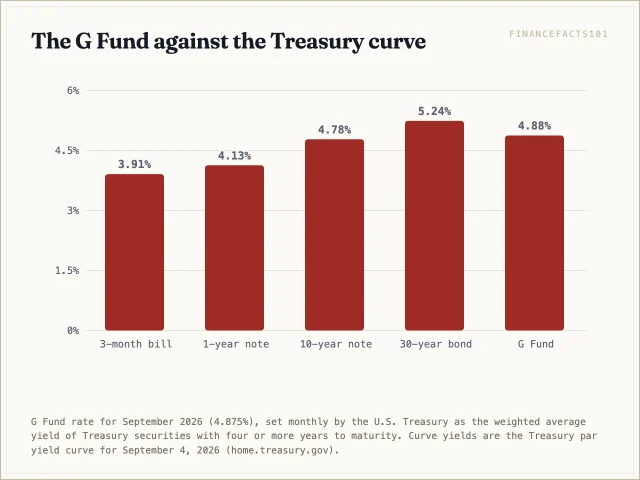
The September 2026 G Fund rate is 4.875%. On the Treasury par yield curve for September 4, 2026, the 3-month bill paid 3.91% and the 10-year note 4.78%. The G Fund beat the bill by 0.97 points — about $970 a year on $100,000 — and edged the 10-year, while carrying the price risk of a savings account, which is none. No money market fund, CD, or Treasury ladder available to a retail investor reproduces that, and it disappears the day you roll your balance out.
The mirror-image risk is inflation. A guaranteed 4.875% is a guaranteed nominal return; over 30 years the G Fund has trailed equities badly. Capital preservation, not growth.
The L Funds and Who Should Use Them
Each Lifecycle fund is a fixed blend of the five individual funds, rebalanced daily and shifted quarterly toward G and F as its target date nears. There are eleven, from L Income to L 2075.
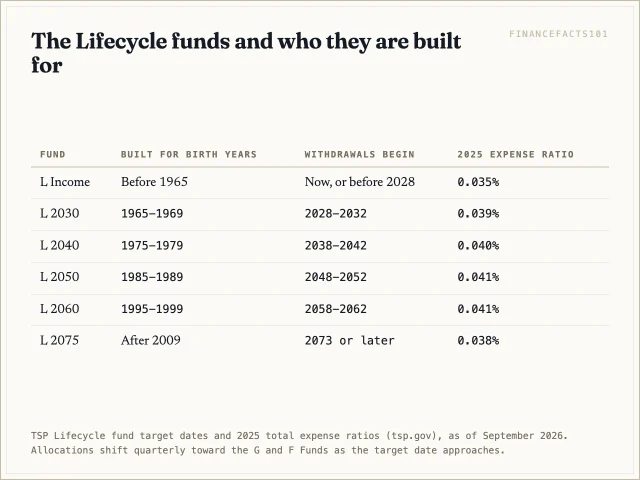
They cost 0.035% to 0.041% — the weighted cost of what is inside, no extra layer. The honest recommendation: if you are not going to rebalance, use one. An L Fund matched to your withdrawal decade beats a hand-built allocation that has drifted 15 points equity-heavy since 2019. If you do manage your own mix, build it from the individual funds; an L Fund alongside them gains nothing. Test the glide path with the retirement calculator, or the Coast FIRE calculator if the question is whether you can stop contributing.
What the Expense Ratio Buys You Over a Career
The TSP reports that fewer than 1% of the roughly 170,000 funds catalogued on FactSet as of January 2026 charged less than its 2025 average. Here is what that is worth in dollars.
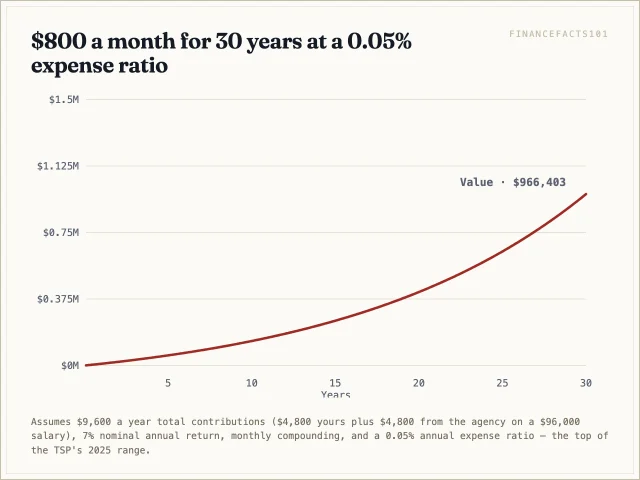
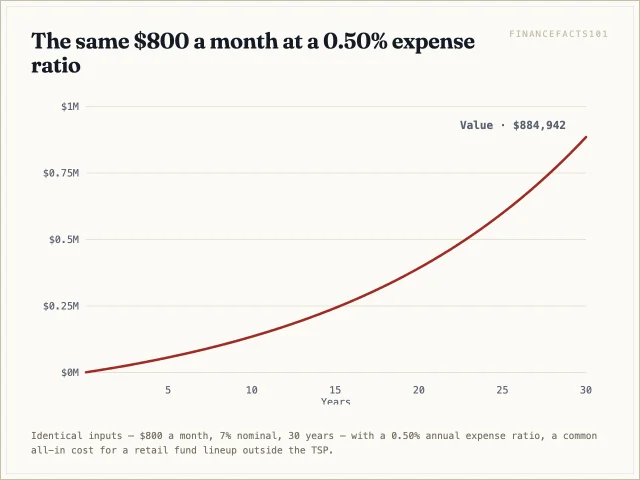
Same inputs both times: $800 a month — the $4,800 you contribute plus the $4,800 the agency adds on a $96,000 salary — at 7% nominal for 30 years. At a 0.05% expense ratio the account ends near $966,400. At 0.50% it ends near $884,900. The 0.45-point difference costs $81,460, or 8.4% of the balance. The Department of Labor's A Look at 401(k) Plan Fees puts the general case bluntly: a 1-point fee difference over 35 years cuts the ending balance by 28%. Vary the assumptions in the compound interest calculator or the SEC's compound interest tool.
Notice what the low ratio does not buy: advice, tax-loss harvesting, individual securities, or anything outside five index funds and a mutual fund window.
Loans and Hardship Withdrawals: The Real Price
You can borrow from your own contributions and their earnings — never from agency money — with a $1,000 minimum and a maximum that is the smallest of your own balance, the greater of half that balance or $10,000, and $50,000 minus your highest loan balance in the past 12 months. General purpose loans run 12 to 60 months for a $50 fee; primary residence loans run 61 to 180 months for $100. The rate is fixed at the prior month's G Fund rate — 4.875% for a September 2026 loan.
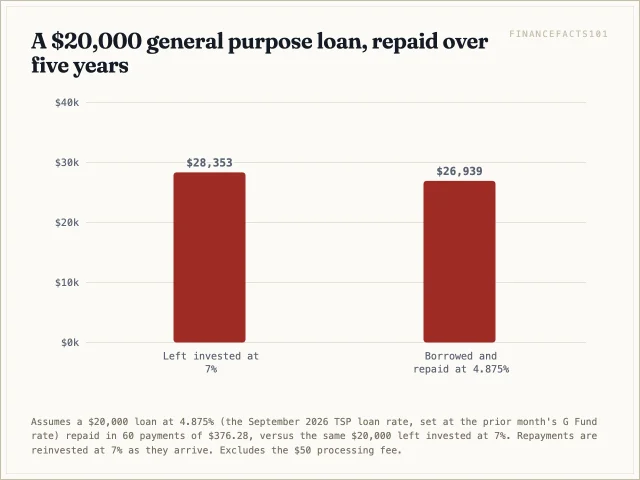
"You pay the interest to yourself" is true and beside the point. The cost is the spread between what the money earns inside the loan (4.875%) and what it would have earned invested (7% here). On $20,000 over five years, each $376.28 payment reinvested as it arrives, that gap is about $1,414 — plus the $50 fee. Against a credit card the loan still wins by an enormous margin; see credit card payoff time.
A hardship withdrawal is a different order of expensive, and permanent — you cannot put it back. You qualify only for negative monthly cash flow, unpaid medical expenses, casualty loss, separation or divorce legal fees, or a FEMA-declared disaster loss.
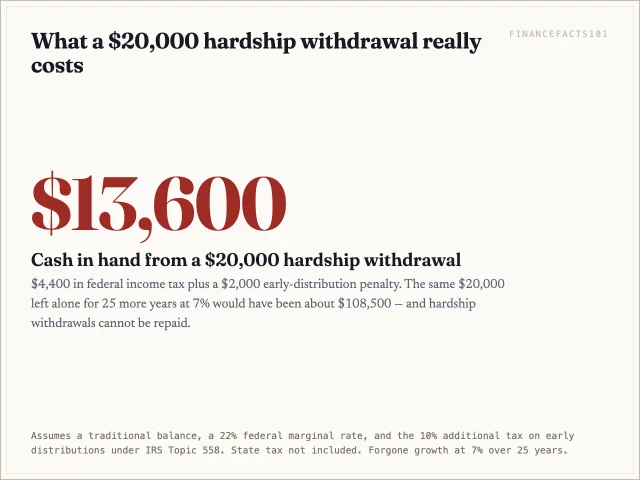
At a 22% marginal rate and under 59½, a $20,000 hardship withdrawal produces $13,600 of cash: $4,400 to federal income tax and $2,000 to the 10% additional tax on early distributions, before state tax. The same $20,000 left for 25 more years at 7% would have been about $108,500. Build the emergency fund instead.
Uniformed Services: BRS, Combat Zones, and the $72,000 Ceiling
BRS members are automatically enrolled at 5% after 60 days of service, and the automatic 1% begins then too — but matching waits until two years of service for anyone who began on or after January 1, 2018. Non-BRS service members receive no automatic and no matching contributions at all.
Service members can also elect 1% to 100% of incentive, special, or bonus pay, provided they contribute at least 1% of basic pay. Housing and subsistence allowances are not contributable.
Combat-zone pay is the genuinely unusual case. Contributions from pay excluded under the combat zone tax exclusion are themselves tax-exempt, and traditional contributions from that pay are not bound by the $24,500 deferral limit — the binding constraint becomes the $72,000 annual additions limit. That is how a deployed service member puts far more than $24,500 into the TSP in one year. Two conditions: catch-up contributions made in a combat zone must be Roth regardless of income, and cannot come from bonus or special pay.
When You Separate: Leave It, Roll It, or Move It
You can keep any vested balance of $200 or more in the TSP indefinitely. You cannot contribute from pay any more, but you keep the funds, the expense ratios, and the G Fund, and you can still roll money in from traditional IRAs and eligible employer plans.
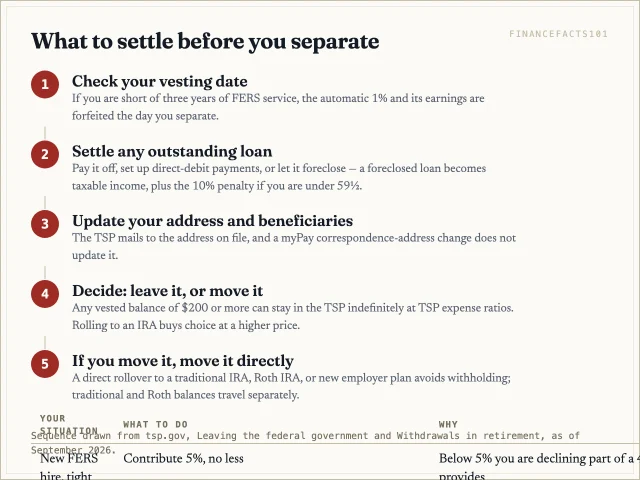
The cost of leaving should drive this.
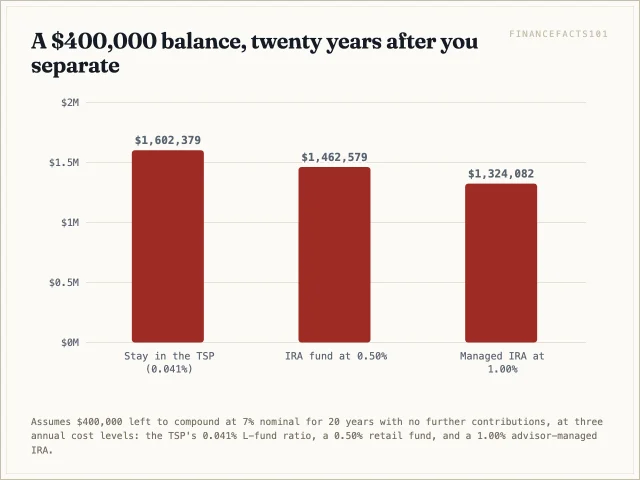
Take a $400,000 balance and 20 years at 7%. Held at the TSP's 0.041% it reaches about $1,602,400. In an IRA index fund at 0.50%, about $1,462,600 — $139,800 less. In an advisor-managed IRA at 1.00% all-in, about $1,324,100, a gap of $278,300 against staying put. The site's advisory fee cost article works the same drag from the advice side.
Rolling out is not wrong; it is a purchase. You buy a wider menu: individual securities, sector and factor funds, in-kind transfers, Roth conversion flexibility, finer withdrawal control, consolidation. You sell the G Fund and roughly 0.46 points a year. Name the thing you need that the TSP cannot do and roll; if you cannot name it, stay. Mechanics are in IRA rollovers and transfers — move it as a direct rollover, and note that traditional and Roth balances travel to separate destinations.
One rule cuts the other way: money left in the TSP qualifies for the age-55 exception to the 10% early-distribution tax if you separate in or after the year you turn 55 (age 50 or 25 years of service for qualifying public safety employees). Roll it to an IRA and the exception is gone — IRAs use 59½. Separating at 56 and rolling out costs three and a half years of penalty-free access.
Required Minimum Distributions
RMDs begin at 73 if you were born before 1960, at 75 if you were born in 1960 or later, in the first year you are both that age and separated from service. The first payment is due by April 1 of the following year; every later one by December 31. Stay employed past your RMD age and the clock does not start.
Only the traditional balance counts and only traditional distributions satisfy it — the Roth TSP balance is exempt, matching the Roth IRA treatment in IRS Publication 590-B. If your withdrawals fall short, the TSP issues a supplemental payment before the deadline rather than letting you miss it. Coordinating that draw with your claiming age is a separate decision, worked through in when to claim Social Security.
The Decision Framework
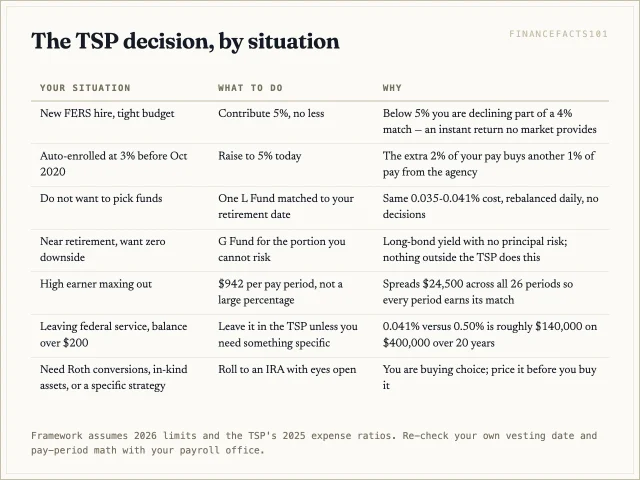
Three rules cover most readers. Contribute 5% of basic pay every pay period, without exception — a 100% return on the first 3% and 50% on the next 2%. Past 5%, elect a dollar amount that divides evenly across 26 pay periods rather than a percentage that finishes early. And treat rolling out as a purchase with a price tag — roughly 0.46 percentage points a year plus the G Fund — paid only for something you can name. Run your own salary through the 401(k) calculator before you change your election.
FAQ
What percentage should I contribute to the TSP?
At minimum 5% of basic pay, every pay period, if you are FERS or eligible BRS — that is the rate that captures the full 4% match on top of the automatic 1%. Above 5% there is no additional employer money, so it becomes an ordinary savings-rate question bounded by the 2026 deferral limit of $24,500.
Do agency matching contributions go into my Roth TSP balance?
No. All agency and service contributions go into your traditional balance regardless of how you designate your own. Someone contributing 100% Roth still accumulates a pre-tax balance from the automatic 1% and the match, and owes ordinary income tax on it in retirement.
Should I roll my TSP into an IRA when I leave federal service?
Usually not, on cost alone. TSP expense ratios ran 0.034% to 0.051% in 2025 against roughly 0.50% for a typical retail lineup — about $140,000 on a $400,000 balance over 20 years, and rolling out also forfeits the age-55 early-withdrawal exception. Roll out only for something specific the TSP cannot do.
Is the G Fund actually risk-free?
It carries no credit risk and no price risk: principal and interest are guaranteed by the U.S. government and the share price cannot fall. It does carry inflation risk. A guaranteed 4.875% nominal in September 2026 is not a guaranteed real return, and over long horizons it has trailed equities badly.
What happens to the automatic 1% if I leave before three years?
It is forfeited with its earnings and used to pay the plan's administrative expenses. Your own contributions and the agency match are vested immediately and stay yours. Most FERS employees vest at three years; noncareer SES, Schedule C, Executive Schedule, congressional, and BRS participants vest at two.
Sources
- IRS, 401(k) limit increases to $24,500 for 2026 — the 2026 elective deferral and catch-up limits
- IRS, Notice 2025-67 — the $72,000 annual additions limit for 2026
- IRS, Topic no. 558, Additional tax on early distributions — the 10% penalty and its exceptions
- IRS, Publication 590-B — required minimum distributions and Roth treatment
- Social Security Administration, Social Security Benefits for Federal Workers — FERS coverage versus CSRS
- U.S. Department of the Treasury, Daily Treasury Par Yield Curve Rates, 2026 — bill and note yields as of September 4, 2026
- U.S. Department of Labor, EBSA, A Look at 401(k) Plan Fees — the 28% effect of a 1-point fee difference
- SEC / Investor.gov, Compound Interest Calculator
- Thrift Savings Plan, Contribution types — the automatic 1% and the matching schedule
- Thrift Savings Plan, Contribution limits — 2026 limits and the Roth catch-up rule
- Thrift Savings Plan, Expenses and fees — 2025 expense ratios by fund
- Thrift Savings Plan, Individual funds and G Fund — benchmarks and the G Fund rate mechanism
- Thrift Savings Plan, Lifecycle funds — target dates and expense ratios
- Thrift Savings Plan, Bulletin 15-1, Vesting Requirements and the TSP Service Computation Date
- Thrift Savings Plan, TSP loans, Financial hardship, and Taking money from your account
- Office of Personnel Management, FERS Information
 Next entry · No. 5,951Tax-Deductible Investments: What Actually Cuts Your 2026 Tax Bill
See also
-
 No. 4,965
31 Jul 2025
18 min
Understanding the Thrift Savings Plan (TSP): A Comprehensive Guide for Federal Employees
Retirement
-
 No. 5,982
16 Oct 2026
16 min
HSA vs 401(k): Where Should Your Next Dollar Go?
Retirement
-
 No. 5,970
04 Oct 2026
17 min
Required Minimum Distributions: When to Start, How Much, and How to Cut the Tax
Retirement
-
 No. 5,941
12 Sep 2026
16 min
401(k) Employer Match: How Much of Your Salary to Defer
Retirement
-
 No. 6,005
08 Nov 2026
18 min
Pension Lump Sum vs Monthly Payments: Which Pays More in 2026
Retirement
-
 No. 6,002
05 Nov 2026
17 min
Roll Over 401(k) or Leave It in the Plan? How to Decide
Retirement